Check out Matt Levine commentary, which goes into more detail (SpaceX Indexing) https://www.bloomberg.com/opinion/newsletters/2026-03-31/are...
No longer will there be a year of price discovery for index funds, 15 days. Meaning index funds have to buy it at the peak of the hype cycle. Will be a huge wealth transfer from mom and pop retirement accounts to the ultra wealthy.
Of course once again, you are "not allowed" to be early into pre-IPO companies which is where the actual money is made.
The moment several companies start IPOing, you are already too late for those multiples and have to wait for a massive crash until these stocks reach all time lows after IPO.
The SpaceX IPO: retail investor notes
https://news.ycombinator.com/item?id=47612775
SpaceX files to go public
Source: https://starlink.com/business/aviation ($250->$10k/mo)
https://starlink.com/business/maritime ($250/mo)
https://starlink.com/business/mobility ($65->$540/mo)
Starship: zero competitors & potentially makes humans inter-planetary.
Seems crazy if investors put more value on Grok.
The argument that Starship is somehow an experimental/unproven technology that might fail to materialise was absurd but plausible sounding before flight 1, there were many new technologies simultaneously being deployed to a single launch system in one go.
But after 3 tower catches of the booster demonstrating centimetres of guided precision of the entire stack, this is becoming a tired argument.
I know the author is not making that case at all here, but it seems like one the core reasons to undervalue SpaceX is that Starship might not work out, and this all sounds exactly like how reusability might not work out for the Falcon 9 from 10 years ago.
net income probably: $1.5B – $3B
P/E:500-1000
Of course people will trip overthemselves to buy it up.
Wait for the lock-up terms.
They’re taking everything thats not nailed down. A wealth tax is the only way, it cannot continue like this.
I ended up largely deferring to them, e.g. predicting the public will value xAI at $258 billion ($222b - $310b) at time of IPO, even though I've elsewhere been skeptical that xAI should be valued like a frontier AI lab.
It's a keynesian beauty contest
Seems like MSCI can add new large constituents very quickly as well [1], so to remain neutral to the frenzy until a price has been discovered, one might need to actively short.
[1] e.g. https://www.msci.com/eqb/methodology/meth_docs/MSCI_GIMIMeth...
I’m genuinely confused how a passive investor winds up tracking the NASDAQ 100 versus a broader index.
Also, if you’re picking and choosing your exposures, you aren’t passive.
After 20+ years in the market, today I learned: "The S&P 500 is a float-adjusted, market-capitalization-weighted index."
So presumably an S&P 500 index fund is not disadvantaged, since it is tracking a float-adjusted index, i.e. the weight of SpaceX will be tiny if its float is tiny.
Or, is there a nuance that I'm missing?
I don’t tend to let my emotions out this much here, but utterly fuck everything about this administration, and fuck anyone who voted in favor of it.
There's no rule you have to own QQQ and indeed most people don't. There are thousands of low cost ETFs that provide passive exposure to the market. If this new rule bothers you, be like most people and buy one of those instead of QQQ. Problem solved.
Like sure, let's improve our tax systems (as an aside, I would say there are many more efficient and progressive options than a wealth tax, but whatever), but I don't see how there is even a tangential link between that topic and the NDX rule change.
For comparison, it is routine to see sale prices of 3x to 5x revenue for many, many kinds of everyday businesses that have much less potential than Tesla.
There are very, very few businesses whose shares one could have purchased in 2010 that performed better over the subsequent 15 years. That is about as objective as one can get about determining whether or not something was under or over valued (in 2010).
What is the realistic, non-science fiction appeal of this?
SpaceX filed confidentially for an IPO on April 1, 2026, targeting a $1.75 trillion valuation and a June listing. If completed, it would be the largest IPO in history.
I found this valuation interesting because SpaceX is a conglomerate now, so valuing the business segments together has a lot of intangible value. But my particular interest was because the IPO will happen in June (or later), so the question is not: what is SpaceX worth now, but what will SpaceX be worth then?
That's a forecasting question, so I decided to forecast it.
I broke SpaceX into seven business segments and forecast what the fair market value of each will be as of June 2026, assuming the IPO happens then. My conclusion is that for the company to be fairly valued at $1.75 trillion in June, each of its businesses would need to outperform between now and then.
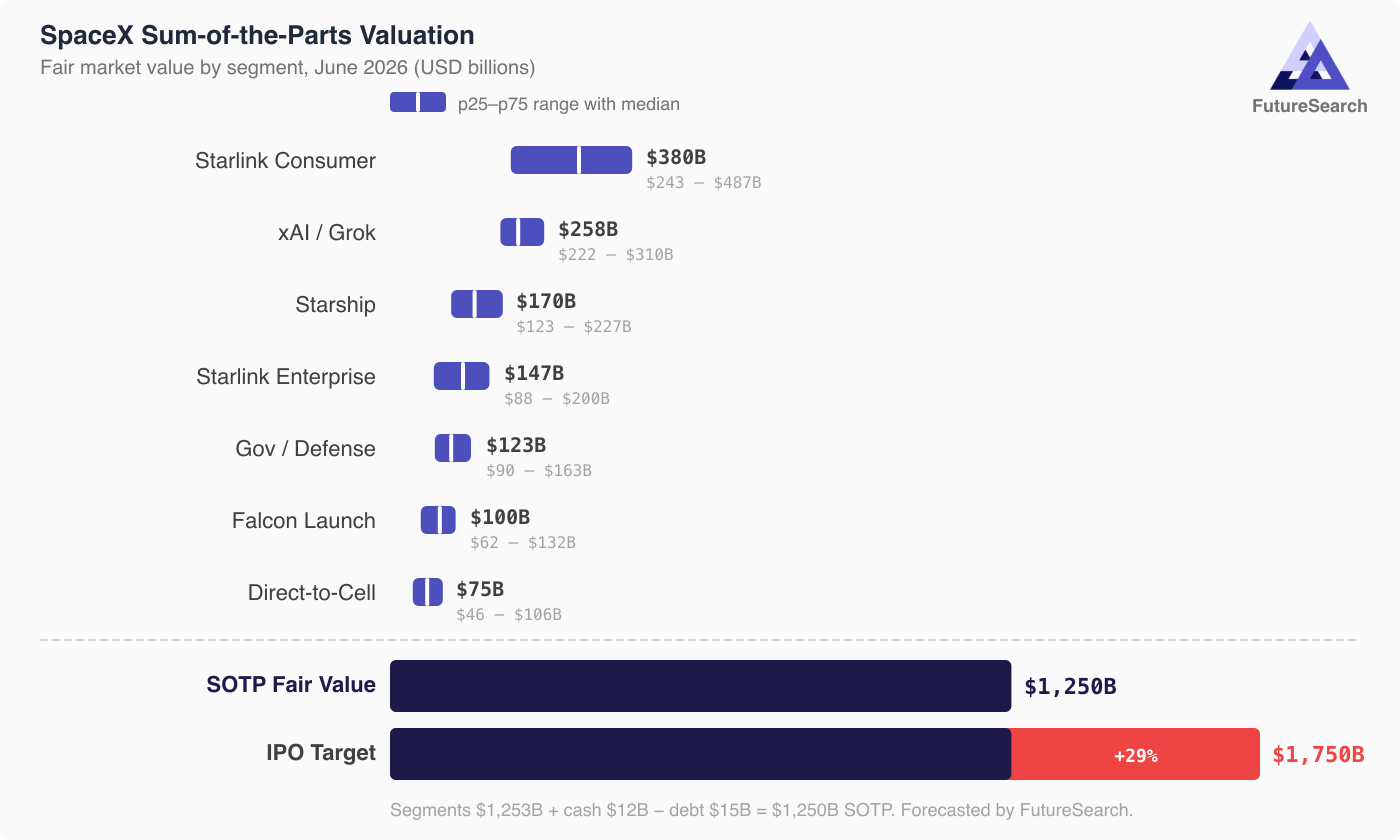
Red on IPO bar shows the 29% premium over median forecasted fair value.
At median forecasted values: Starlink Consumer Broadband at $380B (9.2M subscribers, 38x revenue), xAI/Grok at $258B (anchored by the $250B merger), Starship Commercial Launch at $170B (pre-revenue option value), Starlink Enterprise/Maritime/Aviation at $147B, Government/Defense at $123B ($22B contract backlog), Falcon 9/Heavy at $100B (~60-70% of global launches), and Starlink Direct-to-Cell at $75B (backed by $17-19B in EchoStar spectrum).
This totals $1,253B. Adding $11.6B in cash and liquid assets, subtracting ~$15B in total debt (SpaceX standalone obligations, remaining xAI inherited debt, EchoStar spectrum commitments), the sum-of-the-parts equity value is approximately $1,250 billion, 29% below the $1.75 trillion IPO target.
Where does the $500 billion gap come from? The SOTP method sums forecasted medians, but the IPO prices correlated upside, as if all businesses are valuaed more in my 75th percentile forecast. If investors are bullish on Starlink, they're simultaneously bullish on Starship, xAI, and defense. Taking the 75th percentile across all segments instead of the 50th brings the total to ~$1,675B, close to the target. The $1.75T price is "everything goes right" pricing.
SpaceX may also be one of the rare conglomerate premium cases. Conglomerates usually trade at a discount because investors prefer pure-play exposure. But the narrative that Starlink + Starship + xAI creates something no single segment could (orbital data centers, AI-powered global connectivity) may justify paying above the sum of parts. And the largest IPO in history will generate extraordinary retail demand: reportedly 30% retail allocation versus the typical 5-10%.
A few things stand out. Starlink in all three forms (consumer, enterprise, direct-to-cell) accounts for $602B, or 48% of segment value and 34% of the IPO price. A longer-term forecast of whether Starlink can grow from 9.2M subscribers to 50M+ while expanding revenue per user through enterprise, maritime, aviation, and direct-to-cell channels is critical. I anchored to what others are saying, but I'm skeptical.
The other area where I'm extremely skeptical is xAI at $258B, with ~$430M quarterly revenue against $1.46B quarterly losses, valued almost entirely on the merger anchor from four months earlier. I've forecasted previously that I'd need to see more evidence that xAI is a frontier lab before believing it could be worth this much.
Starship at $170B is pure option value on technology still in advanced testing. And the physical assets (satellites, launch pads, factories, the Falcon fleet) are worth roughly $46B at fair market value, 2.6% of the IPO price. Nobody is buying SpaceX for its factories.
Finally, I should say the fair market value really is just what people are willing to pay. Perhaps the intangibles are worth a 30% pop, that wouldn't be that unusual in IPOs. But based on my forecasts of value, it's not worth it unless everything goes really well all together for them.
If you'd like to try this forecast yourself, you can run our team-of-forecasters approach in futuresearch.ai/app, just ask it to list SpaceX's business segments, then ask it to forecast the fair market value of each one.
See also: Forecasts of Anthropic and OpenAI's IPO dates and post-IPO valuations
You buy VTI, you're impacted.
If you own an ETF that buys SpaceX but without overweighting vs. float, then you're not contributing to the inflated price in that sense. You're still buying at the inflated price though, so the NASDAQ rule change still affects you indirectly.
The wealth tax part doesn't really make sense to me either. I don't see how that's relevant, except generally to the extent higher taxation of the wealthiest people would reduce their power to shape the rules to their benefit as here.
mv some_rich_ppl_money some_poor_ppl
You're making it more inefficient; any other hop in such a system is inefficiency.
Such a tiny minority of real people are not that important to the species. Maybe that important to some mind palace of some contemporary meat suits but they're going to die anyway; kicking the can down the road for future people. If we can fuck the future, fuck us then. Our existence is just as forfeitable
My neighbors and family have been expressing such. If we're just going to screw the next generation via environmental collapse and serfdom to rich overlords they opt to give up on the living enabling it
The other core value generation product will be financial transactions. It is unproven whether X money will be adopted for friction free transactions across national boundaries and whether the company can compete in the financial services sector.
My 50% CI on Starship's fair market value at IPO time is $123b - $227b, with a 80% CI even wider, not based on my own modeling, but based on anchoring to analysts that give credible arguments.
It's absolutely bonkers and wrong but it's unlikely to raise to the level of actual misrepresentation.
I think a lot of it depends on whether they can make the reuse of the second stage work without having to redo stuff constantly like the shuttle. Reusing the booster will obviously save tons of money and make launches cheaper, but they're competing with themselves here. How big is the launch market with cheaper launches? We don't actually know.
I missed 2 and 3 it seems.
Or would you say that e.g. an ETF tracking MSCI ex-US is not a passive fund?
Nasdaq already caved. FTSE and S&P are supposedly considering it.
https://www.economist.com/leaders/2026/03/31/index-providers...
> for a trillionaire[!]
This writes itself. It shouldn't, but "should" as a concept needs a lot of work.
And even that isn't accurate. They are not bending the rules for a trillionaire, they are maintaining the consistency more systemic rules. This is how it has always been. We can all point to real or perceived ethical islands. They certainly exist, and are worth creating and preserving. But for now, the sea still sets the rules, and the sea is deep. For the deeper system, island visibility is a useful distraction. Sometimes something heavy moves near the surface and we misinterpret visibility as exception.
Humans being interplanetary would be an amazing technical tour de force. But relatively speaking, there isn’t much revenue there.
SpaceX has basically admitted as much by promising Starship 2 & 3 with larger payloads (that Starship 1 was already supposed to deliver).
[1] https://www.americaspace.com/2024/04/20/starship-faces-perfo...
So what is the near-to-medium-term economic prospect of Starship? That's the question. You can't just say "bigger rocket make more money", because there exists a useful upper to the size of payloads that companies actually want to ship to LEO in practice. To use an analogy, we have jumbo jets, but most flights are not on jumbo jets.
But as you say, going back to the xAI + SpaceX merger, analysts consistently seem to value it as if it is, so I predict the public will too, at IPO time.
That's the thing about SpaceX, some businesses are real businesses that can be modeled in normal ways, like the government launch contracts, and to some degree starlink.
Others, like ~all of xAI, and the starship stuff, are being valued completely independent of revenue. I predict the IPO investors will generally follow the analysis consensus today with those eye-popping numbers.
I’d consider someone that puts $50 into Coca Cola stock every paycheck a passive investor
No? Contractually, maybe. But legally you can do whatever you want with index constructions.
It’s not really sensible to compare a single spacecraft with what is essentially a fleet of ships with an order of magnitude greater cargo capacity. It’s the possibility of refueling that unlocks the ability to push really large payloads beyond LEO, and many of the more audacious plans (like a Moon base) do require a lot of cargo well beyond LEO.
There are also perfectly ordinary situations in which this pattern is used to imply the influence of an unknown party. "They built a bridge over the river." Clearly the speaker does not believe that bridges over rivers construct themselves. She doesn't need to know who built the bridge.
European settlers being on the north american continent would be an amazing technical tour de force. But relatively speaking, there isn't much revenue there.
This is only true because we are so completely beholden to the tyranny of the rocket equation with the current status quo. With the $/kg (and payload volume) that Starship would unlock, the entire ELO/GEO/Interplanetary/Deep Space market looks very different.
Labs in space. Hotels in space. Weapons in space. Much more interesting satellites in space. More government science missions. Privately funded science/research missions. etc
Well, they are going to live with multi-customer payloads if Starship can do it for a tenth of the price. There's already a large market for ride-sharing and it's only going to get bigger.
... Why not? Aside from memes, I mean.
In this specific case I am retired and I have done this based on financial projections assuming the game continues to be played the same. So it hits closer to home for me. But it’s a far bigger problem than just me—this is looting the retirement savings of millions of Americans—and it is far from the only thing about this administration and those who have supported it to make me absolutely livid.
They’re not. Passive vs active are terms of art in investing. They refer to the degree selection effect is at play.
AFAIK the problem is that they're lobbying the nasdaq 100 index provider to add a 5x multiplier for free float for spacex. Otherwise it would be far less controversial.
If they are, you'd only get a license when accepting their terms.
Spacex will be around 4.5% of the index [2].
If you believe the thesis of the article that Spacex is about 30% overvalued, and if the only advantage your fund manager has over the rest of the market is that they will avoid Spacex, they will save you 1% of your money over the lifetime of your investment. Assuming you're saving for retirement in 30 years time, the fees will cost you 15% or more.
Maybe your fund manager finds a Spacex-level mispricing every two years. In that case, they're worth the fees. Some people will tell you nobody can beat the market. My employer among others believes very strongly in the idea that some people do make better investment decisions than average. What is certainly true is that not everyone does.
[0] https://helpcenter.ark-funds.com/what-is-the-fee-structure-e...
[1] https://www.invesco.com/qqq-etf/en/home.html
[2] https://www.fool.com/investing/2026/04/01/how-the-spacex-cou...
Except that at some point this stops being true. Induced demand is not infinite. There's no telling when we'll reach that point, or indeed if we've already reached it.
I think talent is more important than compute, as I wrote in my Jan 2026 predictions that Anthropic would end up on top this year: https://futuresearch.ai/blog/forecasting-top-ai-lab-2026/
I'm not sure that's the case. Every value in this forecast is absurd, I actually think the author is sincere in there feeling that they are being extremely skeptical.
This excuse only works if who built the bridge isn't central to the discussion. Otherwise this is just generic conspiratorial thinking that we're being oppressed by The Elites™.
The Pilgrims starved their first year.
A huge synthetic telescope in orbit with an aperture the size of the planet?
How many private earth observation satellites?
The market is huge when weight constraints largely go away and $/kg drops so hard.
Apple has a float of >99%. SpaceX is going to come out with 3-4% float. Since all big serious total market / whatever index funds are float adjusted, this means that SpaceX will be treated more like a company with $45B market cap, not $1.5T or whatever.
If you're buying most index funds, you should literally not care about this.
If you buy VTI, then SpaceX is going to be like what, <0.1% of the fund? That is noise.
This calculation is why "growth" companies dominated the stock market during the 2010's: with the Zero Interest Rate Policy that most of the developed world had, the discount rate that the markets used ended up being basically zero. In which case a market player is indifferent between a dollar in 2020 and a dollar in 2040. So if a company had a 10% chance of being worth a trillion dollars in 2040, that was worth (0.1 * 1 trillion=10 billion dollars). But with a more traditional 4% discount rate then a dollar in 2040 is worth less than half of a dollar in 2020, and that means your 10% chance of being worth a trillion dollars in 2040 has less than half of the value. Even if nothing else changed about your business, just the discount rate changing halved the value of your company.
The earnings period is 1 year.
It would mean making 100% return on investment each year. Being that low is only possible if there's reason to think the business is extremely precarious and unlikely to survive.
P/E 30 means returns of 3.33%, P/E of 20 means 5%. These are sensible numbers given people have other investment opportunities.
P/E of Tesla being 400 or so means it would take 400 years of its own profits to be able to afford to privatise itself, i.e. returns of 0.25%; being that high is a gamble that future revenue/unit time will go up by a factor of about 20 to bring it into the sensible range.
The upper bound from the grandparent comment for P/E 500-1000, says the annual return is 0.1%, which is what I saw on various current accounts, not savings accounts, not special deals, current accounts.
How is this a response?
But assuming it is: How would you even call it, and how would you describe your methodology in the prospectus? "Tech 100 (compare with e.g. NASDAQ)"?
Index providers definitely own their trademarks. You can’t market an S&P index without paying S&P. But “the available authority indicates that copyright protection for indexes may extend to the index constituent lists but not index averages, and copyright preemption principles may limit misappropriation protection for indexes to a very narrow class of ‘hot news’ uses” [1].
> you'd only get a license when accepting their terms
Sure. But plenty of indices allow for mixing and matching. The terms are designed to avoid confusion—you can’t use the term NASDAQ 100 if it isn’t exactly that. More broadly, there are tons of indices and benchmark portfolios.
[1] https://www.blegalgroup.com/market-index-licensing-a-review-...
I do think that will reach diminishing returns at some point. Kessler syndrome is a real thing for long-term higher orbits.
Of course some do. After all, that's what makes an "average".
Some people are taller than average, too!
To understand why this isn't a conspiracy of a sort by some "elite" group of people to take money from 401ks and IRAs, you'd have to argue that there's a good reason to shorten the window that outweighs the reason the window exists. The fact remains that many many IPOs crater within a few months. The rule change seems to exist to leave small low-effort investors holding the bag.
Just because we're paranoid doesn't mean they're not out to get us.
> To balance index integrity and investability, Nasdaq proposes a new approach for including and weighting low-float securities (those below 20% free float). Each low-float security’s weight will be adjusted to five times its free float percentage, capped at 100%. Securities with more than 20% free float will continue to be weighted at full, eligible listed market capitalization, while those below 20% free float will be weighted proportionally to preserve investability.
> The rule reportedly includes a 5x float multiplier for low-float stocks, which would require passive vehicles to treat SpaceX as if it had significantly more tradable shares than actually exist, essentially forcing funds to chase the price.
It sounds to me like a way to increase demand for low float stocks by treating the float higher than it actually is. Glad to hear the explanations about this.
Disagree. Buyers of index funds should care about fiduciary and waste. This is what this seems like at this price. Granted, I’d be more concerned if the fund manager was buying it without a requirement to. The issue still remains about why are we paying so much for this stock? Make it make sense?
You have to hand it to him, he’s the best grifter we’ve seen in years.
It's really not clear, which is why I listed 3 plausible options. I'm also not going to bother attacking an imaginary position and be accused of "strawman" or whatever.
There is also the concept of "Index Tracking Error". No fund can perfectly mimic the index, and that is expected and understood, but the goal is generally to have the tracking error <0.1%- 1% would be a bad track. And so an index fund could take the risk that they will have a tracking error and delay picking up SpaceX even after it joins the official index, but then if it goes up they will look worse relative to their real competitors, the other NASDAQ 100 tracking index funds. If SpaceX goes down, of course, they will have positive tracking error, but I'm not sure how much potential investors would value that. SpaceX would be something like 4% of the NASDAQ 100 at it's announced expected market cap, so a 10% movement by SpaceX would be enough on its own to get you into the notable tracking error range if you didn't have any exposure to it.
So you have to be a complete idiot to but stock in a company with a P/E of 500!
It's also not hard to think of half a dozen other groups that could possibly benefit and plausibly have enough clout to steer things in their favor, hence why the need to make a specific claim rather than beating around the bush a vague "they" that can't be refuted.
Someone can win at roulette and make more money than the average player over some measurement period, but nobody can be good at roulette (when properly implemented and stuff). Stocks are somewhat possible to be good at but results are mostly random and the fee you'd pay is usually way too much.
What does that even mean? Almost every single Falcon 9 customer will prefer launching on Starship if/when it is available, because the cost will be much lower. A very small segment who have payloads that are exactly Falcon 9 sized and want a very particular orbit might still be better served by F9, but maybe not.
Beyond that, much lower cost unlocks previously untenable opportunities that you have not sufficiently imagined, as stated earlier.
(Sourcing my claim is difficult. I include this reference [1], which says that the Caribbean colonies were more profitable than all the continental colonies together. It doesn't comment on the cost of the war.)
[1] https://courses.lumenlearning.com/suny-ushistory1ay/chapter/...
Of course it does. With Starship, SpaceX could've charged NASA/ESA more to launch a bigger JWST than the cost to launch with Ariane 5, with huge profit margins.
On top of that, with a much larger fairing, you could almost certainly simplify the telescope and increase capability. A significant part of the JWST's complexity is the unfolding sequence, which could be simplified with a fairing that is more than double (triple? quadruple?) the volume.
I guess figure out whether QQQ is going to do the 5x float thing?
Right, but the whole point of index funds is that you're letting the market decide what's worth investing/buying (via market cap/free float weightings) and at what price. If you're making calls on what's "waste" or not, then you're no longer a passive investor and you're just picking stocks.
This is obviously untrue. Would you sell a box that spits out $1 million dollars a year for 1 million dollars?
How would you know it is or is not luck?
> roulette
Has no winning strategy - it's very different.
The winning strategy with stocks is understanding the underlying businesses better than the average investor. Peter Lynch's Magellan fund did consistently better than others because Lynch had insights others didn't. When others figured it out, Magellan's returns retreated to market levels.
I.e. investors can do better than average if they have insight others don't have and stay below the radar.
Following the rules of the fund and being index is one thing. Sitting silently as this pump and dump is designed to fleece your clients, is something entirely different.
> Starting May 1, 2026, Nasdaq rules allow large IPOs (e.g., top 40 market cap) to join the Nasdaq-100 Index within 15 trading days. This forces index-tracking funds to buy new shares, often at inflated valuations shortly after listing, a "fast entry" rule designed for mega-IPOs like SpaceX or OpenAI
A P/E ratio of 1 indicates that a company's share price is equal to its earnings per share, suggesting that investors are paying $1 for every $1 of earnings.
A P/E ratio of 10 indicates that a company's share price is equal to its earnings per share, suggesting that investors are paying $10 for every $1 of earnings.
Which is the better deal? Neither! The first company could suddenly earn more per share and you will be better off. The second company could loose earnings per share and you will be worse off.
A P/E of 1 means you are paying exactly the earnings per share, which is the fairest and most non speculative price. You are paying what the company is earning.