Most embarrassing failure in the company’s history that far.
Ostensibly, grading by impact is fine: they want people who make a positive difference. In reality, it means that creating is better than finishing. Now add in the cold realities that at any given time in Microsoft, some groups are on the up and some on the down. What's a great way for a group to regain some status? Launch something. Jazz it up for the Build or Ignite crowd. Get some dev evangelist to talk about it. Then get on the job board and slide over to another team ASAP. You're a High Impact person. Who wouldn't be happy to have you?
- windows forms in .net
- flutter
All the rest always presents itself with a sheer aura of "It was a great idea but we couldn't finish it".
Without ever discussing with anyone from MS about it, I think they stopped improving/working on this because of electron.
Any web developer can build a good enough website and a good enough desktop app with electron.
Microsoft developed VS Code and Teams in Electron. That says a lot about how they see the future.
Also, the AI smell in this article is just too much.
They had something reasonably good in WinRT. They should have stuck to that. But Nadella came in, said Azure Cloud is the future and abandoned the Windows platform.
Microsoft has bought into ‘make a web app’ since 1988, they introduced AJAX, they got flexbox and grid into CSS and numerous HTML 5 features to support application UIs. They ‘frikin bought npm!. I use Windows every day but I almost exclusively develop cross-platform systems based on the WWW, Java, Python, etc. Whenever I have developed with .NET it has been for a cross-platform front-end like Silverlight or Unity/itch.io.
I can’t say I have a desire to make a native Windows GUI app when I could make a web app: like if it worth doing from my computer isn’t it worth doing it on my iPad from anywhere with Tailscale? For all the complaints about modern JavaScript it gives you the pieces to make a very pleasant world in terms of DX and UX and you certainly don’t need to ship an Electron runtime for many applications.
Fortunately Rails was taking off at that point so it was fairly easy to change horses and just ignore it.
A few years ago, I wanted to prototype something quick and I wrote it in Windows Forms over C# (all code, no visual editor).
Thankfully I have been mostly insulated from it by sticking to Qt and C++ for the last 25 years.
It's worth noting though that Apple is on a similar trajectory and is now in a very nearly as bad position given all the serious issues with SwiftUI and how badly it has fragmented/degraded Mac desktop application development.
It's almost like the major desktop platform vendors have all given up on supporting high-quality native desktop applications.
Did they even try to make it look like the new context menus?
Windows and Mac in the 90s had very consistent GUIs with such consistency in things like keyboard shortcuts that apps could easily be learned. The term “intuitive” was king in the realm of UI design.
Then the web hit and all that died.
> That silence is the story.
These LLMs are just awful at writing.
Apparently, you do too, since what you said is basically the same as what the article said (.NET wrapper for C#, fastest prototyping to date)
Unreal that MS bet the farm in Windows on so many other turds instead of boring old WinForms/Win32.
Has it become unreasonable to use an image editor for anything? At least to stamp some readable text on top of your slop??
Microsoft used to be the Windows company (after being the BASIC company, then the DOS company). Then it became the Office company. Now it’s SharePoint and Office365 and Azure, a utility. Windows is a relatively small part. Office is both desktop and web (and spacecraft, where they have two versions of Outlook and none of them works). If you are confused at this point, so am I. There is no vision as to what Microsoft is. If Satya Nadella knows what Microsoft is, he isn’t communicating it properly. It’s not Azure, because there is also Office and Windows. And on-prem server products. And a line of hardware products. And stores (do they still exist?).
I'm a developer who has built and published several apps. I want the biggest possible audience for those apps. Why would I limit those apps to Windows? (Or even to any single platform/OS?)
Web apps work everywhere. The web has grown increasingly powerful and capable. Why would I invest in a technology that can only run on a single OS? Doesn't make sense.
Just build for the web. You can package web apps for all the major app stores using PWABuilder[0], no Electron needed. Just fast, lightweight apps distributed by app stores and accessible from the web.
[0]: https://pwabuilder.com. Disclaimer: I work on this
I don't see the reason to use any of the new ms ui frameworks. Especially if ms themselves don't even really use them.
As far as I know visual studio is still a WPF project so I'm not super worried about it no longer working.
Winforms just work, and have a well defined set of behaviors. It does not matter that they do not look as nice for most people.
Before that he had a role as a technical advisor and sat on the board of directors.
I also found it interesting that Steve Ballmer owns considerably more of Microsoft than Bill Gates (4% for Steve Ballmer while Bill Gates owns less than 1%).
Dead silence. Here's what 3 people said (the opposite of silence). Then the meeting went sideways (also the opposite of silence).
The silence is the story.
WHAT SILENCE?Xaml and styling and all sorts to try and compete.
Trouble is, it made desktop development harder, and it didn't win against the web. It left the simple and safe formula of standard and common controls for a designer's playground, but the designers preferred the web. And if you make something for the web, you can package it in Electron and get cross platform cheaply.
That AI image at the end was more amusing than informative. Almost lost it at "Win15" and "Chrondum + frade.js".
Windows Native App Development Is a Mess
Microsoft keeps footgunning things so hard I think even enterprise might be reluctant to go with them moving forward [0]. I don’t have Netcraft numbers in front of me but I doubt things have notably improved even if they do have a strategy shift to enterprise which includes crapping all over Windows for no good reason.
I’m personally glad FOSS is going strong but that’s a complete aside.
[0] We got burned by Azure as I’m sure many other enterprises have, and they did exactly nothing to remedy/compensate the situation, SLAs be damned. At this point our strategy is to move off of reliance on any Microsoft/windows tech. We moved off of ActiveDirectory not too long ago. Bing/Edge/etc honestly who cares.
MS has always been a software application company. Windows was never anything more than a way to sell MS applications--and Windows 3.0 and later wouldn't even have existed in the first place if IBM hadn't dawdled so long over OS/2. Even in the MS-DOS days, when MS was reaping the benefits of IBM's previous bonehead decision to hand the PC OS market to them, MS was selling Office applications--on the Macintosh.
The basic Windows API, in all of its many incarnations, has always been a second-class citizen; MS Office applications have always done their own things that other Windows applications couldn't do without using undocumented features that MS could change at any time (and often did). One could argue that the only reason MS even allowed third-party Windows developers to exist was so that they would, in the words of one of PG's essays, do market research for MS. When a third-party dev came up with something that got enough traction, MS would simply incorporate it into their apps.
How did MS actually implemented it though? After a few messages the chat is blocked because MS did not choose to walk the extra mile and maybe compact the context so that their product can be actually usable.
Of course OpenAI, Perplexity and others later implemented that properly and its integral part of modern AI chat and I actually ditched Google for the most part. Had Microsoft done it, they might have had a shot in replacing Google and maybe becoming the AI Chat provider. But no, Microsoft can't have a well thought UI to provide a delightful UX.
IMHO it's a culture thing. Lack of cohesion is a result of it, I used to be annoyed by Apple that doesn't allow to ship its own UI libraries together with the app so to support old versions etc. but Apple had it right, thanks to the limitations UI is coherent.
People who play this corrosive game either refuse to believe that they are at fault for not changing what they were doing at that time or speaking up about what they were observing then, or they know they're at fault and want to deceptively distract us from that fact. Either way, ask yourself this: "Aren't they sorry?" If they're not, just move on.
I was in DevDiv during his great WinRT push and the overall feeling I remember was that the guys in Windows had zero clue as to what the devs actually wanted, but were hell bent on scorching all the ground that wasn't theirs. My team actually did some prototyping for Python/WinRT support, and we had it working to the point of the visual WPF designer in Visual Studio even. Unlike JS, it was full fledged - you could use anything in WinRT same as C#, extend classes etc, while JS limited you to a "consumer" surface of the API. That prototype was killed because Windows (i.e. at the time = Sinofsky) said they didn't think developers cared about anything but JS so they didn't need another high level language.
It was also when Windows was aggressively pushing their Metro styling on everything in the company, sometimes to ridiculous lengths - e.g. Visual Studio at the time "aligned" with Metro by, I kid you not, making the main menu bar ALL UPPER CASE so that it looked like Metro tabs! You can still see the blog posts announcing this "feature" when it shipped in the first public beta of VS 2012, and the comments on them.
And then there was Windows RT (not to be confused with WinRT, because Microsoft product naming!). Aka the Windows-on-ARM that ditched decades of backwards compatibility because Sinofsky decided that rebooting the ecosystem is the only way to compete with iPad or whatever. What actually happened was that the users went WTF because none of their native apps - which, contrary to his take, were very much alive and kicking! - worked there, and devs went WTF because they were told that they'd need to rewrite everything yet again in some new thing that was kinda sorta but not quite like WPF, because Windows just hated .NET that much and couldn't accept that the devs liked it over their stuff. So the app store was a barren waste, and without apps there would be no users.
Some of the technical details in there are plain wrong, too. For instance, .NET 3.0 actually shipped in Vista, contrary to his claim that it was shipped in Win7 (and that it was the first time .NET shipped in consumer Windows - in fact, that would be .NET 1.1 shipping in WinXP SP1).
Apple (and Next before it) have been iterating on Appkit/UIKit for three and a half decades.
Now they have added SwiftUI as a second option and have been iterating on it for a bit over half a decade.
This is in no way similar to Microsoft creating and abandoning another UI framework every couple of years.
If Microsoft had been steadily improving Win32 all these years, where would it be today?
If you really enjoy worse Windows XP UX with hamburger menus in recent versions then by all means go ahead, it does function.
It's ok. I give it pretty high marks. There is a good deal of "lowest common denominator" in it, naturally due to cross platform abstraction. But, it's generally nice, and commercial licenses are affordable.
A few years ago I was in a meeting with developers and someone asked a simple question: “What’s the right framework for a new Windows desktop app?”
Dead silence. One person suggested WPF. Another said WinUI 3. A third asked if they should just use Electron. The meeting went sideways and we never did answer the question.
That silence is the story. And the story goes back thirty-plus years.
When a platform can’t answer “how should I build a UI?” in under ten seconds, it has failed its developers. Full stop.
In 1988, Charles Petzold published Programming Windows. 852 pages. Win16 API in C. And for all its bulk, it represented something remarkable: a single, coherent, authoritative answer to how you write a Windows application. In the business, we call that a ‘strategy’.
Win32 that followed was bigger but still coherent. Message loops. Window procedures. GDI. The mental model was a bit whacky, but it was one mental model. Petzold explained it. It was the F=MA of Windows. Simple. Powerful. You learned it. You used it. You were successful.
Clarity is your friend! One OS, one API, one language, one book. There was no committee debating managed-code alternatives. There was just Win32 and Petzold, and it worked. This was Physics not Chemistry (this works but only for this slice of the period table. And only under these pressures. And only within this temperature. And only if the Moon is in the 7th house of Jupiter).
What happened next is a masterclass in how a company with brilliant people and enormous resources can produce a thirty-year boof-a-rama by optimizing for the wrong things. AKA Brillant people doing stupid things.
Win32 had real limitations, so Microsoft did what Microsoft does: it shipped something new for the developer conference. Several somethings.
MFC (1992) wrapped Win32 in C++. If Win32 was inelegant, MFC was Win32 wearing a tuxedo made of other tuxedos. Then came OLE. COM. ActiveX. None of these were really GUI frameworks – they were component architectures – but they infected every corner of Windows development and introduced a level of cognitive complexity that makes Kierkegaard read like Hemingway.
I sat through a conference session in the late nineties trying to understand the difference between an OLE document, a COM object, and an ActiveX control. I looked at the presenter like they had a rat’s tail hanging out of his mouth for the entire hour.
Microsoft wasn’t selling a coherent story. It was selling technology primitives and telling developers to figure out the story themselves. That’s the Conference Keynote Cluster***k – Microsoft optimized for an executive impressing people with their keynote and not the success of the users or developers.
At PDC 2003, Microsoft unveiled Longhorn – genuinely one of the most compelling technical visions the company had ever put in front of developers. Three pillars: WinFS (a relational file system), Indigo (unified communications), and Avalon – later WPF – a GPU-accelerated, vector-based UI subsystem driven by a declarative XML language called XAML. Developers saw the Avalon demos and went nuts. It was the right vision.
It was also, in the words of Jim Allchin’s internal memo from January 2004, “a pig.”
By August 2004, Microsoft announced a complete development reset. Scrapped. Start over from the Server 2003 codebase. And after the reset, leadership issued a quiet directive: no f***ing managed code in Windows. All new code in C++. WPF would ship alongside Vista, but the shell itself would not use it.
The Windows team’s bitterness toward .NET never healed. From their perspective, gambling on a new managed-code framework had produced the most embarrassing failure in the company’s history. That bitterness created a thirteen-year institutional civil war between the Windows team and the .NET team that would ultimately orphan WPF, kill Silverlight, doom UWP, and give us the GUI ecosystem boof-a-rama we have today.
WPF shipped in late 2006. It was remarkable – XAML, hardware-accelerated rendering, real data binding. If Microsoft had made it the definitive answer and invested relentlessly, the story might have ended differently. Instead, in 2007, they launched Silverlight: a stripped-down browser plugin to compete with Flash, cross-platform, elegant, and the foundation for Windows Phone. Around 2010 it looked like the rich client future.
Then at MIX 2010, a Microsoft executive said in a Q&A that Silverlight was not a cross-platform strategy – it was about Windows Phone. HTML5 was now policy. The Silverlight team was not told this was coming. Developers who had bet their LOB applications on Silverlight found out from a conference Q&A.
Silverlight wasn’t killed by technical failure. The technology was fine. It was killed by a business strategy decision, and developers were the last to know.
Remember that pattern. We’ll see it again.
Apple had sold 200 million iPhones. The iPad was eating into PC sales. Microsoft’s answer was Windows 8 and Metro – a touch-first runtime called WinRT that was deliberately not built on .NET. Remember the Windows team’s bitterness? Here it manifests. WinRT was a native C++ runtime. Clean break from WPF, WinForms, and a decade of developer investment in .NET.
There were actually two stories being told simultaneously inside Microsoft. The Windows team was building WinRT. The .NET team was still evangelizing WPF. Different buildings, different VPs, different road maps.
What developers heard at //Build 2012: the future is WinRT, and also HTML+JS is first-class, and also .NET still works, and also C++ is back, and also you should write Metro apps, and also your WPF code still runs fine. That is not a strategy. That is a Hunger Games stage where six teams are fighting for your attention.
Enterprise developers took one look at UWP’s sandboxing, its Store deployment requirement, and its missing Win32 APIs, and walked away. The framework designed to win them into the modern era had been optimized for a tablet app store that never materialized.
Windows 10 brought Universal Windows Platform – write once, run on PC, phone, Xbox, HoloLens. Compelling on paper. The problem: Windows Phone was dying, and Microsoft’s own flagship apps – Office, Visual Studio, the shell itself – weren’t using UWP. The message was clear even if no one said it out loud.
When UWP stalled, the official answer became it depends. Use UWP for new apps, keep WPF for existing ones, add modern APIs via XAML Islands, wait for WinUI 3, but also WinUI 2 exists for UWP specifically, and Project Reunion will fix everything, except we’re renaming it Windows App SDK and it still doesn’t fully replace UWP and…
Brilliant people doing stupid things. Technological Brownian motion.
Project Reunion / WinUI 3 represents genuine progress. But ask yourself why the problem existed at all. UWP’s controls were tied to the OS because the Windows team owned them. The .NET team didn’t. The developer tools team didn’t. Project Reunion was an organizational workaround dressed up as a technical solution.
One developer’s summary, written in 2024: “I’ve been following Microsoft’s constant changes: UAP, UWP, C++/CX replaced by C++/WinRT without tool support, XAML Islands, XAML Direct, Project Reunion, the restart of WinAppSDK, the chaotic switch between WinUI 2.0 and 3.0…” Fourteen years. Fourteen pivots. That person deserves a medal and an apology, in that order.
Here is every GUI technology actually shipping on Windows today:
Microsoft native frameworks:
Microsoft web-hybrid:
Third-party:
Seventeen approaches. Five programming languages. Three rendering philosophies. That is not a platform. I might not have a dictionary definition for the term boof-a-rama but I know one when I see it.
Every failed GUI initiative traces back to one of three causes: internal team politics (Windows vs. .NET), a developer conference announcement driving a premature platform bet (Metro, UWP), or a business strategy pivot that orphaned developers without warning (Silverlight). None of these are technical failures. The technology was often genuinely good – WPF was good, Silverlight was good, XAML is good. The organizational failure was the product.
You either have a Plausible Theory of Success that covers the full lifecycle – adoption, investment, maintenance, and migration – or you have a developer conference keynote.
One is a strategy. The other is a thirty-year boof-a-rama.
Charles Petzold wrote six editions of Programming Windows trying to keep up with each new thing Microsoft announced. He stopped after the sixth, which covered WinRT for Windows 8. That was 2012.
I don’t blame him.
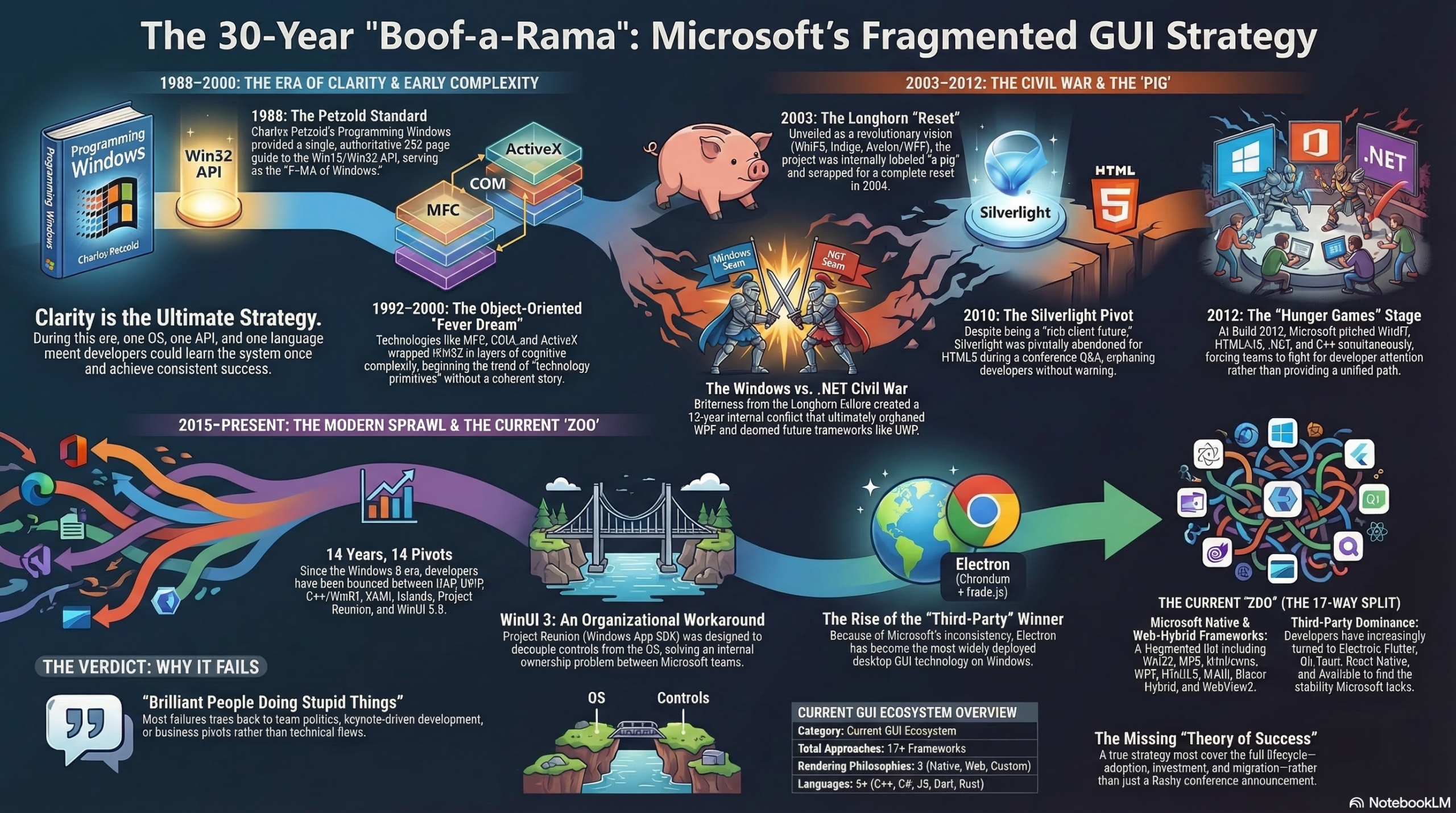
Any trade-off that favors the enterprise in lieu of the user actually benefits nobody in the long term.
It's just that it's a piece of tech from back when Microsoft corporate dominance on the desktop was at its peak, and many large companies bought into the then-current tech stack, including VB6. So now Microsoft is stuck maintaining it because those are the customers that bring consistent revenue.
But then they rioted internally to kill C++/CX (the only time they had something comparable to C++ Builder), Project Reunion got announced and misused from the original goal, porting WinRT back into Win32 killed .NET Native as well, most of the key team members left to Amazon and Google, Azure or AI teams, the team is now mostly interns or juniors from Microsoft India, no direction, and is a mess, naturally.
I went from a WinRT advocate, to pointing out devs to stay away from it, this is how bad they treated those that actually believed WinRT could be it.
Painful and nonsensical from a desktop standpoint but also kind of impressive in a way.
Yeah, he's talking about WinForms like it was a whole new thing, but it was a very transparent OO layer over Win32 and extremely similar both to VB and Borland Delphi. It was one of the reasons why .NET survived at all when Linux servers became the default option.
You can just render on a canvas like flutter and KMP. Most end users don't care
I still don't understand why the windows store search sucked so badly. It isn't like they had billions of apps. So why did it suck?
I would not be surprised if you still cannot launch a fricking .exe.
I think you're being a bit unfair to the Windows division during the Win8 lifecycle. Maybe that's just my rose-tinted glasses though. I know there are some HN/proggit commenters who like to harp on the supposed toxic rivalry between the Windows orgs and Microsoft developer tools orgs and how it has made Windows' developer platform much worse over the years, but I have always thought we had a better relationship than that, since my group's product was the main reason for yours for many years, and your group delivered so much for us in turn. Clearly your side had at least some reason to see things differently. On behalf of all of us, yes even up to stevesi, I'm sorry.
Now let me completely undermine my apology by nitpicking your comment :)
[continued in my replies to this comment]
I think one of his main points is server .net was (and is) great.
But the UI part of it was cloudy.
I see it as complimentary to the post not contradicting it.
I remember that. Especially silly.
> Windows RT (not to be confused with WinRT, because Microsoft product naming!)
The gold standard will always be "Xbox one series X", designed to be confused with Xbox one series S.
Windows RT had one other anti-consumer and anti-developer feature: it was locked down like a Chromebook, so you could only use Store apps on it.
Also, Windows division is shipping a subpar product now.
In a sane world developer division and Windows division would think things together, developer division would produce the tools and the same tools would be used by Windows, other Microsoft products such as Office and third party developers.
Why that doesn't happen at Microsoft, I don't understand.
And I don't understand why Nadella doesn't do anything about it.
> WinRT (2012) - it (or the embodiment in Windows 8) failed in the market but it also showed both the problem and potential solution to building for new markets while respecting the past
I can't express how wrong this is. WinRT was the most destructive thing that the Windows team ever did to the OS. It drove a hard stake into Windows, splitting it in half and declaring that anything previous to Windows 8, oriented toward desktop, or using primary input through mouse and keyboard over touch was dead. Microsoft basically told all existing Windows developers that if they weren't building a new, touch-oriented, mobile-style app specifically for Windows 8, they didn't matter and wouldn't get any support whatsoever, which is exactly what happened every time they broke existing desktop functionality. Calling this "respecting the past" is a crass insult and taking no responsibility for damaging the Windows development experience and accelerating development away from native Windows apps.
He maybe never had a strategy for Windows but he wasn't hired to have a strategy for Windows.
for the dedicated more native stuff dioxus is kinda cool if you don't want a web stack in the mix.
i'm enjoying golang and wails though paired with whatever front end i want, all apps i've made perform execellent on windows. bottom line = yeah i can't really think of a scenario where i personally would ever write an app for windows specifically.
i, like you, used to get hung up on native vs web framework. i'd encourage you to give it a go, possible you cede that mayhaps the native thing isn't as important as you thought.
I think it really abuses the assumption of good faith and the default to generous interpretation, because it forces you to divorce the author from their own published work in order to view them seriously. I suspect most of the comments here are generously ignoring the included graphic. But in the most generous view possible, the author is fine with publishing wildly inaccurate statements.
I think this makes HackerNews much worse, and posts like these should only be flagged.
It's important to remember the specific reasons why Windows RT 8 chose to not support third-party desktop apps. The most important aspect of "iPad compete" that we wanted on Windows for ARM was not "all app UXes look and work well on touchscreen tablets" but "you can't ship malware, not even by rebuilding your x86 malware from source." Thus, every 3rd party app on Windows RT would have to live in the AppContainer sandbox that UWP apps are in by default, and the requirement that you ship through the artist formerly known as the Windows Store would be a second line of defense against malicious apps. And with the forced-enabled Secure Boot, subverting the user-mode controls by secretly installing a bootkit would be hard even with physical access to the PC.
Even within the Microsoft world only, Windows Phone 7 had proven the success of this approach of locked-down apps only available through an app store that checked apps on submission and afterward for security. It was not unreasonable to think that similar lessons might also benefit users of "big" Windows, which is why Windows 10 and 11 have the opt-out "S mode" which defaults to the Windows RT restrictions.
I do wish though that Windows 8 had learned different lessons from WP7 (about which more in another point).
The fact that UWP XAML was its own new thing and not a extension of an existing Microsoft GUI app framework like WPF was not necessarily a "we hate managed code" thing, or even a "we hate those guys who invented managed code and want to screw them because we're Windows" thing. After all, .NET managed code had equal access to UWP through the .NET WinRT projection!
And to me at least (I didn't work on UI-facing stuff in Win8), it was absolutely conceivable that UWP could have just delivered Windows Phone 7 Silverlight's version of XAML to native code apps, with a thin adaptation layer to let even unmodified WP7 app binaries run on the desktop Windows .NET Framework with the WinRT projection and to allow slightly modified WP7 apps to look good in landscape mode on both Windows 8 and WP8. If we had done that instead of making UWP XAML its own thing, and if we had integrated the Windows Store with the Windows Phone Marketplace from the beginning so that Windows and Windows Phone apps could be sold as variants of each other through a single Store/Marketplace product entry on Windows 8 GA day, then I think we could have brought a lot of people forward who were already making good WP7 apps, and the Store wouldn't have been so empty.
Furthermore, IIRC much of the original UWP XAML implementation was done by the original people who built WPF and Silverlight the first time, and they would have known what they were doing in separating UWP XAML from Phone Silverlight. That they didn't go in the direction of extending Phone Silverlight was not necessarily shortsightedness on the part of provincial Windows people. Maybe they thought Phone Silverlight actually demonstrated fundamental limitations of WPF or Silverlight XAML or the Silverlight "coreCLR", or they wanted to make breaking changes as lessons learned from Phone Silverlight, which was put together about as hurriedly. (Windows Mobile 6 -> Windows Phone 7 first previews = 1.5 years; Windows 7 -> Windows 8 first previews = 1.5-2 years, tending toward 1.5 years if you account for the frantic re-planning after iPad came out in early 2010.)
At the risk of getting my Microsoft history wrong, I'm fairly sure that Steven Sinofsky wasn't working on Windows or even MFC (i.e. what he did as one of you guys) in .NET's early days of 1999-2003. He was leading Office at that time. Office of that era was transitioning from the Windows XP look that still persists in Windows Forms to the early Ribbon, and was then (as now?) using very custom GUI code that didn't correspond to any specific higher-level Windows app framework.
Mac OS Office apps had just separated their codebase again from Windows apps after being unified in the mid-90s to get to feature parity (which annoyed Mac users who felt they now had non-native-feeling apps that were slow and bloated), and the "Office framework" was still quite distinct from any single-platform Windows app as a result of that.
So if Sinofsky did not understand why people went from USER/GDI to WinForms, that may just have been the fact that nobody working for him had felt the need to make that transition.
I think the real mistake there was not so much that a particular projection of the Windows Runtime was stopped, but the more general idea that developers should be forced to consume what became known as the Universal Windows Platform or author custom WinRT components through only Microsoft-made WinRT projections.
In the name of winning over new or inexperienced Windows developers with "simpler, safer" projections, we in the Windows division almost completely failed for about 5 years to document or even explicitly say that WinRT was essentially just "COM: The Good Parts, Version 2012". (Martyn Lovell's Build talks on the origin of WinRT were a notable exception to this.) This discouraged people from using their existing COM skills to develop Metro-style/UWP apps or to gradually adopt features from UWP APIs that were accessible to them in their existing desktop apps. Other people have written that "WinRT=COM" thinking is actually a bad idea because it forces people to deal with COM and its more annoying ideas (separate IDL etc.); I disagree because we should have reached out to people who live in COM world to get a ready developer base.
That mistake was a key part of the still larger mistake you touched on of trying to make the UWP and desktop worlds 2 completely different developer platforms that happen to co-exist on the same desktop edition of the Windows OS. That was the key "we didn't listen to developers" mistake that set up UWP for its market failure. Another example: Even today, you can't adopt the battery-friendly UWP app lifecycle using Windows App SDK, which is supposed to be the UWP successor for desktop app developers. So much for WinAppSDK (or indeed UWP/Metro-style apps in Win8) enabling a true no-compromise user experience.
It took real tours-de-force like Kenny Kerr building C++/WinRT and blogging about it, Raymond Chen blogging about using WinRT APIs through the unprojected "ABI" interfaces, or the VideoLAN organization building a Win8/Win10 UWP version of VLC in C, to get the word out that the UWP world wasn't some alien thing with dark magic that only Microsoft wizards had full access to. And it doesn't help that the wizards really do have a few special powers that they jealously guard even now.
fair. but that struck me as strange even then. if anything, visual studio should have adopted the all-lowercase typography of the original metro-style design language from zune and windows phone 7, not AN ALL-UPPERCASE ONE.
Perhaps that was just another way that Windows 8 Metro-style apps' design and developer platform was like Windows Phone 7's Metro style, yet different in seemingly gratuitous ways. That is something I would attribute to internal Microsoft politics. Steven Sinofsky and Terry Myerson (leader of Windows Phone at that time) never really got along, and in the Microsoft philosophy of that era where engineering divisions were completely locked down from each other by default, that rivalry would have discouraged what little natural collaboration would have happened anyway.
I currently have open Chrome, Spotify, Discord, Aseprite, and Zed. All of them look completely different, and that's actively helpful for me, the user.
It's nice to follow the system's light/dark setting, and obviously the behavior of basic UI controls should be unsurprising, but beyond that there's no point in "consistency".
Gates did this with Windows, Office, XBox among other things. Ballmer failed to do this this with Windows Phone. Nadella did it with Azure, but he needs to do it once again with AI. You can see that he's pushing hard with Copilots everywhere, what's missing is a manager that has a coherent vision of what AI at MS should look like. ScottGu is in charge of both Azure and AI at MS, but I don't know if he can deliver.
That was at least in part due to the aforementioned obsession with iPad and generally mobile. One thing that Sinofsky is not wrong about in his post is that the classic Win32 app model is not conductive to good battery life - there's very little there to properly handle things like automatic background suspension or low-power push notifications. WinRT was designed with that in mind, but that would make no difference if the apps would just ignore it, hence the heavy-handed push for WinRT apps only (AFAIR it wasn't restricted to Store, although you had to jump through some "developer mode" hoops to deploy apps directly).
With WinForms, we actually got something that was convenient without shackling you. And the whole cross-language story was great, too, especially around .NET 2.0 - with C++/CLI you could very easily wrap any random native code C or C++ library for consumption from .NET, with end-to-end integration in the build system, IDE etc.
Who says the system theme is well designed at all? Back in the 1980s you could count on most text color combinations on a Commodore 64 or an IBM 3279 or a PC with a CGA working.
Today it is absolutely normal to type
ls
on a Linux machine out of the box and if you are running X or Wayland some of the file names are dark blue on a black background and completely un-readable. To be fair, if you are logging into a Linux machine on Windows with ssh on CMD.EXE or most terminal software you get similarly poorly chosen colors. (To be fair, MacOS does do better!)As a web developer it pisses me off because I am expected to follow
https://www.w3.org/WAI/standards-guidelines/wcag/
and regularly my management gets legalistic looking documents from customers complaining that we only have 6.5:1 contrast on something and you know what I do... I fix it. I wouldn't send anything to my tester that was unreadable and if I did I'd expect her to put in a ticket and I would... fix it. When MUI computes the coordinates wrong and something draws 20px right of where it should be... I fix it.
Whenever I've put similar tickets to the various parts of the Linux desktop mafia they close it as "won't fix" and often give me a helping of verbal abuse. Even Microsoft occasionally fixes something (even if half a decade late) and their people are polite.
When I first started porting programs to Windows ARM64, I didn't have an ARM64 device and had to test in QEMU. It ran extremely slowly, probably 1/50th of real time. All UWP programs like Calculator ran like a slug. But which programs still ran reasonably? Classic WinDbg and Task Manager. Two programs that were still plain Win32.
There are significant issues with Win32, namely its lack of a permissions and isolation and lack of hardware acceleration in the old windowing UI (User/GDI). But the idea that Win32 is inherently power inefficient is, IMO, just BS. Its roots go back to CPUs that were orders of magnitude slower than modern CPUs and there is nothing difficult about making a Win32 program that idles at 0% CPU when not in use.
Can you expand on this, because I'm not seeing it myself. The DOM, html+css is very flexible. It easily encompasses most UI. Most UI is some kind of data display, so lists, trees, tables, forms.
The need for JS might be what you're complaining about. I think we might be stuck with it as a UI control language forever.
That's an extreme scenario but today's politicians are not very keen into redistribution of wealth or prevention of excessive accumulation of economic power leading to exceeding the power of the state itself. I see nothing preventing that scenario from happening.
From the native code side, it was not so great. The .NET 2.0 CLR had very poor support for hosting from the native side and really wanted you to make a program that was .NET first, it didn't work well if you wanted something like primarily a C++ program that hosted a C# UI in the same process. Reverse P/Invoke via native exports wasn't exposed, so creating DLLs for consumption by non-.NET programs was difficult. Mixed mode debugging was and still is painful, with the debugger being glacially slow at some operations like OutputDebugString() processing and blocking some native features like data breakpoints, and the CLR eating access violation exceptions from native code so they couldn't be debugged properly. Build-mode wise, we had to ban C++/CLI assemblies depending on C# assemblies because the C# project system didn't handle incremental builds properly and forced the dependent C++ assembly to rebuild all the time.
These issues still largely exist and are an issue with WPF. It's a great UI framework, but it's unusable unless your front end is primarily a C# program.
Microsoft’s net income is up roughly 5.4x from ~$22B in 2014 to $119B today. Profit margin also expanded, from ~25% net margins in 2014 to over 36% today.
Which bubble are you talking about? Even if you remove everything after January 1 2020, it’s still up 4x since nadella took over. And that follows a decade of stagnation under Balmer.
What numbers do you know of that show that Microsoft hasn’t been successful since nadella took charge?
Complain all you want about the products, but the stock under nadella has been a success.
Also with most GUI frameworks, there's some difference between widgets like label, button, menu, checkbox,... and containers that does layout management. And there are not a lot of elements in both sets. This is the reason why React Native has a very sparse components library. With simpler implementation, you have a simpler rendering path, and the developer have less elements to deal with.
Also some have ready-made implementation of really useful widgets, like tree, grids, tables, lists, and other dynamic things. You can find libraries for those on the web, but the web implementation of scrollable container is janky.
‘I wanted a machine to do the dishes for me so I could concentrate on my art, and what I got was a machine to do the art so now I’m the one doing the dishes’
"Sandbox-first" even made some sense as a direction to work because it is harder to add a sandbox after the fact than to start with one, which is one of the core lessons learned from XP trying to sandbox some of the insecurities in Win32 and getting caught in a lot of complications. (The "sandbox-first" of UWP wasn't even that different under the hood from the XP "sandbox" of Folder/Registry Redirection, just a little better hardened.) Microsoft needed a lot better messaging up front if they had expected to allow more apps to leave the sandbox eventually. But Microsoft probably did believe the UWP sandbox was a better and safer experience for consumers.
But yeah, what's left of Package Identity outside of the sandbox feels like it includes several classic mistakes from .NET's CAS/GAC era, and also seems to point out that Sinofsky was wrong about WinRT "respecting the past" when it failed to learn from that era because it didn't trust .NET's history.
Inside HTML 5 you can find facilities for rendering documents and you can find facilities for rendering applications, including those forms. There is not a clear line between one and the other.
For example, Windows classic desktop apps still have no equivalent to the UWP app lifecycle. Your UWP app's processes can be suspended and resumed without you writing code to force the suspension and request when to be resumed later. Instead, you are expected to appropriately handle event notifications for suspend, resume, and the app entering and leaving background state.
This system-managed UWP app lifecycle makes life harder for UWP app authors, but I think the net win for battery life is much better for the user experience, which is why mobile apps operate the same way. Yet the docs for the Windows App SDK, which is supposed to bring the best of the UWP to desktop apps, explicitly say that WinAppSDK apps control their lifecycle just like other desktop apps, and the only power friendliness in the WinAppSDK API is voluntary (aka no one will use it). [1, 2]
I'll probably write more soon in response to other parts of the original link's comment thread. Overall, I feel like UWP is being unfairly maligned here, and that while its introduction was unforgivably arrogant, Steven Sinofsky is also right that it was daring and necessary to fix the mistakes and outdated decisions of 16-bit Windows and Win32.
[1] https://learn.microsoft.com/windows/apps/windows-app-sdk/app...
[2] https://learn.microsoft.com/windows/apps/windows-app-sdk/app...
HTML have a lot of tools for devex, but if you’re going for a good codebase and simple implementation for a desktop application, QT is way easier.
That relates to some of my criticism that maybe UWP could have used more .NET veterans because that was one of the problems with the CAS sandbox. For the most part the CAS sandbox was "opt-in" and yeah software developers through ego, hubris, and everything else will most often declare "my app/library is a special snowflake and needs access to everything!" So even if things opt-in to additional security controls like CAS, no one tests or builds for Production in a CAS sandbox so even things that claimed to support CAS threw runtime exceptions all over the place to the point no one could trust CAS to the point were CAS died for being practically useless overhead because no one both opted in and knew how to test it.
UWP had a lot of good ideas. It's insistence that it didn't have much to learn from .NET's mistakes was not one of them.