Makes you wonder if the investigators discovered this independently, or decided to maybe ask the hackers already involved in defending against them for help...
Identifying a criminal is ethical.
[Edit] "An international search is underway for Daniil Maksimovich SHCHUKIN on suspicion of numerous counts of gang-related and commercial extortion using ransomware to the detriment of commercial enterprises, public facilities, and institutions."
Some take a "full disclosure" style and expose all OPSEC failures instantly and transparently, because otherwise people seem to collect OPSEC failures and make it seem to be extortion itself, like saying "hey remember that time you signed off with your real name?" or "I know your clearnet address"
Also talk about a headline that would mean absolute gibberish just a couple decades ago.
Unless there's something not covered in the article, his current address, family members, phone, etc were not listed. That's not doxxing; that's "here's a guy were want to arrest."
Clear specialization, outsourcing, and reinvestment — very similar to how startups scale.
This outsourcing of one's morals to the state is excessive even by already high western white collar internet standards.
Now, make no mistake, these guys are up to no good and probably should be identified and prosecuted, but to just declare that a bad thing is now good because government is doing it is basically an abdication of one's moral compass. At best this is still a bad thing but a necessary one because all the other options are worse. Like shooting someone in self defense, or putting someone in a cage for doing sufficiently bad things.
Edit: I'll admit I played too loose with ethics vs morality here, but still the point stands.
I agree that “doxxing” is being misused in TFA, but criminals have privacy rights like anyone else. Violating these rights requires specific justification, it’s not automatically ethical.
E.g. in germany it was a real crime to grow some weed. Now it's legal, but even before a lot of reasonable people didn't want someone go to jail over weed.
56.10 — Restaurant activities and food delivery services
47.23 — Retail sale of fish, crustaceans, and mollusks in specialized stores
47.25.12 — Retail sale of beer in specialized stores
47.25.2 — Retail sale of soft drinks in specialized stores
47.29.39 — Retail sale of other food products in specialized stores, not included in other groups
68.20 — Lease and management of own or leased real estate
Money is reinvested into selling beer and fish :) Interestingly, he registered all that in 2019, just when the ransoms started.No, if they just put UNKN on the most wanted list, then it wouldn't be doxing. But then they also tie UNKN together with "Daniil Maksimovich Shchukin", and that's the doxxing, regardless or not if it's on a most wanted list.
BTW, what do you think will happen when people find out that their neighbor is secretly a pretty wealthy criminal? Attempts of theft, robbery and extortion have happened in the wake of such announcements.
There was even a case where somebody attempted to impersonate an intelligence officer and try to force a recently doxxed cyber criminal to bribe them.
1: https://de.wikipedia.org/wiki/Vorbereiten_des_Aussp%C3%A4hen... [de]
I'd rather "doxxing" just mean "de-anonymizing" because that's 1) how I already read it, 2) removes the whole "who is the more moral side in this dispute therefore has the right to make the accusation" problem
anyway individuals willingly give to teh state some autonomy in return for the safety of governance... that's the social contract free people have with government
"doxxing" a Russian ransomware group is the kind thing to do. bombing them out of existence is within the remit of the range of ideas a government could resort to...
The dilution of the word doxxing has been interesting, though. Some of the recent "doxxing" controversies have been about figures who weren't all that anonymous to begin with. The pop culture meaning has been extended to cover any mention of someone's real identity at all, even if it wasn't a secret.
This seems to be just issuing an arrest warrant.
Who knows, but I'm also not sure how you avoid that situation. Presumably, to be "doxxed" like this, there's substantive evidence he is actually the criminal. Strikes me as just one more downside of being a successful (but now identified) extortionist.
They really couldn't. BVerfG (Germany's constitutional court) has clearly said that dual use tools have a presumption of not being tools to break the law. It's been very clear that mens rea matters. And that a narrow reading of the law is the only constitutional reading.
The problem here is taking "word for word" as "by dictionary meaning", which is never how laws are read.
It's still a problematic law (together with §202a/b) because it doesn't clearly carve out space for grey-hat activities (white-hat attacks with authorization really don't fall under it even with creative reading).
On the upside, Germany is considering fixing that. On the downside, it moves with the speed of classic German bureaucracy and is being "discussed" since 2024.
That one is a classic for russian criminals and warlords.
Perhaps this goes back to leftist terrorism in Germany in the 1970s, they would not use the code names of terrorists on the wanted lists but their real names to find them, because this is what they wanted - but I don't know.
Someone who breaks the law and is actively searched for obviously has no expectation of privacy, or do you think the people visiting Epstein's island were doxxed?
>law
>legally
You keep using these words but it causes circular logic as those are all defined by the same entity that is acting unilaterally.
The action the government took was not a "good" action by any moral standard. But it was perhaps the least worse action available all things considered. Can't just whisk people off the street in a foreign country or drone them over such matters, those options would be worse.
It historically was used for this exact case: revealing someone hiding behind a pseudonym for purposes of law enforcement. The term dates back to the 90s, if not earlier.
This isn't something Gen Z made up. It's a Gen X term. "Hack the gibson" era. Wargames era.
I’ve been seeing it come up in discussions about court cases where people are under the belief that requiring online personalities real names in the court documents is somehow illegal because it’s doxxing.
An elusive hacker who went by the handle “UNKN” and ran the early Russian ransomware groups GandCrab and REvil now has a name and a face. Authorities in Germany say 31-year-old Russian Daniil Maksimovich Shchukin headed both cybercrime gangs and helped carry out at least 130 acts of computer sabotage and extortion against victims across the country between 2019 and 2021.
Shchukin was named as UNKN (a.k.a. UNKNOWN) in an advisory published by the German Federal Criminal Police (the “Bundeskriminalamt” or BKA for short). The BKA said Shchukin and another Russian — 43-year-old Anatoly Sergeevitsch Kravchuk — extorted nearly $2 million euros across two dozen cyberattacks that caused more than 35 million euros in total economic damage.
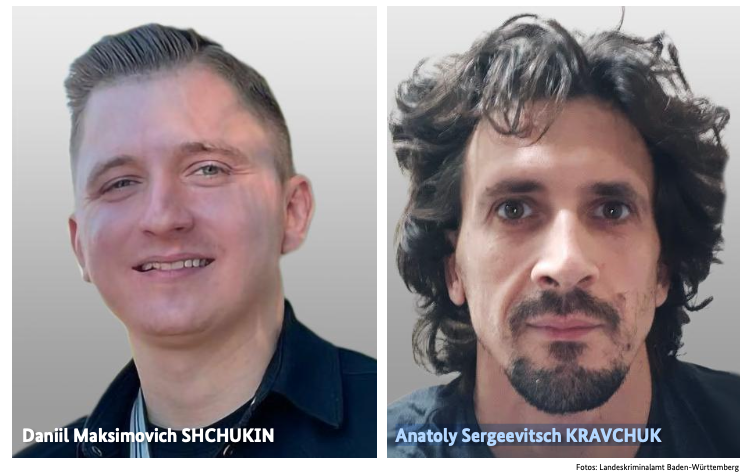
Daniil Maksimovich SHCHUKIN, a.k.a. UNKN, and Anatoly Sergeevitsch Karvchuk, alleged leaders of the GandCrab and REvil ransomware groups.
Germany’s BKA said Shchukin acted as the head of one of the largest worldwide operating ransomware groups GandCrab and REvil, which pioneered the practice of double extortion — charging victims once for a key needed to unlock hacked systems, and a separate payment in exchange for a promise not to publish stolen data.
Shchukin’s name appeared in a Feb. 2023 filing (PDF) from the U.S. Justice Department seeking the seizure of various cryptocurrency accounts associated with proceeds from the REvil ransomware gang’s activities. The government said the digital wallet tied to Shchukin contained more than $317,000 in ill-gotten cryptocurrency.
The Gandcrab ransomware affiliate program first surfaced in January 2018, and paid enterprising hackers huge shares of the profits just for hacking into user accounts at major corporations. The Gandcrab team would then try to expand that access, often siphoning vast amounts of sensitive and internal documents in the process. The malware’s curators shipped five major revisions to the GandCrab code, each corresponding with sneaky new features and bug fixes aimed at thwarting the efforts of computer security firms to stymie the spread of the malware.
On May 31, 2019, the GandCrab team announced the group was shutting down after extorting more than $2 billion from victims. “We are a living proof that you can do evil and get off scot-free,” GandCrab’s farewell address famously quipped. “We have proved that one can make a lifetime of money in one year. We have proved that you can become number one by general admission, not in your own conceit.”
The REvil ransomware affiliate program materialized around the same as GandCrab’s demise, fronted by a user named UNKNOWN who announced on a Russian cybercrime forum that he’d deposited $1 million in the forum’s escrow to show he meant business. By this time, many cybersecurity experts had concluded REvil was little more than a reorganization of GandCrab.
UNKNOWN also gave an interview to Dmitry Smilyanets, a former malicious hacker hired by Recorded Future, wherein UNKNOWN described a rags-to-riches tale unencumbered by ethics and morals.
“As a child, I scrounged through the trash heaps and smoked cigarette butts,” UNKNOWN told Recorded Future. “I walked 10 km one way to the school. I wore the same clothes for six months. In my youth, in a communal apartment, I didn’t eat for two or even three days. Now I am a millionaire.”
As described in The Ransomware Hunting Team by Renee Dudley and Daniel Golden, UNKNOWN and REvil reinvested significant earnings into improving their success and mirroring practices of legitimate businesses. The authors wrote:
“Just as a real-world manufacturer might hire other companies to handle logistics or web design, ransomware developers increasingly outsourced tasks beyond their purview, focusing instead on improving the quality of their ransomware. The higher quality ransomware—which, in many cases, the Hunting Team could not break—resulted in more and higher pay-outs from victims. The monumental payments enabled gangs to reinvest in their enterprises. They hired more specialists, and their success accelerated.”
“Criminals raced to join the booming ransomware economy. Underworld ancillary service providers sprouted or pivoted from other criminal work to meet developers’ demand for customized support. Partnering with gangs like GandCrab, ‘cryptor’ providers ensured ransomware could not be detected by standard anti-malware scanners. ‘Initial access brokerages’ specialized in stealing credentials and finding vulnerabilities in target networks, selling that access to ransomware operators and affiliates. Bitcoin “tumblers” offered discounts to gangs that used them as a preferred vendor for laundering ransom payments. Some contractors were open to working with any gang, while others entered exclusive partnerships.”
REvil would evolve into a feared “big-game-hunting” machine capable of extracting hefty extortion payments from victims, largely going after organizations with more than $100 million in annual revenues and fat new cyber insurance policies that were known to pay out.
Over the July 4, 2021 weekend in the United States, REvil hacked into and extorted Kaseya, a company that handled IT operations for more than 1,500 businesses, nonprofits and government agencies. The FBI would later announce they’d infiltrated the ransomware group’s servers prior to the Kaseya hack but couldn’t tip their hand at the time. REvil never recovered from that core compromise, or from the FBI’s release of a free decryption key for REvil victims who couldn’t or didn’t pay.
Shchukin is from Krasnodar, Russia and is thought to reside there, the BKA said.
“Based on the investigations so far, it is assumed that the wanted person is abroad, presumably in Russia,” the BKA advised. “Travel behaviour cannot be ruled out.”
There is little that connects Shchukin to UNKNOWN’s various accounts on the Russian crime forums. But a review of the Russian crime forums indexed by the cyber intelligence firm Intel 471 shows there is plenty connecting Shchukin to a hacker identity called “Ger0in” who operated large botnets and sold “installs” — allowing other cybercriminals to rapidly deploy malware of their choice to thousands of PCs in one go. However, Ger0in was only active between 2010 and 2011, well before UNKNOWN’s appearance as the REvil front man.
A review of the mugshots released by the BKA at the image comparison site Pimeyes found a match on this birthday celebration from 2023, which features a young man named Daniel wearing the same fancy watch as in the BKA photos.

Images from Daniil Shchukin’s birthday party celebration in Krasnodar in 2023.
No people were harmed so I am leaning towards no crime committed.
It's not, in Germany we have separation of powers.
> The action the government took was not a "good" action by any moral standard.
Morals aren't binary. Morals have context.
I might want to do violence upon you for some reason. Maybe I hate you. Maybe you're doing something that I don't like. If I'm lucky I can round up half a dozen buddies to help. But I don't have infinite resources and infinite reach, so my capability is rather laughable unless you live next door.
Buuuut, if I craft it just right, I can cause the state with it's practically infinite resources, infinite men with guns who kick in doors, etc, etc to choose to kick in your door and do violence upon you. (And the request usually looks a lot like doing their job for them "hey look over here there's this specific person doing this specific thing that you're supposed to go after", but that's beside the point.)
Same as how if I craft a request to a 3rd party server just right a few Kb of on my end can become dozens of Mb on yours.
The German police can't reach these guys. Hence why they're doxing them. They're hoping to structure things such that those who can reach them respond to the request (i.e. rounding up these guys will be a line item in some larger geopolitical context).
Most of us grew up on the Internet, and consequently our world view is incredibly screwed and not particularly based on facts
I misread that as it either would be the thing to do or an alternative option and you were against putting names on a wanted list.
https://en.wikipedia.org/wiki/Extrajudicial_killing#United_S...
"Doxxing" certainly doesn't carry a negative connotation in that usage. Unless you live in a culture where torturing domesticated animals is a good thing.
ANd I recall that, before that, hackers would doxx other hackers in the 90s in order to get them arrested. Again, that seems like the exact same usage as here: tying a pseudonym to an IRL for purposes of law enforcement.
Its almost always associated with a private person (ie not police or anyone of a judicial system) releasing personal information with malicious intent.
As the person above you said, semantics are important. This is a judicial system specifically searching for a person they believe to have caused severe criminal harm.
See the canonical example of this going wrong: the Reddit 'investigation' of the Boston Bomber, where someone was misidentified, doxxed, and their family was harassed.
Of course, law enforcement is capable of making the same mistakes. But ideally they have better safeguards, and victims of their negligence have much better recourse.
If it's negative depends on if you think they deserve the hostility.
I disagree. Tying a pseudonym to an IRL persona for purposes of law enforcement is a part of an official investigation.
Doxxing is specifically non-government unmasking and dissemination of that tie for extrajudicial purposes, almost always for harassment. There is a world of difference between them and we should not fudge them together with terminology. My 2c.
[1] https://en.wikipedia.org/wiki/Parable_of_the_broken_window
The same thing is true with computers. Imagine all the nice things we could have if we didn't have to worry about people abusing the systems we build.
It's on like place 10 out of 180, which makes it one of the least corrupt places.
It also has some surprisingly non-boomer departments, like the Sovereign Tech Fund. Either way you need to celebrate police doing good things and immoral actors being exposed, it can only have good outcomes.
Perhaps it deters them, or deters the next generation of such hackers. Or at least it makes their life less enjoyable, which is fair since they were only able to afford their travels due to their illicitly acquired wealth.
The one that has just invested in Scala? In year 2026? There are many good things about Germany, but competence in tech is not one of them.