The newest frontier AI models can easily find 0-days in all major software stacks, while the two biggest open source security tools on Windows can’t even ship patches.
> Mounir IDRASSI - 7 hours ago > Thank you all for your feedback and your support in getting media attention through various social platforms.
>After posting this, other developers in the security fields (like WireGuard) came forward to announce that they have the exact same issue. I understand why nobody talked publicly about this before and I'm glad that by going public I pushed others to do the same.
>Positive aspect is that a Microsoft VP (Scott Hanselman) has announced on X that he will help address this issue affecting me and others. He also reached out to me and connected me with other Microsoft people to help address this issue.
>I will let you know how things go.
[1] https://github.com/HyperSine/Windows10-CustomKernelSigners
My only experience with Veracrypt is via a law firm I was consulting with, who used it to protect some files they were sharing with me. Law firm and their end client are both big, prestigious companies.
Never was, isn't and I guess won't be.
[1] https://www.microsoft.com/en-us/windows/compare-windows-11-h...
(and yes I know, you'd need to have the option to have "your" (haha...) OS trust it of course)
> Hey I love dumping on my company as much as the next guy, because Microsoft does some dumb stuff, but sometimes it's just check emails and verify your accounts.
Not every "WTF micro$oft" moment is a slam dunk. I've emailed VeraCrypt personally and we'll get him unblocked. I've already talked to Jason at WireGuard.
Not everything is a conspiracy, sometimes it's literally paperwork.
(https://x.com/shanselman/status/2041977121686585396 https://xcancel.com/shanselman/status/2041977121686585396)
The burden of usage/access is now solely on the customers and the feeling is that regular customers are just a nuisance to be ignored.
If anybody within Microsoft is able to do something, please contact me -- jason at zx2c4 dot com.
Even if one doesn't want to maintain that project for purely private reasons, recommending Bitlocker as the drop-in-replacement always made it smell fishy to me.
Windows and macOS are just too risky to do any business with. Waste of all resources.
If there isn't enough outcry they will go forward and disable more signing keys related to things like torrent clients, VPN software, eject UBO from the edge store etc etc.
Atleast now I'm a bit more certain that VC is indeed safe.
But aside from one or two experimental attempts, also presented at BlackHat https://web.archive.org/web/20250914062843/https://portswigg...
- the consumer has nearly lost access to high end plausible deniability
Switch to Linux if you can, and come give Shufflecake a try ;)
Some guy somewhere deciding to delegate threat assessment to Copilot or some other automated tool.
https://techcommunity.microsoft.com/blog/windows-itpro-blog/...
We really need viable solutions. I have been using Linux since +21 years or so, so it does not affect me personally, but I think Linux needs to become really a LOT more accessible to normal people. And it really has not (on the desktop); all the various "improvements" on GNOME3 or KDE are basically pointless, they have not solved the underlying problem. Ideally problems should be auto-resolvable. If someone wants to use the proprietary nvidia driver, that should be a single click - on ALL Linux distributions. Instead you see some distributions have their own ad-hoc solution and other distributions have no easy solution (for simple people).
Their GUI tools for package management are thin wrappers on CLI tools, but are enough hand-holding that most people should navigate it fine. More devices worked out of the box for my with Linux than Windows.
Just like if you haven't tried AI in a year and have mocked it, you need to try it again. Of you haven't tried Linux desktop in a few years, you need to try again. CachyOS really does seem to handle the driver installs and gaming compatibility well.
60 days, long enough for the US to exploit the vulnerabilities discovered by Claude Mythos, short enough to plausibly be bureaucratic corporate awfulness by Microsoft when all is said and done. Basically freezing you and other security software out of protecting the bad guys they particularly want to get at until after the bad guys get got, then everything goes back to normal and Microsoft says "oops, here, we fixed your access."
This is stupid. If Microsoft wants people to stop writing kernel drivers, that's potentially doable (we just need sufficient user mode driver equivalents...) but not doing that and also shortening the list of who can sign kernel drivers down to some elite group of grandfathered companies and individuals is the worst possible outcome.
But at this point I almost wish they didn't fix it, just to drive home the point harder to users how little they really own their computer and OS anymore.
> Effective October 16, 2025, Microsoft will initiate mandatory account verification for all partners in the Windows Hardware Program who have not completed account verification since April 2024.
> Partners who fail to complete Account Verification by the deadline, or who do not meet the requirements, will have their status set to Rejected and will be suspended from the program.
https://github.com/rustdesk/rustdesk/discussions/13025 https://github.com/microsoft/winget-pkgs/pull/345601
tl;dr: ESET Antivirus flags RustDesk as a "Potentially Unsafe Application" because it is a remote administration tool, despite not flagging similar commercial products in the same way, and the WinGet Community repo policy is to block anything flagged as such. Since they were unable to update the repo the RustDesk team requested that the older versions be removed to prevent users from unknowingly installing old versions that could potentially be a security issue in the future. Apparently this has been an issue for a lot of applications especially in the VPN and remote control categories.
There is a discussion about how best to handle these sorts of situations where legitimate and desirable applications get flagged as "potentially unsafe" or "potentially unwanted" but so far it's just been a discussion with no actual changes proposed yet.
On the other hand, if you get rid of Windows you don't even need Veracrypt.
It's a bit worrying that a sensitive app such as VeraCrypt is still distributed there.
[0]: https://guix.gnu.org/manual/devel/en/html_node/Invoking-guix...
This entire "big tech overlords have to sign apps & drivers to keep you safe" concept is one giant pile of nonsense.
Any large scale signing platform will have large oversights and be rendered useless. See the appstore / play store/windows...
Age Verification is the thin end of a much bigger wedge in "open" OS's
I am so sick and tired of the continued erosion of the ownership model. I dont want to rent anything. But corporations see it as an avenue to increase revenue. We pay more, for less. What else is new.
Aside from https://web.archive.org/web/20250914062843/https://portswigg... , there haven't been really many goes at going for plausible deniability with modern systems, and I see the segment about a Hidden OS feature in work as well.
Hoping this succeeds. Funny, eventually Shufflecake, after it gets fully capable on Linux, might have to look at making versions for Windows and Mac
On the driver side of things, new versions of Windows no longer trust the cross-signed certs, so you must submit your driver to Microsoft to validate and sign, so no private key to go missing. https://techcommunity.microsoft.com/blog/windows-itpro-blog/...
On the regular Authenticode side of things, the new CA/B Forum rules have prohibited storing new private keys outside of hardware modules for a while now, so eventually you won't be able to find a leaked private key for code signing that would still be valid.
conspiracy theories are fun and all, but 99.99% of the time it is just incompetence, miscommunication, etc.
The point isn't (or: shouldn't be) to forcefully find your way through some back alley to make it look legit. It's to certify that the software is legit.
Trust goes both ways: we ought to trust Microsoft to act as a responsible CA. Obfuscating why they revoked trust (as is apparently the case) and leaving the phone ringing is hurting trust in MS as a CA and as an organization.
So we'd better find a real solution now.
Whatever reason for this refusal / inability / choice to not contribute but rather re-create is on the reader to assume.
There is very little effort put into real progress as you point out. Sure, tons of work to move from x11 to Wayland, cool, only the developers give a shit… where is Office/365 that would make daily driving actually viable?
While WINE is impressive, it seems the only real progress for anything past Windows 7 is on paid versions of which there are at least three competing options.
Linux Desktop progress is slow because there it’s thousands of floundering side-projects without a goal of actually pulling normal users in.
It should be illegal for these companies, just like utilities, to deny service to anyone or any entity in good standing for dues.
There is little hope for getting this through in the US where most politicians of any stripe hate the public, and the ones that don't have hardly any power. But it might be possible to do this in the EU.
Then, we non-EU folks need to apply for Estonian e-residency [1] which may get us EU regulatory coverage.
<Tin foil hat on> Microsoft doesn't want to allow software that would allow the user to shield themselves, either by totally encrypting a drive, or by encrypting their network traffic! </Tin foil hat on>
Microsoft even supports Wireguard in Azure Kubernetes Service.
This is the same thing that's happened every time I've tried to have a Microsoft account. I don't think Microsoft wants to have customers who aren't rich.
If it weren't for the current administration, I'd say it's time for regulatory action.
Do not discount complete, total, utter, profound fucking incompetence as the driving reason behind this.
Getting the business verification was an astounding shitshow. With a registered C corp and everything, massively unclear instructions, UI nestled in a partner site with tons of dead ends. And then even after all the docs, it took another week because -- in an action that nobody could possibly have ever foreseen -- we had two different microsoft accounts due to a cofounder buying ONE LICENSE of O365 for excel and doing domain verification because it suggested it.
My advice is don't use a MS account if you can, at least not for anything critical. You don't need it for development, you can use 3rd party CAs for signatures.
More regulation won't help here, because the regulation-maker is itself the hostile party.
What would help is full control over the supply chain. Hardware that you own, free and open-source operating systems where no single person is the bottleneck to distribution, and free software that again has no single person who is a failure point and no way to control its distribution.
Also “there is no appeal possible” should be plain illegal.
The old model where the user decides which software or apps to run on their machine, is basically already replaced by a whitelist system that is managed by companies who have no interest or obligation to approve developers. Factors like ”being an individual”, an open source developer or god forbid reside outside the USA, you rely on a combination of L1 support doom loops, unjustifiable high recurring prices, kafkaesque and changing requirements, internal inconsistencies. Windows is the worst, but all platforms (except Linux) suffer from this and you can and will get hurt, delayed, and gaslit. If you haven’t, it’s just a matter of time.
I have been blocked for 6 months now with Digicert code cert renewal, for my app Payload, which will never get any media attention. The app doesn’t matter though, the approval process is per-entity (usually, a company). The point is that nobody gives a shit, because they have a monopoly/cartel and they start the validation process after they take your money.
If you are not an app publisher, the best way I can describe it is the ”pre-let’s encrypt” era of SSL certs, but more expensive, strict and ambiguous. In fact, I’ve never gone through any worse approval process in my life, and that includes applying for residency in two countries, business licenses, manual tax filings etc.
https://web.archive.org/web/20260000000000*/https://www.true...
And now they're locking down Window OS, hard. Expect github and vscode to follow.
Are there some ways to combat such decisions legally?
It was never as good as freshmeat.net even in its heyday.
Because Sourceforge is horrible to use and was at one point actively pushing malware? It's pretty obvious tbh.
You can/should write your congressman (or whatever they are called in your country) and get better laws in place.
They won't let you secure your drive the way you want. They won't let you secure your network the way you want (per the top-level comment about Wireguard). In so doing they are demonstrating not just that they can stop you from running these particular programs but that they are very likely going to exert this control on the entire product category going forward, and I see little reason to believe they will stop there. These are not minor issues; these are fundamental to the safety, security, and functionality of your machine. This indicates that Microsoft will continue to compromise the safety, security, and functionality of your machine going forward to their benefit as they see fit. This is intolerable for many, many use cases.
I think it is becoming clear that Microsoft no longer considers Windows users to be their customers any more. Despite the fact that people do in fact pay for Windows, Microsoft has shifted from largely supporting their customers to out-and-out exploiting their customers. (Granted a certain amount of exploitation has been around for a long time, but things like the best backwards compatibility in the industry showed their support, as well.)
I suspect this is the result of a lot of internal changes (not one big one) but I also see no particular reason at the moment to expect this to change. To my eyes both the first and second derivative is heading in the direction of more exploitation. More treating users like a cattle field and less like customers. When new features or work is being proposed at Microsoft, it is clear that it is being analyzed entirely in terms of how it can benefit Microsoft and users are not at the table.
No amount of wishing this wasn't so is going to change anything. No amount of complaining about how hard it is to get off of Windows is going to change anything; indeed at this point you're just signalling to Microsoft that they are correct and they can treat you this way and there's nothing you will do about it for a long time.
Their first big win was when they banned the Chief Prosecutor of the International Criminal Court from accessing any of the court's documents, then deleted all of those documents. Now they're going after slightly less important enemies of the state. That bar will continue to drop as long as it's allowed to. And let's not kid ourselves: if you develop or use encryption software that Mossad can't break, you are an enemy of the state.
I think you forgot we're talking about the kernel drivers specifically - normal scammers don't need that, they use AnyConnect downloaded from Chrome.
I think you also forgot to read it all and missed that it was supposedly some deanonymisation (ID verification) process that kicked it off, and missed that the dev has immediately verified themselves but then we're told they need to wait 2 months to wait.
Because.
It's not an automated process at this point.
Expect someone read and follow instructions in email are not that realistic anymore
More importantly, if development seized with no public comment, that would be one thing and may strengthen the "he got arrested" theory. However, there was some final communication, specific recommendations to rely on Bitlocker of all things, a new version of Truecrypt was released solely for decrypting existing disks and then the web page was removed, including a flag set on robots.txt to ensure it wouldn't appear on archive.org. All this concurrent to a crowd funded source code audit that, in the end, did not find any server issues or backdoors (I recall some speculation back in the day, that either known code quality issues or an intentional backdoor could have caused the exodus).
That all makes it hard to link this to an arrest of the main developer, though I dislike speculation without any hard evidence and if there is no new information, I'll keep this filed under "there is no answer".
Yikes
> The contempt of court was caused by Levison providing the keys printed in a tiny (4 point) font, which was deemed "largely illegible" by an FBI motion, which went on to complain that "To make use of these keys, the FBI would have to manually input all 2560 characters, and one incorrect keystroke in this laborious process would render the FBI collection system incapable of collecting decrypted data."
(And to be clear, that's all they ever saw of said keys)
Sure, if you're all in on MS365 (like all schools here in the Netherlands), Windows may be somewhat more handy with its native apps and all your stuff there with a single log-in.
You can install Fedora Linux, Linux Mint or Manjaro, and it's more user friendly than Windows 11 and macOS.
Look at popular unix based OS's - Android, MacOS, iOS..
Whats the first thing they do? Take the command line out back and shoot it. Whereas for linux users, their is this l33t h4cker festishization of only using a keyboard to do everything. All these distros have an extremely robust CLI under the hood, and an afterthought quasi GUI on the surface. Just good enough for grandma to check her email and watch youtube.
Linux is the most obvious, but there are numerous flavors of BSD as well.
> and yet... still unusable by the mass majority of people.
That info is 20+ years out of date. Distros like Suse and Ubuntu made Linux "click, click, click, it's installed" more than two decades ago. i've watched complete non-techies switch to Mint Linux long-term, the only intervention from me (their resident techie) being showing them how to boot up the USB stick installer.
I recently de-listed my app in the store and closed my Microsoft developer account. I was wrong for having bothered with it; just a waste of my time for no benefit. Stick to your own deployment.
And of course, it doesn't affect their earnings and there are no consequence, or significant, so they won't care and won't respond or tell what went wrong.
Can one move legally? Sure. But then it effectively is a combo of who blinks first and who can hold their breath longer.
If you publish to any closed platform including ios, mac, win, android, this is the risk you run and a condition of operating you will need to accept.
Veracrypt has kernel drivers. Microsoft's ability to control what you can sign is specific to kernel drivers, and Microsoft's trigger finger around bans exists in the world where bad drivers BSOD machines.
In general this isn't your problem.
> ...it seems like they instituted an identity verification policy, didn't notify me about it, and then I guess they suspended accounts who didn't do the verification.
So, make sure you verify your account? Check spam folder regularly? Log in via web interface at least once a year?
It's easy to paint the big gov as bad, but this is a case where unfortunately the populace seems to be in agreement with the big bad gov. While most US citizens support encryption, 76% or so, the vast majority 63% also favor government "backdoor" access for national security reasons.
I guess either we believe in democracy or we don't. It could be said that if Veracrypt isn't/can't be backdoor'd, perhaps the gov is simply implementing the will of the people :( via Microsoft.
I don’t know the number. But personally I think using the services and ‘simply’ only use them if the disappearance isn’t catastrophic and have the price be low or free while it works isn’t too bad a trade-off.
Admittedly that’s a big ‘if.’
It's decent, but it's not all roses at all, and I wouldn't inflict it on non-techies yet.
I don't think Microsoft cares (about anything besides making mo' money), but there are plenty of (state) actors that can influence the decision-making at Microsoft when it comes to these issues.
No tinfoil needed.
https://en.wikipedia.org/wiki/Embrace,_extend,_and_extinguis...
?
Who cares if it's OSI-approved or not, a line saying "M$, Google, and the like need written permission for every use case" would help to make those leeches honest. Just learn from the JSLint example.
Because the Democrats were better at keeping them on a leash? No. Clinton was in charge 30 years ago and blew it.
Seems rather clear that he doesn't want French jurisdiction.
https://alf-s-room.com/etc/nandarou/binbows/binbows_english....
The FTC wasn't doing their job between 1980-2020 because of their ridiculous standard of, "if it doesn't raise consumer prices, it must be allowed." This lead to massive consolidation in many industries which of course ended up raising prices and hurting consumers anyway.
Recently they've had some wins but overall they're still failing to do their job.
It's possible that they could start issuing separate certificates upon specific request for code signing purposes, but it's doubtful they would be willing to meet Microsoft's requirements for such certificates, so their code-signing CA would not be added to Windows's trust store, rendering the certificates it issues useless.
The ACME protocol, the key automation technology that makes Let's Encrypt possible, performs domain validation only. It verifies that you, the person (or bot) making the request, are an authorized administrator of the DNS records, or port-80 HTTP server, for that domain. This is directly relevant to, and generally considered sufficient for, HTTPS.
However, domain validation is almost completely irrelevant to, and insufficient for, code signing. Microsoft's rules (and Apple's, incidentally) require establishing the identity of a legal person (individual, or preferably, company). There is no way the ACME protocol can do this, which means that the process is totally out of Let's Encrypt's wheelhouse.
But if OSes are being locked down and software has trouble distributing security updates through official repositories for Windows... that's a good reason to finally make the switch. Same as why my family is on Android: I can install f-droid, disable the google store, and don't have to worry about them installing malware / spyware / adware
There's different degrees of openness. Android till 2026 was an acceptable compromise (let's see how it goed forwards). Windows is also on the decline with their account policy, not sure about this certificate revocation thing (thankfully haven't had to deal with it yet; I'm not a user myself) but it sounds like they're moving to a walled garden also
When the degree changes and gets even less open, yeah you can say "well of course, they were never truly open, they're commercial" but it's still a change and might lead people to alter their choices
I really believe most "open source" big projects have been compromised long ago. We have saw all those "Foundations" taking them over with all their governance, bureaucracy and goal which do not make any sense at the first look.
One example is Fedora, which is part of "The Digital Public Goods Alliance" [0], "a multi-stakeholder initiative that accelerates the attainment of the Sustainable Development Goals by facilitating the discovery, development, use of, and investment in digital public goods."
The Digital Public Goods Alliance has about every governments as member plus all the usual suspects: Gate Foundation and co.
All the leaderships have usually no background or experience in open source or even computers but are just magically placed there. But you can't say anything because they are mostly women.
You read the goals and roadmaps of those foundations and find out it has nothing to do with software or open source. It is basically there to control those projects and then have them implement all the age verification, digital id, etc.
So yes this is not a surprise all those projects are now all in absurd features such as age verification.
If Veracrypt was a honeypot, the powers that be would go out of their way to make it as easy to use as possible. They'd instantly sack whoever made this decision, and reverse it.
My guess was that he got caught up in some house-cleaning. My theory being that he's still signing his code the way malware authors also do and got flagged by some automated review that's meant to force him to go get WHCP certified or whatever the new route is.
are there any books or good articles with good sources about this? I'm very interested in what happened in the 80s through the mid 90s.
Pretty sure there were historically a lot of apps that stole peoples contact lists and were signed properly. Certainly in the Android world.
A signature is a signal, not an absolute. Although, to be fair, if Microsoft (or most other CAs) had done a better job, then that trust would have carried more weight than it does currently.
We're in an interesting spot here and the tension is tangible.
Don't do math that way! That math is illegal! Good boys and girls don't keep secrets!
These people sound ridiculous
Could this be the one exceptional case where people agree with the direction of policymaking? Sure. Is that likely? No, not really.
If this requirement was in place they would be a bit more careful about terminating accounts because the cost equation would incentivize it. Maybe they would be more careful in their automation or require more than one level of human review before cutting off access.
These companies are gatekeepers for their platform. It isn’t crazy to require them to act more responsibly.
It wouldn't. For example, before Gmail, email was often free or nearly free (bundled with your internet service), but in most cases, you could talk to a human if you had issues with the service.
What we couldn't do is turn these business models into planetary-scale behemoths that rake in hundreds of billions of dollars in revenue. In essence, you couldn't have Google or Facebook with good customer support. I'm not here to argue that Google or Facebook are a net negative, but the trade-offs here are different from what you describe.
It's actually the only thing that provides any kind of assurance to users. It's not like end users know if FuzzCo is the correct developer for FooApp but they know fooapp.com.
I would be ecstatic to be proved wrong on this, but experience tells me that is not likely to happen.
And if it were related to some kind of scan and malware flagging, the cert would have been revoked. It is not.
Then again, this was something like 20 years ago. Back then, Sourceforge was something closer to GitHub today. It was the de facto public source repository. You could even get an on-premise version, IIRC.
Actually, this is sounding a lot like GitHub these days… not sure what that means.
There are legitimate reasons for governments to intercept information, with the correct oversight -- enforced legally in an "checks and balances" manner. The fact that there is a breakdown of trust between government and people won't be solved with more encryption.
There’s no apparent mechanism to do so. Support was clueless. The privacy email address responded weeks later with “not out department”.
Start worrying about the erosion of your rights as a consumer.
Perhaps cachyos should maintain LTS metapackages for more than just the kernel. Video drivers, boot managers and whatnot.
For a "non-gamer" I would probably keep them on Fedora or even Debian.
If Microsoft amounts to a sentient entity (i.e. is able to care about things), we have a bigger problem.
If we put the wall of metaphor between us and that interpretation, it still remains likely that "users shielding themselves" is of primary concern to Microsoft's bottom line.
In digital services there's no such thing. There's only a damned corporation employing idiots who don't care about community.
But yes, there's a lot of critical single maintainer projects.
> The Department of Justice, now under Bush administration attorney general John Ashcroft, announced on September 6, 2001, that it was no longer seeking to break up Microsoft and would instead seek a lesser antitrust penalty
https://en.wikipedia.org/wiki/United_States_v._Microsoft_Cor...
Look at the Windows start menu. It used to be trivial to switch users. Two clicks, one to open the user list, another to switch - done. Now it's four: user panel, three-dots, switch user, pick user.
Look at the login sequence. They want their Windows Hello and they don't care if it works well or not - no way to get a pin or password prompt instantly, you gotta click three times (one to show a method picker, another to pick PIN entry, and lastly one to focus the goddamn field) despite no reasons to hide this UI.
It's not like they're trying to scam or sell user into something. It looks like some internal decision-makers that don't ever dogfood their decisions losing touch with the common sense.
Apple has that too, and this rot spreads elsewhere. But it's not intently malicious, a lot of things simply don't make sense - just total lack of self-reflection capabilities at the corporate level.
I've been thinking, and said before, 90s Microsoft was far from perfect, but they at least seemed to care a lot about the quality of Windows. 2020s Microsoft seems to see Windows users as a captive audience they can exploit for whatever the corporate executives fancy at the moment. It seems more like a gradual transition.
In any case, it seems to be getting more clear that Linux is destined to be the best OS for power-users.
Quite obviously. Look at the out of box new user experience on a Windows 11 Home installation. What you get when you open a new $600 laptop from Best Buy for the first time. The entire thing is designed to drive users towards perpetual monthly recurring subscription billing for various MS services for life (OneDrive, Office, Xbox Live, Xbox game store purchased games, etc). It's a platform which is built atop a rent seeking cloud services ideology that shows no sign of ever letting up.
I think he was trying to scream “Run!” without actually screaming “run”.
Everything else about complying with the wacko age verification law is up to distro builders.
>When my oldest son [Linus Torvalds] was asked the same question: "Has he been approached by the NSA about backdoors?" he said "No", but at the same time he nodded. Then he was sort of in the legal free. He had given the right answer, [but] everybody understood that the NSA had approached him.
so the assumption here is that TC were also asked to accept "contributions" from bioluminescent individuals, and chose not to. "just use Bitlocker" was a deafeningly loud dogwhistle, don't you think?
Which is 90% of the use of a computer. And Steam is taking care of the other 10%.
For the vast majority of people an operating system is whatever comes with the computer the kid at Best Buy told them they should buy or their IT department gave them. Asking anyone to switch is basically impossible.
There is nothing in a piece of random software obtained from some random source that authoritatively connects it with a particular domain. Without bringing an App Store or other walled garden into the picture, the operating system must evaluate an executable file according to the contents of the file itself. On cold launch, the information in the certificate can be presented to the user, and the certificate issuer can be checked against the O/S trust store, but nothing equivalent to the HTTPS domain check can be done.
DV certs work for the web because of that intrinsic connection between web site and domain. They fail for arbitrary software because of the lack of such a connection. The trustworthiness of code-signing certs comes from the relatively difficult process necessary to obtain them, and not the name attached to them. The identifiable legal entity to which the certificate was issued is more useful to the O/S vendor, as a harder-to-evade ban target, than it is to the end user.
Nothing in the Apple site or phone stuff would even clue the user in to what was happening, much less how to resolve it.
I grew up being able to download software and install it, and actually prefer that model (relying on reputational trust of the party publishing it, my own verification from other signals researched, or sandboxing techniques where appropriate).
Most users may not be aware, but a rare gem of a version of Windows that refreshingly doesn't even come with the store (or a bunch of the other unwanted bloat) is IoT Enterprise LTSC.
As a lifelong Windows user, the premise of Microsoft controlling what goes on my PC is revolting. I'm buying a tool from them, not a set of handcuffs. If it was some non-profit, open-source group running the store I might be more inclined to trust it. But ultimately the only gatekeeper on a product I own should be me. Otherwise I don't really own it, which leads to problems like this one.
WASHINGTON, DC—Assuming that there must be a good reason for the order, U.S. citizens lined up at elementary schools and community centers across the nation Monday for government-mandated fingerprinting. “I’m not exactly sure what this is all about,” said Ft. Smith, AR, resident Meredith Lovell while waiting in line. “But given all the crazy stuff that’s going on these days, I’m sure the government has a very good reason.” Said Amos Hawkins, a Rockford, IL, delivery driver: “I guess this is another thing they have to do to ensure our freedom.”
(source: The Onion, October 9, 2002[1])
[1] https://theonion.com/american-people-shrug-line-up-for-finge...
If in a democratic society, the majority agrees that government should have backdoors (with the correct oversight). Then it follows that Veracrypt should be illegal as its use is not in alignment with the will of the majority.
I personally don't agree with the majority here but can you fault the logic?
"I'm doing it wrong and it doesn't work" means you're doing it wrong, not that it doesn't work.
"In addition to the information referred to in paragraph 1, the controller shall, at the time when personal data are obtained, provide the data subject with the following further information necessary to ensure fair and transparent processing: the existence of automated decision-making, including profiling, referred to in Article 22(1) and (4) and, at least in those cases, meaningful information about the logic involved, as well as the significance and the envisaged consequences of such processing for the data subject."
EDPB Guidelines on automated decision making: https://ec.europa.eu/newsroom/article29/items/612053 especially page 25 is relevant
C‑634/21 is also somewhat relevant to understand how courts have applied ADM in general context of credit reporting https://eur-lex.europa.eu/legal-content/EN/TXT/?uri=CELEX%3A... though it didn't specify what information actually needs to provided for 13(2)(f).
For instance I don't think to this day it is possible to operate a Mastodon server and be compliant with GPDR and the UK online safety Act. There was the famous case of LFGSS forum about to shut down due to the former, the forum was kind of saved by a group of individuals willing to take the risk but the founder stepped down from fear of legal risks.
There hasn't been home raided and servers and personal computers seized yet but that doesn't mean it can't happen and technically any EU or UK volunteer hosting some forums or open source based social media that isn't GPDR or online safety act compliant could be at risk. For most I believe it is not that they don't want to be compliant but they aren't aware of that and/or don't have the technical means without further development on the software they are using and despite them not abiding to their own user rights, most of their users would be more sad to see them shutdown than the current status of not obeying the law.
The contrasting approach, where one designs a platform that remains secure even if the owner is allowed to run whatever software they like, may be more complex but is overall much better. There aren’t many personal-use systems like this, but systems like AWS take this approach and generally do quite well with it.
Microsoft the corporation may only care about making money, but a lot of very high ranking folks within MS Security aren't just friendly to intelligence agencies, they take genuine pride in helping intelligence agencies. They're the kinds of people who saw nothing wrong or objectionable with PRISM whatsoever, they were just mad they got caught, and that the end user (who they believe had no right to even know about it) found out anyway. The kind of people who openly defend the legitimacy of the FISA court.
This aren't baseless accusations, this comes from first-hand experience interacting with and talking to several of them. Charlie Bell literally kept a CIA mug on a shelf behind him, prominently visible during Teams calls, as if to brag.
Remember - Microsoft was the very first company on the NSA's own internal slide deck depicting a timeline of PRISM collection capabilities by platform, started all the way back in 2007. All companies on that slide may have been compelled to assist with national security letters. Some were just more eager than others to betray the privacy and trust of their own customers and end-users.
They've since moved on to the SSS strategy: Ship, Slip, Slop.
plus n-word dot com hosts information about the plus n-word license which purports:
- The software will not be used or hosted by western corporations that promote censorship
- The software will not be used or hosted by compromised individuals that promote censorship
- Users of the software will be immune to attacks that would result in censorship of others
More specifically, it used to be feasible to distribute software between me (the developer) and my customers (the users) without a mandatory gate keeper that looks at me and decides whether I’m worthy, am from the right country, have good intentions etc. This is currently necessary on all desktop and mobile platforms except Linux. There is exactly 1 gatekeeper per platform (the platform owner who controls your device), except windows, which effectively have like 3-4 CAs that’s shrinking every year due to mergers and private equity ownership.
Software curation and reputation systems can be good, either with whitelists (say steam) or blacklists (say antivirus). I can see some use cases for it, but they should be within user control. What we have now is worse than a fearmongering Stallman rant. It’s incredibly bad, both pragmatically and philosophically.
Open source developers are doing Microsoft a big favor when they support Windows and publish Windows builds and installers. It's a substantial effort, and apparently that effort isn't appreciated.
If all open source software dropped support for Windows, it wouldn't really affect the open source community that much. It would definitely cause headaches for Microsoft however.
The ones that tell you there’s a problem with your MS365 subscription, but don’t tell you which one are an especially exciting challenge to deal with. Bonus points if they warn about “possible data deletion” without specifying what.
For the vast majority of people MS365 is a requirement, but really the issue is that even minor fixes require the command line on Linux and that makes it unusable.
I hope Linux never succumbs to the lowest common denominator and people who actually enjoy tinkering will always have somewhere to go and something to learn. If that's being stuck, I hope it stays stuck.
My wife has used Linux for many years successfully and has never used the CLI once.
Any OS that requires even once going to the command line is unusable for 99% of the population (and for me I just shouldn't ever have to).
Anyway, even if you could get your own cert it would be same thing: MS could revoke or blacklist your indicate cert (though usually the grounds for doing so are much less shaky than your account being suspended for vague “tos violations”)
I have stay far away from that process for a long time. Apple MacOS seems like the worst in that department IMHO.
If I submit it manually for every update it tends to go better. If more people download and install it whitelists faster. But that is highly annoying, orwellian bullshit. Might even be anti-competitive or downright illegal.
Like none. Literally the best office you MIGHT KIND OF be able to run in 2016, but probably more like 2013.
Valve focused on games, that is awesome and really helpful…
But there are 10,000 distros and instead of putting real resources to put even rickety bridges over MS’s moat, no sorry, this team is making duplication-of-effort distro 10,001 which is now identical to thousands of others but the taskbar is in the middle of screen.
The people working on Linux are consistently uninterested in then things people would need to drop windows.
What ? On my computer ? Microsoft really has some nerves. My Microsoft account is scheduled for deletion.
Created: 2026-03-30
Updated: 1 day ago
Hi everyone,
I want to share an update following my absence over the past few months.
I have encountered some challenges but the most serious one is that Microsoft terminated the account I have used for years to sign Windows drivers and the bootloader. You can see below a screenshot of the message shown when I tried to sign in.
Microsoft did not send me any emails or prior warnings. I have received no explanation for the termination and their message indicates that no appeal is possible.
I have tried to contact Microsoft through various channels but I have only received automated replies and bots. I was unable to reach a human.
This termination impacts my work beyond VeraCrypt and has consequences for my daily job.
Currently I'm out of options.
Regarding VeraCrypt, I cannot publish Windows updates. Linux and macOS updates can still be done but Windows is the platform used by the majority of users and so the inability to deliver Windows releases is a major blow to the project.
I'm open to proposals and help.
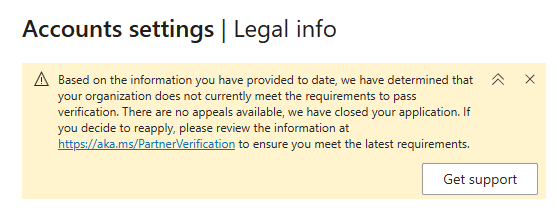
😕
4
![]()
Some practical questions about the most current Windows release, until this situation can be resolved:
The current version 1.26.24 is signed with the 2011 CA, which is soon to expire. This will certainly affect secureboot.... but how will this affect mounting non-system volumes (partitions and/or file containers) as a user? Will one have to disable secureboot just to install VeraCrypt, even if not using system encryption? And how will this affect portable use?
The same question applies to unsigned versions people may choose to build for themselves for Windows.
👍
3
@martymacgyver: for non-system volumes, there is no issue since driver will continue to work. For system encryption, inability to publish a new signed bootloader will definitely cause issues once the 2011 EFI CA is revoked later this year.
I prefer not to think about this possibility since there are positive signs that the issue will be resolved.
Let's wait and see.
👍
3
![]()
Thanks for that detail - it's useful information regardless. Given the widespread coverage of this situation I'm very hopeful that this will be resolved quickly!
![]()
Hi Mounir,
I’m so sorry to hear about this. I would try contacting Microsoft using the link below. There is a link to “Help with the Microsoft account recovery form” on this page:
There is also a link to “I need to talk to a customer support agent” on that page. Apologies if you have already tried these links.
Alex R’s kind suggestion of posting to Reddit and Twitter (now X) are great suggestions too since this will likely get you re-directed to the right people.
If your account has been disabled for more than 30 days it could be unrecoverable. You may need to set up a new account and start the verification process all over again to have your new account enabled for driver signing purposes.
I hope this is somewhat helpful. Thanks.
Last edit: AJ B 2026-04-08
@ajb87351: Thank you for the feedback. I already tried all the links.
Clearly media coverage has more power and the fact that other projects are affected helped gain more traction.
Everybody was silent because of the power Microsoft holds. I'm glad my first move triggered this collective reactions to make our voices heard.
❤️
1
![]()
Hi Mounir,
Sorry that you had already tried those suggestions. It’s fabulous that you are receiving the right support now.
The entire community welcomes you back. Please do let us know if you encounter any other challenges we can you help with. I agree with @Xiu, the VeraCrypt community loves you and needs you.
Thank you so much!
👍
1
![]()
Would you be OK if I posted this to socials, such as Microsoft's reddit or twitter accounts? Might get some traction.
❤️
1
👍
2
yes, no problem. I don't have much social presence so this can be helpful. Thanks.
![]()
In view of this situation, I recommend adding a signature-independent program that provides archive-like creation and extraction functions (without support for real-time modification), so as to cope with highly targeted scenarios.
@fzxx: We already have similar mechanism using GPG signatures. The issue here is that Microsoft holds the keys for SecureBoot on all the worlds PCs in addition to Windows driver signing keys so without their approval you are basically out of business!
🎉
1
![]()
This is a sad turn of events, Mounir! This may seem a bit out in left field (to use an American idiom), but is it possible that some seemingly minor aspect of your recent relocation to Japan is at the root of this inexplicable account revocation?
Grasping at straws is a hobby of mine :)
@garymarks: Thank you for the feedback. Judging by the fact that other projects like WireGuard are affected, I don't think my move to Japan has anything to do with it. There seem to be an internal Microsoft policy that triggered this issue at large scale and there lack of communication and feedback made things worse.
positive signs are coming...crossing fingers that it will be solved soon.
![]()
I'm really sorry to hear this bad news. Someone probably reported the software, claiming it could be used for illegal activities, which led to the account being deleted. Unfortunately, the general trend is increasingly toward controlling and monitoring what people do, and there is less and less respect for privacy.
Is there no way to get around this limitation, even temporarily? Perhaps by restricting the software, for now, to non-system partitions and volumes?
@phoenix-rising: there is no real secure solutions or workaround if Microsoft doesn't sign the driver or bootloader. Other solutions degrade Windows security and I will never recommend them: in such cases, it is better to move to another operating system like Linux.
I would try sending an email to Microsoft CEO, Satya Nadella at:
Use brief details from your first post in this thread along with the error message screenshot.
Possible email shown below.
Subject Line: Reinstate Partner Center Program Account for my Software Developer Business
Dear Satya Nadella,
I need someone from your staff's to help me get my Partner Center program account reinstated for my Windows developer business.
I attempted to login to my Partner Center account and I received the following error message.
insert your screenshot of error here
I did not receive from Microsoft any email notices or prior warnings that there is an issue with my Partner Center account and I have contacted support for assistance without results.
This issue impacts my business to provide third-party Windows software.
Kind Regards,
Mounir Idrassiinsert your business(es) name(s)insert your business emailinsert your business phone number and any alternate phone numbersinsert your business address
Time zone : JST (UTC+9)
@enigma2illusion: Thank you for the proposal.
At the end, social media postings and interview with journalists helped trigger a response from Microsoft especially that other projects turned out to be affected.
Microsoft VP Scott Hanselman reached out to help few hours ago. Hopefully it will be sorted out soon.
🎉
1
😄
1
👍
3
![]()
Good to hear, does that mean RTM 1.26.27 is coming soon?
❤️
1
Last edit: ara ara 2026-04-09
![]()
First, I doubt (hope not!) the account is actually deleted, it's most likely just disabled/turned off. Your accounr is just in the recycle bin... :)
I would email people in the crypto community/other devs who would know someone at MS - bruce schneir, chris titus, niels ferguson; or are someone at MS - karen easterbrook, nathan ide.
I would also contact media - tom's hardware, ars techica, wired, the intercept, EFF. there are a bunch of reddit subs that would apply - both in the privacy and crypto areas. also the guys from the all-in podcast and elon musk.
I would also contact the offices of the following US congressmen and ask for help: Reps: Tom Massie and Senators: Rand Paul, Ron Wyden. Even though you're not a US citizen, there is a compelling privacy interest for US citizens who are the bulk (guessing) of the users of this software.
👍
2
Last edit: Preguntar Jeeves 2026-04-06
@geeivegotmail: Thank you for the feedback. Definitely media coverage helped to get Microsoft publicly communicate about this. Big thanks to the community for this.
🎉
2
![]()
yeay! Scott's a good guy. Totally forgot about him still working for MS.
Hey Mounir, do you have an email I can share with Microsoft? (you can email me at rafael@withinwindows.com) I can help route this to the right folks internally.
👍
1
❤️
4
Last edit: Rafael Rivera 2026-04-08
@withinrafael: Thank you for your proposal. Few hours ago I was contacted by a Microsoft VP (Scott Hanselman) following the media coverage. He connected me with the right people from Microsoft and hopefully things will be sorted out soon.
I will share updates.
🎉
1
❤️
1
Hi Mounir. Just so you know, I ran into the exact same issue you mention when I tried to update my developer legal info for Secure Boot signing (you can see the full screenshot I got on my side, with the same error message in https://github.com/pbatard/rufus/issues/2918#issuecomment-3893620279).
I was able to get it sorted after contacting Microsoft support through the Partner Center and, from what I gather, the "There are no appeals available" is just boilerplate text that pertains to a separate part of the process that isn't directly tied with the formal business validation.
In my case (as far as I can tell), the issue was that I my domain name was from a .ie registrar and not a .com/.org for which Microsoft could automatically validate the WHOIS data. It is my understanding that the error message we both get is is what Microsoft defaults to when their automated WHOIS validation fails.
I have to say that, once I got hold of them, the Microsoft support people were quite helpful and managed to get my business validation sorted, once I provided them with the relevant data from the registrar (mostly my last domain registration invoices).
Hopefully, your issue is similar to mine, and will be resolved quickly once you get hold of someone at Microsoft.
👍
3
❤️
1
Last edit: Pete Batard 2026-04-08
@pbatard: thank you for sharing your experience. In my case, I was never able to get in touch with a human. I tried every possible contact form and link and every time it was automatic or AI feedback.
Seeing others affected like clearly show that there is a a communication issue on the side of Microsoft. Deploying automated systems that take such radical decisions should come with clear feedback and messaging to affected people so that adequate actions could be taken.
👍
1
Log in to post a comment.

There's a lot that one can gripe about Amazon as a company about, but credit where credit is due -- their inversion of responsibility is game-changing.
You see this around the company, back to their "Accept returns without question" days of mail order.
Most critically, this inversion turns customer experience problems (it's the customer's problem) into Amazon problems.
Which turns fixing them into Amazon's responsibility.
Want return rates to go down because the blanket approval is costing the company too much money? Amazon should fix that problem.
Too often companies (coughGoogleMicrosoftMetacough) set up feedback loops where the company is insulated from customer pain... and then everyone is surprised when the company doesn't allocate resources to fix the underlying issue.
If false positive account bans were required to be remediated manually by the same team who owned automated banning, we'd likely see different corporate response.
That would be both hilarious and horrifying if the only thing stopping the corporate dystopia is that Microsoft doesn't want to say the N word.
It's outrageous. MS is simply enforcing some Government crackdown on encryption software that would interfere with backdoors.
Valkey is better because all of the new development work happens on Valkey, not because of the license. If the actual developer changed the license, that would be a different situation.
These are real? I get these in my spam box all the time and they have all the hallmarks of a phishing scam, urgency combined with vague description with no verifiable details that aren't gleaned from my email address itself.
No it isn't actually, not for the majority, my wife (former Sales Person and Manager) uses Google office tools and used LibreOffice Write and Calc for years successfully.
You just needs something that opens a browser or a simple app. Nothing is more minimal and clear at the same time than Gnome, imho. Click Icon - Open App - Have clock at top. What more does one need?
Right now, if a handful of tech companies crater they'll take the whole world's financial systems out with them, so the government could easily be made complicit in any scheme they can conceive of to bolster their finances.
You can also roll you own encryption if you are not stupid and naive. Probably a question of self-reflection.
Wow, we're dating ourselves on this, but I remember when it was a big deal that SF.net added SVN support. They apparently didn't turn off CVS until 2017!
And https://www.facebook.com/help/contact/178402648024363 doesn't work either. Black hole, as far as I can determine.
Their chatbot, when asked, sends you to https://help.meta.com/support/privacy/ and says:
> To submit a GDPR objection request on Facebook, you can use the Privacy Rights Request channel.
> Select Facebook as the product you want to submit an objection about.
> Choose the option "How can I object to the use of my information" and follow the instructions.
But that option doesn't exist.
In the U.S. in particular, there's strong respect for individual rights enshrined in the Constitution, and a key role of the judicial branch is ensuring that those rights are respected regardless of what the majority thinks. The majority cannot enslave the minority, for example, regardless of what the legislature votes. Nor can it deprive it of speech or free assembly, or guns, or a right to trial by jury.
aka leave it to the experts because the majority isn't qualified to make such decisions.
I was always convinced that Skype was bought by microsoft so CIA/US intelligence agencies to have listening capabilities.
The first thing Microsoft did after the Skype purchase was making it easier to tap into the calls by removing p2p calling and routing calls using centralized servers.
It also reminds me of the case of the entire family who lost all of their payment-linked individual accounts including business data and an academic dissertation because the son allegedly behaved inappropriately with a bot. Collective punishment on top of technofeudal instant banishment.
I agree that supporting Windows helps its ecosystem.
But also open source software on Windows is an important gateway to the free world. When you are already used to Firefox, LibreOffice and VLC, you might as well switch to Linux painlessly, but if those didn't run on Windows, switching to Linux would require relearning everything.
I myself am quite different. I have thoroughly had it with my current iPhone and am eyeballing /e/OS, before that I really started to find Android boring, before that Windows mobile (the nice one with the cards). I switch Gnome, KDE, some other DE (now getting ready to try Niri) every year or 2. I don't get the struggle, for me a new env is like a present (even though I normally hate presents). So much niceness to explore, so much to optimize. I love it. But I'm also one of those guys that reads the oven manual and tries all functions in week 1.
I'm not weird, all you people are weird.
Also I hate linux repos with a passion, because they are optimized for CLI usuage, and (like the whole OS) the GUI parts are a total unoptimized afterthought. Never mind that they are a dumping ground for whatever code anyone shits out, with virtually zero management or curation. With a CLI you don't see this, with a GUI it's a total mess.
I'm fine with app stores, but they need to be actively managed and curated. If not, I far far prefer just downloading .exe's from the source.
The Microsoft Store account was painful to set up, I'll note. My developer account had also been cancelled by Microsoft for unknown reasons, and I ultimately had to set up a brand new one. New email, new name. My new account has my middle initial because I couldn't clash with the existing, closed account. My first and last name alone are banished forever from the store.
The "same thing", as you concede, isn't the same thing. Quantity has a quality of its own: one happens all the time and we're reading an article about it happening right now. In the comments there's another prominent maintainer who it happened to, and it happened to me personally! That's three right here! The other happens so infrequently that people in this same HN thread are complaining that it isn't happening enough. Can you find an example that's like Veracrypt and WireGuard? In practice, it seems they rarely do this, even when they should. You can actually view the list under "Manage computer certificates" > "Untrusted Certificates." On my computer the entire list is 20 certificates.
I'm standing by my suggestion, 100%. These aren't equivalent risks at all.
tbh, I thought that I had built enough reputation on this particular MSI release, until testing it just now. Hate to see it :(
Why the hell would you want that? Office365 is a buggy piece of nightmare.
At least it reached its goal if it entertained you
The catch is, views like those must be kept to a fairly modest level by the people who hold them. Discussing them with ideologically aligned colleagues may be fine, but for example, when someone makes statements or asks questions with such pro-privacy framing on stage directly to security leadership at internal company conferences, that is a quick way to a severance package not only for the person on stage, but also for dozens of folks in the audience who clapped a little too enthusiastically at the onstage remarks.
MS went from "developers, developers, developers" to being a nightmare for everyone involved.
I actually liked Visual Studio 6 and the old MSDN. Now I only wish they were gone.
It could have grown into a massive, self-service testing playground where any developer could submit their product and put it through an arsenal of basic, automated evaluations (e. does uninstall leave tidbits behind?), with paid upgrades to more tailored services. They could even publish scores to help consumers coarsely compare workmanship across different vendors, and encourage an emphasis on quality across the whole ecosystem.
Instead they decided to just become overpaid bouncers who take your money, check your ID, and don't even bother about what you bring through the door.
Microsoft and Apple uses their OS store to slowing take away control and ownership from device owners.
Yeah no, guys, that's not what I meant. Let me just show you this real quick...
I wonder if enough of freshmeat still exists on the Wayback machine to make a clone, maybe a skin for forgejo?
Simpler times, simpler everything.
if only it were so simple
A sudden lack of software on windows will increase user migration. If we all keep publishing for windows, users will just stay there because their needs are already met.
I just migrated to MS artifact signing and, thank the lord, had an actually easier time getting verified than I did with the Sectigo and Comodo in the past. I’m sure I’m not representative of anyone else’s experience but having already had a developer account (with a different email and without an Azure account!) that I had already been using for the Microsoft Store might have helped, as well as the fact that I had a well-established business history (I’ve heard businesses younger than 3 years can’t get verified??), but reading all the comments here makes me very uneasy about the future.
It’s good to know the HSM route isn’t a complete non-starter. The main reason I panned it is that when I started looking into this I found that a number of companies that had previously offered the HSM route had done a bait and switch and were now keeping custody unless you were big enterprise (meaning willing to put up with 10k/yr fees). I did find a few that would allow OSS devs to sign their work, but read horror stories on Reddit and elsewhere about their freezing the account and issuing no refunds if you ask them to issue the cert in the name of your LLC or corporation instead of with your personal name (which I expressly did not want). Also, they actually were more expensive than Azure artifact signing even after the HSM cost was taken out.
downloading an exe is "whatever code anyone shits out" cause that's exactly what built binaries are
A lot of the programs you use on Windows are actually the exact same ones on Linux be it VLC or Chrome. If you want to download binaries directly "from the source" and run those.... well that was always allowed. But remember the entire stack delivering the entire internet to you at any time is open source code that "anyone shits out".
distros are catering to server installs most of the time. if you want a gui you install that entire stack but for most classic distros like debian the GUI is not the main thing. if you want a GUI from start to finish go with Fedora or the new KDE distro.
Hold your nose and work on WINE if you need to think that way. But MS has moats, and office is one of the widest.
https://www.tiktok.com/@etong_winter_palikir/video/739554877...
No, that's the thing; they ideally would only need to replace the OS. Many long years ago, when I switched from Windows to Ubuntu (this was back when it was good), part of why it was so easy is because I mostly kept the same applications. If you use eg. Firefox, VLC, open/libreoffice, audacity, etc., then you can install a new OS, reinstall the same applications, and barely have to change anything. That's huge.
This is a little like the joke: "Madam, would you sleep with me for 1 million dollars?", to which she replies "I would". "Madam, would you sleep with me for 1 dollar?", to which she replies, "Sir, what sort of woman do you think I am?" To which he replies "We have already established what sort of woman you are, now we are just trying to establish your price!"
By agreeing to this initial Age Verification, companies are establishing that they are willing to implement checks on age for their users, now we will see just how much more they are willing to do - all to protect the children of course.
[1] https://comodosslstore.com/code-signing/comodo-individual-co...
If you, as a parent, make yourself open to this attack, you will find that you are making us less free of a society by expecting others to parent for you.
For a freedom you didn't have to pay for at all? Why accept this absurdity?
If you oppose the law to force liquor stores to deny service to minors, but people are still upset about minors getting alcohol, you have no right to be surprised when the next proposal is to ban alcohol for everyone, and you have no right to be surprised if it passes.
LibreOffice also has bad UI choices and glitches.
It’s not like we’re talking VLC vs OS Media Player here.
You can stomp your feet, but the world uses Exchange and Office and not for no reasons at all.
https://learn-attachment.microsoft.com/api/attachments/f8eac...

