12 hours ago
Sophie Hardach

 Getty Images
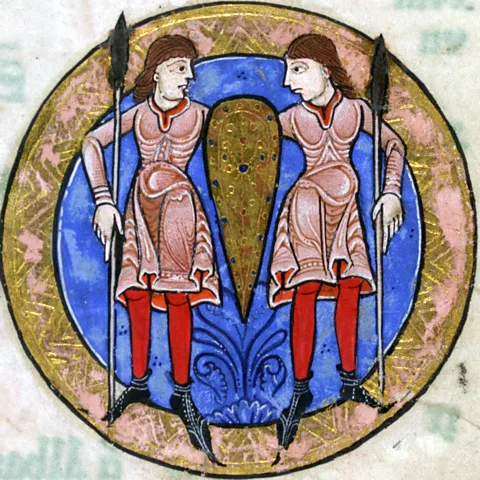
Tales of love and adventure from 1,000 years ago reveal a dazzling range of now-extinct English pronouns. They capture something unique about how people once thought about "two-ness". But why did they die out in the first place?
Which word would you use to refer to yourself? "I", presumably, in the singular. And how about you and a group of people? "We", of course, in the plural.
But how about you and one other person?
In modern English, there is no word for that. You would probably just use "we" or "the two of us".
But more than 1,000 years ago, you would have said: "wit".
This term, once also used affectionately to describe the closeness between two people, is one of many personal pronouns that have been lost or transformed amid huge social and political change over the centuries. The English language has become simplified – but at times this has left gaps, creating confusion.
"Wit" means "we two" in Old English, a Germanic language spoken in England until about the 12th Century, which evolved into the English we speak today. Now completely lost, "wit" was part of an extinct group of pronouns used for exactly two people: the dual form, which also includes "uncer" or "unker" ("our" for two people) and "git" ("you two"). That dual form vanished from the English language around the 13th Century. (You can hear how some of these were pronounced in the short clips later in this article.)
"There's a whole history in the [personal] pronouns", including the impact of Viking and Norman invasions on the English language alongside shifting norms and customs that have changed how we talk, says Tom Birkett, a professor of Old English and Old Norse at University College Cork in Ireland.
Many Old English pronouns are still in use, says Birkett. Our oldest English personal pronouns include "he" and "it", as well as "we", "us", "our", "me" and "mine", Birkett says. They have made it through more than 1,000 years of history and upheaval, almost intact.
"'He' definitely is a very old English form, and also 'hit', which lost the 'h' and became 'it'," Birkett says. The Old English "Ic" has also been resilient, losing only one letter, to become the modern English "I".
But other pronouns were cast off – such as the once-common dual form. "It's fairly widespread in Old English texts. Particularly in poetry, we get the use of 'wit' and 'unc' for 'us two, the two of us'," says Birkett.
To illustrate the poetic power of the dual, Birkett gives the example of a love poem, known as Wulf and Eadwacer, that is over 1,000 years old. In the poem, a woman yearns for her lover, Wulf, who is separated from her because he was rejected by her clan. The last line reads, in a modern English translation:
"One can easily split what was never united,
In the Old English original, the words for "the song of the two of us" are "uncer giedd" – meaning "our song", but just for two people.
"The dual pronoun is used in that poem, and I think it's quite an intimate use, because it's all about 'We two together against the world'," says Birkett. "Certainly in poetry, it has that use of creating an intimate connection between two people."
Fighting the "hronfixas"
In the Beowulf, the dual makes a dramatic appearance: two warriors swim in the sea holding swords, "to defend the two of us against whales" ("wit unc wið hronfixas werian" in the original). Thought to be written in the 8th Century, Beowulf is the earliest European epic written in the vernacular – the language commonly spoken – rather than a high culture, or literary language.
The dual form survived the transition from Old English to Middle English, after the Norman conquest in 1066, but then disappeared. "That's a whole category of pronouns that's just been lost," says Birkett. According to him, one of the last times the dual appears is in "Havelok the Dane", a text by an unknown author from around 1300:
"Roberd! Willam! Hware ar ye? Gripeth eþer unker a god tre, and late we nouth þise doges fle."
("Robert! William! Where are [you all]? Both of you two grab a good staff, and let's not allow this dog to flee!")
Introducing "she"
The dual form still exists in some languages, such as Arabic. But why did such a poetic pronoun go extinct in English? It seems especially strange when popular culture still celebrates that sense of a special two-ness today and the prevalence of "just the two of us" pervades song and literature.
Generally speaking, "language tends towards simplicity", Birkett says. Given that the broad, plural "we" can also be used for two people, there may simply not have been a strong enough reason to make the extra effort of keeping the dual form alive, in his view.
He points out that many other Old English pronouns have, in fact, not survived to the modern day either – replaced by words from foreign languages or more useful alternatives.
"She", for example, is younger than "he", and seems to be an amalgamation of two Old English female pronouns, Birkett says – "heo" and "seo". "[These] probably combined over time, to make 'she'," he says.
Vikings and werewolves
Another commonly used modern pronoun, "they" – along with "them" and "their" – is actually not Old English at all, according to Birkett. It arrived with Old Norse, a Scandinavian language spoken by the Vikings who invaded and settled in England from the 800s onwards. "They" then spread and replaced the Old English "hie".
The foreign "they" may have become popular for practical reasons, Birkett suggests: the native "hie" was potentially confusing as it could mean "they" but also, "her" – whereas "they" was distinct and therefore clearer.
Later, "they" was also occasionally used in the singular, as it is today when used as a gender-neutral pronoun, Birkett says. The singular "they" appears, for example, in the 14th-Century text "William and the Werewolf", as well as in "The Pardoner's Prologue", by Geoffrey Chaucer, written around the same time.
"Chaucer was using 'they' as a singular back in the 14h Century," says Birkett. "It's a very, very old usage, and very useful when you don't know the person, [and don't want to refer] to them as 'he' or 'she'."
 Getty Images
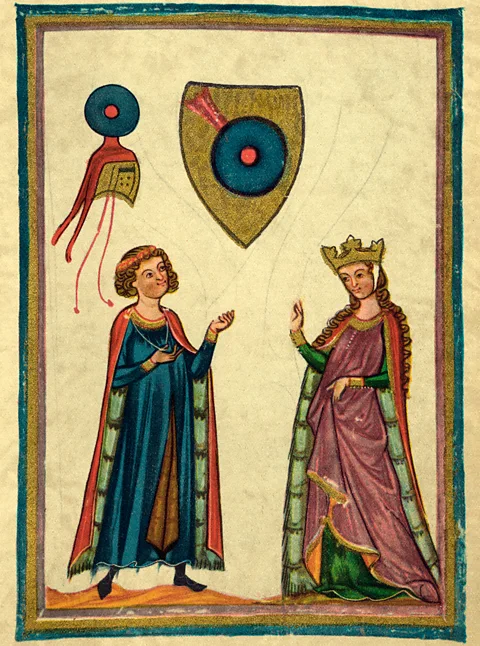
Two-ness is often portrayed as special, as in this European mid-12th Century scene (Credit: Getty Images)
You, you all, you guys
In the centuries after the Norman conquest of England in 1066, our language underwent another profound change: we began using "you" to address one person, and also, many people.
Before, there had been different words for that. In Old English, "Þu" (later spelled "thou") was the word for "you (singular)". A different word, "ge", which has survived in some English-speaking regions as "ye", was used for "you (plural)". With the Norman conquest, another chapter of transformative multilingualism began in England, in particular, intense contact between English and French. The Norman French "vous" arrived in England, which is used to address both a group, and also, in a formal context, only one person. The native English plural was then also used as a mark of respect in the singular, when addressing just one person, Birkett says.
"It was natural to extend that [French 'vous'] to English and to use that plural 'you' form to talk to the king and to the aristocracy," he says. "And then it was used as a respectful term for people in senior positions, and then, eventually, for everybody."
In the process, "thou", "thee" and "thine" disappeared, replaced by the catch-all "you".
"So you've got the politics there, of Norman French and the aristocracy, and the influence of French on English, which of course has been extensive," Birkett says.
Today, some dialects of English spoken in Ireland and elsewhere still make distinction between the plural and singular you, he says. "In my area, in Munster in Ireland, 'ye' is very, very commonly used as a plural. People wouldn't tend to write it down as much, but in spoken English it's used a lot," he says. In Glasgow and west central Scotland, another version, "youse", is often used as the plural in the local dialect.
And people today also use spontaneous workarounds to clarify the plural in everyday life, such as "you all" and "you guys".
Despite these changes, Birkett says that compared to nouns and verbs, personal pronouns have remained quite stable and retain some grammatical features of Old English that have entirely disappeared from English nouns. For example, we still say "he", "his" or "him", depending on the case – whereas English nouns and adjectives, which in the past also changed depending on the case, no longer do.
In Old English, for instance, the word for "king" – "cyning" – changed depending on its role in a sentence: "Hē is cyning" is in the nominative case and means "he is king", whereas "mid Þæm cyninge" is in the dative case and means "with the king".
"[Personal pronouns] have tended to survive because they're the bedrock of language," says Birkett. "They're used every day, all the time, and they've certainly changed less than nouns or verbs in the [English] language. Pronouns have had that kind of staying power."
Is there any chance the extinct English dual pronouns might return one day, turning Bill Withers' "Just the Two of Us" into "Just Wit", and Taylor Swift's "Our Song" into "Uncer Song"? Based on Birkett's historical examples, a comeback seems unlikely: once the dual fell out of use, it did not reappear.
However, surely, the future of our pronouns is whatever we want it to be. Perhaps wit – you and me – could make a start, and sprinkle some lost pronouns into our conversations today?
--
If you liked this story, sign up for The Essential List newsletter – a handpicked selection of features, videos and can't-miss news, delivered to your inbox twice a week.
For more science, technology, environment and health stories from the BBC, follow us on Facebook and Instagram.