It's an incredibly specific vanity domain called passiveradar.com. Who would want that unless they're a radar manufacturer or an expert in the field? In both cases, they would put their name on it, but there's no attribution whatsoever.
The site contains two short articles, mostly illustrated with photos lifted from elsewhere. For example, the schematic of how the radar works in the earlier article comes from:
https://www.researchgate.net/figure/A-schematic-diagram-show...
The article is also illustrated with what appear to be two vibecoded SVG animations that don't look quite right.
So, what's going on here? I suspect it's an attempt to farm domains for resale, or for LLM spam operations down the line?
There's a lot of current interest in what Iran is using for air defense. Search "Iran air defense passive radar". Some people speculate passive infrared. Some speculate passive radar. Nobody who's posting really knows, of course.
Ukraine uses many passive systems, including audio. Sort of like Shot Spotter, but for drones.
Wasn't some Github repo ITAR'd, couple of years ago, due to having python code for some SDR doing this?
Edit: Found it. 3years ago https://www.reddit.com/r/RTLSDR/comments/yu9rei/krakenrf_pul...
GNSS interferometric reflectometry (GNSS-IR) uses navigation satellites as the transmitter for a bi-static radar. The measurement device is any GNSS receiver (even your phone).
The technique can estimate environmental parameters like sea level, soil moisture, snow depth, and vegetation water content from systematic changes in the the multi-path around the antenna.
There is an open source Python package for this technique: https://github.com/kristinemlarson/gnssrefl
An introductory paper "The Accidental Tide Gauge": https://www.kristinelarson.net/wp-content/uploads/2015/10/La...
An example would be a website creating awareness around a disease for which there is (or was at the time) only one or two treatments for, like ED, crohns, a specific type of cancer, etc. in fine print at the bottom will say “Pfizer” or “j&j” but no drugs are mentioned, just a call to “ask your doctor about possible treatments.”
We know of such grants and customers, we need motivated people to help us get the grant.
It is mostly a computational software problem that needs a cheap supercomputer, we believe we are experts at that [1].
We already have two test area's where we are not restricted by laws: the Ukraine battlefield (brimming wit jammers and radar) and a radio silence area LOFAR receiver next to a military low fly zone near a large nature reserve and sea.
We hope to find people through Hacker News who can help us get the funding. Maybe even apply at YC.
Please contact me through my HN profile.
See my other comment below on how passive radar could become a game changer (that got downvoted just because I mentioned it here).
Some nice graphics related to passive radar:
[1] Cheap Wafer Scale Integration Supercomputer https://www.youtube.com/watch?v=vbqKClBwFwI
[2] How The U.S. Will Track EVERY Vehicle from Space: SAR GMTI/AMTI https://www.youtube.com/watch?v=-GTpBMPjjFc
[3] The Insane Engineering of Starlink V3 https://www.youtube.com/watch?v=U6veU66z2TQ
There will be a few false positives from farmers coming to work the fields by our road, or people looking to hike in the nearby forests, etc. but it could be pretty fun nonetheless!
A config that strikes me as obvious but doesn’t seem to be popular would be just bistatic where you fire your own transmitter far away from yourself?
There’s got to be a reason, but it seems like best of both worlds.
Those have always been good questions to ask, but especially these days.
Regarding passive radar it is nice system in theory. In practical setup it’s not mobile and location bound. Every location has different RF radiation environment. Since transmission is not controlled the reception (and detection) can’t be optimized for anything.
If you have more than one receiver, the main issue is time sincronisation between the receivers.
Using the two transmitters will complicate things a lot
Halfway in the video he mentions the MIT (or Stanford) course of a professor who recently died. That course is online and has a lot of documentation (much better than this course.
Build Your Own Drone Tracking Radar: Part 1 https://www.youtube.com/watch?v=igrN_wd_g74&t=292s
You can contact me if you want more guidance. For passive radar you can just start with recorded data. I have access to huge amount of recordings on the Ukraine battlefield. Buying or building cheap antennas and radios is not needed for passive radar software development.
Radar was developed during the last two years of WOII, mainly in Boston at MIT and hundreds of companies each building a radar, most were deployed months later to win the war. Development after the war shifted to Silicon Valley, founding Silicon valley and the later chip and software startups decades later.
[1] Best Porch Pirate Moments of 2025 (All Clips) https://www.youtube.com/watch?v=avUWmpfoK10
[2] When Porch Pirates Get Caught In The Act https://www.youtube.com/watch?v=zR8Imw7EN78
The survivability gains are also overhyped since 1. the enemy can just blow up the transmitters leaving you with a bunch of useless receivers and 2. most air defense doctrines already treat radars as something that should be distributed widely, so you can lose a few without the whole system collapsing.
The article goes into this only briefly, but modern radar systems don't just send out any random pulse but they very specifically tailor the waveform going out in order to do cool signal processing tricks like pulse compression. There is also the matter of frequency. The lower the frequency, the bigger the antenna you would need to get a proper direction reading out of it. Fire control radars typically operate in the X-band, around 10 GHz. Most civilian radio transmitters are around 100 MHz, so you'd need impractically large antennas and even then the bandwidth limitations would severely limit spatial resolution. One saving grace here is that stealth airplanes are typically most highly optimized against X-band radars from the direction they're going to bomb (forward), so you might have a better chance with a normal system, but then you still might not have a precise enough target to actually shoot at.
So while the multistatic system does offer some advantages, in practice it's just cheaper and (importantly for military use) requires less fiddly bits in the field to just use normal monostatic radars. Civilian use also doesn't benefit greatly from being multistatic. It's a bit like Tesla turbines or hyperloops: cool idea and it even "works" in a way, but the normal way of doing things is just way better when budgets and engineering realities come into play.
Source: I was a radar engineering officer in the Dutch navy about a decade back.
https://www.silentiumdefence.com.au/our-solutions/space-doma...
but whether they have any connection or are just getting image jacked ... couldn't say.
I showed your comment to the 20 year old drone detection experts in Ukraine and they laughed at your dismissal, I imagine these guys know a lot more about FPGAs (slide 12 and further of [1]) then you, their lives depend on it every day.
Actual passive radar as we do in the Ukraine kill zones is very difficult science because all radio sources move all the time and the entire environment is full of reflections of moving leaves, nets, etc.
But then the rewards are big too. At the moment 80% of Russian casualties are from fiber optic FPV or cheaper radio controlled FPV drones only. So if we get even a little passive radar working (mainly by better over the network nanosecond time calibration [1] and orders of magnitude cheaper software defined radio receivers scattered densely on the ground plus cheap decoy transmitters and jammers) we save hundreds of thousands of lives. Key is the orders of magnitude more complex calculations we do, hence the need for cheap supercomputers (cheaper than NVDIA). The first supercomputer I sold in 1986 to a Phd working on radar at Holland Signaal, the military brach of Philips.
[1] White Rabbit - High precision clock distribution in modern astroparticle experiments https://indico.kit.edu/event/22/contributions/927/attachment...
[2] New timing system for the LOFAR2.0 telescope https://videos.cern.ch/record/3015600
p.s. Btw, rocket science is the wrong term because that is actually really not very hard science at all, never was. "Elon Musk set back space travel 50 years" - Alan Kay. (He means rocket science is the wrong science for space travel, you need much better propulsion than chemical rockets.
Imagine a large number of crowdsourced software defined radio receivers with FPGA's and extremely accurate femto-second timing calibration connected to the internet spaced apart geographically and a distributed supercomputer to do all the realtime calculations. No single country or army would have this detector but everyone could use it for defense. Now imagine the resolution would be accurate enough for detecting planes, drones, birds, people, ground vehicles, ships, fish, insects, wind, tree leaves. We are close, we just need a cheap planetary deployment (like we had with SETI@home) and write better software. I imagine in 10 years we all have a detector, like we all have a smartphone or a router with a firewall. A passive radar in every building for spotting drones above our house and garden.
If each transmitter picks up the rebroadcasts if its own signals, then with some assumptions about the rebroadcast lag (or measurements of it added to the signal!), that's enough to know the range to each other transmitter, right? So maybe they do that and then just broadcast the ranges (tagged on to their main signal), then any remote receiver can work it all out from there.
Only in a flat environment without too much atmospheric distortions. As soon as you get multipath effects from eg waves bouncing off buildings and mountains then the computational complexity goes through the roof. Also I don't think you should underestimate how much the signal degrades in a "target path" vs the "direct path". The article mentions -60 dB and I think that is fairly optimistic. The transmitter power needs to be HUGE to make it work, so it would be much easier to have stationary transmitters. Normal radars manage to do this because they are highly directional, but multistatic radars need to look in all directions at once and need to up the power as a result.
Carl also references Plato's Republic when visiting the actual cave where Plato lived.
Carl also references books classical mechanics but not the book the parent comment mentions but earlier ones like Al-Baghdadi, Cristian Huygens, Galileo, Newton.
Passive radar is radar that doesn't need a transmitter; it uses existing broadcasts of opportunity.
07 Apr 2026 • 12 min read

Silentium Defence Maverick S-series (Source)
Passive radar is radar that works by listening passively. It doesn't transmit anything; it detects signals that already exist in the environment. By listening to how broadcasts like FM radio and digital TV bounce off objects, it's possible to determine their positions and velocities.
The result is a radar system with no transmitter, no expensive hardware, and no need for a broadcast license, unlike traditional, or "monostatic" radar.
All radar relies on two core physical phenomena: the Doppler effect and signal delay.
When a source of waves and an observer are moving relative to each other, the observed frequency changes. An ambulance siren sounds higher-pitched as it approaches and lower-pitched as it drives away. This is the Doppler effect.
Radar exploits the same principle with radio waves. When a radio signal bounces off a moving object (like an aircraft), the reflected signal's frequency shifts slightly:

The Doppler Effect (Source)
The size of this shift is proportional to the object's radial velocity — how fast it's moving toward or away from the receiver. This lets radar measure an object's speed.
The second measurement is simpler: time. A radio signal travels at the speed of light. If a reflected signal arrives later than the direct signal, that time difference (delay) tells you something about how far the signal traveled to reach the object and bounce back.
In active radar, the delay time is directly proportional to the distance. In passive radar, as we'll see, it maps to something slightly more complex, an ellipse.
Active radar is monostatic: the transmitter and receiver sit in the same place. Passive radar is bistatic: the transmitter (e.g., an FM radio tower) and receiver (your sensor) are in different locations.
A passive radar receiver picks up two copies of the broadcast signal:
By comparing these two signals, the receiver extracts the Doppler shift (speed) and the time delay (path length) of the reflected signal.
The direct path is the baseline distance between tower and receiver. The reflected path is Transmitter → Object → Receiver. The difference in path length is what produces the measurable delay.
In active radar, a given delay corresponds to a specific target distance, meaning a circle around the radar. In bistatic passive radar, a given delay corresponds to an ellipse with the transmitter and receiver as its two foci.
The delay measures the total extra path length: Transmitter → Object → Receiver, minus the direct path. All points where this total path length is the same form an ellipse. The object is somewhere on that ellipse, but you don't know exactly where with more data.
One ellipse isn't enough to locate an object. But if you use multiple transmitters (or multiple receivers), each pair produces its own ellipse. The object's position is where those ellipses intersect.
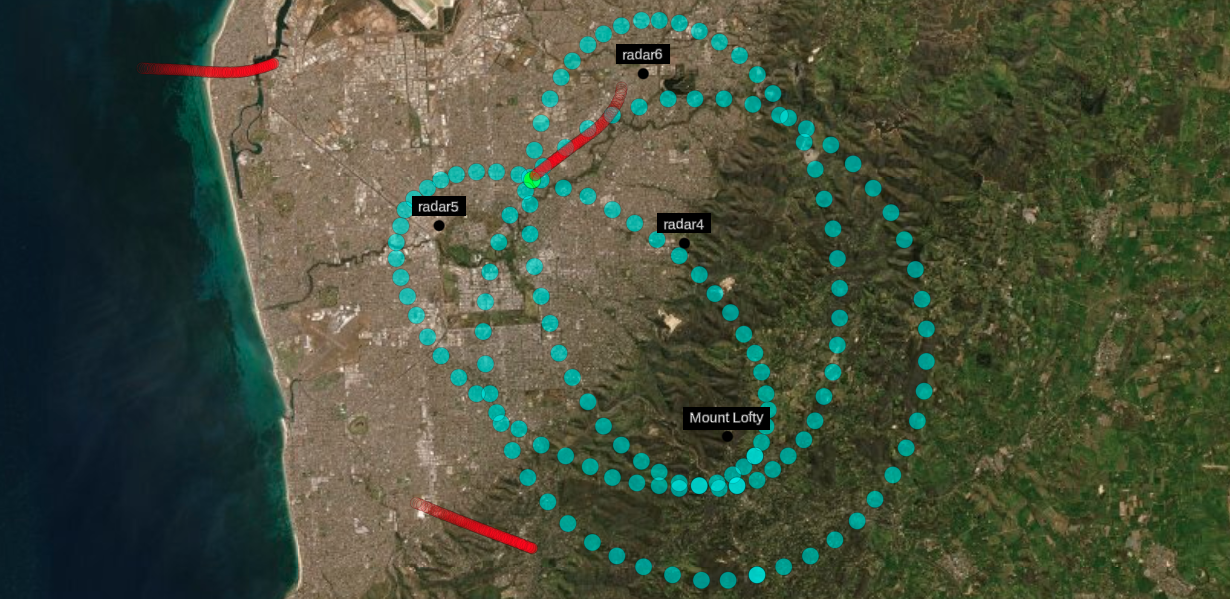
Intersecting Ellipses (Source)
Two ellipses typically intersect at two points, while three will give a single location. This is the fundamental principle: more transmitters of opportunity = better localization.
In a dense urban or suburban environment, there are often dozens of FM stations, TV transmitters, and cell towers illuminating the sky from different directions. A well-designed passive radar system fuses all of these to build a coherent picture of what's moving overhead.
Ulimately, the reason there is increasing interest in passive radar is because it is accessible. No broadcast license, transmitter, and newly inexpensive hardware makes radar available to consumers and businesses in a way that wouldn't be possible only a few years ago.