https://www.sciencedaily.com/releases/2026/03/260329222938.h...
I'm all for removing PFAS and similar chemicals from the many places and uses they aren't needed, but if people don't care about PFAS in their tap water, they certainly aren't going to care about penguin PFAS.
1. Why you/penguins should care about this: PFAS suppress immune function and reduce reproductive success in birds [1]. They transfer from mothers to eggs and disrupt thyroid hormones and immune organ development in avian embryos [2]. In humans, IARC classified PFOA as a Group 1 carcinogen in 2023, which means there is the highest classification (i.e. International Agency for Research on Cancer is convinced PFAS causes cancer). A 2x increase in serum PFAS is associated with a 49% drop in vaccine antibody levels in children [3]. These are the same compounds showing up in >90% of penguin samples in remote Patagonia. They don't break down. They bioaccumulate up the food chain. And the "safer replacements" like GenX are clearly reaching the ends of the earth too. This is bad for penguins and for people.
2. This is a problem I'm taking seriously. My startup, NeutraOat (neutraoat.com) is developing a modified oat fiber that selectively binds PFAS and plasticizers in the GI tract without stripping nutrients like charcoal does. It will also remove PFAS from the blood. Early-stage, binding data is promising. Clinical trial happening in ~6-9 months. Website has our early data and a pre-order signup form.
[1] Vendl et al., "Profiling research on PFAS in wildlife," Ecol Solut Evid, 2024. https://besjournals.onlinelibrary.wiley.com/doi/full/10.1002... [2] Halldin et al., "Developmental exposure to a mixture of PFAAs affects the thyroid hormone system and the bursa of Fabricius in the chicken," Sci Rep, 2019. https://www.nature.com/articles/s41598-019-56200-9 [3] Grandjean et al., JAMA 2012;307(4):391–397. https://pubmed.ncbi.nlm.nih.gov/22274686/
The interesting part here is using the animals as “scientists” to collect samples in their habitats for years (2022-2024) instead of sending humans to collect samples. This is far more reliable in my opinion
Important to correct for, but doesn't invalidate the whole microplastics concern.
People don't? Sounds to me like they need to look at history a bit more.
To me, this looks very much like some of the other magical materials...
Lead in gasoline, asbestos as building material, tobacco etc
You said it removes them from the blood: does the body dump microplastics in the gut for your product to remove them from the blood or how does it work (if you can answer due to proprietary reasons)?
Are saunas and blood donations not also effective for this?
45% of US households contain PFAS, apparently, but no mitigation or even manufacturing bans are required for years.
In the US, one side cries about regular flouride in the water, but is meh to PFAS. Meanwhile, the other side is supposedly pro-environment, but can't even get the fortitude to ban PFAS ski wax.
I definitely agree they need to look at history, consider what they're being exposed to, and understand how simple and easy some of the substitutions/mitigations could be. There's 0 reason why manufacturers are getting 5+ years to phase out a forever chemical in something like ski wax or dental floss.
It's almost like legislators saw that the machines could ostensibly detect 4 parts-per-trillion and decided that should be the limit without continuing to read the machine manual to describe the reduction in accuracy at that threshold level.
The levels in this test were close to this threshold and there was one outlier sample that severely changed the average results. The testing methodology also involved several laboratory steps where contamination could have occurred.
Blood donations are also somewhat effective, saunas less so. Also, to be clear, PFAS are very different from microplastics. PFAS are the Teflon chemical.
Seriously though, amazing idea I love this.
Or stainless steel?
The ideal societal conditions for, say, a petrochemical company that is creating toxins that are genuinely "forever" for all intents and purposes, is a society where people are exhausted from their terrible job (or two jobs, or job + gig economy side hustle) and spend their leisure time glued to their phones, scrolling AI slop on instagram and gambling away their meagre savings on sports betting and prediction markets.
These are not people who are going to get educated about chemistry.
Scientific expertise is derided as elitism. The president lies constantly by issuing "truths" on his social media platform. Public education gets defunded and IQ scores are declining. Either this is just random societal decay, or this is serving the interests of the rich and powerful. I know where I stand on it. And yes, I'm cranky.
> Are saunas and blood donations not also effective for this?
Yes, plasma & blood donations are good at reducing PFAS blood concentration. Some(?) firefighting foam contains PFAS, so they tend to have high blood concentrations. Donations have shown to significantly reduce that: https://pmc.ncbi.nlm.nih.gov/articles/PMC8994130/
Blood donations clearly do.
Microplastics and PFAS aren't synonyms however.
What isn't established is a dose dependant harm from PFAS. Some things are harmful in minute quantities to the point it doesn't matter if you have a lot or a little.
Lead has a clear dose response but a relatively low threshold for noticeable harm. It's not clear what PFAS curve will look like.
I won't restart the linear no threshold flame wars about radiation harm but let's just say it's not always intuitive.
Penguins living along the Patagonian coast of Argentina can serve as living monitors of their environment by using small, chemical-detecting leg bands, according to a study from the University of California, Davis, and the State University of New York at Buffalo.
For the proof-of-concept study, published in the journal Earth: Environmental Sustainability, UC Davis scientists outfitted 54 Magellanic penguins with silicone passive samplers placed gently around their legs for a few days during the 2022-24 breeding seasons. The sensors safely absorbed chemicals from the water, air and surfaces the penguins encountered while the unwitting “toxicologists” foraged to feed their chicks.
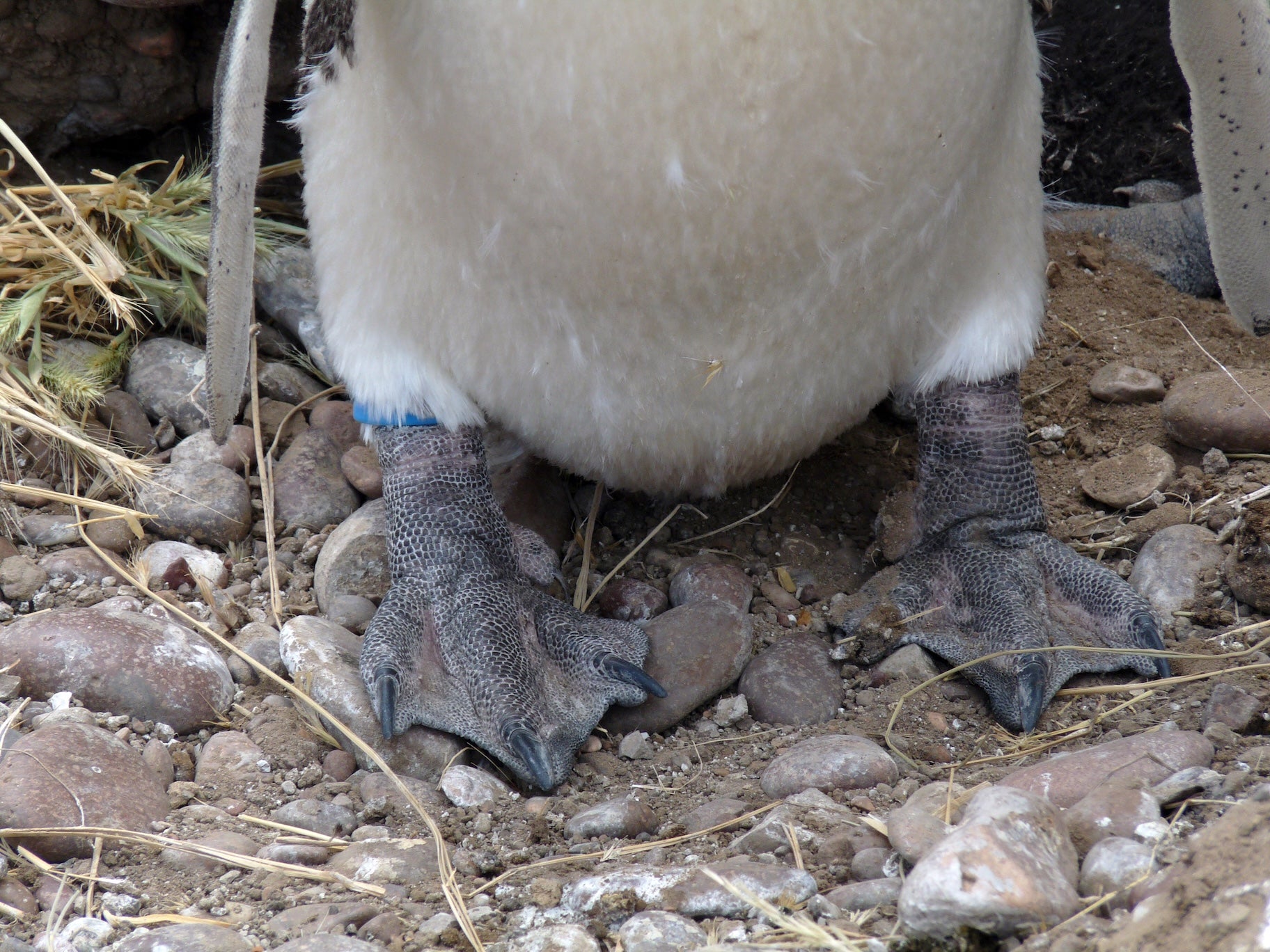
A chemical-sensing, silicone passive sampler is worn as an ankle band on this penguin in Argentina. (Ralph Vanstreels/UC Davis)
Once retrieved, the samplers were sent to University at Buffalo-SUNY for testing, which revealed that per- and polyfluoroalkyl substances (PFAS) — often called “forever chemicals” — were detected in more than 90% of the bands, even in this remote region.
“The only way we’ve had of measuring pollutant exposure in the past is by getting blood samples or feathers,” said co-corresponding author Ralph Vanstreels, a wildlife veterinarian with the Karen C. Drayer Wildlife Health Center within the UC Davis Weill School of Veterinary Medicine. “It’s exciting to have something that is only minimally invasive. The penguins are choosing the sample sites for us and letting us know where it’s important to monitor more deeply. As the animals go about their business, they’re telling us a lot about the environment they’re experiencing.”
An adult Magellanic penguin stands with its chick during breeding season in Argentina. (Ralph Vanstreels/UC Davis)
Testing revealed a mixture of older legacy pollutants, as well as chemicals that replaced phased-out PFAS.
“By using a non‑invasive sampling approach, we were able to detect a shift from legacy PFAS to newer replacement chemicals in the penguins’ environment over time,” said senior author Diana Aga, a SUNY distinguished professor in the Department of Chemistry at University at Buffalo. “The presence of GenX and other replacement PFAS — chemicals typically associated with nearby industrial sources — shows that these compounds are not staying local but are reaching even the most remote ecosystems. This raises important concerns that newer PFAS, despite being designed as safer alternatives, are still persistent enough to spread globally and pose exposure risks to wildlife.”
Researchers deploy a chemical-sensing ankle band on a Magellanic penguin in Argentina. (Ralph Vanstreels/UC Davis)
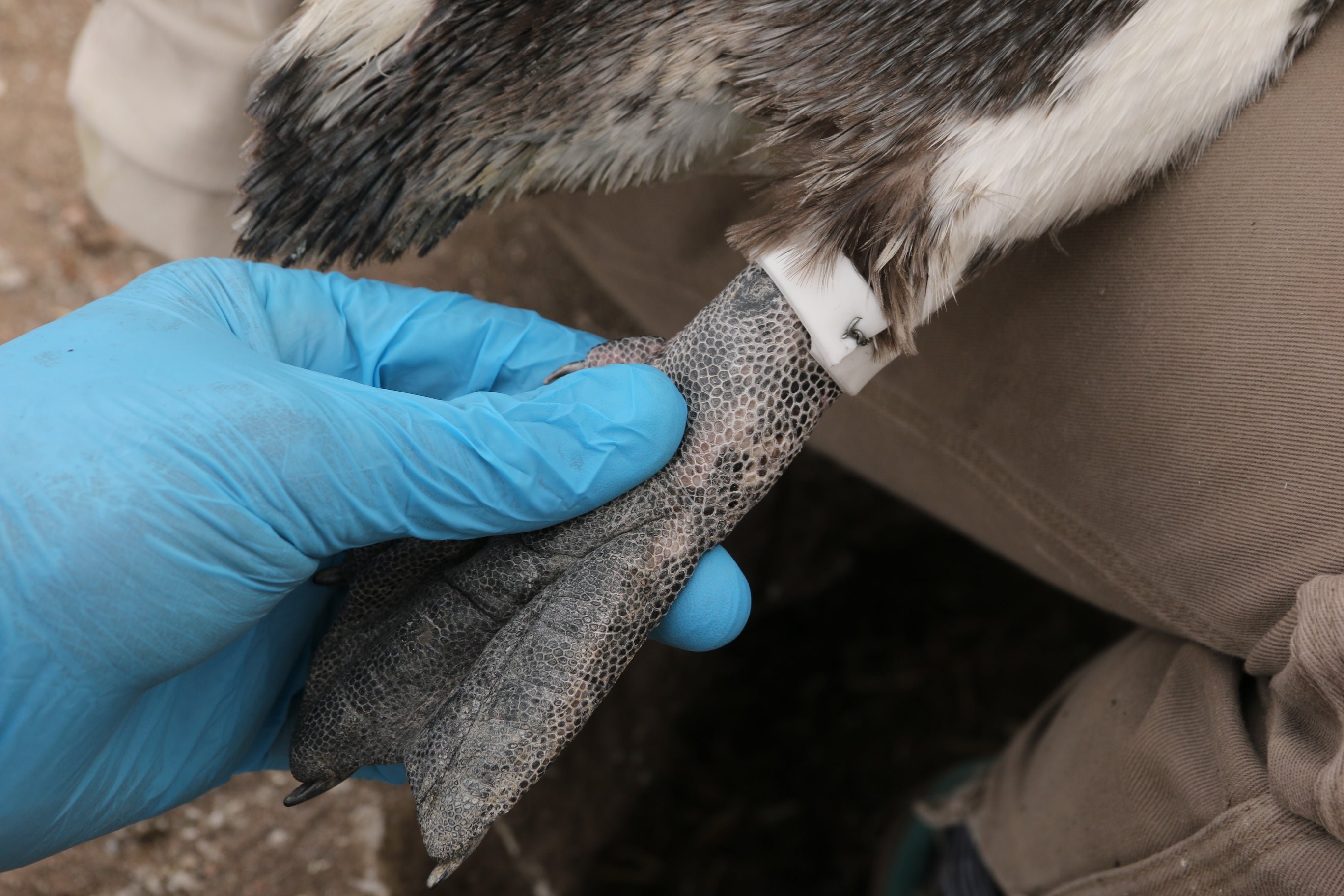
Close-up of a chemical-sensing ankle band, or silicone passive sampler, on a penguin. (Ralph Vanstreels/UC Davis)
The study provides an efficient, practical means of tracking the locations and times of chemical exposure, particularly in hard-to-sample aquatic environments. The authors envision the method being used to identify pollution exposure from oil spills, shipwrecks and other industrial sources.
“Moving forward, we’d like to increase our environmental detectives by expanding to different species,” Vanstreels said, adding that they next plan to test the method on cormorants, which can dive to depths of more than 250 feet.
“By turning penguins into sentinels of their environment, we have a powerful new way to communicate issues relevant for wildlife health and more broadly for the conservation of marine species and our oceans,” said co-author Marcela Uhart, director of the Latin America Program within the UC Davis Karen C. Drayer Wildlife Health Center.
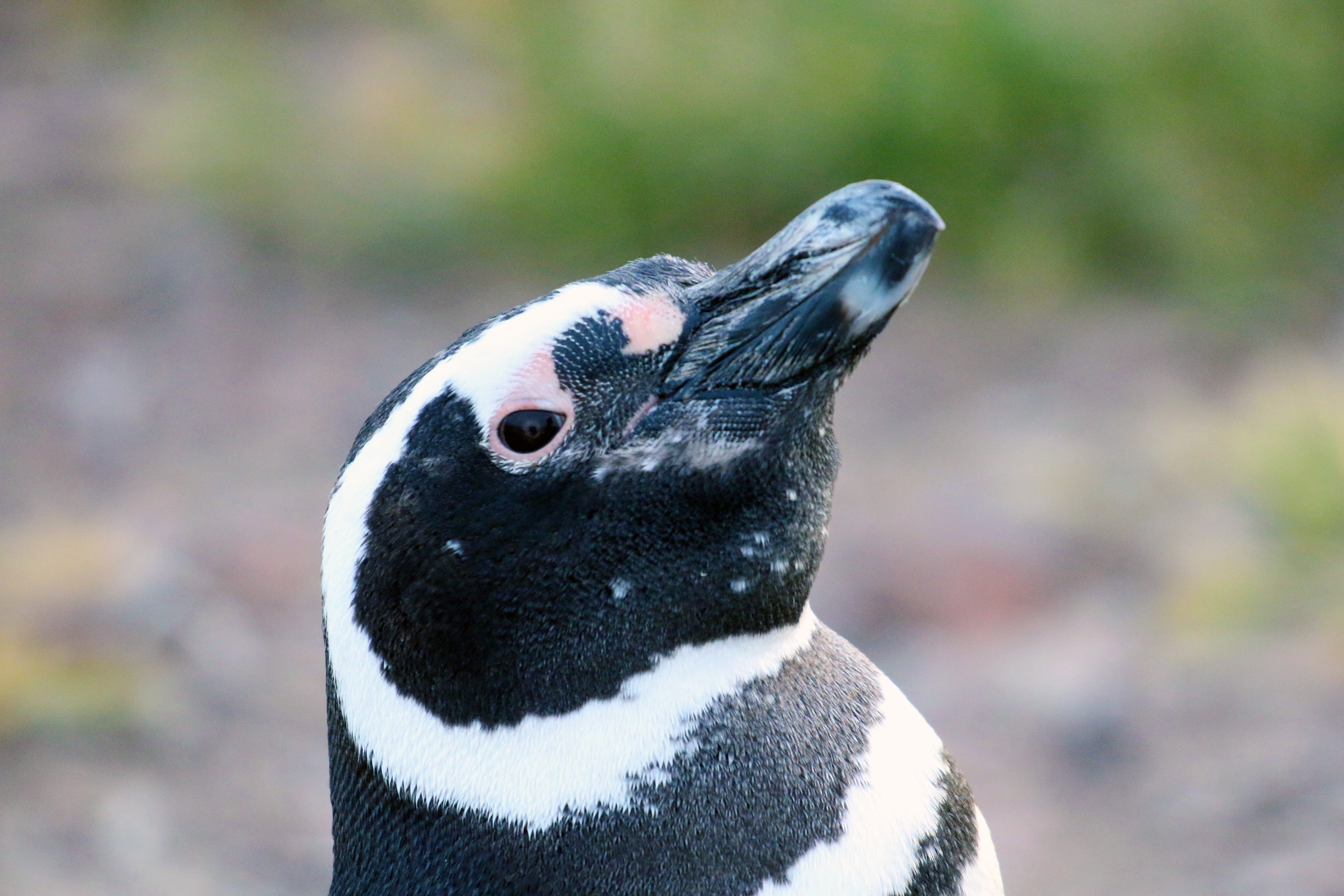
Magellanic penguins, like this one in Argentina, showed that penguins can help monitor their own environments by wearing small, retrievable leg bands that collect information about pollution they encounter. (Ralph Vanstreels/UC Davis)
Additional co-authors include first author Paige Montgomery and Katarzyna Kordas from University at Buffalo-SUNY; and Luciana Gallo, Gabriela Blanco and Flavio Quintana from Consejo Nacional de Investigaciones Científicas y Técnicas in Argentina (CONICET).
The study was funded by the Houston Zoo.
I wonder if there's a safe way to equip people to just do simple bloodletting if they have high exposure to PFAS. I mean obviously it's better to donate, even in that case, given the steady state of most blood banks. But it's still a bit of a pain in the ass.
Teflon is PTFE, which is fully fluorinated but is also very much a plastic: it’s a highly unreactive solid at reasonable temperatures (which sadly do not include temperatures commonly encountered on stoves).
By “the Teflon chemical” are you perhaps referring to the various nasty liquid, water-soluble surfactants commonly used in factories that make or process PTFE? Those include PFOA, PFOS, and the newer and not obviously any safer “GenX” compounds.
They aren't particularly similar.
Honestly, the way the two are conflated is quite annoying. You should be terrified of PFAS. You should be mildly worried about microplastics, mostly because there isn't enough research on the effects yet.
Regardless, the main thing about cast iron is to use it all the time. If you really, truly use cast iron all the time, it will never have food stick to it, you'll never need to "scrub" it. Hot water in the pan, let it sit for 10 seconds, scour with a normal dishes brush or whatever you use, put the pan on the stove, heat till there's no water, hit quickly with an oil spray. Notice i didn't mention soap. It takes EXACTLY the same amount of time as cleaning an older teflon pan, less the heating part. I just look at the heating as sterilization, and i don't worry about it.
I have 3 induction hobs, i switched to 100% cast iron and stainless cookware, and i'm happy. I just got tired of being upset about flakes/damage to my cookware from other people using it. MIL gave me a set of lodge she didn't want, plus i had 3 pans from ages ago that we re-seasoned and started using. Cast iron griddle, cast iron flat weight.
If my arthritis gets so bad i can't lift the pans at all, i might consider carbon steel or something, but i haven't used it yet. I'm better at cooking on cast iron than stainless, but i can make stainless work, too; it's just more hands-on than cast iron or teflon.
I've used peanut, rapeseed, olive, coconut, avocado oils; butter, bacon and other rendered fat. All work fine, although butter i'd put some other oil in with it. I only use avocado, peanut, olive, and bacon, in that order these days because of diet and other concerns.
I'm not into GLPs, but I could see a reasonable case made for supporting them. For most of the past 50K years, we either had to hunt, walk around, farm, split wood etc. which means burning 500+ calories daily. Now, most of us sit in offices 8 hours a day using 0 calories and 0 muscle, surrounded by calories.
It's not surprising really that the default in this situation is obesity.
...which has absolutely nothing to do with the PFOA that you might reasonably be concerned about. Teflon is chemically inert. It's literally used for human body implants. Teflon-coated pans are not your enemy. Fire-fighting foam, on the other hand -- you probably shouldn't bathe in it.
Any test that "detects" teflon in the generic category of "PFAS" is a hopelessly flawed test [1]. Unfortunately, a great many of these papers don't make the distinction, whether intentionally or due to incompetence, or simply because it's far easier to do that, and it gets better headlines.
[1] Important aside: historically, several of the major manufacturers of teflon had problems with PFOA contamination around the factories due to manufacturing processes. This is unrelated to your personal use of a Teflon pan, and also, the process has been changed. If you want to argue that the new process is also polluting, fine, make that argument -- but don't assert that the use of the final product is itself unsafe.
Jesus Christ.
Speaking of which, it occurs to me that my toothbrush is also made of plastic, and that most toothpastes are also mildly abrasive...
Unfortunately, PFAS sticks around forever, so everywhere that the old firefighting foam was deployed (e.g. air force bases) still has high levels of PFAS contamination.
I wouldn't overestimate the quality of this forum. It certainly has its uses, but I wouldn't overstate the quality of discourse here. It's not that great.
Overheat them, which means the stuff gets into the air. Many many pet birds have died of this only because they're more susceptible
Use the wrong material in them meaning the start to scratch the Teflon layer.
I'm not saying you cannot use them right, but too many people don't and the product isn't safe when improperly used. This is true for many products but in this case plenty of people aren't aware they're holding it wrong.
Unfortunately, that is not the case. Yes, Teflon is inert but only when it's not exposed to high temperatures (>350F). When heated, such as in a non-stick pan, Teflon gives off fumes which contain byproducts including breakdowns back into PFAS compounds. So /YES/ the use of the final product (as cookware) /is/ unsafe. NOBODY SHOULD BE USING TEFLON NONSTICK COOKWARE.
In order to reduce contamination in my home's drinking water, I have a whole-home water filtration that's lab certified to NSF 53 standards (and beyond) to remove PFAS, and then for drinking and cooking usages, I further filter water via a 5-stage RO system that's certified to NSF 58 standards (and beyond). Not just drinking/cooking incurs contamination, water is aerosolized and breathed in while showering as an example. I only cook using bare metal; cast iron, carbon steel, stainless steel, glass and ceramic bakeware. Even with these precautions, I still get PFAS exposure just via the foods I eat, and being exposed in the overall environment (e.g. through rainfall).
[1]: https://www.usgs.gov/news/national-news-release/millions-us-... [2]: https://www.ewg.org/interactive-maps/pfas_contamination/
You could just do phlebotomy (blood letting) where your blood is discarded in case you have insanely high PFAS.