“We tend to overestimate the effect of a technology in the short run and underestimate the effect in the long run.” - Amara’s law
I can’t think of a better poster child for this principle than autonomous vehicles.
Back in 2017, when I started working in venture capital, AVs were one of the hottest themes in “tech”. Perhaps this had something to do with Elon Musk proclaiming in December 2015 that Tesla would deliver “full autonomy” within two years. (Musk has earned himself a reputation for repeatedly jumping the gun on this topic.) This frenzy was also fueled by Uber, which was flying high at the time, and talking a big game about self-driving cars. In any case, a substantial share of the tech community was convinced that AVs were right around the corner.
In hindsight, this level of excitement was clearly premature. Tech leaders were generally way too bullish about the prospect for AV commercialization in 2017, and 2018, and 2019 (and 2020, and 2021…) Yet, in the scheme of human history, it turns out that AVs were, in fact, approximately “right around the corner”. AVs are finally real now, and most people I know have not yet fully contended with the transformational potential of this technology.
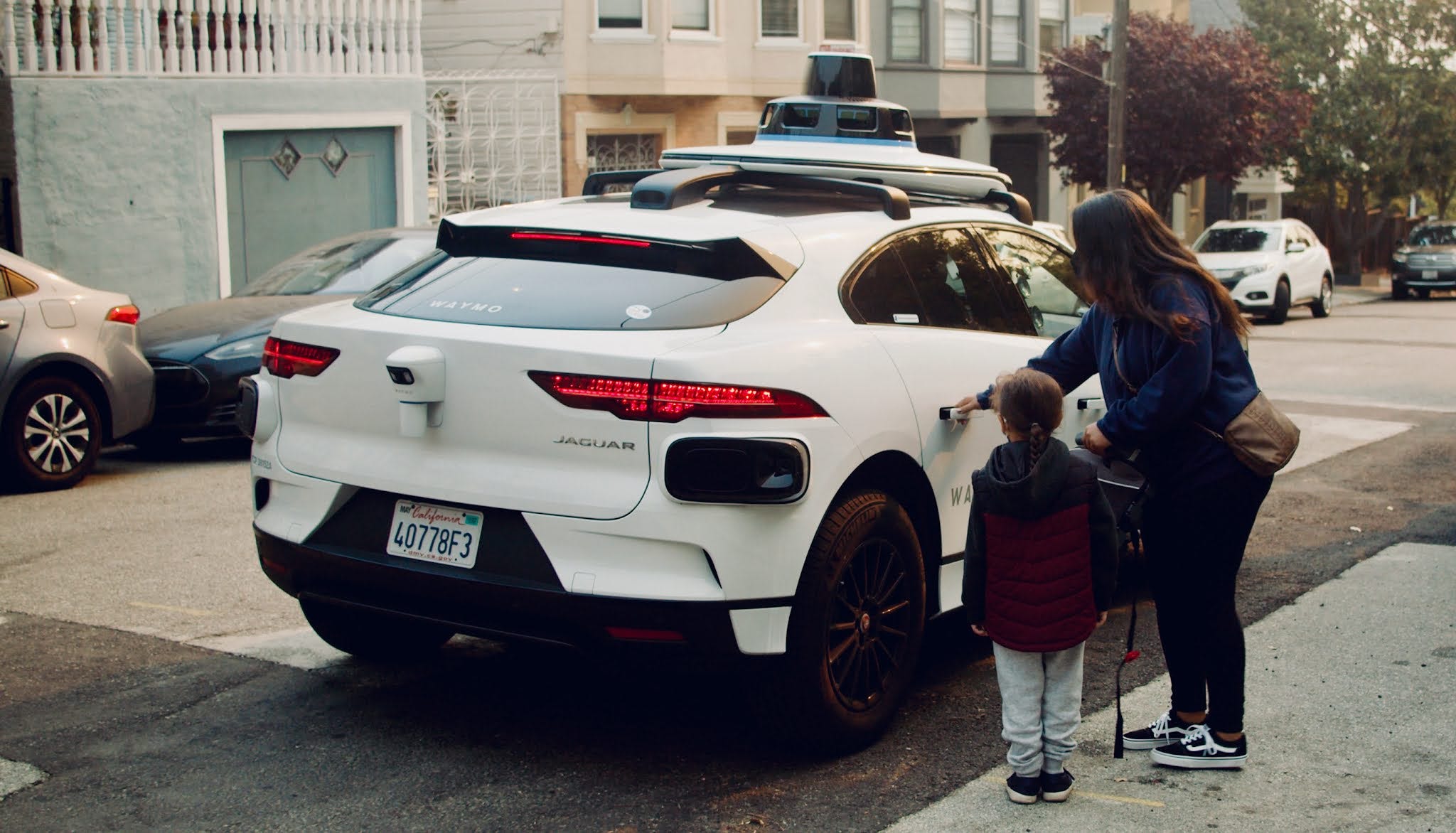
That’s partially because of the way that Waymo, the leading American AV company, has rolled out its services: gradually, and then all at once… one city at a time. This initial approach to the market was driven by the need to train machine learning models on real city streets, and establish a track record of safety in order to earn public acceptance. If you haven’t spent time recently in either of the company’s launch markets — Phoenix or San Francisco — you may not be aware of just how rapidly Waymo has made progress towards both of those objectives.
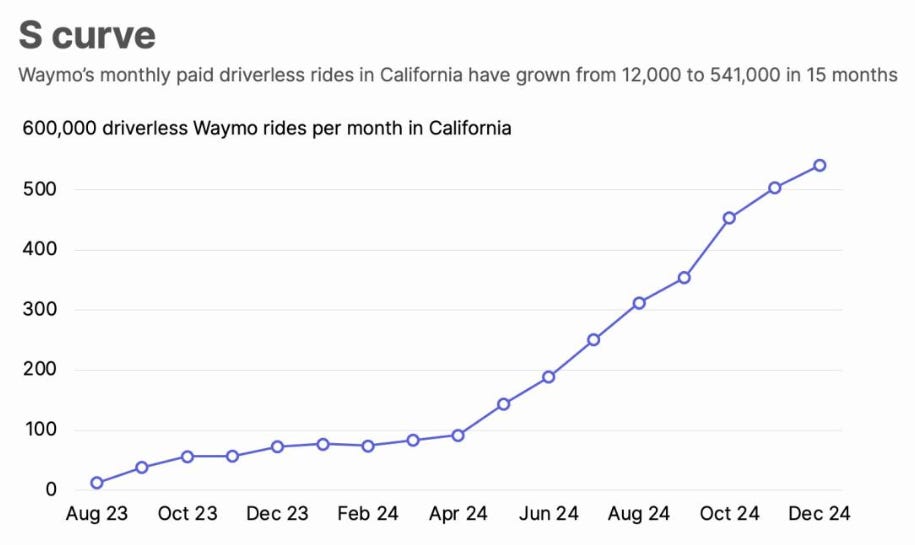
[An update below with some fresh data on the adoption curve, courtesy of the California Public Utility Commission — and thanks to the inimitable Nat Bullard for producing and then directing my attention to this chart…]
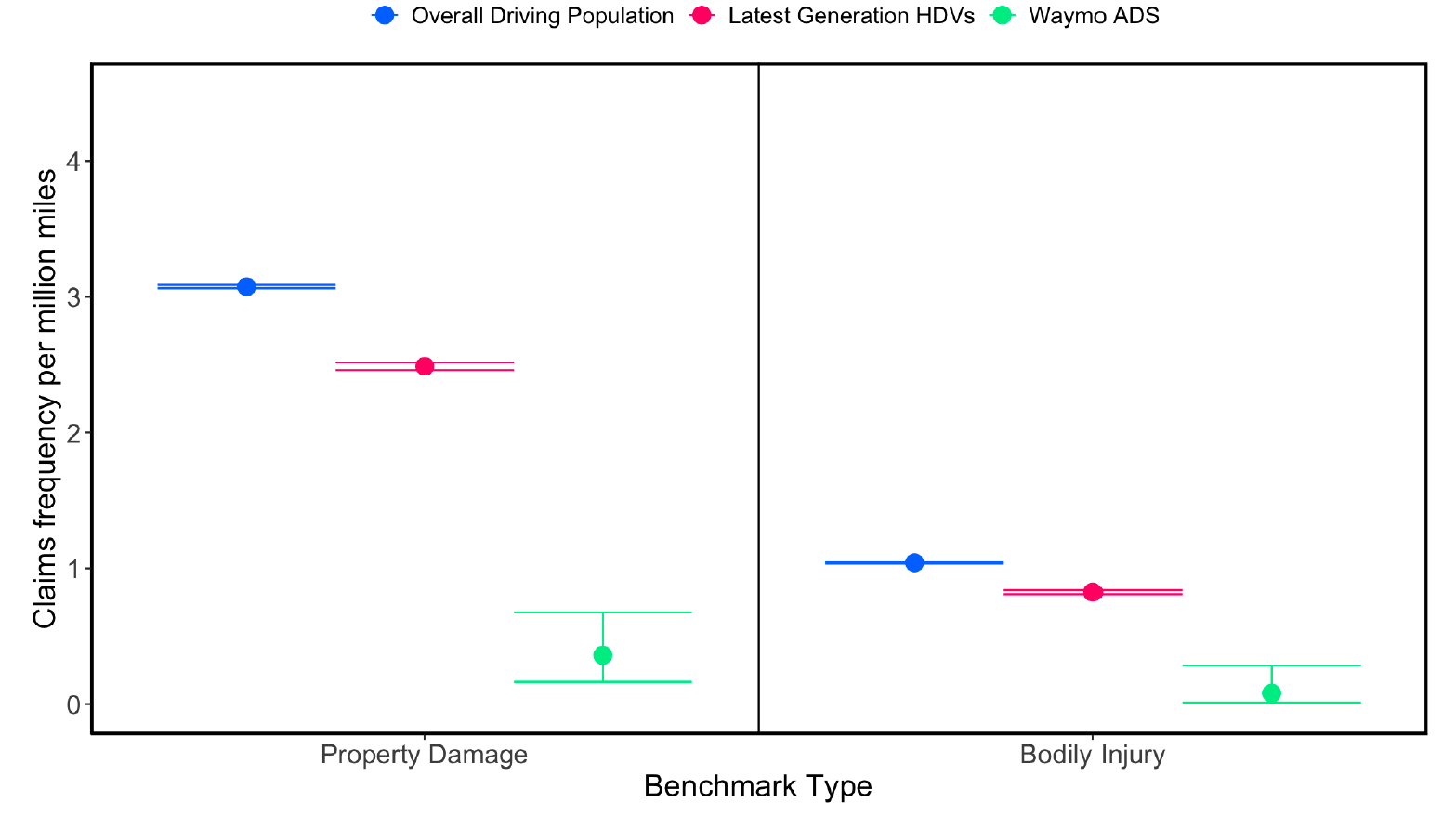
This brings me to a December 2024 study spearheaded by Swiss RE, which analyzed safety data from 25.3 million autonomous vehicle rides by Waymo. This study compares the rate of accidents resulting in significant damage between Waymo’s autonomous vehicles and the “human-driven vehicle” (HDV) population — including an elite subset of HDVs utilizing the latest generation of semi-autonomous safety features.
The upshot? AVs are roughly ten times safer than human drivers, regardless of those extra features. It’s not even close.
The team at Waymo seems to believe that they have crossed the autonomy Rubicon. The company is expanding to more cities — Austin, Atlanta, and Miami — and appears to be ramping up production, as revealed by recent drone footage of the company’s factory in Arizona. There are over 2,000 vehicles mustered on this lot. That’s nearly three times as many vehicles as Waymo has deployed to date!
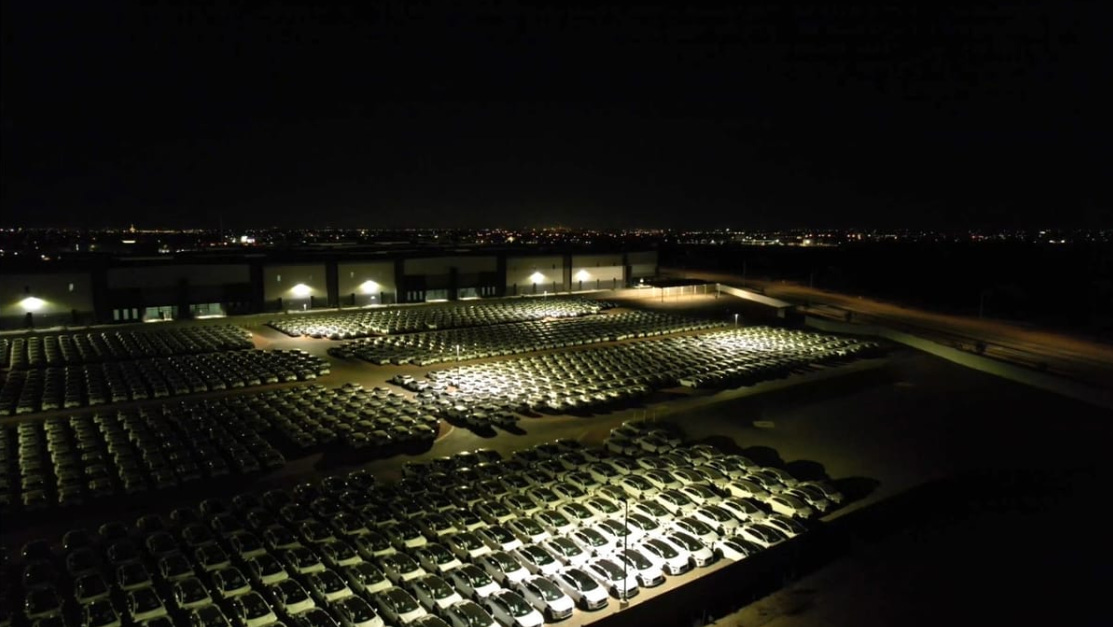
Source: “New Drone Footage of the Waymo Factory in Arizona”, Autonomy Central, Jan 2025.
More vehicles means more training data, which means that performance should continue to improve. It’s true that in each new city the company enters, there does seem to be some degree of fresh model training required — as it takes some time to absorb the idiosyncrasies of unfamiliar alleyways and roundabouts — but the learning curve appears to be largely transferrable. Hence, my bet is that Waymo will reap a substantial advantage from being the first mover in this market, and there’s a chance that the company’s position could become practically unassailable. (Ironically, given Elon’s poor track record in this space, Tesla is still Waymo’s closest competitor.) If there is indeed a winner-take-all (or winner-take-most) dynamic in this market, I’m convinced that AV dominance could be one of the biggest prizes in all of “AI”.
Of course, that depends on economics as much as it depends on technical performance.
Human labor is by far the most expensive input to any kind of taxi or rideshare business, so the economic pitch for autonomous vehicles sounds pretty straightforward: get rid of the driver. Yet, in reality, the story is more complicated, because the equipment required to make a vehicle autonomous is very expensive. For example, Waymo’s 6th generation sensor kit includes 13 cameras, 4 LiDAR units, and 6 radar units. A recent paper from the University of San Francisco added up the total cost of these sensors, plus high performance computing hardware, and other ancillary systems. The result is a total cost estimate of $167,160… but the authors end up concluding that “total vehicle costs are likely $200,000 or more”.
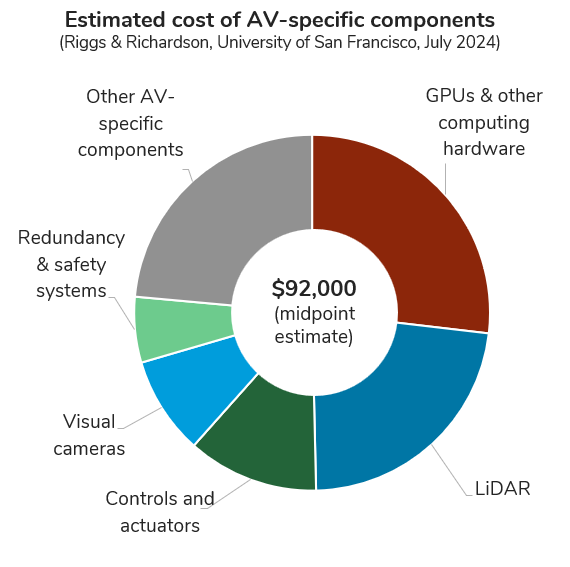
Even at this price point, however, my best estimate is that AVs are already cheaper per mile than taxis or rideshare services. And it doesn’t take a lot of imagination to envision how greater adoption could drive down the cost of key components — especially LiDAR and computing hardware — in a relatively short timeframe. Plus, Waymo is currently rolling out autonomous Jaguar I-PACES, which have a suggested retail price of $73,275… so, there’s definitely some wiggle room in that $200,000 capex estimate.
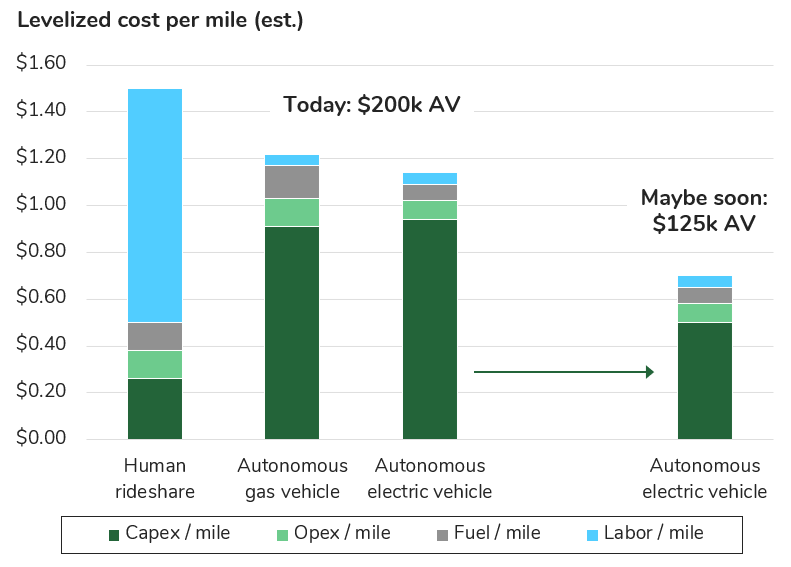
One subtle point that tends to fly below the radar (LiDAR?) in this type of analysis is that autonomy is very favorable for electric vehicles. In fact, Waymo’s entire fleet is already electric, and I strongly doubt this is merely a case of corporate altruism.
Autonomous vehicles are generally going to be high-utilization vehicles. That’s true because they can be, but also because they need to be in order to justify such high capex. This is an ideal scenario for the electric drivetrain, which has lower maintenance and lower energy costs than the internal combustion engine.1 The more a vehicle is utilized, the more these operational advantages matter when it comes to the total cost of ownership. Additionally, all of those expensive sensors and chips which need to be packed into an AV also need to be powered, which compounds the efficiency advantage of going electric. It’s just silly to contemplate running 13 cameras, 4 LiDAR units, 6 radar units and multiple GPUs on an internal combustion engine.
In sum: Pay attention to autonomous vehicles. I think they may be one of the most underappreciated, positive technology stories of our time (although those dang LLMs keep soaking up all the attention) and it’s even more underappreciated how positive this story could be for electrification.
And or more on autonomy — beyond vehicles — check out my prior post on robotics!
EVs have lower energy costs than gasoline or diesel vehicles even in scenarios with relatively high electricity prices — say, 20-30 cents per kWh.
No posts