Also missing is the Killer Ape theory of the sixties which led to the research that chimpanzees have much higher lethal conflict numbers than humans.
Also, this Ngogo group is highly researched, and many many films where made about them.
Kemp had the very anarchist friendly theory that it's states (Goliaths) and / or the conditions that lead to them that lead to violence.
His evidence is most convincing when it's looking at the paleolithic, as h sapiens made its way out of Africa ... but maybe this is not a natural state as they had not yet reached any population limits so migration was always an alternative to conflict?
https://www.goodreads.com/book/show/61662.Shadows_of_Forgott...
That would explain that sort of behaviour as well as our human shenanigans (country/religion/“race”/politics/football team/etc).
Perhaps some groups are biased towards ‘us’ (i.e. more accepting), and other groups are biased towards ‘other’ (i.e. more hostile).
The death of a few key individuals can absolutely remove all the commonality between two groups. Seems to have happened with those chimpanzees, and happens all the time in human groups.
It is sad though that this is happening, on top of all the shit that is going on.
-------------
There's a theory that humans (and likely chimps as well) have a cognitive upper limit to the number of stable relationships they can maintain (i.e. Dunbar's number[1]). Also, there is the idea that most people have nowhere near that many relationships, but some people are super connectors. They know everyone in the community and tie it together, even if the average member of the community doesn't know most other people in it.
It almost sounds like, before the conflict, the tribe was at or a little beyond their "Dunbar's number"[1] and then several of their super-connectors died. Suddenly the community, despite its losses, was too big and not connected enough to remain stable. Minor conflicts arose, individuals started choosing sides, and there wasn't anyone with connections to both sides able to bridge the gap and calm things down.
I'm not a sociologist/anthropologist/etc., so I'm probably woefully misinformed and spewing nonsense here. I'd love to hear what someone up to date on this stuff thinks actually happened.
_______________________
So just like humans, then.
People seem to talk a lot about chimpanzees and their closeness to humans, and comparative behavior, but a lot less is said about the other closest species, the bonobo monkey.
Their society is very peaceful and things like infanticide, a popular pastime in chimpanzee society, is absent among bonobos.
The most notable trait of bonobos is that everyone has sex with every one else, constantly, (almost) regardless of relation, gender or age.
You'd think humans could learn much from such a peaceful species, but most people don't even know they exist.
Now we’re saying that war is just natural. It must be a coincidence.
Personally I feel like the effects of counter-culture are understated in humanity because I think it might drive a lot of human behaviour and its a natural outcome when a grouping grows beyond people's ability to maintain it. Counter-culture also offers a solid explanation for human insanity such as anti-vax which imho makes much more sense couched as:
"I hate that guy and that guy is keen on getting vaccinated, so fuck vaccinations, they're awful".
I would imagine one could find similar outcomes as this study of chimps, in human groupings too, albeit such experimentation would be unethical. Which is why I imagine it will eventually become a reality show someday: Lets play 400 friends or 200 enemies! Day 4: lets reduce the available food by 50% and see what happens... etc, etc.
I haven't kept up with biology for years and don't know what the current consensus on the topic is but it's interesting to consider if some environments naturally promote the unlucky inhabitants to harm each other.
I noticed there was a respiratory epidemic that killed 25 chimps naturally quickly, one would imagine that would have quite a societal destabilizing impact?
To the extent that they have good memory, they live in a world of finite resources, and their behavior was shaped by the forces of game theory as applied to tribes, this is more or less inevitable. You can read that as defeatism or just math. We can't overcome the force of game theory, but we can make it work for us by making our transactions increasingly transparent and repeatable, so that cooperation is more successful than defection.
Where have I seen this before.. Think.. Think..
That's a weird thing to say. Studies of primitive tribes showed decades ago that they only seem to fight each other for a handful of reasons. Religion, ethnicity and political beliefs aren't among them. Fighting over resources, women and blood feuds are.
Supposedly academic anthropology had difficulties accepting these findings, especially the Yamomamö studies by Chagnon where he documented them going to war to steal each other's women, as it contradicted the popular idea of the noble savage.
a) Chimpanzees going to war. b) Humans ending humans.
Both is presently in the making, if one looks at the geopolitical scale and looks at damage caused by drones; a) is probably not yet full scale. Chimpanzees may be better diplomats than humans.
sometimes I feel like that at work
edit: I'm rate-limited, so here's my answer to your comment of:
> I remember watching a nature documentary many years ago with exactly that scenario. The original group killed all the splitters.
Yeah, you're right. You probably remember this: https://en.wikipedia.org/wiki/Gombe_Chimpanzee_War
It does seem like a very similar scenario, so now I'm confused.
Central Ngogo has complained that every time it's tried to democratically elect a leader, that leader had been overthrown by Western Ngogo—creating an environment that is hostile to anyone other than WN having a so-called "democracy". CN has also criticized WN as ultimately just being "oligarchy with extra steps" and creating an empire that requires the subjugation of CN.
Convincing someone to go kill other people so you can get their stuff is a lot harder. You have to get creative with the reasons, and even then you had better be giving those fighters their cut unless you've really managed to get them fully committed to whatever excuse to made up. It helps a lot if there is some kind of wedge issue you can exploit, which is where religion and ethnicity come in handy.
We've known for decades that chimpanzees go to war, and during that war will happily slaughter each other.
Why is it weird? Religion, ethnicity and political beliefs are argued all the time, even here on HN, as the reason for why shit happens.
Also, what is a "blood feud" in the primates? Chimps seeking revenge for the murder of another Chimp? Why was the first Chimp killed then? I think "blood feud" is a good start, but why? The paper sort of explores possible reasons.
> Supposedly academic anthropology had difficulties accepting these findings, especially the Yamomamö studies by Chagnon where he documented them going to war to steal each other's women, as it contradicted the popular idea of the noble savage.
I don't know what you mean, the "noble savage" is a discredited racist trope. Chagnon is worth considering but surely you're aware of the academic criticism of his work and methods? It wasn't because of the "noble savage", that would be a lazy dismissal of the criticism. He didn't have the final word on the topic.
Animals have inner lives as well. They have their own thoughts and feelings. And sometimes those feelings are anger and their thought is to kick the shit out of those assholes over there.
Fuck man, my cats occasionally scrap with each other. I know it's not anything they've learned from the people in my house because we don't go full Wrestlemania on each other.
1. When competing for resources, killing your neighbour frees up resources, which you can take. Most species of animal and even plants do this to some extent.
2. By collaborating in a group, you can achieve more than individuals acting alone. This is the idea behind teams, companies, countries, etc.
Combine the two ideas, and you get war.
Edit : I just read the paper and the discussion does a good job at laying out the entire landscape that contributed to the disruption. Pretty fascinating but also totally explainable due to the circumstances explained, which in and of itself is wildly fascinating!
If anything, I'd say plants do it more. Everything in the garden is trying to kill everything else.
Lions murdering prey to eat is a stable equilibrium.
Primates fighting each other is not.
Murdering for acquisition of a resource is short term advantage.
We are strongly, strongly evolutionary oriented away from 'murder' - it's the original sin. It's not something we even argue over. Murder = Bad. No disagreement across cultures. Murder = social cheating. No disagreement there either.
Or put another way - the 'self' can gain advantage with murder, but the group and species probably will pay for it long term.
I wonder if there are just things that species really have to learn over and over, particularly things like 'active deconfliction' etc..
We have more than enough resources to go around for 10 billion people.
The limiting factor is in intelligence and dexterity. In other words, we get richer when we are more.
I don't think it's that straightforward. War is usually extremely wasteful for all involved, even the victor. Plus it puts the whole group at risk, if it spirals out of control.
In species where a prominent male has a harem of multiple females. This usually involves killing not only rival males, but all of their offspring too. Here's a Wikipedia article about it: https://en.wikipedia.org/wiki/Infanticide_(zoology)
In species which keep territories, animals will kill rivals of the same species, but because it's not targeted it's not genocidal, unless the species eusocial, in which case it can result in massive genocidal wars, e.g. https://en.wikipedia.org/w/index.php?title=War_in_ants
Numbers 31.17-18
And I genuinely believe blaming things on social media and news is just a diversion so we wouldn't look at the main issue.
there were several seemingly destabilizing factors, sort of a perfect storm, each contributing to further disconnect and polarization.
the group grew too large (and displaced other groups), but then ended competing for the best food among themselves, and having trouble socializing and bonding in such a large group.
subgroups forming, first fluid but eventually creating a split
loss of older alpha males exacerbating competition between males
loss of the few individuals that still maintained some relationship with the other group (the last one doing so actually died in that epidemic while the split was already well underway)
it is indeed an amazing read. my take away is that the root cause was mainly the group becoming too large, this affected socialization and cohesion, and thus the group was unable to cope with everything that came after.
A plant that killed all offshoots of itself would not survive. But plants much more often make perfect genetic copies than animals do, so the selfish gene can explain this behavior
Inside their territory, they will attempt to kill any other predator who could compete with them and who belongs to a weaker species. This is a necessary strategy, because any territory has a limited productivity and it cannot sustain too many predators that want to eat the same kind of prey. Thus predators either specialize into separate niches, e.g. some eat mice, some eat rabbits and some eat deer, or they kill each other if they want the same food, to eliminate the competition.
They will also attempt to repel outside their territory any predator of the same species with them. They will seldom attempt to actually kill a predator of their own species, but that mainly because this would be risky, as in a fight to death they could be killed themselves, so ritualized harmless fights are preferred.
The difference with some primates like chimpanzees and humans, is that competitors of the same species may be treated as other predators treat only predators from different, weaker species.
The reason might be that when you cooperate within a bigger team, you may have the same advantage against competitors that a stronger predator has against a weaker predator, e.g. a wolf against a fox.
Thus a fight to death may be chosen, because the bigger team has good chances to win the fight. So chimpanzees start wars for the same reason why Russia attacks Ukraine or USA attacks Iran, those who have more weapons and more money believe that they can win the war, so they start it.
Most other predators do not start wars against their own kind, because in a balanced fight the winner is unpredictable.
The idea of sin is designed to fix less than ideal human tendencies. If anything, this being the biggest sin means murder is the most inherent bad trait of humans.
Very strong statement given the massive killing of kettle and poultry per second.
Also given all the wars including those currently raging - I think is rather untrue.
Besides the killing a lion does is not over resources, it’s the resource itself.
We could hardly eat a fraction of what we eat today if we hadn't teamed up with microbes.
I think the distinction is between killing a line and killing a tribe. But granted, that’s valid.
(It also features a very amusing photo at the top that makes it look like the subject is the biologist Robert Sapolsky.)
The talking points that were ascendent in the Tea Party era to 2016, and are still ascendent today, were honed at that time in that sphere. Limbaugh said words 30-40 years ago that breathed life into a reactionary movement 20 years later and shaped its theory.
You can keep following the thread back, but I think this form of weaponized aggrievement took its shape at that time, its literal memes were potent and virulent back then, they just needed the right environment to really spread.
An alternative view is that in groups with alphas that father most offspring, and status is based on the individual's ability to risk death. Genes in an individual of low status are already 'dead' so manufacturing instincts and hormonal responses that increase violence does not have a downside.
I guess dying because you think you’re going to impress’s a mate and stay alive is quite common.
Further, murder may be restricted to the killing of publicly acknowledged members of the public "friend" group, i.e. citizens, while the killing of outsiders living with the "friend" group, like slaves, is considered something else in the law.
When we codify morals as laws, we usually make a heavy and deliberate distinction between private and public, and between citizen and non-citizen. This is probably related to the nature of a social animal.
Just to use your own example https://en.wikipedia.org/wiki/Mapogo_lion_coalition
There are plenty of people who advocate for war and consider it good, and plenty of disagreements over war.
People are usually in agreement that war / killing is bad when other people do it but will find all sorts of ways to justify themselves doing it when it is to their advantage. This isn't really contradictory, from an evolutionary perspective.
That's not a given. Look at the Old Testament, it professes that you shall not kill, but is also full of laws that are upheld by death, stories of just killings, etc and the whole thing is written via dictation from a war god.
In cultures where honor is a big thing, it can be seen as just to kill those who bring dishonor or to maintain honor.
In cultures where purity/cleanliness is a big thing, it can be seen as just to kill those who are impure/unclean.
Not as simple as murder bad
I watched the entire 4-part documentary and loved it. In general the series gives you a raw look into the a-b-c's of primate politics. Chimps just like us and the rest of our ape cousins are preoccupied with hierarchy, status and accumulation of resources which guides every single action they take from birth until death.
What is different about Chimp Empire is that it is presented in a much more compelling way relative to the standard (dry) academic literature or popular science texts (i.e. Chimpanzee Politics by Frans De Waal).
Even after finishing the documentary I've found myself connecting events in the series with current geopolitcal issues. One event in the show that stuck out to me was a battle between two rival camps over a single fruit tree. Gaining control over that tree was a critical factor in determining the survival of the two rival groups. To us, post neolithic age and industrial revolution, it's an amusing watch. But to chimps, a single fruit tree in their territory is everything. It is life and death. While there's a difference in scale, the same underlying motivations - in my mind - currently explain what is going in the middle east and eastern europe.
Also, the documentary is great case study in how, loneliness and introversion can be absolutely lethal in the wild. The politics in each Chimp community can get quite toxic but participation isn't really optional. You either play the game or quite literally die.
If you really want a good intellectual exercise, I recommend watching Chimp Empire in its entirety and then The Expanse right after. Try to tell me they are not the same show :P
Game theory isn't a force. It's just one way of modeling behavior through one sense of rationality, and it rarely maps neatly onto actual human behavior.
Note that the conclusions of the paper, while acknowledging the problem of access to resources, are different. They also do not conclude that this is "more or less inevitable":
> The lethal aggression that followed the fission at Ngogo informs models of intergroup conflict. All observed attacks were initiated by the numerically smaller Western group, contradicting simple imbalance-of-power models that predict an advantage for larger groups. Persistent offensive success by Western males suggests that cohesion supported by enduring relationships can outweigh numeric disadvantage. Our observations are also relevant for predictions from parochial altruism. Because cohesion among the Western cluster preceded overt hostility, external threats may be unnecessary to foster cooperation. Cohesion among members of the wider Ngogo group, however, may have weakened when external threats from adjacent groups decreased after territorial expansion in 2009.
and
> This study encourages a reevaluation of current models of human collective violence. If chimpanzee groups can polarize, split, and engage in lethal aggression without human-type cultural markers, then relational dynamics may play a larger causal role in human conflict than often assumed. Cultural traits remain essential for large-scale cooperation, but many conflicts may originate in the breakdown of interpersonal relationships rather than in entrenched ethnic or ideological divisions. It is tempting to attribute polarization and war that occur in humans today to ethnic, religious, or political divisions. Focusing entirely on these cultural factors, however, overlooks social processes that shape human behavior—processes also present in one of our closest animal relatives. In some cases, it may be in the small, daily acts of reconciliation and reunion between individuals that we find opportunities for peace.
Which sounds kinda hopeful!
My own observations is that the preconditions for the split that led to open warfare between the two Chimp groups was:
1. The nonviolent (illness) death of a few key individuals that linked both groups, and...
2. The complete stop of interbreeding. Once the two groups stopped interbreeding, the split was finalized and they became truly hostile.
Stretching this a bit, it makes me think of those (usually white supremacists) who claim "multiculturalism" is to blame for all the world's problems, and if only every ethnic or religious group stayed in their lane and didn't mix with the other, we could all live in peace. But it seems to me the lesson from this paper is that this (isolating us in separate groups) would make the split complete enough that we would decisively start butchering each other.
But to comment on your point: species DO pay for it in the long term when members murder or teratorialism.
Lions are not cannibals. Some lions are cannibals. A successful group of lions cannibals existing (and what a brutal and awesome-in-the-biblical-sense story it is!) does not mean that it pays for the lion species as a whole to have groups of cannibals existing.
In fact, I could only see the “proliferation of groups like this committing atrocities” reach a tipping point for a species - not murdering when this murdering happens will make you cease to exist. So if the species doesn’t have a reason to reach the extreme where this NEVER happens, then it will quickly reach the point where this ALWAYS happens
And it's all roughly consistent.
Arbitrary murder is always 'wrong' across cultures.
Self defence is almost always considered reasonable and a form of justification.
Even basic cultures developed sense of 'justice' as retribution or punishment.
It gets a bit more complicated in terms of organized violence, but even there, it's generally always considered moral in the posture of defence, just as it were a single person defending themselves.
For other things, it's more complicated.
And of course 'war parties' and 'arbitrary retribution' has always been there, aka 'they slighted us, we harm them' absent true moral justification. That's always been problematic, admittedly.
Also "and the whole thing is written via dictation from a war god." this is not an appropriate assertion (not nice or welcome)
There is enough food to feed everybody.
> we suggest that infanticide is a sexually selected behaviour in killer whales that could provide subsequent mating opportunities for the infanticidal male and thereby provide inclusive fitness benefits for his mother.
I can see gene fitness benefit but mating opportunities, how?
"hey, me and maman uh killed your baby, wanna pump out a replacement real quick?"
Shared social structures and behaviors can last through much longer periods of time than 8 million years. For example take bees and ants sharing a common ancestor in the 100 of millions of years age.
based on my memory of readings in the matter I don't think so, most animal species "impress a mate" is either
1. do mating ritual better than others
2. actually directly compete with rival who has mate to win mate.
In the second more rare scenario the actually directly compete with rival tends to be very ritualized, and thus when you lose you don't actually get significantly hurt.
In the ritualized combat for mates some species have evolved to points in which accidents become a major problem, for example Stags locking antlers in combat for does.
Obviously this is a scenario where you want to impress and stay alive but it doesn't work out, but it is relatively rare in the species that has evolved antlers to the point where it happens, and it is rare for species to have similar problems, generally the one who loses these competitions does not die, they just assume a lower status.
So all that said the human tactic of Bob, hold my beer while I impress Cindy by riding this croc, is a pretty rare tactic for getting a mate.
'Murder' is nearly a universally negative social concept.
There zero cultures wherein arbitrary killing is considered acceptable
> But it seems to me the lesson from this paper is that this (isolating us in separate groups) would make the split complete enough that we would decisively start butchering each other.
of course, and historically we can see that from the past 300 years leading up to ww1 and ww2; every empire was in it for themselves and very nationalistic, mercantilism ruled the day, and lots of crazy theories such as phrenology and eugenics started to appear leading to all kinds of atrocities...If you want to convince somebody who actually seeks truth, you have to make an argument how any country who has started a war recently has had a net economic profit.
Does it? I don't think reproduction is very influenced by game theory.
If they frequently had great people step in, we'd just produce them artificially all the time.
If the only place a particularly beneficial mutation appears is wiped out by chance volcanic eruption, that's just how it is - the survivors who weren't near the volcano go on to reproduce.
1 day ago
Hafsa Khalil

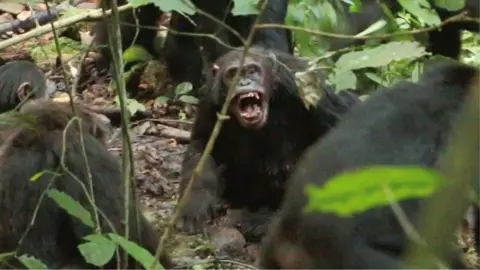
Aaron Sandel via Reuters
This shows adult male chimpanzees of one group attacking a male chimpanzee of another group in 2019
The world's largest known group of wild chimpanzees has split and been locked in a vicious "civil war" for the last eight years, according to researchers.
It is not clear exactly why the once close-knit community of Ngogo chimpanzees at Uganda's Kibale National Park are at loggerheads, but since 2018 the scientists have recorded 24 killings, including 17 infants.
"These were chimps that would hold hands," lead author Aaron Sandel said. "Now they're trying to kill each other."
Sandel, an anthropologist from the University of Texas in the US, and co-director of the Ngogo Chimpanzee Project, says chimpanzees are "very territorial", and have "hostile interactions with those from other groups".
"[It's] like a fear of strangers," he told the Science podcast.
But over several decades, Sandel said the nearly 200 Ngogo chimpanzees had lived in harmony.
There were divided into two sets - known to researchers as Western and Central - but they had existed overall as a cohesive group.
Sandel said he first noticed them polarising in June 2015, when the Western chimpanzees ran away and were chased by the Central group.
"Chimpanzees are sort of melodramatic," he said, explaining that following arguments there would ordinarily be "screaming and chasing" and then later, they would grooming and co-operating.
But following the 2015 dispute, the researchers saw that there was a six-week avoidance period between the two sets, with interactions becoming more infrequent.
When they did occur, Sandel said they were "a little more intense, a little more aggressive".
Following the emergence of the two distinct groups in 2018, members of the Western group started attacking the Central chimpanzees.
In 24 targeted attacks since the split, at least seven adult males and 17 infants from the Central chimps have been killed, the study found, although the researchers believe the actual number of deaths are higher.
The researchers believe many factors such as the group size and subsequent competition of resources, and "male-male competition" for reproducing may be to blame.
But they say there were three likely catalysts:
Sandel and his colleagues said their findings encourage people to rethink what they know of human conflict and warfare.
"In the case of the Ngogo fission, individuals who lived, fed, groomed and patrolled together for years became targets of lethal attacks on the basis of their new group membership," they wrote in the paper.
If chimpanzees - one of the species closest to humans genetically - could do so without human constructs of religion, ethnicity and political beliefs, then "relational dynamics may play a larger causal role in human conflict than often assumed", they added.
James Brooks, a researcher at the German Primate Center in Germany, said it was a "reminder of the danger that group divisions can present to human societies".
Commenting on the study in Science, he wrote: "Humans must learn from studying the group-based behaviour of other species, both in war and at peace, while remembering that their evolutionary past does not determine their future."
You may also be interested in:

Getty Images/BBC
BBC Africa podcasts
> In evolution the survivors reproduced, and that includes 100% of our ancestors.