Bring on Artemis III and IV!
control: "i guess we'll have to go back".
(paraphrased from memory)
Missaved their version 2 Excel spreadsheet using the wrong file name causing confusion about this version was the latest.
Nearly missed a cell in their burn sheet had multiple lines of text until mission control reminded them to resize the cell.
This is not sarcastic. This is very much meant. I love that America does this. We still get to evoke an awe which previous empires awesome as they may be, could never match. American superlatives are amazing. God bless America
It's worth pointing out that this is the first extremely public, widely acknowledged high risk mission NASA has done in over 50 years. The Shuttle was risky, but it wasn't thought of or acknowledged by NASA as being risky until very late in its lifecycle.
According to NASA's OIG, Artemis acceptable crew mortality rate is 1 in 30. Roughly 3x riskier than the shuttle. There genuinely is a world where they don't make it back home.
I am grateful that they did. And I'm grateful that we're going to go even further. I can't wait to see what Jared's cooking up (for those who don't know, he made his own version of the Gemini program in Polaris and funded it out of pocket).
Probably the rose tinted glasses of being a child but being from Florida I always had a sense of amazement and wonder as I heard the sonic boom of the shuttle returning to earth.
Really felt like I was coexisting in this incredible scientific powerhouse of a country full of bright and enabled peoples that knew how to prioritize curiosity and innovation.
Feeling like a bit of a "vibe" post which is everything wrong lately but I can't help but feel some satisfaction that we're still able to accomplish something like this in our space endeavors.
It all boils down to equations that describe the world accurately, and a way of experimentation, iteration, thinking that gets us all the way to do something this unbelievably complex.
Glad they got home safe and sound!
Also, what were these puffs on thermal camera after the main chutes were deployed?
How did they arrive at that number?
(Eg. Did they arbitrily establish the target at the outset? Or did it evolve by gauging the projected failure rate of their core mechanical etc. systems as those began to take shape, then establishing a universal minimum in line with that, to achieve some level of uniformity and avoid drastically under/over-engineering subsequent systems?)
They understood it to be extremely risky immediately. They understood the ice issue early on as evidenced by the fact that they completely changed the coating on the external fuel tank to try to compensate for it. They also added ice bridges and other features to the launch pad to try to diminish the risk. They also planned for in orbit heat shield tile repair. They specifically chose the glue to be compatible with total vacuum conditions so they could actually detach and rebond a whole tile if necessary. They developed a complicated and, unfortunately wrong, computer model to estimate the damage potential of ice strikes to the heat shield tiles. What they _finally_ came to understand was that you just have to swing the arm out on orbit and take high resolution pictures of the vehicle to properly assess it's condition.
NASA was and always is very bad at calculating systemic risk. They have the right people developing risk profiles for individual components but they've never had the understanding at the management level of how to assess them as a complete vehicle in the context of any given mission.
> Roughly 3x riskier than the shuttle.
The huge advantage they now have is a capable launch escape system which can possibly jettison them away from the rocket should any issues arise during ascent. That was the one thing the shuttle could not possibly integrate.
On the other hand they could take a far larger crew to orbit and maintain them comfortably for several weeks during the mission. The "space bus" generated a healthy 21kW from it's fuel cells and created so much water that you had to periodically dump it overboard. This was a blessing for the ISS because you could bag up all that excess water and transfer it for long term use.
Anyways.. as you can tell.. I just really loved the shuttle. It was a great vehicle that was ultimately too exceedingly tricky to manage safely.
This current administration has made sure these things never happen again, Artemis is very much the swan song of an America that has died. I am not interested in watching our corpse twitch and calling it life.
Bravo, Artemis team for an exceptional return to extra-orbital space travel.
For reference the shuttle generally reentered at ~17.5K mph, and today's was 24K-25K mph.
It's not clear that we could build a craft with wings that could survive that. So then you're looking at adding fuel just to slow down, plus fuel for the weight of the wings themselves, plus fuel to carry all this extra fuel to the right place, etc.
Splashdown-style landings are the simplest and safest, parachutes are always good but adding water makes for another layer of safety (and of risk, to be fair, it could sink).
With lunar landing flights they would still have to choose 4 days before, as long as they do direct return.
Eventually you want to break to Earth orbit (propulsively or aerodynamically) and board a dedidacted craft for landing. But till then water landing capsules work.
Space Planes are not only much more dangerous, but are not ideal for this type of mission. They carry a lot of extra weight (wings) that would affect how much fuel is needed to launch them to the Moon.
Capsules are safer and more lean in terms of weight.
The Shuttle was not ideal in many ways. It was used so long not because it was the best option, but because Congress wanted it to keep it going for jobs.
A small Apollo-style capsule that parachutes into the ocean has a simpler mission profile, which allows for simpler technical and operational requirements, which in turn reduces program cost.
These days the only qualification required for people believing anything you say is to have a blog and strong critical opinions about $AUTHORITY. Software engineers somehow believe they are knowledgeable in any topic just because they spend a lot of time reading on the Internet.
This seems insane to me. That X decades later we accept, with all our advancements in tech, a weaker system than ever before. That if we send 30 people we _accept_ that one is possible to die.
That's the starting point? That's what we document as acceptable?
Do you have a link? I’m asking because it is very easy to make mistakes when comparing risks. For example https://news.ycombinator.com/item?id=47725961 translates that into “That if we send 30 people we _accept_ that one is possible to die.” If that interpretation is correct, given Artemis has a crew of four, that looks more like a 1:120 chance of a mortality of 4. I think that would make it an improvement over the space shuttle.
I think that audio stream was designed to be POTUS safe.
So with 4 crew members, chance of one dying was 13%! Very lucky they all survived.
(Some would snidely say as long as they don't put seven people on the rocket they'll be fine.)
There are reasons to think Artemis is safer. It has a launch abort system that the shuttle lacked. Reentry should also be much safer under Artemis; the capsule is a much simpler object to protect.
It's becoming a public hazard, we must act!
The reason the heat shield failed was due to gas buildup inside the ablative material. This was due to the skip reentry profile they used, where the craft does a single skip (as in skipping stones) during reentry. The high bounce caused the shield to be heated enough that the heat penetrated the material causing gas release but not enough that the material ablated. Thus gas would build up deep inside up until it caused large chunks to break off. They could reproduce this in tests.
The fix was two-fold. First they lowered the bounce height, so a much less pronounced skip, avoiding the lowered heating of the shield. And they tweaked the material formula a bit so it was more porous, allowing subsurface gas to escape rather than build up.
That's a snappy one-liner but it doesn't address the real concerns.
First of all, subsonic lift is well understood and has been for decades. The answer is much more mundane: The Artemis mission profile does not require payload doors that open, no Canadarm, no requirement to service, launch, and/or capture satellites in orbit, and so like good engineers they designed the minimum vehicle that satisfies the requirements.
Also, the Shuttle was actually much more expensive to reuse than originally predicted.
But if I'm allowed to repeat myself from elsewhere in the thread and the meat of the above thing,
It's physically not possible at our current level of technology to make this "safer" due to the distances and energies involved. Even with the Commercial Cargo and Crew Program (C3P), NASA has set the acceptable mortality threshold at 1 in 270 over the entire mission and 1 in 1000 on ascent / descent. If they could set it higher by gaming the math, they would. They can't.
We're a very primitive species, and the forces involved here are genuinely new. And no, Apollo wasn't much better either, at least 10 astronauts were killed in training or burned alive, as well as (far worse, because astronauts sign up for the risk) one member of ground staff.
People love to hate the Shuttle, and it ended up being subpar / fail expectations due to the political constraints NASA was under, but the Shuttle was a genuine advance for its time – a nonsensical, economically insane advance, but still an advance. If you look at the Shuttle alternative proposals / initial proposals as well as stuff like Dynasoar and Star Raker, you'll see NASA iterating through Starship style ideas. But those were rejected due to higher up front capital investment at the time.
The Shuttle is an odd franken-turduckling, because it was designed for one mission and one mission only. And that mission never happened. That cargo bay existed to capture certain Soviet assets and deploy + task certain American space assets and then bring them back to Earth.
And that's the bit that's hard to emphasize. The fact that the Shuttle could put a satellite up there, watch it fail, then go back up, grab it, bring it back, repair it, then launch again was an insane capability.
Was the program a giant fuck up at the end? Yes. But does that mean Artemis will be safer than the Shuttle? No. That's not how the energetics, time from civilization, acceptable risk profiles etc. work out.
[wiki link](https://en.wikipedia.org/wiki/List_of_spaceflight-related_ac...).-,During%20spaceflight,fatality%20rate%20at%202.4%20percent.)
If you want a historical comparison, over 200 men left with Magellan on his voyage around the globe and only 40 returned.
Apollo 13 was a very close call. If that had ended in failure the mortality rate would have been 1 in 6.
So 1 in 30 would be a pretty clear improvement from Apollo, and we are a lot better and more thorough at modeling those risks and testing systems than we were during the Apollo program.
"1968 and the country was on fire. Vietnam. Assassinations. Civil unrest. Protests.
Apollo 8 was the one bright event of a terrible year.
2026 and the country is on fire. Iran. Corruption. Fascists. Civil unrest. No Kings.
I hope Artemis II will stand out as a bright spot for our country."
Some more background on her: https://chicago.suntimes.com/news/2026/04/01/chicagoan-amy-l...
We can do this because of war.
We know where it will land accurately because that maths and physics has been sharpened with butt loads of data. Even the reentry blackout has links to war in Plasma Stealth[0].
That data was mostly obtained because we want to know where our ICBM warheads will land. And where the enemies ICBM warheads will land so we can work on the problem of shooting them down.
The Russian Kinzhal missile can hit targets at mach-10, with a plasma aura making it's terminal phase hard to track on Radar. But after some data was collected Patriot missile systems were able to intercept about 1 in 3 air launched Kinzhal missiles. Then minor terminal adjustments were introduced and interception fell to about 1 in 20. Now there's a constant cat and mouse game going on in Ukraine.
On the one hand that's a good thing, our combative efforts being sublimated into curiosity of the world.
On the other hand, we still put far more effort into furthering our ability to destroy the world.
I like starting from the fact that Ptolemy was able to get the accuracy of the "motions of the heavens" down so well that it took more than a thousand years to get observations that showed discrepancies. The math, it maths.
Note: next time, pack a walkie talkie. ;-)
The commentary said that the initial problems with the boats approaching Integrity was due to an unexpected swell. Unexpected, in the Pacific?
Edit: all of the Apollo missions, except 8, had their stabilization collars inflated in under 20 minutes. With Integrity today it took nearly an hour more.
I don’t see how anything as substantive like this can be seen as “vanity” (unless you mean to count that as a bonus).
It’s amazing to see NASA doing newer great things (Webb, Mars probes, all have been incredibly cool too, but manned stuff always hits a different note). Yes they’re way more expensive than SpaceX, I get all that. But it’s nice to see something so overwhelmingly positive and a true example of human ingenuity, collaboration, and bravery, that we need a lot more of that to remind us these days of the positive times we live in.
And the fact that we did this 50 years ago, at least to me, means I appreciate even more how we got it done with that age’s technology and knowledge the first time.
You can't just start from zero and fly to Mars. You need to build an entire workforce able to produce and operate fantastically complicated machines. And you need to fly regular missions, each more ambitious than the last, until finally we can land people on the Red Planet.
Artemis II is the beginning.
You really don't have anything like that when playing golf, so I don't thin it is a good analogy.
But for the old Sprint anti balistic missile - that was spot on. :D Hitting ICBM warheads kilometers abobe ground, second before detonation - yeah, that fits. It also dispelled the myth that you can't communicate to compact craft due to re-entry plasma. Of course you can, just use a 30 MW radar beam & it will get through just fine! Not to mention the Sprint missile was protected by an ablative heatshield and covered by plasma going up during launch. :D
grrr
Having worked for various government agencies for a while I've learned to recognise the signs of the "We're following the procedure whether it makes sense or not, dammit!" attitude you get with large bureaucracies.
I’d say we’re doing better!
I am very curious about what they're seeing, and how well the get-it-over-with solution worked.
It was a bold move and the results will be fascinating.
They actually covered this in the broadcast: Helicopters are faster to get the astronauts to medical, smoother in rough seas, and there's less risk of being swamped by a rogue wave. Plus, since the astronauts might have fatigue/muscle atrophy/whatever, it complicates potential boat transfers.
I said easy. Not well understood. I can fly planes. It’s hard, and has limited room for fucking up. (It’s also hyperbole to suggest we understand lift. We don’t.)
Piloting a boat is easier and more forgiving. Hence, splashdown. You don’t need direction. You don’t need lift. Parachute physics is a backbreaker, but it’s symmetrical. Same for splash.
SpaceX catching with chopsticks and doing booster catches has already done that for me. Crazy advances.
Not to say it's the best of times, nor to say it's the worst of times, mind you. Just that it's really hard to objectively compare.
That's not true at all.
It is entirely within current technical and fiscal means to launch a much more robust and powerful craft that is capable of goign to the moon and returning with lower velocity by sending it up in pieces with Falcon 9 (Heavy) and assembling it in LEO before launching to the moon.
This mission architecture is intrinsically compromised by social constraints in the form of pork barrel spending dsfunctional decision making process.
That was indeed quite a year. The Rest is History podcast on it was quite good.
> We're a very primitive species, and the forces involved here are genuinely new.
It's absolutely wild to me that we went from inventing flying machines to putting people on the freaking moon in the span of a human lifetime. What we've accomplished with technology in the last 500 years, let alone in the last century, is nothing short of remarkable.
But, yes, in the grand scheme of things, we're still highly primitive. What's holding us back isn't our ingenuity, but our primitive instincts and propensity towards tribalism and violence. In many ways, we're not ready for the technology we invent, which should really concern us all. At the very least our leaders should have the insight to understand this, and guide humanity on a more conservative and safe path of interacting with technology. And yet we're not collectively smart enough to put those people in charge. Bonkers.
"Death, from disease or excess, was a commonplace, and two-thirds of the Company servants who came out never made it back – fewer still in the Company’s army, where 25 per cent of European soldiers died each year."
Indeed, it's rather amazing to think about just how recently things changed. The generation that first went to the moon had a much lower infant mortality rate than in the 1500s, but it was still about 20 times higher than today, and critically they were all raised by parents and lead by people who had grown up around normalized high infant mortality rates. Boomers are the first generation where infant mortality was continually below 5%, and millennials are the first generation to be raised by parents who considered their children's survival to adulthood a given. And of course that's for the developed world; global infant mortality only fell below 5% in 2010. Right now is the first time in human history that you can say with 95% confidence that a random human newborn will survive to adulthood. We should be much more risk averse than our ancestors, we are on average anteing up many more happy, healthy years than they were.
If it means that, on average, a team member dies every 30 flights, with a crew of four, it’s likely there are fatalities in ‘only’ one in every 120 flights.
For space shuttle, that number was about one in every 60 flights. So, with that interpretation, Artemis would be about twice as safe as the Space Shuttle.
If, on the other hand, it means that, if you step aboard Artemis, your chance of dying during the flight is about one in 30, the Space Shuttle would be about twice as safe as Artemis.
Gordo! Who's the best pilot you ever saw? -- You're lookin' at him!
Loan me a stick of Beemans.
Light this candle!
It just blew!
No bucks, no Buck Rogers.
Wild stuff really. There is a book about it, using an Abe Lincoln quote he said hoping that the civil war wouldn’t happen, “better angels of our nature”.
It’s all in fun, really, like the old analogies involving hard drive heads and jet planes.
But the interception rate for the Kh-32 is basically nonexistence (<1%).
The Kh-22/32 is why mach-5 + maneuverability is the current goal of offensive missile systems.
The plasma has complex interaction with radar, it's not stealth as in entirely invisible just chaotic scattering and reflections. The result is a jamming effect preventing a definite intercept solution.
On the other hand the plasma shows up on satilite based IR tracking systems.
All of these factors and more have to be taken into account if you want your predictions to be accurate. Aside from telemetry processing, most of the computing power on the ground during a space mission is used for churning out navigation solutions.
Fun info: The NASA orbital codes include things like photon pressure... from sunlight reflected off of other planets in the solar system. At some point, I think they are just showing off :)
My opinion is that landing humans on Mars could be the start of a new age of exploration, which would massively benefit humanity. And the risk of contamination is worth the potential reward.
That's just my opinion, of course, but it happens to be NASA's opinion as well.
Was the first automobile so slow and clunky it was useless, or did it lead to the F1 cars of today?
Was Alan Touring’s computer so slow it was useless, or did it lead to this comment being typed on a device that is many orders of magnitude faster and smaller?
Going to Mars will teach us a lot. In the future when we go further it will be useful in ways we can’t imagine today.
11:15 PM / April 10, 2026
NASA officials were all smiles in their post-splashdown news conference Friday night from Houston, with exploration ground systems program manager Shawn Quinn describing Artemis II's successful return to Earth as an "an incredible end to an incredible mission."
"It's good to be NASA, it's good to be an American today," Quinn said.
Howard Hu, Orion program manager, told reporters: "We're going to learn from this mission, we're going to look at the data, and we're going to move forward. This is the start of a new era of space exploration."
And Dr. Lori Glaze, deputy associate administrator of Exploration Systems Development, declared: "This is our first mission to the moon of many more to come."
11:03 PM / April 10, 2026
In a news conference from Houston Friday night, NASA associate administrator Amit Kshatriya praised the families of the four crew members for what he described as "their courage" during the reentry of Orion.
"The families of the crew this week said there had been happiness and joy, but also anxiety, wanting to get their loved ones home safely. I was with them tonight," Kshatriya said. "Four families sat through those six minutes, and their courage is the same as the crew that came home."
For about six minutes, there was a communications blackout period while Orion reentered Earth's atmosphere.
10:26 PM / April 10, 2026
NASA Administrator Jared Isaacman met the Artemis II crew on the flight deck of USS John P. Murtha.
Isaacman gave them hats, and then all four astronauts, with little assistance, walked to the ship's medical bay.
Watch: Artemis II astronauts airlifted out of ocean after splashdown 09:12
10:02 PM / April 10, 2026
The four Artemis II astronauts were successfully hoisted into waiting helicopters and flown to the flight deck of USS John P. Murtha, which was positioned about 2,000 yards away from Orion.
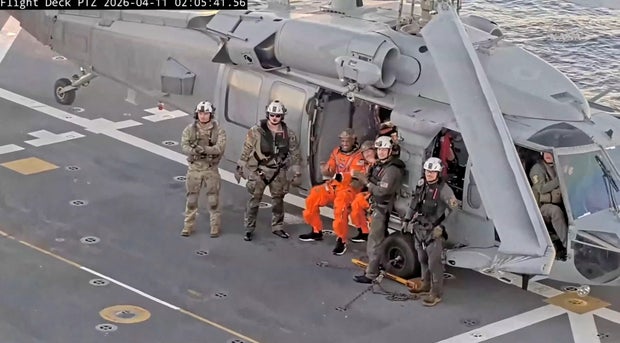
![]()
Astronauts Christina Koch and Victor Glover aboard a recovery ship after being extracted from the Artemis II capsule in the Pacific Ocean, following the Artemis II crew's flyby of the Moon, in this screengrab from a livestream video, April 10, 2026. NASA/Handout via REUTERS
9:44 PM / April 10, 2026
The front porch, an inflatable raft used to help the astronauts exit Orion, was being repositioned about 100 yards from the capsule so the crew, now wearing hoisting vests, can be individually lifted into helicopters.
Once all four are collected, the helicopters will land on the flight deck of the recovery ship, USS John P. Murtha.
9:34 PM / April 10, 2026
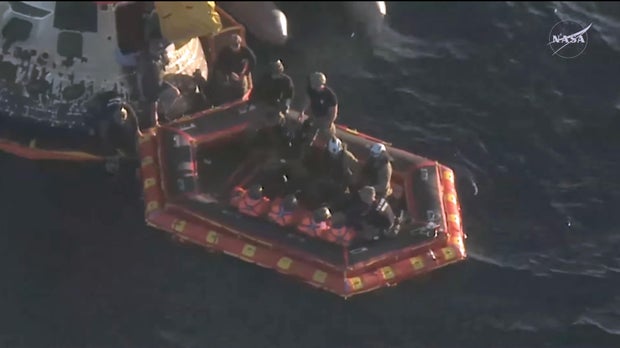
The Artemis II crew began emerging from Orion about 90 minutes after splashdown.
The crew exited via a side hatch, one by one, onto an inflatable raft known as a front porch that allows the four astronauts to get their sea legs back after 10 days in space. Commander Reid Wiseman was the last to exit the capsule.
![]()
This image from NASA TV shows the Artemis II crew members after exiting their Orion capsule. NASA TV
A medical officer who entered the Orion reported to Mission Control that all four members of the crew were "feeling great, happy to be home, and ready to be extracted as soon as possible."
To recover the astronauts, a group of Navy divers sailed up in a small vessel, opened its side hatch and attached the front porch. Due to strong currents, divers struggled to stabilize Orion with an inflatable collar that was wrapped around its base.
Four Navy divers entered Orion to medically evaluate the astronauts before they were safely brought out.
A Navy chopper will transport the astronauts to the nearby USS John P. Murtha.
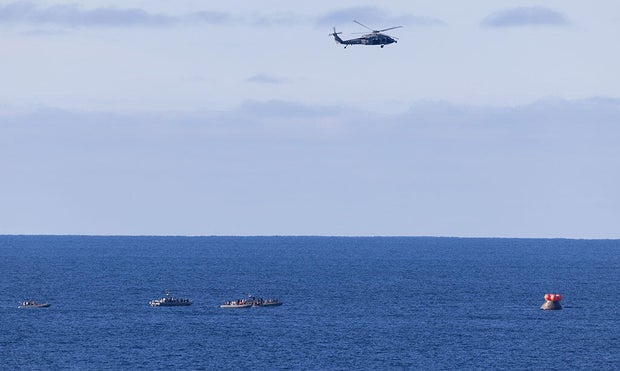
![]()
A U.S. Navy MH-60 Seahawk flies overhead as small boats approach Orion spacecraft after splashdown. Joel Kowsky/NASA via Getty Images
9:11 PM / April 10, 2026
In a post Friday night, President Trump congratulated the crew on their "spectacular" mission and said he "could not be more proud!"
"Congratulations to the Great and Very Talented Crew of Artemis II," he wrote. "The entire trip was spectacular, the landing was perfect and, as President of the United States, I could not be more proud! I look forward to seeing you all at the White House soon. We'll be doing it again and then, next step, Mars!"
8:52 PM / April 10, 2026
Following a brief technical issue, communication has been restored between the Artemis II crew aboard Orion and the recovery team.
The crew module has been powered down for recovery, and members of the recovery crew are approaching the capsule and performing a sweep with air quality sensors to make sure no hazardous fumes, such as hydrazine propellant or ammonia coolant, are leaking from the spacecraft.
Once Orion is deemed safe to approach, Navy divers can bring their boats up against the bobbing capsule and members of the 16- to 20-person team jump into the water and begin attaching hardware to steady the capsule and prepare it for crew extraction and recovery.
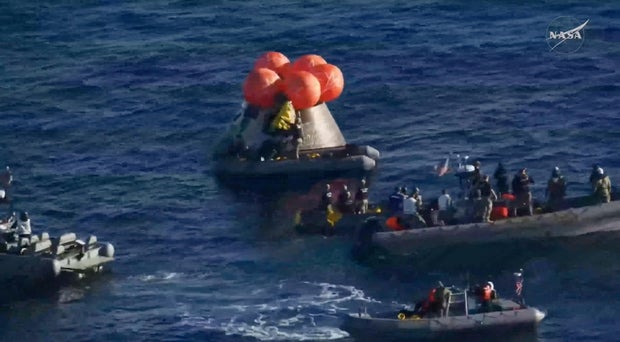
![]()
Recovery personnel open the side hatch of the Artemis II crew capsule floating in the Pacific Ocean following splashdown on April 10, 2026. NASA via Reuters
This includes installing a sea anchor — an underwater parachute that stabilizes the capsule — as well as an inflatable collar around its base.
Before the astronauts can exit the capsule, divers will install an inflatable raft, called a front porch, under Orion's side hatch.
8:39 PM / April 10, 2026
U.S. military and NASA personnel are approaching Orion following its splashdown, NASA said.
The crew will be extracted from Orion about an hour after splashdown, although a communication issue between the recovery team and Integrity may delay that. They will then be flown to USS John P. Murtha, which is stationed nearby, for medical evaluations.
Meanwhile, Navy divers will attach a cable to Orion to tow it to a specially designed cradle inside Murtha's well deck.
Orion will then be returned to Naval Base San Diego, before being transported back to the Kennedy Space Center in Florida where the capsule will be inspected and its valuable data retrieved, NASA said.
8:34 PM / April 10, 2026
NASA is troubleshooting an issue with communications between the Orion capsule Integrity and the recovery team. The planned power-down of the spacecraft has been delayed as recovery teams waits nearby.
The power-down is a post-splashdown step in which flight controllers shut down nonessential systems and transition the capsule into its recovery configuration. This reduces power demand and prepares the spacecraft for crew extraction as recovery teams move in.
8:24 PM / April 10, 2026
President Trump watched the splashdown of the Artemis II crew on TV, a White House official told CBS News.
A television was brought into a roundtable dinner so the president could see the event, the official said. The president is at a winery in Virginia for a fundraising event.
Mr. Trump spoke with the crew during the mission, after they completed their flyby around the moon, and told them they had "inspired the entire world."
"Today, you've made history and made all America really proud," he told them Monday. "Humans have never really seen anything quite like what you're doing in a manned spacecraft. It's really special."
8:13 PM / April 10, 2026
After Orion dropped into the Pacific Ocean, Mission Control called it "a perfect bullseye splashdown."
"This is a perfect descent for Integrity," Mission Control said.
NASA also said Artemis II commander Reid Wiseman radioed that all four crew members are doing well.
8:08 PM / April 10, 2026
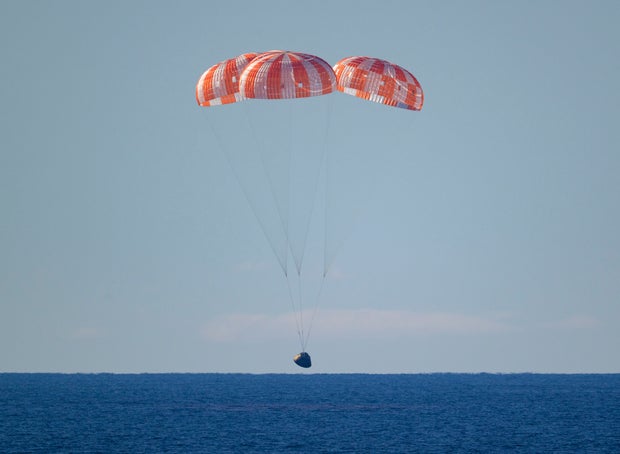
The Orion capsule has splashed down in the Pacific Ocean, about 40 to 50 miles off the coast of San Diego, with the four Artemis II astronauts back on Earth after their historic 10-day trip to the moon.
"This is a perfect descent," a NASA commentator said as the capsule parachuted gently to the surface.
![]()
NASA's Orion spacecraft with the Artemis II crew splashes down in the Pacific Ocean off the coast of California on April 10, 2026. Bill Ingalls/NASA via Getty Images
The splashdown occurred at 8:07 p.m. ET, right on schedule.
8:04 PM / April 10, 2026
Parachutes have begun to deploy to slow the Orion crew capsule down from about 300 mph to a safe velocity of less than 20 mph for splashdown.
— NASA (@NASA) April 11, 2026
8:02 PM / April 10, 2026
The Orion capsule emerged from its communications blackout and the crew confirmed to Mission Control, "We have you loud and clear!"
7:55 PM / April 10, 2026
An expected 6-minute communications blackout period has taken effect as Orion reenters the atmosphere. The blackout began at about 7:53 p.m. ET.
The blackout is due to the heat shield from the spacecraft enduring temperatures as high as 5,000 degrees Fahrenheit. The temperatures cause plasma to form around the capsule, blocking the transmission of radio signals.
Temperatures inside will remain comfortable, but the crew is feeling about 3.9 Gs at this time.
Orion will emerge from the communications blackout just shy of 8 p.m. ET, with about 7 minutes to go before splashdown.
At about 8:03 p.m. Orion will jettison its forward bay cover and deploy its drogue parachutes near 22,000 feet. About one minute later, at 8:04 p.m., it will unfurl its three main parachutes around 6,000 feet to slow the capsule for splashdown.
7:47 PM / April 10, 2026
Retired NASA astronaut Suni Williams told CBS News that the Artemis II astronauts must be feeling "pretty excited" for their reentry.
"They're excited, they're in their seats, they're all strapped in, they're probably getting ready, they're gonna start to feel gravity before too long, and that allows you to tighten down your straps," said Williams, who retired from NASA in January.
Williams and fellow astronaut Butch Wilmore were famously stuck in space for 286 days between 2024 and 2025 because of technical issues with the Boeing Starliner spacecraft that delayed their return.
7:40 PM / April 10, 2026
NASA says Orion has successfully completed the crew module raise burn, adjusting the spacecraft's orientation to align its heat shield for reentry.
7:35 PM / April 10, 2026
Mission Control confirmed Orion's crew module separated from the service module as planned.
Following separation, the crew module, with four astronauts onboard, maneuvers so that its heat shield is pointed in the direction of travel. The heat shield protects them from the extreme temperatures that come with hitting the atmosphere at a top speed of about 24,000 mph.
7:31 PM / April 10, 2026
NASA says Orion has transferred its communications from the agency's Deep Space Network system to its Tracking and Data Relay Satellite system.
According to NASA, the Deep Space Network is the largest and most sensitive scientific telecommunications system in the world, while the Tracking and Data Relay Satellite System allows the capsule to maintain communication in low Earth orbit.
6:58 PM / April 10, 2026
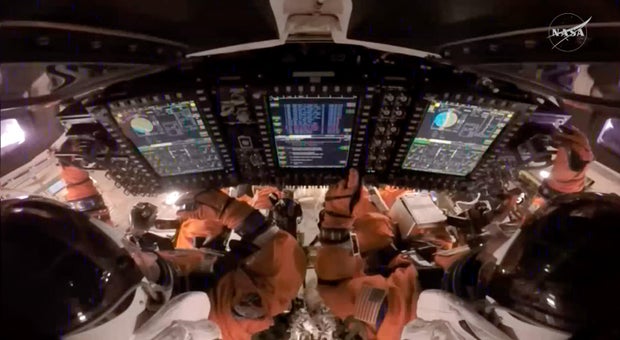
Shortly before 7 p.m. ET, the astronauts confirmed that they've completed donning their orange Orion Crew Survival System suits, an essential step before their return to Earth.
![]()
This image from NASA TV shows the Artemis II crew suited up for their return to Earth. NASA
NASA says plans are proceeding on schedule for reentry and splashdown, a little over an hour away.
6:45 PM / April 10, 2026
At 7:33 p.m. ET, four explosive bolts located underneath Orion's heat shield will shatter in order to separate the crew module from the service module.
Following separation, the crew module will maneuver so that its now-exposed heat shield is pointed in the direction of travel. The no-longer-needed service module will reenter on its own and burn up in the atmosphere over the Pacific Ocean.
5:59 PM / April 10, 2026
NASA has updated its maximum speed prediction for Artemis II to 24,661.21 mph. They should hit that mark at 7:54:04 p.m. ET, during the peak heating period of reentry, when the crew will be feeling 3.9 Gs.
This will fall about 130 mph short of the human speed record, set by the Apollo 10 crew coming back from the moon in 1969.
5:20 PM / April 10, 2026
There will be an expected 6-minute communications blackout period as Orion reenters the atmosphere at 7:53 p.m. ET.
During reentry, the heat shield on the spacecraft endures temperatures as high as 5,000 degrees Fahrenheit and plasma will form around the capsule, blocking the transmission of radio signals.
Orion should emerge from the communications blackout a few seconds shy of 8 p.m. ET, with about 7 minutes to go before splashdown.
Updated 4:52 PM / April 10, 2026
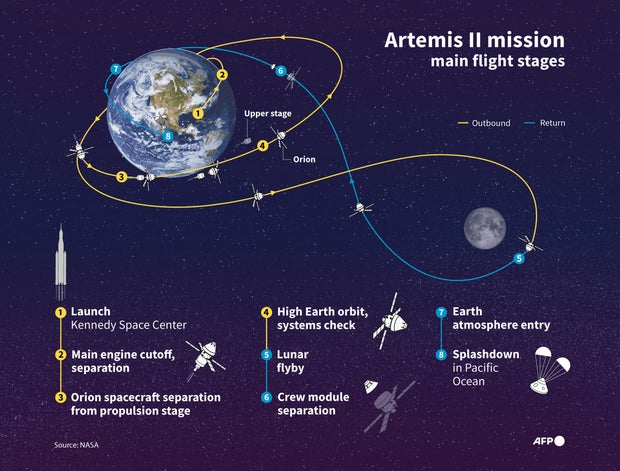
By the time they return to Earth, the Artemis II crew will have traveled a total distance estimated at 694,481 miles on their journey looping around the Earth and moon.
The total expected duration of their mission: 9 days, 1 hour and 31 minutes.
They set a record earlier in the flight for the farthest distance from Earth humans have ever gone, reaching a maximum distance of 252,756 miles from our planet during their flyby around the moon.
![]()
NASA's Artemis II mission circled around the moon. Graphic by Jonathan WALTER and Paz PIZARRO / AFP via Getty Images
3:03 PM / April 10, 2026
Reentry into Earth's atmosphere should begin at 7:53 p.m. ET, according to NASA's timeline for landing day.Twenty-four seconds after reentry begins, and some 1,950 miles from splashdown, heating across the Orion capsule's 16.5-foot heat shield will build to the point that electrically charged plasma will engulf the spacecraft, preventing normal communications.
One minute and 22 seconds into the descent, temperatures across the heat shield will reach a peak of some 5,000 degrees Fahrenheit — half as hot as the visible surface of the sun.
The communications blackout is expected to end after about six minutes.
At that point, the spacecraft will be descending at about 9,000 mph, less than 200 miles from the targeted splashdown point. Eight minutes after entry, the Orion will pass through an altitude of about 100,000 feet. One minute later, the spacecraft will drop below the speed of sound.
At an altitude of about 50,000 feet, at a velocity of some 300 mph, 11 parachutes will begin deploying in sequential fashion to further slow and stabilize the spacecraft. Finally, three pilot chutes will pull out Orion's three 116-foot-wide main chutes, which will begin inflating at an altitude of about 6,000 feet.
That will slow the craft to a relatively gentle 17 mph splashdown in the Pacific Ocean.
Updated 3:42 PM / April 10, 2026
A video camera mounted inside Orion's cabin captured commander Reid Wiseman and pilot Victor Glover using their iPhones to snap final photos of Earth from about 40,000 miles away.
The astronauts held the phones up to the video camera to show the pictures to Mission Control.
"We're going to need a copy of that photo when you guys get back," the capsule communicator can be heard saying.
3:26 PM / April 10, 2026
Mission Control in Houston provided a positive update on conditions with less than 5 hours to go until splashdown.
"Everything on board Integrity is in great shape," a NASA commentator said, referring to the name of the Orion spacecraft. "All the systems are functioning perfectly."
The crew is taking some time to stow items they no longer need in preparation for reentry.
"All is well aboard Integrity and the weather is go for splashdown," NASA said.
Updated 2:55 PM / April 10, 2026
The Orion spacecraft has performed its last major maneuver of the mission, according to a status update from NASA.
The spacecraft fired its thrusters to fine-tune its entry path to the splashdown location. The burn lasted eight seconds.
NASA communicators told the crew that it appeared to be a good burn. The crew will continue to prepare for reentry.
Updated 2:35 PM / April 10, 2026
When the Artemis II Orion crew capsule returns to Earth on Friday, it will hit the discernible atmosphere some 75 miles above the Pacific Ocean at a blistering speed of around 24,000 mph, and within seconds, temperatures across its 16.5-foot-wide heat shield will climb to some 5,000 degrees — half as hot as the visible surface of the sun.
The four astronauts on board are counting on the heat shield to keep them safe all the way through the peak heating zone to a parachute-assisted splashdown off the coast of San Diego.
"We have high confidence in the system, in the heat shield and the parachutes and the recovery systems we put together," Amit Kshatriya, NASA's associate administrator, said Thursday.
NASA made some modifications to plans for the reentry trajectory after the uncrewed Artemis I test flight in 2022 sustained damage to its heat shield.
Read more about the heat shield and reentry here.
1:54 PM / April 10, 2026
NASA commentator Rob Navias says forecasters are predicting the densest portion of cloud cover in the region will remain closer to the California coast. Out at the splashdown location, roughly 40-50 miles southwest of San Diego, they are predicting broken, scattered clouds, winds of 10 knots and seas of 4 feet.
1:46 PM / April 10, 2026
NASA Administrator Jared Isaacman will be aboard the USS John P. Murtha for splashdown. The ship is tasked with safely recovering the four astronauts and their billion-dollar spacecraft.
Four helicopters and six small boats will take part in the crew and capsule recovery after splashdown in the waters of the Pacific.
Updated 1:29 PM / April 10, 2026
The Orion capsule carrying the astronauts will be traveling at about 24,000 mph when it hits the top of the atmosphere during reentry. That's fast enough to fly from New York to London in less than nine minutes.
1:11 PM / April 10, 2026
For the final day of their mission, the Artemis II astronauts woke up at 11:35 a.m. ET to the tunes of "Run to the Water" by Live, selected by the crew, and "Free" by Zac Brown Band.
"What a great way to start the day, Houston. Courage and grit. That'll stick with me and it should stick with all of you all day long," commander Reid Wiseman said.
At wake-up time, they were 61,326 miles from Earth.
A day earlier, NASA shared the crew's morning playlist on Spotify. "Each track was selected by the Moon crew, continuing a tradition that started more than 50 years ago," NASA wrote on social media.
Read more and see the list of songs here.
1:11 PM / April 10, 2026
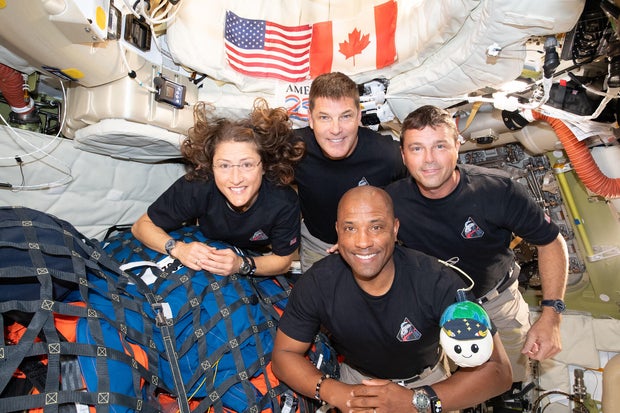
"Rise," the plush mission mascot aboard Artemis II, has served an important role as the crew's zero-gravity indicator during the trip around the moon.
Rise also became a viral sensation, floating through videos and photos from the Artemis II crew, and carried the names submitted to NASA's "Send Your Name with Artemis" campaign.
![]()
The Artemis II crew — clockwise from left: Christina Koch, Jeremy Hansen, Reid Wiseman and Victor Glover — pause for a group photo with their zero-gravity indicator "Rise," floating at lower right. NASA
The adorable plush is the brainchild of 8-year-old Lucas Ye. The California second-grader made sure to include historical references in every part of the plush's design and ensured it would meet NASA's strict standards.
Someday, he says, he hopes to become an astronaut himself.
Read more about how Rise was designed and developed.
1:11 PM / April 10, 2026
CBS News will have live coverage as the Artemis II mission comes to an end after nine days in space.
1:11 PM / April 10, 2026
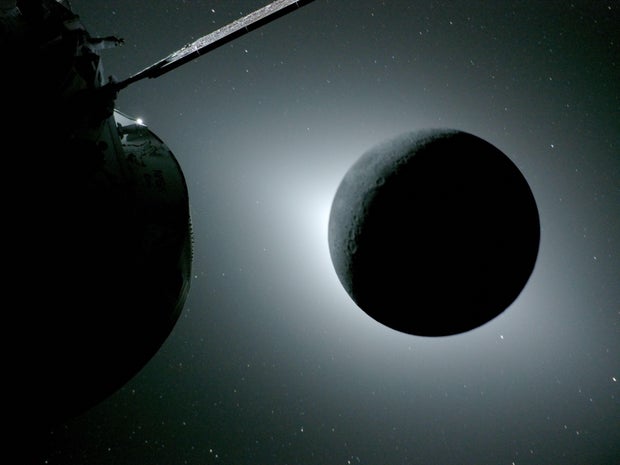
Astronaut Victor Glover told reporters that watching the sun disappear behind the moon in a solar eclipse was the highlight of the mission for him.
"We saw great simulations made by our lunar science team, but when that actually happened, it just blew us all away," he said during a news conference Wednesday. "Launching on April 1 meant the far side (of the moon) wasn't as illuminated as we were hoping. And so (the eclipse) seemed to be a consolation, and it was one of the greatest gifts of that part of the mission."
![]()
The moon, seen here backlit by the sun during a solar eclipse on April 6, 2026, is photographed by one of the cameras on the Orion spacecraft's solar array wings. Orion is visible in the foreground on the left. NASA via Getty Images
Asked about the splashdown, Glover said he's been thinking of that moment ever since he was assigned to the crew. He also said there will be much more to share once they're back on Earth.
"All the good stuff is coming back with us. There (are) so many more pictures, so many more stories. And gosh, I haven't even begun to process what we've been through," he said. "Riding a fireball through the atmosphere is profound as well. I'm going to be thinking about and talking about all of these things for the rest of my life, for sure."
1:11 PM / April 10, 2026
President Trump told the crew of NASA's Artemis II mission they had "inspired the entire world" in a 12-minute chat late Monday, after they looped around the moon on their record-breaking voyage.
"Today, you've made history and made all America really proud," he said. "Humans have never really seen anything quite like what you're doing in a manned spacecraft. It's really special."
Mr. Trump praised the astronauts for their "courage" and "genius" — and noted that their trip is a precursor to NASA's bid to return humans to the surface of the moon for the first time in over half a century.
"America is a frontier nation, and the four brave astronauts of Artemis II … really are modern-day pioneers," the president said, adding that the U.S. plans to "push on to Mars" next.
1:11 PM / April 10, 2026
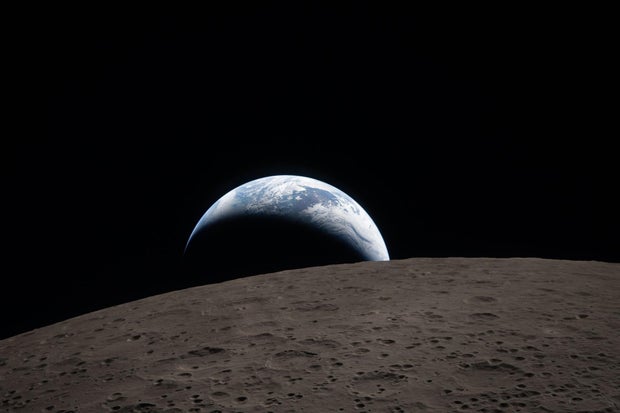
The crew captured stunning photos during the mission, with spectacular views from the far side of the moon and an eclipse in space.
One image from NASA showed "Earthset" — the Earth dipping behind the moon. Part of the Earth is seen in darkness, while Australia and Oceania are visible on the planet's surface. Details of the moon appear in the photo's foreground.
"Humanity, from the other side," the White House said about the image.
![]()
Earthset captured through the Orion spacecraft window at 6:41 p.m. ET, April 6, 2026, during the Artemis II crew's flyby of the moon. NASA
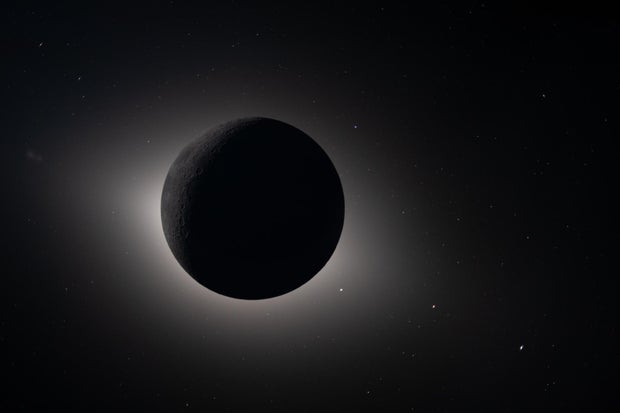
Another stunning photo showed the moon eclipsing the sun. The eclipse was not visible from Earth, only to the crew aboard the spacecraft, and the astronauts needed to wear eclipse glasses to protect their eyes until the moon completely covered the sun.
![]()
This image taken by the Artemis II crew during their lunar flyby on April 6, 2026, shows the moon eclipsing the sun. NASA
1:11 PM / April 10, 2026
In an emotional tribute, astronaut Jeremy Hansen said he and fellow crew members Christina Koch and Victor Glover chose to name a moon crater "Carroll" after commander Reid Wiseman's wife, who died of cancer in 2020. Hansen's crewmates could be seen wiping away tears as he shared the dedication.
"Some times of the moon's transit around Earth we will be able to see this," he said of the crater. "... And it's a bright spot on the moon. And we would like to call it Carroll."
Wiseman later said it was the most deeply profound moment of the mission.
"That was an emotional moment for me, and I just thought that was just a total treasure," Wiseman said during a space-to-ground news conference Wednesday.
He said his crewmates proposed the memorial when they were all in medical quarantine a few days before launch.
Before launch, the science team had helped identify a few relatively fresh craters on the moon that had not been previously named. The crew proposed naming another of the craters "Integrity" after the name of their Orion spacecraft.
1:11 PM / April 10, 2026
The crew of Artemis II set the record for the farthest distance any human has traveled from Earth just after 7 p.m. ET on Monday as their Orion spacecraft looped around the far side of the moon.
The new record — 252,756 miles from Earth — surpassed Apollo 13's record from 1970 by more than 4,000 miles, according to NASA. The crew had exceeded Apollo 13's record earlier in the day.
The distance record was one of two big moments for the crew on Monday night. The Orion capsule also made its closest approach to the moon when it flew 4,067 miles above the surface.
Both milestones came without radio contact to NASA back on Earth. Since the moon blocked Orion, and its signal, from Earth, the crew entered a planned 40-minute loss of communication until it came out on the other side.
Adding to it - Apollo 13 was a mission where 3 men should have died, but somehow didn't. If it had happened while the LM was on the moon, you would have had the CSM lose power, and then two men on the moon would have had no way to return home.
(And for the shuttle design mission - my understanding is it was likely the ability to do a HEXAGON-style film return mission in a single orbit, before the Soviets knew what was happeneing.)
> There’s a reason why there wasn’t an Apollo 18, or 19 and 20. Even though funding had been secured, an executive decision was made to kill the program early, because LoC was inevitable.
Was funding really secure? I believe that was the main sticking point; a quick search [0] seems to confirm this, and the John Young quote below backs it up: "Even if they’d had the money..." Not to say the risk wasn't a factor too of course, but it doesn't look like funding was otherwise guaranteed.
Anyway, I think what sets the risk of the Shuttle apart from Apollo is summed up nicely in one of the quotes (in reference to the Apollo program): "The awareness of risk led to intense focus on reducing risk." In the Apollo program, there was a pattern of rigorously hunting down and eliminating any possible known risks, leaving unknowns as the primary source of risk; on the other hand, the Shuttle program let known risks accumulate continuously until crews paid the price for a bad draw.
When debris hit Atlantis on STS-27 [1] and the shuttle only survived on a one in a million stroke of luck -- the completely broken tile happened to be over an aluminum mounting plate -- it should have been taken as a free lesson on one more known source of risk to eliminate. Instead, it led to seven people dying completely preventable and unnecessary deaths a few years later.
Spaceflight is inherently risky, it's true. That's why things like the Orion heat shield are so worrisome; because it is physically possible at our current level of technology to make it safer, and yet for political / funding / etc. reasons we're not doing the best we can.
[0] https://airandspace.si.edu/stories/editorial/why-did-we-stop...
One launch a year is not even close to what we can manage with our current technology, to the point where the scope is too small to be legitimately worth doing.
Its not solely a matter of energy; its about opportunity for learning. The current scale is too small to be worth doing at all.
If it was a program of something like >50 payloads over a decade, that gives enough opportunity for refinement, in cost, safety, and scale manufacture methods to actually see something new.
I am stunned to see that LoC risk assessment.
I kept wondering to myself over the past week, “will this be the last USA-supported human space travel if these astronauts don’t survive?”
I’d have a hard time imagining the general public would support any future missions if they hadn’t survived.
These astronauts are some elite humans. My respect for them is even greater now that I’ve seen the risk quantified.
Note that all the fatalities have been launch or landing related, not in space itself. Clawing out of this gravity well is tough. Make Earth a bit larger and you’d never get off it without something like NERVA or nuclear pulse Orion.
I wonder sometimes if that’s another thing to toss in the Fermi paradox bucket. Many rocky planets might be much more massive than Earth. On one with 3X our gravity a space program might never get going.
Were Magellan’s men volunteers? For example, in the incident with The Wager, 1,980 men left on 6 ships, and only 188 survived. Men of the original men were press-ganged (kidnapped to crew these ships), and a lot of them were even taken from an infirmary and not in great health. And, of course, conditions were pretty terrible.
So yeah, we’re more risk adverse… and also a lot better at keeping people alive. I think most people would not have signed up for some of these really risky endeavors if they knew the true risk.
The risk factor is calculated _per mission_ from what I understand. You can have three accidents in a row and nothing for decades but the risk itself can still be 1 in 30.
1) Eventually you will die, no matter what. It can be the most mundane thing. Slipping on a ketchup splatter can cause great damage for example.
2) It's a profession where you intentionally kill people, so, that changes the calculation for your own risk.
3) It's a unique opportunity.
(and potentially) 4) Gives a sense of living / be in history books for his family.
So you have a possibility of a guaranteed exciting life for a death that you anyway will have, but doing something you love, it's not too bad.I definitely don’t envy kids that are born nowadays.
But what about comparing the same country/region? After all that's a better sense of how things are progressing locally to you, and when people are asked "are things better or worse" they probably compare the way they live with the way their parents lived.
Would you rather be born in 1980 or 2020 in China? In Poland? No question. Same question but in the USA? In the UK? The West in general? I'm really not so sure.
I think you're being a pedant, if your point is a grazing entry causing rebound skip ultimately returns to some orbital path downward.
Artemis II never escaped Earth’s pull.
That video that NASA put out where the craft did a sling shop around the moon is extremely deceptive. The pull of the moon had very little effect.
If they had missed, they would have eventually crashed back to earth in the worst case, and best case just re-adjusted and returned a little bummed.
There was also Nautilus-X which never made it beyond the concept stage.
What was the real reason? Tradition? Lack of imagination? Photo opportunities?
The rest was great tho.
Memory foam, smart phone cameras, tech miniaturization in general, GPS, baby formula, cordless tools... just a tiny sliver of things we use daily that are directly attributable to the pursuit of space travel.
It is far from useless
Yep, while we are measurably destroying the Earth's biodiversity orders of magnitudes faster than the mass extinction that killed the dinosaurs. And this is without global warming, which is another great thing we are doing.
Arguably, the biggest thing humanity is doing is killing the Earth. Great that we have some comfort in doing fun things on the side.
Otherwise I would also just bet on RCS venting like in Apollo.
[1] https://web.archive.org/web/20171208090538/http://www.tested...
And from an older NASA explanation: https://www.nasa.gov/news-release/nasa-shares-orion-heat-shi...
> Engineers already are assembling and integrating the Orion spacecraft for Artemis III based on lessons learned from Artemis I and implementing enhancements to how heat shields for crewed returns from lunar landing missions are manufactured to achieve uniformity and consistent permeability.
Heating likely plays a role as well.
I am not a rocket engineer, but I have read How Apollo Flew to the Moon and Ignition!: an informal history of liquid rocket propellants, both of which cover these issues. Highly recommended.
note - I can't verify any of the following, it's more - for lack of a better term - aerospace nerd fan theory at this point.
Post-collapse, people think that the Buran justification was paranoia. But based on what I've read / seen (though this is getting hard to source, so I might be just good ol' hallucinating here), they weren't entirely wrong. The subtext around that large payload bay had to do with the Soviet pursuit of systems like Fractional Orbital Bombardment System (FOBS) https://en.wikipedia.org/wiki/Fractional_Orbital_Bombardment... that weaponized space.
Again, there's a reason for those ASAT tests. There's a reason for the weird specifications set in the early 1970s for the Shuttle. And I don't think deploying a spy satellite alone is it. But this is speculation. AFAICT, nothing was put on paper.
It would have been an incendiary WW3 starting act to capture a Soviet asset. But I think it is understandable if certain people within the American blob wanted that capability at hand.
I wish I was immortal. I'd drop everything for a decade and try to find people from the time who're still alive (and some still are!) and ask them these questions directly - on the record – for posterity's sake. I suspect, we came much closer to war via space than most people think. And because we didn't, we'll eventually repeat these mistakes.
---
Oh and then there was the documented attempt to capture Salyut-7 https://www.thespacereview.com/article/2554/1
Somehow all the numbers just happened to line right up. :)
How could they have eliminated that risk?
> Was funding really secure?
It's worth breaking down what the "funding" means over here. As this is a depressing topic for me, I'm going to be a bit playful. :)The Saturn V's existed. Saturn V serial numbers were designated as S-5## where # is an increment from 1. https://en.wikipedia.org/wiki/Saturn_V#Launch_history <--- see the Saturn V numbering scheme here.
SA-513 was repurposed from Apollo 18 to Skylab. SA-514 was meant for Apollo 19. They put it on display. SA-515 was also chopped up and put on display. Some parts were used in Skylab. https://www.space.com/nasa-extra-apollo-moon-saturn-v-rocket...
So there were 3 Saturn V already assembled and in existence.
Did the CSMs and LEMs exist? CSMs had a similar serial number scheme. And they designated "Block 1" and "Block 2" (iterations of the spacecraft design based on testing) CSM-0## and CSM-1##
The CSM used in Apollo 17 was CSM-114. On wikipedia it says that CSM-115 and CSM-115a were never fully assembled and cancelled, but if you look past that, you can also see that Skylab used, CSM-116, CSM-117 and CSM-118. These were Apollo CSMs, fresh off the same assembly line. https://en.wikipedia.org/wiki/Apollo_command_and_service_mod...
So there were 3 CSMs.
What about LEM? Similar number scheme, LM-## which is incremented with each one made. So first one was LM-1 and the last one used on Apollo 17 was LM-12. LM-13 is on display in a museum. LM-14 was on the production line (along with LM-15??) and a "stop work" order was issued and they were scrapped. Yes, they were literally broken down and turned into scrap. https://www.businessinsider.com/nasa-lunar-modules-lm14-lm15...
So NASA had 1 LEM and 2 were on the way. I think, we can charitably say that there were 3 LEMs available at the time. I think it's fair to say that...
There were 3 LEMs.
Did they have 3 crews? Funnily enough, they did have 3 crews already assigned! What a coincidence. https://web.archive.org/web/20181224161154/https://nssdc.gsf... :)
So the Saturn Vs existed and had been paid for. The CSMs existed and had been paid for. The LMs existed / were on the line and had been paid for. The crews existed (and had been partially paid for).
So what is the "funding shortfall" that caused America to stop going to the moon?
The "funding shortfall" here is the money required to pay for the ground crews and personnel for carrying out the mission. And that amount was $42.1 million out of $956 million for Apollo. The total NASA budget was, $3.27 billion that year.
> NASA was canceling Apollo missions 15 and 19 because of congressional cuts in FY 1971 NASA appropriations, Administrator Thomas O. Paine announced in a Washington news conference. Remaining missions would be designated Apollo 14 through 17. The Apollo budget would be reduced by $42.1 million, to $914.4 million - within total NASA $3.27 billion.
$42.1 million. NASA admin just couldn't find $42.1 million of ground staff salaries etc out of the remaining $2.3 Billion budget.It's probably a coincidence that this happened right after Apollo 13. The decision was announced on September 2nd, 1970. Apollo 13 happened in April, 1970.
----
So yes, the funding was there. I suspect the "funding cut" argument was an attempt to save face; after the US Government (and I mean the Government, it's clear both the White House and Congress were involved) decided to cut the cord post-Apollo 13.
I also suspect this is one of the many "open secrets" lost to time. It might have been known by "everyone" in the know at the time, but those who knew died off, and history crystallized around the written page.
I agree entirely that it's much easier to imagine a successful moon program built around repeatable missions at high cadence, so I'm not disagreeing on that point. I would just push back on the idea that this has little or no value.
From the broadcast, they made it sound like a big factor is the 2 hour program requirement to get the crew out of the capsule. Maybe they can't reliably hit that mark with a well deck recovery?
[1] https://www3.nasa.gov/sites/default/files/files/orion-recove...
I was born in 1978, and in the early '80s, beat approximately 50/50 odds by not getting infected with HIV from the only available treatments at the time, and as a result of this and other risks including hepatitis, treatments were only used in response to active bleeding episodes throughout my childhood, resulting in arthritis in my ankles and elbows by the time I was around 8.
And I still wound up with hepatitis C from near birth (at which point it was referred to as "non-A, non-B", as the virus would not be identified until the late '80s) until a cure was developed decades later, fortunately never symptomatic.
So, while I beat the odds, my life expectancy from birth until much later would have been considerably longer had I been born in 2020, and my joints would work a lot better.
Oh, and as someone who grew up with the Shuttle and attended both Space Camp and Space Academy in Huntsville, inevitable political nonsense notwithstanding, I'm elated about the successful mission.
As for the odds, given the opportunity, I wouldn't even hesitate unless they were worse than 1 in 10.
If you feel constrained by the size of the Falcon Heavy fairing the now defunct Bigelow Aerospace launched several prototype inflatable habitats that apparently tested well in LEO.
Combine this with a lunar cycler[0] orbit and you could keep reusing the same craft over and over and expanding to it if you want to ferry the astronauts to the moon.
You'll note that everything I'm describing requires existing technology and very proven techniques (except maybe the inflatable stuff) but the thing it doesn't require is a giant rocket like SLS or Starship. I'm not saying that we shouldn't build machines like that, it's just that they really aren't needed for a mission like this and I question why something like SLS was built in the first place.
Hope is powerful, cynicism is an opiate.
I will point out however that the budget was congressionally-mandated, and no funds were allocated for moon landings as they were in previous years; it would have been illegal to use funds dedicated to other areas for moon landings. Maybe I'm being overly pedantic here, but to say the 'funding was secured' as in the article implies the decision to cancel the remaining programs lay with NASA leadership; it would be more accurate to say that funding for the remaining programs, though possible, was not secured, most likely as an attempt to save face by congress/govt.
In countries like China, Russia, or even India, you won't find as many American products. The influence of Hollywood is much less. American styles of doing things are not necessarily the ones chosen for civic institutions. American agencies don't work as closely with their scientific enterprises as the American allies. On the other hand, they have strong armies that are not beholden to what America dictates, as evidenced by how often they end up in conflict.
As an example, the world sanctioned Russia and... nothing happened... because Russia is a real country able to build its own things. It has industrial capacity, mining capacity, and the organization to do that independently of what others think. It also has an army willing to defend it.
The countries you listed do not have these things. Their 'army' to defend the nation is a vague promise that they'll think about while they ask America to carry out their interests. American magnanimity usually means this is a safe bet.
Then we can talk
At no point were the astronauts piloting a boat. The reasons they splash down into the ocean has nothing to do with buoyancy being easier to solve, and even less to do with the ease of piloting a boat.
>It’s also hyperbole to suggest we understand lift. We don’t.
Maybe you personally do not understand lift, but "we" do in fact understand it. Please educate yourself before continuing this discussion any further.
I'm also a pilot (CFI). My day job is space operations. And I can tell you've had too many hangar arguments about how wings work.
Pilots don't understand lift. Aero engineers understand it just fine.
This isn’t true. The same article even explains that.
From that article: “It takes only some basic fact checking to debunk all the preposterous allegations…”
- They replaced the specific foam insulation that struck Columbia with external heaters, and redesigned other areas where foam was necessary to ensure greater structural stability + minimize damage to the shuttle in case of breakage. They also began more thorough inspection of any heat shield panels that would be reused between missions
- They added various cameras, both on the shuttle and on the ground, to monitor the heat shield throughout launch, plus accelerometers and temperature sensors. Also, the heat shield was checked manually on every mission once in orbit for damage, both with an extension to the Canadarm, and with ISS cameras when possible (a funky maneuver [0] where they would do a backflip to flash the shuttle's belly at the ISS for it to take high res pictures)
- Every mission from then on had a backup plan in case the shuttle wasn't in a state to return to Earth (this wasn't really the case before then, which is kinda wild). Another shuttle was always ready to launch, with a new configuration of seats to allow for sufficient crew space
- They sent up equipment and materials for repairs in space with every launch, though admittedly the usefulness of that was dubious and the repair kits were never used
Perhaps 'eliminate' was too strong a word, but there's no reason these precautions couldn't or shouldn't have been taken before it resulted in deaths and the loss of a spacecraft. (well, other than the aforementioned funding/politics/organizational failure)
Read Payne Harrison's 1989 novel Storming Intrepid, followed by NASA publication SP-4221, "The Space Shuttle Decision," from 1999. [1] The first is a pretty good depiction of what you're imagining, and the second explains why the imagination of a technothriller author is where that idea went to die. Then maybe give your head a shake. If Reagan had violated the Outer Space Treaty - via NASA of all agencies! - how do you imagine it'd have stayed secret over these forty years just past?
[1] https://web.archive.org/web/20241229052235/https://ntrs.nasa...
Here we are, half a century after the first moon landing, doing a flyby of the moon in preparation for landing and supposedly for establishing a base there that makes no sense. We’re not even close to being able to send humans to the nearest planets, and even if we did send people to Mars, in one of the most pointlessly dangerous and expensive missions in history, it’d be extremely unlikely to lead even to a base, let alone a settlement.
Yet with all that, people still talk about the Fermi paradox as though it’s a mystery.
It makes me think we’re really dealing with a kind of religious belief. Religion backfills reality with comforting fantasies, like life after death. In this case, the fantasy that there are much more advanced, interstellar spacefaring civilizations than ours elsewhere in the galaxy. This implies that humans too could one day become an interstellar species (with enough grit and determination and pulling back on the control stick and yelling, I suppose!) But somehow, mysterious effects prevent us from ever observing any evidence of this belief.
- Historical. Low N as you say. (Even though each mission and spacecraft is different and they're spread out over time, there's value in this)
- Bureaucrat number; absurdly low, but looks good to politicians etc
- Engineering estimateThey certainly could've gotten the return wrong but with a perigee of 119 miles they arent even in a stable orbit and likely could deorbit themselves using only rcs thrusters at apogee, or by just waiting a few orbits.
No, it had a very significant effect: it's what made possible the free return trajectory while observing the far side of the moon.
>> Under Artemis, NASA will send astronauts on increasingly difficult missions to explore more of the Moon for *scientific discovery*, economic benefits, and to build on our foundation for the first crewed missions to Mars.
Yeah fuck me for thinking this was about that that.
It doesnt matter if you are actually running missions, if the scale is so small and wasteful that its not meaningfully comparable to the aspirational future missions.
For me, it's a fun conspiracy theory to engage with. I'm only doing this for the love of the game as it were. Please don't take it that seriously.
But you have to admit, it is a fun theory. A lot of the claims made by the Russians / Roscosmos are most likely false, but if you notice the article says,
> The only concrete document referred to is an intelligence memo that Defense Minister Sokolov supposedly received on February 24 about the assignment of the French astronauts. Whether such a memo really landed on his desk that day is questionable (after all, Baudry’s assignment to 51E had been publicly announced by NASA in August 1984), but the idea that the assignment raised some suspicions in Soviet circles about the objectives of the Challenger mission may not be so far-fetched. There had always been a high level of paranoia in the Soviet Union about the military potential of the Space Shuttle. Misconceptions about the military applications of the shuttle, such as the belief that it was capable of diving into the atmosphere to drop bombs over Moscow, had been a key factor in the Soviet decision to develop Buran in 1976. The Buran orbiter was a virtual carbon copy of its US counterpart in shape and dimensions, exactly to counter the perceived military threat of the Shuttle. Furthermore, a couple of developments in the Shuttle program in early 1985 may have fueled the Soviet paranoia. The Shuttle had flown its first dedicated Defense Department mission (STS-51C) in January 1985 and a controversial laser experiment in the framework of SDI was planned for the STS-51G mission in June.
Whether or not said documentation can be trusted, which bits could be taken as true v. what's just insane paranoia is something that would require more work to discount than most would think. Because, as I've said, the numbers do line up from the article, > The least one can say is that Salyut-7, which was 13.5 meters long and had a maximum diameter of 4.15 meters, would have fit inside the Shuttle’s cargo bay, whose dimensions were 4.6 by 18 meters. In fact, after the final crewed mission to Salyut-7 in 1986, the Russians significantly raised its orbit in hopes that one day it could be retrieved by Buran, which had the same dimensions as the American shuttle.
The Shuttle was an amazing piece of technology with amazing capabilities. See: https://en.wikipedia.org/wiki/STS-41-C and https://en.wikipedia.org/wiki/STS-49and this is one of my favorite missions, https://en.wikipedia.org/wiki/STS-51-A (with my favorite space selfie)
Fun fact, the original deorbit plan for the Hubble was for the Shuttle to bring it back and then put it inside the Smithsonian, https://www.hou.usra.edu/meetings/orbitaldebris2019/orbital2...
(the Smithsonian part is IRL lore, and isn't mentioned online, AFAICT)
So no space program from a super Earth until they figure out not just fusion but compact high density fusion that could fly. You’d need stuff like in The Expanse, or at least in that rough ballpark.
Using fission is something they probably wouldn’t do unless they faced an existential reason forcing them to go to space, like deflecting an asteroid.
Life may not be that unusual but it might be mostly just goo: little extremophile type bacteria and maybe very tiny creepy crawlies living in deep seas, underground, in liquid mantles in ice moons, etc.
But to get stuff even as sophisticated as frogs and bunnies, let alone something that can try space flight, requires a place that is all of: big, stable, with abundant energy, with high enough metallicity, and in an environment well shielded from flares and impacts.
There may not be a lot of places like this.
And yes, space flight is brutally hard. Look up the history of sailing. Look up the Polynesian indigenous peoples and how long that took, through multiple waves of exploration, or the people who walked across a land bridge to North America during the ice age. Space flight is easier and safer than some of those feats, given the tech they did it with at the time.
If there is a fantasy it’s the idea that we’d have bases on the Moon and Mars by now. What we are doing today is the equivalent of early Polynesians hollowing out some logs and going fishing.
But then, Apollo 1 was after all the first mission on the Saturn V. I think we should assess even its pre-launch risk much higher than the rest of them. Similarly Artemis II has a much higher risk than the subsequent ones will have.
Moreover, even in the US, the seventies were the greatest time for the electronics and computers industries, when the greatest amount of innovations have been made.
After 1980, there have been huge advances, but all of them were completely predictable, i.e. the electronics and computing industries settled on an evolution path that was well defined for a few decades, with very few surprises.
The seventies were much wilder, when much more diverse things have been tried (and many of those have failed) and they were surely hopeful, especially in their second half.
During the seventies, there were a lot of US companies that I liked and I was convinced that if I bought something from them that was mutually beneficial, because they really tried to make products that fulfilled as well as possible the needs of their customers, while ensuring a decent and reasonable profit for the vendor.
Nowadays there exists no big company in the entire world from which I can buy a product without feeling that this is an adversarial transaction, where they try as hard as they can to fool me into paying as much as possible for something that is worth as less as possible.
Civil Rights Activists protested against Apollo 11 at the Kennedy Space Center in 1969, and "Whitey on the Moon" was released in 1970.
In fact, the trajectory they chose for this mission exploited the opposite effect to yield a free return without propellant expense.
In the modern day, the chance of a math error being the root cause behind this failure mode are vanishingly small, but minor burn execution mistakes that do not require hundreds of extra pounds of propellant are definitely plausible. They were extremely common in the early days of spaceflight and plagued most of the very first moon exploration attempts. Again, with modern RCS this is unlikely. But reentry is still incredibly tight and dangerous. Apollo famously had a +-1° safe entry corridor, and Orion is way heavier and coming in even faster. If their perigee was off they could’ve easily burned up or doubled their mission time, which they may not have been able to survive.
Like I said, the gif you saw makes it look that way.
Here is a link that explains it very well. https://youtu.be/MF8IbYbVIA0?t=269
I’ll agree, it seems crazy that it left earth, made it to the moon, and never really left earth orbit at all. That the furthest we’ve been away is still destined to return on its own.
I would assume spending 10 days in zero G is orders of magnitude more chaotic for your motor skills.
Apollo 18, 19 and 20 were cancelled in 1970. 3+ years ahead of Apollo 18. Apollo 17 didn't happen until December 1972.
The US couldn't plug this funding "shortfall" in 3+ years out of the many, many parts of NASA?
It's pretty clear that the decision to kill Apollo had been made. The money is just how they chose to do it so that the POTUS didn't have to go on record cancelling Apollo. There was no room for negotiation. POTUS and Congress had decided that Apollo needed to die and so it died. How it died was relevant only so far as to serve as a mechanism to save face.
> the 'funding was secured' as in the article implies the decision to cancel the remaining programs lay with NASA leadership
Yes, you're right. I just don't know how else to put it. The capital outlays for the components of the missions had already been committed to ahead of time. The physical capital was present; the main cost of the missions; those assets existed / were in place. I don't know what the right language is over here.Actually the backup plan almost every time was to just stay on the ISS until another Shuttle could be prepared. They only had another Shuttle on standby a couple times, during missions where they weren’t going to the ISS.
>They sent up equipment and materials for repairs in space with every launch, though admittedly the usefulness of that was dubious and the repair kits were never used
Yeah it wasn’t even useful for a situation like Columbia. It didn’t lose a few tiles or something, it had a giant hole punched into its wing.
There’s no fixing that in space. So I personally think they focused on situations they could theoretically fix, even though those situations weren’t what happened to Columbia.
Hmm. Maximum speed attained by Artemis II when they left their initial orbit was about 11.1 km/s IIRC. While this is somewhat less than true escape velocity from Earth (11.2 km/s) and you are technically correct, it is also enough of a speed that if you fly away in any random direction (and not a carefully calculated one), perturbances from the Sun and other massive objects will probably prevent you from reaching any sort of stable orbit around the Earth, and you will start bouncing around the inner Solar System in an erratic way.
I certainly wouldn't like to model that trajectory for months or years.
While I have no reason to believe this particular escapade, I do expect that there are a thousand such wild stories that have remained secret. Watergate seems obvious and explosive to moderns, but at the time it could easily have gone undiscovered or unremarked. How many other similar scale plots, domestic and international, succeeded or failed without ever being surfaced into the history books? A few? Dozens? Hundreds? ¯\_(ツ)_/¯
And the public is not fooled. Whatever benefits they got from Apollo (Tang? Zero-G pens?) were not worth the cost. But no matter how long the USA lasts, it will always be remembered as the country that landed humans on the moon.
What IIRC was actually done was that some antennas were placed on the back of the shuttle & its size was big enough that the plasma bubble would not fully envelope it - it would be open up to space. And that antenna on the back would communicate with TDRS satellites through this gap, enabling contact through the whole re-entry.
Starship does basically the same, just with Starlink satellites instead of TDRS.
Also Orion and other capsules fall like a rock (steep reentry profile ) compared to shuttle/starship, which intentionally slow down the reentry and kinda glide (ballpark 10min with capsules compared to 30min with shuttle/starship).
tl;dr: capsules get fully enveloped in plasma due to their shape, size and reentry profile
Sending people in space? Mostly cool engineering.
https://en.wikipedia.org/wiki/Launch_loop
Or potentially beamed power for launch, so you don't kug a power source. But in any case, indeed much harder. :)
Of course Apollo would have likely had a better average if it had continued, but the risk of the Apollo program, as executed, included things like the first flight of the Saturn V.
If the final empirical mortality result of the Artemis program is 1/30 or less, it will be better than Apollo in that statistic.
A comparison of acceptable mortality is where this discussion began. If Apollo was acceptable at 1/12 (We did it, it was apparently acceptable as the program was not cancelled due to mortality rate) then an acceptable mortality of 1/30 is stronger than Apollo, not weaker.
The time correctly delimited by you was the time of the greatest false political hopes, when everybody around the World believed that we got rid of the communist blood-sucking parasites and now the World would become that which had been described for decades in the propaganda of the Voice of America, where the political elites are held accountable for their actions, so if they are bad they are replaced through democratic elections, and the bad commercial companies are eliminated by competition in the free market.
Instead of this happening, already a couple of years before 9/11 a wave of destructuring many important historical companies happened, followed by a huge wave of mergers and acquisitions that has continued until today and which has eliminated competition from most markets, so that they are now dominated by quasi monopolies. Then the democratic elections have brought to power worse and worse human beings, all of whom have been much worse than some citizens that would have been randomly selected for those positions.
Nowadays, the economies of USA and of the other "Western" countries, and also their political institutions, resemble much more those of the socialist countries that they mocked during the seventies, than those of USA and W. Europe of that time.
So all the hopes of the nineties were naive and none of them was realized.
I feel like the original claim paints the whole thing as on a knife edge and barely achieved by virtue of not making a single mistake. In today's age with so many moon landing deniers and worse I feel like we should be specific about where the actual dangers challenges and unknowns there were here. In reality, the orbital mechanics are one of the simplest parts of the entire problem, at least when we're talking about a moon flyby
Makes it look what way?
Watch the NASA video carefully. It's clear that, even before the "loop" begins, Artemis is slowed down and is soon going to reverse direction relative to Earth. Which of course it would anyway, as you say--because, as the video you linked to points out, it doesn't have Earth escape velocity. The TLI burn gave it just enough velocity to reach the Moon's orbit with a little extra speed left over to get it about 4000 miles further.
But what would not happen without the Moon there is the "backwards" part of the loop--the part that took Artemis around the far side of the Moon. The Moon's gravity is what did that. In the Moon-centered frame in the video, yes, it looks like just a slight deflection--because that frame is moving with the Moon, whereas Artemis was moving backwards--in the opposite direction from the Moon in the Earth-centered frame.
Without the Moon there, Artemis would never have moved backwards, relative to the Moon's orbit, at all. Its trajectory in the Earth centered frame would have been a simple ellipse, with a maximum altitude from Earth a little higher than what it actually achieved (since the Moon's gravity did pull it back a little bit).
No, it's not. You aren't responding to what I actually said. See below.
> the “free return” would have happened if they launched entirely in the wrong direction.
But it would not have been a free return that let them see the far side of the moon, which is what I said. The Moon's gravity is what made that possible. And that was very significant.
https://en.wikipedia.org/wiki/Sprint_(missile)
"Sprint accelerated at 100 g, reaching a speed of Mach 10 (12,000 km/h; 7,600 mph) in 5 seconds. Such a high velocity at relatively low altitudes created skin temperatures up to 6,200 °F (3,400 °C), requiring an ablative shield to dissipate the heat. The high temperature caused a plasma to form around the missile, requiring extremely powerful radio signals to reach it for guidance. The missile glowed bright white as it flew."
By comparison, Earth may be barely habitable. It is amusing to think that we may be living on the galactic equivalent of Australia.
Perhaps the upside is that our gravity well is low enough to make routine spaceflight possible.
"In 1995, geologists Roger Buick, Davis Des Marais, and Andrew Knoll reviewed the apparent lack of major biological, geological, and climatic events during the Mesoproterozoic era 1.6 to 1 billion years ago (Ga), and, thus, described it as "the dullest time in Earth's history"
I’m a little obsessed with Orion though. The fact that the math works on that lunacy. The good old devil’s pogo stick.
If you could make pure fusion bombs it would be maybe politically viable, especially if you also use superconducting magnets to make it less just brute force. You’d still induce a little radioactivity from neutrons but it would be short lived and not even close to fissile fallout bad.
To see that thing launch. From somewhere very remote though, probably Antarctica. And from many miles away, and probably with welders glass. But damn. That would be epic.
Why is this so difficult to understand? Honestly I think that misleading NASA graphic did a lot of damage.
You throw in acceleration, which I never mentioned and doesn’t matter. The Artemis II never left Earth’s gravitional pull, the original issue was effectively what if it missed - and the answer is no big deal.
That assumes a fair coin. The fact is you don't know what the odds were of getting heads or tails for that particular coin, all you know is that you got 3/4 heads. And in this analogy, a few hundred coins have every been made, in maybe a dozen styles, none of which have been fair, so you have no good reason to believe that this particular coin should have 50/50 odds of landing heads up.
SETI BTW is kind of a joke. The only way we would hear anything is if someone was very close or was intentionally blasting a signal at us at incredible transmit power (like terawatts or more). Radio signals fade pretty quickly.
The public doesn't care if Apollo had a theoretical risk rate lower or higher than 1/12, what they saw was that 1/12 missions resulted in the death of the crew. The NASA administrator explaining that their estimated risk was only 1/1000 doesn't change the real-world perception or outcome.
I’m sorry? Wut?
FWIW, the 1/12 is also actually off, the long-term mortality rate for Apollo astronauts is high.
But so is the 1/1000, Nasa's own estimates were so bad that they decided it was bad optics to keep doing them - https://ntrs.nasa.gov/api/citations/20190002249/downloads/20...