- California: 83% renewable, dominated by solar
- Spain: 73%, dominated by solar & wind
- Portugal: 90%, dominated by wind & solar
- The Netherlands: 86%, dominated by solar & wind
- Great Britain: 71%, dominated by wind & solar
There's real momentum happening.
Just because a country generates 100% of its energy from renewables, it doesn't mean that its enough to power the entire or even majority of the country. Case in point: DRC. I believe only half of the population has access to electricity. It's been a while since I've looked into continental stats, but a quick Google search suggests the situation hasn't changed that much in the last few years.
https://www.nytimes.com/2026/03/23/climate/offshore-wind-gas...
The best way to go green is still going green yourself. Get some panels, batery, inverter and go where no government wants you to go, off-grid. (And a gas generator, too, just in case...)
The only countries with <100 g CO2/kWh and >10TWh/y are using nuclear. Large scale batteries are exciting for the future but need more development. The 2 biggest battery investments in the world are being made in Australia and California, yet still produce 4x the g CO2/kWh of France.
Let's head to electricitymaps.com !
Albania (https://app.electricitymaps.com/map/zone/AL/live/fifteen_min...)
- On 2026-04-12 16:45 GMT+2, 22,67% of electricity consumed by Albania is imported from Greece, which generates 22% of its electricity from gas. Interestingly, Albania exports about as much to Montenegro as it imports from Greece.
Bhutan:
- 100% hydro, makes perfect sense
Nepal:
- 98% hydro, a bit of solar for good measure
Iceland:
- 70% hydro, 30% geo
Paraguay:
- 99,9% hydro
Ethiopia:
- 96,4% hydro
DRC
- 99.6% hydro
So, the lessons for all other countries in the world is pretty clear: grow yourselves some mountains, dig yourselves a big river, and dam, baby, dam !!
(I'm kidding, but I'm sure someone has a pie-in-the-sky geoengineering startup about to disrupt topography using either AI, blockchain, or both.)
Not to downplay the positive steps that are being taken towards using renewable energy worldwide, but one must point out that all those countries except one are almost exclusively using hydroelectric power, whose availability at such scale is a geographical lottery. As for Iceland, which also relies mostly on hydroelectric power but not in such great a proportion, it makes up for it thanks to easy and abundantly available geothermal power (which, though environmentally friendly, is arguably not technically renewable).
One state is considered to be fully 'renewable' if the means of transport (excluding Airplanes since I can't find a suitable alternative ) for land is done via electric cars
Why is it that those are reserved for ultra-big utility companies and I cannot buy those for my home or even my balcony?
Other countries will have to be more reliant on interconnects, diverse renewable mixes and batteries. Luckily this is now almost always cheaper and more secure than fossil fuels and the trend lines point towards that continuing to be more and more true over time.
Bhutan: 99% Hydropower, $ 4700 GDP/person
Nepal: 23% Imported $ 1381 GDP/person
rest Hydropower (2/3 of energy: firewood etc.)
Paraguay: 100% Hydropower, $ 7990 GDP/personIceland: 99% Hydry/Geo, $90000 GDP/person
Ethiopia: 88% Hydropower, $ 1350 GDP/person
DR Kongo: 98% Hydropower, $ 760 GDP/person , 13% of country has electricity
Not sure how this is applicable (and in many cases: desirable) for countries that do not have significant hydropower potential or maybe want a GDP greater than $760 per person per year.
On the other hand, balcony solar power will be a game changer for the world, provided your neighbors won't steal the panels like they do the catalytic converters in my neighborhood.
Being powered almost entirely by hydro means that the system is highly susceptible to droughts, so then they either have to spin up those oil plants from time to time or import electricity from abroad. I think it's also worth pointing out that nothing really changed because of climate change, the decision to rely on hydro was made in the 90s. The country used to have its own oil power plant that it heavily relied on before that decision, which slowly produced less and less until it was shut down for good in 2007. Some images of it from 2019: https://www.oneman-onemap.com/en/2019/06/26/the-abandoned-po...
But: 7 isn't the number that matters, what matters is that next year it will be 8 or 9. That would be worth documenting.
Or then they talk about how some countries have miraculous levels of an energy independence and social services and then look at their total population.
[1] https://www.nve.no/energi/energisystem/energibruk/stroemdekl...
[2] https://www.nrk.no/tromsogfinnmark/norges-siste-kullgruve-pa...
Most data you find will be using data that's massively out of date and be off by at least 2x though...
I had another facepalm moment when I read about EU planning to go nuclear again. That would've been amazing and smart in 2015 - but now? Yeah, it's dumb af. And that's coming from a German living at the northern end of the country.
Not to downplay the positive steps that are being taken but we are conveniently skipping over the denominator here at least in the case of Ethiopia and DRC who both have a grid that is only serving their full population at a fraction of the level needed to make this story one about geographical lotteries and abundance instead of one about poverty preventing them from access to the traditional carbon power generating routes to server the rest of the population.
You are still technically correct, which is the best kind of correct.
But if we follow that rationale, in a long enough timeline, solar and wind is also not renewable.
Brazil, a continental country, has more than 80% of its energy from renewables
However, given that there's no downsides to cooling down a hotspot other than, well, no longer being able to extract energy from it, geothermal is a bit of an honorary "renewable".
Actual renewables ultimately all come down to recent[0] solar energy, which will never deplete their source however much they are used. All the energy in wind, hydroelectric and biofuels has recently originated in the Sun.
[0] I say "recently" because fossil fuels are all also derived from the Sun, but their rate of regeneration is a bit too slow compared to the speed at which we use them.
Solar is powered by fusion of Hydrogen in the Sun.
I'd use the same classification for both.
Largest chunk left is transport which can mostly be electrified now. Industrial and home heat too. There are hard to electrify sections in both but overall it's fairly obvious what to do next.
And the easy parts eliminate 3 or 4 units of primary energy for every one they replace, so even 40% primary energy is way over 50% toward the finish line of electrifying all the useful stuff.
I think it's also an interesting question as to whether countries that use a lot of electricity have lower per kWh prices because they spread the fixed costs further.
This is because using it cools the hole slowly and after a few decades (depending on how quickly ground water can dissipate heat gradient) a new hole need to be drilled a distance away.
Might be experimental and unavailable, but just for small orders? Come on ...
Geothermal is renewable.
We have a lot of uranium and nuclear is fairly renewable at least in the span of a few centuries. The waste issue is a problem.
Most of the radiogenic heating in the Earth results from the decay of the daughter nuclei in the decay chains of uranium-238 and thorium-232, and potassium-40.
https://en.wikipedia.org/wiki/Radiogenic_heating
Potassium is more or less distributed in the body (especially in soft tissues) following intake of foods. A 70-kg man contains about 126 g of potassium (0.18%), most of that is located in muscles. The daily consumption of potassium is approximately 2.5 grams. Hence the concentration of potassium-40 is nearly stable in all persons at a level of about 55 Bq/kg (3850 Bq in total), which corresponds to the annual effective dose of 0.2 mSv.
https://www.nuclear-power.com/nuclear-engineering/radiation-...
That is not the case for geothermal. It could in theory be cooled down if exploited at a massive scale.
Saying geothermal is not renewable is not an indictment nor a criticism. Geothermal is great and we should use it more. It's just technically not renewable, but that doesn't matter.
https://en.wikipedia.org/wiki/Solar_irradiance#On_Earth's_su...
Does this effect occur in lets say 10-20 years or is this longterm like 50y+?
Geothermal hotspots do not reheat by fission or otherwise at the same speed that we extract their energy (if they did we'd be in trouble if we weren't extracting it!).
As I mentioned in another comment, build a Dyson sphere of solar panels around the Sun and it will last just as long. Build an all-Earth geothermal plant and the heat will be depleted.
But if we're open to applying a quantitative timescale threshold to the thought experiment, at which we can argue geothermal is renewable, that raises the question for nuclear. If we could access all fissile uranium and thorium on Earth, how long would it take for us to deplete its stored energy? Does that mean nuclear energy is renewable?
Seven countries now generate nearly all of their electricity from renewable energy sources, according to newly compiled figures.
Albania, Bhutan, Nepal, Paraguay, Iceland, Ethiopia and the Democratic Republic of Congo produced more than 99.7 per cent of the electricity they consumed using geothermal, hydro, solar or wind power.
Data from the International Energy Agency (IEA) and International Renewable Energy Agency (IRENA) also revealed that a further 40 countries generated at least 50 per cent of the electricity they consumed from renewable energy technologies in 2021 and 2022 – including 11 European countries.
View more
“We don’t need miracle technologies,” said Stanford University Professor Mark Jacobson, who published the data.
“We need to stop emissions by electrifying everything and providing the electricity with Wind, Water and Solar (WWS), which includes onshore wind, solar photovoltaics, concentrated solar power, geothermal electricity, small hydroelectricity, and large hydroelectricity.”
View more
Professor Jacobson also noted that other countries like Germany were also capable of running off 100 per cent renewable-generated electricity for short periods of time.
Figures released by the IEA in January show that the UK generated 41.5 per cent of its electricity from renewable sources in 2022 – up 10.5 per cent from the year before.
In Scotland, renewable energy technologies generated the equivalent of 113 per cent of the country’s overall electricity consumption in 2022.
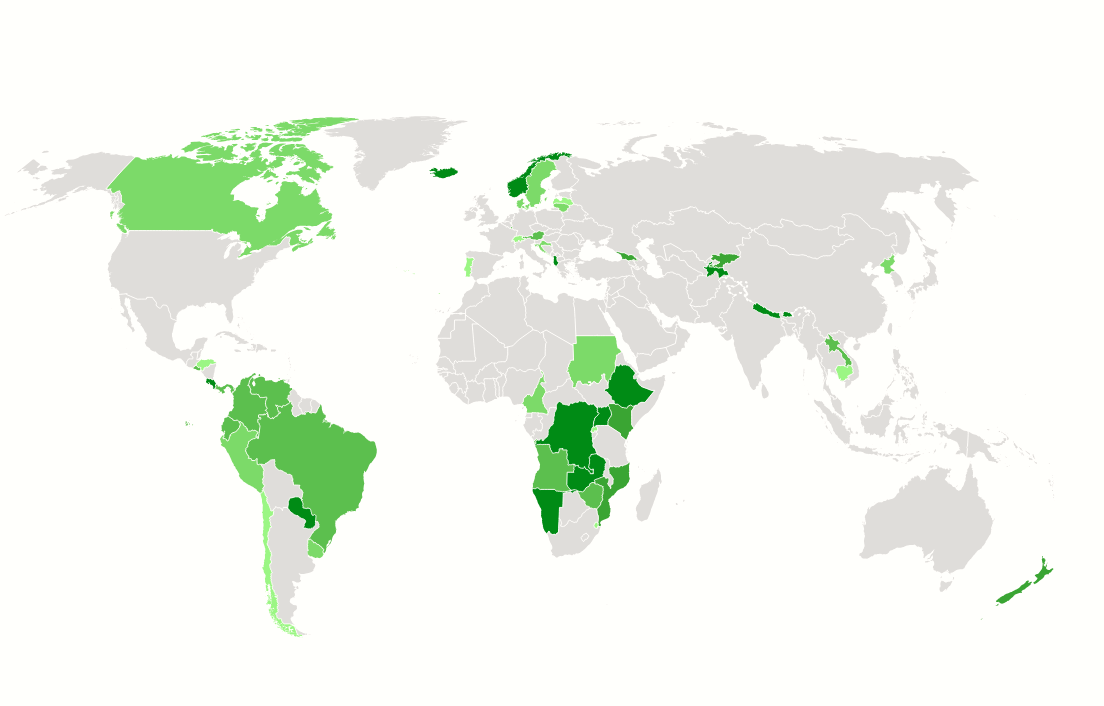
Nearly 50 countries now generate more than 50 per cent of their electricity from renewable energy sources (The Independent)
“These record-breaking figures are a major milestone on Scotland’s journey to net-zero, clearly demonstrating the enormous potential of our world-class renewable energy resources,” Claire Mack, chief executive of Scottish Renewables, said at the time.
While Scotland’s electricity generation was dominated by wind power, researchers predict that solar will come to dominate global electricity supplies over the coming decades.
There has been significant progress in recent years with improving efficiency rates for solar cells, primarily boosted by the so-called ‘miracle material’ perovskite.
Commercial costs have also fallen, which led scientists at the University of Exeter and University College London to claim last year that solar energy has reached an “irreversible tipping point” that will see it become the world’s main source of energy by 2050.
Their 2023 paper, published in the journal Nature Communications, found that technological and economic advances meant the transition to clean energy is not just reachable, but inevitable.
“Due to technological trajectories set in motion by past policy, a global irreversible solar tipping point may have passed where solar energy gradually comes to dominate global electricity markets, without any further climate policies,” the researchers wrote in the study.
“Solar energy is the most widely available energy resource on Earth, and its economic attractiveness is improving fast in a cycle of increasing investments.”