I question the idea of pastoralism though, I would argue this is another kind of construct. Laurel Hatcher Ulrich’s ‘age of homespun’ talks about this in detail, and how handcraft revivals were an expression of fear or anxiety about the radical changes brought about by industrialisation, and became a sort of myth making device for the rejection of technological overlords.
In any case, Paper Computer charts neat reformulation of the personal computer into something more interesting. If all individual computing tasks become distributed back into real spaces, objects and physically manipulable media it becomes more of an interpersonal computer, and distributed computing power can be pushed to things that don’t ordinarily engage with computational tasks such as wind or plants or anything within the shared working environment.
[0] https://www.youtube.com/watch?v=7wa3nm0qcfM [1] https://dynamicland.org/
https://x.com/daviddorg/status/2037050583274954882
UNIX Principle anyone ? Do one thing, and do it well - seems like in this 'age of AI' the industry is rediscovering by detour best practices, decades old, all over again.
But otherwise having 'interfaces' printed out to you and an LLM multi-modal later working from your notes on it sounds really interesting and less stressful than modern 'computing'.
The Office's Michael Scott would be proud - Paper may just be the future of Digital after all!
The only compromise would be a limited area like a physical desktop that had affordances like an overhead camera and some form of paper output.
(My blog post btw if you’re curious https://bhave.sh/make-humans-analog-again/)
Just the other day, I noticed my thinking was so hijacked by distractions while building something (with AI help) that I started writing in a notebook to stay on track. The last time I'd written in the notebook was 3 years ago; in this case writing stuff down in it really helped to get me unstuck.
I'm excited to imagine workflows that could make computing a more physical activity. Thanks for writing and sharing this.
I see this seemingly everywhere. People are looking for these extreme solutions to solve the problem of getting distracted by an app like Instagram or TikTok on their phone. Wouldn’t uninstalling the app, and going a step further, deleting the account, be the more pragmatic solution here? We control what is installed on our devices, what accounts we have, and which notifications we receive. If someone has enough agency to move to a pen and paper, surely they can uninstall some apps?
While I like the idea of having a magic paper notebook that would somehow interact with computer systems, that idea seems like mostly science fiction without having significant levels of technology all around you (cameras, projectors, etc) which would kind of defeat the purpose imo.
I watched the first video on Dynamic Land and I think I’d feel very uncomfortable in a room like that. Look the wrong way and catch a projector’s light in the eye, and once big tech gets into the game, who knows what happens with all the data from the cameras. I’ve grown rather paranoid.
A phone with just utilities installed, no social media, or going a step further to something like an e-ink tablet (something like Remarkable), seems like it would get most of the way there and actually work today. The biggest concern then becomes the web browser, but the big tech companies do most of the work for us by making sites insufferable to use while logged out and without an app.
Something might be able to get rigged up with RocketBook as well, for an actual pen on paper experience, but having to take a picture of the pages is kind of a pain. I have one and the novelty wore off very quickly; it has sat in a drawer for years now.
I’ve struggled with this idea a bit myself, as I sometimes romanticize the idea of using analog tools, but when they exist alone on an island, that seems to come with some considerable downsides in the modern world.
Apple Notes can be good for some of this too. Instead of using ChatGPT, Apple Notes can use the phone camera to do live OCR on text and add it into a note. I’ve used it a couple times and it’s pretty handy, when I remember it.
Also, check the spirograph too, among the slide ruler and any abacus.
It's essentially a poor man's hacked up DynamicLand - projector, camera, live agent. There are so many things you could do if you had a strong working baseline for this. My kids used it to create stories, learn how to draw various things, and watching safe videos they could hold in their hand.
There's something weirdly compelling and delightfully physical about holding a piece of paper that shows a live rocket launch, with the flames streaming down the page. It could also project targeted pieces of text, such as inline homework advice, or graphs next to data. It doesn't take long to imagine any other number of fun use cases, and it feels a lot more freeing and inspiring than keeping everything bound to a screen.
Github - https://github.com/Pugio/Orly (hacky minimal prototype that did the thing)
Video Pitch - https://youtu.be/-9l1x7GnmxU (filmed an hour before the deadline on an old phone with no sleep)
This reminds me of those predictions from 1900 about the year 2000, when they thought we'd all live in enormous skyscrapers and get around by flying cars. Instead we moved out to suburbs because improved logistics systems meant we could buy things from suburban shopping centres rather than having to go into city centres. Revolution, not evolution.
Surely the real advantage of an 'actually good AI' would be getting the AI to do the work itself, rather than just allowing the work to be done in a format with which the human is more comfortable. The underlying problem is that there are too many things vying for our attention.
Human picks up all the sheets out of the printer, writes out replies with pen
Human puts the stack of answered email sheets in a multi-page scanner
Scanner physically scans them, agent transcribes them and matches them back to the incoming emails via the unique ID on each sheet, sends replies
You could adjust this flow for anything where human input is just one part of a larger sequence: just add print -> write -> scan into your flow where you'd normally have a human type. It's kind of a rebirth of faxing
Using paper and space to organize ideas is nice, but that's a niche use-case. And in any case, you'll have to digitalize it anyway afterwards, so better start on the digital version immediately, and be good at it. Everytime I start a new project, I'm tempted to take a pencil and paper, but then I refrain and use draw.io or the like because I know it will be winning on the longer run.
For the rest, you can easily customize your phone / browser / anything to be less distracting.
As for using AI just for convenience, this looks like very expensive in terms of resource.
That said, I do much prefer reading on paper, or at least on e-ink, for many of the same reasons outlined in the post. Computers and phones are just too distracting, and too dynamic.
And I'd love some way to write down shopping lists or appointments, and have them available wherever, without having to pull out the phone. Our current method is a whiteboard + a photo whenever we need it, which doesn't quite cut it.
If you don't mind me asking, what hardware did you use? Especially for the project, I'm guessing it needs to have quite a strong bulb in order to be seen in broad daylight?
When I showed her the reply button in Eudora (this was in 2001), she was so happy that she bought me a cake.
She struggled with IT but was tack sharp otherwise. So far she's the only boss I've ever really liked.
Emacs, and technologies built on it, such as org-mode, come somewhat close to ideas expressed here by having plain text in a buffer be the unifying data format. You can organize stuff by just moving snippets of text around.
I think it's difficult in practice to design data manipulation interfaces based on real-world objects because atoms are heavy and bits are not. Data is just much more malleable and transformable than real world objects, at least at the pre-Diamond Age tech level we're at. But maybe ML will help make this easier by allowing computers to track and scan the objects more easily.
Although the cardboard implementation is kind of the point, I think it's cool that someone made an FPGA version (dead link though, RIP drdobbs.com).
It sounds like the author is on the same track, has the same mindset. And I like.
I am also reminded of the book in Neil Stephenson's Diamond Age. It is not exactly what the author describes but, if the book had a computer backend, does divorce the user from the computer interface we have come to know. Perhaps for me some future (better) local LLM within such a book is what I want. A kind of companion I ask questions of…
(I mean I suppose I should just do what was posted a day or to ago to the Ask HN: and put a local LLM behind a messaging app and I could just converse with it wherever I am. Tangent: I am kind of fascinated by the idea of a personal LLM that has context stretching back to my earliest days—were I to have started conversing with this synthetic companion at a young age. Imagine the lifetime of context where the LLM knows my habits, how I've changed over the years. I suppose this is nightmare fuel for a number of you.)
Just a simple:
> Folk Computer is a research & art project centered around designing new physical computing interfaces.
From ./notes/tableshots.txt with a link towards the top would imo be quite helpful.
(Sorry, this is just one of my pet peeves: needing to know what a project is about before being able to read about it is just terrible UX, although extremely common as we as humans tend to forget that we know things others don't)
Now that we have actually good AI, I have this vision of a form of computing that doesn’t involve me using a computer so much. Imagine you had the day’s emails to go through. It would be nice if the ones that required a simple decision could be dispatched with a few pen-strokes: I could write down a date that would work for that meeting; check a box to accept that invitation; etc. If an email required me to review a draft, I'd love to mark up a print version on my couch, sans screen, and have those notes scanned and sent off as if I'd done the whole thing on Google Docs.
The point is not to give up on virtuality, but just to save the end user from having to interact with it. It's great to be able to send information to anyone in the world instantly; but let me do it without the glaring screen and the thousand distractions. Is such a thing even possible? I'm not sure, but I just now uploaded a first draft of this post, handwritten in a small notebook, into ChatGPT. Its transcription was nearly perfect.
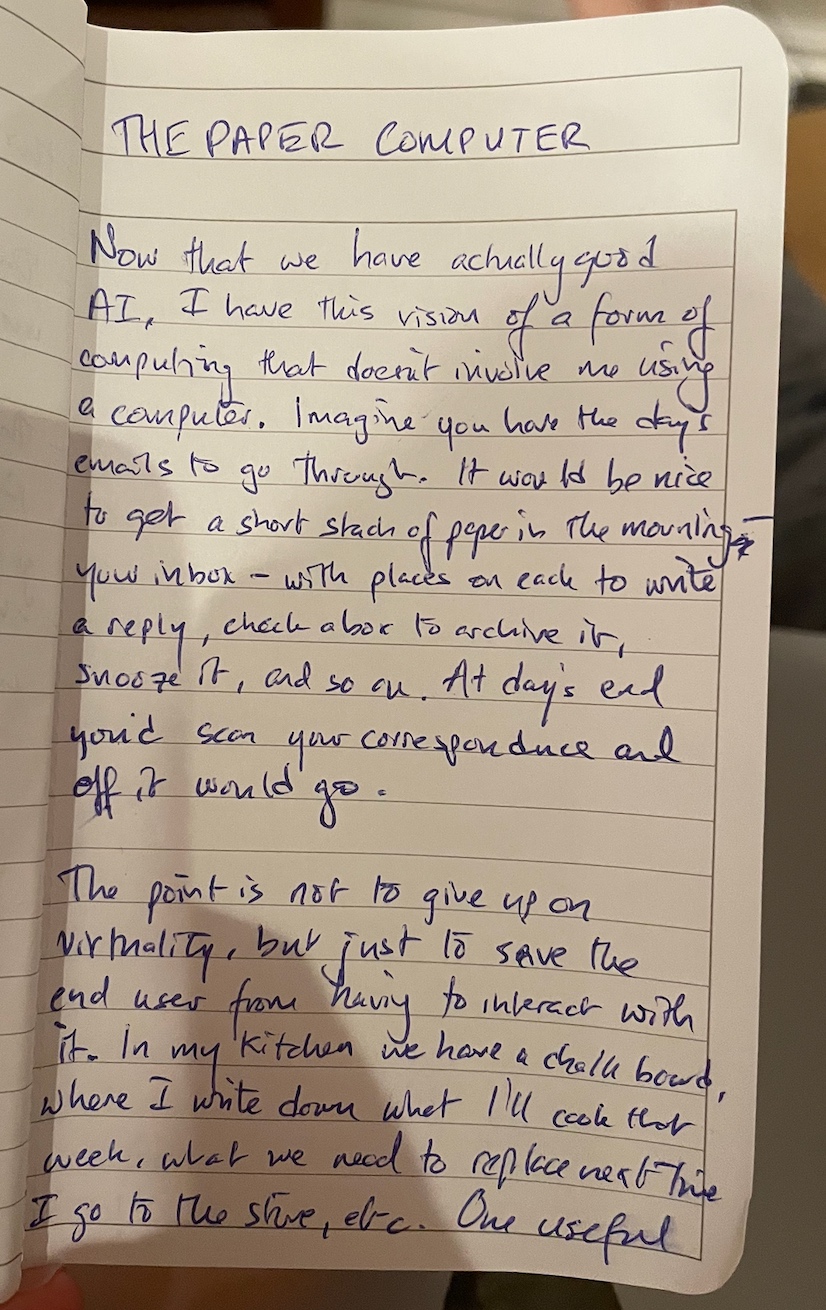
A first draft of this blog post
Here's another example: when I really want to play with re-arrangements of a complicated outline, or when I want to collaborate with someone else on one, I find myself laying physical note cards on a table. Having real objects to work with allows for more flexibility than software. If the problem demands it, you can stack cards, draw on them, cut them, tape things to them, etc.—and none of these improvised ways of organizing has to be coded up in advance.
Space turns out to be a good way to organize information. I gather that in the paper days if you had a big project you were working on, say a book, it would spill out into the room you were working in: chapter outlines pinned up on the walls, stacks of books in meaningful piles on the floors, folders with drafts and clippings. Certain sections of the work in progress would become associated in your mind with certain parts of the room. Chapter 3 would be over there.
I rarely use paper or physical space this way because it lacks critical conveniences. A huge wall-mounted paper calendar is maybe the best way to plan and visualize a large coordinated effort. (In "making-of" documentaries you find that movie shoots are often planned this way.) Everyone can see it and point to it because it's at human-scale; you can express many dimensions of information simultaneously using shape, color, position, size, and any other physical attribute. But I have a hard time understanding how I'd keep such a calendar up to date. In practice, like almost everyone else, I use a virtual calendar that automatically adds events as I'm invited to them, syncs with other people's calendars, reconciles time zones effortlessly, and interoperates with other programs like email.
Could we get the best of both worlds? In other words, shouldn't one goal of rapid technical advancement be some melding of the physical and virtual worlds such that I can sit quietly in an easy chair with pen and pad; or lay cards out on a table to organize my thoughts; or turn a room into the embodiment of a project; and yet have the same flexibility, portability, persistence, and remixability as in the digital versions of these things?
I spend a lot of my day on screens. There are many problems with these things, articulated well by Bret Victor in the context of his Dynamicland project. Screens are small, antisocial, and they have a tiny vocabulary of affordances compared to physical objects. Plus they have the problem that they make it difficult to just use your calendar, todo list, or map—or even just respond to a friend's message—without encountering something else along the way, like a social network, short-form video, Slack, the news, or some other notification. To state the obvious: your phone is the best place to keep your calendar and inbox and todo list because you always have it with you, but of course that makes it ripe for other intruders. Bundling makes your phone indispensable, but also a menace.
If nothing else I'd like it if operating systems and web browsers helped me be less distracted and frenetic, instead of encouraging exactly that multi-tasking freneticism. When I opened my phone or computer, it'd be nice if it was constrained to operate in a mode purpose-built for whatever task I intended to use it for. If I want to look something up, for instance, my phone should be a look-up machine (ie no texts, no apps, no ads, just a place for my question and the answer). If I want to compose a word of the day entry, I should launch straight into a browser with the tabs I regularly use for that, including the CRM, Webster's dictionary, and the OED; if I want to work on an article, my computer should assume the form of a typewriter, word processor, or McPhee mode note-processor depending on what stage I'm at. In each of these modes everything else should disappear, inaccessible. At least then you could mimic in software that thing you get from physical objects—which is that they are usually built to do one, and only one, thing well. My alarm clock, for instance, is just an alarm clock; and that's what I like about it!
Not too long ago I spoke to a roboticist for an article I was writing, who worked with large autonomous earth-moving machines—e.g. a retrofitted excavator that could lift a boulder, scan its every edge and dimple, then model how it would settle amongst other boulders in a retaining wall before placing it there. He imagined a future in which such machines enabled a return to natural materials in the built world. He talked about old stone walls he’d seen in New England. Those walls, made of loose rocks found in situ, are lovely and sturdy, and adaptive—constantly rebuilt as farmers go about their work and notice areas that need patching up, adding stones they find lying around. But this is the very reason such walls aren't really built anymore. They're too labor-intensive. We live in a prefab world because the scarce thing now is not material or money but "the works and days of hands."
I am moved by the idea that our future could feel less futuristic than pastoral. High tech could save us from high tech. We'd go back to the old interfaces without giving up the conveniences of the new ones. Read, write, communicate, create—and hardly ever see or touch a screen.
I'm not sure that'll happen or be what people want. But shouldn't we be thinking of ways to use the new magic to spend less time tapping and clicking?