What seems to have happened here is that the storage allocator underneath is unverified. That, too, has a relatively simple spec - all buffers disjoint, no lost buffers, no crashes.
Type checking allows you to (outside of type casting such as in languages like C/C++ and casting to object for generic containers in Java) verify that an object is of a given type. That allows you to be sure that a well-formed program isn't doing things like putting a random object in a list.
Languages like C#, Scala, and Kotlin improve Java generics by making the generic type of a container or other interface/type part of the type system. This allows generic types of a generic type to preserve the inner type. This makes it possible to implement things like monads and mapping functions to preserve the generic type.
A similar thing is possible with union types, sealed interfaces/traits, etc. that allow you to check and verify the return type instead of defaulting it to a generic object/any type.
Likewise with other features like nullable/non-null annotations (or corresponding nullable type annotations like in Kotlin and recent C# versions).
All of these can be abused/circumvented, but if you keep your code within that framework the compiler will stop that code compiling. Likewise, these solve a limited set of bugs. For example, nullable types can't verify memory management and related bugs.
That being said, using a coding agent to direct fuzzying and find bugs in the Lean kernel implementation is the big news here. (After all the kernel's implementation is not proved.)
The moral of the story is to push for more verified code not less and try AI bug hunting.
> Every Lean proof assumes the runtime is correct.
No. Every valid Lean proof assumes that if the runtime/mathlib etc is correct, then it too is correct.
Tangentially also, most lean proofs are not dependent on whether or not the runtime has things like buffer overflows or denial of service against lean itself at all, because if I prove some result in Lean (without attacking the runtime) then a bug in the runtime doesn’t affect the validity of the result in general. It does mean however that it’s not ok to blindly trust a proof just because it only relies on standard axioms and has no “sorry”s. You also need to check that the proof doesn’t exploit lean itself.
I'm genuinely excited about AI agents and formal verification languages. To me it's obviously the way forward instead of moonshots trying to make agents that program in their own AI blackbox binary, or agents that code in current programming languages.
If we are heading in the direction of "huge codebases that nobody has written", or, "code is an artifact for the machine", I don't see a way out without making it proved.
If humans can review and edit the spec, then verify that the implementation matches it, suddenly leaving the implementation be an artifact for the machines seems okay
The downside of provers also being that they are a massive pain in the ass that very few want to use, this is also a complete win.
"Lean proves other program correct but not itself"
Regarding the DoS in the lean-zip application itself: I think this is a really neat example of the difficult problem of spec completeness, which is a subcase of the general problem (mentioned by porcoda in a sibling comment) of being sure that the spec is checking the right things. For a compression program, the natural, and I would also say satisfyingly beautiful thing to prove is that decomp(comp(x)) = x for all possible inputs x. It's tempting to think that at that point, "It's proven!" But of course the real world can call decomp() on something that has never been through comp() at all, and this simple, beautiful spec is completely silent on what will happen then.
Tsk, tsk.
I've come across issues in the past which weren't actually bugs. For example, the software was behaving exactly as intended but it looked like a bug to a user who didn't understand the nuances and complexities of what was happening.
I also cannot count how many times a non-technical person asked me to implement conflicting functionality or functionality which would have made the UX incredibly confusing for the user.
https://news.ycombinator.com/item?id=12761986 (being this link more than 10yrs old is not surprising)
If you have a spec that isn’t correct, you can certainly write code that conforms to that spec and write proofs to support it. It just means you have verified a program that does something other than what you intended. This is one of the harder parts of verification: clearly expressing your intention as a human. As programs get more complex these get harder to write, which means it isn’t uncommon to have lean or rocq proofs for everything only to later find “nope, it has a bug that ultimately traces back to a subtle specification defect.” Once you’ve gone through this a few times you quickly realize that tools like lean and rocq are tricky to use effectively.
I kinda worry that the “proof assistants will fix ai correctness” will lead to a false sense of assurance if the specs that capture human intention don’t get scrutinized closely. Otherwise we’ll likely have lots of proofs for code that isn’t the code the humans actually intended due to spec flaws.
> The two bugs that were found both sat outside the boundary of what the proofs cover. The denial-of-service was a missing specification. The heap overflow was a deeper issue in the trusted computing base, the C++ runtime that the entire proof edifice assumes is correct.
Still an interesting and useful result to find a bug in the Lean runtime, but I’d argue that doesn’t justify the title. Or the claim that “the entire proof edifice” is somehow shaky.
It’s important to note that this is the Lean runtime that has a bug, not the Lean kernel, which is the part that actually does the verification (aka proving). [1] So it’s not even immediately clear what this bug would really apply to, since obviously no one’s running any compiled Lean code in any kind of production hot path.
[1] https://lean-lang.org/doc/reference/latest/Elaboration-and-C...
As an aside, why can't people just write factually? This isn't a news site gamed for ad revenue. It's also less effort. I felt this post was mostly an insulting waste of time. I come to HN to read interesting stuff.
What I'd actually want from the tooling is a machine-checkable statement of the envelope itself, propagated as a runtime guard rather than a compile-time comment. Then "proof holds" and "we are still inside the proof's domain" are two separate, observable properties, and the unverified-parser / unverified-runtime cases stop being invisible.
Update: Actually, I guess this may have been her point: "The two bugs that were found both sat outside the boundary of what the proofs cover." So then I guess the title might be a bit click baity.
They used an AI agent sending ideas to a fuzzer and discovered a heap buffer overflow in Lean. This is big.
"This is genuinely one of the most memory-safe codebases I've analyzed."
Before everyone starts blabbing about formal verification, etc., consider this: how do you know that you didn't make a mistake in your formal verification? IOW, how do you know your formal verification is bug-free? Answer: you don't. Or if you try to formally verify your formal verification then you're just translating the problem to a new layer. It's just a chain of proofs that is always ultimately based on an unproven one, which invalidates the whole chain.
You can get asymptotically close to zero-bug proof, but you can never get there 100% of the way.
I notice two classes of bugs in my own programs:
- I meant the code to do X, but it does Y
- I meant the code to do X, and it does X, but X causes problems I didn't foresee
A proof assistant can help you prove the code does X, but it can't help you prove doing X doesn't cause problems you didn't foresee.
In other words, it can prove the soundness of the implementation, but not the design?
Is that right? Though I imagine if there are internal contradictions in the design, lean would catch those too.
So the issue would be "internally consistent yet incorrect designs"?
In the case of TFA, the issue was exhaustiveness, right? "What happens if..."
That sounds like a pretty important quality as far as security goes. Is there a way to make sure everything is actually verified?
I heard actually verifying everything is prohibitively expensive though, like it took 10-20 years to verify seL4 (10K LoC).
To illustrate, let's say you want to verify a "Hello world" program. You'd think a verification involves checking that it outputs "Hello, world!".
However, if a contractor or AI hands you a binary, what do you need to verify? You will need to verify that it does exactly print "Hello, world!", no more, no less. It should write to stdout not stderr. It shouldn't somehow hold a lock on a system resource that it can't clean up. It cannot secretly install a root-kit. It cannot try to read your credentials and send it somewhere. So you will need to specify the proof to a sufficient level of detail to capture those potential deviations.
Broadly, with both bugs, you need to ask a question: does this bug actually invalidate my belief that the program is "good"? And here you are pulling up a fact that the bug isn't found in the Lean kernel, which makes an assumption that there's no side-effect that bleeds over the abstraction boundary between the runtime and the kernel that affects the correctness of the proof; that safety guarantee is probably true 99.99% of the time - but if the bug causes a memory corruption, you'd be much less confident in that guarantee.
If you're really serious about verifying an unknown program, you will really think hard "what is missing from my spec"? And the answer will depend on things that are fuzzier than the Lean proof.
Now, pragmatically, there many ways a proof of correctness adds a lot of value. If you have the source code of a program, and you control the compiler, you can check the source code doesn't have weird imports ("why do I need kernel networking headers in this dumb calculator program?"), so the scope of the proof will be smaller, and you can write a small specification to prove it and the proof will be pretty convincing.
All in all, this is a toy problem that tells you : you can't verify what you don't know you should verify, and what you need to verify depends on the prior distribution of what the program is that you need to verify, so that conditional on the proof you have, the probability of correctness is sufficiently close to 1. There's a lesson to learn here, even if we deem Lean is still a good thing to use.
Well, Lean is written in Lean, so I am pretty sure a runtime bug like this could be exploited to prove `False`. Yes, since the kernel is written in C++, technically it's not the part affected by this bug, but since you cannot use the Lean kernel without the Lean compiler, this difference does not matter.
> That means proving the absence of bugs, and you cannot prove a negative. The best thing you can do is fail to find a bug, but that doesn't mean it isn't there.
You can conclusively (up my next point) prove a specific bug or class of bugs aren't there. But "entirely free of (all) bugs" is indeed a big misconception for what formal methods does.
> how do you know your formal verification is bug-free? Answer: you don't. Or if you try to formally verify your formal verification then you're just translating the problem to a new layer. It's just a chain of proofs that is always ultimately based on an unproven one, which invalidates the whole chain.
It's another misconception of formal methods to say that any result is established conclusively, without any caveats whatsoever. But then again neither is mathematics, or any other intellectual discipline. What formal methods does is reduce the surface area where mistakes could reasonably be expected to reside. Trusting the Rocq kernel, or a highly scrutinized model of computation and language semantics, is much easier than trusting the totality of random unannotated code residing in the foggiest depths of your average C compiler, for instance.
For example it's extremely easy to prove there is no square with diagonals of different lengths. I'm the hard end, Andrew Wiles proved Fermat's Last Theorem which expresses a negative.
That's just a nit though, you're right about the infinite regress problem.
You can prove that the program implements a specification correctly. That doesn't require proving a negative, but it does prove the absence of bugs. (I think you know this argument is weak, since your next paragraph is a complete non-sequitur)
> Or if you try to formally verify your formal verification then you're just translating the problem to a new layer. It's just a chain of proofs that is always ultimately based on an unproven one, which invalidates the whole chain.
All proofs ultimately rest on axioms. That's normal and not really an argument unless you want to doubt everything, in which case what's the point in ever saying anything?
The question of who validates the validator is real, but the abstraction of "formal verification" does serve a purpose, like any good mathematical or programming abstraction. Whole classes of bugs are removed; what's left to verify is usually much shorter.
Even with the addition of two numbers the execution of a program can be wrong if the CPU has a fault or if the runtime of the program has a bug.
I think you just need to look at why formal verification exists.
By your logic, it's impossible to prove that a car is driving at 60mph. There could be an error in the speedometer which makes it impossible to verify that said car is going at the speed. You can get asymptomatically close to being sure that you're driving at 60 mph but you can never be 100% sure.
This is useless and serves no purpose.
although, this is the best example of how quickly a trivality can knock so called "correct" programs over.
I can build applications rapidly but the requirements and UX are the bottleneck. So much so that I often like to sit on a concept for multiple days to give myself the time to fully absorb the goal and refine the requirements. Then once I know what to build, it snaps together in like 4 hours.
There are a lot of ambiguities which need to be resolved ahead of time. Software engineering becomes a kind of detailed business strategy role.
Wikipedia: [1] Turing proved no algorithm exists that always correctly decides whether, for a given arbitrary program and input, the program halts when run with that input. The essence of Turing's proof is that any such algorithm can be made to produce contradictory output and therefore cannot be correct.
But that's not saying the proofs are an issue - usually the spec you can reasonably prove in lean or another prover, say TLA+ or Z3 depending on your kind of program - has to be overly simplified and have a lot of assumptions.
However, that is powerful.
It doesn't mean your program doesn't have bugs.
It means this big scary complicated algorithm you think works but are skeptical doesn't have bugs - so when you encounter one, you know the bug is elsewhere, and you start really looking at the boundaries of what could be misspecified, if the assumptions given to the prover are actually true, etc.
It eliminates the big scary thing everyone will think is the cause of the bug as the actual cause.
This has been insanely valuable to me lately. It is also something I never really was able to do before the help of AI - vibe coding proofs about my programs is IMO one of the killer apps of AI, since there aren't a ton of great resources yet about how to do it well since it is rarely done.
You have a program that does something and you write another program to prove it. What assurance do you have that one program has fewer bugs then the other? Why can one program have bugs but the other can't? How do you prove that you are proving the right thing? It all sort of ties into Heisenberg's uncertainty theorem. A system cannot be fully described from within that system.
Don't get me wrong, I think these are great systems doing great work. But I always feel there is something missing in the narrative.
I think a more practical view is that a program is already a sort of proof. there is a something to be solved and the program provides a mechanism to prove it. but this proof may be and probably is incorrect, as bugs are fixed it gets more and more correct. A powerful but time consuming tool to try and force correctness is to build the machine twice using different mechanisms. Then mismatched output indicates something is wrong with one of them. and your job as an engineer is to figure out which one. This is what formal verification brings to the table. The second mechanism.
If a buffer overflow causes the system to be exploited and all your bitcoins to be stolen, I don't think the fact that the bug being in the language runtime is going to be much consolation. Especially if the software you were running was advertised as formally verified as free of bugs.
Second, there was a bug in the code. Maybe not a functional correctness bug, but I, along with many and most end users, would consider a crashing program buggy. Maybe we just have different tastes or different standards on what we consider an acceptable level of software quality.
W.r.t people running Lean in production, you'd be surprised...
I think we need a way to verify the specs. A combo of formal logic and adversarial thinking (probably from LLMs) that will produce an exhaustive list of everything the program will do, and everything it won’t do, and everything that is underspecified.
Still not quite sure what it looks like, but if you stipulate that program generation will be provable, it pushes the correctness challenge up to the spec (and once we solve that, it’ll be pushed up to the requirements…)
https://kirancodes.me/posts/log-who-watches-the-watchers.htm...
You can see the clickbaitiness increases over time.
Ignorant question: why not? Is there an unacceptable performance penalty? And what's the recommended way in that case to make use of proven Lean code in production that keeps the same guarantees?
This is so reductive a framing as to be essentially useless [0]. I think maybe you want to learn more about program correctness, formal verification, and programming language semantics before you make such statements in the future.
[0] See, e.g., type-checking.
Not possible for all problems. We cannot decide correctness (ie adherence to a specification) for all programs, but we can definitely recognize a good chunk of cases (both positive and negative) that are useful.
The Halting Problem itself is recognizable. The surprising result of Turing’s work was that we can’t decide it.
Surely you are talking about Godel incompleteness, not Heisenberg's uncertainty principle; in which case they're actually not the same system - the verification/proof language is more like a metalanguage taking the implementation language as its object.
(Godel's observation for mathematics was just that for formal number systems of sufficient power, you can embed that metalanguage into the formal number system itself.)
Common static types prove many of the important properties of a program. If I declare a variable of type String then the type checker ensures that it is indeed a String. That's a proof. Formal verification takes this further and proves other properties such as the string is never empty.
Common static types are very effective. Many users of Rust or Haskell will claim that if a program compiles then it usually works correctly when they go to run it.
However there is a non-linear relationship between probability of program correctness and the amount of types required to achieve it. Being almost certain requires vastly more types than just being confident.
That's the real issue with formal verification, being 75% sure and having less code is better than being 99% sure in most situations, though if I were programming a radiotherapy machine I might think differently.
A bug in the formal verification tool could be potentially noticed by any user of that formal verification tool. (And indirectly by any of their users noticing a bug about which they say "huh, I thought the tool told me that was impossible.")
A bug in your program can only be potentially noticed by you and your users.
There are also entirely categories of bugs that may not be relevant. For instance, if I'm trying to prove correctness of a distributed concurrent system and I use a model+verifier that verifies things in a sequential, non-concurrent way, then I don't have to worry about the prover having all the same sort of race conditions as my actual code.
But yeah, if you try to write your own prover to prove your own software, you could screw up either. But that's not what is being discussed here.
I often think of the ‘news level’ of a bug. A bug in most code wouldn’t be news. A bug which caused lean to claim a real proof someone cared about was true, when it wasn’t, would in the proof community the biggest news in a decade.
Why?
Are you saying that all the programs ever written have the exact same chance of bugs? A hello world is as buggy as a vibe-coded Chromium clone?
If you accept the premise that different programs have different chances to have bugs, then I'd say:
1. Simpler programs are likely less buggy.
2. Programs used by more people are likely less buggy.
3. Programs maintained by experts who care about correctness are likely less buggy.
4. Programs where the stakes are higher are likely less buggy.
All things considered, I think it's fair to say Lean is likely less buggy then a random program written by me at weekend.
> Heisenberg's uncertainty theorem
It has nothing to do with the uncertainty principle. If you think otherwise, it means your understanding of uncertainty principle comes from sci-fi :)
Even if it is, the verification is still very useful. The verifier is going to run for a few minutes and probably not hit many edge cases. The chance it actually hits a bug is low, and the chance a bug makes it wrongly accept your program is a lot lower. Especially if it has to output a proof at the end. Meanwhile it's scrutinizing every single edge case your program has.
Say more about people running Lean in production. I haven’t run into any. I know of examples of people using Lean to help verify other code (Cedar and Aeneas being the most prominent examples), but not the actual runtime being employed.
I took a quick scan of lean-lang.org just now, and, other than the two examples I mentioned, didn’t see a single reference to anything other than proving math.
I’m sure you’re in the Lean Zulup, based on what you’ve been up to. Are you seeing people talk about anything other than math? I’m not, but maybe I’m missing it.
It runs (maybe crashes), therefore … it exists.
The tension between spec bugs vs. implementation bugs is real. But i will take a bug in a situation where the implementation has been verified any day.
Working over what we really want is problem solving in the problem domain.
As apposed to going into the never ending implementation not-what-we-were trying to solve weeds.
Reminds of what some people in the Rust community do: they fight how safe this is or not. I always challenge that the code is composed of layers, from which unsafe is going to be one. So yes, you are righ to say that. Unsafe means unsafe, safe means safe and we should respect the meaning of those words instead of twisting the meaning for marketing (though I must say I heard this from people in the community, not from the authors themselves, ever).
That sounds like quite the monthly bill. o_O
Are we baiting people with headlines now?
It's called clickbait.
On the other hand, I've discovered thousands of bugs that weren't hardware bugs, and dozens of bugs due to people not having read hardware errata documents, so just formally modeling what we can model will absurdly reduce the bug quantity.
LLM's are capable of producing code that passes formal verification.
The writing is on the wall: in the future more and more software on the abstract or platonic side of our computing base will be hermetically sealed against bugs and exploits. This quenching of bugs in the assured side will shift the mean location of bugs closer to the hardware side: at some point bugs and exploits will rely more and more on hardware quirks, and simply unspecified hardware.
Afterwards we can expect a long exponential decay of preventable safety violations: people mistakenly or surreptitiously disengaging the formal verification steps and shipping malicious or unverified code. Each such event will be its own big or small scandal, at some point there will be no deniability left: something must be on purpouse, either a malicious vulnerability or intentional disengagement of safety measures.
As the attack surface recedes towards the lower level hardware stack, it will open the debate that the community needs proper formal hardware descriptions (at least at the interface initially, not necessarily how the hardware has implemented it). As interface bugs get formalized 3 things can happen:
either vulnerabilities go extinct, and full formal hardware descriptions are not released
or vulnerabilities remain in each new generation of hardware, and malicious intent or negligence on behalf of the manufacturer can only be presumed, this will set up the community against manufacturers, as they demand full hardware descriptions (verilog, VHDL,...).
or vulnerabilities are tactically applied (vulnerabilities appear extinct to the bulk of the population, but only because manufactured vulnerabilities are sparingly exploited by the manufacturing block)
It is hard to predict what is more valuable: embedding HW vulnerabilities for the status quo and being able to exploit it for while before the public demands full hardware IP descriptions (verilog, VHDL) etc. or facing the end of vulnerabilities a little sooner but keeping hardware IP private (if the bugs stop with full interface descriptions).
"There are no squares with diagonals of different lengths"
"All squares have diagonals of equal lengths"
Similarly, I can rephrase the statement about the absence of bugs. These are equivalent:
"This program has no bugs"
"This program always does exactly what it is supposed to do"
If you think you can't prove the first statement, then go ahead and prove the second one.
Are people thinking of falsification when talking about "proving negatives"? I.e. you can only falsify statements about the physical world, never prove them.
Linking back to the parent statement, it's hard to prove a program has no bugs when there is always the possibility the bug just hasn't been found yet. On the flip side it's easy to prove something does have bugs as soon as you find one.
This surprises me. Formal verification so far has been a very niche thing outside of conventional type systems. I didn't think lack of vibe coding was much of a bottleneck in the past. Where do you use it?
forall paths P from A to B:
len(shortest(A,B)) <= len(P)
That's much simpler than any actual shortest path algorithm.I agree, but it’s not fair to imply that the verification was incorrect if the problem lies elsewhere.
This is a nice example of how careful you have to be to build a truly verified system.
Yes, and that would be relevant if this was a verified software system. But it wasn't: the system consisted of a verified X and unverified Y, and there were issues in the unverified Y.
The article explicitly acknowledges this: "The two bugs that were found both sat outside the boundary of what the proofs cover."
Formally-verified software is usually advertised "look ma no bugs!" Not "look ma no bugs*" *As long as this complicated chain of lemmas appropriately represents the correctness of everything we care about.
In boating theres often debate of right of way rules in certain situations, and some people are quick to point out that giant tanker ships should be giving way to tiny sailboats and get all worked up about it*. The best answer I've heard: they're dead right! that is to say as right as they are dead (if they didnt yield) lol. In the same vein, I think someone who assumed that a formally-verified software was perfect and got hacked or whatever is going to be a bit wiggly about the whole thing.
* = Technically the rules prioritize the tankers if they are "restricted in ability to maneuver" but everyone loves to argue about that.
If a buffer overflow causes the system to be exploited and all your bitcoins to be stolen, I don't think the fact that the bug being in the language runtime is going to be much consolation. Especially if the software you were running was advertised as formally verified as free of bugs.
Secondly, I did find a bug in the algorithm. in Archive.lean, in the parsing of the compressed archive headers. That was the crashing input.
Nobody should be advertising that. Even ignoring the possibility of bugs in the runtime, there could also be bugs in the verifier and bugs or omissions in the specification. Formally verified never means guaranteed to be free of bugs.
Thats not the main finding of the article however. The main bug found was actually in the lean runtime, affecting all proofs using scalar arrays where the size of the array is not bounded.
> When we speak of bugs in a verified software system, I think it's fair to consider the entire binary a fair target.
Yeah, I would actually agree. We wouldn't want to advertise that a system is formally verified in some way if that creates a false sense of security. I was just pointing out that, by my reading, the title appears to suggest that the core mechanism of the Lean proof is somehow flawed. When I read the title, I immediately thought, "Oooh. Looks like someone demonstrated a flaw in the proof. Neat." But that's not what is shown in the article. Just feels a bit misleading is all.
i have a hard real time system that i would love to try this on, but that's a lot of tools to learn and unclear how to model distributed systems in lean.
also, please add rss so i could subscribe to your blog
Yes, it's still very much a bug. But it has nothing to do with your program being formally verified or not. Formal verification can do nothing about any unverified code you rely on. You would really need a formal verification of every piece of hardware, the operating system, the runtime, and your application code. Short of that, nobody should expect formal verification to ensure there are no bugs.
1/ lean-zip is open source so it's much easier to have more Claude's eyes looking at it
2/ I don't think Claude could prove anything substantial about the zip algorithm. That's what lean is for. On the other side, lean could not prove much about what's around the zip algorithm but Claude can be useful there.
So in the end lean-zip is now stronger!
When I see a title transitioning from "Lean said this proof is okay" to "I found a bug in Lean", I'm intuitively going to think the author just found a soundness (or consistency) issue in Lean.
You can probabilistic say "it's extremely unlikely purple zebras exist" but you can never prove 100% they don't exist. And back to the real example, how can you prove there isn't a bug you just haven't found yet?
When is an OS supposed to halt? When you shut it down, or when you power down the hardware, and no other times. So if you don't do either of those things, then the OS is supposed to run forever. Does that, by itself, mean that the program is incorrect, or that the language is inadequate? No, it means that the definition is worthless (or at least worthless for programs like OSes).
By way of analogy, if there was an article saying "I bought a 1Tb drive and it only came with 0.91 terabits", I think if you started explaining that technically the problem is the confusion between SI vs binary units and the title should really be "I bought a 0.91 terabit drive and was disappointed it didn't have more capacity", technically you'd be right, but people would rightfully eyeroll at you.
I don’t think the author is attempting to decry formal verification, but I think it a good message in the article everyone should keep in mind that safety is a larger, whole system process and bugs live in the cracks and interfaces.
Same way you can count to any finite integer with enough time, but you can never count to infinity.
Those kinds of interactive programs take in a stream of input events, which can be arbitrarily long, but eventually ends when the computer is shut down.
Termination checkers don't stop you from writing these interactive loops, they only stop non-interactive loops
> The most substantial finding was a heap buffer overflow! but, not in lean-zip's code, but in the Lean runtime itself. (emphasis mine)
> The OOM denial-of-service is straightforward: the archive parser was never verified. (me again)
"Lean proved this program correct" vs "I found bugs in the parts that Lean didn't prove was correct". The failure was not in Lean's proof (which as I said is heavily implied by the title), but in ancillary or unverified code.
Do I misunderstand how Lean works? I am by no means an expert (or even an amateur) on Lean or formal systems in general. Surely the first class of bug could be found in any code that uses the framework, and the second class of bug could happen to any system that isn't proven? Does that make sense? Otherwise where's the boundary? If you find a bug in the OS, does that mean Lean failed somehow? How about the hardware? If your definition of a 'formally verified system' goes beyond the code being verified and the most important thing is whether or not you can make it crash, then the OS and the hardware are also part of the system.
Of course bugs are important to users regardless of the cause, but the audience for your article seems to be software engineers and as a software engineer, your article was interesting and you found something useful, but the title was misleading; that's all I'm saying.
I take some comfort from being technically correct though; it's widely accepted by all of us pedants that that is the best kind of correct ;-)
I fuzzed a verified implementation of zlib and found a buffer overflow in the Lean runtime.
AI agents are getting very good at finding vulnerabilities in large-scale software systems.
Anthropic, was apparently so spooked by the vulnerability-discovery capabilities of Mythos, they decided not to release it as it was "too dangerous" (lol). Whether you believe the hype about these latest models or not, it seems undeniable that the writing is on the wall:
The cost of discovering security bugs is collapsing, and the vast majority of software running today was never built to withstand that kind of scrutiny. We are facing a looming software crisis.
In the face of this oncoming tsunami, recently there has been increasing interest in formal verification as a solution. If we state and prove properties about our code using a mechanical tool, can we build robust, secure and stable software that can overcome this oncoming barrage of attacks?
One recent development in the Lean ecosystem has taken steps towards this question. 10 agents autonomously built and proved an implementation of zlib, lean-zip, an impressive landmark result. Quoting from Leo De Moura, the chief architect of the Lean FRO (here):
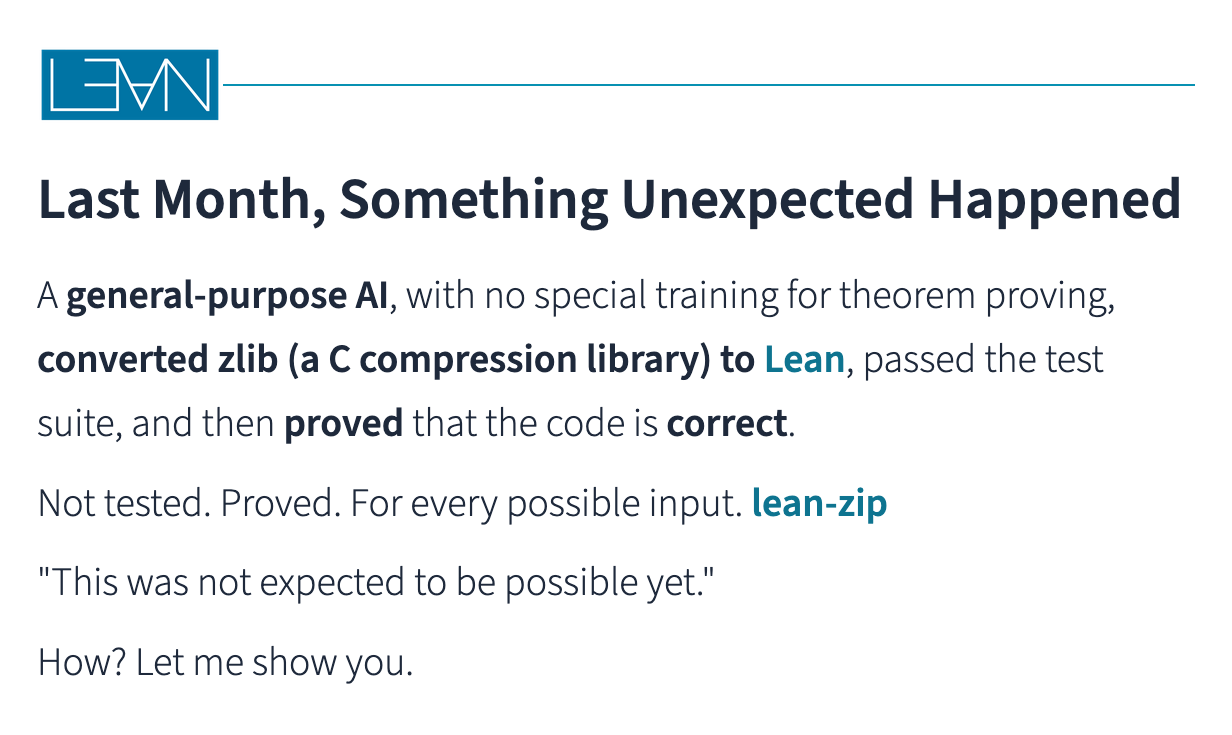
With apologies for the AI-slop (Leo has a penchant for it, it seems), the key result is that lean-zip is not just another implementation of zlib. It is an implementation that has been verified as correct end to end, guaranteed by Lean to be entirely free of implementation bugs.
What does "verified as correct" actually look like? Here is one of the main theorems (github):
theorem zlib_decompressSingle_compress (data : ByteArray) (level : UInt8)
(hsize : data.size < 1024 * 1024 * 1024) :
ZlibDecode.decompressSingle
(ZlibEncode.compress data level) = .ok data
For any byte array less than 1 gigabyte, calling ZlibDecode.decompressSingle on the output of ZlibEncode.compress produces the original data. The decompress function is exactly the inverse of compression. This pair of functions is entirely correct.
Or is it?
I pointed a Claude agent at lean-zip over a weekend, armed with AFL++, AddressSanitizer, Valgrind, and UBSan. Over 105 million fuzzing executions, it found:
lean_alloc_sarray), affecting every version of Lean to date. (bug report, pending fix)lean-zip's archive parser, which was never verified.The setup for the experiment was quite simple. I took the lean-zip codebase and produced a stripped down version and pointed Claude at it.
In particular, as part of the setup: (1) I dropped all theorems and specifications, (2) removed all markdown documentation, and (3) stripped out lean-zip's C FFI bindings to zlib which it provided as an alternative to its native implementation. What remained was purely the verified code: the native Lean definitions for DEFLATE, gzip, ZIP archive handling, and tar. Any bug found in this would correspond to an error in the verified code.
The idea with dropping theorems and documentation was to avoid biasing the Claude agent by revealing that the code was actually verified – I figured if it knew the code "had no bugs" then it might pre-emptively give up, while operating in the blind might let it work through the software without bias.
With the lean implementation accessible through a CLI, I then spun up a server for the fuzzing experiments, pointed Claude at it, and let it go wild.
Over the course of a night, Claude launched 16 parallel fuzzers across the 6 attack surfaces of the library: ZIP extract, gzip decompress, raw DEFLATE inflate, tar extract, tar.gz, and compression. It built separate binaries with AddressSanitizer and UndefinedBehaviorSanitizer, ran Valgrind memcheck, used cppcheck and flawfinder for static analysis, crafted 48 hand-written exploit files targeting known zlib CVE patterns.
Overall, this resulted in 105,823,818 fuzzing executions. 359 seed files. 16 fuzzers running for approximately 19 hours uncovering 4 crashing inputs, and 1 memory vulnerability in the code.
The most substantial finding was a heap buffer overflow! but, not in lean-zip's code, but in the Lean runtime itself.
The vulnerable function is lean_alloc_sarray, which allocates all scalar arrays (ByteArray, FloatArray, etc.) in Lean 4:
lean_obj_res lean_alloc_sarray(
unsigned elem_size, size_t size, size_t capacity
) {
lean_sarray_object * o =
(lean_sarray_object*)lean_alloc_object(
sizeof(lean_sarray_object) + elem_size * capacity
);
// ...
}
For a ByteArray of capacity n, the allocation size is 24 + n. When n is close to SIZE_MAX (2^{64} - 1 on 64-bit systems), the addition wraps around to a small number. The runtime allocates a tiny buffer of around 23 bytes, but the caller proceeds to read n bytes into it.
The overflow can be triggered through lean_io_prim_handle_read, the C function backing IO.FS.Handle.read:
obj_res lean_io_prim_handle_read(
b_obj_arg h, usize nbytes
) {
FILE * fp = io_get_handle(h);
obj_res res =
lean_alloc_sarray(1, 0, nbytes); // overflows here
// ...
usize n = std::fread(
lean_sarray_cptr(res), 1, nbytes, fp
);
// ^^^ 23-byte buffer ^^^ SIZE_MAX count
A 156-byte crafted ZIP file with a ZIP64 compressedSize of 0xFFFFFFFFFFFFFFFF is sufficient to trigger it. The same pattern exists in lean_io_get_random_bytes. The bug affects every version of Lean 4 up to and including the latest nightly (v4.31.0-nightly-2026-04-11). The minimal reproducer is 5 simple lines:
def main : IO Unit := do
IO.FS.writeFile "test.bin" "hello"
let h ← IO.FS.Handle.mk "test.bin" .read
let n : USize := (0 : USize) - (1 : USize) -- SIZE_MAX
let _ ← h.read n -- overflows in lean_alloc_sarray
Edit: there is a pending PR to lean to fix this.
AFL also found a denial-of-service in lean-zip's own code. The readExact function in Archive.lean passes the compressedSize field from the ZIP central directory straight to h.read without validating it against the actual file size (here):
def readExact (h : IO.FS.Handle) (n : Nat) ... := do
-- ...
while buf.size < n do
let remaining := n - buf.size
let chunk ← h.read remaining.toUSize
-- n comes from the ZIP header
-- ...
A 156-byte ZIP claiming a compressedSize of several exabytes causes the process to panic with INTERNAL PANIC: out of memory, as h.read allocates more memory than available. This is indeed a bug: the system unzip handles this gracefully, validating header sizes against the file before allocating, while lean-zip does not and crashes with an OOM.
The OOM denial-of-service is straightforward: the archive parser was never verified. lean-zip's proofs cover the compression and decompression pipeline (DEFLATE, Huffman, CRC32, roundtrip correctness), but Archive.lean, the module that reads ZIP headers and extracts files, has zero theorems even in the original unstripped codebase. The compressedSize field is read from an untrusted header and passed directly to an allocation without validation. The situation is reminiscent of Yang et al.'s CSmith work (PLDI 2011), which found that CompCert's verified optimisation passes had zero bugs while its unverified front-end did. Verification works where it is applied. The archive parser was where lean-zip was not verified.
The heap buffer overflow is more fundamental. lean_alloc_sarray is a C++ function in the Lean runtime, part of the trusted computing base. Every Lean proof assumes the runtime is correct. A bug here does not just affect lean-zip. It affects every Lean 4 program that allocates a ByteArray.
The positive result here is actually the remarkable one. Across 105 million executions, the application code (that is, excluding the runtime) had zero heap buffer overflows, zero use-after-free, zero stack buffer overflows, zero undefined behaviour (UBSan clean), and zero out-of-bounds array reads in the Lean-generated C code. To quote Claude's own assessment of the codebase (without knowing it was verified):
This is genuinely one of the most memory-safe codebases I've analyzed. The Lean type system with dependent types and well-founded recursion has eliminated entire classes of bugs that plague C/C++ zip implementations. The CVE classes that have plagued zlib for decades are structurally impossible in this codebase.
The two bugs that were found both sat outside the boundary of what the proofs cover. The denial-of-service was a missing specification. The heap overflow was a deeper issue in the trusted computing base, the C++ runtime that the entire proof edifice assumes is correct (and now has a PR addressing).
Overall verification resulted in a remarkably robust and rigorous codebase. AFL and Claude had a really hard time finding errors. But they did still find issues. Verification is only as strong as the questions you think to ask and the foundations you choose to trust.
Quis custodiet ipsos custodes?
Would you publish a blog post titled "the XXX test suite proved there was no bug. And then I found one"?
It would be a bit silly, right?
- When they fix the run time, bug A goes away. So the proof still holds and the zlib code is still correct.
- When they add a system of proofs for the parser and modify that, then bug B goes away. So the proof still holds and the zlib code is still correct; and now more of the library is proven correct.
The formulation of the title is "I was told X but that's not true"... but that's not true. You were told X, and X is true, but you found Y and Z which are also important.
But yes, it would be equivalent to stating "No tests failed but I found a bug" and one would correctly deduce that test coverage is insufficient.
There are two different answers to this question, and which one is "correct" depends entirely on the context of who is asking it.
1. It's the code that is specific to this program that sits above the run-time layer (internal view, that most programmers would take).
2. It's the code in the binary that is executed (external view, that most users would take).
The key question does not seem to be "was the proof correct", rather "did the proof cover everything in the program". The answer depends on whether you are looking at it from the perspective of a programmer, or a user. Given the overly strong framing that the article is responding to - highlighting the difference in this way does seem to be useful. The title is correct from the perspective that most users would take.
Then it would help to not introduce any confusion into the ecosystem by using a click-baity title that implies you found a bug which violated the formal specification.
My feeling is that if you told the average non-technical user that some person/organisation had produced a formally verified version of a C compression library, you would likely get a blank look, so I think it's reasonable to assume that both Lean's intended audience, and the audience of the blog post linked here, correspond with number 1. in your list.