Meanwhile, I wish BMD would take a step back and do the housecleaning that Resolve so desperately needs. They threw a bunch of purchased products together on different pages and called it "integrated," when in fact the integration is buggy and janky.
The #1 thing they need to do is integrate all the nodeviews. A single nodeview for all processing would make Resolve a truly groundbreaking product, and undoubtedly eliminate a lot of bugs.
There is a bunch of other stuff I think is interesting in this release's marketting as well. For instance. OGraf, a new EBU standard for HTML in motion graphics systems, as well as Lottie animation support.
The AI blemish remover looks interesting. The AI content search looks interesting. AI Slate ID looks interesting, although I've never actually used a slate. I'm less thrilled to see an AI speech generator though.
There is now Vertical Resolution support. Not something I have particularly wanted to do, but I can see it being useful to a lot of people. Also, the new Picture in Picture tool looks like it might be a time saver, as someone who does a lot of people talking next to slides.
The cinematic color grading seems super cool, can’t wait to give this a try.
I’ve returned to Canon Desktop photo Pro for processing raw, but it’s clunky and Windows and only does canon raw (though I kind of get that). I’m trying DXO on windows some good gpu acceleration, but no Linux. I’ve moved most of my work to Linux, and I did try raw therapy and darktable but it wasn’t intuitive enough and i had to tweak a lot. I’ll pay for a light room alternative (which I bought years ago.. they don’t support new cameras which is how they get you to upgrade.)
I don't know, does Resolve have lens corrections for 100+ lenses built-in? That's the thing that DxO does really well: Lens corrections, matching your camera's color rendering, denoising. Unfortunately, they still struggle with HDR output.
I imagine the tools in Resolve save you much time, due to automation. Probably handy if you shoot a lot. Yet, the biggest difference is that in photography, you're not necessarily limited by throughput. You can and do actually put a lot of effort into single images.
Edit: ofc it couldn't be that easy, need to update some libs to make DaVinci Resolve happy.
Could check this out
Might be the final nail in the coffin for my creative cloud subscription
Only Darktable seemed to push the technical capabilities of photo editing forward (AgX, parametric masks, tone equalizer, etc), while rest of "industry standard" software lagged behind for quite so long, stagnant. Even more so when it comes to "creative" ways of editing, which Video Editing software have adopted for years but photo editors didn't (relight, actual LUT usage without complications, film emulation, halation, other aesthetic effects like VHS film damage, etc).
There's so much we can do. To me, it seems like these sort of conservative culture (photography) vs progressive (video editing). I've been into both worlds, and for some reason video editing software and professionals were much eager to try new stuff and celebrate new ways to shape visuals, compared to photographers.
There are whole guides online how to walk around these issues and even then I could not get the audio working. Somehow it relies on some old ALSA API, which is no longer maintained/supported on Ubuntu/Kubuntu, or I'm just too stupid to make it work. AI assistants could not provide working solution for me either.
I've moved back to Linux a year ago after around 10 years of Windows (and I used to use Linux Slackware for ~15 years beforehand). I am amazed how big progress the KDE made and whole Linux ecosystem. Gaming these days is just as easy as on Windows, which was my primary reason to switch to Windows. My printer just works now. Even music production is excellent on Linux now. There is plenty of great software options to choose from and they just work - as I would expect from the mature ecosystem.
This all feels so good, given how Linux is not pushing trash into my computer (OS-bound spyware/bloatware), has excellent, customizable UI. Full freedom. I do feel that I own my hardware.
Yet I miss DaVinci Resolve. For now I use Kdenlive, which is nice for simple editing, but feels unfinished, or I just don't know how to use it correctly.
> It includes native RAW support for Canon, Fujifilm, Nikon, Sony and even iPhone ProRAW.
I looked all over for a more technical page that just lists these kind of specs in bullet-point form, but apparently they refuse to communicate information about their product in this way? The "Tech Specs" page only seems to show information about hardware products. /shrug
Would be cool to have something I can use to edit my Fujifilm-shot photos without any sort of subscription. Capture One Express (or whatever it's called now) is super light on features, but processes Fujifilm .RAF's very well (oh, or it used to, apparently it's permanently discontinued now, great). I'd love to use Lightroom but I refuse to pay for a subscription to use software, so... options are limited :\
[1] https://images.blackmagicdesign.com/images/products/davincir...
Kind of stoked to see this release even though I've transitioned to a 100% open source photo workflow on Linux now.
IMO, most exciting developments in photo editing today happens in open source. But this is really something.
For culling there is nothing better than Photo Mechanic. Worth every penny. For editing, surprisingly, the best solution (performance/features wise) I found is Photomator (recently acquired by Apple). The trick though is not to import RAWs into Photomator, but import into Apple's photo library first (so it doesn't copy RAW files from SSD and doesn't not sync with gallery ofc), and Photomator picks it up natively.
Performance/features wise this stack works fine, but it's a constant juggling with 3 apps, which makes if far from perfect.
Curious to try DaVinci Photo and see how it handles large collections of RAWs and how practical it is to use.
I've been using DaVinci Resolve as my desktop video editor for years, and it's great, can highly recommend it as well.
If I can switch to a photo editor that lets me process everything properly, skip the monthly subscription, and not have Adobe tracking all over my system—that’s exactly what I want.
This feels like a dream come true. Really amazing.
I mean, they all process image data, so it had that going for it, but I'm still disappointed Apple gave up on Aperture, then nobody really innovated after that, in terms of library management and workflows.
I've been editing my videos by transcription for the past two years. Can edit very quickly. Takes about 2 hours to edit a one hour video. It's actually faster than working with an editor.
I wrote 2 scripts for that:
- first is for keyboard shortcut that automates "Switch to color tab, Grab a still, Save a still to folder, Switch back"
- second for more advanced workflow where I put markers on the frames I like, and then it uses Fusion's Saver node to save images as EXR
This flow is even faster than culling with Photo Mechanic. In both cases I get 10bit PNG or EXR images that I can import into the photo editor. Workflow is far from the perfect yet, as it might need some adjustment when working with Log profile or different FPS (for 2nd script).
But aside of giving me an option of "shooting" video+photos at the same time, it blows my mind that it's practically "shoot photos 240 times per second and choose later", and how good the end result is. The bitrate of video is 280Mbps (4:2:2, 10bit) and while video compression quality is not negligible, the resulting "still photos"'s quality is more than enough for social media purpose. Photo example [1]
[1] https://drive.google.com/file/d/13So6ZuVx3dn2jZCw7cm3LkbzydF...
I have just verified that Dehancer Pro for DaVinci Resolve works perfectly with the Photo mode of the new beta. So if you're on subscription - you can use both plugins and see what's best for you.
I personally didn't like the new Photo mode because it's clearly intended for video editors and not photographers at all.
This is how they're going to win over LR users. It always comes back to it not just being a decent photo editor, it's also a library management tool. Beyond good organization, If you're non-destructively editing photos and not wanting to render out every single artifact, then you need a tool that can you show the library and dynamically render the edits.
It's nice experimenting with different editors, but having library management is turning into more of what keeps me shelling out. I'll have to check this out more.
On that note, is this supported on Linux?
One of the big things Darktable has been pushing for a few years is moving from the now deprecated display-referred workflow to a scene-referred one. The key idea is that you keep the image in something closer to the original scene as captured by the camera for as long as possible, instead of rendering it early into output-referred display space such as sRGB. With raw files that matters, because many editing operations behave very differently depending on where in the pipeline they happen.
That is a bit different from how tools like Adobe Lightroom tend to work. The main problem with display-referred workflows is not just reduced precision, but that you can end up clipping information and applying nonlinear transforms too early. Once that happens, later edits are working against damage that has effectively already been baked into the pipeline. So subtle tone mapping tweaks can push colors out of gamut, for example. There are a lot of ways to deal with that obviously and Adobe does a nice job of balancing tradeoffs. But they do remove a lot of choice and control from the process.
The UX tradeoff in Darktable is that module order matters a lot and there are a lot of different modules that do similar things in different ways. You can adjust modules in any order you like, but the processing order itself is usually best left alone. That is a leaky abstraction: it is hard to explain why the order matters unless you already understand what the pipeline is doing. And of course Darktable now allows reordering because there are sometimes valid reasons to do that. But that also means users can easily make things worse if they start changing the order without understanding the consequences.
But for simple editing, Darktable is actually really nice these days. I have some auto applied modules with rules for camera type and a few other things. Mostly it looks alright without me doing much. One of its strong points is rule based application of particular edits based on camera or lens. With my Fuji, it needs a little exposure correction because it under exposes intentionally to protect highlights for example.
Some do all the editing for you. Others make you do the editing. Some do "in between". Where they do some edits but then ask you to validate, etc.
That middle group has always been annoying because it has been a huge context shift. By the time I go through their questions, it's typically easier for me to do the full edit myself.
No, I'm not editing a feature length movie.
what does this mean? it is an editor
Movies routinely have 8 or 9 digit budgets, with teams of hundreds of people who have to collaborate to make footage coming from dozens of different cameras look seamless and consistent. Meanwhile, $1M would be an insane budget for a photo shoot.
You can see this in the actual skills of people working in the field as well. Anyone working in video has a solid understanding of the technical underpinnings of their craft. On the other hand, it’s not uncommon for working photographers to not understand some really basic stuff about color science/data formats/etc.
As a casual photographer, I wanted to love darktable and I'm sure it's extremely capable. But the UI is just so hard to get to grips with. I've put a few hours into it, tried following some tutorials etc. but I have no idea what I'm doing there.
I do have a fairly decent grasp of color science from working in 3d graphics so it's not that I'm lacking there. I guess it's like blender of yore. It could become mainstream but it would require a full UI overhaul and in the meantime it's for experts only, or determined people with a lot more time on their hands than I have.
I know it sounds shocking to criticise the color editing capabilities of a dedicated colorist tool, but...
Resolve only got HDR output support on Windows recently! Up to version 18 or 19 it output gibberish that only specialised (super expensive) monitors could display. So you could have a HDR OLED 4K monitor and you'd get a washed out mess unless you also spent a ton of money on SDI cards for no good reason.
Sure, they fixed that now, but the pedigree of "we're a hardware company first, software company second" remains. They're not a photo editing company and have no idea what makes Lightroom "the" industry standard.
> conservative culture (photography) vs progressive (video editing)
I've found the exact opposite to be true!
Lightroom has used "scene referred" (correct) color management since forever. 32-bit float ultra-wide-gamut HDR throughout. This is a "new" feature in Resolve! [1]
Similarly, I just tried Resolve 21 photo export and it exports... SDR. Probably in sRGB, who knows? Appears to be totally uncalibrated.
Meanwhile Lightroom can export 16-bit PNGs, wide-gamut, true HDR, HDR gain maps, JPEG XL, etc, etc.
Resolve is way behind on the basics.
[1] There are excuses for this, mostly to do with performance when editing real-time footage vs a still image.
I wish using Darkroom more, but it is terrible in defaults. It's one of those software that is developed by enthusiastic programmers but ignore actual needs of photographers. You don't need tons of demosaic algorithms but none reliable selection tool.
I was really impressed by how well it worked for me on Linux.
I think these things might have helped:
- I use an X11 desktop (Cinnamon), not Wayland. I've tried it out on a GNOME Wayland desktop but it seemed quite a bit more clunky and froze frequently.
- PipeWire runs the system's audio routing, so Resolve just appears as another ALSA client, and I can then use wiremix to send to my preferred speakers or headphones. (I haven't tried any audio input yet)
- I didn't try to install Resolve natively, I used davincibox [1] to install and update it within a container (it uses distrobox, which then uses podman).
I'll now be purchasing the studio version, which hopefully will work as well.
Photo shoots for automotive advertising regularly are around that pricepoint.
And even without neural networks, DarkTable denoising is better than open-source competitors, due to the database of camera sensor noise shipped with it. For each supported camera and ISO setting, it contains the measured values of Poissonian and Gaussian components of the sensor noise, so proper denoising becomes a one-click operation. That's as opposed to the much more complicated "drag the luminance and chrominance noise sliders until the noise disappears, then drag two more sliders to recover detail" workflow found, e.g., in ART.
- It appears to be an out-of-band pre-processing stage (run the image through denoise to produce an intermediary TIFF), unlike most other parts of the program.
- All AI features are gated behind compile-time flags which default to off.
Nowadays default filtering is that everybody crank saturation and vibrance way too high so that it looks good when looked on a small screen full of fingerprints and a scratched screen protectors, under the sunlight. Same way music is dynamically overcompressed because the baseline is it need to still sound half decent on hostile noisy environments with crappy speakers/headphone.
I've just installed DaVinci and pointed it at my photos from this year and so far it's been frozen for 8 minutes, not initially confidence inspiring.
Is scripting from an external system (like Claude Code) easier/only possible with the full Studio version?
Only thing keeping me atm is having learned Premiere Pro's workflow quite well by now. Time to change.
Lens corrections are also a big question mark, and if they are using something like lensfun I really do hope they allow user imported db/corrections rather than whatever is compiled into it.
Neat that they try to support JXL compressed raws but colors render very off.
Seems some promise, while I love davinci for video I'm not sure this will be for me, but I'm excited for those who it is enough for.
Library management whas how Lightroom got started. Back in ~2005 or so when the first betas came out that was the big selling point and why I and other photographers jumped on it. Back then, the editing tools in Lightoom were still behind photoshop, but the library management was intuitive and fast.
The other comparable tool (at the time) is PhotoMechanic, but that one is quite different in terms of library management, though far superior to Lightroom in many regards. But it isn't very functional as an overall library tool IMO.
I also like the cloud backup and sync that Lightroom has. But I swear it gets slower and slower with every update.
There are at least an order of magnitude more people making a professional salary as photographers (ie.: enough to justify a software purchase) than professional videographers.
Outside of film, videographers are generally paid a day rate about half as high as photographers, with enormously higher equipment costs.
Film - hollywood, streaming, TV etc, combined actually employ a relatively small number of people. Sure there's enormously more budget for any given TV show than say a wedding photoshoot, but think about how many people get married, how many corporate photo sessions there are etc etc.
Basically by conflating videography and cinematography you've obscured the issue. Source - I'm a videographer that also works as a cinematographer / director on smaller budget projects.
Also on anything bigger than a very low budget short, it's editors and post people who are using the editing software not the videographers / camera operators / DOP. Bare in mind DaVinci does not own the film industry. It's very much still Avid's game, with Nuke for colour, and a small percentage of Adobe Suite.
Once you care only about editing and not cataloging then RawTherapee ends up being better editor for mr.
The Sony RAW file rendered terrible compared to Lightroom.
I found the interface unintuitive and did not even manage to locate the much praised Color grading features. That tab opens with a Video view.
This needs some work to compete with Lightroom for Photos - I see that it's Beta 1, just saying.
Let alone the other things listed.
Installation still requires workarounds and codecs support is limited, but having that aknowledged and accepted, the application is finally usable!
PS. I don't know where the h264 (and other codes?) limitation come from, since ffmpeg has full support of it. Or is it just business model? Weird.
I guess everyone forgot that Pentax still exists.
Used to have lunch regularly with one of the owners too. Need to check in with him again!
At least back in 2019, BMD made a lot of money selling professional licences for DaVinci Resolve. I don't know exact figures but that part of the business was healthily profitable of its own accord. Very, very healthily profitable!
Most parts of the business were profitable standalone, AFAIK. Their model didn't revolve around loss leaders, burning VC money or anything like that; just selling good products at fair prices and making bank.
I think a big part of it was a fairly lean culture (whole company was bootstrapped and grown sustainably), and specifically in the case of DaVinci they bought out an existing business that had already done a lot of the development and marketing work for absolute peanuts.
Very smart team doing good work.
They also sell a paid version, if you want a few extra features.
AND it runs on Linux!
It's not every night you make a wish and wake up to find out it has come true.
As someone who hasn't touched DaVinci products before (but a lot of experience with LR) - I am immediately confused by the integration of photo editing here. It feels very much like video editing software with photo editing tacked on. I can imagine that this would be much more intuitive for people who are already used to using DaVinci for video editing.
I can intuit from the interface that there are a lot of powerful editing opportunities here, but I feel lost in the software. I spent 15 minutes or so trying to figure out how to do simple masking, but I could not find any way to do it for photos.
Obviously this is just a beta and hopefully the workflow will be improved, but unless the photo editing features are extracted in to their own software package, I don't think it's enough yet to sway me from LR (and I want so desperately to be swayed)
1) How does this compare to Affinity Photo?
2) Is there an iPad version?
Or phrased differently: If your shoot codts a million a day it doesn't matter if your camera costs 400 bucks a day or 40. In fact they may ask you whether you really wanna go with the 40-buck camera.
AFAIK, the reasons Ansel exists are:
1. To yank out internals for code purity reasons.
2. Its (talented) developer worked better by himself than in group.
He was vehemently opposed to any idea containing the words "intuitive" or "UX".
Resolve is designed to be controlled with their "panels", which have lots of dials and knobs to turn.
The software only interface is clunky at best, and they steadfastly refuse to fix basic usability issues lest that undermine the justification for buying their hardware.
For example, cropping and rotating media in Lightroom is a totally different experience compared to Resolve (photo or video, they're both bad!).
Lightroom lets you fine-adjust sliders by pressing shift so that instead of rotating an image by HUGE AMOUNTS BACK AND FORTH you can easily remove a 0.4% tilt without having to type in the numbers into an "angle" text input box like a savage.
Lightroom's crop and rotate controls do a "constrained crop" by default so that you don't get black wedges in the corners of the image. When the background is already mostly (but not perfectly) black, this can be infuriating to fix in Resolve by alternatively rotating, cropping (numerically!), rotating, cropping etc...
While I'm complaining about Resolve issues, it gets the color temperature scale wrong, as per this video, to the point where I find it nearly unusable: https://www.youtube.com/watch?v=WADuXiMZxq4
I would guess the codec limitation might come from licensing requirements, as BMD would need to pay for h264/h265 licenses for Linux, and that can't really be sustainable for a free product. MacOS and Windows already come with licensed system codecs.
My project had ProRes source media, so there was no codec issue and everything worked very smoothly. I exported ProRes and used ffmpeg to transcode to whatever I needed.
I don't think I would have bothered trying to run Resolve on Linux were it not for finding that davincibox script. It was incredibly straightforward to install, and now I just start it by clicking on an icon like a regular application.
Have fun!
#!/usr/bin/env bash
set -euo pipefail
INPUT_DIR="${1:-}"
TARGET_FPS="${2:-30}"
if [[ -z "$INPUT_DIR" ]]; then
echo "Usage: $0 <directory with clips> [target fps (defaults to 30)]"
exit 1
fi
if [[ ! -d "$INPUT_DIR" ]]; then
echo "Error: directory does not exist: $INPUT_DIR"
exit 1
fi
OUTPUT_DIR="$INPUT_DIR/conv"
mkdir -p "$OUTPUT_DIR"
EXTENSIONS=(
mp4 avi wmv mpg mpeg mov
mkv m4v flv webm ts mts m2ts 3gp
)
shopt -s nullglob nocaseglob
for ext in "${EXTENSIONS[@]}"; do
for file in "$INPUT_DIR"/*."$ext"; do
filename="$(basename "$file")"
name="${filename%.*}"
output="$OUTPUT_DIR/${name}.mov"
echo "Konwersja: $file -> $output"
ffmpeg -y -i "$file" \
-map 0:v:0 -map "0:a?" \
-vf "fps=${TARGET_FPS}" \
-vsync cfr \
-c:v prores_ks -profile:v 1 \
-pix_fmt yuv422p \
-c:a pcm_s16le -ar 48000 \
"$output"
done
done
echo "Results in: $OUTPUT_DIR"
and then converting final exported video to h.265: #!/usr/bin/env bash
set -euo pipefail
INPUT="${1:-}"
CRF="${2:-21}"
PRESET="${3:-slow}"
if [[ -z "$INPUT" ]]; then
echo "Usage: $0 <input file> [crf=21] [preset=slow]"
exit 1
fi
if [[ ! -f "$INPUT" ]]; then
echo "Error: file does not exist: $INPUT"
exit 1
fi
DIR="$(dirname "$INPUT")"
FILE="$(basename "$INPUT")"
NAME="${FILE%.*}"
OUTPUT="$DIR/${NAME}_h265.mp4"
ffmpeg -y -i "$INPUT" \
-map 0:v:0 -map '0:a?' \
-c:v libx265 \
-preset "$PRESET" \
-crf "$CRF" \
-pix_fmt yuv420p \
-tag:v hvc1 \
-c:a aac \
-b:a 192k \
-movflags +faststart \
"$OUTPUT"
echo "Ready: $OUTPUT"(Except DaVinci, which I couldn't get to do anything without freezing for minutes at a time this morning.)
From an outside perspective, "selling good products at fair prices and making bank" sounds about right for the hardware, but I always assumed the Resolve software itself was, if not a loss loss-leader, also not a major profit center.
Then again, there's something to be said for volume, especially in a market that includes lots of independent operators and dedicated amateurs worldwide who are willing to spend what good money they have on their craft.
As someone who has only used layer-based approaches can someone elucidate on why node-based workflows are more powerful? I still remember the first time I discovered layers in professional photo editing applications and I was blown away by how powerful this was.
You have all those features already in professional photo software already as well. DaVinci is cool but it doesn't unlock anything like "make my photo look like VHS" that hasn't existed for decades by now.
https://signalprocessingsociety.org/community-involvement/in...
AP has had these rules since the late 90s:
"Only the established norms of standard photo printing methods such as burning, dodging, black-and-white toning and cropping are acceptable. Retouching is limited to removal of normal scratches and dust spots."
https://niemanreports.org/aps-policy-banning-photo-manipulat...
I'm yet to see a filter that makes your photo look like taken from a specific camera (old or otherwise). Smearing colors and sticking a frame that imitates camera film border does not count.
Also they were first to sell us USB3 based HDMI capture devices that we could take around and do live capture from cameras at full HD for also a pretty affordable price (around 1000$?).
Whenever we needed affordable (semi) professional gear, they were consistently the ones to look at.
But, if there's a battle-tested, mature UI, I'm up for giving it a shot. I have done no video editing, so no clue how my experience with DaVinci Resolve is going to go. I might give Darktable another go while I'm at it. Just tend to have a bad gut feeling about it.
Some people love tinkering. I do that as my job, so I don't often have the urge to do it when I just want to get shit done.
a professional editor will take longer as they are laughing/crying about the dumpster fire of footage dumped into their bay. a content creator is just going to yolo jump cut their way through it with absolutely no regards for the same criteria a professional editor would be looking for. you know, things like continuity, different angles, cut away shots and other things to make a clean edit. so yeah, something you just taped on your system with no regards to normal production quality will take a professional editor longer just to get their head wrapped around it.
Practical example: I have a bird that's being chased by another bird, and they overlap in the shot. There's weird lighting on the bird that's further away, so I need to grade them differently. But they overlap so now I have a challenge. I could try to do this using layers and masks: mask both birds in a way that the masks don't overlap, while perfectly tweaking the mask feathering so that there's minimal bleed on their overlap, then tie each mask to an adjustment layer.
But if I have graph based adjustments available, I first split my input into separate nodes for the background and each bird, then for each of those, I can send them through a node that masks them appropriately without worrying about mask overlap. I can then chain adjustment nodes to grade all three and I can save those grades separately, too so I can use them on other shots from the same series, then I can send each chain into a muxer that turns the three elements back into a single composition.
I could do that with layers, where I clone the full image several times, create my adjustments in groups, then render each group to a new layer, hide everything else, and mix those layers, but now what do I do if I want to tweak the grading? Delete my layer, unhide the group, tweak the adjustments, rerender the group, mix the new "final" layer in, and holy crap how many things I did I just need to do that weren't "making my adjustments"? Whereas with a node graph you just make your adjustment. Done, your change simply cascades through the graph.
There's a lot that you can do with layers, but layers are just a linear graph: you can do more if you can branch and merge your graph.
(Actually, anyone else from BMD here? Was that the product that the Industrial Designers won second place in the design awards for, losing out to the accessible playground?)
I made the unconventional choice of using a Blackmagic Micro Studio 4K camera for a robotic application and it turned out to be a not crazy choice - we get our choice of lenses and they have controllable focus and zoom, there's a REST API for the camera (which can connect to Ethernet), etc. To speak nothing of the crisp image. And that I can pick one up in 30 minutes at B&H (in NYC).
Industrial vision cameras can cost ~the same but you'll want to rip your hair out before you get to grab an image (or change the focus - sorry, that's mostly never possible).
Huge, huge fan of Blackmagic. The rock-solid free editing software is just cherry on top.
And the great thing about the paid version is that updates are (so far) free with no subscription bs.
I paid for it once like 10 years ago and still get every new version for free.
Native photo editor with decent ux was the missing piece.
If you know how to do masking with video in Davinci, then it all just applies to photos too. I tried today some basic Magic Mask and color tab editing with photos, and it works exactly the same (without the annoying waiting time on huge videos for Magic Mask, ofc).
Isn't it exactly what it is?
We use the SDI output (that cable is sturdy and the bnc lock connector is rock solid) and a Blackmagic 12G SDI to HDMI converter, and then an El Gato HDMI capture card.
Intuitively, I’d say most of the delay is coming from the HDMI capture side (it’s a pretty cheap usb dongle).
BMD’s entire game here is that they are a hardware company first.
They hook you in with some really good software - and when you start getting in to professional workflows that requires specialized hardware (I.e. capture cards, I/O devices etc) you’re locked in to needing to use BMD hardware.
So it doesn’t cost them a great deal to offer the free version to most people because they have to have the software anyway to support the hardware.
Also, while they certainly make a profit on the studio licenses, it seems to be largely because offering those advanced features have costs they can’t eat. For example, the official (and expensive) Apple ProRes encoder SDKs, and advanced tech behind their noise reduction plugins among others.
I guess once you reach the level where you need to work on these types of files, it would be warranted to pay the very reasonable price for Resolve.
All the tools are here for a good photo editing product - they just need to be extracted and arranged in a way that is intuitive for photo editing, and this would be a legitimate LR alternative.
edit: This is a great video on the Photo tools: https://www.youtube.com/watch?v=HuKgfytA0lg. I do feel a little more confident that I could use Resolve for editing after watching this.
I do hope they split this out to a separate focused product, as the photo editing space is in dire need of more options.
> Whether you’re a professional colorist looking to apply your skills to fashion shoots and weddings, or a photographer who wants to work beyond the limits of traditional photo applications, the Photo page unlocks the tools you need

The Photo page brings Hollywood's most advanced color tools to still photography for the first time! Whether you’re a professional colorist looking to apply your skills to fashion shoots and weddings, or a photographer who wants to work beyond the limits of traditional photo applications, the Photo page unlocks the tools you need. Start with familiar photo tools including white balance, exposure and primary color adjustments, then switch to the Color page for access to the full DaVinci color grading toolset trusted by Hollywood’s best colorists! You can use DaVinci’s AI toolset as well as Resolve FX and Fusion FX. GPU acceleration lets you export faster than ever before!

Colorists who have spent years mastering the high-end color tools in DaVinci Resolve can now apply those skills to still images! Controls include primary color correction, curves, qualifiers and Power Windows. You can build complex grades in a node-based workflow that goes far beyond the layer-based approach of conventional photo applications. You can even use professional scopes for photography, including parade, waveform, vectorscope and histogram. There is a wide range of Resolve FX and AI tools to add cinematic effects and isolate subjects, objects or backgrounds with a click. Plus, DaVinci Resolve color panels provide hands-on creative control that's faster than a mouse and keyboard!
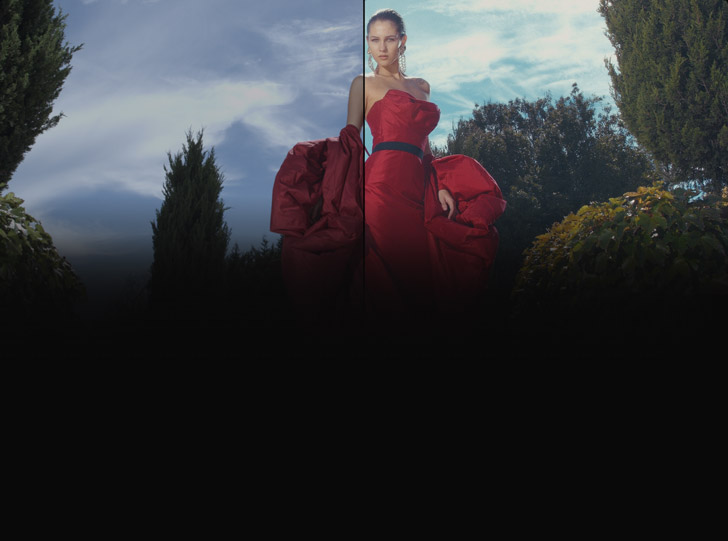
Original camera RAW image
After Primary Color Grading
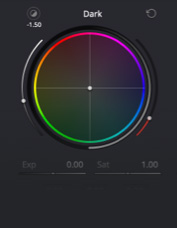
HDR Color Wheels
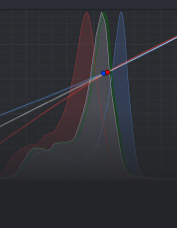
Custom Curves
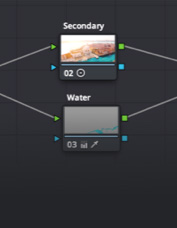
Node Editor
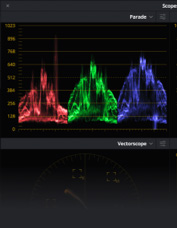
Scopes
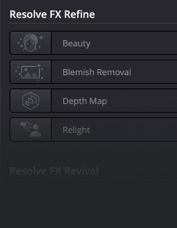
Resolve FX
![]()
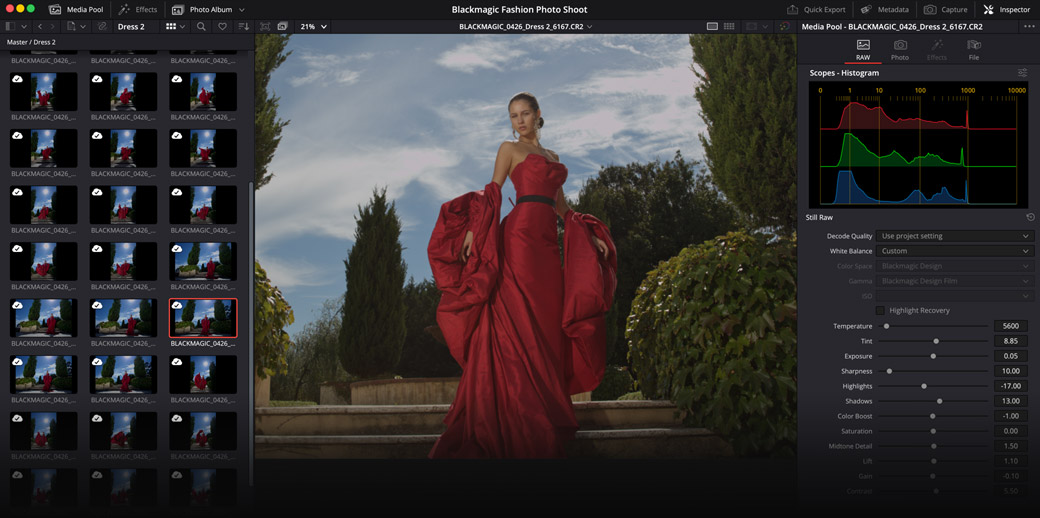
For photographers, the Photo page offers a familiar set of tools alongside DaVinci’s powerful color grading capabilities. It includes native RAW support for Canon, Fujifilm, Nikon, Sony and even iPhone ProRAW. All image processing takes place at source resolution up to 32K, or over 400 megapixels, so you're never limited to project resolution. Familiar basic adjustments including white balance, exposure, color and saturation give you a comfortable starting point. With non-destructive processing you can reframe, crop and re-interpret your original sensor data at any time. And with GPU acceleration, entire albums can be processed dramatically faster than conventional photo applications!
Original
Exposure
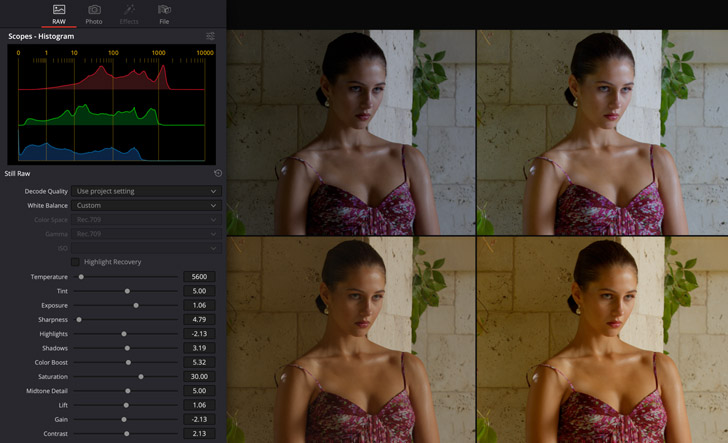
Temperature
Saturation
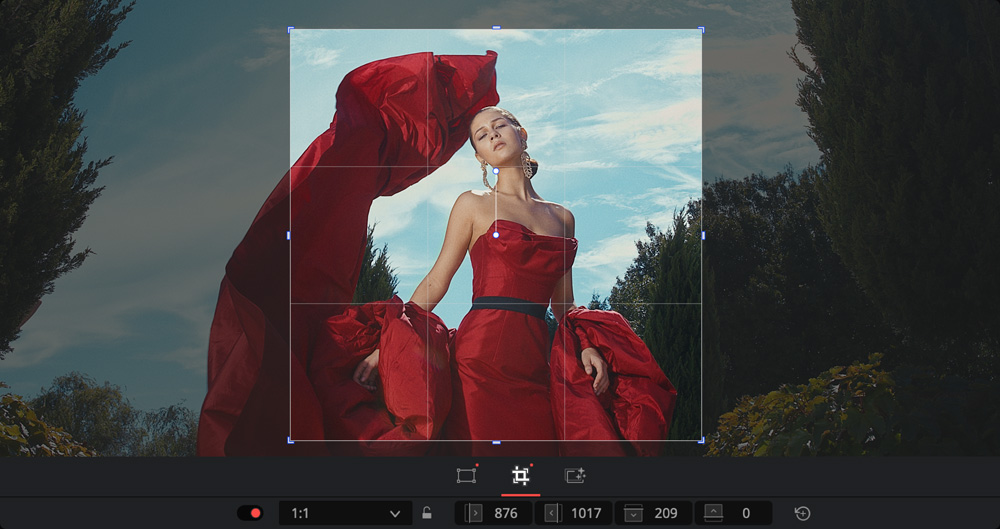
The Photo page Inspector gives you precise control over the transform and cropping parameters of your images. Reframe and crop non-destructively at the original source resolution and aspect ratio, so you’re never restricted to a fixed timeline size! Zoom, position, rotate and flip images with full transform controls and use the cropping parameters to trim the edges of any image with precision. Reframe a shot to improve composition, adjust for a specific ratio for print or social media use, or simply remove unwanted elements from the edges of a frame. All adjustments can be refined or reset at any time without ever affecting the original source file!
![]()
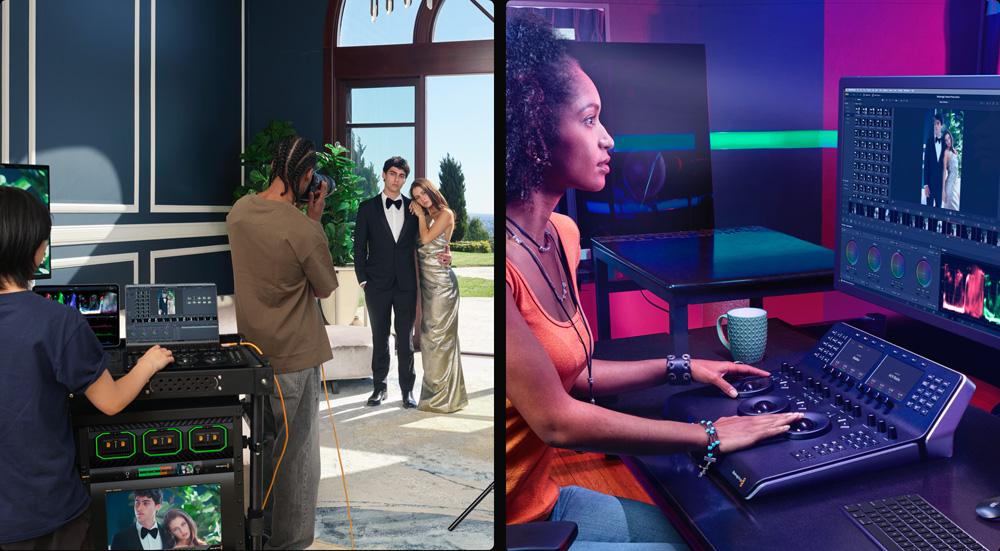
DaVinci Resolve is the world's only post production software that lets everyone work together on the same project at the same time! Built on a powerful cloud based workflow, you can share albums, all associated metadata and tags, as well as grades and effects with colorists, photographers and retouchers anywhere in the world. Blackmagic Cloud syncing keeps every collaborator with the latest version of your image library in real time, and remote reviewers can approve grades offsite without needing to be in the same room. Hollywood colorists can even grade live fashion shoots remotely, all while the photographer is still on set!
![]()
The Photo page gives you everything you need to manage your entire image library from import to completion. You can import photos directly, from your Apple Photos library or Lightroom, and organize them with tags, ratings, favorites and keywords for fast, flexible management of even the largest libraries. It supports all standard RAW files and image types. AI IntelliSearch lets you instantly search across your entire project to find exactly what you’re looking for, from objects to people to animals! Albums allow you to build and manage collections for any project and with a single click you can switch between your photo library and your color grading workflow!
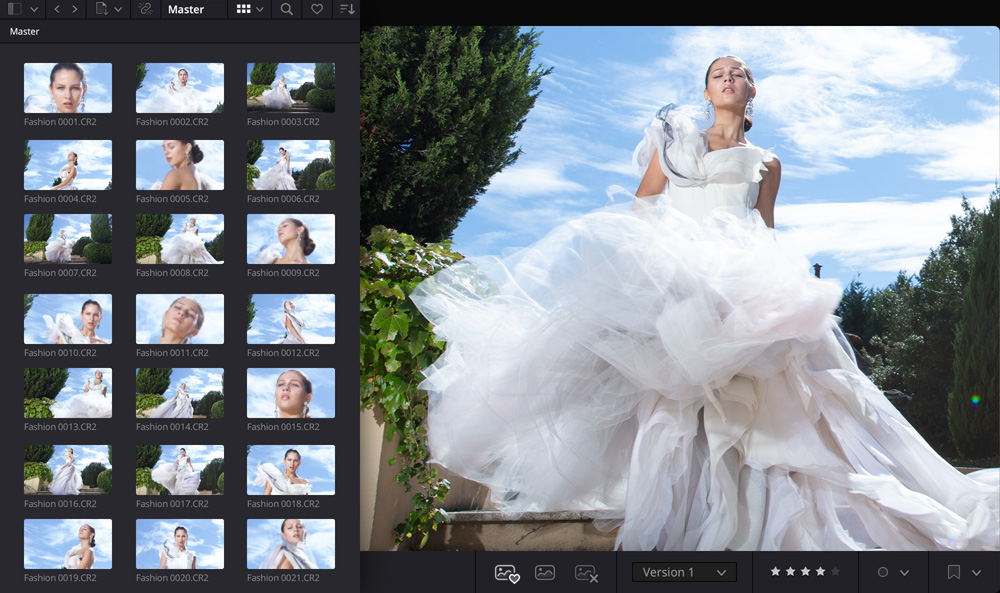
![]()
Albums are a powerful way to build and manage photo collections directly in DaVinci Resolve. You can add images manually to each album or organize by date, camera, star rating, EXIF data and more. Powerful filter and sort tools give you total control over how your collection is arranged. The thumbnail view displays each image’s graded version alongside its file name and source clip format so you can see your grades at a glance. Create multiple grade versions of any image, all referencing the original source file, so you can explore different looks without ever duplicating a file. Plus, grades applied to one photo can be instantly copied across others in the album for a fast, consistent look!
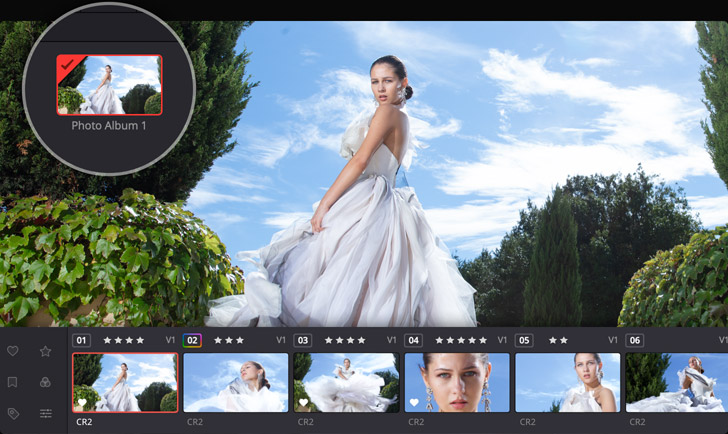
![]()
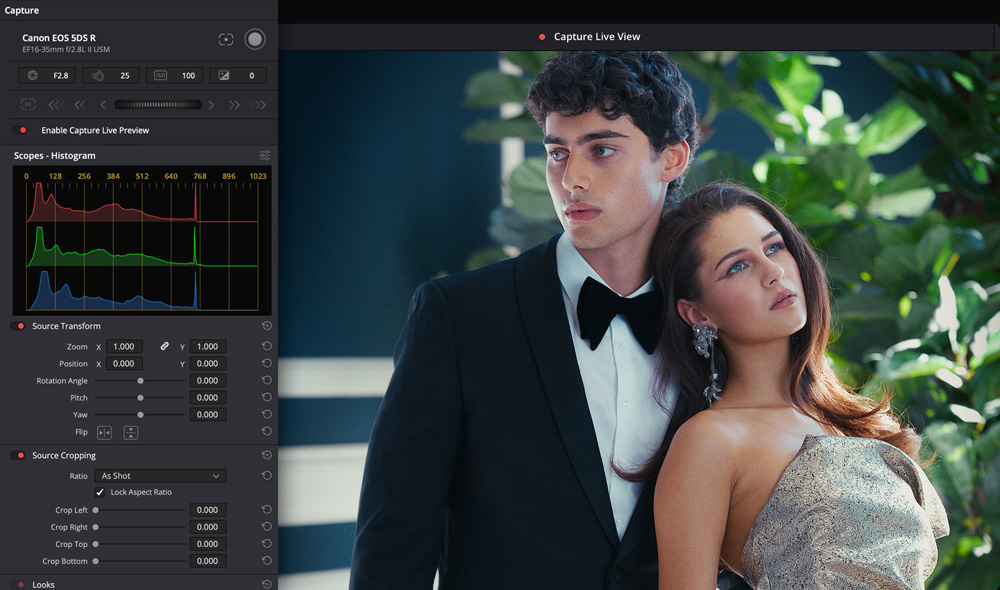
Connect Sony or Canon cameras directly to DaVinci Resolve for tethered shooting with full live view! Adjust camera settings including ISO, exposure and white balance without leaving the page and save image capture presets to establish a consistent look before you shoot. Images can be captured directly into an album, with albums created automatically during capture so your library is perfectly organized from the moment you start shooting. Grade images as they arrive using DaVinci Resolve’s extensive color toolset and use a hardware panel for hands-on creative control in a collaborative shoot. That means you can capture, grade and organize an entire shoot without leaving DaVinci Resolve!

The Photo page gives you access to over 100 GPU and CPU accelerated Resolve FX and specialty AI tools for still image work. They're organized by category in the Open FX library and cover everything from color effects, blurs and glows to image repair, skin refinement and cinematic lighting tools. These are the same tools used by Hollywood colorists and VFX artists on the world's biggest productions, now available for still images. To add an effect, drag it to any node. Whether you're making subtle beauty refinements for a fashion shoot or applying dramatic film looks and atmospheric lighting effects emulating the looks of a Hollywood feature, the Photo page has the tools you need!
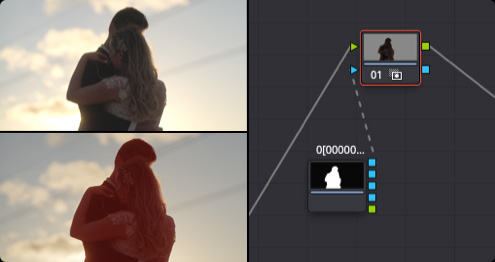
Before
After
Magic Mask makes precise selections of subjects or backgrounds, while Depth Map generates a 3D map of your scene to separate foreground and background without manual masking. Use together to grade different depths of an image independently for results that have never before been possible for stills!
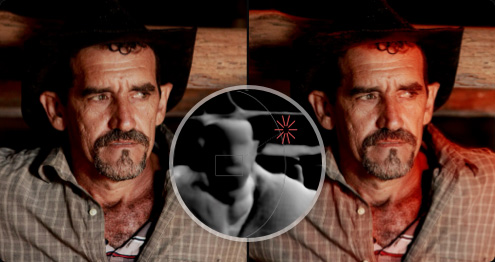
Original Footage
After Relight
Add a realistic light source to any photo after capture with Relight FX. Relight analyzes the surfaces of faces and objects to reflect light naturally across the image. Combine with Magic Mask to light a subject independently from the background, turning flat portraits into stunning fashion images!
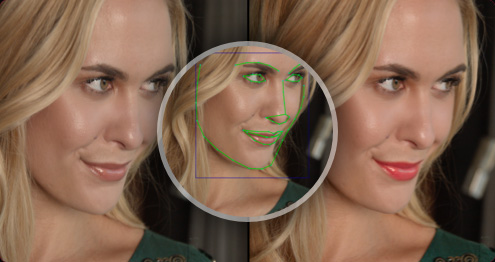
Original Footage
After Refinement
Face refinement automatically masks different parts of a face, saving countless hours of manual work. Sharpen eyes, remove dark circles, smooth skin, and color lips. Ultra Beauty separates skin texture from color for natural, high end results, while AI Blemish Removal handles fast skin repair!
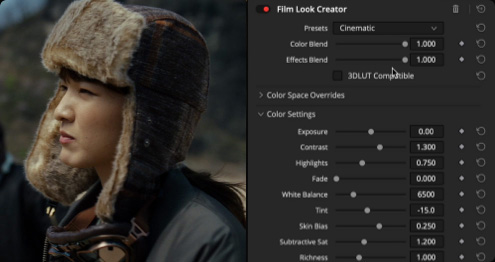
The Film Look Creator lets you add cinematic looks that replicate film properties like halation, bloom, grain and vignetting. Adjust exposure in stops and use subtractive saturation, richness and split tone controls to achieve looks usually found on the big screen, now for your still images!
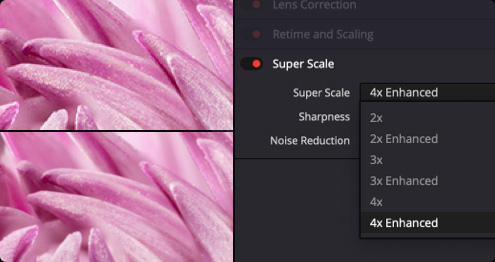
Upscale with Regular NLE
Upscale with DaVinci Resolve
AI SuperScale uses the DaVinci AI Neural Engine to upscale low resolution images with exceptional quality. The enhanced mode is specifically designed to remove compression artifacts, making it the perfect tool for rescaling low quality photos or frame grabs up to 4x their original resolution!
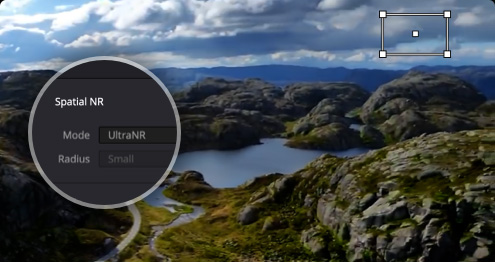
UltraNR is a DaVinci AI Neural Engine driven denoise mode in the Color page’s spatial noise reduction palette. Use it to dramatically reduce digital noise from an image while maintaining image clarity. Use with spatial noise reduction to smooth out digital grain or scanner noise while keeping fine hair and eye edges sharp.
Before
After
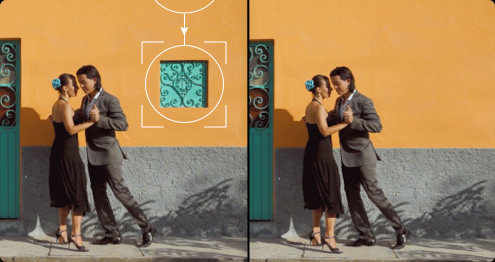
Before
After

Sample an area of a scene to quickly cover up unwanted elements, like objects or even blemishes on a face. The patch replacer has a fantastic auto grading feature that will seamlessly blend the covered area with the surrounding color data. Perfect for removing sensor dust.
![]()
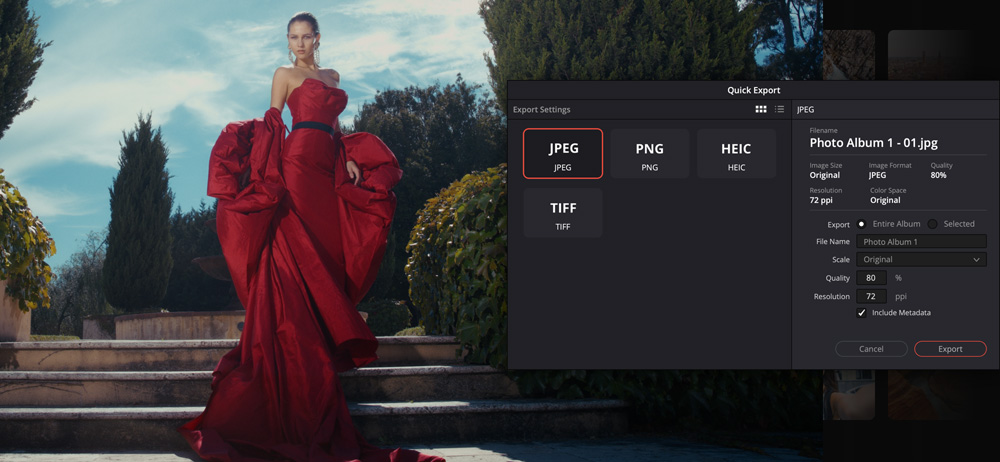
The Quick Export option makes it fast and easy to deliver finished images in a wide range of common formats including JPEG, PNG, HEIF and TIFF. Export either an entire album or just selected photos providing flexibility to meet your specific delivery needs. You can set the resolution, bit depth, quality and compression to ensure your images are optimized for their intended use. Whether you're exporting standalone images for print, sharing on social media platforms or delivering graded files to a client, Quick Export has you covered. All exports preserve your original photo EXIF metadata, so camera settings, location data and other important information always travels with your files.
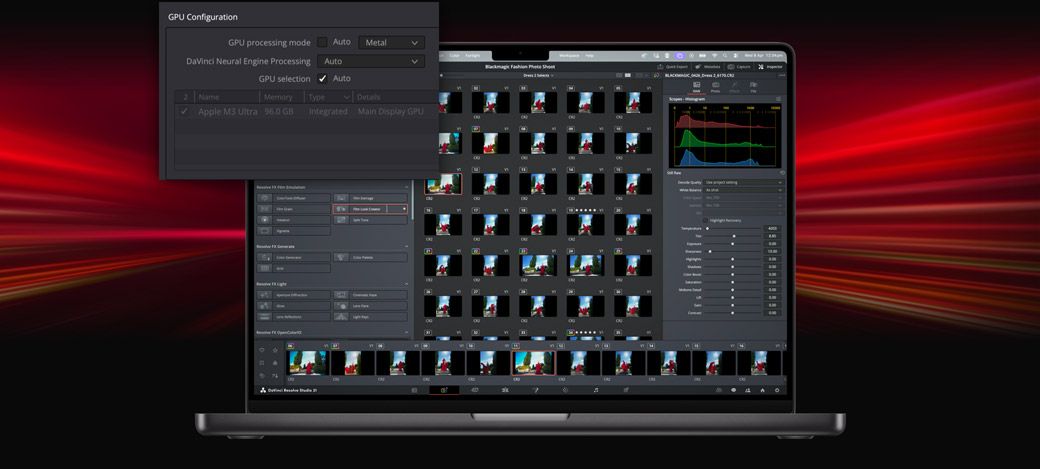
The Photo page uses GPU accelerated processing to deliver fast, accurate results across your entire workflow. Process hundreds of RAW files in seconds with GPU accelerated decoding and apply Resolve FX to your images in real time. GPU acceleration also means batch exports and conversions are dramatically faster than conventional photo applications. On Mac, DaVinci Resolve is optimized for Metal and Apple Silicon, taking full advantage of the latest hardware. On Windows and Linux, you get CUDA support for NVIDIA GPUs, while the Windows version also features full OpenCL support for AMD, Intel and Qualcomm GPUs. All this ensures you get high performance results on any system!
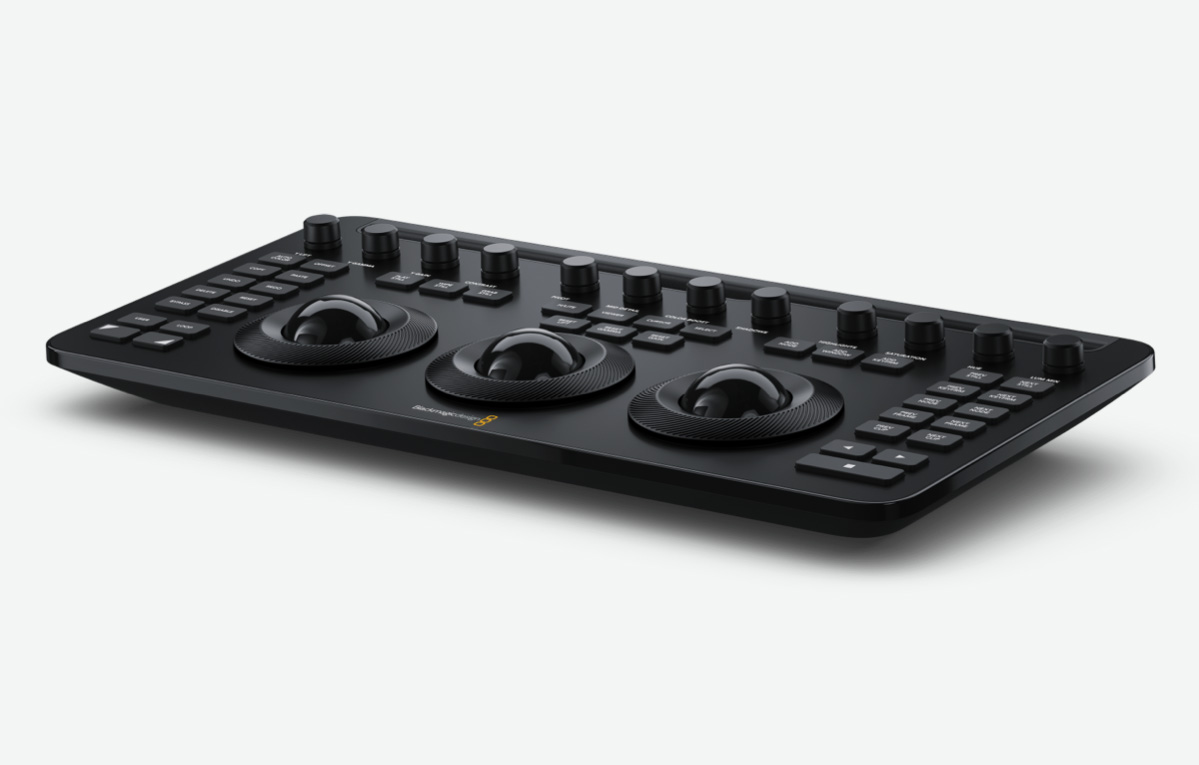
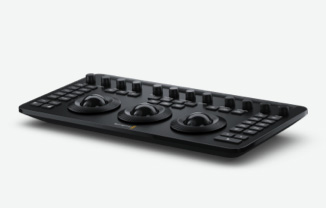
Hollywood colorists have always relied on hardware panels to work faster and more creatively and now photographers can too! The DaVinci Resolve Micro Color Panel is the perfect companion for photo grading as it is compact enough to sit next to a laptop and portable enough to take on location for shoots. It features three high quality trackballs for lift, gamma and gain adjustments, 12 primary correction knobs for contrast, saturation, hue, temperature and more. It even has a built in rechargeable battery! DaVinci Resolve color panels let you adjust multiple parameters at once, so you can create looks that are simply impossible with a mouse and keyboard.

Hollywood’s most popular solution for editing, visual effects, motion graphics, color correction and audio post production, for Mac, Windows and Linux. Now supports Blackmagic Cloud for collaboration!
Free
The most powerful DaVinci Resolve adds DaVinci Neural Engine for automatic AI region tracking, stereoscopic tools, more Resolve FX filters, more Fairlight FX audio plugins and advanced HDR grading.
$295

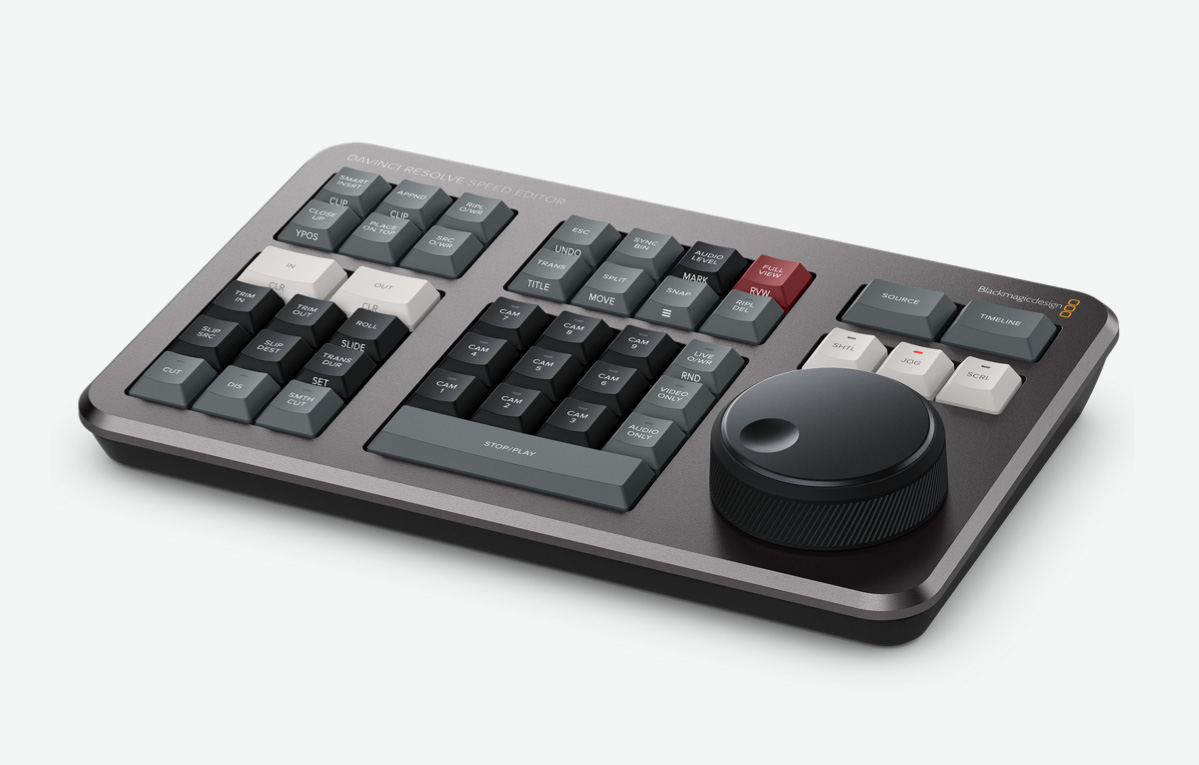
Includes large search dial in a design that includes only the specific keys needed for editing. Includes Bluetooth with battery for wireless use so it's more portable than a full sized keyboard!
$435
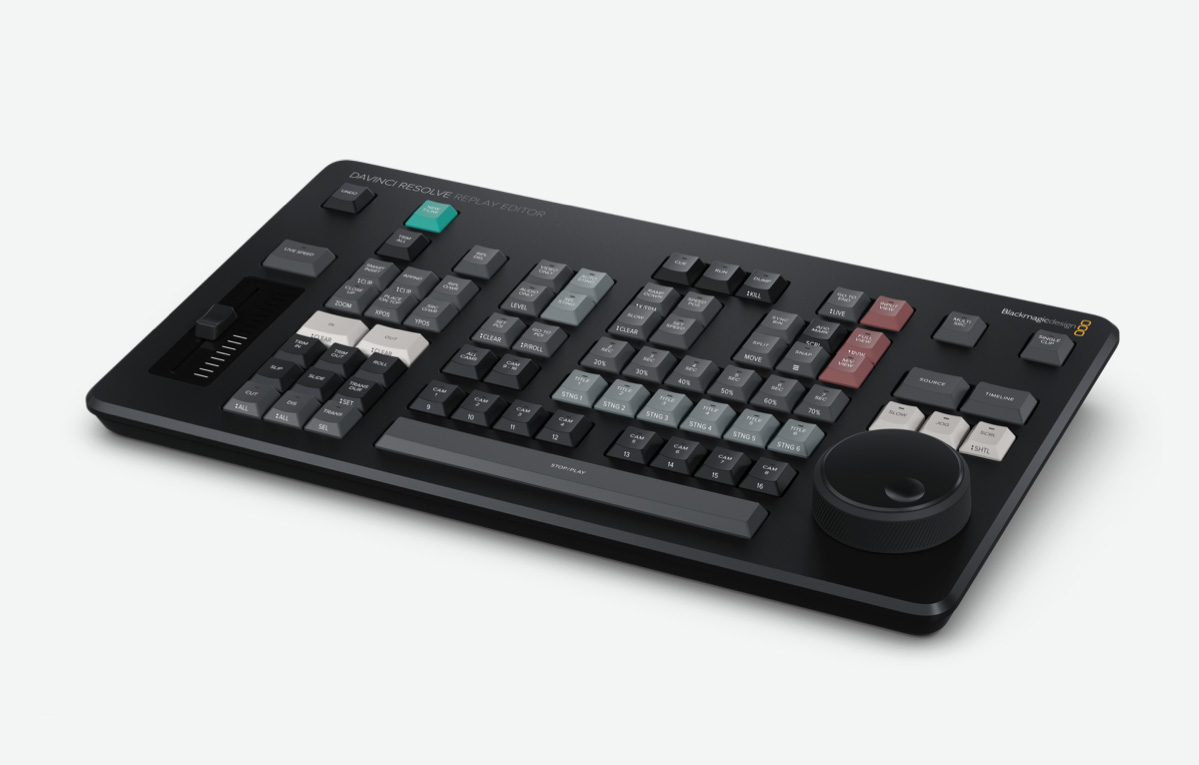
Editor panel specifically designed for multi-cam editing for news cutting and live sports replay. Includes buttons to make camera selection and editing extremely fast! Connects via Bluetooth or USB‑C.
$545
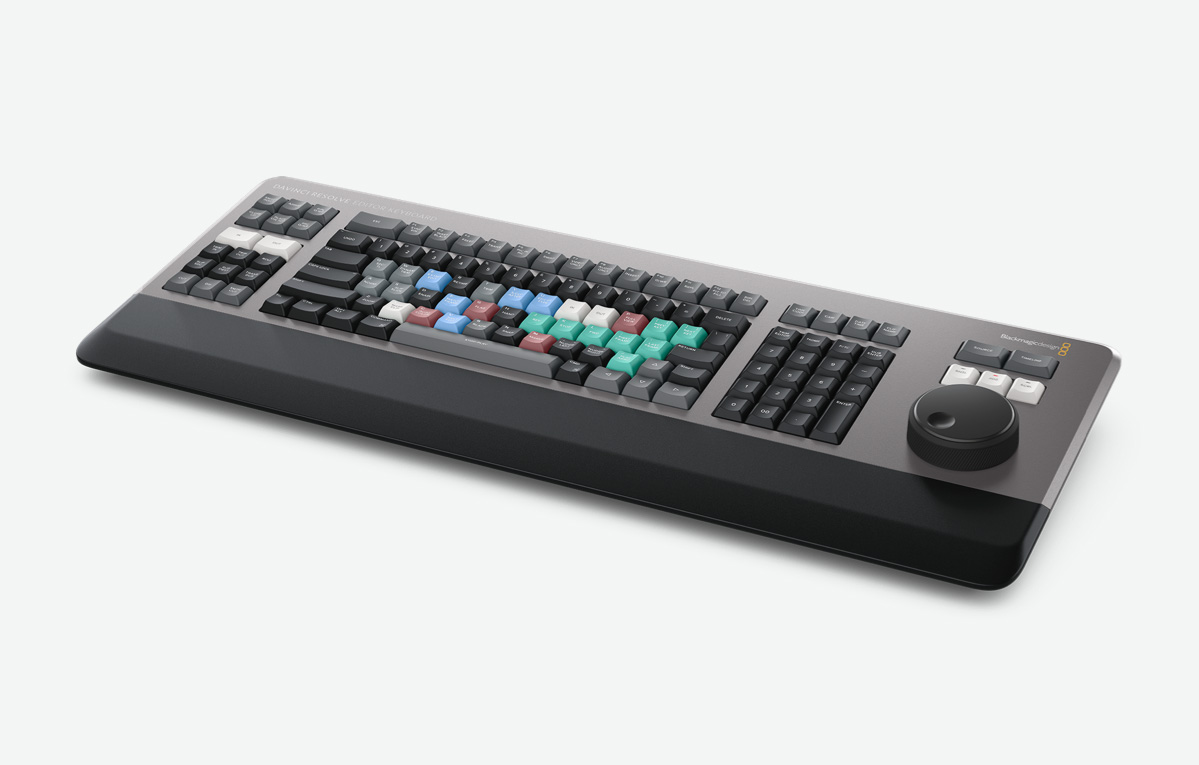
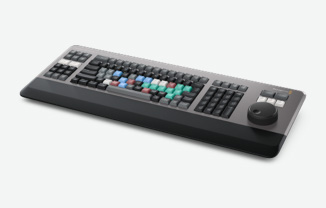
Full sized traditional QWERTY editor keyboard in a premium metal design. Featuring a metal search dial with clutch, plus extra edit, trim and timecode keys. Can be installed inset for flush mounting.
$655

Powerful color panel gives you all the control you need to create cinematic images. Includes controls for refined color grading including adding windows. Connects via Bluetooth or USB‑C.
$559
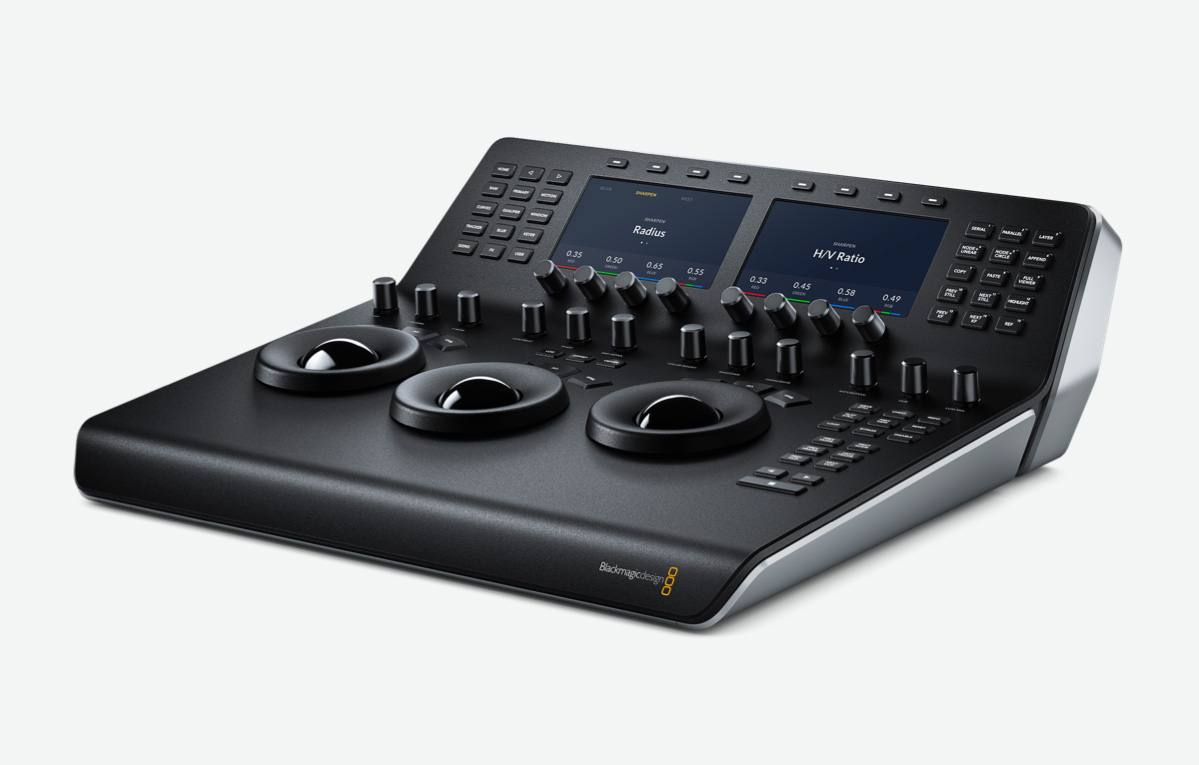
Portable DaVinci color panel with 3 high resolution trackballs, 12 primary corrector knobs and LCDs with menus and buttons for switching tools, adding color nodes, HDR and secondary grading and more!
$2,319
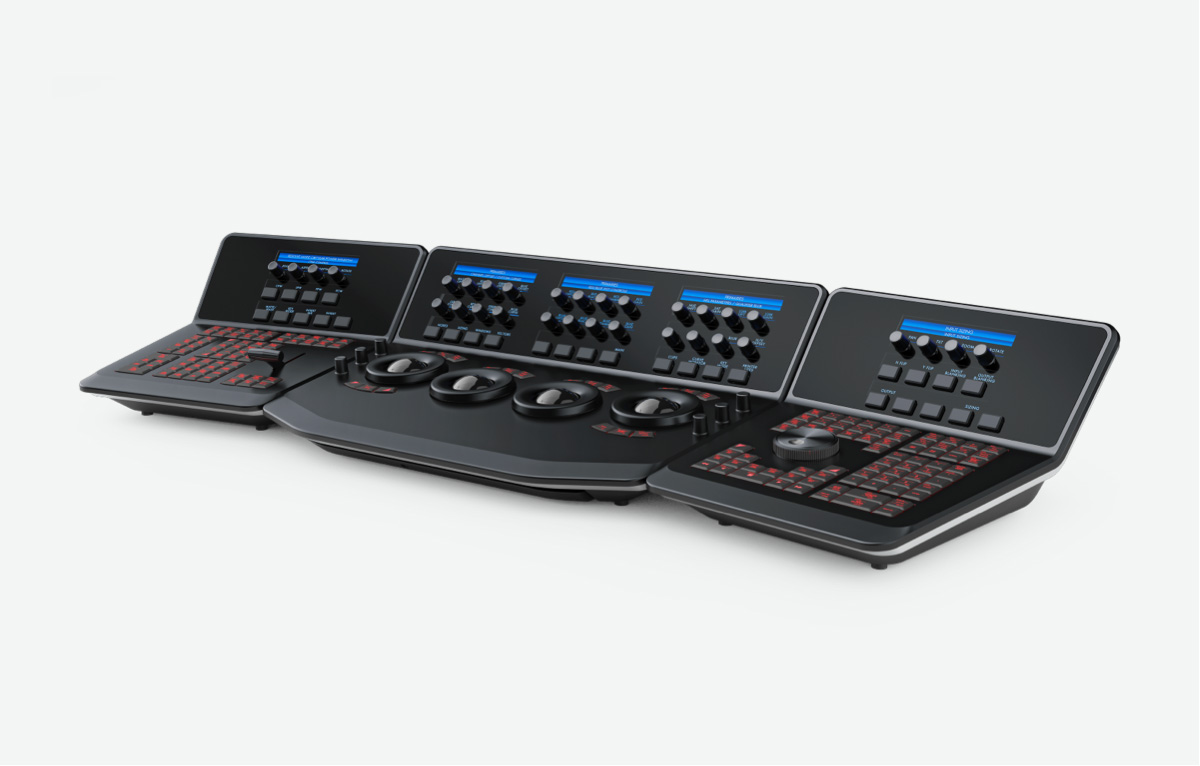
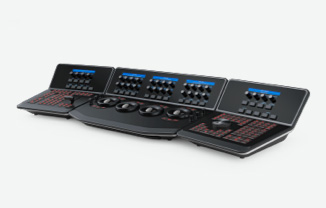
Designed in collaboration with professional Hollywood colorists, the DaVinci Resolve Advanced Panel features a massive number of controls for direct access to every DaVinci color correction feature.
$31,089

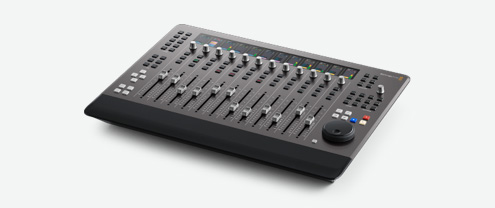
Portable audio control surface includes 12 premium touch sensitive flying faders, channel LCDs for advanced processing, automation and transport controls plus HDMI for an external graphics display.
$3,445
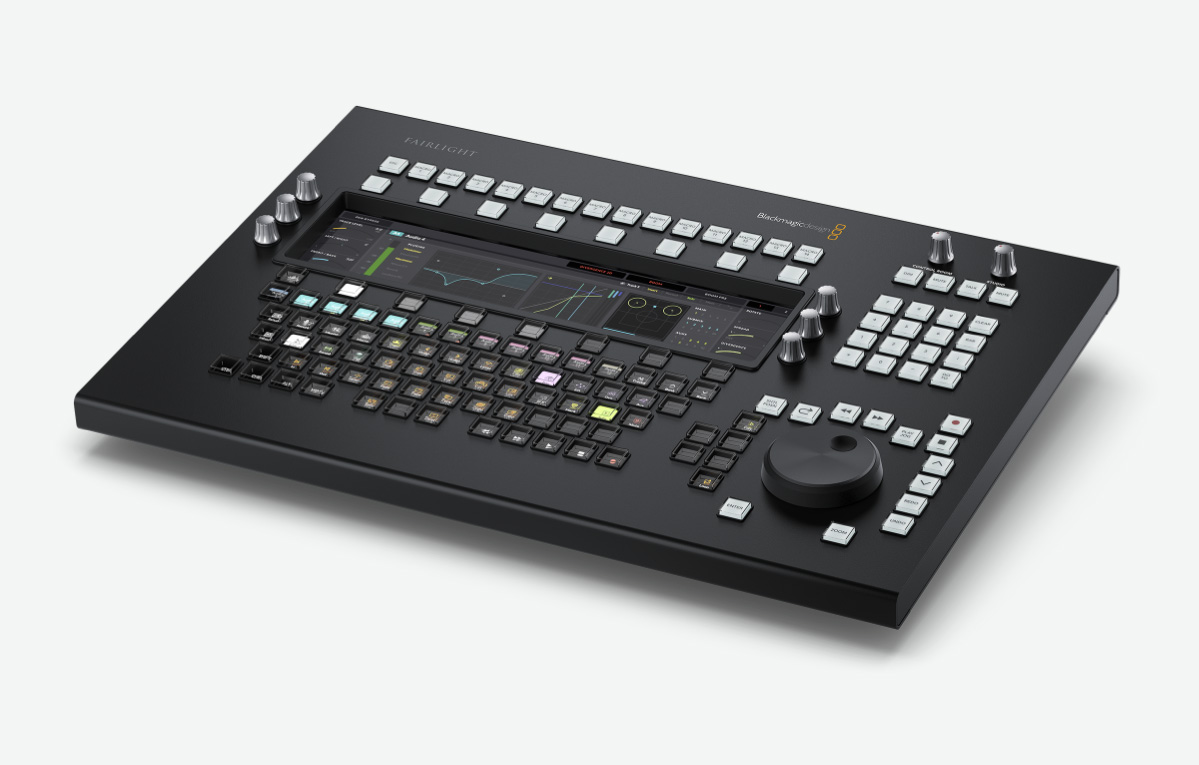
Get incredibly fast audio editing for sound engineers working on tight deadlines! Includes LCD screen, touch sensitive control knobs, built in search dial and full keyboard with multi function keys.
$5,055
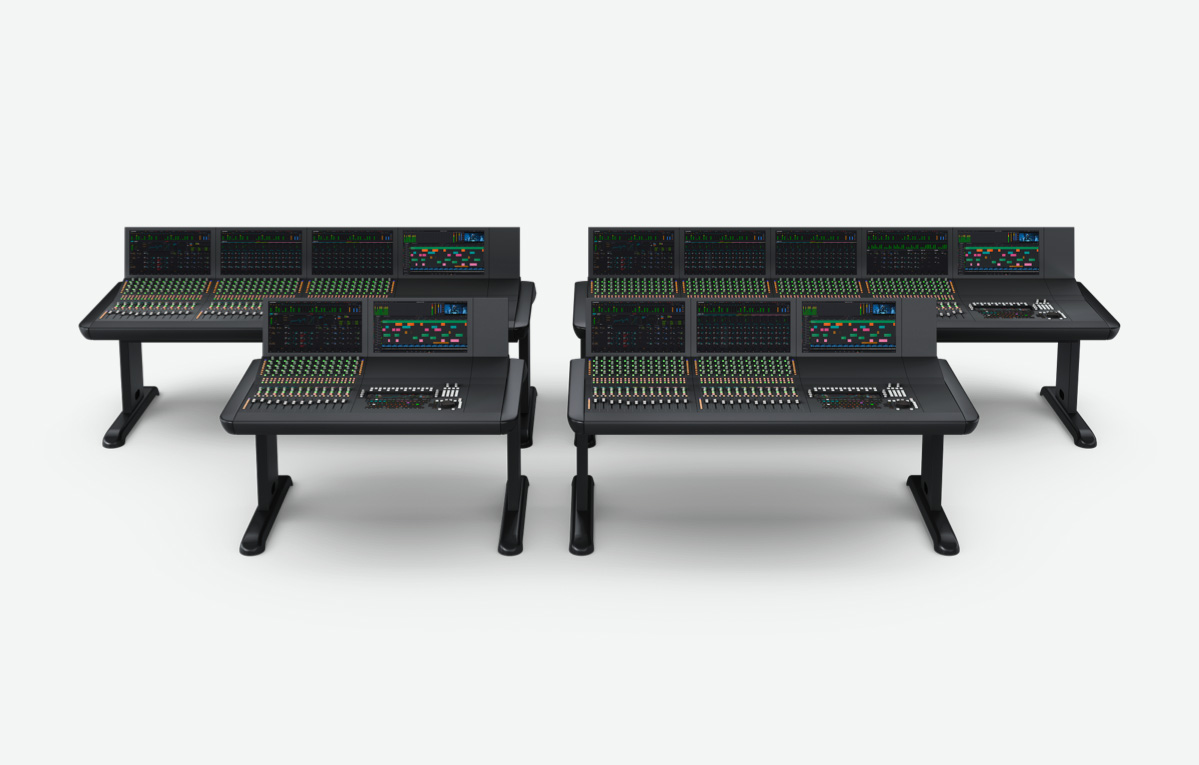
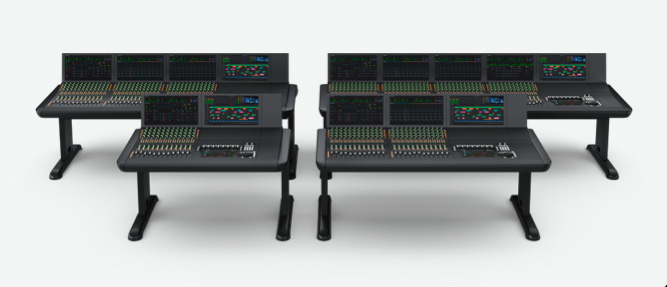
Used by Hollywood and broadcasters, these large consoles make it easy to mix large projects with a massive number of channels and tracks. Modular design allows customizing 2, 3, 4, or 5 bay consoles!
From $24,195
Complete Fairlight studio console with 1 channel fader, 1 channel control, 1 audio editor, 2 LCD monitors and 2 bay chassis.
$24,195
Complete Fairlight studio console with 2 channel faders, 2 channel controls, 1 audio editor, 3 LCD monitors and 3 bay chassis.
$32,995
Complete Fairlight studio console with 3 channel faders, 3 channel controls, 1 audio editor, 4 LCD monitors and 4 bay chassis.
$43,995
Complete Fairlight studio console with 4 channel faders, 4 channel controls, 1 audio editor, 5 LCD monitors and 5 bay chassis.
$53,895
Fairlight studio console legs at 0º angle for when you require a flat working surface. Required for all Fairlight Studio Consoles.
$435
Fairlight studio console legs at 8º angle for when you require a slightly angled working surface. Required for all Fairlight Studio Consoles.
$435
Features 12 motorized faders, rotary control knobs illuminated buttons for pan, solo, mute and call, plus bank select buttons.
$4,595
12 groups of touch sensitive rotary control knobs and illuminated buttons, assignable to fader strips, single channel or master bus.
$2,815
Get quick access to virtually every Fairlight feature! Includes a 12” LCD, graphical keyboard, macro keys, transport controls and more.
$5,115
Features HDMI, SDI inputs for video and computer monitoring and Ethernet for graphics display of channel status and meters.
$1,495
Empty 2 bay Fairlight studio console chassis that can be populated with various faders, channel controls, edit and LCD monitors.
$9,455
Empty 3 bay Fairlight studio console chassis that can be populated with various faders, channel controls, edit and LCD monitors.
$10,555
Empty 4 bay Fairlight studio console chassis that can be populated with various faders, channel controls, edit and LCD monitors.
$12,095
Empty 5 bay Fairlight studio console chassis that can be populated with various faders, channel controls, edit and LCD monitors.
$14,295
Use alternative HDMI or SDI televisions and monitors when building a Fairlight studio console.
$299
Mounting bar with locating pins to allow correct alignment of bay modules when building a custom 2 bay Fairlight console.
$415
Mounting bar with locating pins to allow correct alignment of bay modules when building a custom 3 bay Fairlight console.
$675
Mounting bar with locating pins to allow correct alignment of bay modules when building a custom 4 bay Fairlight console.
$779
Mounting bar with locating pins to allow correct alignment of bay modules when building a custom 5 bay Fairlight console.
$879
Side arm kit mounts into Fairlight console mounting bar and holds each fader, channel control and LCD monitor module.
$259
Blank 1/3rd wide bay for building a custom console with the extra 1/3rd section. Includes blank infill panels.
$545
Allows mounting standard 19 inch rack mount equipment in the channel control area of the Fairlight studio console.
$275
Blank panel to fill in the channel control area of the Fairlight studio console.
$205
Blank panel to fill in the LCD monitor area of the Fairlight studio console when you're not using the standard Fairlight LCD monitor.
$469
Blank panel to fill in the fader control area of the Fairlight studio console.
$289
Adds 3 MADI I/O connections to the single MADI on the accelerator card, for a total of 256 inputs and outputs at 24 bit and 48kHz.
$219
Add up to 2,000 tracks with real time processing of EQ, dynamics, 6 plug‑ins per track, plus MADI for extra 64 inputs and outputs.
$1,249
Adds analog and digital connections, preamps for mics and instruments, sample rate conversion and sync at any standard frame rate.
$2,615