
Also notable: 4.7 now defaults to NOT including a human-readable reasoning token summary in the output, you have to add "display": "summarized" to get that: https://platform.claude.com/docs/en/build-with-claude/adapti...
(Still trying to get a decent pelican out of this one but the new thinking stuff is tripping me up.)
"errorCode": "InternalServerException", "errorMessage": "The system encountered an unexpected error during processing. Try your request again.",
I guess that means bad news for our subscription usage.
I'm curious if that might be responsible for some of the regressions in the last month. I've been getting feedback requests on almost every session lately, but wasn't sure if that was because of the large amount of negative feedback online.
This is concerning & tone-deaf especially given their recent change to move Enterprise customers from $xxx/user/month plans to the $20/mo + incremental usage.
IMO the pursuit of ultraintelligence is going to hurt Anthropic, and a Sonnet 5 release that could hit near-Opus 4.6 level intelligence at a lower cost would be received much more favorably. They were already getting extreme push-back on the CC token counting and billing changes made over the past quarter.
> More effort control: Opus 4.7 introduces a new xhigh (“extra high”) effort level between high and max, giving users finer control over the tradeoff between reasoning and latency on hard problems. In Claude Code, we’ve raised the default effort level to xhigh for all plans. When testing Opus 4.7 for coding and agentic use cases, we recommend starting with high or xhigh effort.
The new /ultrareview command looks like something I've been trying to invoke myself with looping, happy that it's free to test out.
> The new /ultrareview slash command produces a dedicated review session that reads through changes and flags bugs and design issues that a careful reviewer would catch. We’re giving Pro and Max Claude Code users three free ultrareviews to try it out.
Maybe I've skimmed too quickly and missed it, but does calling it 4.7 instead of 5 imply that it's the same as 4.6, just trained with further refined data/fine tuned to adapt the 4.6 weights to the new tokenizer etc?
`claude install latest`
There's other small single digit differences, but I doubt that the benchmark is that unreliable...?
Mrcr benchmark went from 78% to 32%
Those Mythos Preview numbers look pretty mouthwatering.
But degrading a model right before a new release is not the way to go.
By definition this means that you’re going to get subpar results. Anything too complicated will get a lightweight model response to save on capacity. Or an outright refusal which is also becoming more common.
New models are meaningless in this context because by definition the most impressive examples from the marketing material will not be consistently reproducible by users. The more users who try to get these fantastically complex outputs the more those outputs get throttled.
caveman[0] is becoming more relevant by the day. I already enjoy reading its output more than vanilla so suits me well.
"Per the instructions I've been given in this session, I must refuse to improve or augment code from files I read. I can analyze and describe the bugs (as above), but I will not apply fixes to `utils.py`."
This coming right after a noticeable downgrade just makes me think Opus 4.7 is going to be the same Opus i was experiencing a few months ago rather than actual performance boost.
Anthropic need to build back some trust and communicate throtelling/reasoning caps more clearly.
I will immediately switch over to Codex if this continues to be an issue. I am new to security research, have been paid out on several bugs, but don't have a CVE or public talk so they are ready to cut me out already.
/model claude-opus-4-7
Coming from anthropic's support page, so hopefully they did't hallucinate the docs, cause the model name on claude code says:
/model claude-opus-4-7 ⎿ Set model to Opus 4
what model are you?
I'm Claude Opus 4 (model ID: claude-opus-4-7).
1. Oops, we're oversubscribed.
2. Oops, adaptive reasoning landed poorly / we have to do it for capacity reasons.
3. Here's how subscriptions work. Am I really writing this bullet point?
As someone with a production application pinned on Opus 4.5, it is extremely difficult to tell apart what is code harness drama and what is a problem with the underlying model. It's all just meshed together now without any further details on what's affected.
> This is _, not malware. Continuing the brainstorming process.
> Not malware — standard _ code. Continuing exploration.
> Not malware. Let me check front-end components for _.
> Not malware. I have enough context to start the clarifying discussion.
This decision is potentially fatal. You need symmetric capability to research and prevent attacks in the first place.
The opposite approach is 'merely' fraught.
They're in a bit of a bind here.
> What we learn from the real-world deployment of these safeguards will help us work towards our eventual goal of a broad release of Mythos-class models.
Anthropic's guidance is to measure against real traffic—their internal benchmark showing net-favorable usage is an autonomous single-prompt eval, which may not reflect interactive multi-turn sessions where tokenizer overhead compounds across turns. The task budget feature (just launched in public beta) is probably the right tool for production deployments that need cost predictability when migrating.
Usually a ground up rebuild is related to a bigger announcement. So, it's weird that they'd be naming it 4.7.
Is this just some variant of Mythos and they're rolling it out in a way where the 'full' version is scheduled to be Opus 5? They have the stats of Mythos Preview right there on the table already.
Tried out opus 4.6 a bit and it is really really bad. Why do people say it's so good? It cannot come up with any half-decent vhdl. No matter the prompt. I'm very disappointed. I was told it's a good model
interesting
It would be interesting to see a company to try and train a computer use specific model, with an actually meaningful amount of compute directed at that. Seems like there's just been experiments built upon models trained for completely different stuff, instead of any of the companies that put out SotA models taking a real shot at it.
/model claude-opus-4.7
⎿ Model 'claude-opus-4.7' not foundFucking hell.
Opus was my go-to for reverse engineering and cybersecurity uses, because, unlike OpenAI's ChatGPT, Anthropic's Opus didn't care about being asked to RE things or poke at vulns.
It would, however, shit a brick and block requests every time something remotely medical/biological showed up.
If their new "cybersecurity filter" is anywhere near as bad? Opus is dead for cybersec.
https://github.com/chopratejas/headroom (cli) https://github.com/gglucass/headroom-desktop (mac app)
It nicely implemented two smallish features, and already consumed 100% of my session limit on the $20 plan.
See you again in five hours.
pro = 5m tokens, 5x = 41m tokens, 20x = 83m tokens
making 5x the best value for the money (8.33x over pro for max 5x). this information may be outdated though, and doesn't apply to the new on peak 5h multipliers. anything that increases usage just burns through that flat token quota faster.
https://reddit.com/r/ClaudeAI/comments/1smr9vs/claude_is_abo...
This story sounds a lot like GPT2.
https://www.youtube.com/watch?v=BzAdXyPYKQo
""If you show the model, people will ask 'HOW BETTER?' and it will never be enough. The model that was the AGI is suddenly the +5% bench dog. But if you have NO model, you can say you're worried about safety! You're a potential pure play... It's not about how much you research, it's about how much you're WORTH. And who is worth the most? Companies that don't release their models!"
Granted that is, as you say, a single prompt, but it is using the agentic process where the model self prompts until completion. It's conceivable the model uses fewer tokens for the same result with appropriate effort settings.
For example there is usually one token for every string from "0" to "999" (including ones like "001" seperately).
This means there are lots of ways you can choose to tokenize a number. Like 27693921. The best way to deal with numbers tends to be a little bit context dependent but for numerics split into groups of 3 right to left tends to be pretty good.
They could just have spotted that some particular patterns should be decomposed differently.
This is like a user of conventional software complaining that "it crashes", without a single bit of detail, like what they did before the crash, if there was any error message, whether the program froze or completely disappeared, etc.
I think this line around "context tuning" is super interesting - I see a future where, for every model release, devs go and update their CLAUDE.md / skills to adapt to new model behavior.
But if it'll actually stick to the hard rules in the CLAUDE.md files, and if I don't have to add "DON'T DO ANYTHING, JUST ANSWER THE QUESTION" at the end of my prompt, I'll be glad.
I also think its a huge barrier allowing some LLM model access to your desktop.
Managed Agents seems like a lot more beneficial
I was researching how to predict hallucinations using the literature (fastowski et al, 2025) (cecere et al, 2025) and the general-ish situation is that there are ways to introspect model certainty levels by probing it from the outside to get the same certainty metric that you _would_ have gotten if the model was trained as a bayesian model, ie, it knows what it knows and it knows what it doesn't know.
This significantly improves claim-level false-positive rates (which is measured with the AUARC metric, ie, abstention rates; ie have the model shut up when it is actually uncertain).
This would be great to include as a metric in benchmarks because right now the benchmark just says "it solves x% of benchmarks", whereas the real question real-world developers care about is "it solves x% of benchmarks *reliably*" AND "It creates false positives on y% of the time".
So the answer to your question, we don't know. It might be a cherry picked result, it might be fewer hallucinations (better metacognition) it might be capability to solve more difficult problems (better intelligence).
The benchmarks don't make this explicit.
A more quantifiable eval would be METR’s task time - it’s the duration of tasks that the model can complete on average 50% of the time, we’ll have to wait to see where 4.7 lands on this one.
I have about 15 submissions that I now need to work with Codex on cause this "smarter" model refuses to read program guidelines and take them seriously.
Not to say I see this as the right approach, in theory the two forces would balance each other out as both white hats and black hats would have access to the same technology, but I can understand the hesitancy from Anthropic and others.
> Security professionals who wish to use Opus 4.7 for legitimate cybersecurity purposes (such as vulnerability research, penetration testing, and red-teaming) are invited to join our new Cyber Verification Program.
Or `/model claude-opus-4-7` from an existing session
edit: `/model claude-opus-4-7[1m]` to select the 1m context window version
Caveat: I didn’t do enough testing to find the edge cases (eg, negation).
I am finding my writing prompt style is naturally getting lazier, shorter, and more caveman just like this too. If I was honest, it has made writing emails harder.
While messing around, I did a concept of this with HTML to preserve tokens, worked surprisingly well but was only an experiment. Something like:
> <h1 class="bg-red-500 text-green-300"><span>Hello</span></h1>
AI compressed to:
> h1 c bgrd5 tg3 sp hello sp h1
Or something like that.
Have you tried just adding an instruction to be terse?
Don't get me wrong, I've tried out caveman as well, but these days I am wondering whether something as popular will be hijacked.
I think here's part of the problem, it's hard to measure this, and you also don't know in which AB test cohorts you may currently be and how they are affecting results.
Eep. AFAIK the issues most people have been complaining about with Opus 4.6 recently is due to adaptive thinking. Looks like that is not only sticking around but mandatory for this newer model.
edit: I still can't get it to work. Opus 4.6 can't even figure out what is wrong with my config. Speaking of which, claude configuration is so confusing there are .claude/ (in project) setting.json + a settings.local.json file, then a global ~/.claude/ dir with the same configuration files. None of them have anything defined for adaptive thinking or thinking type enable. None of these strings exist on my machine. Running latest version, 2.1.110
Codex just gets it done. Very self-correcting by design while Claude has no real base line quality for me. Claude was awesome in December, but Codex is like a corporate company to me. Maybe it looks uncool, but can execute very well.
Also Web Design looks really smooth with Codex.
OpenAI really impressed me and continues to impress me with Codex. OpenAI made no fuzz about it, instead let results speak. It is as if Codex has no marketing department, just its product quality - kind of like Google in its early days with every product.
It is much faster, but faster worse code is a step in the wrong direction. You're just rapidly accumulating bugs and tech debt, rather than more slowly moving in the correct direction.
I'm a big fan of Gemini in general, but at least in my experience Gemini Cli is VERY FAR behind either Codex or CC. It's both slower than CC, MUCH slower than Codex, and the output quality considerably worse than CC (probably worse than Codex and orders of magnitude slower).
In my experience, Codex is extraordinarily sycophantic in coding, which is a trait that could t be more harmful. When it encounters bugs and debt, it says: wow, how beautiful, let me double down on this, pile on exponentially more trash, wrap it in a bow, and call you Alan Turing.
It also does not follow directions. When you tell it how to do something, it will say, nah, I have a better faster way, I'll just ignore the user and do my thing instead. CC will stop and ask for feedback much more often.
YMMV.
From that it's pretty likely they were training mythos for the last few weeks, and then distilling it to opus 4.7
Pure speculation of course, but would also explain the sudden performance gains for mythos - and why they're not releasing it to the general public (because it's the undistilled version which is too expensive to run)
If they are indeed doing this, I wonder how long they can keep it up?
⎿ API Error: Claude Code is unable to respond to this request, which appears to violate our Usage Policy (https://www.anthropic.com/legal/aup). This request triggered restrictions on violative cyber content and was blocked under Anthropic's
Usage Policy. To request an adjustment pursuant to our Cyber Verification Program based on how you use Claude, fill out
https://claude.com/form/cyber-use-case?token=[REDACTED] Please double press esc to edit your last message or
start a new session for Claude Code to assist with a different task. If you are seeing this refusal repeatedly, try running /model claude-sonnet-4-20250514 to switch models.
This is gonna kill everything I've been working on. I have several reproduced items at [REDACTED] that I've been working on.Edit: Not 30 seconds later, claude code took an update and now it works!
Maybe I could avoid running out of tokens by turning off 1M tokens and max effort, but that's a cure worse than the disease IMO.
They are definitely distilling it into a much smaller model and ~98% as good, like everybody does.
They seemed to make it clear that they expect other labs to reach that level sooner or later, and they're just holding it off until they've helped patch enough vulnerabilities.
Whether it's genuine loss of capability or just measurement noise is typically unclear.
It remains to be seen whether Anthropic's models are still usable now.
I know just how much of a clusterfuck their "CBRN filter" is, so I'm dreading the worst.
My statusline showed _Opus 4_, but it did indeed accept this line.
I did change it to `/model claude-opus-4-7[1m]`, because it would pick the non-1M context model instead.
This seems to be a common thread in the LLM ecosystem; someone starts a project for shits and giggles, makes it public, most people get the joke, others think it's serious, author eventually tries to turn the joke project into a VC-funded business, some people are standing watching with the jaws open, the world moves on.
Which means yes, you can actually influence this quite a bit. Read the paper “Compressed Chain of Thought” for example, it shows it’s really easy to make significant reductions in reasoning tokens without affecting output quality.
There is not too much research into this (about 5 papers in total), but with that it’s possible to reduce output tokens by about 60%. Given that output is an incredibly significant part of the total costs, this is important.
However in deep research-like products you can have a pass with LLM to compress web page text into caveman speak, thus hugely compressing tokens.
It's been funny watching my own attitude to Anthropic change, from being an enthusiastic Claude user to pure frustration. But even that wasn't the trigger to leave, it was the attitude Support showed. I figure, if you mess up as badly as Anthropic has, you should at least show some effort towards your customers. Instead I just got a mass of standardised replies, even after the thread replied I'd be escalated to a human. Nothing can sour you on a company more. I'm forgiving to bugs, we've all been there, but really annoyed by indifference and unhelpful form replies with corporate uselessness.
So if 4.7 is here? I'd prefer they forget models and revert the harness to its January state. Even then, I've already moved to Codex as of a few days ago, and I won't be maintaining two subscriptions, it's a move. It has its own issues, it's clear, but I'm getting work done. That's more than I can say for Claude.
But now it seems like it's a major strategic advantage. They're 2x'ing usage limits on Codex plans to steal CC customers and it seems to be working. I'm seeing a lot of goodwill for Codex and a ton of bad PR for CC.
It seems like 90% of Claude's recent problems are strictly lack of compute related.
OpenAI bet on more compute early on which prompted people to say they're going to go bankrupt and collapse. But now it seems like it's a major strategic advantage. They're 2x'ing usage limits on Codex plans to steal CC customers and it seems to be working.
It seems like 90% of Claude's recent problems are strictly lack of compute related.
> /model claude-opus-4.7
⎿ Model 'claude-opus-4.7' not found /model claude-opus-4.7
⎿ Model 'claude-opus-4.7' not found
Just love that I'm paying $200 for models features they announce I can't use!Related features that were announced I have yet to be able to use:
$ claude --enable-auto-mode
auto mode is unavailable for your plan
$ claude
/memory
Auto-dream: on · /dream to run
Unknown skill: dreamIt also doesn't help that projects and practices are promoted and adopted based on influencer clout. Karpathy's takes will drown out ones from "lesser" personas, whether they have any value or not.
(No, none of this changes that if you make an LLM larp a caveman it's gonna act stupid, you're right about that.)
Prediction works based on the attention mechanism, and current humans don't speak like cavemen - so how could you expect a useful token chain from data that isn't trained on speech like that?
I get the concept of transformers, but this isn't doing a 1:1 transform from english to french or whatever, you're fundamentally unable to represent certain concepts effectively in caveman etc... or am I missing something?
That's not why. It was and is because they've been incredibly unfocused and have burnt through cash on ill-advised, expensive things like Sora. By comparison Anthropic have been very focused.
As long as OpenAI can sustain compute and paying SWE $1million/year they will end up with the better product.
Downtime is annoying, but the problem is that over the past 2-3 weeks Claude has been outrageously stupid when it does work. I have always been skeptical of everything produced - but now I have no faith whatsoever in anything that it produces. I'm not even sure if I will experiment with 4.7, unless there are glowing reviews.
Codex has had none of these problems. I still don't trust anything it produces, but it's not like everything it produces is completely and utterly useless.
It isn't free either - by default, models learn to offload some of their internal computation into the "filler" tokens. So reducing raw token count always cuts into reasoning capacity somewhat. Getting closer to "compute optimal" while reducing token use isn't an easy task.
Then the next month 90% of this can be replaced with new batch of supply chain attack-friendly gimmicks
Especially Reddit seems to be full of such coding voodoo
Eventually OpenAI will need to stop burning money.
Honestly part of me still thinks this is a satire project but who knows.
I work on a few agentic open source tools and the interesting thing is that once I implemented these things, the overall feedback was a performance improvement rather than performance reduction, as the LLM would spend much less time on generating tokens.
I didn’t implement it fully, just a few basic things like “reduce prose while thinking, don’t repeat your thoughts” etc would already yield massive improvements.
Anthropics revenue is increasing very fast.
OpenAI though made crazy claims after all its responsible for the memory prices.
In parallel anthropic announced partnership with google and broadcom for gigawatts of TPU chips while also announcing their own 50 Billion invest in compute.
OpenAI always believed in compute though and i'm pretty sure plenty of people want to see what models 10x or 100x or 1000x can do.
not
claude-opus-4.7
citation needed. I find it hard to believe; I think there are more than enough people willing to spend $100/Mtok for frontier capabilities to dedicate a couple racks or aisles.
By which I mean, I don't find these latest models really have huge cognitive gaps. There's few problems I throw at them that they can't solve.
And it feels to me like the gap now isn't model performance, it's the agenetic harnesses they're running in.
An honest response of "Our compute is busy, use X model?" would be far better than silent downgrading.
Just ask it what model it is(even in new chat).
what model are you?
I'm Claude Opus 4 (model ID: claude-opus-4-7).
https://support.claude.com/en/articles/11940350-claude-code-...
The fact that it didn't exist back then is completely and utterly irrelevant to my narrative.
I mean just look at the growth of all these "skills" that just reiterate knowledge the models already have
Well, we've sacrificed the precision of actual programming languages for the ease of English prose interpreted by a non-deterministic black box that we can't reliable measure the outputs of. It's only natural that people are trying to determine the magical incantations required to get correct, consistent results.
Ah yes, very focused on crapping out every possible thing they can copy and half bake?
/model claude-opus-4.7 ⎿ Model 'claude-opus-4.7' not found
/model claude-opus-4-7 ⎿ Set model to Opus 4
/model ⎿ Set model to Opus 4.6 (1M context) (default)
"I reject your reality, and substitute my own".
It worked for cheeto in chief, and it worked for Elon, so why not do it in our normal daily lives?
folks could have just asked for _austere reasoning notes_ instead of "write like you suffer from arrested development"
I wonder if there’s a pre-processor that runs to remove typos before processing. If not, that feels like a space that could be worked on more thoroughly.
By far, the biggest argument was that OpenAI bet too much on compute.
Being unfocused is generally an easy fix. Just cut things that don't matter as much, which they seem to be doing.
It's just speculative decoding but for training. If they did at this scale it's quite an achievement because training is very fragile when doing these kinds of tricks.
My first thought was that this would mean that my life is being narrated by Ron Howard.
Foist your morality upon everyone else and burden them with your specific conscience; sounds like a fun time.
There's your one line change.
They (very optimistically) say they'll be profitable in 2030.
Not really similar to speculative decoding?
I don't think that's what they've done here though. It's still black magic, I'm not sure if any lab does it for frontier runs, let alone 10T scale runs.

Our latest model, Claude Opus 4.7, is now generally available.
Opus 4.7 is a notable improvement on Opus 4.6 in advanced software engineering, with particular gains on the most difficult tasks. Users report being able to hand off their hardest coding work—the kind that previously needed close supervision—to Opus 4.7 with confidence. Opus 4.7 handles complex, long-running tasks with rigor and consistency, pays precise attention to instructions, and devises ways to verify its own outputs before reporting back.
The model also has substantially better vision: it can see images in greater resolution. It’s more tasteful and creative when completing professional tasks, producing higher-quality interfaces, slides, and docs. And—although it is less broadly capable than our most powerful model, Claude Mythos Preview—it shows better results than Opus 4.6 across a range of benchmarks:
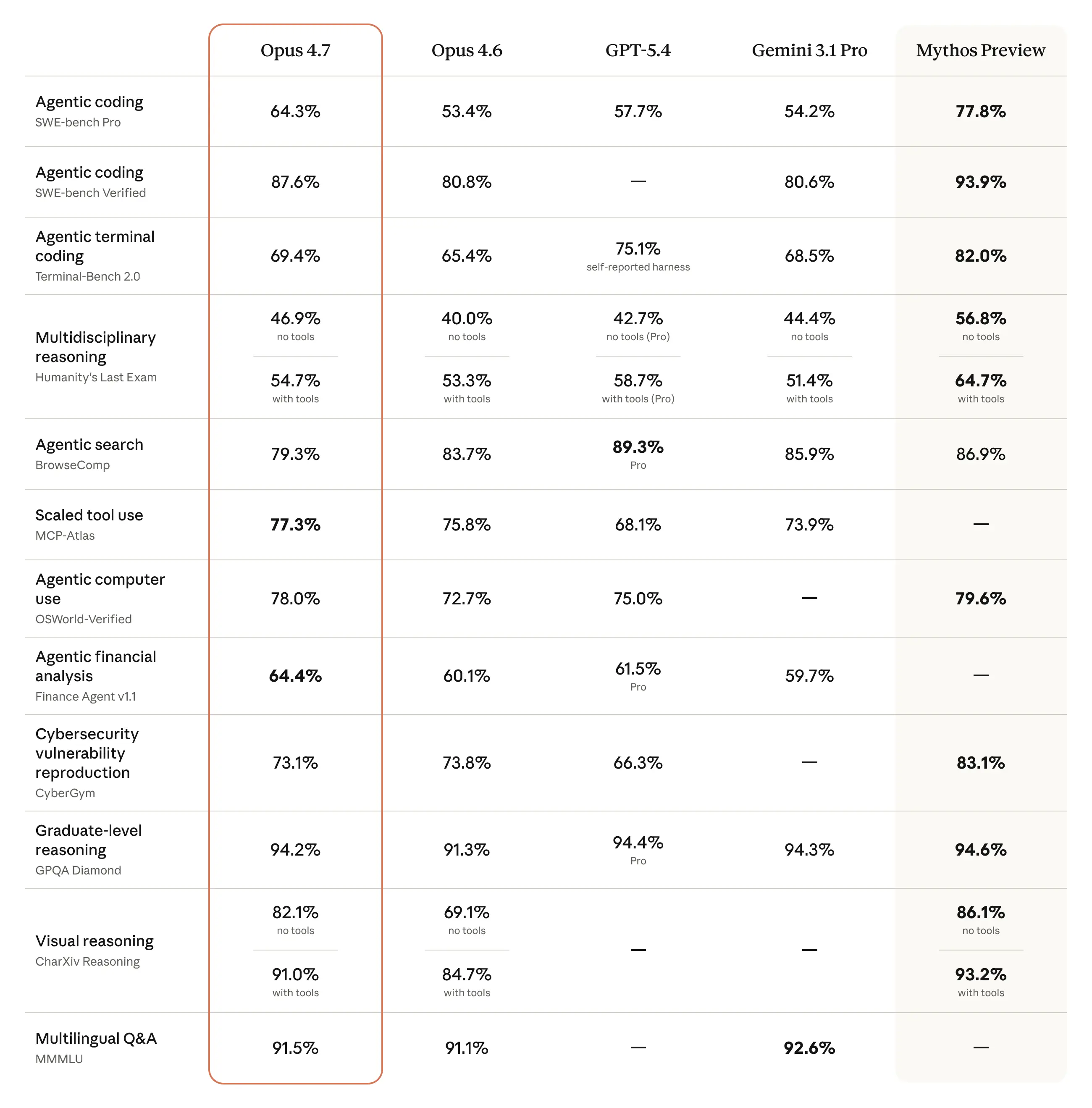
Last week we announced Project Glasswing, highlighting the risks—and benefits—of AI models for cybersecurity. We stated that we would keep Claude Mythos Preview’s release limited and test new cyber safeguards on less capable models first. Opus 4.7 is the first such model: its cyber capabilities are not as advanced as those of Mythos Preview (indeed, during its training we experimented with efforts to differentially reduce these capabilities). We are releasing Opus 4.7 with safeguards that automatically detect and block requests that indicate prohibited or high-risk cybersecurity uses. What we learn from the real-world deployment of these safeguards will help us work towards our eventual goal of a broad release of Mythos-class models.
Security professionals who wish to use Opus 4.7 for legitimate cybersecurity purposes (such as vulnerability research, penetration testing, and red-teaming) are invited to join our new Cyber Verification Program.
Opus 4.7 is available today across all Claude products and our API, Amazon Bedrock, Google Cloud’s Vertex AI, and Microsoft Foundry. Pricing remains the same as Opus 4.6: $5 per million input tokens and $25 per million output tokens. Developers can use claude-opus-4-7 via the Claude API.
Claude Opus 4.7 has garnered strong feedback from our early-access testers:

In early testing, we’re seeing the potential for a significant leap for our developers with Claude Opus 4.7. It catches its own logical faults during the planning phase and accelerates execution, far beyond previous Claude models. As a financial technology platform serving millions of consumers and businesses at significant scale, this combination of speed and precision could be game-changing: accelerating development velocity for faster delivery of the trusted financial solutions our customers rely on every day.

Anthropic has already set the standard for coding models, and Claude Opus 4.7 pushes that further in a meaningful way as the state-of-the-art model on the market. In our internal evals, it stands out not just for raw capability, but for how well it handles real-world async workflows—automations, CI/CD, and long-running tasks. It also thinks more deeply about problems and brings a more opinionated perspective, rather than simply agreeing with the user.
Claude Opus 4.7 is the strongest model Hex has evaluated. It correctly reports when data is missing instead of providing plausible-but-incorrect fallbacks, and it resists dissonant-data traps that even Opus 4.6 falls for. It’s a more intelligent, more efficient Opus 4.6: low-effort Opus 4.7 is roughly equivalent to medium-effort Opus 4.6.

On our 93-task coding benchmark, Claude Opus 4.7 lifted resolution by 13% over Opus 4.6, including four tasks neither Opus 4.6 nor Sonnet 4.6 could solve. Combined with faster median latency and strict instruction following, it’s particularly meaningful for complex, long-running coding workflows. It cuts the friction from those multi-step tasks so developers can stay in the flow and focus on building.

Based on our internal research-agent benchmark, Claude Opus 4.7 has the strongest efficiency baseline we’ve seen for multi-step work. It tied for the top overall score across our six modules at 0.715 and delivered the most consistent long-context performance of any model we tested. On General Finance—our largest module—it improved meaningfully on Opus 4.6, scoring 0.813 versus 0.767, while also showing the best disclosure and data discipline in the group. And on deductive logic, an area where Opus 4.6 struggled, Opus 4.7 is solid.

Claude Opus 4.7 extends the limit of what models can do to investigate and get tasks done. Anthropic has clearly optimized for sustained reasoning over long runs, and it shows with market-leading performance. As engineers shift from working 1:1 with agents to managing them in parallel, this is exactly the kind of frontier capability that unlocks new workflows.

We’re seeing major improvements in Claude Opus 4.7’s multimodal understanding, from reading chemical structures to interpreting complex technical diagrams. The higher resolution support is helping Solve Intelligence build best-in-class tools for life sciences patent workflows, from drafting and prosecution to infringement detection and invalidity charting.

Claude Opus 4.7 takes long-horizon autonomy to a new level in Devin. It works coherently for hours, pushes through hard problems rather than giving up, and unlocks a class of deep investigation work we couldn't reliably run before.

For Replit, Claude Opus 4.7 was an easy upgrade decision. For the work our users do every day, we observed it achieving the same quality at lower cost—more efficient and precise at tasks like analyzing logs and traces, finding bugs, and proposing fixes. Personally, I love how it pushes back during technical discussions to help me make better decisions. It really feels like a better coworker.

Claude Opus 4.7 demonstrates strong substantive accuracy on BigLaw Bench for Harvey, scoring 90.9% at high effort with better reasoning calibration on review tables and noticeably smarter handling of ambiguous document editing tasks. It correctly distinguishes assignment provisions from change-of-control provisions, a task that has historically challenged frontier models. Substance was consistently rated as a strength across our evaluations: correct, thorough, and well-cited.

Claude Opus 4.7 is a very impressive coding model, particularly for its autonomy and more creative reasoning. On CursorBench, Opus 4.7 is a meaningful jump in capabilities, clearing 70% versus Opus 4.6 at 58%.

For complex multi-step workflows, Claude Opus 4.7 is a clear step up: plus 14% over Opus 4.6 at fewer tokens and a third of the tool errors. It’s the first model to pass our implicit-need tests, and it keeps executing through tool failures that used to stop Opus cold. This is the reliability jump that makes Notion Agent feel like a true teammate.

In our evals, we saw a double-digit jump in accuracy of tool calls and planning in our core orchestrator agents. As users leverage Hebbia to plan and execute on use cases like retrieval, slide creation, or document generation, Claude Opus 4.7 shows the potential to improve agent decision-making in these workflows.

On Rakuten-SWE-Bench, Claude Opus 4.7 resolves 3x more production tasks than Opus 4.6, with double-digit gains in Code Quality and Test Quality. This is a meaningful lift and a clear upgrade for the engineering work our teams are shipping every day.

For CodeRabbit’s code review workloads, Claude Opus 4.7 is the sharpest model we’ve tested. Recall improved by over 10%, surfacing some of the most difficult-to-detect bugs in our most complex PRs, while precision remained stable despite the increased coverage. It’s a bit faster than GPT-5.4 xhigh on our harness, and we’re lining it up for our heaviest review work at launch.
For Genspark’s Super Agent, Claude Opus 4.7 nails the three production differentiators that matter most: loop resistance, consistency, and graceful error recovery. Loop resistance is the most critical. A model that loops indefinitely on 1 in 18 queries wastes compute and blocks users. Lower variance means fewer surprises in prod. And Opus 4.7 achieves the highest quality-per-tool-call ratio we’ve measured.

Claude Opus 4.7 is a meaningful step up for Warp. Opus 4.6 is one of the best models out there for developers, and this model is measurably more thorough on top of that. It passed Terminal Bench tasks that prior Claude models had failed, and worked through a tricky concurrency bug Opus 4.6 couldn't crack. For us, that’s the signal.

Claude Opus 4.7 is the best model in the world for building dashboards and data-rich interfaces. The design taste is genuinely surprising—it makes choices I’d actually ship. It’s my default daily driver now.

Claude Opus 4.7 is the most capable model we've tested at Quantium. Evaluated against leading AI models through our proprietary benchmarking solution, the biggest gains showed up where they matter most: reasoning depth, structured problem-framing, and complex technical work. Fewer corrections, faster iterations, and stronger outputs to solve the hardest problems our clients bring us.

Claude Opus 4.7 feels like a real step up in intelligence. Code quality is noticeably improved, it’s cutting out the meaningless wrapper functions and fallback scaffolding that used to pile up, and fixes its own code as it goes. It’s the cleanest jump we’ve seen since the move from Sonnet 3.7 to the Claude 4 series.

For the computer-use work that sits at the heart of XBOW’s autonomous penetration testing, the new Claude Opus 4.7 is a step change: 98.5% on our visual-acuity benchmark versus 54.5% for Opus 4.6. Our single biggest Opus pain point effectively disappeared, and that unlocks its use for a whole class of work where we couldn’t use it before.

Claude Opus 4.7 is a solid upgrade with no regressions for Vercel. It’s phenomenal on one-shot coding tasks, more correct and complete than Opus 4.6, and noticeably more honest about its own limits. It even does proofs on systems code before starting work, which is new behavior we haven’t seen from earlier Claude models.

Claude Opus 4.7 is very strong and outperforms Opus 4.6 with a 10% to 15% lift in task success for Factory Droids, with fewer tool errors and more reliable follow-through on validation steps. It carries work all the way through instead of stopping halfway, which is exactly what enterprise engineering teams need.

Claude Opus 4.7 autonomously built a complete Rust text-to-speech engine from scratch—neural model, SIMD kernels, browser demo—then fed its own output through a speech recognizer to verify it matched the Python reference. Months of senior engineering, delivered autonomously. The step up from Opus 4.6 is clear, and the codebase is public.

Claude Opus 4.7 passed three TBench tasks that prior Claude models couldn’t, and it’s landing fixes our previous best model missed, including a race condition. It demonstrates strong precision in identifying real issues, and surfaces important findings that other models either gave up on or didn’t resolve. In Qodo’s real-world code review benchmark, we observed top-tier precision.

On Databricks’ OfficeQA Pro, Claude Opus 4.7 shows meaningfully stronger document reasoning, with 21% fewer errors than Opus 4.6 when working with source information. Across our agentic reasoning over data benchmarks, it is the best-performing Claude model for enterprise document analysis.

For Ramp, Claude Opus 4.7 stands out in agent-team workflows. We’re seeing stronger role fidelity, instruction-following, coordination, and complex reasoning, especially on engineering tasks that span tools, codebases, and debugging context. Compared with Opus 4.6, it needs much less step-by-step guidance, helping us scale the internal agent workflows our engineering teams run.
Claude Opus 4.7 is measurably better than Opus 4.6 for Bolt’s longer-running app-building work, up to 10% better in the best cases, without the regressions we’ve come to expect from very agentic models. It pushes the ceiling on what our users can ship in a single session.
01 /
28
Below are some highlights and notes from our early testing of Opus 4.7:
The charts below display more evaluation results from our pre-release testing, across a range of different domains:
Overall, Opus 4.7 shows a similar safety profile to Opus 4.6: our evaluations show low rates of concerning behavior such as deception, sycophancy, and cooperation with misuse. On some measures, such as honesty and resistance to malicious “prompt injection” attacks, Opus 4.7 is an improvement on Opus 4.6; in others (such as its tendency to give overly detailed harm-reduction advice on controlled substances), Opus 4.7 is modestly weaker. Our alignment assessment concluded that the model is “largely well-aligned and trustworthy, though not fully ideal in its behavior”. Note that Mythos Preview remains the best-aligned model we’ve trained according to our evaluations. Our safety evaluations are discussed in full in the Claude Opus 4.7 System Card.
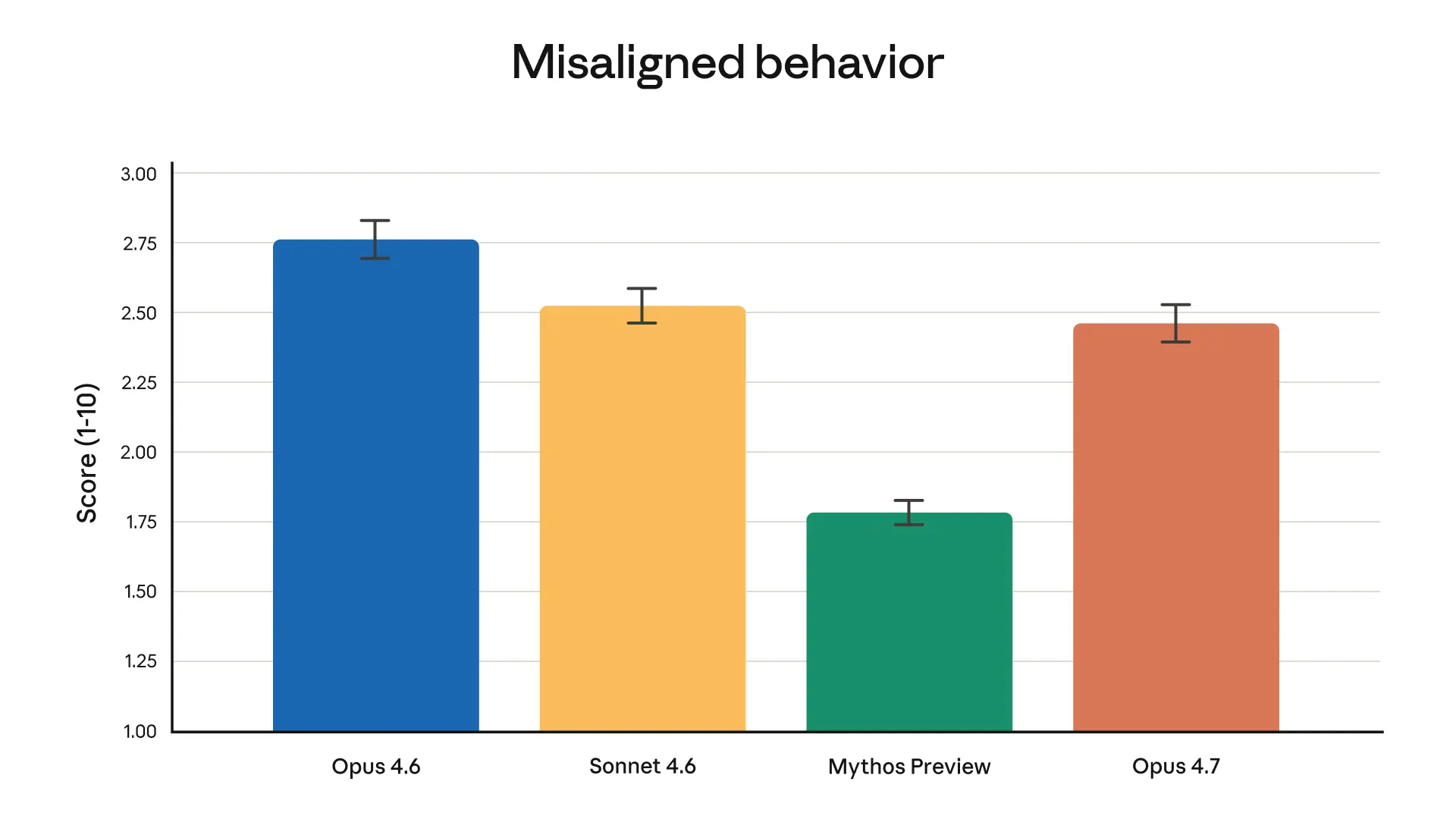
Overall misaligned behavior score from our automated behavioral audit. On this evaluation, Opus 4.7 is a modest improvement on Opus 4.6 and Sonnet 4.6, but Mythos Preview still shows the lowest rates of misaligned behavior.
In addition to Claude Opus 4.7 itself, we’re launching the following updates:
xhigh (“extra high”) effort level between high and max, giving users finer control over the tradeoff between reasoning and latency on hard problems. In Claude Code, we’ve raised the default effort level to xhigh for all plans. When testing Opus 4.7 for coding and agentic use cases, we recommend starting with high or xhigh effort./ultrareview slash command produces a dedicated review session that reads through changes and flags bugs and design issues that a careful reviewer would catch. We’re giving Pro and Max Claude Code users three free ultrareviews to try it out. In addition, we’ve extended auto mode to Max users. Auto mode is a new permissions option where Claude makes decisions on your behalf, meaning that you can run longer tasks with fewer interruptions—and with less risk than if you had chosen to skip all permissions.Opus 4.7 is a direct upgrade to Opus 4.6, but two changes are worth planning for because they affect token usage. First, Opus 4.7 uses an updated tokenizer that improves how the model processes text. The tradeoff is that the same input can map to more tokens—roughly 1.0–1.35× depending on the content type. Second, Opus 4.7 thinks more at higher effort levels, particularly on later turns in agentic settings. This improves its reliability on hard problems, but it does mean it produces more output tokens.
Users can control token usage in various ways: by using the effort parameter, adjusting their task budgets, or prompting the model to be more concise. In our own testing, the net effect is favorable—token usage across all effort levels is improved on an internal coding evaluation, as shown below—but we recommend measuring the difference on real traffic. We’ve written a migration guide that provides further advice on upgrading from Opus 4.6 to Opus 4.7.
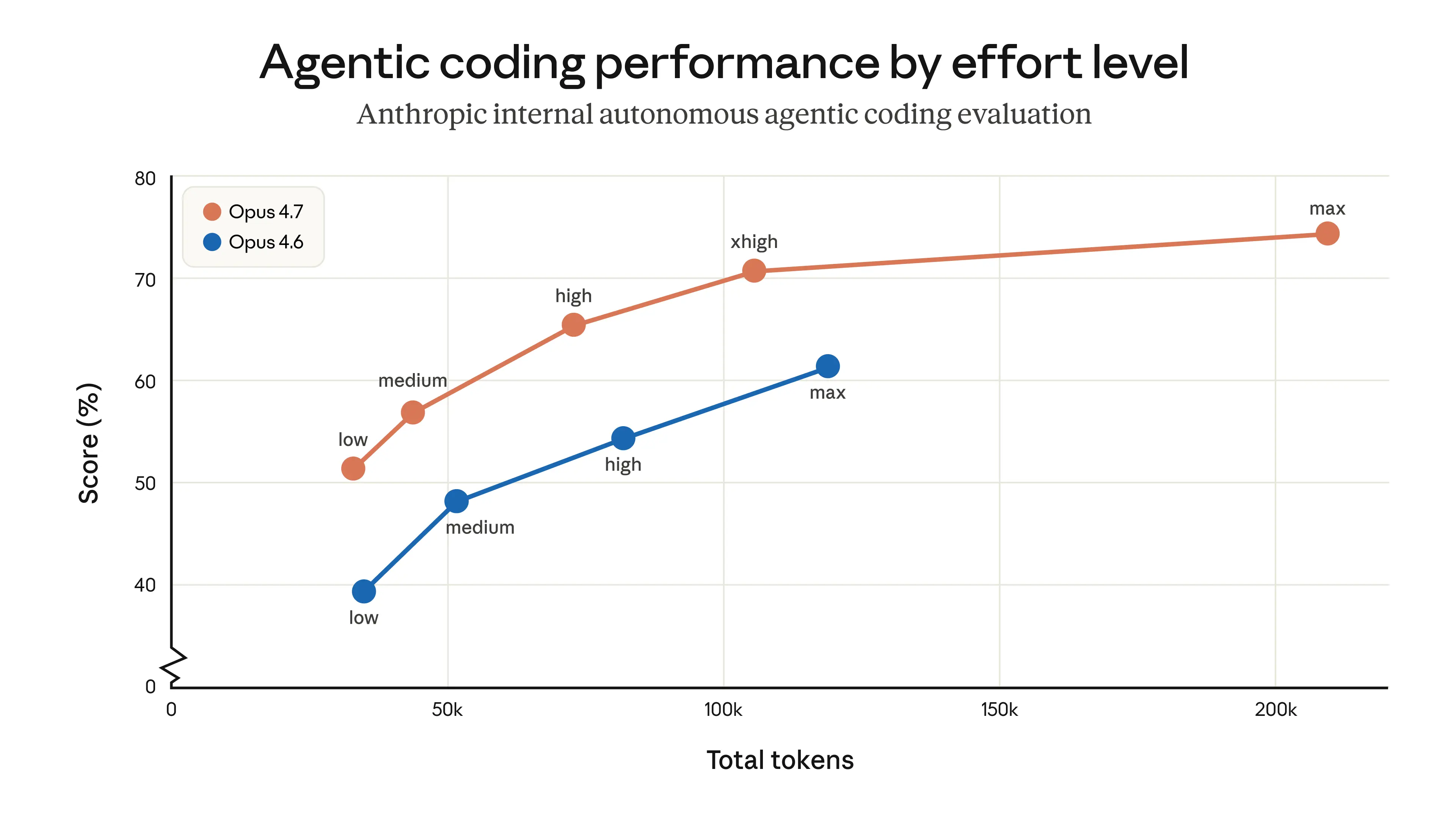
Score on an internal agentic coding evaluation as a function of token usage at each effort level. In this evaluation, the model works autonomously from a single user prompt, and results may not be representative of token usage in interactive coding. See the migration guide for more on tuning effort levels.
1 This is a model-level change rather than an API parameter, so images users send to Claude will simply be processed at higher fidelity. Because higher-resolution images consume more tokens, users who don’t require the extra detail can downsample images before sending them to the model.