https://youtu.be/85mAmP4k1Co?si=yuxpJ2xhkH7r_eo3
The video has lots of helpful information for puzzle game design. I have started to incorporate some of that knowledge into my own puzzle game https://qcgeneral29.itch.io/lets-learn
Never heard of it.
Unlike other consensus "bests", it's relatively unknown to the public (which is understandable for many reasons). It's very likely that if you're a puzzle game devotee, you will fall in love with SSR; but at the same time, if you don't have experience with puzzle games, you'll very likely hate it.
As a result, I've always thought it's an interesting window into how we value "taste" and "mastery", how too much mastery can actually distance us from one another, and what meaning there is in designing games for an ideal world shaped around ourselves, versus the world we actually live in.
It's well-known that puzzle games sell badly on Steam, and I think part of that is that difficulty and struggle is an acquired taste. Most try to paper over that gap with nice soundtracks and graphics, "hooky" mechanics, and narrative. SSR is so interesting because it contrasts so violently: it's ascetic, has no obvious hook, and offers nothing but difficulty and struggle, and the best feeling in the world if you decide to push through it anyway.
I'd take Void Stranger or probably even Deadly Rooms of Death: The Second Sky over Stephen's Sausage Roll any day, I imagine.
Put another way, it's been years since I played Baba and I can still remember the key insights to some of the sneakier puzzles. I couldn't even begin to do that for SSR.
From this post by one of the original devs: https://bsky.app/profile/draknek.bsky.social/post/3m7qybidq7...
Wouldn't really agree considering:
Antichamber, The Witness, Talos Principle, Manifold Garden, Portal, Zachtronics, Tunic, Blue Prince, Return of the Obra Dinn, Seance of Blake Manor, a bunch more I could list.
The puzzle game that reaped all the rewards this year is Blue Prince, it has its sokoban moment, but as a whole it is definitely not a sokoban game.
The game is hard. I only kinda got the hang of it, and I didn't quite get to that ah-ha moment. You have to be willing to sit with it and think. I think with sokoban games, you can often just almost random walk your way to a solution, because the state space and its transitions is easy enough to wander into. But I didn't find that to be the case with SSR. You have to be able to reason about the state space changes, I think because the state space isn't exactly euclidean, so it's harder to wander into the solution.
de•li•cious saus•ag•es
In favor of SSR: The design is more vertical than Baba, it explores fewer mechanics but with greater depth. And it's entirely spatial, whereas Baba's solutions are sometimes a matter of wordplay, with the sokoban just a formality.
I like Baba better, but I'm not sure if it's the better game.
I guess Zelda, Metroid and Half-Life also count as puzzle games then. :)
Imo it's better to approach Demon's Souls as an exploration puzzle game with RPG stuff and combat, not as an action RPG (such as Dark Souls 3).
That said, The Witness isn't a bad game as such, though the puzzles do get a bit repetitive in my opinion. I prefer more variety rather than hyper focus on one type of puzzles.
I suppose the new Breath of the Wild / Tears of the Kingdom titles are more action-oriented, but everything in the mold of Ocarina of Time is a puzzle game with some light combat sprinkled on top.
After reading the linked article, and the comments here I still have zero clue about the game. It's a puzzle game involving sausages and a large fork does nothing to describe what kind of puzzles they might be.
Baba is You ramps up as you go to, but the ramping up is mostly done by the game giving you new tools to work with. Plus, the amount of interesting puzzles you can do with the mechanics of Baba is You is virtually endless, whereas SSG makes you feel like the game squeezed all the possible gameplay out of moving sausages around.
This one? It looks interesting but definitely a lot less visible than SSR and not on storefronts or etc, right?
And you don't have the time element of Outer Wilds (Outer Wilds is brilliant though, and it kinda needs that time element to work properly).
I mean technically it does in that you only have so many steps in a day, but you only spend a step moving from one room to another, so you can take your time in any given room, and you have ways to increase those steps.
Also you're more likely to block yourself off with your room layout for the day than you are to run out of steps, at least once you start getting better at the game (it can happen though).
Sorry Mario, but your princess is another castle!
I've seen this game recommended many times but I've never played it because I feel like I would get bored very fast. Same with Zachtronics games.
I’m good with zero-story puzzle games. I’ve spent many hours in Simon Tathem’s Puzzles [1] on my iPhone, just for the 100% pure logic goodness that they are.
[1] https://apps.apple.com/us/app/simon-tathams-puzzles/id622220...
rolled, surely
Today marks 10 years since Stephen's Sausage Roll released on PC and changed puzzle games forever. A sokoban game where you use an oversized fork to cook chunky sausages, it's become known for its meticulous puzzle design and tough-as-nails difficulty, winning the hearts (and minds) of puzzle-lovers and aspiring game developers. The influence that the game has had on the thinky community and the puzzle games we love is immeasurable, so here at Thinky Games, we’d like to join in the celebrations and put a party hat on for what we consider a puzzle game masterpiece.
When game designer Stephen Lavelle (Increpare Games) released Stephen's Sausage Roll back in April 2016, it was accompanied by a trailer that showed almost nothing about the game, yet word still spread quickly. Puzzle developers and fans praised the game for its impeccable design, teasing out layers of deep puzzling and mind-expanding discoveries from so few puzzle elements. It was also renowned for its uncompromising, yet always fair, difficulty curve, with immensely challenging puzzles from the very start. These sentiments are still held to this day, as this beloved sausage-pushing sokoban continues to influence new generations of puzzle developers, inspiring some of the best sokoban games ever made and introducing "Sausage-likes” to the puzzle vernacular.
A few years prior to Stephen's Sausage Roll, Stephen Lavelle also released PuzzleScript, a web-based game engine for creating grid-based puzzle games, giving developers an incredibly powerful way explore sokoban game design. With both Stephen's Sausage Roll and PuzzleScript, it's safe to say Lavelle has had an incredible influence on modern thinky puzzle games.
To celebrate the game's 10-year anniversary, we asked a handful of developers how Stephen's Sausage Roll has influenced their own puzzle games, design philosophies, and creative visions. You’ll find their words below.
So, on that note, Happy 10th Birthday to Stephen's Sausage Roll!
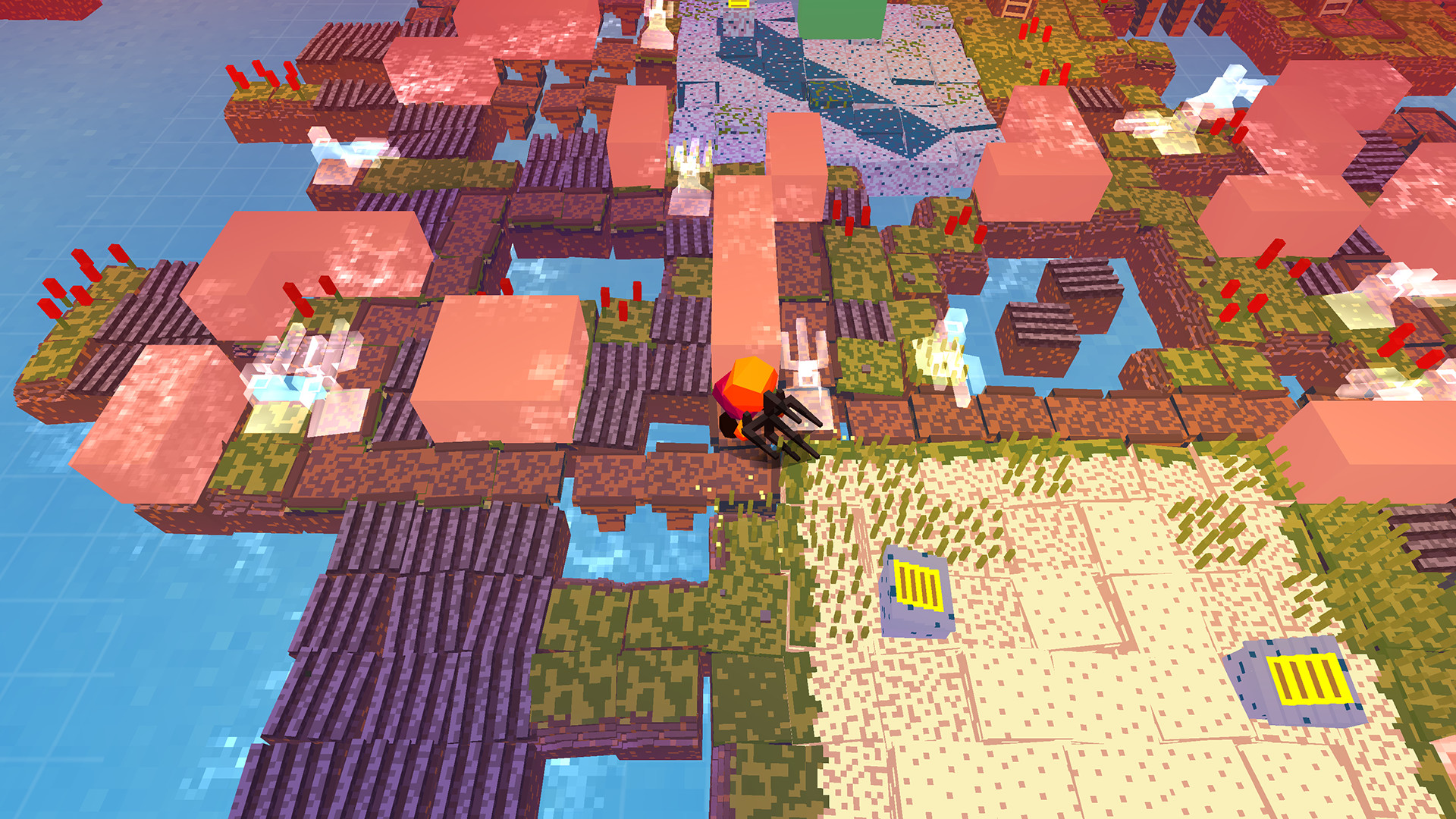
"Stephen's Sausage Roll is a masterclass of doing a lot with a little - taking a small number of game elements, never adding anything new, but constantly surprising you with the consequences of the mechanics that were always there. Other games have followed this design ethos since (our game A Monster's Expedition among them), but they all stand on the shoulders of this beautiful tower of sausages." – Alan Hazelden (Draknek & Friends, A Monster's Expedition, Spooky Express, Sokobond)
.jpg)
"Player. Fork. Sausage. Grill. Block. Ladder. So much comes from just these 6 objects! Stephen's Sausage Roll masterfully harnesses and explores the deep mathematical richness of sokoban-like systems. And yet, the physical metaphors of these objects keep the ruleset understandable, intuitive, human-relatable, and make the surprising consequences and absurd constructions that much more amazing. SSR exemplifies the qualities of Stephen's huge lineage of sokoban-like games. On a personal note - SSR inspired me to take Patrick's Parabox in a non-action, pure-puzzle direction! And it inspired me to put my name in my game's title!" – Patrick Traynor (Patrick’s Parabox, Linelith)
"When Stephen’s Sausage Roll was first recommended to me I was not a puzzle gamer. I played mostly AAA RPGs. I had a background in AAA art, and I was rather unimpressed with SSR’s aesthetics. At my friend's behest I begrudgingly gave this game and shot, and it changed the course of my career. Stephen’s Sausage Roll was a gateway drug into sokobans in general. I spent hours playing Pipe Push Paradise, then Alan Hazelden’s games, the various sokoban puzzlescript experiments, and so on. I eventually left my indie gig and developed two sokoban titles of my own – Kine and then Lab Rat. None of this would have happened if it wasn't for SSR. I'm so, so grateful that this game exists." – Gwen Frey (Kine, Lab Rat)
.jpg)
"Discovering Stephen's Sausage Roll was so creatively exciting for me. Everything about it had this radical stripped-down purity. 3 inputs, no time pressure, no reflex-based pressure, and yet somehow among the richest experiences I had ever had with a game. It was like 'the Ramones in 1976' of video games. Similar to Fumito Ueda's games like Ico and Shadow of the Colossus, it pushed back, for me at least, on the expectation of these superficial layers we came to expect in a game. It stretched out my understanding of what a game could be and made me realise those boundaries would continue to stretch, and gosh, how inspiring. I wanted to be a part of it." – Corey Martin (Bonfire Peaks, Pipe Push Paradise)
"Stephen's Sausage Roll taught me to love sokoban. It may have taken me two attempts to get into it, but by the time I'd finally cooked that last sausage, I was a sokoban fan for life. For me, Stephen's Sausage Roll marks a clear shift from classic fiddly sokoban design to the kind of beautiful, deep, insightful, and focused puzzle design we look for in all modern thinky games. Not only that, but both it and the many hundreds of games it has inspired have proven that sokoban, as a puzzle framework, is an unbelievably rich space with still so much to explore." – Joseph Mansfield (Thinky Games)
Learn more about Stephen's Sausage Roll in our database of thinky games, where you can also find similar games and some of the best sokoban games ever made.
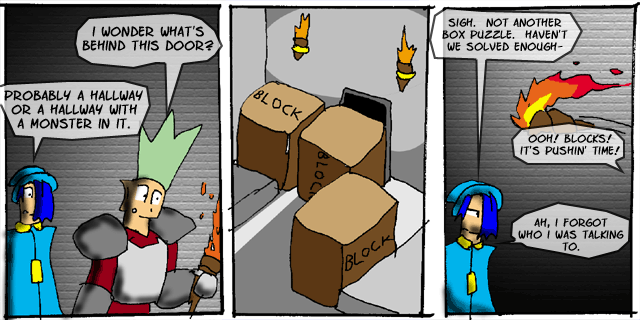
A video is worth a thousand words, and there's a video at the very beginning of the article. Did you watch the video?
You control a character on a grid and you have to push sausages around the grid in order to grill them (some of the floor tiles are grill tiles). That's the core game. But the sausages roll and you can't let a given side touch a grill more than once. And the grid is space constrained - you can accidentally push a sausage off the grid and it will fall into an abyss and you have to start over. The puzzles are very difficult because there is so much complexity that stacks:
- Your character can strafe and push things, but your character is also 2 tiles wide and can pivot and swing a fork (and the swing action can push things)
- sausages only roll along one axis, otherwise they slide
- sausages can be stacked into the 3rd dimension which means there's also gravity
- if a sausage falls on your character's head you can move it around and rotate it
- etc.
This game introduces a very small set of controls and mechanics (you basically only have the arrow keys, and initially can just move around), and combines it with minimally small, yet surprisingly hard puzzles. Every puzzles is distilled to its smallest form, and involves a genuinely satisfying eureka moment.
The game then explores every possible hidden way to use the minimal set of mechanics introduced, before introducing a new mechanic (e.g. early on you'll be able to suddenly 'stab' you sausages which allows you to move them around differently. So you become a master of the game as you progress.
The problem for new players is that it's deceptively difficult to solve even the simplest puzzles + it encourages you to explore and learn how things work instead of giving you hints. This makes inexperienced players abandon it way before it fully reveals itself (which takes many hours into the game).
What I suggest is if you are new and are frustrated, find a Youtuber that solved it so that you can look at what they did. This way you won't get stuck to the point of leaving it, while still allowing you to fully enjoy it.
Sure, sure. Here's the annotated second paragraph from TFA:
When game designer <Stephen Lavelle> [0] (Increpare Games) released Stephen's Sausage Roll back in April 2016, it was accompanied by <a trailer> [1] that showed almost nothing about the game, yet word still spread quickly. Puzzle developers and fans praised the game for its impeccable design, teasing out layers of deep puzzling and mind-expanding discoveries from so few puzzle elements. It was also renowned for its uncompromising, yet always fair, difficulty curve, with immensely challenging puzzles from the very start. These sentiments are still held to this day, as this beloved sausage-pushing sokoban continues to influence new generations of puzzle developers, <inspiring some of the best sokoban games> [3] ever made and introducing "Sausage-likes” to the puzzle vernacular.
Clicking link [3] leads us to a page that has this as its first paragraph: Sokoban games, also known as block-pushing or box-pushing games, are turn-based puzzle games in which you control a character pushing or moving objects around on a grid. The genre has origins in the 1982 game Sokoban, designed by Hiroyuki Imabayashi, in which you have to push boxes around a warehouse onto designated targets. The japanese word 倉庫番 (“sōkoban”) translates to “warehouse keeper”.
Incidentally, link [3] is repeated in the final paragraph of TFA, which I will also copy and annotate: Learn more about Stephen's Sausage Roll in <our database of thinky games> [4], where you can also find <similar games> [5] and some of the <best sokoban games ever made>. [3]
Link [4] is pretty clear about what the game is. Did you bother to click it in order to "[l]earn more about Stephen's Sausage Roll", as it invites you to do?[0] <https://increpare.com/>
[1] <https://www.youtube.com/watch?v=lCNqYLGwqxU>
[3] <https://thinkygames.com/lists/best-sokoban-games/>
[4] <https://thinkygames.com/games/stephens-sausage-roll/>
[5] <https://thinkygames.com/games/stephens-sausage-roll/similar/>
I prefer games where I can play slow and deliberate. If there is a time mechanic it should be turn based, not real time. (Or it should be a very short time based system such as "run across the room to hit the other button, the cost of failing is 10 seconds of trying again, not 10 minutes".)
And even more if figuring out how to buy it wasn't a challenging puzzle in its own right.
[0]http://itunes.apple.com/us/app/english-country-tune/id476962...
It's a fantastic game, one of the all-time greats, and there are tricky parts to execute, but it's not particularly challenging in terms of puzzling.
Simple turn-based eight-direction grid movement, where one of your adjacent squares contains your "sword" and you can rotate your sword around yourself one square per-turn. Kill (deterministic and 1hp) monsters by moving your sword on to all the monsters move after your move, and "complete" a room by killing all monsters.
There's quite an active community (at least there was when I was in to it) but I've rarely heard it mentioned outside of the community.
Edit: I'm happy to see some other references to DroD in this thread.
By construction, nothing in the game is far away. You're only limited by how much you've figured out. And having the spark of understanding occur can take place at any time, including while you're away from the keyboard.
So it's mostly about following your curiosity wherever it leads you, and from there you keep digging all the way, safe in the knowledge that in 22 minutes at most any screwups will be rolled back. And then you can try again, or, better follow your curiosity somewhere else. There's no lack of things to figure out, and some of them are completely optional. But... Figure them out anyway, the reward is worthwhile.
"Thank you for remembering me."
I can see why Outer Wilds might feel the same way. But somehow it didn’t for me. Probably because it really doesn’t take much at all to get right back to where you were.
https://store.steampowered.com/app/353540/Stephens_Sausage_R...
On sale for 6$ at 80% off.
"Sokoban" translates to "warehouse keeper". The original game was about moving boxes around in a crowded warehouse.
https://images.squarespace-cdn.com/content/v1/5758783607eaa0...
https://tvtropes.org/pmwiki/pmwiki.php/Main/BlockPuzzle
Complaining that games may be described as "like Sokoban" is kind of like complaining that they might be described as "real-time strategy".
Even knowing what a "strategy game" is won't help, since the meaning of that term has shifted since "RTS" was derived from it.
Similarly, knowing that Sokoban means "warehouse guard" doesn't help you to know what to expect in a Sokoban game. But the fact that this is a common term familiar to ~everyone does.
When everyone around you is using a word with no problems, don't complain that you wish they'd all forget what it meant. Learn how to talk.