
I’m no security engineer, but this is flatly unacceptable, right? This feels like Vercel is covering its own ass in favor of helping its customers understand the impact of this incident.
Both have been changing as people realize it's rarely the right tool for the job, and as LLMs also become more intelligent and better at suggesting other, better options depending on what is asked for (especially Claude Opus).
Everything runs fine locally until you try to deploy it, and bam you need 4g ram machine to run the thing.
So you host it on Vercel for free cause it's easy!
Then you want to check for more than 30 seconds of analytics, and it's pay time.
I’m still planning to move elsewhere though, the vendor lock-in is not worth it and I’d like to keep our infra in the EU.
Knowing how to operate a basic server is perceived as hard and dangerous by many, especially the generation that didn’t have a chance to play with Linux for fun when growing up
The internet does that but it feels different with this
That's a funny way of saying "race to the bottom."
> The internet does that but it feels different with this
How does "the internet do that?" What force on the internet naturally brings about mediocrity? Or have we confused rapacious and monopolistic corporations with the internet at large?
nextjs is also powerful due to AI. But the value is a robust interactive front-end, easily iterated, with maybe SSR backing, nothing specific to nextjs.
So much complexity has gone into SSR. I hate 5MB client runtime just to read text as much as anyone, but not if the tradeoff is isomorphic env with magic file first-line incantations.
But the argument is if you’re using Vercel for production, you’re paying 5-10x what you’d pay for a VM, with 4gb.
So then what’s the rationale? You can’t be a hobbyist but also “it’s pay time” for production?
They regularly try to get me to join an enterprise plan but no service cutoff threats yet.
However it is less clear on how to do this, people mostly take the easiest path.
> b. (Recommended) Do something that works now, you can always make it better later
Has anyone made the move to self hosting on their own servers again?
Clicking the Vercel logo at the top left of the page hard crashes my Chrome app. Like, immediate crash.
What an interesting bug.
> Indicators of compromise (IOCs)
> Our investigation has revealed that the incident originated from a third-party AI tool whose Google Workspace OAuth app was the subject of a broader compromise, potentially affecting hundreds of its users across many organizations.
> We are publishing the following IOC to support the wider community in the investigation and vetting of potential malicious activity in their environments. We recommend that Google Workspace Administrators and Google Account owners check for usage of this app immediately.
> OAuth App: 110671459871-30f1spbu0hptbs60cb4vsmv79i7bbvqj.apps.googleusercontent.com
https://vercel.com/kb/bulletin/vercel-april-2026-security-in...
At what point do we start asking questions about the concentration of trust in the web ecosystem?
It's funny that at the engineering level we are continuously grilled in interviews about the single responsibility principle, meanwhile the industry's business model is to undermine the entirety of web standards and consolidate the web stack into a CLI.
So they use third-party for incident management? They are de-risking by spending more, which is a loose-loose for the customers.
I see Vercel is hosted on AWS? Are they hosting every one on a single AWS account with no tenant isolating? Something this dumb could never happen on a real AWS account. Yes I know the internal controls that AWS has (former employee).
Anyone who is hosting a real business on Vercel should have known better.
I have used v0 to build a few admin sites. But I downloaded the artifacts, put in a Docker container and hosted everything in Lambda myself where I controlled the tenant isolation via separate AWS accounts, secrets in Secret Manager and tightly scoped IAM roles, etc.
> Indicators of compromise (IOCs)
> Our investigation has revealed that the incident originated from a third-party AI tool whose Google Workspace OAuth app was the subject of a broader compromise, potentially affecting hundreds of its users across many organizations.
> We are publishing the following IOC to support the wider community in the investigation and vetting of potential malicious activity in their environments. We recommend that Google Workspace Administrators and Google Account owners check for usage of this app immediately.
> OAuth App: 110671459871-30f1spbu0hptbs60cb4vsmv79i7bbvqj.apps.googleusercontent.com
https://vercel.com/kb/bulletin/vercel-april-2026-security-in...
Something happened, we won't say what, but it was severe enough to notify law enforcement. What floors me is the only actionable advice is to "review environment variables". What should a customer even do with that advice? Make sure the variable are still there? How would you know if any of them were exposed or leaked?
The advice should be to IMMEDIATELY rotate all passwords, access tokens, and any sensitive information shared with Vercel. And then begin to audit access logs, customer data, etc, for unusual activity.
The only reason to dramatically overpay for the hosting resources they provide is because you expect them to expertly manage security and stability.
I know there is a huge fog of uncertainly in the early stages of an incident, but it spooks me how intentionally vague they seem to be here about what happened and who has been impacted.
https://x.com/theo/status/2045862972342313374
> I have reason to believe this is credible.
https://x.com/theo/status/2045870216555499636
> Env vars marked as sensitive are safe. Ones NOT marked as sensitive should be rolled out of precaution
https://x.com/theo/status/2045871215705747965
> Everything I know about this hack suggests it could happen to any host
https://x.com/DiffeKey/status/2045813085408051670
> Vercel has reportedly been breached by ShinyHunters.
Next.js is the new PHP, but worse, since unlike PHP you don't really know what's server side and what's client side anymore. It's all just commingled and handled magically.
https://aws.amazon.com/security/security-bulletins/rss/aws-2...
Chrome Version 147.0.7727.101 (Official Build) (64-bit). Windows 11 Pro.
Video: https://imgur.com/a/pq6P4si
I use uBlock Origin Lite. Maybe it blocks some crash causing script? edit: still no crash when I disabled UBO.
He also suggests in another post that Linear and GitHub could also be pwned?
Either way, hugops to all the SRE/DevOps out there, seems like it's going to be a busy Sunday for many.
I find it fun we're all reading a story how Vercel likely is compromised somehow, and managed to reproduce a crash on their webpage, so now we all give it a try. Surely could never backfire :)
I’m not exactly surprised, but it seems like the unserious, ill-informed and lazy are taking over. There is absolutely zero reason why a large, essential public service should be overspending and running on an unnecessary managed service like vercel… yet, here we are.
This was an interesting tidbit too. If true, this means that Vercel’s IT/Infosec maybe didn’t bother enabling the allowlist and request/review features for OAuth apps in their Google Workspace.
On top of that, they almost certainly didn’t enable the scope limits for unchecked OAuth apps (e.g limiting it to sign-on/basic profile scopes).
Theo's content boils down to the same boring formula. 1. Whatever buzzword headline is trending at the time 2. Immediate sponsored ad that is supposed to make you sympathize with Theo cause he "vets" his sponsors. 3. The man makes you listen to a "that totally happened" story that he somehow always involved himself personally. 4. Man serves you up an ad for his t3.chat and how it's the greatest thing in the world and how he should be paid more for his infinite wisdom. 5. A rag on Claude or OpenAI (whichever is leading at the time) 6. 5-10 minutes of paraphrasing an article without critical thought or analysis on the video topic.
I used to enjoy his content when he was still in his Ping era, but it's clear hes drunken the YT marketer kool-aid. I've moved on, his content gets recommend now and again, but I can't entertain his non-sense anymore.
> @ErdalToprak: "And use your own vps or k3s cluster there’s no reason in 2026 to delegate your infra to a middle man except if you’re at AWS level needs"
> @theo: "This is still a stupid take"
lol, okay. Thanks for the insight, Theo, whoever you are.
No crash.
Now I don't want to click that "Finish update" button.
No, but most breaches today come from compromised internal accounts that are then used to break everything.
> A Vercel employee got compromised via the breach of an AI platform customer called http://Context.ai that he was using.
> Through a series of maneuvers that escalated from our colleague’s compromised Vercel Google Workspace account, the attacker got further access to Vercel environments.
> We do have a capability however to designate environment variables as “non-sensitive”. Unfortunately, the attacker got further access through their enumeration.
> We believe the attacking group to be highly sophisticated and, I strongly suspect, significantly accelerated by AI. They moved with surprising velocity and in-depth understanding of Vercel.
Still no email blast from Vercel alerting users, which is concerning.
The only possibility for that not being a reasonable starting point is if they think the malicious actors still have access and will just exfiltrate rotated secrets as well. Otherwise this is deflection in an attempt to salvage credibility.
While a different kind of incident (in hindsight), the other week Webflow had a serious operational incident.
Sites across the globe going down (no clue if all or just a part of them). They posted plenty of messages, I think for about 12 hours, but mostly with the same content/message: "working on fixing this with an upstream provider" (paraphrased). No meaningful info about what was the actual problem or impact.
Only the next day did somebody write about what happened. Essentially a database running out of storage space. How that became a single point of failure, to at least plenty of customers: no clue. Sounds like bad architecture to me though. But what personally rubbed me the wrong way most of all, was the insistence on their "dashboard" having indicated anything wrong with their database deployment, as it allegedly had misrepresented the used/allocated storage. I don't who this upstream service provider of Webflow is, but I know plenty about server maintenance.
Either that upstream provider didn't provide a crucial metric (on-disk storage use) on their "dashboard", or Webflow was throwing this provider under the bus for what may have been their own ignorant/incompetent database server management. I guess it all depends to which extend this database was a managed service or something Webflow had more direct control over. Either way, with any clue about the provider or service missing from their post-mortem, customers can only guess as to who was to blame for the outage.
I have a feeling that we probably aren't the only customer they lost over this. Which in our case would probably not have happened, if they had communicated things in a different way. For context: I personally would never need nor recommend something like Webflow, but I do understand why it might be the right fit for people in a different position. That is, as long as it doesn't break down like it did. I still can't quite wrap my head around that apparent single point of failure for a company the size of Webflow though.
/anecdote
But there are more people trying to secure this framework and the underlying tools than there would be on some obscure framework or something the average company built themselves.
Also "pay a real provider", what does that mean? Are you again implying that the average company should be responsible for _more_ of their own security in their hosting stack, not less?
Most companies have _zero_ security engineers.. Using a vertically-integrated hosting company like Vercel (or other similar companies, perhaps with different tech stacks - this opinion has nothing to do with Next or Node) is very likely their best and most secure option based on what they are able to invest in that area.
Wasn't unheard of back in the day, that you leaked things via PHP templates, like serializing and adding the whole user object including private details in a Twig template or whatever, it just happened the other way around kind of. This was before "fat frontend, thin backend" was the prevalent architecture, many built their "frontends" from templates with just sprinkles of JavaScript back then.

Update 4/19/26: Added additional information from Vercel that was disclosed after publishing.
Cloud development platform Vercel has disclosed a security incident after threat actors claimed to have breached its systems and are attempting to sell stolen data.
Vercel is a cloud platform that provides hosting and deployment infrastructure for developers, with a strong focus on JavaScript frameworks.

The company is known for developing Next.js, a widely used React framework, and for offering services such as serverless functions, edge computing, and CI/CD pipelines that enable developers to build, preview, and deploy applications.
In a security bulletin published today, the company said a limited subset of customers was affected by a security breach.
"We've identified a security incident that involved unauthorized access to certain internal Vercel systems," warns Vercel.
"We are actively investigating, and we have engaged incident response experts to help investigate and remediate. We have notified law enforcement and will update this page as the investigation progresses."
The company says its services have not been impacted and that it is working with impacted customers.
Vercel says it is taking steps to protect its customers, advising them to review environment variables, use its sensitive environment variable feature, and to rotate secrets if needed.
After publishing this story, Vercel updated its advisory to state that the breach stemmed from the compromise of a third-party AI tool's Google Workspace OAuth application.
Vercel is advising Google Workspace administrators and Google account owners to check for the following application:
OAuth App: 110671459871-30f1spbu0hptbs60cb4vsmv79i7bbvqj.apps.googleusercontent.com
Vercel CEO Guillermo Rauch later shared additional details on X, stating that the initial access occurred after a Vercel employee's Google Workspace account was compromised via a breach at the AI platform Context.ai.
According to Rauch, the attacker then escalated access from the compromised account into Vercel environments, where they were able to access environment variables that were not marked as sensitive and therefore not encrypted at rest.
While intended to contain non-sensitive information, the attacker gained further access after enumerating these variables.
"Vercel stores all customer environment variables fully encrypted at rest. We have numerous defense-in-depth mechanisms to protect core systems and customer data," Rauch said.
"We do have a capability, however, to designate environment variables as 'non-sensitive.' Unfortunately, the attacker got further access through their enumeration."
The company's investigation has confirmed that Next.js, Turbopack, and its other open-source projects remain safe.
Vercel has also rolled out updates to its dashboard, including an overview page of environment variables and an improved interface for managing sensitive environment variables.
Customers are strongly advised to review environment variables for sensitive information and enable the sensitive variable feature to ensure they are encrypted at rest.
If you have any information regarding this incident or other undisclosed attacks, you can contact us confidentially via Signal at 646-961-3731 or at tips@bleepingcomputer.com.
The disclosure comes after a threat actor claiming to be "ShinyHunters" posted on a hacking forum that they had breached Vercel and were selling access to company data.
It should be noted that while the hacker claims to be part of the ShinyHunters group, threat actors linked to recent attacks attributed to the ShinyHunters extortion gang have denied to BleepingComputer that they are involved in this incident.
In the forum post, the hacker claimed to be selling access keys, source code, and database data allegedly stolen from Vercel, along with access to internal deployments and API keys.
"This is just from Linear as proof, but the access I'm about to give you includes multiple employee accounts with access to several internal deployments, API keys (including some NPM tokens and some GitHub tokens)," reads the forum post.
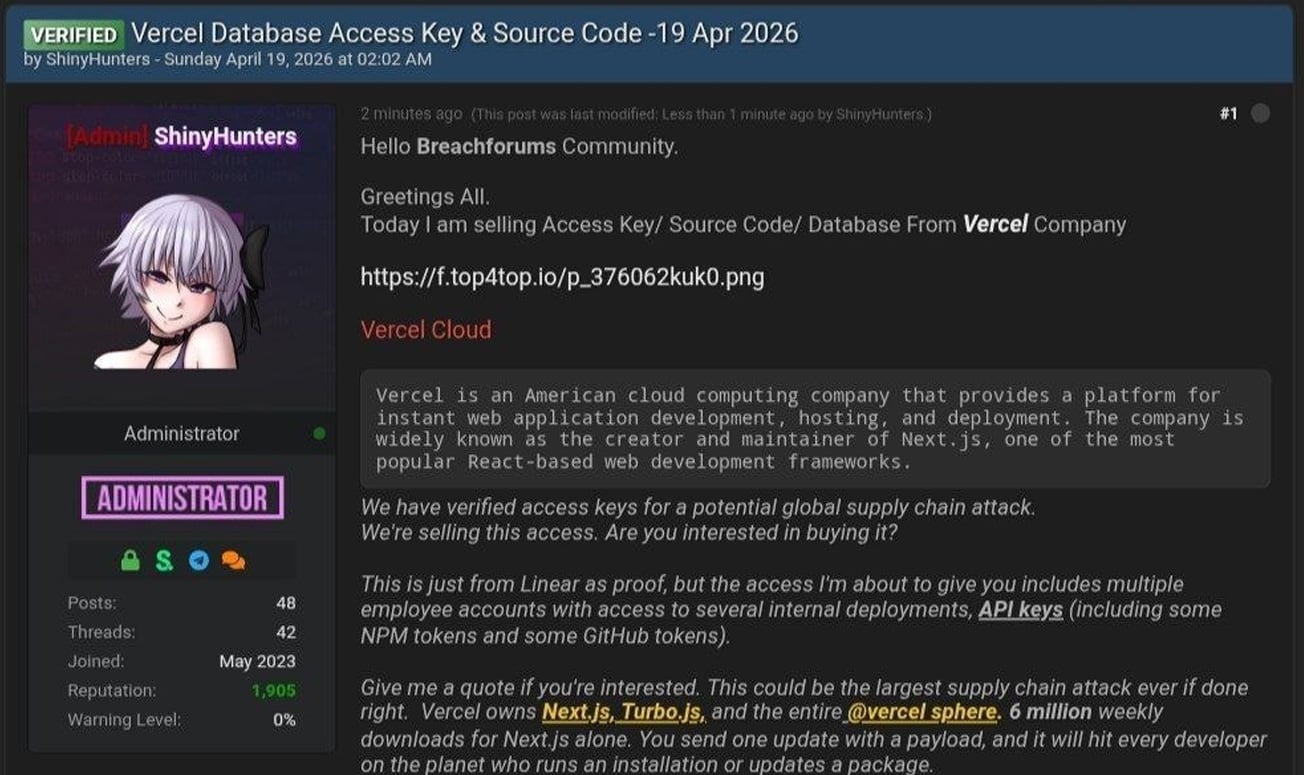
A screenshot of a forum post shared by the threat actor on Telegram
The attacker also shared a text file containing Vercel employee information, which consists of 580 data records containing names, Vercel email addresses, account status, and activity timestamps. They also shared a screenshot of what appears to be an internal Vercel Enterprise dashboard.
BleepingComputer has not been able to independently confirm if the data or screenshot is authentic.
In messages shared on Telegram, the threat actor also claimed they were in contact with Vercel regarding the incident and that they discussed an alleged ransom demand of $2 million.
BleepingComputer contacted Vercel with additional questions about the breach, including whether any sensitive data or credentials were exposed and if they are negotiating with the attackers, and will update this story if we receive a response.
Update 4/19/26 6:14 PM ET: Updated article to add further information disclosed by Vercel.
Update 4/19/26 7:21 PM ET: Updated article with additional information from Vercel's CEO.

AI chained four zero-days into one exploit that bypassed both renderer and OS sandboxes. A wave of new exploits is coming.
At the Autonomous Validation Summit (May 12 & 14), see how autonomous, context-rich validation finds what's exploitable, proves controls hold, and closes the remediation loop.
This feels like a natural consequence of the direction web development has been going for the last decade, where it's normalised to wire up many third party solutions together rather than building from more stable foundations. So many moving parts, so many potential points of failure, and as this incident has shown, you are only as secure as your weakest link. Putting your business in the hands of a third party AI tool (which is surely vibe-coded) carries risks.
Is this the direction we want to continue in? Is it really necessary? How much more complex do things need to be before we course-correct?
> Environment variables marked as "sensitive" in Vercel are stored in a manner that prevents them from being read, and we currently do not have evidence that those values were accessed. However, if any of your environment variables contain secrets (API keys, tokens, database credentials, signing keys) that were not marked as sensitive, those values should be treated as potentially exposed and rotated as a priority.
https://vercel.com/kb/bulletin/vercel-april-2026-security-in... as of 4:22p ET
This and because it's so convenient to click some buttons and have your application running. I've stopped being lazy, though. Moved everything from Render to linode. I was paying render $50+/month. Now I'm paying $3-5.
I would never use one of those hosting providers again.
I feel for the team; security incidents suck. I know they are working hard, I hope they start to communicate more openly and transparently.
if it's not marked as sensitive (because it is not sensitive) there is no reason to roll them. if you must roll a insensitive env var it should've been sensitive in the first place, no?
PHP was so simple and easy to understand that anyone with a text editor and some cheap shared hosting could pick it up, but also low level enough that almost nothing was magically done for you. The result was many inexperienced developers making really basic mistakes while implementing essential features that we now take for granted.
Frameworks like Next.js take the complete opposite approach, they are insanely complex but hide that complexity behind layers and layers of magic, actively discouraging developers from looking behind the curtain, and the result is that even experienced developers end up shooting themselves in the foot by using the magical incantations wrong.
It is horrendous that aws doesnt allow any usage limits.
If you answer No and complain that it’s not taken seriously, it’s at least in part because you didn’t show the risk clearly.
Reads like the script of a hacker scene in CSI. "Quick, their mainframe is adapting faster than I can hack it. They must have a backdoor using AI gifs. Bleep bleep".
Hmm? Who is the customer in this relationship? Is Vercel using a service provided by Context.ai which is hosted on Vercel?
Blame it on AI ... trust me... it would have never happened if it wasn't for AI.
Google in particular has been staggeringly good, and don't sleep on IBM when they Actually Care.
However, since the LLM Cambria explosion, he has become very clickbaity, and his content has become shallow. I don't watch his videos anymore.
> Here’s what I’ve managed to get from my sources:
>3. The method of compromise was likely used to hit multiple companies other than Vercel.
https://x.com/theo/status/2045870216555499636
To be fair journalists often do this too, eg. "[company] was breached, people within the company claim"
And that's how I passed for a annoying "PM". With half of the program management complaining that I was slowing down things until 6m later, the head of risk management told them to get lost.
It doesn’t make sense for a random employee who mistakenly uses a third party app to compromise all of its users it’s a poor security architecture.
It’s about as insecure as having one Apache Server serving multiple customer’s accounts. No one who is concerned about security should ever use Vercel.
Hey, I’m with you - I think social media needs to die specifically for this reason. I’m reminded of the term “snake oil” - it’s like the dawn of newspapers again.
On the one hand, I get that it's a Sunday, and the CEO can't just write a mass email without approval from legal or other comms teams.
But on the other hand... It's Sunday. Unless you're tuned-in to social media over the weekend, your main provider could be undergoing a meltdown while you are completely unaware. Many higher-up folks check company email over the weekend, but if they're traveling or relaxing, social media might be the furthest thing from their mind. It really bites that this is the only way to get critical information.
We need a different hosting model.
Oh and the owner likes to proudly remind people about his work on Google AMP, a product that has done major damage to the open web.
This is who they are: a bunch of incompetent engineers that play with pension funds + gulf money.
https://vercel.com/docs/environment-variables/sensitive-envi...
What’s worse is vercel corrupted the react devs and convinced them that RSC was a good idea. It’s not like react was strictly in good hands at Facebook but at least the team there were good shepherds and trying to foster the ecosystem.
I can imagine the reason why an env variable would be sensitive, but need to be re-read at some point. But overwhelmingly it makes sense for the default to be set, and never access again (i.e. Fly env values, GCP secret manager etc)
When you're putting the bar that low, sure.
He's about as knowledgeable as the junior you hired last week, except that he speaks from a position of authority and gets retweeted by the entire JS slop sphere. He's LinkedIn slop for Gen Z.
That's why it's important to org-chart engineer for security, if a company is really serious.
Better to report 100% known things quickly. People can figure it out with near zero effort, and it reduces one tiny bit of potential liability in the ops shitstorm they’re going through.
They can be brought in to do their job on a Sunday for an event of this relevance. They can always take next Friday off or something.
Imagine if cars were developed like websites, with your brakes depending on a live connection to a 3rd party plugin on a website. Insanity, right? But not for web businesses people depend on for privacy, security, finances, transportation, healthcare, etc.
When the company's brakes go out today, we all just shrug, watch the car crash, then pick up the pieces and continue like it's normal. I have yet to hear a single CEO issue an ultimatum that the OWASP Top 10 (just an example) will be prevented by X date. Because they don't really care. They'll only lose a few customers and everyone else will shrug and keep using them. If we vote with our dollars, we've voted to let it continue.
The point is, I used to just throw everything up on a PaaS. Heroku/Render, etc. and pay way more than I needed to, even if I had 0 users, lol.
I don't think he's a bad guy or that he's trying to be misleading. I suspect he wants his content to actually carry value, but he produces too much for that to be possible. Primarily he's a performer, not a technologist.
You really have no clue what you’re talking about don’t you? Were you a sales guy at AWS or something?
Wouldn't the CEO be... you know... the chief executive?
This is not how things work. In a crisis like this there is a war room with all stakeholders present. Doesn’t matter if it’s Sunday or 3am or Christmas.
And for this company specifically, Guillermo is not one to defer to comms or legal.
Instead of "programs that do one thing and do it well", "write programs which are designed to be used together" and "write programs to handle text streams", I might go with a foundational philosophy like "write programs that are do not trust the user or the admin" because in applications connected to the internet, both groups often make mistakes or are malicious. Also something like "write programs that are strict on which inputs they accept" because a lot of input is malicious.
So they are harder to introspect and review once set.
It’s probably good practice to put non-secret-material in non-sensitive variables.
(Pure speculation, I’ve never used Vercel)
There really isn't an option here, IMO.
1. Somebody does it
2. You do it
Much happier doing it myself tbh.
From what I can figure out, Vercel charges "$0.60 per million invocations" [1], which would cost me $180 per day.
[0] https://news.ycombinator.com/item?id=47611454 [1] https://vercel.com/docs/functions/usage-and-pricing#invocati...
Does Vercel do the same?
The Oracle that published an announcement that said "we didn't get hacked" when the hackers had private customer info?
The Oracle that does not allow you to do any security testing on their software unless you use one of their approved vendors?
The Oracle that one of my customers uses where they have to turn off the HR portal for 2 weeks before annual performance evaluations because there is no way to prevent people from seeing things?
The only reason Oracle isn't having nightmarish security problems published every other week is because they threaten to sue anyone that does find an issue.
Oracle is a joke in every conceivable way and I despise them on a personal level.
I ran a LoB webapp for multiple companies on a similar setup. Turns out 1GB of RAM is insufficient to run even the most trivial Java webapps, like Jenkins, but is more than sufficient for even non-trivial things using Go + PostgreSQL.
Your stack may be slow, not the machine.
Top leaders excel because they assemble a team around them they trust. You can't do everything yourself, you need to delegate. And having people in those positions also means you shouldn't be acting alone or those people will not stick around
Are you really defending Vercel as a hosting platform that anyone should take seriously?
If the attacker is moving with "surprising velocity," every hour of delay on an email blast is another hour the attacker has to use those potentially stolen secrets against downstream infrastructure. Using Twitter/X as a primary disclosure channel for a "sophisticated" breach is amateur hour. If legal is the bottleneck for a mass email during an active compromise, then your incident response plan is fundamentally broken.
GP said it's about taking the Unix philosophy to extremes, you say something different.
Anything taken to extremes is bad; the key word there is "extremes". There is nothing wrong with the Unix philosophy, as "do one thing and do it well" never meant "thousands of dependencies over which you have no control, pulled in without review or thought".
It was also a different model on ownership and vetting of those focused tools. It might have been a model of having the single source tree of an old UNIX or BSD, where everything was managed as a coherent whole from grep to cc all the way to X11. Or it might have been the Linux distribution model of having dedicated packagers do the vetting to piecemeal packages into more of a bazaar, even going so far as to rip scripting language bundles into their component pieces as for Python and Perl.
But in both of those models you were put farther away from the third-party authors bringing software into the open-source (and proprietary) supply chains.
This led to a host of issues with getting new software to users and with a fractal explosion of different versions of software dependencies to potentially have to work around, which is one reason we saw the explosion of NPM and Cargo and the like. Especially once Docker made it easy to go straight from stitching an app together with NPM on your local dev seat to getting it deployed to prod.
But the issue isn't with focused tooling as much as it is with hewing more closely to the upstream who could potentially be subverted in a supply chain attack.
After all, it's not as if people never tried to do this with Linux distros (or even the Linux kernel itself -- see for instance https://linux.slashdot.org/story/03/11/06/058249/linux-kerne... ). But the inherent delay and indirection in that model helped make it less of a serious risk.
But even if you only use 1 NPM package instead of 100, if it's a big enough package you can assume it's going to be a large target for attacks.
There are cases where I want env variables to be considered non-secure and fine to be read later, I have one in a current project that defines the email address used as the From address for automated emails for example.
In my opinion the lack of security should be opt-in rather than opt-out though. Meaning it should be considered secure by default with an option to make it readable.
I suspect I could do 3000+ rps with some tuning and a more modern CPU or hetzner VPS, but there's some fun cachet from running on an old Pi while there's still headroom.
Now I will agree that there are many executives like the ones you describe. But they are not top leaders.
For most secrets they are under your control so, sure, go ahead and rotate them, allowing the old version to continue being used in parallel with the new version for 30 minutes or so.
For other secrets, rotation involves getting a new secret from some upstream provider and having some services (users of that secret) fail while the secret they have in cache expires.
For example, if your secret is a Stripe key; generating a new key should invalidate the old one (not too sure, I don't use Stripe), at which point the services with the cached secret will fail until the expiry.
And my own kernel. Can't trust some shit written by a Finnish dude 30 years ago.
And my own UEFI firmware. Definitely can't trust some shit written by my hardware vendor ever.
Theo has long been Vercel supporter and was sponsored by them several times. In this case it could be a combination of him being genuinely interested in Vercel (a rare thing) and hopes for future sponsorships
Oh and I never download random npm packages to my computer. I build and run everything locally within Docker containers
It has absolutely nothing to do with “the modern state of web development”, it’s a piss poor security posture.
Again, I know how the big boys do this…
Who is Apple?
But that is news to me. Interesting. Although for static sites, I always use Netlify or even GitHub pages.
And yeah, I would expect a CEO to have enough legal knowledge to handle such a situation (customer communication) on his own.
But I also have to mentioned that I'm not in the US. Not every country has the litigation system of the US where you can basically destroy a company because you as the customer are too dumb to not spill hot coffee over yourself.
The AI maximalists would argue that the only way is through more AI. Vibe code the app, then ask an LLM to security review it, then vibe code the security fixes, then ask the LLM to review the fixes and app again, rinse and repeat in an endless loop. Same with regressions, performance, features, etc. stick the LLM in endless loops for every vertical you care about.
Pointing to failed experiments like the browser or compiler ones somehow don’t seem to deter AI maximalists. They would simply claim they needed better models/skills/harness/tools/etc. the goalpost is always one foot away.
presuming you're referring to the hot coffee lawsuit, maybe read details of the story. McDonalds wasn't at all blameless, and the plaintiff had reasonable demands
Should the CEO also bang out some dev estimates for the roadmap because, hey, they should be competent enough to do something like that. Why not submit the accounts for the year? How hard can it be, just reading a few lines off their Sage or Quickbooks accounts?
Regarding the unix philosophy argument, comparing it to AI tools just doesn't make any sense. If you look at what the philosophy is, it's obvious that it doesn't just boil down to "use many small tools" or "use many dependencies", it's so different that it not even wrong [0].
In their Unix paper of 1974, Ritchie and Thompson quote the following design considerations:
- Make it easy to write, test, and run programs.
- Interactive use instead of batch processing.
- Economy and elegance of design due to size constraints ("salvation through suffering").
- Self-supporting system: all Unix software is maintained under Unix.
In what way does that correspond to "use dependencies" or "use AI tools"? This was then formalised later to
- Write programs that do one thing and do it well.
- Write programs to work together.
- Write programs to handle text streams, because that is a universal interface.
This has absolutely nothing in common with pulling in thousands of dependences or using hundreds of third party services.
Then there is the argument that "AI is just a higher level compiler". That is akin to me saying that "AI is just a higher level musical instrument" except it's not, because it functions completely differently to musical instruments and people operate them in a completely different way. The argument seems to be that since both of them produce music, in the same way both a compiler and LLM generate "code", they are equivalent. The overarching argument is that only outputs matter, except when they don't because the LLM produces flawed outputs, so really it's just that the outputs are equivalent in the abstract, if you ignore the concrete real-world reality. Using that same argument, Spotify is a musical instrument because it outputs music, and hey look, my guitar also outputs music!
You can write good and bad code with and without AI, on a managed service, self-hosted, or something in between.
And the comment I was replying to said something about not trusting something written in Akron, OH 2 years ago, which makes no sense and is barely an argument, and I was mostly pointing out how silly that comment sounds.
If they are unprepared frankly they suck as CEO and should be thrown out. If only competency was a requirement for these jobs...
There is no “I wrote this code with some AI assistance” when you’re sending 2k line change PR after 8 minutes of me giving you permission on the repo. That’s the type of shit I’m dealing with and management is ecstatic at the pace and progress and the person just looks at you and say “anything in particular that’s wrong or needs changing? I’m just asking for a review and feedback”
What is the use of a CEO if not to have enough depth of knowledge about the different aspects of running a business?
Like what? Poor little CEO that doesn't understand anything about the world and how to run a company. Seems like helplessness is expected at every stage.
Bit of a difference between “having depth of knowledge in their business” and “can speak off-the-cuff with the necessary accuracy to remain in compliance with every contract and legal jurisdiction their organisation is engaged in, without consulting the numerous domain experts they employ for just this purpose,” isn’t there.
Also, such a situation that requires the CEO’s direct attention has already gone FAR beyond your standard incidents where you can throw out a pre written statement. Do you want your organisation just cuffing it from the top down? Are you Elon Musk in disguise?