I don't think this is correct. In my experience no one buys Figma because of Dev Mode only. Dev Mode just makes it easier/faster to go from an existing design to working code. So it is/was a means to increase Figma's moat, not to get new customers or users. (Devs already needed access to Figma before the introduction of Dev Mode.)
The reaction that designers I know have given Claude Design couldn’t be different than how Claude Code was received by software devs. It’s simply useless for designers, their workflow is very different from software devs. You can’t “oh let Claude Design come up with a quick logo for this” in the same way that Claude Code was able to quickly solve small annoyances for devs.
People that think that Claude Design is going to replace Figma don’t really understand how both products relate.
Claude Design empowers non-designers to make decent designs. It’s not aimed at designers.
Figma will probably better integrate AI in their own offering at some point which will help designers become more productive. And that will be the end of it.
I'm not sure how much of that is overhyping Claude, or Google's poor marketing of their own products.
And wait it gets even worse!
Why?
- Figma is sending Anthropic a bunch of training data from its own LLM assisted data. As much as Anthropic claims that it won’t use it, we all know what Amazon did with third party sellers.
- Anthropic hasn’t started to play hardball yet. Why wouldn’t they just hold back a model like Mythos (or better) while they use it to gut a few SaaS companies? It’s an easy way to increase their revenue!
While it has a strong potential to let people iterate on using a design without the nuts and bolts of going back and forth with a designer, CD operates at the "leaf-node" level, where the output is generated.
However, a lot of design has a deeper life-cycle than that. There's the collaboration, pitching, review, iteration, asset management, etc.
In fact, the first step for using CD is "onboarding", where it sucks up a design system from your existing assets/resources. It presumes you already have a design.
As it stands now, CD is one way... existing design -> task specific resources. This could be very useful, but only touches on a part of what a complete design tool does. But for iteration it's not so great. E.g. task specific concerns don't have a way to feed back to the originating design. Changes to the originating design don't have a direct path to feed back to the task specific output (e.g., when a logo or branding focus changes, or maybe just spacing guidelines are updated, the ad hoc processes around CD will have to be repeated if the changes are to actually land.)
I'd think AI design integrated with Figma is in a much better position to address these more complicated scenarios.
I doubt Claude Design even cares about these deeper scenarios, BTW -- it's intended as a leaf-node tool. Just pointing out it's not about to replace Figma or other more comprehensive design tools.
Would Figma in Adobe be a stronger competitor against Claude Design today than Figma and Adobe can be separately?
At the same time I have the feeling Claude Design is more useful to get UI context closer to Code Claude then anything (and eventually some quick prototyping), but I might be wrong.
Either way, I've been trying to upload a 95MB .fig file and I get a generic error message without any information on the issue itself (is the file too big? not the right format? Tell me!)
So...we can shitcan the designers and offload the work to the 10 developers still keeping the lights on?
I guess I had expected something like Claude Code with visual tools added on top, but that’s not what this is.
Well, when you put it that way, that sounds bad for designers, and, by extension, Figma.
ps. I do like commas.
There is a bunch of repetitive work in design as well, once you start working on larger projects. Yes, everything should be setup with components/reusability and what not, but just like programmers take shortcuts sometimes, so do designers, and you have to repeat the same change across many instances/files whenever you have to pay back the "technical debt".
Probably Claude Design could be quite helpful in those cases, and the same goes for other domains too, same happens in video editing and 3D work, probably any creative effort has moments of dull, repetitive "do this change across X" where any automation would be of serious help to reduce that. It seems like a quite good thing to try to address with LLM tooling, still driven by actual humans.
Haha, that's exactly how cc was received initially. It's just autocomplete. It's useless. It can't even x. I tried to y and it gave me z. Over and over all over the internet this was the reaction. Then the bargaining began. Oh, it will maybe speed up some simple things. Like autocomplete on steroids. Maaaybe do some junior tasks once in a while. And so on...
At this point, Claude now writes > 99% of my code. I wasn't an enthusiastic early adopter; it took me a while to be willing to let go of the reins. But in tandem with LLMs getting better, I also began to realize that what happens inside the code is very rarely important enough for me to care about. Like, I care that it's secure, and performant where it needs to be, etc. -- but mostly I just care about its outputs. If it does what I want it to do, then how it does this doesn't really matter to me or my clients or my users. On the development side, my attention has focused to writing specifications and monitoring the correctness of the test suite, and > 99% of the time that's good enough. It's been a lesson in non-attachment to let go of lovingly crafting every single line of code, but the tradeoff in terms of productivity has absolutely been worth it.
What makes this viable is the fact that there's essentially a "hidden layer" (the code) upon which Claude can operate. My clients don't actually care about the code, and within certain bounds (correctness, security, performance, extensibility, etc.) it turns out that neither do I. This gives Claude a lot of latitude to solve things in its own way, and I think that's a bit part of its effectiveness.
On the other hand, with design there is no hidden layer. Every single aspect of the design is visible to the user and the customer. So the design reflects upon my work in ways that code does not. This means that the conditions which allow me to relax my grip on coding just don't exist for design. It's very difficult for me to imagine delegating design in the same way that I've become comfortable delegating coding.
That said: I suspect that the use-case for Claude Design will be for applications which today receive very little design attention. There are loads of applications where design is less than an afterthought, and the product suffers terribly for it. Delegating to Claude, in those contexts, would likely be a very big win. But for applications which already have designers obsessing over every pixel, I see a very limited role for this. Figma's market is mostly the latter -- the former, by definition, is not part of the market for design tools -- so I don't see them being threatened by this for a long time.
Quoting from the article, which of course you did not read:
>Looking at Figma's S1 (which is somewhat out of date by now, but is the only reported breakdown I can find) corroborates this potential weakness. Only 33% of Figma's userbase in Q1 2025 was designers, with developers making up 30% and other non-design roles making up 37%.
>A lot of Figma's continued expansion depended on this part of their userbase.
Plus, Figma uses Claude, so
>At this point Figma is effectively funding a competitor - and the more AI usage Figma has - the more money they send over to Anthropic for the tokens they use. Even worse, Sonnet 4.5 is miles behind what Anthropic uses on Claude Design (Opus 4.7, which has vastly improved vision capabilities)
Maybe it will replace (a large share of) Figma users.
Perhaps this will change soon if AI models reach the "army of geniuses in a datacenter" level, but current models are a far cry from just being able to clone Jira or Asana.
All they have to do is hold back a super capable model like Mythos while using it to clone your entire product. There’s nothing Figma, Salesforce, Workday, etc could do.
This looks like it is out of a template, though. If you need something like this, why not use a template? The font is pretty bad, though, so a template might be an improvement here.
It makes it very hard to read, and if you're counting on people scanning the page to quickly understand your offering, and then stick around, you should consider fixing that.
Choose a better proportioned font to improve readability and it will make your site instantly better and easier to understand.
I honestly thought the rendering was broken when I first loaded the page (I'm on an ultra-wide monitor) but then realized it was just like that.
To me, it seems obvious that AI will attack this from both directions - upskilling developers to make more design changes AND upskilling designers to make more design iterations and more changes to the codebase -- the design artifact is "new react components" (which can be re-implemented or not) instead of a figma design.
It still produces subpar code, with horrendous data access patterns, endless duplication of fucntionality etc. You still need a human in the loop to fix all the mistakes (unless you're Garry Tan or Steve Yegge who assume that quality is when you push hundreds of thousands of LoC per day).
Same here.
Oh, and Claude Code is significantly worse at generating design code than almost any other type of code.
It is pretty good for internal apps and dashboards or small hobby pages and websites where being generic look and feel doesn't matter much.
Haha, maybe by you. By many on HN, but HN is a bubble of its own. By plenty of others it was received very differently. Many of us had been doing agentic coding for more than a year already when Claude Code was released, because we found it valuable.
We will see if such groups of professional designers also form for Claude Design or other such tools.
What makes you think that I didn’t read the article, but rather just disagree with it?
“which of course you did not read” is such a negative/toxic statement that adds no value.
obviously developers use the product to collaborate with designers. but it’s not the developers that are buying this product. they’re just stakeholders.
For example, in the world of e-commerce, one goal is improving conversion rate, as long as we get that and the design looks nice, that's OK.
If designers still want Figma then the other people are along for the ride (unless the idea is the designers are being replaced with a PM+Claude.)
They will gladly use something like this (many have already started experimenting with other similar products) to get them even 60% of the way there and then they can polish the rest in code...
Which is basically how they used Figma before. Visualize to close enough and then iterate to final in code.
If Claude Design can ingest your design system and previous examples and go further than templates and scaffolding, if it can help you brainstorm ideas and variations so you can - as the human in the loop - get to your final design faster..
Why wouldn't you do that?
I think Figma is increasingly becoming a go-to case study in the victims of the so-called "SaaSpocalypse". And Claude Design's recent launch last week just adds a whole new dimension of pain.
Firstly, I should say that I love(d?) the Figma product. It's hard to understand now what a big deal Figma's initial product was when it launched in the mid 2010s.
The initial product ushered in a whole new category of SaaS - using the nascent WebGL and asm.js technologies to allow designers to design entirely in browser. It used to be the running joke that an app like Photoshop would ever run in the browser, but Figma proved it wrong.
It quickly overtook Sketch as the defacto design tool in the market. Firstly for UI/UX wireframing and prototyping, but increasingly for everything graphic design. As it was based in the browser, it was a revelation from the developer side to be able to open UI/UX files if you weren't on a Mac (Sketch is Mac only). It was also brilliant to be able to leave comments on the design and collaborate with the designer(s) to iterate on designs really quickly.
The collaborative features (without requiring anyone to download any software) quickly meant it got adoption outside of pure design roles - PMs and executives could finally collaborate in real time on the product they were building, without having to (at best) send back revisions and notes from badly screenshotted files that tended to be out of date by the time they were received.
I'll skip over the rest of the history, including a no doubt distracting takeover attempt by Adobe, that was later blocked on competition grounds. But (of course) LLMs happened and suddenly one of the most forward looking SaaS companies became very vulnerable to disruption itself.
One completely unexpected development me and others noticed (and wrote up a few months ago at How to make great looking reports with Claude Code) was that LLMs started to get fairly "good" at design.
By good I do not mean as good as a talented designer, clearly it's nowhere near that - currently. But like many things, not everything requires a great designer. Even if you use a great design team to build out your core product experience (and many do not), there's an awful lot of design 'resource' required for auxiliary parts of the product, reports, proposals etc. It's not stuff that tends to get designers excited but can sap an awful lot of time going back and forth on a pitch deck.
And this is exactly why I think Figma is almost uniquely vulnerable. The way it managed to expand into organisations by getting uptake with non-designers becomes a liability if those non-designers can get an AI agent to do the design for them.
Looking at Figma's S1 (which is somewhat out of date by now, but is the only reported breakdown I can find) corroborates this potential weakness. Only 33% of Figma's userbase in Q1 2025 was designers, with developers making up 30% and other non-design roles making up 37%.
A lot of Figma's continued expansion depended on this part of their userbase. A lot of their recent product development has been to enable further expansion in organisations - "Dev Mode" for developers (which now looks incredibly quaint against LLMs), Slides (to compete against PowerPoint and other presentation tools) and Sites (a WebFlow-esque site builder) all are about expanding their TAM out of "pure" design.
The real surprise for me though was how basic their "flagship" AI design product Figma Make is. It really does feel like something that someone put together in an internal AI hackathon one weekend and it never progressed beyond that. Given how much Figma managed to push the envelope on web technology I found this surprising - perhaps they were caught off guard with how quickly LLMs' design prowess improved, or there were internal disagreements about the role AI should or will play in design. Regardless, it's an incredibly underwhelming product as it stands.
If things weren't bad enough, Anthropic themselves launched Claude Design which is a pretty direct competitor to Figma in many ways. While it's nowhere near functional and polished enough to replace Figma's core design product, I expect it will get significant traction outside of that. The ability for it to grab a design system from your existing assets in one click is very powerful - and allows you to then pull together prototypes, presentations or reports in your corporate design style that look and feel far better than anything a non-designer could do themselves.
And I thought it was extremely telling that unlike a lot of the other Anthropic product launches that have touched design - Figma did not provide a testimonial on it (understandably). Canva did, which I found extremely odd (they are in my eyes even more vulnerable to this product than Figma).
I think this really underlines two major weaknesses in many SaaS companies' AI strategies:
Firstly, it's very difficult to compete on AI against the company that is providing your AI inference. A quick check on Figma Make suggests that Figma (at least on my account) is indeed using Sonnet 4.5 for its inference - though I have seen it use Gemini in the past:
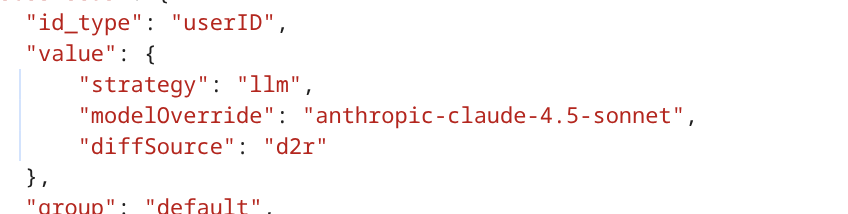
At this point Figma is effectively funding a competitor - and the more AI usage Figma has - the more money they send over to Anthropic for the tokens they use. Even worse, Sonnet 4.5 is miles behind what Anthropic uses on Claude Design (Opus 4.7, which has vastly improved vision capabilities[1]), so the results a user gets on Make vs Claude Design are almost certainly going to underwhelm.
Also, unlike most/all SaaS costs, inference (especially with these frontier models) is expensive. As Cursor found out, the frontier labs can charge a lot less to end users than API customers like Figma. When you are potentially looking at a shrinking userbase, it's far from ideal to have very expensive variable costs that start pulling your profitability down.
Secondly, it really underlines to me how incredibly efficient headcount-wise companies can build products now. Figma has close to 2,000 employees - not all working on product engineering of course. I really doubt Anthropic even needed 10 to build Claude Design. Indeed the entirety of Anthropic is around 2,500 people.
It's also worth noting that a lot of the things that would traditionally lock a company like Figma in stop working as well in an agent-first world. Multiplayer matters less when your collaborator is an agent iterating on a prompt. Plugin ecosystems matter less when you can just ask for the functionality directly. Design system tooling is the whole point of Claude Design. Enterprise SSO - Claude already has that. Most of the moats that protect a mature SaaS company are moats against other SaaS companies, not against the thing providing their inference.
I might be wrong about how bad this gets for Figma specifically. Companies with strong brands, great distribution and genuinely talented teams can often adapt faster than outsiders expect, and I'd rather be long Figma than most of its competitors.
But the structural point is harder to wriggle out of. Figma has ~2,000 employees. Anthropic has ~2,500 total and I doubt Claude Design took more than a handful to build. Figma now needs to out-execute a competitor whose inference is ~free to them, whose marginal cost to ship is roughly zero, and who employs fewer people on the competing product than Figma has on a single pod. That's a very hard position to pivot out of.
This feels like a preview of where SaaS economics are heading. The companies that built big orgs on the assumption of steady seat expansion are going to find themselves competing with products built by tiny teams inside the frontier labs. Figma just happens to be the first big public name where one of their primary inference suppliers has started competing against them.