
Also: in Europe everybody normally takes paracetamol and not FANS as a first reach to minimize adverse effects. So this article looks like very US centric. AFAIK liver failure because of paracetamol in Europe is very rare. So here there could be cultural issues at play (medical culture of what is prescribed, and the fact that Europeans in general take lower dosages of everything).
EDIT: trick, if you very rarely take paracetamol and other pain medications, the next time try to take just 250mg. It works for most people, no need to take 750 or even 1 gram of paracetamol. 500 works for almost everybody, 250 for many folks.
FDA FAERS is the official dataset for reporting Adverse events from taking a drug. FDA adverse event reports about 2 million cases and 4,067 unique drugs
I agree the results are not easy for non medical professionals to interpret correctly. For example DEATH is very strong with Parecetemol and so is DEPENDECE. The latter because from AI it is a confounding factor. Acetaminophen/parecetemol is frequently co-formulated with opioids (like Hydrocodone or Codeine). The "Dependence" signal is likely attributed to the opioid, not the Acetaminophen itself...
Adverse Event Acetaminophen PRR (95% CI) Acetaminophen n ibuprofen PRR (95% CI) ibuprofen n ACUTE KIDNEY INJURY 0.87 (0.80-0.96) 498 4.27 (3.91-4.67) * 483 ANAPHYLACTIC REACTION 0.61 (0.51-0.72) 122 9.85 (8.90-10.90) * 382 ANGIOEDEMA 1.31 (1.13-1.53) 170 15.26 (13.77-16.92) * 378 DEATH 1.44 (1.40-1.49) 3958 0.07 (0.06-0.10) 42 DEPENDENCE 237.12 (231.51-242.88) * 39679 0.02 (0.01-0.05) 4 DEPRESSION 2.18 (2.05-2.31) * 1157 0.39 (0.29-0.52) 43 DRUG EFFECTIVE FOR UNAPPROVED INDICATION 16.77 (16.11-17.46) * 3180 44.17 (42.18-46.25) * 1921 DRUG HYPERSENSITIVITY 0.57 (0.51-0.64) 327 3.30 (2.98-3.65) * 372
Have gotten into a habit of keeping a note of which med when on the fridge.
Not only you can't take more than 4 grams of paracetamol per day, you must not take it for more than 3 days straight, it says so on the leaflet.
Biochemistry and medicine are hard and complex, all the quacks out there that preach snake oil treatments went down the path of thinking their domain specific knowledge in random domains somehow transfers to medicine it does not.
Acetaminophen is part of ECA stack weight loss formula, while article says not OK with fasting. Either way, more safe solutions are known these days.
That said, I've found great relief at times taking a moderately large dose of ibuprofen for several days to break what seems to be a cycle of persistent inflammation. YMMV I guess.
[1] https://pubmed.ncbi.nlm.nih.gov/40819833/
[2] https://ddeacademy.dk/ddea/what-new-research-reveals-about-p...
That being said I weirdly find Naproxen the most effective of all of these. Everyone is different though
This is semi recent research on how it might be blocking pain
You take too much and it can give you a fever, which might entice you to take more aspirin. Nasty.
Obligatory Reye's mention:
https://www.uspharmacist.com/article/reyes-syndrome-a-rare-b...
and my own editorializing -- this is not just a problem for little kids. As various articles explain, if you've had flu-like symptoms (from whatever cause) you should be wary of aspirin. Will one standard dosage kill you? Unlikely. But if you've got better options, particularly pre-loading NAC before Tylenol, why not consider them first?
Further reading:
https://www.nhs.uk/medicines/low-dose-aspirin/who-can-and-ca...
And for those of you with kids: https://www.nhs.uk/conditions/kawasaki-disease/
Of course it's not all bad. There's even some discussion of anti-cancer potential. How might this work? One hypothesis: https://www.nature.com/articles/srep45184
This topic is a bit personal for me and I'm glad it's getting some attention here. Bravo, hackers.
Guess it depends on country. Here in Norway official sources[1][2] do say acetaminophen (paracetamol here) should be the default for treating fever and pain in kids, adults, pregnant women and elderly, and have for some time. Ibuprofen they say should be used with caution.
[1]: https://www.dmp.no/nyheter/behov-for-smertestillende-slik-ve...
[2]: https://nhi.no/for-helsepersonell/nytt-om-legemidler/arkiv-2...
I always thought a simple over-the-counter supplement (NAC) being the cure for an overdose was so cool. It's a pretty cool substance in a lot of ways, and this is a great spur to myself to research it more thoroughly.
I'm aware of acetaminophen's down sides, and yet recently I was taking it combined with 2 other medications at the time.
Why? Because all three medications are recommended for dealing with the issue I had. (Alone and in combination)
The moment it wasn't helping further? Done.
There is this broken idea, particularly apparent in North America, but in western society that more is better for many things. It's not.
More pain killers don't do anything if they max out the relief they can give you, overloading their mechanism doesn't reduce anything, but taxing your liver or your kidneys.
All medications are potentially toxic, your body wants to dispose of them. In appropriate dosages they will benefit you, but more isn't inherently better.
Even water can kill you in sufficient quantity.
We do the same with diet; where someone declares one ingredient in a meal healthier than another; it isn't. A single ingredient isn't better or worse for you in a meal. Your diet however can be good or bad; over time that matters.
The positive of it is it got me in the habit of logging whenever I take it, either in a note on my phone or just a sheet of paper I place on my dresser under the bottle. This helps make sure I stay under the 3-4g/d limit.
Last year I was diagnosed with a rare headache disease (NDPH). We thought it completely came out of nowhere, but I had logs in my phone recording headaches and acetaminophen use intermittently from a few weeks prior. This proved useful in the diagnosis.
Moral of the story: log when you take it to avoid overdosing. Combine that with some basic symptom logging (like 1 line, 10 words or less). You never know when that might be useful for your doctors later on.
I've never once thought about taking more than the recommended dosage of acetaminophen, largely because I had no expectation that it would provide additional benefit..
In reality, I try to consume 1/2 doses of anything or nothing at all, unless it's a serious medical treatment being administered by a professional.
Paracetemol has always been seen as first thing you'd take for pain relief, and you'd "step up" ibuprofen as an escalation, but that might more to do with marketing of Panadol (paracetemol) vs Nurofen (ibuprofen).
We'd look on at the US where you were taking Advil like candy in confusion.
One great thing you learn as a parent, you can alternate acetaminophen and ibuprofen. Both of them are recommended every four hours, but you can stagger one by two hours to maintain consistency of pain-relief taking ibuprofen then paracetemol two hours later
I'll second the claim that no doctor at any point in his life had told him the risks of doing that, and many encouraged the use of ibuprofen over any other alternative (including the alternative of not using OTC painkillers every single day).
Even then, doctors are usually disapproving of ibuprofen (or some combination of it with paracetamol) unless paracetamol is contraindicated for some reason, and I had always wondered why.
But yet in some countries pediatricians will libreally prescribe it to toddlers
[1] https://www.bmj.com/content/368/bmj.m1086
Also from [2] "In this systematic review of NSAID use during acute lower respiratory tract infections in adults, we found that the existing evidence for mortality, pleuro-pulmonary complications and rates of mechanical ventilation or organ failure is of extremely poor quality, very low certainty and should be interpreted with caution."
https://bpspubs.onlinelibrary.wiley.com/doi/10.1111/bcp.1451...
I didn't know about this acetaminophen risk. So I'll be looking for alternatives. Ibuprofen is for inflammation and not headaches. Naproxen is a candidate.
Unrelated, but it feels like an oversight that this article said nothing about how both acetaminophen and ibuprofen reduce fevers. They aren't used solely for reducing pain.
1g of Paracetamol with 400mg of Ibuprofen gives similar pain relief as 2mg of IV morphine.[1]
Can confirm this is true in India.
Paracetamol is widely used. Paracetamol + Ibuprofen is more common than Ibuprofen by itself.
The same is the case in the Netherlands.
I avoid both and stick with naproxen sodium. Any issues with that one? Lasts the longest too.
What you describe in an interesting contrast to the situation in The Netherlands. Here, virtually no one is prescribing ibuprofen _without_ also prescribing a baseline of paracetamol.
[1]: https://99percentinvisible.org/episode/579-towers-of-silence...
Needless to say we had covid at least 12 times at this point, all with positive tests so no mistake there. Plus few other questionable cases without tests. Some were brutal, like first and second one, that was before vaccines, and then a recent one when we seem to have lost most of immunity. Back then I lost taste for few weeks completely and smell didn't fully come back till 6 months after (sniffing bottle of vodka did smell like forest air, even later my perfume smelled rotten). Weird times, eating nice looking gunk and trying to imagine how it tasted before.
I don't think I had flu that many times over my whole life, hate that shit with fiery passion and having small kids in creche/school is just a 24/7 virus importing service. None of our peers had it as bad as we did, no idea why the 'luck'.
If you don’t realize your kidneys are already damaged you might die from kidney failure because of ibuprofen.
56,000 emergency room visits is the key here, because "the mortality associated with acetaminophen overdose is low if recognized and treated within the first 8 hours after an acute ingestion."
So I guess it depends on if you think 56,000 is low or not.
Source: "Acetaminophen Toxicity", David H. Schaffer; Brian P. Murray; Babak Khazaeni. 2026/02/19. https://www.ncbi.nlm.nih.gov/books/NBK441917/
Ibuprofen is very well supported as a treatment for migraines. Not necessarily headaches generally, but definitely migraines.
But there are multiple classes of abort drugs now that a doctor might be able to prescribe you, like triptans and CGRP inhibitors, that work much better than either NSAIDs or acetaminophen.
I find it interesting that people take these as fever reduction mechanisms. Fevers are a defence mechanism, not just an inconvenience. Maybe it makes more sense in places without decent workers' rights (like having a limited amount of sick days you need to manage), but it feels weird for me to actively harm your body's defence mechanisms unless you're in "you should see a doctor" territory already.
Max dose combination (IBU/APAP FDC) can be useful as a substitute in emergency therapeutic situations compared to opiates. Not recommended ordinarily because of liver, kidney, and stomach impairment.[0]
Taking ibuprofen with questionable stomach condition may want to consider taking a famotidine adjuvant or duexis [1] or acetaminophen instead.
Overdose treatment of acetaminophen poisoning is the stinky N-acetylcysteine (NAC), so that maybe worth stocking whenever Tylenol is kept in a house with kids. Overdose of ibuprofen is palliative, requiring IV fluids and dialysis.
0. https://www.researchgate.net/publication/382639515_Ibuprofen...
Pain a warning signal from the body. It's something one should listen to, not just try to ignore and overrule. If I sprain my ankle it only hurts when I lean on it. Because it's healing. So I don't. Why would headaches or other "inconvenient" pains be different?
In my case headaches are usually caused by sleep deprivation causing high sensitivity to external stimuli, muscle tension, dehydration, or some combination of that. So I'll first try to take a nap and/or stick to low-stimuli environments, have a good stretch and/or heated up massage pillow for the neck, and make a quick home-made oral rehydration solution with some salt and sugar. That usually alleviates most if not all of the pain.
And I'm not saying painkillers should always be avoided. If I have insomnia-induced headaches in the morning and a long day ahead with many social interactions, then I know that headaches will make me a grumpy asshole, so I'll obviously will take a painkiller for everyone's sake. And sometimes I can only fall asleep if I take a painkiller to get rid of the headache first, so I need it to break the vicious cycle. I'm not saying people should "walk it off" here, just to focus on trying to figure out the actual cause first before medicating the symptom way. That's also healthier in the long run, no?
> but it does absolutely nothing with actual pain. It is placebo at best.
This is simply false.
For ibuprofen you need to go to a pharmacy.
Apparently for some people it also helps with lessening tolerance for their ADHD meds, but I'm not so sure about that.
It works against fewer or maybe mild inflammation and what not ... but it does absolutely nothing with actual pain. It is placebo at best.
Also, possible blood clotting or stomach issues sound scary, but Aspirin has similar (opposite) issues. Pharmacists regularly push its combinations with Acetominophen (which has, of course, synergetic bonuses, but is not the reason) under multitude of brands with a hefty premium when people ask for either one. So in many situations you need to consider the added risks from Aspirin too.
Ideally, I'd like to have an optimized strategies of using all three of the aforementioned substances for common situations. Like, is rotating ibuprofen/acetominophen during the day safer than consuming just one?
Since I've had a fair share of it in my life so far (more than 1kg of it so far, in total), and I investigated the disparaging studies and they are definitely not convincing at all; more recent ones somewhat absolve it (check the Wikipedia page).
I've never had any side effects from it, and I don't know anyone who did, unlike for any other painkiller (diclofenac, ketoprofen, ibuprofen, acetaminophen / paracetamol).
It is a medicine where I'm almost 100% sure the studies against it are intentional sabotage by pharma companies, and the vigor and persistence this is done with is really telling (lots of doctors and pharmacists in my extended family, including in regulatory bodies). The campaign against it never ends.
Work a manual labor job or one where you're on your feet all day and sprained your ankle? Would you rather miss a week of pay (or worse lose your job) or take some pain killers and work through it?
Long-winding tangential anecdote (which is why I'm replying to myself in a separate comment), but I have pretty extreme example of this: I managed to avoid nearly all suffering after getting a tonsillectomy in my mid-thirties, while using almost no painkillers.
My ENT surgeons warned that me "I'd hate him for about a month, then I'd love him for never having to deal with [serious medical condition that justified the removal of tonsils] again". He prescribed all kinds of stuff to alleviate the expected suffering, and advised me to try to take the weakest options I was comfortable with, because the heavier ones might have some unpleasant side effects. It's the only time in my life I've been prescribed painkillers at all, actually (this was in Sweden, btw).
I got codeine/paracetamol as a coughing suppressor and mild painkiller, a couple of heavier painkillers for if it got worse (I forgot the name but some kind of heavy-duty variation of diclophenac that you can only get with a prescription), and some kind of nasty solution to gargle with that supposedly would numb my throat if it got really bad. I've been told this is nothing compared to what you can expect in the US.
Then in the evening after the surgery, when I was trying to eat a soup with my mom, I realized soup didn't hurt as much as drinking plain tap water. And then I thought: isn't it odd that drinking plain water feels like a thousand paper-cuts in the open wound in my throat, but whenever the coughing made the wounds open and bleed, the blood doesn't hurt at all? Blood is mostly water, so what is the difference? Could it be the salt? Is this similar to why drinking demineralized water is bad for you? What's the opposite of demineralized water? Oral rehydration solution. Ok, trivial to make, let's try that. I'll drink it luke-warm to be close to body temperature too.
Turns out that that works. Oral rehydration solution is almost painless to drink after a tonsillectomy. I know this is anecdata, but sample size three: I've since shared this information with two friends who got a tonsillectomy, and they've been extremely grateful for this tip.
It even seemed to speed up my recovery, probably due to a lack of irritation triggering inflammation. I was eating solid food within days. DAYS. My mom, a retired family physician herself, couldn't believe her eyes.
I ended up only needing the codeine/paracemtal in the evening to suppress coughing in my sleep, and brought back all the other pain-killers without opening them.
Hard agree, same with fevers. Heat helps kill many diseases, dont blunt your body's defenses.
There are exceptions to both rules, but many people forget which part is the exception and which part is the rule.
Occasionally I'll find that the more I try to identify specific features of the sensation, the harder it gets to do so and the pain sensation fades away.
Meanwhile, it's funny that it seems like acetaminophen should safer in more scenarios, but the other has a lot of overdoses with typical use, I guess that's why there's a gap between the two, because ODs are apparently a lot more common or at least more legible than problems caused by the other drug.
The benefits stack, the side effects don't.
So if you are going to be loading up on higher doses of pain relief, take half acetaminophen and half ibuprofen.
I've had doctors prescribing short runs of opioids (2 weeks for surgery recovery) but they always said "try Tylenol first and if the pain is too much you can fill the prescription". I liked having the option but never really used it up to this point.
Neither paracetamol nor ibuprofen work by blocking pain. Depending on the type of pain and your physiology it can range from really effective to not at all.
I only take paracetamol, it works better than both ibuprofen and opioids for me. I know other people who have the exact opposite experience. There’s no absolute here.
Soluble paracetamol literally turned the pain off like a switch - of course I was limited as to how much I could take, which I was careful to stick to but I was almost in tears waiting for the time to come where I could take more paracetamol.
So in some situations paracetamol can be an extremely effective painkiller.
I would definitely have a chat with a doctor about it.
IBU: -stomach -kidneys -bp+ -clotting --NERD --NECD --NEUD --SNIUAA --SNIDR --DRESS
APAP: -liver --DRESS
-- extreme, rare side-effects
So when pondering the issue of numbers, it matters what path people took to overdose.
Having gout, I've also had some pretty severe bouts where the pain level has been in the 8/10 range. Unfortunately nether paracet or ibuprofen worked.
In any case, when I see regular people eating these painkillers as candy, I'm starting to wonder what pain levels they are experiencing. I'm generally very cautious of using this stuff.
Paracetamol is the safer version Phenacetin. You used to be able to buy aspirin, phenacetin and caffeine..but phenacetin with withdrawn. APC when it was marketed was very popular but soon you were told to never give children aspirin for a fever so we used Paracetamol. Then Phenacetin was withdrawn and paracetamol became part of APC (like Alka selzta XS , or just the popular caffeine paracetamol combos)
Paracetamol came in as safer but similar, yet no where near effective. It captured bith the market feeling of its pros and cons. So we interpreted it as safer than alternatives (especially aspirin for children due to Reye syndrome). But also dangerous which might be why OPs view was that ibuprofen is safer.
The NNT (number of people you'd need to take it) to be headache free after 2 hours is about 12-20 for paracetamol. But only 7-10 for ibuprofen.
It's quite surprising that paracetamol became the defacto analgesic given it performs so poorly but it was historical inertia. And plenty of people argue that if we were to start over we would not make paracetamol OTC.
I Am Not A Doctor And This Is Not Medical Advice.
(I think?).
Pain is also suffering, and there is no virtue in suffering needlessly.
Even more importantly, there's also chronic pain, which can severely affect quality of file permanently and is essentially an illness all of its own. Research supports the concept of "pain memory", where chronic pain develops as the result of leaving the pain from a temporary condition untreated.
This is vastly overstating the rationality of the human body. It's no more rational than the human mind, which is often quite irrational. Your body isn't the product of medical school, nor intelligent design, but rather random natural selection, which is decent but demonstrably far from perfect.
water?
EDIT: I see it's a thing. Salt, water and sugar.
Americans' relationship with painkillers is absolutely unhinged.
When I took ibuprofen it did actually made an actual real change.
I'd believe it. I first heard of NAC on the nootropic subreddit in a past lifetime. The benefits vary, but generally it's a safe thing with a low chance of making anything worse, but a possibility to improve things. Many neurodivergent folk have written about how they benefit.
I'd give more info on the exact benefits they found (iirc OCD and rumination loops could be broken more easily), but unfortunately my memory is failing me.
I arrived in Aus in 2021 and was amazed to be able to buy a pack of 40+, coming from the UK where the limit had been in place for some years.
You can overdose on water too, they haven't banned 5-gallon jugs (yet).
The discussion started in the context of taking painkillers regularly for things like "inconvenient head-aches" without pausing to investigate what causes those headaches. It should be clear from the context that I am not talking about something like people struggling with migraines. I know they try to figure out not to have them in the first place, and if they do have them deserve all the pain relief they can get. I've had migraines myself growing up.
Nobody is saying that people who suffer from chronic pain shouldn't have a relief from their suffering. But as another comment pointed out: the US seems to have a big issue with untreated conditions in general than other countries.Not in the sense of not treating the pain, but in the sense of not treating the conditions leading to pain. You don't even have paid sick leave apparently. Tackle issues like that and there will be fewer chronic pain sufferers to begin with.
The body does not absorb water passively but actively, and it's been known for a very long time that water with a bit of salt and sugar is absorbed faster. This has been crucial in reducing (especially child) mortality due to acute fluid loss from diarrhea due to, say, cholera[0]. (I personally find amazing that Robert K. Crane figured out the mechanism behind it in the sixties already[1])
Now, "proper" ORS, according to the WHO, is the following:
Sodium chloride 2.6 gr/l
Glucose, anhydrous 13.5 gr/l
Potassium chloride 1.5 gr/l
Trisodium citrate, dihydrate 2.9 gr/l
However, that is in the context of oral rehydration therapy:glucose facilitates the absorption of sodium (and hence water) on a 1:1 molar basis in the small intestine; sodium and potassium are needed to replace the body losses of these essential ions during diarrhoea (and vomiting); citrate corrects the acidosis that occurs as a result of diarrhoea and dehydration.
So you can usually get away with not having the potassium and trisodium if the reason for dehydration is neither diarrhoea or vomiting.
This translates to a simple home recipe of:
1 liter (or 4.25 cups) of water
1/2 a teaspoon of salt (3 gr)
2 table spoons of sugar (30 gr) OR 1 table spoon of glucose (15 gr)
The reason for doubling the amount of sugar is that the active absorption of water relies on glucose, while regular sugar is made out of sucrose. Sucrose breaks down into equal parts fructose and glucose (both have identical chemical formulas but a different arrangement of the atoms).[0] https://en.wikipedia.org/wiki/Oral_rehydration_therapy
[1] https://en.wikipedia.org/wiki/Sodium-glucose_transport_prote...
[2] https://www.who.int/publications/i/item/WHO-FCH-CAH-06.1 page 12 of the linked on that page (labeled as page 3)
(one of the major problems with paracetamol is that the effective dose is only a few multiples away from the dose which starts to cause liver damage! It is by a long way the most dangerous OTC drug)
There is a limit to the amount of opioids they will prescribe you, even if you are in mind shattering pain. For instance while attempting to get your dental insurance to actually cover a treatment you may find yourself between risking organ damage or risking $5000+ in ER visit bills only to have them refuse to give you anything but Tramadol.
20 not-especially-large tablets
It's the usual public health balancing act of help vs harm.
Harm reduction is about shifting probability distributions, not guaranteeing outcomes. Kids can still get into pill bottles with childproof medication caps, but accidental ingestion of aspirin by children reduced by 40-55% after they were mandated. [0]
"My head is pounding. Shit...did I take this at 3PM or 5PM? I know I took it and then fell asleep, but I can't remember when. It is now 9PM, can I take more or not?"
Rationalizations like “they probably put the limit way lower than the real limit so idiots don’t OD themselves, so I can safely take a bit more” become very attractive when you’re in a lot of pain.
For mild stuff I use ibuprofen, if it gets worse, diclofenac works every time.
In many countries if a doctor believes you're too sick to work you have a right to take leave until you recover, without risking your job and without expending limited "sick days". In those circumstances the doctor will of course prescribe something for your pain, but as a patient you have no incentive to insist the painkiller is strong enough to allow you to continue working.
I guess it tracks with personal experience. I find Paracetamol is OK for fevers/generic cold symptoms but absolutely useless for a headache, Ibuprofen is the only thing that shifts them.
Well it's the only thing that shifts them now I'm in a country where I can't buy soluble aspirin and codeine OTC.
It was withdrawn for sometimes being metabolized into another, toxic and carcenogenic, molecule.
So by all accounts it should be cheaper for for-profit insurance companies too, unless they have ways to externalize the costs onto the rest of society. Which I guess is more circumstantial evidence for how messed up the system must be.
Additionally, in EU you can just take a sick day to rest and recover pretty much any time you need it. In the US you have limited “sick days”. E.g I now only have 6 “sick days” per year.. (and I’m fortunate to work in tech, I just WFH when I’m under the weather. But people who are less well off need to suck it up and go to work).
Paracetamol got it's start as replacing the more effective but much more dangerous and withdrawn drug Phenacetin.
Why don't people notice that it's such a small benefit over nothing? Well because placebo effect is quite good for pain and pain is usually transitory anywhere..if you have a tension headache you're probably going to aim to relax. Turn away from the screen or even have some caffeine and those are more effective than paracetamol!
An interesting thing with ibuprofen is that at the regular dose of 400mg it inhibits pain but if you take 1600mg it doesn't inhibit much more pain than the 400mg dose, but the inflammatory effect does increase significantly. A lot of people don't know that and take too much thinking it scales linearly.
So don't be the "smarter" person. Do as your doctor says and if you have doubts, consult another doctor before just doing what you think is safe, but actually isn't.
So we should not be too quick to dismiss the pain of others.
As far as 10/10 pain goes, I've heard cluster headaches can get so bad it has driven people to suicide during an episode.
What annoys me is that so many people have your experience and are effectively gaslit about the fact it seems to often perform so poorly.
It's a paradox no?
Paracetamol is only the presumed only active metabolite, and that is why paracetamol rapidly replaced phenacetin.
There is a quirk though, phenacetin actually delivers paracetamol to your brain and spine (where it primarily reduces pain) faster than an oral dose of paracetamol.
Similarly IV paracetamol is far more effective that oral paracetamol.
Phenacetin was also considered mildly addictive, and induced a gentle euphoria and then sedation.(We still see sedation after paracetamol in children and the elderly). But general use we don't see these effects in paracetamol, why did phenacetin do this more effectively? Probably the higher peak levels around nerve endings.
These effects are both wanting of an explanation of phenacetin is just paracetamol and directly analegisic.
[0] https://web.archive.org/web/20240721144157/http://www.eviden...
UNH stock has been tanked all year, until the govt announced that they would raise Medicare advantage reimbursement rates. The insurance companies have an incentive to pursue volume instead of cutting costs for programs that the government is subsidizing. For everyone else, they just raise the prices which is a much more complicated issue.
> The glutathione hepatic values in mice obtained by intraperitoneal injection of the ester are superimposable on controls and the oral LD50 was found to be greater than 2000 mg kg^-1 and the intraperitoneal LD50 was 1900 mg kg^-1 ...
That's for pyroglutamic and glutamic acid esters of paracetamol: https://pubmed.ncbi.nlm.nih.gov/8799871/
and more general analogs apparently can also be designed to not produce NAPQI:
> Thus, in 2020, N-sulpharyl-APAP prodrugs 39–40 (Fig. 11) were developed. [...] They are not hepatotoxic because they do not generate toxic metabolite NAPQI, even in concentrations equal to a toxic dose of APAP (600 mg kg^−1 in mice).
https://pubs.rsc.org/zh-tw/content/articlepdf/2024/ra/d4ra00... p. 9702.
These would probably require trials, though.
Sprained ankle? Injured back? Headache? Broken bone? All things that people work through everyday with some NSAIDs because calling out sick means losing income
Be kind. Don't be snarky. Converse curiously; don't cross-examine. Edit out swipes.
Sure, that's extreme. But if you're unaware of the risks, you feel sick, and you believe it's helping you.
I mean, people aren't killing themselves in masses with it, but it happens every now and then. Easily imaginable that one in a few million people will have enough tendency to take more pills and is unaware of the overdose danger.
edit: https://www.24pharma.nl/paracetamol-eg-1000mg-120-tabletten
Took me 3 months, out of 2 i wasn't able to sit. Luckily I could walk and that give me great relief. So walked for hours.
Keeping the habit, will mostly being coding from my phone & walking from now on.
I know people with permanent pain due to medical conditions who have been given a doctor's approval to exceed the limits printed on the packaging (after having previously been monitored). You can exceed the limit on the packaging by one or two pills.
A bit more is often not deadly, but it's very easy to take more than a bit. When I had a messed up mouth for several days, I took the maximum doses and set timers to help me regulate the dosage throughout the day, but I sure wished I could've taken more at that time.
From personal experience if i have a headache I'll take 1000 mg all at once; it either works right away or it doesnt and I stop bothering until I've had a good nights rest...
I wish they dipyrone was sold here, but alas I can only get it when I travel abroad.
Acetoaminophen also has issues for people with weaker stomachs (I can attest), and will come with additional medication to cover these effects as needed. The whole "Is it safe yes/no" table has many asterixes and might be outright false depending on the how you look at it.
As usual, it's just complicated.
I had a relative with a different story in the same theme. It sucks and I want to see this technology do something truly beneficial for a change....
Occasionally I have a headache. Not frequently, and I don't necessarily know why. These things just happen. I take a painkiller, and problem solved. I've been seen by doctors over the years for physicals or other reasons, and there's no indication of any underlying medical condition. An occasional headache is not an indicator of something more serious, and the painkiller is not "masking" a larger problem.
The same goes for random muscle aches. They're infrequent, but they can happen, for whatever reason, and there's no reason to panic or to suffer when you can just make them go away.
I don't think I'm unusual here. As far as I've heard, random, infrequent headaches or other aches are extremely common.
Moreover, there are pains that we know the cause: for example, I experience a bump or a cut. My body continues to annoy me with pain unnecessarily. Yes, I'm healing, I'm well aware of that. I just need my body to STFU with the pain and stop reminding me of it.
Whenever its prescribed here, its paired with some sort of intestine protection medicine to stop it burning holes in your stomach/intenstines
Ibuprofen is much safer, so long as you eat with it.
Paracetamol is also safer, so long as you don't OD.
BUT! so long as you stay below 4 grams a day, you'll be safe. (yes yes, in some situations you can take double, but unless you are under supervision, thats asking for liver pain.)
Tylenol/acetaminophen is good for fever which NSAIDs won't help. Otherwise, take both and alternate their dosing times for better pain coverage.
Here is an example from the Cochrane library
> For the IHS preferred outcome of being pain free at two hours the NNT for paracetamol 1000 mg compared with placebo was 22 (95% confidence interval (CI) 15 to 40) in eight studies (5890 participants; high quality evidence), with no significant difference from placebo at one hour.
A NNT of 22 means that in absolute terms 1/22 people met the positive endpoint criteria more than placebo. This figure is usually quoted as 20% for placebo and 25% for paracetamol giving NNT of 20.
The NNT of 22 gives 1/22= 4.5%.
https://www.cochranelibrary.com/cdsr/doi/10.1002/14651858.CD...
I'm fairly sure that caused some liver damage. I wasn't aware of anything apart from feeling a bit weird.
At the time, I had no idea it was potentially deadly.
I had only very brief experiences with longer intense pain but it made my mind into pudding and desperate knot of how-to-stop-this-at-all-costs. Normal life is not possible and sanity is not granted.
Seriously, how can you guys consider this acceptable. I am not of faith but doesn't bible teach to be kind to your fellow men above all? One would expect more adherence to such basic moral rules in such conservative christian society.
I guess it is much better than the situation before that, where you paid $5000+ and they also gave you an opioid addiction.
Alcohol and Acetominophen/paracetamol should not be mixed.
When alcohol enters the picture, it increases the activity of CYP2E1, so the body produces more of the NAPQI toxin. Alcohol also decreases glutathione production, the body’s natural defense mechanism, meaning NAPQI is more likely to build up in the liver in dangerous concentrations.
https://www.medicalnewstoday.com/articles/322813Sorry, crappy link. If you don't like it, it is easy to search for a better one.
On the other hand, if in the early 2000s you were to share those concerns with certain doctors, they would propose a more effective and non addictive alternative to morphine instead. Only the first part of what they would tell you was true.
Also applies to most similar phrases ending in -proof. Should be eye-opening.
Episodic tension type headache tested with ibuprofen Vs placebo NNT is 14. (Btw that's not great itself) But it's better than paracetamols often quoted figure 20.
Here's why I say it's not great. Why don't you guess some reasonable NNTs for say moderate depression treated with SSRIs, or no relapse in schizophrenia treated with an antipsychotic. Now guess the NNT for a statin to prevent a first heart attack.
SSRI for moderate depression about 10, antipsychotics to prevent schizophrenia relapse over 2 years NNT= 3 (excellent )Statin to prevent a first heart attack 200! (This one always shocks me). Statins have a clear role of course.
[0] https://thennt.com/nnt/ibuprofen-treatment-episodic-tension-...
Speaking as someone who is not-infrequently in significant pain, I sincerely hope that you never have to.
Suppose your arthritis is acting up, so you start taking Tylenol 8hr Arthritis Pain[1]. That's 2 tablets every 8 hours. They're extended-release with 650mg per tablet. A total of 3900 mg in 24 hours.
A few days later you get the flu, so you decide to add what seems like a completely different medication: Theraflu Flu Relief Max Strength[2]. It has a cough suppressant and an antihistamine. But each caplet also contains 500 mg of acetaminophen. It says to take 2 caplets every 6 hours, so you take 8 of them in 24 hours[3]. That's another 4000 mg.
Between the two, you're at 7900 mg.
Then you wake up in the morning and take both medications, but 30 minutes later you've forgotten you took them. You're not thinking straight because you're sick. So you accidentally take a second dose. That additional 2300 mg brings your total to 10200 mg.
---
[1] https://www.tylenol.com/products/arthritis/tylenol-8hr-arthr...
[2] https://www.theraflu.com/products/day-night-flu-relief-max-s...
[3] You weren't supposed to take 8 of them, though. If you'd read the label very carefully, you'd have seen it also says not to exceed 6 in a 24-hour period.
Usually here in Canada it's available in capsule form which I find less effective.
A fever is not dangerous within normal parameters, except for being dangerous to the virus and bacteria that threaten the body. Your body runs a fever because it engages in a battle to the death with these microbes.
If you defeat the body's own defenses by lowering the fever, for example if you are a nervous mother who hates her baby's fussing, or if you're hospitalized and the nurses are laser-focused on "number go down" treatments, then you can expect to be ravaged by the contagion for much longer than expected.
And when you want to be gentle, you alternate between them.
However the last time I went to my GP she scoffed at me taking the maximum and suggested I take literally double the maximum recommended dose 4-5 times a day which totaled I think 2.5x the daily maximum on the package. I am very much a "believer" in science and reasonable medical authority but this experience sowed the seeds of doubt, because from what I have always heard, that can actually kill you or cause permanent liver issues. I was also taking diclofenac simultaenously, and when I told her how many mg, she asked "where can you even buy such small doses, that's what I would give a small child" =/
I presume your protein intake was adequate and diverse prior to this misadventure....
If you did a socialist system then everything is "free" but possibly slow and expensive on the back end when the government isn't efficient.
If you did a libertarian system then everything is cheap but it's caveat emptor because nobody is stopping you from buying morphine for $10 from Amazon.
The US system isn't either one. It pretends to be a market sometimes but then has a bunch of rules to thwart competition. Doctors are required by law to do residency but the government limits the number of residency slots in response to lobbying from the AMA so there aren't enough doctors. "Certificate of need" laws explicitly prohibit new competitors for various services. Insurance is tied to employment to make it hard for individuals to shop around. Laws encourage, require or have the government provide "prescription drug coverage" to make patients price insensitive so drug companies can charge a huge premium for patenting a minor improvement or simple combination of existing drugs and have the patient will something which is marginally if at all better even if it's dramatically more expensive because they don't see the cost when the insurance/government is required to pay for it.
It's a big pile of corruption, because all that money is going to places. But then if you try to fix it, half the population insists on doing the first one and the other half is only willing to do the second one, and the industry capitalizes on this to prevent either one.
Maybe instead we should do both rather than neither. Have the government provide a threshold level of services, like emergency rooms and free clinics and anything more than that the local government wants to fund, and then have a minimally regulated private system that anyone can use if the government system doesn't satisfy them.
Who says that? I don't think anyone sane can believe that US healthcare is "solved".
Your crappy source is vague in what consumption pattern constitutes a risk and actually cites a better source that supports the idea that acute alcohol consumption reduces paracetamol toxicity. https://www.biorxiv.org/content/10.1101/2020.07.07.191916v1....
That's a mathematical model, but this relationship between the two is what I was taught in medical school and it is still supported by the science. There's plenty of other sources, I just picked that one because your article cites it. Just search for "paracetamol ethanol" on Google Scholar.
I didn't until I had a bulging lower back disc pressing on my sciatic nerve. My leg felt like it was constantly on fire no matter what position I put myself in. In the past I've torn my ACL and had surgery to reconstruct and that pain was like stubbing my toe compared to the back pain. I understood how people become addicted to pain meds after my back situation.
Having a condition that actually warrants strong opioids and not being able to get them at any price is definitely not an improvement.
The problem is fundamentally that we want to pretend doctors can always distinguish two people describing the same symptoms when one person actually has them and the other is trying to get drugs. The often can't, so you can either make it hard for people to get pain medications even if they need them, or you can make it easy for people to get them even if they don't. And between these the second one is unambiguously better, because the first one is the government screwing innocent people and the second one is guilty people screwing themselves.
... Suddenly I'm maintaining a continuous note of when I'm taking which medicine to avoid crossing safe limits (which I anyway was crossing most days).
I was only told to take 2 paracetamols a day (bullshit dose, I'd be waking up from the pain even with more pain meds).
"Diclofenac for rare use" - well, if nothing else is touching the pain, is it an emergency?
Eventually after forever I was able to transition to Ibuprofen + paracetamol. And I already have a health condition which is heavy on my kidneys... pain management can be absolutely crazy.
Ibuprofen is a Nonsteroidal Anti-inflammatory Drug (NSAID) that reduces pain and inflammation, while acetaminophen does not. (Acetaminophen is believed to act mainly in the brain rather than at the site of injury).
Ibuprofen- Fundamentally, if the pain is caused by inflammation, reducing the immune systems response to it can reduce pain, but if the pain is more acute it won't make a dent.
With acetaminophen, taking more isn't a solution in most cases, you need another method to reduce the pain further if it doesn't achieve its goal.
(That's why it's combined with things like codeine, which affects the brain in a different way for an additive effect)
Also, loved your TV show back in the day. :-)
I don't think you can even do that in the UK.
Yeah we usually have a few packs hanging around, and I get the 'it seems stupid' thing, but sometimes just adding a tiny bit of friction when someone's trying to kill themselves might save a life. I dunno, I hope that's shown in the evidence anyway. Otherwise it's just pointless like the whole pseudoephedrine song and dance, which has inconvenienced anyone looking for a decongestant while doing sweet FA to the availability of meth.
Could not agree more. Depriving people with legitimate pain of opioids is IMHO legitimate torture. It's a bit of a variance on the trolley problem in that the doctor/government isn't causing the pain, but their inaction is prolonging it.
In general, taking a lower dose than recommended can cause problems, but aside from antibiotics, the problems are probably going to be from insufficiently treating the underlying condition, rather than the medication itself. Most OTC drugs give a single recommended dosage for all adults, so some people will necessarily get a lower "effective" dose than others (eg. a 200 lb man compared to a 90 lb woman).
> Specifically, the two mentioned in the article. [...] but if my doctor tells me to take 1 ibuprofen every 6 hours or so, if I halve that am I actually doing more damage?
With the caveat that I'm not a doctor, you should be fine: the only effect of acetaminophen is pain suppression, so if the pain is tolerable, then you should be fine. Ibuprofen has some anti-inflammatory effects that could be important here, but realistically, if the anti-inflammatory effects are the primary reason for the prescription, then your doctor is more likely to prescribe naproxen or celecoxib.
But if this ever comes up for you again, probably the best solution would be to tell your doctor/pharmacist "I have a high pain tolerance, would it be okay if I take less?", since in my experience, medical practitioners are generally pretty happy to hear when you want to take less drugs.
Yes, ignorant consumers and physicians across the world.
You can't just 'vibe medicine' or 'vibe biology' - please don't comment if you don't know what you're talking about.
I don’t know about “most cases” but often you don’t want to reduce the pain _further_, you want to reduce the pain _again_. (Having an alternative definitely helps in the meantime.)
I did toss on the other option, stand alone, at one point so I could get some sleep.
It left the medication I was more comfortable taking as an add-on option if things got bad enough. (This particular medication has much lower risk of overdose, so if I got stupid and took it again there would be no significant additional risk.)
It's ironic, but taking the combined medication with a known higher risk of its own was better than taking the lower risk medication.
One was controlled, higher risk, taken at specific times, while the other was taken in addition, on demand, as required.
tl;dr: Yes
Paraphrasing from [0], after September 1998 when the restriction was introduced, "The annual number of deaths from paracetamol poisoning decreased by 21% [...] the number from salicylates decreased by 48% [...] Liver transplant rates after paracetamol poisoning decreased by 66% [...] The rate of non-fatal self poisoning with paracetamol in any form decreased by 11%"
See also [1]: "in the 11 years following the legislation there were an estimated 765 fewer suicide and open verdict deaths from paracetamol poisoning, which represented a reduction of 43% [...] This reduction was largely unaltered after controlling for a downward trend in deaths involving other methods of poisoning and also suicides by all methods."
[0] https://pmc.ncbi.nlm.nih.gov/articles/PMC31616/
[1] https://www.psych.ox.ac.uk/research/research-groups/csr/rese...
No, when you visited they were still on the shelf. They only put them behind the counter in 2025.
> sometimes just adding a tiny bit of friction when someone's trying to kill themselves might save a life
I'm philosophically not for making suicide harder. If someone wants to die, that's their right. And practically, while you might be able to show a stat-sig decrease in paracetamol poisoning, I'd expect the suicides to largely just move to other methods.
The vast majority of the time medicine can only ever help with (acute) symptoms and rarely the underlying cause unless it is something like vaccines or antibiotics.
Medicine has side effects because if there was a free lunch to be obtained from medicine, the human body would have synthesized the medicine directly. Hence medicine is always about making tradeoffs.
When it comes to general health, there is always a causal chain of cause -> primary symptom -> secondary symptom -> tertiary symptom -> ... and a lot of medicine tends to work on the secondary or tertiary symptom.
Pain evolved to be an accurate indicator of damage to encourage you to stop ruining your body and not a punishment.
I did a fevered research dive last time I had the flu and came to the conclusion that there wasn't really any good evidence that fever is helpful for flu, and I should have few compunctions about suppressing it. (And that most of the situations where fever is really valuable for are ones where in the modern world you should go to a hospital and in the case of a bacterial infection be given antibiotics)
Just imagine someone trying to lecture a network engineer about how really async bugs should really never be different than bugs you see single-threaded if you use a semaphore. I mean, that's why we have semaphores!
Anyway, the temperatures attained during fevers are at best bacteriostatic (read not helpful in actually treating an infection that would lead you to seek medical care). If you've got evidence-based arguments, happy to counter them. Just please don't evoke 'evolution' to explain your bias-du-jour.
Evolution didn't create the personal computer or build a skyscraper. We're firmly in uncharted territory wrt things our bodies were evolved to deal with. As a great example, human temperature has been going down over time—evolution tells us that must mean we're all more susceptible to getting sick!!! https://med.stanford.edu/news/all-news/2020/01/human-body-te...

Acetaminophen, ibuprofen, and what doctors probably want you to know.
Lots of people die after overdosing on acetaminophen (paracetamol, often sold as Tylenol or Panadol). In the U.S., it’s estimated to cause 56,000 emergency department visits, 2,600 hospitalizations, and 500 deaths per year. Acetaminophen has a scarily narrow therapeutic window. The instructions on the package say it's okay to take up to four grams per day. If you take eight grams, your liver could fail and you could die.
Meanwhile, it seems to be really hard to kill yourself by overdosing on ibuprofen (Advil, Nurofen, Motrin, Brufen). In 2006, Wood et al. searched the medical literature and found 10 documented cases in history. Nine of those cases involved complicating factors, and in the 10th, a woman took the equivalent of more than 500 standard (200mg) pills.
So, for many years, if I needed a painkiller, I’d try to take ibuprofen rather than acetaminophen. My logic was that if eight grams of acetaminophen could kill my liver, then one gram was probably still hard on it. I’m fond of my liver and didn't want to cause it any unnecessary inconvenience.
But guess what? My logic was wrong and what I was doing was stupid. I’m now convinced that for most people in most circumstances, acetaminophen is safer than ibuprofen, provided you use it as directed. I think most doctors agree with this. In fact, I think many doctors think it’s obvious. (Source: I asked some doctors; they said it was obvious.)
Should this have been obvious to me? I figured it out by obsessively researching how those drugs work and making up a story about metabolic pathways and blood flow, and amino acid reserves. It’s a good story, one that revealed that my logic stemmed from an egregious lack of respect for biology and that I’m a big dummy (always a favorite subject). But if the clearest road to some piece of knowledge runs through metabolic pathways, then I don't think that knowledge counts as obvious.
So how is a normal person meant to figure it out? Why doesn't the fact that acetaminophen is typically safer than ibuprofen appear on drug labels or government websites or WebMD? Are normal people supposed to figure it out, or has society decided that this is the kind of thing best left illegible?
Note: You should not switch medications based on the uninformed ramblings of non-trustworthy pseudonymous internet people.
Jul Quanouai
Ibuprofen inhibits the body’s production of the Cyclooxygenase (COX) enzyme. This in turn inhibits the formation of messenger molecules involved in inflammation, which leads to less physical inflammation and thus less pain.
The same story is true for almost all over-the-counter painkillers, which is why they’re almost all considered “non-steroidal anti-inflammatory drugs,” or NSAIDs. This includes ibuprofen, aspirin, naproxen (Aleve), and a long list of related drugs. But it does not include acetaminophen.
Nobody knows!
Like ibuprofen, acetaminophen inhibits some COX enzymes. But it does so in a weird way that barely affects inflammation or messenger molecules, so it’s unclear if this matters for pain reduction.
In the brain, acetaminophen is metabolized into a mysterious chemical called AM404. This activates the cannabinoid receptors and increases endocannabinoid signaling, which seems to reduce the subjective experience of pain. AM404 also activates the capsaicin receptor, which is associated with burning sensations that you’d normally expect to increase pain, but maybe some desensitization thing happens downstream? And maybe acetaminophen also interacts with serotonin or nitric oxide or does other stuff? How this all comes together to reduce pain is still somewhat a scientific mystery.
Aside: When trying to understand painkillers, it’s natural to focus on chemistry and molecular biology. But the unknown physical origins of consciousness are always nearby, looming ominously.
In an ideal world, the only thing ibuprofen would do is reduce inflammation in the part of your body that hurts. But that is not our world. When ibuprofen inhibits the COX enzymes, it does so throughout the body. And mostly, that is bad.
For one, ibuprofen reduces production of mucus in the stomach. That might sound okay or even good. But stomach mucus is important. You need it to shield the lining of your stomach from your extremely acidic gastric juice.1 Having less mucus can lead to gastrointestinal problems or even ulcers.
Ibuprofen also affects the heart. When ibuprofen inhibits the COX enzymes there, this in turn inhibits one chemical that prevents clotting and another that causes clotting. In balance, this seems to lead to more clotting, and an increased statistical risk of heart attacks 2 . If you’re healthy, the risk of a heart attack from an occasional low dose of ibuprofen is probably zero. But if you have heart issues and take medium to large doses regularly for as little as a few days, this might be a serious concern.
Ibuprofen also affects the kidneys. If you’re stressed, or cold, or dehydrated, or take stimulants, your body will constrict your blood vessels. That squeezes your kidneys’ intake tube, depriving them of blood. Your kidneys don’t like that, so they release signaling molecules to locally re-dilate the blood vessels.
Trouble is, when ibuprofen inhibits COX enzymes in the kidneys, it inhibits those signaling molecules. If everything is normal, that’s okay, because the kidneys wouldn’t try to use those molecules anyway. But if your body has clamped down on the blood vessels, then the kidneys don’t have the tool they use to keep blood flowing, meaning they don’t get as much blood as they want. This is bad.3
There are many other less common side effects, including allergies, respiratory reactions in asthmatics, induced meningitis, and suppressed ovulation. If you take a lot of ibuprofen, this could hurt your liver. But the major concerns seem to be the stomach, the heart, and the kidneys.
Acetaminophen also inhibits some COX enzymes. But unlike ibuprofen, the effect is minimal outside the central nervous system. Thus, acetaminophen has little effect on stomach mucus, blood clots, or blood flow, and so presents almost none of the risks that ibuprofen does.
Even so, if you take too much acetaminophen at once, you could easily die.
How does this happen? Well, when acetaminophen is metabolized by the liver, it’s mostly broken down into harmless stuff. But a small fraction (5-15%) is broken down by the P450 system into an extremely toxic chemical called NAPQI.
Ordinarily this is fine; your body creates and neutralizes toxic stuff all the time. For example, if you drank 20 grams of formaldehyde, you’d likely die. But did you know that your body itself makes and processes ~50 grams of formaldehyde every day? When liver cells sense NAPQI, they immediately release glutathione, which binds to NAPQI and renders it harmless.
But there’s a problem. If you take too much acetaminophen at once, the pathways that break it down into harmless stuff get saturated, but the P450 system doesn’t get saturated. This means that not only is there more acetaminophen, but also that a much larger fraction of it is broken down into NAPQI. Soon your liver cells will run out of glutathione to neutralize it. Then, NAPQI will build up and bind to various proteins in the liver cells (especially in mitochondria) causing them to malfunction and/or commit suicide. This can cause total liver failure.
So you should never take more than the recommended dose of acetaminophen.4 If you do take too much, you should go to a hospital immediately. They will give you NAC, which will replenish your glutathione and neutralize the NAPQI. Your prospects are good as long as you get to the hospital within a few hours. 5 6
Acetaminophen has lots of other possible side effects, like skin issues and blood disorders. But these all seem to be quite rare.
The primary concern with acetaminophen is liver damage. So if you have liver disease, then surely you’d want to avoid acetaminophen and take ibuprofen instead, right?
Nope. It’s the opposite. Liver disease shifts the balance of risk in favor of acetaminophen.
With liver disease, it’s hard for blood to flow into the liver, meaning that blood tends to pool in the abdomen. To counter this, blood vessels elsewhere in the body contract. This includes blood vessels around the kidneys.
Remember the kidneys? Again, when blood vessels are constricted, the kidneys send out signaling molecules to locally re-dilate the blood vessels. But those signaling molecules are blocked by ibuprofen. So if you have liver disease, taking ibuprofen risks starving your kidneys of blood just like if you were dehydrated.
Meanwhile, people with moderate liver disease are usually still able to process acetaminophen without issue, as long as it’s in smaller amounts. So doctors usually tell patients with liver disease to avoid ibuprofen and take acetaminophen instead, just with a maximum of two grams per day instead of four.
(Obviously, if you have liver disease, then you should talk to a doctor, I beg you, for the love of god.)
The main takeaway from all this is that the risks of both drugs emerge from the madhouse of complexity that is your body. Surely there are some situations where acetaminophen is more dangerous than ibuprofen?
I tried to capture the most common situations in this table:
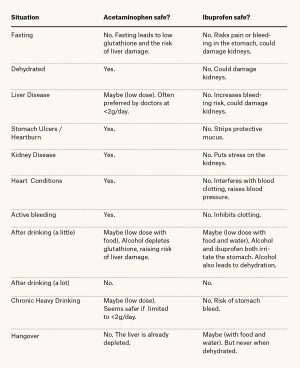
It’s actually fairly hard to find situations where ibuprofen is safer than acetaminophen. Possibly this is true if you’re hungover, but I would be very careful, because you tend to be dehydrated when hungover, raising the risk of kidney damage. (It’s probably optimal, from a health perspective, to avoid taking recreational drugs at doses that leave you physically ill the next day.)
Aside from hangovers, the only situations I could find where ibuprofen might be safer than acetaminophen are if you’re taking certain anti-seizure or tuberculosis drugs or maybe if you have a certain enzyme deficiency (G6PDD).
What have we learned so far?
1. The body is really complicated!
2. The main risk of acetaminophen is liver damage by creating too much NAPQI. Taking too much at once can easily kill you. However, as long as you don’t take too much at once and your liver isn’t depleted, then your liver will maintain NAPQI levels at zero and it will be completely fine. And there are very few other risks.
3. Meanwhile, ibuprofen poses a risk of gastrointestinal issues, heart attacks, or kidney damage. The risk varies based on lots of factors like whether you’ve eaten food, whether you’re dehydrated, your blood pressure, and your heart health.7
4. Therefore, acetaminophen is probably safer, provided you never take too much.8
I don’t want to be alarmist. If you’re healthy, the risk from taking an occasional dose of ibuprofen as directed is extremely low. Given that so many people find that ibuprofen is more effective for many kinds of pain, it’s totally reasonable to use it. I do so myself.
Still, it seems to be the case that in the vast majority of situations, acetaminophen is saf_er_. Personally, if I have pain, I first take acetaminophen, and then add ibuprofen if necessary. I’m pretty sure many experts think this is somewhere between “sensible” and “obvious.”
But if acetaminophen is safer, then why don’t official sources tell you that?9 I can get doctors to admit this off-the-record. I can find random comment threads with support from people who seem to know what they’re talking about. But why does this fact never appear on government websites or drug labels?
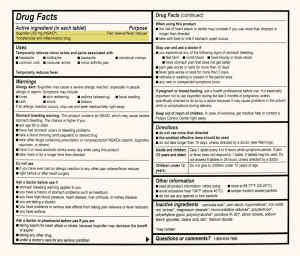
In the U.S., the Food and Drug Administration (FDA) creates10 a “drug facts” label for over-the-counter drugs.
Here’s what that looks like for ibuprofen:
And here’s what it looks like for acetaminophen (acetaminophen):
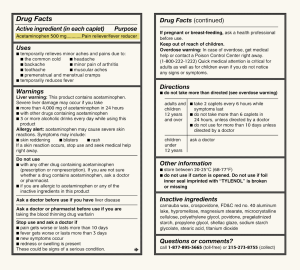
I feel dumb saying this, but when I saw those labels in the past, I thought of them as a bunch of random information thrown together for legal reasons. But after spending a lot of time trying to understand these drugs myself, I now realize that these labels are... really good?
Imagine you work at the FDA and it’s your job to write a safety label. You need to synthesize a vast and murky scientific landscape. Your label will be read by people with minimal scientific background who are likely currently in pain, and who could die if they take the drug in the wrong situation.
If I were in that situation, I’d think about all the different situations in which taking one of these drugs could literally kill someone, and then — after a quick panic attack — I’d write a label that screamed, HEY, IF YOU ARE IN ANY OF THESE SITUATIONS, TAKING THIS DRUG COULD LITERALLY KILL YOU. Then I’d think about all the other situations where taking the drug might be okay depending on a set of complex science stuff and tell people in those situations to PLEASE TALK TO A DOCTOR FOR THE LOVE OF GOD because I DON’T KNOW IF YOU’VE HEARD BUT SCIENCE IS COMPLICATED. Everything else would be a minor concern.
From that perspective, these labels are a triumph. This isn’t random information — every word is a synthesis of a mountain of research, carefully optimized to save lives.
How did those drug labels come to be?
If you want a taste for the FDA’s process, I encourage you to skim the 2002 Federal Register document in which the FDA proposed to update ibuprofen’s safety label and to formally classify it as Generally Recognized as Safe. It’s more than 21,000 words long and — I think — astonishingly good. It not only summarizes the entire medical literature on ibuprofen, it summarizes it well. Here is onerepresentative bit:
Bradley et al. (Ref. 42) conducted a 4-week, double-blind, randomized trial in 184 subjects comparing the effectiveness and safety of the maximum approved OTC daily dose of 1,200 mg of ibuprofen (number of subjects (n) = 62) to that of a prescription dose of 2,400 mg/day (n = 61), and to 4,000 mg/day of acetaminophen (n = 59) for the treatment of osteoarthritis. While there were no significant differences in the number of side effects reported during this study, the study demonstrated a trend towards a dose dependent increase in minor GI adverse events (nausea and dyspepsia) associated with higher doses of ibuprofen (1,200 mg/day: 7/62 or 11.3 percent; versus 2,400 mg/day: 14/61 or 23 percent). In addition, two subjects treated with 2,400 mg/day of ibuprofen became positive for occult blood while participating in the study.
I spend a lot of time complaining about bad statistical writing. A lot. Probably too much. But I’m here to tell you, that paragraph is gorgeous. The writing is clear and penetrating. It contains all the important details, but no other details. Compared to the abstract of the original paper, the above is shorter and easier to understand yet simultaneously more informative. Five stars.
The rest of the document is equally good, with clear and sensible explanations for various recommendations. For example, they discuss a proposal from the National Kidney Foundation for additional warning about risks to kidneys, explain why they think that proposal has merit, and then recommend a shorter version, which appears on every package of ibuprofen sold today.
As far as I can tell, this level of quality is typical. For example, the FDA’s 2019 proposed rule on sunscreens is similarly masterful.
This leaves us with this constellation of facts:
1. Acetaminophen is, in general, safer than ibuprofen.
2. The FDA doesn’t tell you that. Neither do other respectable authorities.
3. The FDA is highly competent.
So what’s happening here? Have the experts conspired to keep this knowledge secret?
I don’t think so. Mostly, I think this is down to two factors. First, the FDA doesn’t really have a mission of determining “in what circumstances is drug A safer than drug B?” Their goal is to take individual drugs and determine how people can use them safely. They seem to be quite good at this.
Second, everyone is mortally afraid of giving “medical advice.” It varies by jurisdiction, but in general, giving "wellness advice" is OK, but if you give personalized advice, you risk going to prison. The more credible you are, the higher that risk is.11
Stepping back, how should we think about this situation?
The body is complicated. When experts give the public advice on drugs, they are trying to insulate us from that complexity. But there is no way to do that without making trade-offs. Society has implicitly chosen tradeoffs that mean certain "less important" facts are de-prioritized. It’s not obvious that this is the wrong choice. I feel foolish for not having more respect for the body’s complexity and for the difficulty of the task all the experts are trying to accomplish. This is not medical advice.