Found a tiny typo, this sentence from quite early (page 17):
Notice how apparently wasteful this file format is: some of the triplets contain only byte.
I think the word "one" is missing before the final "byte".
Had the privilege of meeting Jeff "Yak" Minter in Singapore, and also attended his presentation. Another legendary game developer, in the same league as David Theurer
(Would love one about Space Giraffe / NEON but I appreciate they're on much more complex systems than Tempest and Psychedelia.)
A paddle controller for the Atari 2600 had a hard stop, so that it could only make one revolution (or a bit less) in each direction. Therefore, you could use it with Tennis or Pong or whatever else just had you going back-and-forth.
https://en.wikipedia.org/wiki/Paddle_(game_controller)
A driving controller spun freely in both directions without stopping its motion. This was not analogous to the steering wheel of a car, but it did permit driving games to be relatively free-wheeling, and you could spin the car's wheels endlessly in either direction.
In my experience, paddle controllers were more compatible with more games, but if you had a diverse library, it behooved you to keep driving controllers on-hand for that eventuality. Other unique controllers included the BASIC Programming pads, and one of those space games which had some really intricate controls on the dash.
The "driving" controller class was the type that was supported by Tempest. Analogous to the arcade controller, you could spin indefinitely in either direction without having the physical tab to stop the motion. This definitely contributed to the fun and suspense of the gameplay!
One is basically a self centring sprung up/off/down switch. That would be similar to a car indicator stalk and simple left/right arrow keys.
Another would be rotary with a stop but it sent a physical position, presumably it was something like a variable resistor or very fine resolution rotary switch. With these you could instantly position your character by the position on the ring/slider. This could be interpreted as position 1, 2, 3 etc etc.
The third was a free spinning which moved the character faster the faster you spun it. This would be how I remember Tempest playing, you could slowly nudge it or just do a fast spin & stop to quickly move around. This would produce a signal such as clockwise+very slow or anti-clockwise+very fast.
I had several driving games, too. But they used a joystick or the paddles.
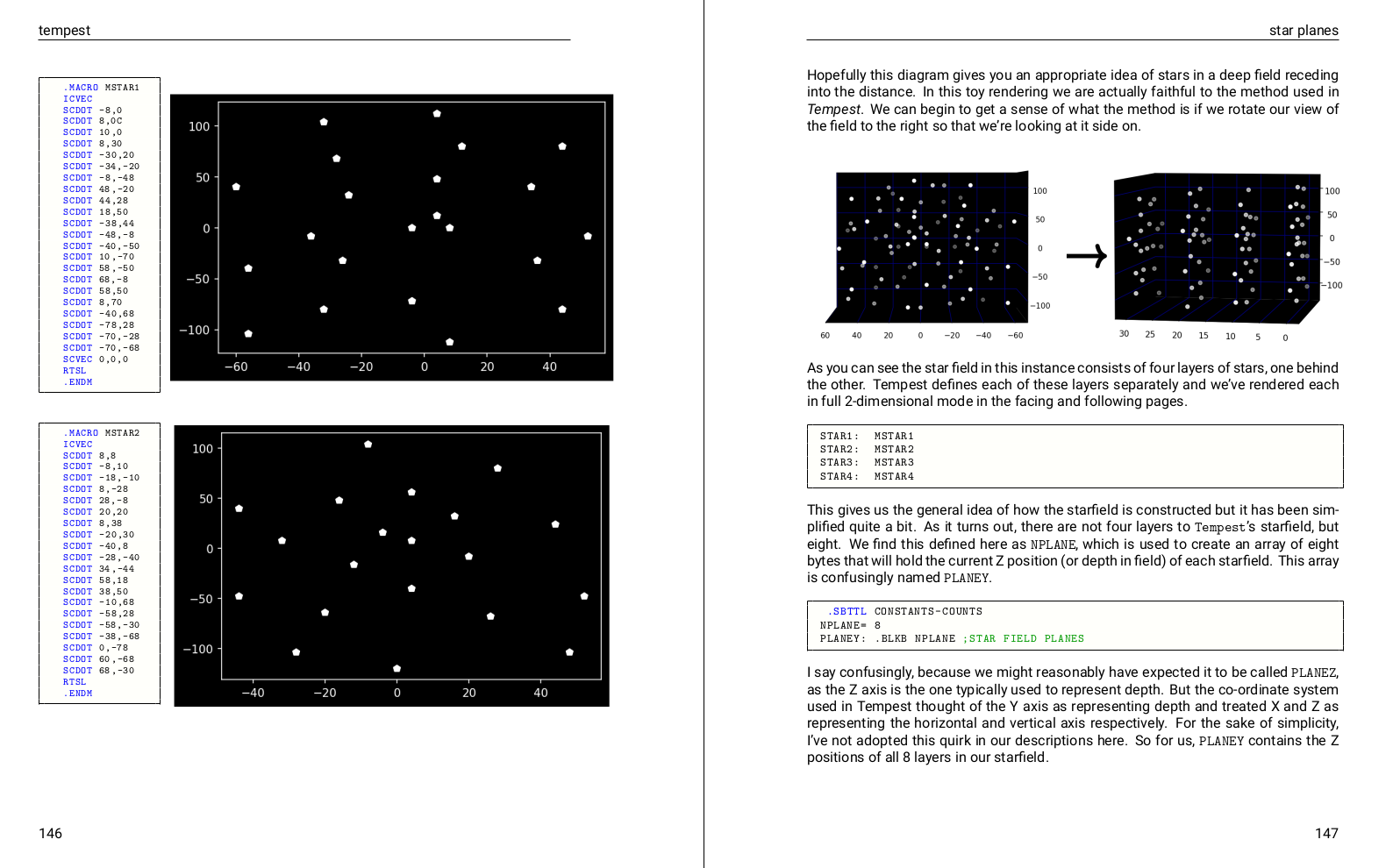
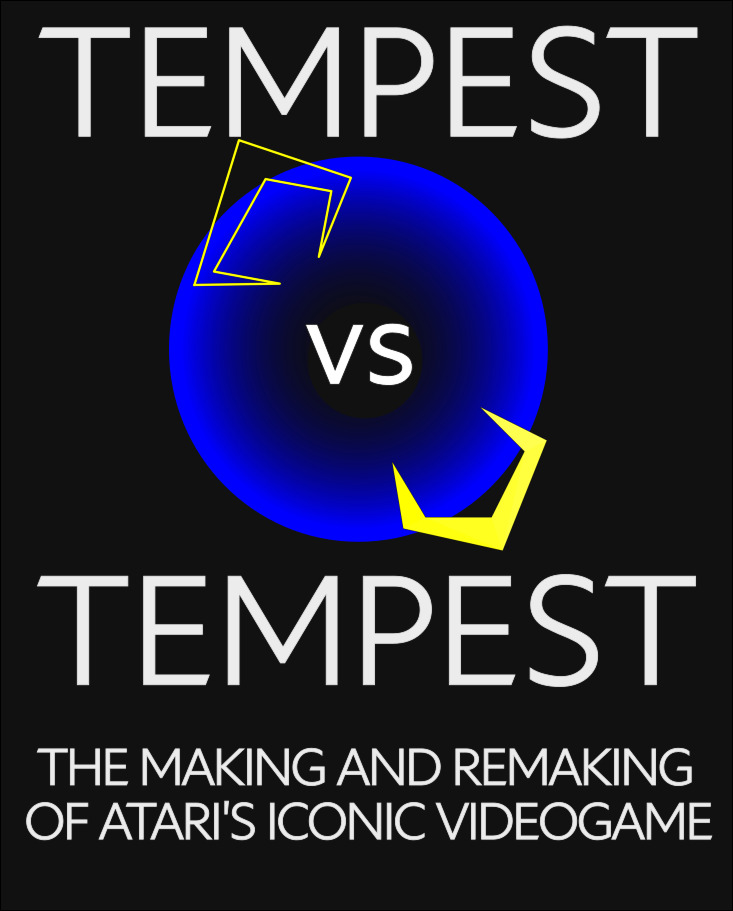
TEMPEST vs TEMPEST is a book-length attempt to explore and understand the code and craft of Dave Theurer's 'Tempest' (1981) and Jeff Minter's 'Tempest 2000' (1994).
The idea is to explain how lots of different little things in each of the games actually work, down to the level of how they are implemented in the 6502 (Tempest) and 68K Motorola (Tempest 2000) assembler source code.
I tried to keep it light and digestible so the book consists of lots of little chapters, each one presenting a hopefully-tasty morsel from one of the games.
You can download and read the book here (9MB). A dual-page view in your PDF reader is recommended to aid viewing code and commentary side-by-side.
If bandwidth is no object, here is a high resolution version with better quality pictures (27MB).
The book is free, but if you like it you can gift what you want.
Find out more about the making of this book at its github repository.
IRIDIS ALPHA THEORY , a book length treatment of Iridis Alpha that goes into the game's mechanics in just about the same insane level of detail as this one.
psychedelia syndrome , a book length treatment of psychedelia exploring the full mechanics and source code of Jeff Minter's Psychedelia.