Jon Peterson is an expert on the history of wargames, and the tabletop role-playing games that they spawned. His books include Playing at the World, on simulated combat from chess to Dungeons & Dragons, The Elusive Shift, on the evolution of role-playing, and Game Wizards, on the legal feuds that shaped the early history of D&D.
One of us (Clara) has spent more time than she’d like to admit at the gaming table. The other (Angela) has never filled out a character sheet in her life. But both of us are fascinated by what happens when we try to reduce the most violent and unpredictable of human actions down to a set of rules. In this interview, the three of us discuss how advances in statistics and cartography made wargaming possible, the journey from 18th century Prussian military officers to Midwestern hobbyists, how RAND played an instrumental role in the birth of D&D, and how little the core debates on game design have changed in the past 200 years. Have fun.
This interview has been edited for clarity.
Umpires, topography, and dice
Angela Chen: I wanted to start by talking about the very early history of wargames. In your book Playing at the World, you write that an Indian game called chaturanga was the precursor to and inspiration for chess, which then developed into the first modern wargame.
Jon Peterson: Right, and through India, chaturanga made it to the Arabic world. And when chess was introduced to Europe through the Iberian Peninsula and the Caliphate, it had a huge impact, first in Spain and then spreading to the remainder of Europe. People viewed the game as a means of studying statecraft, and so they saw it differently from other kinds of parlor games that were circulating at the time.
Christoph Weickhmann writes about this in his 1664 book The Newly Invented Great Kings’ Game. He believed that games that were based on a board — based on being able to deploy units and manage them, and to engage in a competition that required you to understand different lines of attack— could help you become a better leader.
But in these early games, you had very prescribed movements, so people questioned how useful it really was as an understanding of military tactics or grand strategy. And so a lot of people started proposing ways that you could improve the game of chess. People said, “let's get rid of all these confusing units and break this down to what the battlefields of Europe look like today. There's infantry, there's cavalry, there's artillery. Let's focus on trying to figure out ways to represent them, still using the basic concepts of chess, where there’s a board, there’s a grid.”
So Johann Hellwig, who was educated in Brunswick in the late 18th century, was the one who first recommended a game like this for the instruction of the young who needed to learn how to be officers. He recommended playing a game that would be entertaining, but at the same time didactic.
Angela: At this point it’s still on a board. How did it develop from there?
Jon: Well, let’s talk about Georg Venturini first. Venturini really applied a scale to the map, which was not something you would find in Hellwig’s game. His map was still treated like a chessboard, but he was concerned about questions like: What distance is this square supposed to represent? How far does the soldier march in a day? And based on that, how many squares will a soldier march in the day in a realistic game?
Clara Collier: The wargame variants that exist before Venturini sound a lot like combat in tactical turn-based video games that have squares on a grid. The squares can have different terrain — this one can be swampy, and it makes your unit slower, for example. But there's no sense of how that corresponds to real distances in space.
Jon: Quite accurate, yes. Venturini really wanted to create a scale as a tool that bound the setting of the game to its system.
Then the same principles determine how far artillery can fire. It becomes a question of, “based on how far we think the distance to the square is, how far can our guns fire?” And they calculated this before people actually had rifled barrels, so guns couldn't actually fire very far at all. Throughout the 19th century, as time went on, technological innovation required designers to revisit the principles of wargames and adjust for that.
Angela: After Venturini, we get the elder Georg von Reisswitz and his son, who together invented the first modern wargame, the Kriegsspiel. It sounds like there were a few key conceptual leaps between Hellwig’s and Venturini’s games and what the Reisswitzes developed.
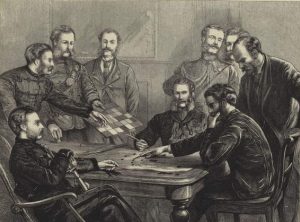
Officers playing at Kriegs Spiel or ‘The Game of War.’ Courtesy Alamy.
Jon: Reisswitz the elder lived in what was then Breslau. Reisswitz dispensed entirely with the grid. He said, “Okay, I'm just going to build these terrain models, and these terrain models are to a specific scale, and I'm going to use a ruler, and the ruler is going to determine how far it is that these particular troops move.”
Clara: So many of the chess variants appear all over Europe. But once you get into Kriegsspiel in the early 1800s, the whole tradition is so German and so concentrated in the German-speaking world. Why is that?
Jon: It was probably Leibniz who really first proposed that you could operate a simulation that would look at the branches of the military. This was picked up on by later German military scientists.
To get down to brass tacks: by the end of the 1790s, the German-speaking world had a big problem and his name was Napoleon. People were really thinking about ways to get an edge over the French. And there was a lot of work on trying to measure everything related to warfare, trying to figure out statistics, trying to predict answers to questions like “if we expect we're in a march of 10,000 soldiers from this place to this place, over this period of time, how many of them will be kicked to death by their own horses?”
They took statistical data and used it to be able to make predictions. Is there something particularly German about that? Yeah, probably — they had a great interest, again, in those modernist principles of being able to quantify and, based on quantifications, being able to predict what was going to happen in the future. Certainly those all dovetailed with all the requirements for the invention of wargaming.
So again, between 1811 and 1812 Napoleon was kind of wiping the board with most of the German-speaking world. And there's a tremendous interest in being able to get tools that could help the military gain an edge. Occupied Prussia basically was not allowed to have an army, so Prussian military scientists turned their interests to things like wargames. And that's really where the elder Reisswitz fits in.
Then his son, who was an artillery officer, took over his father’s game designs, and he started looking at simulation systems and probability. Once you combine that with the idea of using an instrument of chance, like rolling a die right against a table of probability, you have something new.
Clara: He introduces dice and combat result tables to board games.
Jon: Yes, and simultaneously. They come together in the 1824 work of the younger Reisswitz.
And there’s the concept of a referee, or umpire. The way you play this game is no longer that you pick up a piece like a chess piece and move it across the board. Instead, your job is to write orders to pass along to a messenger, played by the referee, who will take them to a unit that’s going to tell you what to do. And all you’re going to get back as feedback from your actions is a written field report saying, “yeah, we tried to take that move and everybody was killed_._” The referee decides that with dice and tables behind the scenes.
Angela: I have a question related to the efficacy of wargames. As we talked about, there’s this period when Prussia becomes a dominant military power, Kriegsspiel-type games take off, other countries become interested. I wanted to know more about the actual effect of Kriegsspiel on the success of the military. You write that it’s hard to assess — have there been attempts to do so? And a sub-question: Whatever effect Kriegsspiel might have had, how can you disentangle this from a general increase in probabilistic thinking?
Jon: At the time, military scientists certainly believed that wargames were making them more effective. People initially thought the Prussian Army was a peacetime army and that if they were drawn into any sort of conflict, it would be trivial to overcome them. They were just shocked by how successful the Prussians were on the battlefield, especially during the Franco-Prussian war, and they wanted an explanation. There are all these writings from the time about how “if we aren’t using this technology, we’re gonna get left in the dust by these guys.”
But did it really help? How could you prove if it did or not? What would the empirical trial be? We'd have to literally have people going into war, right? I don't know what the evidence would really look like.
But using probabilistic thinking — having people prepare and kind of role play out conflicts — seems like the sort of technique that could be pretty beneficial. Now, of course, they did play out all sorts of scenarios. Kaiser Wilhelm the Second did one for the lightning offensive of the First World War and they were entirely wrong and ended up mired in horrible trench warfare for eight years. So… tough to say.
Fighting yesterday versus tomorrow’s wars
Clara: Angela and I have both noticed an uptick in wargaming in our circles, though I guess I’d say it’s professional more than hobbyist. I participated in a wargame run by a nonprofit, the AI Futures Project. We modeled different scenarios for how the world would respond to heavily advanced AI. Both of us seem to think this trend is catching on in general. I’m curious if this is a trend you’ve noticed, and if so, what you think of it. What can the history of wargaming tell us about what makes these practices effective?
Jon: I don’t have much insight into contemporary activities, because it's really not what I study. But there are lessons to be taken from it, certainly. AI is a great thing to be thinking about gaming out at this point. It is about that relentless advance of technology.
The ability to understand the way disparities in access to these tools can be decisive in military conflicts might be the single most important thing that I took away from the history of wargaming. It was important that people looked at this through the lens of, “okay, we have telegraphs now, what does the game look like now that we have telegraphs?” Same with adequate railroad systems or rifle artillery, or later nuclear weapons.
That is a more successful approach to game design than the people who re-fought yesterday’s war. Ironically, hobby wargaming — a trend initiated by H.G. Wells when he wrote Little Wars circa 1913 — was far more concerned with the more romantic wars of the previous century than the realities that people found in the trench warfare of the First World War. Similarly, we look at the rise of modern board-based wargaming, the Avalon Hill wargames of the 1960s, and they were relitigating at best the Second World War, maybe the First World War, maybe Napoleonic battles. But they were really not thinking seriously about the impact of nuclear weaponry.
There is an interesting distinction between what the actual professional military people want out of these games and what they find successful in them, and the kinds of things that hobbyists pursue in wargames.
Clara: The hunger for wargaming fell off after World War I and World War II. You also make this point about that one thing pushing Dungeons & Dragons, which comes from the same lineage as wargames, in the direction of the medieval and fantasy setting is that there’s a lot of anti-war sentiment because of Vietnam in the 1960s and 1970s. D&D was instead an escape from the reality of modern war.
Jon: It was a time when the counterculture was really concerned about the war mongers, and that colored their perception of wargames. This is something [D&D co-creator] Gary Gygax came down very hard against early on, suggesting that, in his experience, most hobby wargamers were strictly anti-war. The wargames market was basically inaccessible to people that were part of the anti-war movement, unless it was couched in a way that wasn’t revisiting the atrocities that people were seeing on TV coming out of Vietnam.
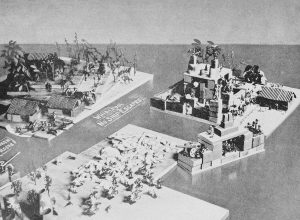
From the 1912 edition of H. G. Wells’s Floor Games.
Diplomacy shift
Angela: I’m curious about the shift from these wargames that focus on individual battles to more political games like Risk and Diplomacy. What happened there?
Jon: Diplomacy is a huge part of it. I view Diplomacy — although Allan B. Calhamer, its inventor, would vehemently disagree with me — as obviously an offshoot from the operational research sorts of games that were developed by RAND.
Clara: I was waiting for you to get to the RAND part of the story.
Jon: There's just too much of the system in common for that not to be the case. I really view Diplomacy as the forerunner to all the things we call 4X games, in the sense that it was a game where you start out with a few bases, and your job is to capture supply centers, because with each new one that you expand into, you can then exploit it to have a new army that's on the field, and that then gives you a bigger army to go and capture more things and so on. A lot of the 4X mechanics come from that, and they're even more explicit in a lot of the Diplomacy variants.
Diplomacy looks back into history again a bit nostalgically, at a simpler era than the nuclear era of the RAND games, but it really takes the approach that what matters in a world of mutually assured destruction is more political maneuvering than actually what your forces do on the battlefield.
The idea is that what matters is who you choose as allies and ultimately who you choose to betray in order to advance your interests in the broader political sphere. Those are the lessons that all of that operational research technology and RAND had taught people: that when you start thinking about what to do with the nuclear weapons that were then available, all you've got is what you can convince people of, or intimidate or confuse or negotiate, whatever leverage you can gain in the political sphere.
Clara: And this also introduces a bunch of different gameplay mechanics and constraints.
Jon: They did. There were these political exercises that were being conducted by the Joint Chiefs of Staff in 1964, which were the first instance I can really find of our use of the term “role-playing game.” You were playing the head of the state or the head of the military, and someone else played the director of the internal affairs of the state, and then somebody else was externally facing, like the foreign secretary versus the home secretary or whatever. And that created a framework that people would recognize as role playing.
I think it's pretty cool. I view the way that people like Gary Gygax and Dave Arneson and Dave Wesley and others in their circle cut their teeth playing Diplomacy — and having to play these characters as they negotiated with each other — as one of the more direct and well-documented instances of how role playing, as we've come to understand it, emerged.
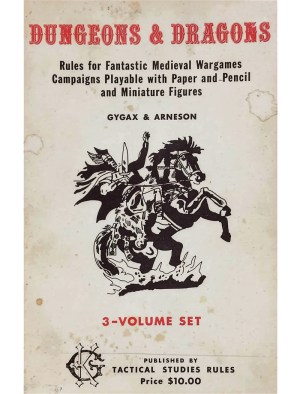
Cover of Dungeons & Dragons original edition.
The teleology of games
Clara: Another thing I found really interesting in the book was how so many of the same components keep getting recombined across these games. There are also changes, but the essential elements are all present from very early on.
Some things do change. The basic idea of role-playing exists for a long time in this history, but then it takes a long time to codify this idea into formal rules. Not only are you a character, but the kind of character you are has mechanical implications for how you interact with the world of the game.
Still, for the most part, it's so cyclic. All of these basic elements of modern tabletop games are in place in these systems that existed in the 1820s and then the rest of the history is dropping different parts of it and reinventing them and working around the same kinds.
Jon: Don't sell the role-playing in 1824 short, though. The game was actually played in the feedback loop, in the dialogue. A referee gives you a situation, you play a commander, you are roleplaying somebody in the field. It’s a level of role-playing purity that I think people really strove for in the late 1970s and 1980s.
I have another game history book called The Elusive Shift that covers up to 1980 or so and people are still talking about the same role-playing topics and asking if we haven't just gone full circle back to free Krieggspiel.
Clara: It’s really striking, as someone who has played a lot of tabletop role-playing games, that there is always a debate about whether the rules are too complicated, and whether specifying the results of all these different mechanical interactions are a useful way of simulating reality or a straitjacket that stops the game master from exercising their judgement and imagination. But Prussian officers like Verdy du Vernois were having this exact same argument about Kriegsspiel in the 1870s! It never changes.
Jon: It is the same today. Ed Greenwood, the guy who created the Forgotten Realms, wrote an article for Dragon magazine circa 1980 in which he encouraged new players not to learn the rules of D&D. Instead, he suggested you just imagine you're a person in that situation. Tell the Dungeon Master, this is what I want to do, and they'll tell you what happens. Greenwood felt that was the best way to play. Now, there are other people who disagree very strongly with that position, who think that you have to understand enough of the system that your actions are meaningful.
So did we actually make a clean break from these older wargame systems when we created RPGs as a genre? This is something that people endlessly debated at the time. But it’s entirely correct that there are things that TTRPGs inherited from this wargame tradition that it's really impossible to remove without effectively breaking into a different genre than what RPGs are.
RPGs exist in the tension of these kinds of questions. How much agency should the player have versus the referee? Should the player be able to even see dice rolls that the referee makes, to what degree should the player understand the system? Should the player just be able to ignore the rules and say this, this is what I want to do?
Back in 1824, Reisswitz didn't want the player to know the system. He wanted you to write rules like you would if you were a commander in the field, because he wanted you to have the same experience of uncertainty that a commander in the field would have. He wanted that for didactic purposes, but later gamers wanted to repurpose this as a means of entertainment, and then personal exploration, and then a whole bunch of other things.
Clara: Once you have the dice and the results tables and the referee all together, I think this tension is just inherently going to emerge.
Jon: One of the things I always try to stress when I talk about D&D and the birth of tabletop role-playing games is that this was something that was kind of in the air at the time. It came from so many different directions. We can point to things as disparate as the Fight in the Skies campaigns that were being run in the Twin Cities by people who were playing as individual pilots. We see talk in their fanzines about how you should play your pilot based on a personality and you should write a backstory for them.
The interesting question that emerged by the end of the 1970s is: How would you design systems that would encourage role playing? This is something that's obviously still heavily debated. What do we think the characteristics you roll for your characters mean? If you have high Intelligence, that means you’re supposed to make good decisions? If you don’t make a good decision, should the Dungeon Masters tell you your character wouldn’t do that because you're so intelligent?
Clara: In the AI simulation game I played, it is the case that for at least part of a runtime, some of the players will have greater than human intelligence. And these games are attempting to be a realistic scenario. So how do you handle that?
Jon: I'd be very interested in the design of games like that. I can't see I've reviewed any that are attempting to do that, but it sounds fascinating.
Clara: I am also interested in how the Kriegsspiel tradition feeds into the practice of wargames as they’re conducted by modern militaries, which is very complicated and elaborate.
Jon: So much of that has been supplanted by computer simulation at this point that there can't be that much resemblance. I'm no expert on this. I know there are people at the Naval War Center and Newport News who work on this stuff and have been using computers for this since it first became possible.
Clara: My final question is: given all this cyclic and convergent evolution, is it coherent to talk about progress in wargaming or in tabletop games?
Jon: I think it is. Across the history of wargames, there’s the evolution of technology and ways that, over time, people have refined simulation models so that they took into account technological innovations that didn't previously exist.
But you can look at more radical leaps, like the RAND school of thought, where people realized tactical wargames of the sort that we were previously exploring were just not meaningful anymore. It's not that there aren't still going to be land wars, but people found this paradigm shift of new things that they need to explore. You can talk about progress, or whether it's truly teleological — that’s a different matter.
Are we ever going to get to a point where we devise the perfect TTRPG? I really don’t think so. That is a lot like trying to figure out what the best music to dance to is. There are always going to be aesthetic distinctions or fashions that are going to push that one way or another, and the same is true with any hobbyist pursuit.