[1]: https://meshcore.io
[1] https://reticulum.network/ [2] https://lilygo.cc/products/t-echo-lilygo [3] https://github.com/torlando-tech/columba
>And, he’s kept that small detail a secret - that it’s all majority vibe coded.
Without any more context, I am highly suspicious of this framing.
1) Someone "taking over" the ecosystem seems like an entirely different issue. How is this possible? Does it mean he's publishing things and people want to use them?
2) Is the code bad? It sounds like they had no idea he was using AI. That seems to imply there was nothing wrong with the code as-is. Why not judge it on it's merits?
>The team didn’t feel it was our place to protest, until we recently discovered that Andy applied for the MeshCore Trademark (on the 29th March, according to filings) and didn’t tell any of us.
Taking this at face value, this is indeed hostile and bad.
But no, I'm not going to get outraged that someone is simply using Claude Code.
It is essential to disclose it.
Wifi HaLow 802.11ah is finally out & available, sometimes at ok prices. We don't really have ad-hoc communication pioneered for wifi, but it's doable and we ought lean into it, rather than using some totally different stack, especially one that is under strict control of a single company.
What we learn doing wifi halow can directly port and improve the rest of ways we connect. That would be grand.
It's ridiculous to me that they're concerned about the trustworthiness of AI-generated code when their code quality is so low. They don't even have automated tests and ignore attempts to add them.[0, 1, 2, 3]
Last I checked, there's little validity checking in the code, so it's possible to broadcast nonsense values (like GPS coordinates outside of Earth's bounds) and the code happily accepts it.
And that's fine if they're just like a scrappy upstart doing their best, but it annoys me to be so high and mighty about their code quality when they don't invest in it.
I really want to like MeshCore but I feel like its stewardship makes it hard. The main two people I know running it are Scott Powell and Liam Cottle, both of whom are trying to build businesses on closed-source layers on top of the firmware. I don't think there's anything wrong with an open-core business model (I ran such a business myself), but it creates perverse incentives where the core maintainers try to suppress information about the open-source alternatives and push their own closed-source paid products.
Also, MeshCore's recommended broadcast settings for the US are illegal.[4] I emailed the Liam and Scott about this months ago, and they ignored me.
[0] https://github.com/meshcore-dev/MeshCore/pull/925
[1] https://github.com/meshcore-dev/MeshCore/issues/1059
[2] https://github.com/meshcore-dev/MeshCore/pull/1065
Just a word of caution, claude code might look impressive if your knowledge is shallow or intermediate in a topic, but if you know what you’re doing, once you dig deeper it starts to introduce plenty of scope creeps into your code base, piling one on top of another that you won’t even recognize your own code shortly.
Neat concept but so many footguns that (imo) it’s not really sustainable to try bootstrapping.
Specifically, I had tried to port the stack to Rust no-std to use on nrf52 LoRA devices to use/abuse the existing MeshCore network to deliver reticulum packets. Turned out to be a nightmare just trying to figure out if my packets were even correctly formed.
It was fun and cheap to set up, but I look forward to something with better messaging persistence so you can at least reliably not miss stuff.
although, i’ve already done real time voice calls over 1 hop of reticulum lora on and it works pretty ok.
edit - community wiki with getting started instructions is here:
Only very very small testbeds.
Different countries allow unlicensed use on different frequencies. Look up which is correct for your location.
Also great for position tracking, sensor data or motion detection etc.
The closed client isn't needed anymore.
Anyone that has used AI at all knows this isn't how it works. AI is extremely good at producing plausible-but-wrong outputs. It's literally optimised for plausibility, which happens to coincide with correctness a lot of the time. When it doesn't you get code that seems good and is therefore very difficult to judge on its merits.
With human written code it's a lot easier to tell if it's good or not.
There are exceptions to this - usually if you have some kind of oracle like that security work that used AddressSanitizer to verify security bugs, or if you're cloning a project you can easily compare the behaviour to the original project. Most of the time you don't have that luxury though.
All over the internet people are putting up vibe coded projects and no one says that's what it is up front. They all just say "I made this" and they are more than happy to take in the adulation of people impressed that they made something with an animated pattern.
Then when they finally admit that they wrote nothing and don't know how any of it works people start to say "nothing wrong with using ai", as if using it is the same as copying it verbatim, not understanding anything and taking complete credit as if you wrote it while lying about how it was used.
Hostapd people also do not seem interested in bringing in any 802.11ah support. So it's crap in that aspect as well. Drivers all fake 802.11n or the chipset offers some garbage AT-command interface and does all of the networking.
On the other hand MeshCore and Meshtastic have similarly terrible codebases as far as I've seen. At least they're somewhat usable though.
Honestly no clue why these software stacks are all this dangerously written, unstable and haven't improved in years.
First, I don't know if their interpretation of the rules is correct. For the sake of argument, I'll assume it is. More importantly, most other people in that thread seem to be going along with the idea that it is correct. This is how it reads to me:
Submitter: We're violating the rules and should make this change.
Replier 1: That change would be inconvenient in Seattle so we're not doing it.
Replier 2: It wouldn't work well in Boston, either, so it's a no-go.
Part of me wants to shake them. This isn't 'Nam. There are rules. Whatever you think about the FCC regulations, they're not voluntary, and they certainly don't have an opt-out for "it wouldn't work as well that way". To a first approximation, everyone else using the public airwaves is more or less following the law. If following the law makes your project not work as well, that's your problem. It's on you to fix your project so that it's legal to use.
I'm not one of those old hams who gets hyper cranky about this stuff, but I do understand how they come to be that way. The only reason we can use the spectrum at all is that people are mostly using it legally so that their work isn't interfering with everyone else trying to use the same public resource.
This is also a loaded question. The only specifics they've offered are that he simply used Claude Code. Um... OK? Do the tests pass? Did his changes add any security flaws? Regressions that were untested?
Agreed, but at least it's somewhat sensibly structured. AI? Good lord you'll end up with a slopaghetti mess.
> They don't even have automated tests and ignore attempts to add them.[0, 1, 2, 3]
Two people, 540 issues and 270 PRs open at the moment. Not wanting to be that guy... but do the math. The reviewer team is small as hell and after this drama (which probably kept both of them busy with BS) they'll likely be even less willing to trust others.
If you want to stand a better chance at getting your code into other people's hands, go and contact the person behind the Evo fork. IIRC he's part of Hansemesh, Germany's biggest regional MC.
I have heard indirectly multiple times now that the only two ways to get a PR of interest merged is to either gather enough people to Like the issue on Github or to join the Discord and ask.
at the very least, try it. maybe it's simpler than you think
It's so much fun with little pages, message boards and random people hitting you up for a chat. I brought up my own transport node and propagation node too to contribute to the mesh.
If there ever where a more serious situation where my life depended on one of these meshes, I would be feeling pretty uneasy. They are absolutely not reliable enough to even consider such a thing. I suppose they might be better than nothing.
To say nothing of what is required to set up the devices. I wanted to put a full dev system on a raspberry pi 3 just so it would all be in one place and I could work on it when in a location with no internet - it ran out of memory trying to compile the massive web app that is the default client interface.
My local mesh was testing out meshcore last week, this definitely kills my interest too
Now the trademark take over seems crazy especially given Andy hasn't contributed to the github project, only personal for profit add ons.
I do also think that the meshcore core team have "tacked on" and tried to enforce a stronger narrative with their anti ai coding bias.
Is there still a reason to do this?
Can you name the game? Meshtastic has got me thinking about that kind of stuff.
You don't have to use the closed source app; there's an open-source client too, there are Blackberry-style client devices which don't require an app at all, and all the actual firmware is open source (MIT).
In that context it is quite logical to take a trademark out once the project is mature enough so you can profit off other people's work.
Considering their user base does not like the hidden vibe coded idea I don't think this is bias but a sane rationalisation.
I can't read that without assuming the real intent is to deliver bombs accurately, but the startup pitching it knows that'd get bad press, and the investors all know exactly what it really means...
Simple. Follow the money. Meshcore has more than 100k of users, repeaters are cropping up like weeds across the world. And that means there is a serious incentive to "cash out".
Notably, the person "cashing out" here wasn't involved in Meshcore firmware or app development, but in marketing.
Worth noting that the Blackberry-style devices are also closed source and the hardware and software is way worse than Blackberry was 22 years ago.[0]
[0] https://mtlynch.io/first-impressions-of-meshcore/#this-is-no...
I think it's totally sensible for the organization to want to have some level of control over what gets their label on it -- the Wi-Fi people wouldn't be very happy about someone slapping their logo all over a bunch of completely incompatible hardware.
I wasn't expecting the T-Deck to be anything more sophisticated than a walkie-talkie for SMS, but it's a bummer than the UI code isn't open.
Also, I'm assuming we're in agreement that software should not accept invalid GPS coordinates from untrusted peers regardless of semantics about whether or not they're within Earth's bounds.
They always want to posture as if they'll be some critical service every emergency responder comes running to in a major disaster and it rarely if ever happens.
In the interests of not reinventing the wheel, you can see here in the same thread the comment from many other posters about the problems that they have with the behavior, attitude, and perspective of many ham radio operators.
Circular coordinates wrap around, cartesian coordinates don't.
Most of the world just collects dx entities like pokemon, pota/sota locations, backpain complaints on nets and argue if ft8 counts or not for anything.
You're probably more correct, but not having the FCC as a barrier to entry using $20 hardware means a passing curiosity becomes me installing a repeater on our roof with a cavity filter that reaches half a city. It's super fun.
I was using a vibe coded UI (unrelated to this guy) that wasn't super disclosed and each dot revision a new basic thing broke. One I couldn't upgrade the firmware without a full reflash. Now I have to turn bluetooth off and back on to connect to it each time. In both cases it worked fine before that revision came out.
Was it because of vibe coding? I mean... it sure seems likely. Maybe it just needs actual testing?
At the same time it is seemingly the only UI firmware that supports bluetooth to my phone, uses map tiles on an SD card to show GPS maps (I have a tdeck so it has an LCD suitable for it), and runs on a tdeck. Oh, and our local channel names are too long for the ripple firmware (perhaps fixed by now) and the channel number limit was like 4? Maybe 10? Arbitrarily low in any case.
So like... I'm still using this vibe coded UI that breaks some new basic functionality each revision. I can connect to it over bluetooth (even if it's now unreliable), I can use my literally like 1 million map tiles with the GPS, I can actually enter the channel names, and I can have up to 20 channels.
I know a few hams that are chill and they are precious doves. I know quite a few more who I won't even engage with for fear of crossing them and them dedicating their lives to making mine hell. Because I've seen them do it to others.
That's not _just_ the hams, mind you. This behavior is overrepresented in hackerspaces in general. But there's a lot of overlap between those groups. Hasn't changed much in the 40-some-odd years I've been involved there either.
Since inception, the MeshCore development team have been working hard to build MeshCore.
We’ve released more than 85 versions of the MeshCore Companion, Repeater and Room Server firmwares with support for more than 75 hardware variants. All of this has been hand crafted, by humans.
We have always been wary of AI generated code, but felt everyone is free to do what they want and experiment, etc. But, one of our own, Andy Kirby, decided to branch out and extensively use Claude Code, and has decided to aggressively take over all of the components of the MeshCore ecosystem: standalone devices, mobile app, web flasher and web config tools.
And, he’s kept that small detail a secret - that it’s all majority vibe coded.
We ran a poll recently, and asked in the MeshCore Discord about AI and trust, and these are the results:
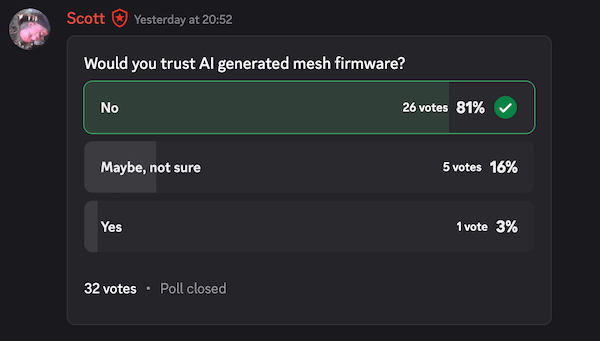
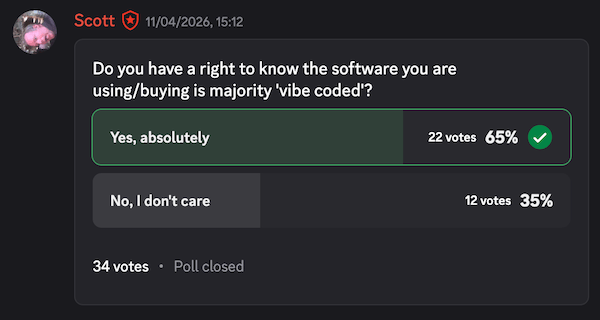
The team didn’t feel it was our place to protest, until we recently discovered that Andy applied for the MeshCore Trademark (on the 29th March, according to filings) and didn’t tell any of us. We have tried discussing this, and what his intentions are, but those broke down and we now have no communication with Andy.
It’s been a stressful few months trying to sort this out, and is now a sad day to bring this out to the public. It’s been a slap in the face to the team that have worked so hard on this project, to have an insider team up with a robot and a lawyer.
The use of the ‘official’ status is what is currently being contested. Andy is adamant that he owns the brand, and is using the word very heavily with his MeshOS line.
Meanwhile, in reality, the only ‘official’ MeshCore is the github repo. It’s the source of truth in terms of what is MeshCore, and Andy has never contributed to that.
Since the internal split, we launched the meshcore.io site, as Andy controls the meshcore.co.uk site and original discord server. We’ve been left with little other recourse. And, since launching the site, Andy copied the look and feel (again, using Claude) even though we asked him not to.
The MeshCore project has been on an incredible journey.
Having only started in January 2025, we have grown extremely fast!
As of this post, the official MeshCore Map shows 38,000+ nodes around the world, and the official MeshCore App has more than 100,000+ active users across Android and iOS.
It’s pretty epic how we’ve all built such an incredible community in such as a short time!
As the project grows, so does our need for a dedicated space that provides you with official information from the core team.
In recent times, we’ve seen an explosion of growth in MeshCore web sites dedicated to specific countries and mesh communities.
To name a few, we’ve seen:
Andy Kirby did do an amazing job helping to promote the MeshCore project on his personal YouTube, but only promotes his own products now.
So, the core team are pushing ahead with the meshcore.io website, the ongoing work of firmware feature development, bug fixes, managing PR’s and developer discussions, etc.
We now release change logs, blog posts and technical documentation for all of our new firmware and app releases here.
You’ll also find some familiar faces on our blog posts, such as:
The MeshCore team, now consisting of Scott, Liam, Recrof, FDLamotte and now Oltaco remain committed to designing and developing high quality, human-written software.
Please update your bookmarks!
This is where we will be hosting all official releases, technical documentation, and community discussions moving forward.
With the new website, we are also starting fresh with a new Discord server!
This is where you can interact directly with the MeshCore developers, get help with your projects, and contribute to the future of MeshCore.
Thanks for being a part of this journey!
The MeshCore Team
Frankly I'm surprised to see this here. Hackers have had more than their share of hurtful stereotype applied to both our hobby and our personality. We should know better. But perhaps there's a generational divide at work there.
The "secret, encrypted, private" chats correlate more with random "doomsday preppers", and younger non-hams (cheap, no need to get licenced). Many of those people buy (ham) radios too ("for emergencies", can't transmit legally anyway), but don't really contribute to anything. Emergencies are handled by trained groups of hams when/if they're called to help by whatever proper agency needs help with communications.
I always found it interesting how many useful little apps hams write, keep them closed source and then...die.
Yes, old mildly misogynist, mildly racist, wellakshually, holier than thou, pro-trumper types.
I was there at Dayton Hamvention (2024) when they had to turn off the 2M repeater because 2 or 3 of them got into a screaming match over trump.
Naturally, I skipped over any trump-flag hanging booth. But the hatred and extreme conservatism is everywhere in the community.
And its not my community any longer. I let my license lapse, and I will not renew. I also sold my radios, except for 2 2M handhelds, just on the off case SHTF.
I'm a radio hacker, not a ham. I'm no liddy elmer. And nor will I perpetrate shit like YL (you g lady) or OL (old lady), which is common vernacular.
Hams act super gatekeepey and act insanely protective/defensive around things that don't actually belong to them. They tend to have a high sense of self-importance around their skillset and try to do their own "enforcement" of rules that they feel empowered to harass people about. Hams tend to be "fixated persons". They care about their personal capabilities and usually some made up authority they think that gives them. All so they can just endlessly chirp hello world at each other. They developed a skillset and then don't do anything useful for the community with it. Notice I said the community and not their community. They love building insular clubs. They act like authority figures _across the whole damn spectrum_ when their purview is tiny.
The coolest radio hacker I ever met was an ex Army radio guy and Desert Storm vet. He ran a licensed LPFM station somewhere in the rust belt but with a pirate radio mindset. Their transmit power was way above what the license allowed but they also weren't bothering anyone :). His station ran afrocentric community/educational content and he ran after school programs teaching teens in his community brodcasting/radio/electronics skills. He helped several of them obtain scholarships. I've rarely if ever seen hams do anything nearly that cool.
I’ve been sniffing around it as a hobby for decades but there are just a ton of people involved that clearly are exorcising trauma from being bullied or feeling marginalized in their life on a whole. Following and enforcing the rules seemed like the beef big draw for a sadly large chunk of them.
Like with roads and cars, radio spectrum is a very limited and very shared resource, and there has to be some regulation, or else some Elon Musk-type person would already take it for themselves for a commercial reason.
It's also self-policed, so that means that hams have to find the problematic entities and hope that authorities with legal power act on those reports.
The devices can also be uncertified (self-certified by a ham technically), so you can cause all sorts of havoc for many other entities, like actual emergency services (a case not long ago in US) or worse.
If you are not able, or for some reason or another don't want to get licenced, there are other ways to communicate, like mentioned meshtastic, which doesn't require a licence on ISM bands, or PMR/FRS radios (or gmrs in us, which does require a licence but you don't have to learn the radio basics for the exam).
Again, like with roads and cars, you expect others there to be mentally capable enough to pass that simple exam and follow the basic rules on the air. If not, they can get a bicycle and argue on the bicycle lane with other cyclists. And the ham exam is much cheaper and easier than a driving exam (in most developed countries at least, the driving one costs 1keur++ if you finish optimally, whereas over here, a full intro to ham course (a few weeks, usually on zoom) with a printed book and the actual exam costs <100eur, even less with a pdf instead of a book)
The problem is hams - the people who are habitually are on amateur radio.
I find them to be incredibly anti-digital, holier than thou, loud about hard-conservative positions, misogynist, racist, and more. And when Ive tried to further the art and science of radio comms, hams are some of the first to talk down what I contributed.
They are people who I dont, and dont want to associate myself with.
Ive also known others that made that assumption when I said I was a ham. Lots of people have had those experiences, and also chosen not to associate with them.
I'm sure this doesnt apply to "all Hams". It does apply to a supermajority in the USA, enough to say that I do not want to be a ham any longer. I already refused to communicate with them, nor associate with them.