If I could offer one correction, it would be that SBU (as specified by the USB 3.0 Promoter Group[1]) means "Sideband Use" rather than "Secondary Bus".
On some devices, it is used to carry UART; on others, audio.
[1]: https://www.usb.org/sites/default/files/USB%20Type-C%20Spec%... (pdf)
USB Cheat Sheet - https://news.ycombinator.com/item?id=31271038 - May 2022 (168 comments)
I read it once years ago and I come back to it every now and then wishing my current PC (10+ years and going) would gently die so I could finally build something small and tiny.
- Female vs male crossover naming and pinouts for Type-C connectors
- Actual voltage, modulation and signaling schemes (USB4v2 uses PAM3 11b/7t encoding)
- PD generations and profiles
Correction - HPD signal is translated into vendor message and carried over CC lines - same ones that are used for PD and AltMode negotiation.
In DP-Alt mode SBU1/2 basically becomes AUX+/-.
What technological advance was not available x years ago to dream up usb 4?
We already know we will use the bandwith, why not dream up what will be the usb 8 spec in 20 years now and have everything working without change for 20 years?
Imagine the following naming:
USB 3.0 / USB 3.1 Gen 1 / USB 3.2 Gen 1 -> USB 3 5Gbps
USB 3.1 / USB 3.1 Gen 2 / USB 3.2 Gen 2 -> USB 3 10Gbps
USB 3.2 Gen 2x2 -> USB 3 20Gbps
Isn't that much clearer? I think USB 4 is finally going to the right direction.A Thunderbolt 5 cable will always support 80Gbps, DisplayPort 2.1, PCIe, USB4 and power of up to 240 watt.
Higher number = better
- USB4 is built on Thunderbolt 3's protocol, implementing a subset of its mandatory features
- Thunderbolt 4 is a strict profile of USB4 (all optional features made mandatory)
- USB4 v2 introduced 80 Gbps signaling
- Thunderbolt 5 is a strict profile of USB4 v2 (again, optional features made mandatory)
I think most of those cables will also support USB the protocol.
USB 4 is actually going into an even worse direction. USB 4 = Thunderbolt 4, except everything is optional. e.g. USB 4 might not even support DP Alt mode. Thunderbolt 4 always will.
I connects via USB4 to the host, and has the following markings on its ports:
- Power in/USB 10Gbps
- USB 10Gbps
- USB 10Gbps
- 8K HDMI
Pretty happy with this one so far.
Except active optical cables. None exist yet that I'm aware of though.
Not until 2023 did I even have a computer newer than 2012, so I missed almost all of USB3's hayday — including nomenclature disputes — but the speeds sure are an improvement!
I use USB-C displays, but they run in DP Alt mode. I don't have many (any?) storage devices that can max out a 20gbps connection, and usually don't exceed 5gbps
It's true that the actual data is sent over a lower number of diffpairs.
I suspect the shield is not included in the number of wires, since all USB cables have a shield (not sure if usb 3.0 has an extra return ground wire for high speed).
So it's happening, unfortunately I'm not paying for new RAM. So I'm planning a new rig around my existing CMK64GX4M4A2400C14 sticks.
It's totally not because its density is probably close to lead given the concentration of parts in such a tiny space, with some rubber feat that thing ain't going nowhere.
Concerning Thunderbolt 3: USB4 is based on the Thunderbolt 3 protocol [1].
Concerning Thunderbolt 4: "In July 2020 Intel announced Thunderbolt 4 as an implementation of USB4 40 Gbit/s with additional requirements, such as mandatory backward compatibility to Thunderbolt 3 and requirement for smaller notebooks to support being charged over Thunderbolt 4 ports.[14] Publications such as AnandTech described Thunderbolt 4 as "superset of TB3 and USB4" and "able to accept TB4, TB3, USB4, and USB 3/2/1 connections"." [2]
Concerning Thunderbolt 5: Intel considers Thunderbolt 5 as an implementation of USB4 Version 2.0. [3]
[1] https://en.wikipedia.org/w/index.php?title=USB4&oldid=134742...
[2] https://en.wikipedia.org/w/index.php?title=USB4&oldid=134742...
[3] https://en.wikipedia.org/w/index.php?title=USB4&oldid=134742...
Type A connectors are typically guaranteed only for around 1000 cycles, with some better connectors rated up to 1500 cycles and some worse connectors rated only for a few hundred cycles.
If you have a device with a Type A connector that you plug and unplug at least once per day, there is a non-negligible risk that the connector will become defective before other components of the device.
On the other hand Type C connectors are guaranteed for at least ten thousand mating cycles, with the best guaranteed for at least twenty thousand cycles, so you should not be able to wear them out through normal usage.
It is true however that you must handle Type C connectors much more delicately than Type A, otherwise you can break them before they are worn out by mating cycles.
During the last few years, high-endurance Type A connectors have also appeared, which can survive a limit between 5 thousand and 20 thousand mating cycles, matching Type C connectors, but most equipment with Type A connectors does not use such more expensive connectors.
USB interface chips are, as far as I've seen, a Cypress/Infineon FX3 or a bit more rare FTDI FT600/FT601. I even talked with the FTDI guys at s conference and they said nobody's asking for higher than 5gbps. Infineon just recently, after I think 10+ years, came out with 10 and 20gbps chips. But only for receive. Seems to be for cameras mainly. So surprisingly yes, video production.
But I want it for other reasons professionally. For example, if you look at the signalhound (which uses the fx3) series of products, they often cap out at 40 Msamples/sec for USB. This is a classic 5gbps limit. To compete with the big boys they need 250 MHz if not more. That's 8 gbps before protocol overhead. It doesn't help that USB is extremely dependent on host compute capability to keep throughput up but assuming your PC is up to the task, 20 gbps could interface some serious data to the real world.
Update: USB-PD is a requirement, but manufacturers are allowed to have their own proprietary charging solution.
The sole exception should be made for "charge only" cables, which can, and should, be referred to as "wired for USB 2.0". These cables "shouldn't" exist, but I also don't want to buy a $30 cable just to charge my phone.
Not completely true: Thunderbolt 5 demands some capabilities that are optional for USB4v2.
But USB 3.0 is pretty much the only "speed" that hasn't changed - it always required the extra connectors for 5Gbps from the start - but no more. What about those ports is now not "3.0"?
May 05, 2022
USB Cheat Sheet
I spend time investigating a non-existing bug today because I misunderstood a USB term. So I made myself a cheat sheet. Maybe it will save time to someone.
| Marketing Name | Also Known As | Signal Gbps | Signal MiB/s | Wires | Cable |
|---|---|---|---|---|---|
| USB 1.1 | Full Speed | 12 Mbps | 1.5 MiB/s | 4 | 4m |
| USB 2.0 | Hi-Speed | 480 Mbps | 60 MiB/s | 4 | 4m |
| SuperSpeed USB 5Gbps | USB 3.0 | ||||
| USB 3.1 | |||||
| USB 3.2 | |||||
| USB 3.1 Gen 1 | |||||
| USB 3.2 Gen 1 | |||||
| 5000 Mbps | 625 MiB/s | 8 | 3m | ||
| SuperSpeedPlus USB 10Gbps | USB 3.1 | ||||
| USB 3.2 | |||||
| USB 3.1 Gen 2 | |||||
| USB 3.2 Gen 2 | |||||
| 10000 Mbps | 1250 MiB/s | 8 | 2m | ||
| SuperSpeedPlus USB 20Gbps | USB 3.2 | ||||
| USB 3.2 Gen 2x2 | |||||
| 20000 Mbps | 2500 MiB/s | 12 | 1m | ||
| USB4 20Gbps | USB4 Gen 2×2 | ||||
| USB4 | |||||
| 20000 Mbps | 2500 MiB/s | 12 | 0.8m | ||
| USB4 40Gbps | USB4 Gen 3×2 | ||||
| USB4 | |||||
| 40000 Mbps | 5000 MiB/s | 12 | 0.8m |
Gen naming Convention, lanes, and Speed
USB Gen A x B
A = Generation
B = Num lanes used
| Name | Signal | Sig Totala | Encoding | Effective bb | Effective Bb | Real Lifec |
|---|---|---|---|---|---|---|
| USB 3.2 Gen 1x1 | 5,000 Mbps | 5,000 Mbps | 8b/10b | 4,000 Mbps | 500 MiB/s | 400 MiB/s[1] |
| USB 3.2 Gen 1x2 | 5,000 Mbps | 10,000 Mbps | 8b/10b | 8,000 Mbps | 1,000 MiB/s | 800 MiB/s |
| USB 3.2 Gen 2x1 | 10,000 Mbps | 10,000 Mbps | 128b/132b | 9,696 Mbps | 1,212 MiB/s | 780 MiB/s[2] |
| USB 3.2 Gen 2x2 | 10,000 Mbps | 20,000 Mbps | 128b/132b | 19,392 Mbps | 2,424 MiB/s | 1,600 MiB/s[4] |
| USB 4 Gen 2x2 | 10,000 Mbps | 20,000 Mbps | 128b/132b | 19,392 Mbps | 2,424 MiB/s | 1,600 MiB/s |
| USB 4 Gen 3x2 | 20,000 Mbps | 40,000 Mbps | 128b/132b | 38,787 Mbps | 4,848 MiB/s | 2,700 MiB/s[5] |
Note: Multi-lanes systems, uses lane striping (on TX) and lane bonding (on RX).
a - What they put on the box.
b - Rate with encoding overhead. e.g, 8b/10b = 20%.
c - Real life sequencial read rate.
Cables
4 wires: PWR, GND, D+, D-.
8 wires: PWR, GND, D+, D-. RX+ , RX- , TX- , TX+.
12 wires: PWR, GND, D+, D-, RX1+, RX1-, RX2-, RX2+, TX1+, TX1-, TX2-, TX2+.
Note: 1 USB lane = 1 twisted wire pair +/-.
Note: 4 wires = 1 half-duplex lane, 8 wires = 2 lanes (one up, one down), and 12 wires = 4 lanes (two up, two down).
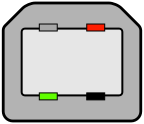
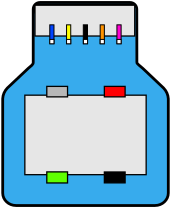
USB-A/B: Connectors 4/8 wires
| Type-A 4-wires | Type-A 8-wires | Type-B 4-wires | Type-B 8-wires |
|---|---|---|---|

USB-C: Connectors 12 wires
Only the USB Type-C connector has enough pins to support two lanes.

- CC1 and CC2 are downstream facing port (DFP) and upstream facing port (UFP) detection. Also used for power negotiation and alt mode switch.
- SBU1 and SBU2 are secondary bus wires, for the DisplayPort AUX channel and hot plug detection (HPD).
Charge rates / Cable types
| Specifications | Max. Voltage | Max. Current | Max. Power |
|---|---|---|---|
| USB 2.0 | 5V | 500mA | 2.5W |
| USB 3.0 / USB3.1 | 5V | 900mA | 4.5W |
| USB Battery Charging (BC) 1.2 | 5V | 1.5A | 7.5W |
| USB-C Current Mode (non-PD) | 5V | 3A | 15W |
| USB-C / Power Delivery (PD 1/2) | 20V | 5A | 100W |
| USB-C PD 3.1 (EPR) | 48V | 5A | 240W |
Specifications
USB 1.0 (Jan, 1996).
USB 1.1 (Sep, 1998).
USB 2.0 (Apr, 2000).
USB 3.0 (Nov, 2008).
USB 3.1 (Jul, 2013).
USB 3.2 (Sep, 2017).
USB 4.0 (Aug, 2019).
References
*