The alluring, musky fragrance of marigolds floats from a Hindu shrine, as a group of men laugh over ginger-infused milk teas served in clay cups called kulhads. In a nearby perfume distillery, a man turns his head towards the laughter as he crushes a batch of discarded kulhads. Here in Kannauj, a town in the north Indian state of Uttar Pradesh, generations of perfumers have used kulhads and other clay materials to capture an enticing scent known as mitti attar.
“It’s the smell of the baked, parched earth when the first rains arrive after a long drought,” says Rajat Mehrotra, co-owner of the family-run Meena Perfumery. Perfumers like Mehrotra, who runs the company with his brother, have been bottling the enigmatic fragrance for centuries.
At his office, some 500 feet away from Meena’s tin-roofed distillery, Mehothra carefully pours the thick mitti attar oil into a glass bottle. “You cannot get mitti attar anywhere else,” he says, resting his eyes on each precious drop—0.26 gallons sell for about 180,000 Indian rupees, around $2,178.
Attars, also spelled ittar, are scented oils made from natural ingredients. The scent profiles in attars vary widely, from fragrances derived from flowers such as Damsak roses and jasmine to heavy, warm scents made from agarwood. Mitti means “earth,” and mitti attar loosely translates to the smell of rain-soaked earth. The fragrance is made only here in Kannauj using a special, centuries-old technique.
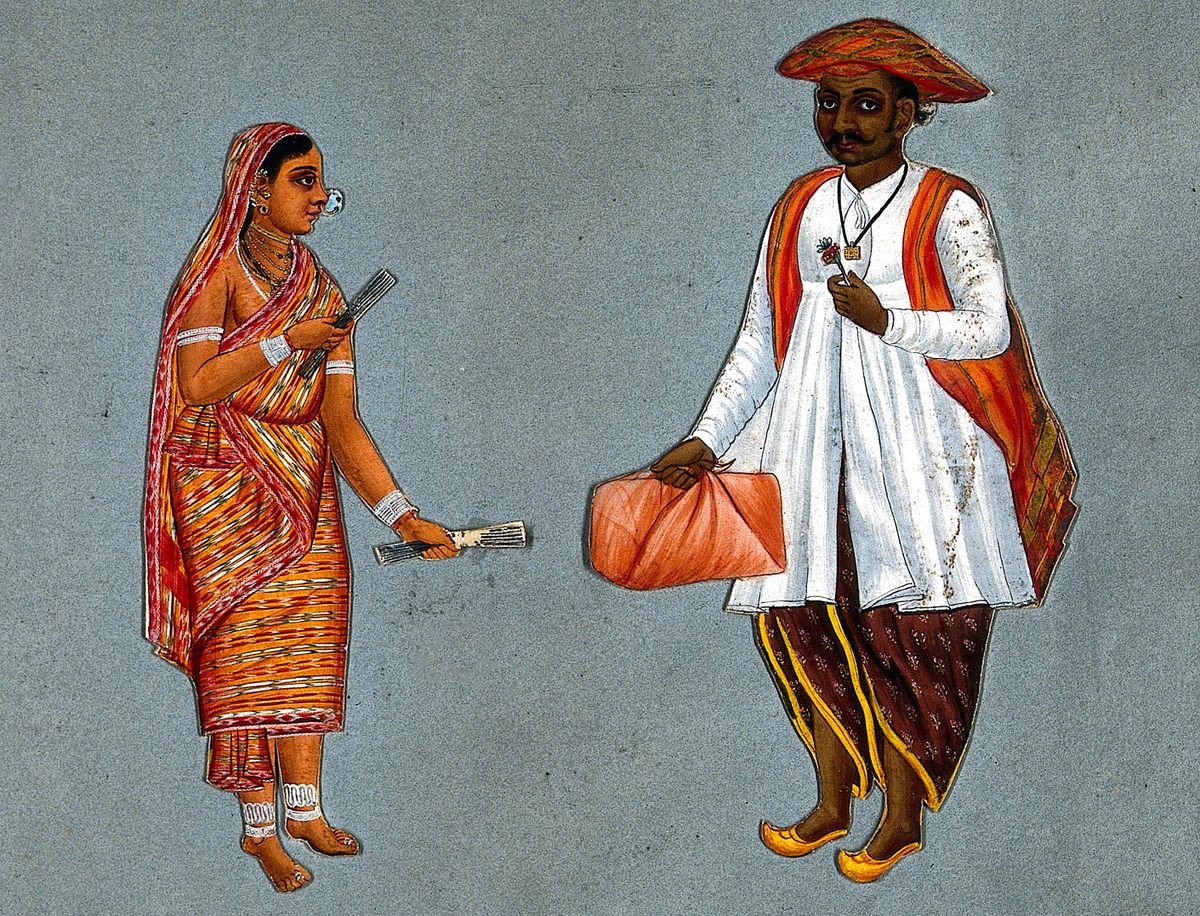
This early 19th-century gouache painting shows a Muslim perfume seller (right) with his wife (left). Public Domain
Despite the scent’s long local history, little is known about mitti attar’s origins, says Giti Datt, a boutique perfume house owner and an anthropologist at the Australian National University who studies attar. Datt says nobody knows when attars were first made or why Kannauj is the epicenter. It’s believed that attar distillation is similar to a distillation method found in the Indus Valley Civilization between 3300 BC to 1300 BC. “If that’s true, the process has survived the fall of civilizations and empires and conquerors,” says Datt.
Ancient Indus people used aromatic waters and plant extracts to create different scents used in medicine and religious rituals; later Vedic Age people continued these practices, wrote historian Jyoti Marwah in the paper, Attars: The Fading Aromatic Cultures of India. The Sanskrit epic Mahabharata—compiled by the end of the 3rd century—also mentions the use of perfume in royal courts. This Indigenous Indian perfume practice later mingled with fragrance traditions of early Muslims who arrived in the subcontinent, says Datt. “So we ended up with a very unique, rich combination of Indo-Islamic perfume culture.”
In the 19th century, the British colonized India and wiped out many Indigenous art forms. “So we are trying to figure out what that meant for attar,” says Datt, who hasn’t found any Kannauj perfumery with pre-British origins. Mehrotra family’s business can only trace its roots to the 20th century. Although there’s little evidence, it’s possible that the British wanted to make attar into a commodity and set up the Kannauj perfume houses, says Datt.
Despite these murky origins, today mitti attar is well-known throughout the Indian subcontinent. Sacred Hindu scriptures such as the Bhagavad Gita reference the earth’s aroma after rainfall. “One can assume that it could be part of the inspiration for why people started bottling this unique smell,” says Datt.

To make different scents, perfume distillers fill large copper vats with aromatics. When making mitti attar, they fill the vats with some 600 pounds of clay. SAJJAD HUSSAIN/ Stringer
Back at the factory, Mehrotra watches as a distiller collects kiln-baked clay discs bought from a local potter and other discarded clay materials, such as kulhads. The perfumer then dumps the clay materials (some 600 pounds of the stuff) into a large copper vat called a deg and pours in some water before closing it.
The distiller then takes a small, long-necked copper vessel, called a bhapka, that’s filled with sandalwood oil—the base of all attars. The bhapka’s opening is fixed to an angled bamboo pipe, which is in turn connected to the clay-filled deg. Once the set-up is complete, the distiller seals any opening with wet multani mitti, a type of clay often used as a skin cleanser. “Now, it’s naturally air-tight,” Mehrotra says, smiling.
Using a mix of wood and sun-dried cow dung, the distiller then lights up a small, carefully-controlled fire beneath the deg. For about seven hours, the clay and water-filled deg simmers over the flames. Mehrotra watches as the distiller splashes water onto the blaze, “because he knew the heat was too much.” If the flames go down, the distiller will add more cow dung to keep the fire hot enough.
When the clay boils inside the heated deg, an aromatic steam builds up and travels through the bamboo pipe and into the oil-filled bhapka. The sandalwood oil inside the bhapka then slowly absorbs the clay-essence of the vapor.
At the end of the day, the distillers separate the water from the sandalwood oil through a small opening. The entire process repeats for at least 10 days until the thick oil is saturated with the heady fragrance of baked clay that mimics the smell of earth after monsoon showers. “You won’t get any smell in one day. It takes at least four or five days to start getting the aroma,” Mehrotra explains.

A worker carefully maintains the flames beneath the aromatic-filled copper vats, using dried cow dung to increase the heat or water to cool the flames. SAJJAD HUSSAIN/Stringer
Once finished, perfumers store the mitti attar in camel-skin flasks, which helps excess water to evaporate and preserves the fragrance. “Attar is like liquor,” Mehrotra laughs. “It ages like fine wine. The older it becomes, the [more] mature and expensive it gets.”
Mehrotra has visitors and buyers from many countries, from Grasse, France, the “perfume capital of the world,” to New Delhi and Mumbai. “People from Grasse come here to see how we make mitti attar. They’ve tried [to make] it but they can’t get the right essence,” he says, showing his WhatsApp chats with French perfumers. Some of Mehrotra’s other buyers mix synthetic materials with attar to create new, unique scents of their own. “Attar is the base. They can’t make those perfumes without it. So anyone who wants natural perfume oil has to come here,” he says.
Distillers in New Delhi once made their own attars to use in paan, an after-meal mouth freshener in India, says Datt. But over the years, paan has fallen in popularity. “So a lot of those distillers stopped and moved into other businesses,” she says.
Despite these industry shifts, Datt says that attar continues to endure and evolve. “I don’t think it’s a dying industry, but certainly a changing one,” she says. “Certain types of markets—like paan—[are] maybe no longer there, but there are new, up-and-coming perfume houses in India that use attar, and we are seeing an increasingly growing switch towards natural oils across the world.”
Mehrotra says there’s more demand for attar than ever before. “If you use chemical perfumes, it’s not good for your body,” he says, “but attar is natural. You can even eat it!” It seems as long as people continue to savor the scent of monsoon rains on dry earth, mitti attar isn’t going anywhere.