Butterflies Are in Dramatic Decline Across North America. A Close Look at the Western Monarch Shows Why
Pesticides, habitat loss and climate change have taken their toll on the beloved insects. But the experts working with them still find hope for their future
/https://tf-cmsv2-smithsonianmag-media.s3.amazonaws.com/accounts/headshot/unnamed-edit.png)
April 24, 2026
:focal(2784x1856:2785x1857)/https://tf-cmsv2-smithsonianmag-media.s3.amazonaws.com/filer_public/f0/cc/f0cccc48-0697-4243-89b0-1e93aa195dc2/dsc_0152.jpg)
Western monarch butterflies bask in the sun on a eucalyptus branch at Lighthouse Field State Beach. In December 2025, researchers placed ultralight radio tags on some monarchs at this site, hoping to track their movements and identify areas to prioritize for the species’ conservation. Darren Orf
On a misty Friday morning in November, with dawn’s last warm hues clinging to the gloomy clouds above, the Pacific Grove Monarch Sanctuary is whisper quiet. Even the persistent roar of the ocean, only a few minutes’ walk from this small copse among single-family homes, is deadened by walls of eucalyptus and Monterey cypress. The tires of approaching cars crunch on a gravel road that slips between two buildings, each adorned with murals of the brilliant monarch butterfly.
In one of those cars is Natalie Johnston, the interpretive programs manager at the Pacific Grove Museum of Natural History. With a pair of binoculars and a clipboard in hand, Johnston, along with a small cadre of volunteers, is canvassing this two-acre sanctuary in search of monarchs.
Every year, the monarch butterfly makes one of the animal kingdom’s most wondrous migrations as millions flutter across the United States to warmer climates. In the east, their destination is the cozy comfort of central Mexico’s oyamel fir forests, but the much smaller western monarch population—mostly separated from its eastern counterparts by the Rocky Mountains—instead makes its way to Pacific Grove and hundreds of similar sites along the California coast.
Because monarchs require the sun’s warmth to fly, cool mornings like this one provide the perfect opportunity to count them before they begin stirring. Peering into the canopy, the volunteers categorize the insects by their behavior, counting “sunners,” “grounders,” “loners” and even a “flier” or two. On her clipboard, Johnston notes the individual trees containing butterflies. Today, a few “loners” are scattered throughout the grove, and only one small collection of 72 is nestled together. The day’s final count: 99.
/https://tf-cmsv2-smithsonianmag-media.s3.amazonaws.com/filer_public/fc/d4/fcd43c90-2e6d-46b2-9ae7-8ef2aa9dca51/dsc_0045.jpg)
Liese Murphree (left), director of education and outreach at the Pacific Grove Museum of Natural History, and Kat Morgan (right), monarch docent, conduct their weekly counts of the monarch butterfly at the Monarch Grove Sanctuary. Darren Orf
In the past few years, Johnston has experienced some emotional highs during these weekly counts, as in 2021, when a single tree hosted thousands of monarchs among its broad branches. But nothing prepared her for what she witnessed one Friday morning in early 2024.
“‘Oh my God, there are so many grounders,’” Johnston remembers saying after spotting some 200 dead or dying monarchs on private property near the grove. “We started counting—one, two, three, four, five—but they’re in these dense piles … spasming, their abdomens curled. … For so many of them to be wiped out in a single event in a place that was supposed to be safe was just horrible.”
Johnston describes that day as one of the worst experiences of her life. Over the next two weeks, staff and volunteers continued to see dying monarchs with the same symptoms, though in smaller numbers. A toxicology report published a year later revealed a cocktail of pesticides in the dead insects’ bodies, including some toxins typically found in residential sprays.
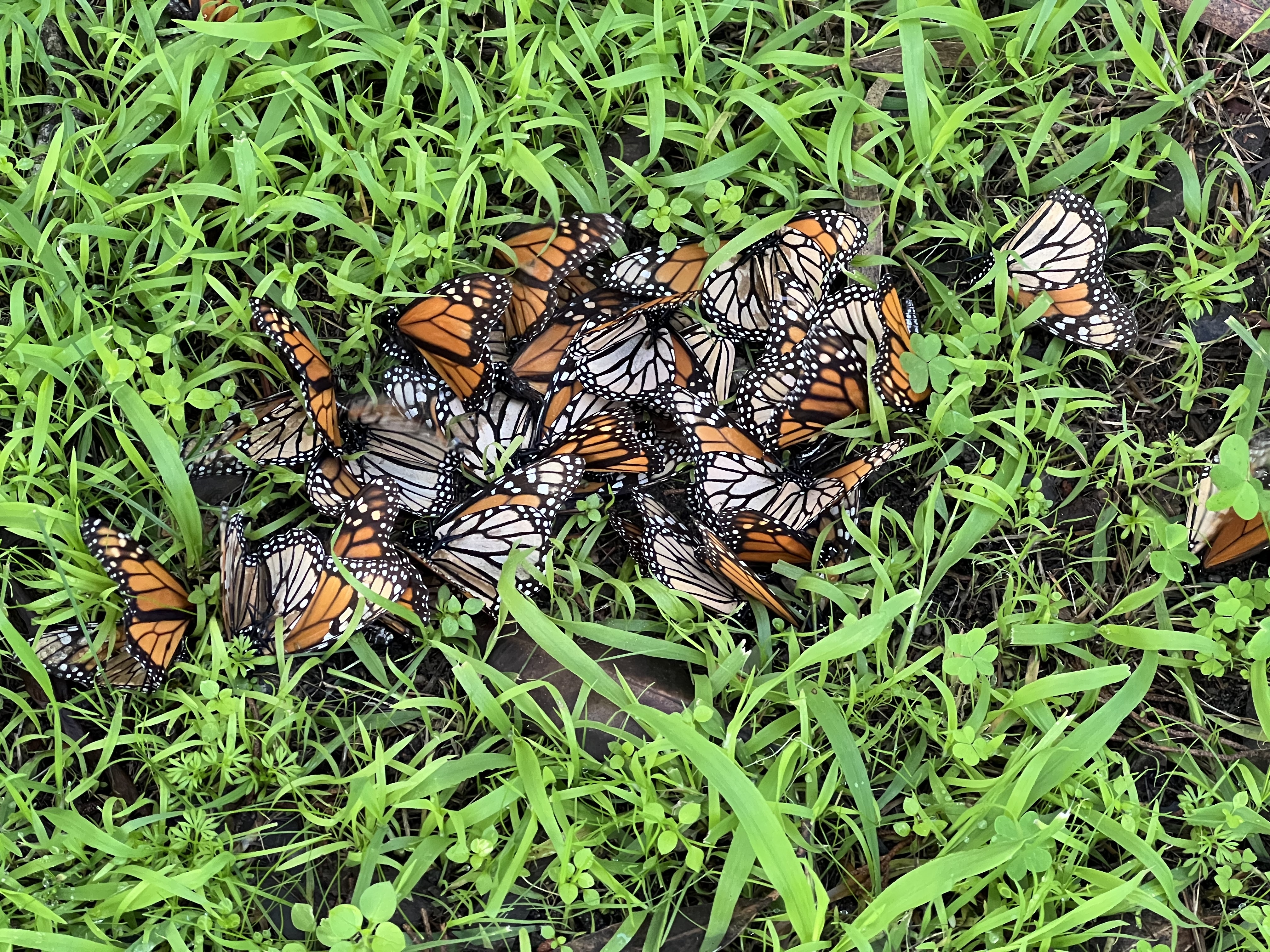
Volunteers found dead and dying monarchs in January 2024. A toxicology report revealed several pesticides in the insects’ bodies. Kat Morgan
This mass casualty is just one highly visible event among many invertebrate dramas that play out every day. Monarchs, as well as hundreds of other butterfly species across the U.S., are struggling to survive against toxic pesticides, habitat loss and a rapidly changing planet. Eastern monarchs face a 56 to 74 percent chance of extinction by 2080, according to the U.S. Fish and Wildlife Service. And western monarchs, during that same period, have a 99 percent chance of vanishing.
Quick fact: A spot of hope
While western monarch counts recently revealed low numbers, the eastern monarch population had some good news in 2026. The amount of habitat occupied by overwintering eastern monarchs increased by 64 percent compared with last year.
Since time immemorial, butterflies like the monarch have been an irreplaceable part of our wild world, but without our help, most of them may soon disappear. That’s why hundreds of scientists, conservationists and volunteers are working together to count and protect this species before it’s too late—because what’s good for the monarch is good for other butterflies as well.
The plight of the butterflies
The monarch is only one of the U.S.’s 750 or so butterfly species, each with its own incredible patterns and idiosyncrasies. The tailed orange, for example, flits about the dry southwest. The West Virginia white calls the moist deciduous forests of the Appalachians home. The natural range of the ruddy copper, with its shocking orange flair, stretches the width and breadth of the western mountain ranges. Although these three species differ in appearance, numbers and geography, they’re all in decline.
/https://tf-cmsv2-smithsonianmag-media.s3.amazonaws.com/filer_public/f9/3c/f93ceadf-190b-4ff4-b1a9-1ff230eab461/9421696417_c1ef9cd4bc_h.jpg)
The ruddy copper butterfly (Lycaena rubidus) Alan Schmierer via Flickr under public domain
/https://tf-cmsv2-smithsonianmag-media.s3.amazonaws.com/filer_public/d0/d5/d0d51c96-1b5a-4634-9bbc-eee0950f60c0/pieris_virginiensis_on_wild_mustard_usa_-_20030504.jpg)
The West Virginia white butterfly (Pieris virginiensis) Rlephoto (Randy L. Emmitt) via Wikimedia Commons under CC BY-SA 3.0

For the first time, scientists illustrated the full extent of this ecological crisis in a study published in the journal Science in March 2025 and in a subsequent State of the Butterflies report from the Xerces Society for Invertebrate Conservation. The report covered 554 species and estimated trends for 342 of them, as insufficient data was available for the others. From 2000 to 2020, researchers found, butterflies declined overall by 22 percent across the country. Although some butterflies saw modest increases during that time, a majority did not—and 24 species declined by 90 percent or more, including the tailed orange, the West Virginia white and the ruddy copper.
“When a bulldozer comes through, or a giant flood from climate change happens, or a drought happens, or even an invasive species moves in—that’s something you can see,” says Scott Black, executive director of the Xerces Society and co-author of the Science study. But pesticides, as demonstrated by the Pacific Grove casualties, are essentially invisible, he adds. “They’re an unseen, massive threat.”
Pesticides in some form or another have been around nearly as long as recorded history: Ancient Sumerians in Mesopotamia used sulfur dusting to control pests and mites around 2500 B.C.E. But after World War II, chemical companies in the U.S. created powerful insecticides like Dichlorodiphenyltrichloroethane, or DDT, to control growing pest populations spurred by the vulnerabilities inherent in raising only one crop, or monoculture farming.
Public backlash against DDT in the 1960s led to new pesticide formulas designed to cause less harm to other living things, including humans, while being orders of magnitude deadlier to insects—sort of like trading in an indiscriminate chemical shotgun for a hyper-focused sniper rifle. Across the pesticide industry, the prevailing mind-set, according to some conservationists, became “spray first and ask questions later”—or maybe don’t ask questions at all.
“The insecticides we’re spraying are more toxic. We’re spraying different kinds that are combining, and we’re spraying more of these chemicals across these landscapes,” Black says. This is why “butterflies and other insects are declining at greater rates in the 2000s than in the past.”
In a study published in September in the journal Environmental Toxicology and Chemistry, the University of Nevada Reno ecologist Matt Forister and his team analyzed 336 individual plants, including milkweeds vital to the monarch’s survival, at urban sites in Albuquerque, New Mexico, and Sacramento, California. They found that only 22 of those plants had no detectable levels of pesticides. On average, the plants contained at least three types of chemicals, and 71 of them contained concentrations of pesticides that are lethal or nearly lethal for butterflies.
/https://tf-cmsv2-smithsonianmag-media.s3.amazonaws.com/filer_public/02/c6/02c6a090-e0b7-4f80-a9fd-beebefc542b7/43185366012_65b1446c9f_k.jpg)
Monarch caterpillars need to eat milkweed to survive, and adult monarch butterflies lay their eggs only on milkweed plants. Jim Hudgins / USFWS
In a similar study in 2022, Forister and his team tested 235 milkweed plants from 33 retail nurseries across the U.S. and detected 61 different pesticides, with an average of 12.2 pesticides per plant. This echoes the findings of a 2020 study in which Forister tested milkweed plants across 19 sites in California’s Central Valley and two stores that sell plants to home gardeners—pesticides were found in all 227 samples.
“We couldn’t find a milkweed leaf in the north Central Valley that didn’t have pesticides in it or on it,” says Forister. The 2020 study counted 64 different insecticides, herbicides and fungicides in total. “Of this very long list, only a small number have ever been tested on a monarch caterpillar—and that’s just the monarch,” Forister adds. “When you think about the more than 150 other butterflies in the state, we know almost nothing.”
Black describes the butterfly’s plight as a “death by a thousand cuts” scenario. While pesticides ravage the insect’s populations, habitat destruction and exacerbated droughts due to climate change only make things worse. According to Forister, however, even small changes can turn things around. And although progress against habitat loss and climate change will take time, pesticide use could, theoretically, be curbed much sooner.
“Insects are just amazing at responding very quickly to anything good that people do,” he says. “If people stop putting insecticides in their yards, they’ll see more insects. … Even in the heart of the Central Valley, we continue to be surprised by the level of resilience.”
A roadmap to recovery
/https://tf-cmsv2-smithsonianmag-media.s3.amazonaws.com/filer_public/34/f4/34f434f7-6812-4d69-a9b8-d8594fbb8b32/dsc_0080.jpg)
Two monarch butterflies warm their wings in the early morning at Lighthouse Field State Beach. Only 12,260 monarchs were counted during the 2025-26 season at 249 overwintering sites like this one. Darren Orf
About a 60-minute drive from Pacific Grove is Lighthouse Field State Beach in Santa Cruz. Behind the eponymous lighthouse that juts out into Monterey Bay, a stand of stalwart Monterey cypress protects monarchs nesting at the park’s north end. The gray skies are gone, burned away by the surprisingly brilliant November sun overhead, and with that warmth, the blazing orange wings of the monarchs come to life as hundreds flutter from one tree to another.
Crowds gather to take in these bright jewels. Some people are in awe; others express dismay at how few monarchs have survived their arduous fall migrations from the northwestern U.S. While 2021 saw thousands of butterflies visit Lighthouse Field, and hundreds of thousands more at nearly 300 overwintering sites, the 2025-26 season tallied near-record lows, with only 12,260 butterflies total across 249 sites—the third-lowest figure since counting began in 1997.
“It’s not uncommon for insect populations to go up and down by orders of magnitude,” says Cheryl Schultz, an ecologist at Washington State University Vancouver and the senior author of the Science paper. “What we want to do is increase the floor so they don’t go extinct.”
The problems facing butterflies seem almost insurmountable, but Schultz knows that the insects’ disappearance doesn’t need to be a foregone conclusion. That’s because she led the charge of saving one species from the brink of extinction.
/https://tf-cmsv2-smithsonianmag-media.s3.amazonaws.com/filer_public/48/f0/48f0cbec-7d17-4ef5-b71c-827eddecc519/7013965633_8c9bb14dfe_z.jpg)
The Fender’s blue butterfly was brought back from the brink of extinction with the help of conservationists who restored habitats with its host plant, Kincaid’s lupine. USFWS
In Oregon’s Willamette Valley lives the Fender’s blue, a small butterfly that relies on a flowering plant called Kincaid’s lupine for survival. First documented in the 1920s, the butterfly disappeared in the ’30s and was presumed extinct due to destruction of its beloved lupine. Then, miraculously, scientists rediscovered the butterfly near Eugene, Oregon, in the late 1980s. Though it had managed to evade extinction, the species remained perilously endangered. So Schultz began extensive fieldwork to restore its habitat in the Willamette Valley’s upland prairies.
Her team learned what the butterflies needed from their habitat, then helped establish some 90 sites that host the Fender’s blue—they found the locations, planted lupine and protected them. The species became a rare success story among insects by getting downlisted from “endangered” to “threatened” under the Endangered Species Act. “I’m a person who’s always focused on the positive and what we can do,” Schultz says. “That little butterfly took a few decades, and it took a lot of people and a lot of commitment, but it can happen. I have to hold on to that.”
The monarch and Fender’s blue share many characteristics. They both require specific plants, for example, and like most butterfly populations, their numbers are bouncy. However, monarchs are migratory, while the Fender’s blue sticks to Oregon year-round. Migrating creatures bring their own challenges for conservation, as scientists need to spread their attention across a broad landscape—but in some ways, the monarch isn’t even the most difficult migratory species to conserve. The west coast lady, for instance, is found in across the western states and faces upwards of 80 percent declines in many regions.
“It’s a dispersive, large, super-beautiful butterfly, and no one expected it to be in decline 20 years ago. But it’s just plummeting everywhere,” Forister says. “It’s not going to be an easy solution for conservation, because for this particular butterfly, it is not easy to put our finger on a place where we can set up a fence around habitat to restore.”
According to Forister, the west coast lady and the western monarch are examples of traditional conservation biology meeting the headwinds of climate change. Although the methods used to restore the Fender’s blue could work for many butterflies, dispersive and migratory species face the brunt of our warming world, especially because of the immense drying out of the Western U.S., which affects their specific host plants and increases the chances of extreme weather events.
To better understand the stresses on these migratory species, scientists at Lighthouse Field are testing a new ultralight radio tag. Weighing less than a tenth of a gram, these tags, when placed on butterflies, can passively ping Bluetooth- and location-enabled cellphones of anyone nearby. The data is stored in an app called Project Monarch, which allows scientists to accurately track where female monarchs lay their eggs after overwintering.
The hope is that by tracking the butterflies, researchers will find where female monarchs are headed after they leave sites like Pacific Grove and Lighthouse Field. Then, conservationists could employ the tried-and-true methods that saved the Fender’s blue—prioritizing those sites and providing milkweed habitat for future caterpillars.
To build climate resilience into those new habitats, Diana Magor, a longtime volunteer monarch counter, is conducting her own research into the butterfly benefits of heartleaf milkweed. Although not as abundant as the showy or common milkweed, this variety grows earlier in the year. This is a particularly useful attribute, because as climate change causes warmer weather to arrive earlier, butterflies might migrate before common or showy milkweed has sprouted.
“When we restore these habitats and manage pesticides, we see change—positive change,” Black says. “The diversity and abundance of insects goes up, and that happens really quickly.”
Farms could curtail pesticides, smarter land use could protect wild spaces and cutting carbon emissions could help the world avoid the worst-case climate scenarios. But despite conservationists’ best efforts, many butterfly species will still be lost. Looking ahead, Forister hopes, at the very least, that they won’t be forgotten.
“I started a new scientific journal recording the loss of species,” he says. “It makes me feel better, because we’re at least preserving a memory of things as they’re going away and highlighting rare species that we can still look for.”
Hope for a possible future
/https://tf-cmsv2-smithsonianmag-media.s3.amazonaws.com/filer_public/ab/2c/ab2c96a2-4f22-47b8-8cfe-6a052ea36b6e/dsc_0200.jpg)
Western monarch butterflies cling to a eucalyptus branch at Natural Bridges State Beach. Although eucalyptus isn’t native to California, the trees provide a tall, wind-resistant refuge that supports monarchs during the winter. Darren Orf
The sun’s light is already weakening as visitors to Natural Bridges State Beach in Santa Cruz, only a few miles north of Lighthouse Field, descend a long boardwalk terminating at a large, wooden platform. A small group glances skyward in awed silence as, high in the canopies, hundreds of monarchs fly from tree to tree, moving like gently falling leaves that defy the inexorable laws of gravity.
Just a few decades ago, at least 120,000 monarchs overwintered here—in 2025, Natural Bridges saw only 2,500 at its highest count. Yet, faced with these overwhelming odds, these delicate insects metamorphose each year from caterpillars into an indelible symbol of resilience. For people like Johnston, Black, Forister, Magor and Schultz—and the hundreds of others who give their time and talent to protect these vulnerable creatures—seeing the monarchs brings hope.
“There are a lot of people waking up and trying to do this,” Black says. “Will it be enough at the end of the day? … I don’t know yet.” But “I go out and I look at these places and meet the people doing this great work, and it keeps me motivated.”
You Might Also Like
February 1, 2024
July 28, 2021
April 21, 2021
July 22, 2022
January 22, 2015
More about: