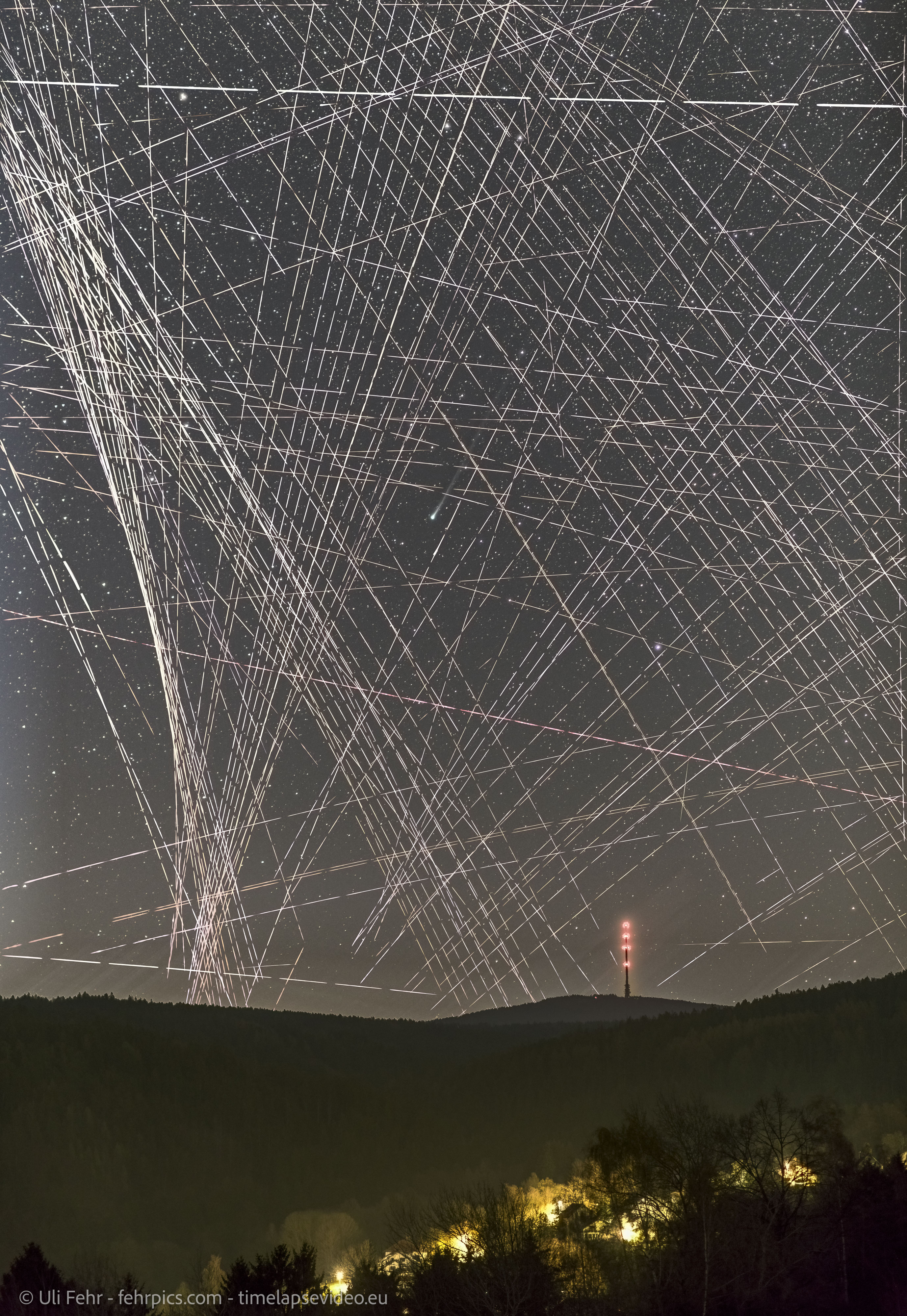
Their obvious dual-use nature makes them tempting, and a military target if a large conflict will take place in the near future. I hope their lower orbit will help any space junk burn up fast.
The situation is one order of magnitude worst in radio-astronomy.
It is fair to state that satellite constellations will certainly be the main obstacle to multiple major scientific discoveries in the next decade.
[0] https://doi.org/10.1109/AERO50100.2021.9438165
[1] https://en.wikipedia.org/wiki/Lunar_Crater_Radio_Telescope
There are some classes of observatories, which you cannot build in space but which are still affected by satellites to some degree.
However, it has serious disadvantages. It will exclude the poorer from astronomical research, except within the limits enabled by whatever cooperation the richer will be willing to do with them.
For the richer, that will make astronomical research much more expensive. When even USA, who claims to be the richest country, cuts a lot of the scientific funding, this makes likely a great reduction in the research targets that could be accomplished, even if a Lunar array of telescopes and radiotelescopes and communication relays for them were approved.
While professionals might still be able to do some work, the amateurs will be able less and less to enjoy the sight of the distant Universe.
There are already many years since I have become unable to see the sky that I enjoyed looking at when young, because it cannot be seen from the city where I live, due to light pollution (and high buildings). To see it again, I would have to go somewhere up in the mountains, far from a city or village, but I have not succeeded to do this recently. Even there now you can hardly look at the sky without seeing satellites, and it will only become much worse.
Nowadays there are many children who have never seen even once the sky that our ancestors were seeing every night, so many passages from old texts that mention the sky are unintelligible for them.
Do you really think a starlink style installation won't be put in orbit of the moon before such a telescope could be funded?
The limiting factor of passive optical telescopes on earth is the atmosphere.
A small telescope is just a small telescope even when you put it in space.
There are ITUs rules that forbid that and the far side of the moon is declared as radio quiet.
What about Hubble, Chandra, Spitzer, JWST, etc? As of my understanding, the only reason we haven't built radio and and other long-wave telescopes in space is because of their impractical size preventing them from being deployed in orbit.
> There are some classes of observatories, which you cannot build in space but which are still affected by satellites to some degree.
Examples?
https://commons.wikimedia.org/wiki/File:Atmospheric_electrom...
This shows that wavelengths between ~10cm and ~10m are largely unaffected by the atmosphere, so you wouldn't gain much from putting receivers of those wavelengths in space. Spitzer and JWST (IR), and Chandra (x-ray) operate in bands that are generally blocked by the atmosphere, and Hubble gets better images than a similarly sized earth-based telescope because of the atmospheric distortion (stars don't "twinkle" when you're in space), however there are still earth-based visible light telescopes because you can more easily build a massive one on earth than in space
Discover the cosmos! Each day a different image or photograph of our fascinating universe is featured, along with a brief explanation written by a professional astronomer.
Comet R3 PanSTARRS Behind Satellite Trails
Image Credit & Copyright: Uli Fehr
Explanation: Can you find the comet? Somewhere through this web of satellite trails is Comet C/2025 R3 (PanSTARRS), a bright visitor passing through the inner Solar System. Now, the orbiting satellites themselves only appear as streaks because of the long camera exposure, over 10 minutes in this case. On the contrary, to the eye, satellites appear as points that drift slowly across the night sky and shine by reflecting sunlight -- primarily just after sunset and before sunrise. The featured image was taken just before sunrise two weeks ago from Bavaria, Germany. Presently, Comet R3 PanSTARRS is hard to see for even another reason -- because it is so (angularly) close to the Sun. As the comet rounds the Sun, it will be best seen in coming weeks from southern hemispheree skies, although then it will be heading out to interstellar space and fading. If you haven't yet found the comet, don't despair; please take a closer look just above the image center.
Tomorrow's picture: cometary mountains
< | Archive | Submissions | Index | Search | Calendar | RSS | Education | About APOD | Discuss | >
Authors & editors: Robert Nemiroff (MTU) & Jerry Bonnell (UMCP)
NASA Official: Amber Straughn Specific rights apply.
NASA Web Privacy, Accessibility, Notices;
A service of: ASD at NASA / GSFC,
NASA Science Activation
& Michigan Tech. U.