There is still an entire Medieval European world out there in the archives still waiting to be discovered. Sadly, there are not many of us who have the skills to do this and we are not paid very well or often not at all.
"Now we must praise the protector of the heavenly kingdom the might of the measurer and his mind’s purpose, the work of the father of glory, as he for each of his wonders, the eternal Lord, established a beginning. He shaped first for the sons of the earth heaven as a roof, the holy maker; then the middle-world, mankind’s guardian, the eternal Lord, made afterwards, solid ground for men, the almighty Lord."
via https://imagejournal.org/article/caedmons-hymn-the-first-eng...
Now let us praise Heaven-Kingdom's guardian, the Maker's might and his mind's thoughts, the work of the glory-father—of every wonder, eternal Lord. He established a beginning. He first shaped for men's sons Heaven as a roof, the holy Creator; then middle-earth mankind's guardian, eternal Lord, afterwards prepared the earth for men, the Lord almighty.
Nu scilun herga hefenricæs uard
metudæs mehti and his modgithanc
uerc uuldurfadur sue he uundra gihuæs
eci dryctin or astelidæ.
he ærist scop ældu barnum
hefen to hrofæ halig sceppend
tha middingard moncynnæs uard
eci dryctin æfter tiadæ
firum foldu frea allmehtig
I couldn't make hide nor hair of it without the translation, but with the translation I see quite a few more words than just "and his" that have stayed around: hefen: heaven
uerc: work
uard: guard/ward
hrofæ: roof
æfter: after
middingard: Earth, to Marvel
allmehtig: almightyhttps://colingorrie.com/books/osweald-bera/
Basically it’s a full blown story/graded reader with no modern English apart from vocabulary. You build an understanding of the language as you read the book and what is initially gibberish becomes quite clear as you progress . It does help if you’ve had a lot of exposure to German ( vocab and grammar), or barring this any case inflected language.
What’s noticeable is that it’s about 200 pages long, so the story gets quite sophisticated , and rather unexpectedly the book is a bit of a page-turner !
Actually, here is the full text with the modern English inserted:
Nu scilun herga hefenricæs uard
Now let us praise Heaven-Kingdom's guardian,
metudæs mehti and his modgithanc
the Maker's might and his mind's thoughts,
uerc uuldurfadur sue he uundra gihuæs
the work of the glory-father—of every wonder,
eci dryctin or astelidæ.
eternal Lord. He established a beginning.
he ærist scop ældu barnum
He first shaped for men's sons
hefen to hrofæ halig sceppend
Heaven as a roof, the holy Creator;
tha middingard moncynnæs uard
then middle-earth mankind's guardian,
eci dryctin æfter tiadæ
eternal Lord, afterwards prepared
firum foldu frea allmehtig
the earth for men, the Lord almighty.Also worth pointing out that the Old English version at each of those dates probably varied quite a bit. This was the time period over which Old English was being influenced by external factors such as Norse and Latin.
So you can write it down to tech brainrot.
The sign above the door at the primary school outside Karlstejn Castle is unreadable to a speaker of modern Czech.
School website: https://www.skolakarlstejn.cz/
Better pics can be found easily.
It's quite rare for a language to remain close enough to be intelligible.
English is a mongrel, with influences from old French and ancient Saxon and Norse and Celtic. Every few centuries you go back, you strip away whole layers of additional vocabulary left by the descendants of successive invasions.
https://librivox.org/caedmons-hymn/
The text is read in the Early West Saxon dialect. Same version found here (incl. OGG Vorbis format):
https://gutenberg.org/ebooks/19677
Nu scilun herga hefenricæs uard
metudæs mehti and his modgithanc
uerc uuldurfadur sue he uundra gihuæs
eci dryctin or astelidæ.
he ærist scop ældu barnum
hefen to hrofæ halig sceppend
tha middingard moncynnæs uard
eci dryctin æfter tiadæ
firum foldu frea allmehtig
"Caedmon's Hymn"Reading Old English as a Scandinavian is always interesting, because if you squint hard enough, you can easily see how the languages are so deeply related. So many modern Scandinavian words have what seem to be lost cognates in Old English, and I suppose vice versa.
That said, I wish translations into contemporary English went further to preserve the etymology of certain words and the grammatical structure of the poem, even if it would make for a much more awkward text. For example, this text translates "middangeard" as "middle-world", which is correct, but it is cognate with "Midgård", which is the Norse mythological name for Earth. (In Scandinavian translations of J.R.R. Tolkien, "Middle Earth" is translated as "Midgård".) I think this lets us understand more about how writers of Old English understood the world, and how it was connected to the broader mythological landscape in North/Western Europe around this time, how Christian and Pagan belief systems were interacting through language as the region was in the process of christianization.
Edit: "The newly-discovered manuscript in the National Central Library of Rome of Caedmon’s Hymn dates from between the years 800 and 830, making it the third oldest surviving text of the poem." So... 1.2k then?
https://tolkiengateway.net/wiki/Guide_to_the_Names_in_The_Lo...
that this was in _A Tolkien Compass_ which was one of the first books I purchased w/ my own money (along w/ _A Tolkien Reader_) is arguably a big part of why I chose to study languages early on in my life.
And of course, English develops organically (unlike, say, French), allowing new words to emerge, and for old words to take on new meanings. I love it.
As an Englishman, I always find it interesting that there is this weird defined notion of "Englishness" in language, culture, whatever, when our entire history is one of mashing and remixing ideas over at least 2,000 years, and recent discoveries at Stonehenge push that back potentially by 3,000-5,000 years more.
I particularly like the irony of the far-right going on about English identity on a march in London before going to have a lager and chicken tikka masala before heading home to a bungalow and putting on their pyjamas... :)
I think the Scandinavian roots you talk about trace back to common Germanic roots perhaps, but also the Viking aspect will influence a lot. I think English has been "dipped into" by those roots a few times in history, as has Latin.
On the need to keep the etymology aligned in translation: I think this is a routine challenge of the translator's skill, and why so many people have different views of different translations of the same texts.
The Bible could easily be translated in many different ways, but the "King James" version is considered the standard within the Anglican churches in the UK (and seems to be the common root for US church bibles too), but a more modern translation would be possible, as would one that has a closer etymological meaning to the original sources.
It's all interpretative. If people are building entire belief systems and ways of life (and arguably, laws for society), around a translation, and getting it off in a few places, it's likely we're going to run into the same problems even more when translating Tolkien or an ancient poem...
This is how the Icelandic sagas were translated into English in the nineteenth century. Translators then almost always chose the English cognate of the Old Norse world, even if that English cognate was obsolete or its meaning had changed. Far from helping immerse readers in the medieval world, the effect (at least for modern sensibilities) is offputting and goofy, and in the twentieth century publishers like Penguin replaced those translations by new ones with a very different approach. More judicious use of the Germanic lexicon in English, à la Tolkien, provides a more appealing atmosphere of olden times.
It is a very great thing that so many peoples now speak languages with clear common roots buried behind the deviations of use; and outmost interesting to recognize the plan and the deep thought in those radixes.
Lithuanian and Celtic had no direct contact with each other AFAIK, although Celtic was in contact with Vasconic, Romance, Germanic and Slavic... And Lithuanian was in contact with Slavic and Germanic, maybe Finno-Ugric...
Obviously numbers...
Sniegas - Sneachd — Snow
In — An(n) — In
Najas — Nuadh — New
Marios — Muir (genitive mara) — Sea
Srūti (to flow) — Sruth (stream)
Mirti (to die) — Murt/mort (murder)
klausytis (to hear) – cluas (ear), cluinntinn (listen)
sekla — sìol — seed
Senas — Sean — Old
Vyras - Fear (plural Fir)- Man (wer(e))
Dantas (tooth) - Deudag (toothache)
Ugnis (fire) — Aigeann (fireplace)
Raudonas — Ruadh — Red
Dienas (day) — Di- (day in day names) – Day
Pilnas — Làn — Full
Kaire — Ceàrr — Left
Dešinė — Deas — Right
It would be a gargantuan effort just alone to devise a language that would unify historic language origins roots in a contemporary time. The objective would be to stop the death and eradication of languages, e.g., Welsh, German, or any of the numerous other smaller languages and dialects that are all under varying states and types of endangerment or extinction risk, but also prevent an ignoble, unstable, and inadequate language like contemporary English from dominating the whole world.
Tolkien's "Middle-Earth" is a "folksy mistranslation"
Closer translation-- "Mid-Yard"
Old English word eardgeard =Earth-Yard
/ ˈæ͜ɑrdˌjæ͜ɑrd / "ardyard" /
https://english.nsms.ox.ac.uk/oecoursepack/wanderer/notes/no...
In the center, humans inhabit Midtgård. The gods in Valhall and the Jotun in Jotunheim.
Then there's also Helheim or Hel - for the dead, Alfheim for the elves, Svartalfheim for the dwarves...
https://commons.wikimedia.org/wiki/Category:Locations_in_Nor...
Stewart Lee had a good bit about this:
> [..] > ‘Bloody Beaker folk. Coming over here, rowing up the Tagus Estuary from the Iberian Peninsula in improvised rafts. Coming here with their drinking vessels. What's wrong with just cupping up the water in your hands and licking it up like a cat?’
Racism always tends towards the silly, of course, but British ethnic nationalism particularly so, given the history. What’s ’British’, anyway?
- Vanaheim, home of the Vanir, a group of gods associated with fertility.
- Asgård, home of the Aesir, the big-name gods (Thor, Odin, Freya, etc.).
- Jötunheim, home of the Giants.
- Alfheim, home of the elves.
- Helheim, the underworld ("Hell").
- Svartalfheim / Nidavellir, home of the dwarves.
- Midgård, home of the humans.
- Muspelheim, home of fire elementals.
- Niflheim, world of mists.
(This is the commonly accepted list, but it's always worth mentioning that surviving literary sources of Norse mythology are very scarce. Much of the lore was reconstructed in the 19th century.)
My understanding is that Old English vocabulary mostly predates Viking invasion, but even then the colonizers would have a large shared vocabulary with (non-Celtic) British natives, who would be the descendants of Anglo-Saxon settlers a couple of centuries earlier.
I don't find this to be true. Even at high mass ('bells & smells' type communion) you get more modern versions. To my recollection NIV would be most common. Obviously not a representative survey. Also, it might be at traditional/formal services you get [N]KJV as I've been to less of those.
Amongst very old people you see strong support for KJV because that's what they learnt 70 years ago. It sounds very archaic to modern ears. I'd say KJV hasn't been favoured this side of the millennium.
Just my impression.
Latin influences English as a learned tongue, used by clerics and academics. Other than that most of it comes via French, when the Normans brought it.
Oh my. I find the reverse. It's spooky and enchanting because once I know all the cognates I feel like I can magically understand the original.
[1] https://en.wiktionary.org/wiki/%D9%85%D8%B1%D8%B3%DB%8C#Pers...
NIV is the preferred translation for the low-church side, the evangelicals, so definitely won't be used by the bells-and-smells high church crowd. KJV is preferred by a niche who also prefers the Book of Common Prayer liturgy over Common Worship. Usually this is either an older population, a certain ethnic subgroup with calcified traditions, or old-school low church folks (so not modern evangelicals) who prefer the old ways and even the Thirty-Nine Articles.
Recent research, namely an article by Lars Nooij & Peter Schrijver [0], suggests that a population speaking Latin/Romance may have remained present in Britain until the late first millennium. Granted, the effect of this local Latin would have been on Welsh more than English.
There are loads.
https://en.wikipedia.org/wiki/List_of_Japanese_words_of_Port...
https://muyinteresante.okdiario.com/historia/60526.html
Well, let's see:
Perro, guerra, mes, pagar, ver, fuego, tierra, cima, perro, clero, altar, tribunal, rey... lots more. Tapa, dardo, ganso, ropa, guardia, sala, cama, barro, guijarro, zarza... more than anyone would think. Aspa, espía, brotar... and the -engo suffix. Visicothic and Celtic cultures are more ingrained in the North/Middle of Spain more than anyone would think despite everyone pictured it as a 100% Mediterranean culture.
Rico/rich, fresco/fresh, Blanco/blank... is not a coincidence.
Heck, tons of Medieval lore in the Castilles use a Gothic typeface...
Posted on: 30 April 2026
Old fashioned sleuthing and the help of modern technology leads to discovery of manuscript with poem composed by a farm labourer 1,300 years ago
An early 9th century manuscript containing a text of the first known poem in the English language has been discovered in Rome by researchers from Trinity College Dublin.
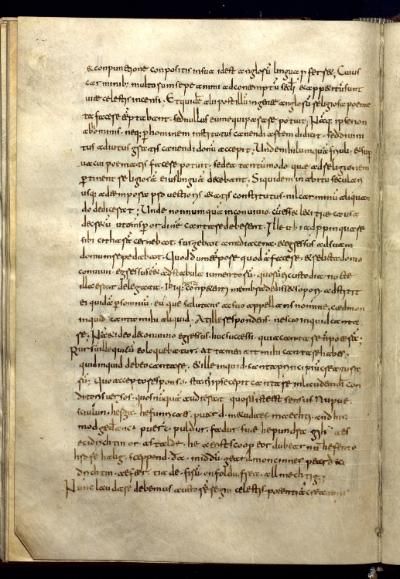
The newly-discovered manuscript in the National Central Library of Rome of Caedmon’s Hymn dates from between the years 800 and 830, making it the third oldest surviving text of the poem.
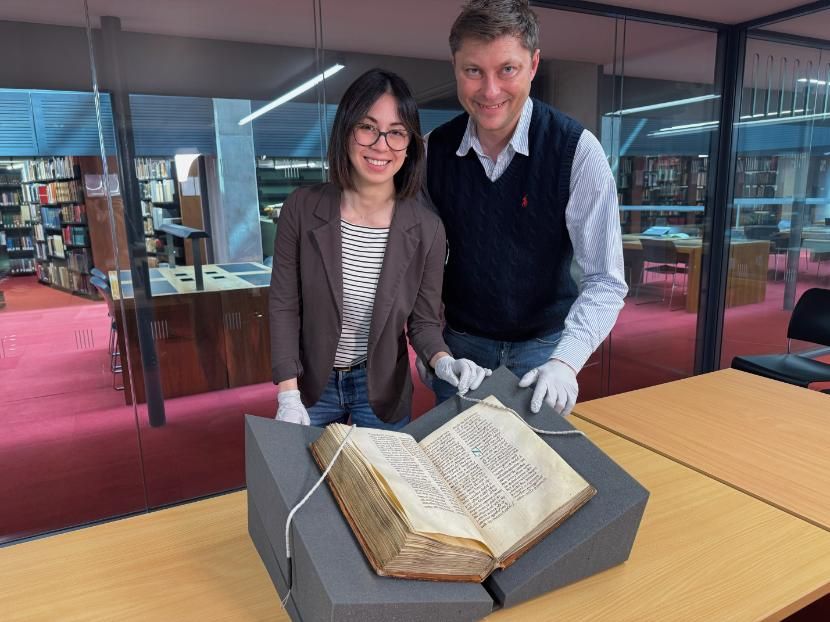
Dr Elisabetta Magnanti and Dr Mark Faulkner with the Trinity copy of Bede's Ecclesiastical History in the Library of Trinity College Dublin.
The discovery is highly significant because the Latin manuscript contains the poem in Old English in the main body of the text. The two older copies in Cambridge and St Petersburg have the poem in Latin, with the Old English text only added in the margin or at end.
The inclusion of the poem in Old English in the Rome manuscript indicates how Old English poetry was valued by Bede’s readers, according to researchers from Trinity’s School of English.
Written over 1,300 years ago Caedmon’s Hymn is a nine-line poem praising God for the creation of the world. It is said to have been composed by a cowherd from Whitby, North Yorkshire, after a divine visitation.
The poem was composed in Old English – the form of English used in the early Middle Ages. It survives today thanks to its inclusion in some copies of the Ecclesiastical History of the English People, an 8th century history of England written in Latin by the Venerable Bede, a northern English monk.
The manuscript was discovered by Dr Elisabetta Magnanti and Dr Mark Faulkner, School of English, both experts in medieval manuscripts. Details of their discovery have been published by Cambridge University Press in the open-access journal Early Medieval England and its Neighbours.
Dr Elisabetta Magnanti explained: “I came across conflicting references to Bede's History in Rome, some pointing to its existence and some indicating it was lost. When its existence was confirmed by the library and the manuscript was digitised for us, we were extremely excited to find that the manuscript contained the Old English version of Caedmon’s Hymn and that it was embedded in the Latin text.
“The magic of digitisation has allowed two researchers in Ireland to recognise the significance of a manuscript now in Rome, containing a poem miraculously composed in Northern England by a shy cowherd a millennium and a half ago. This discovery is a testament to the power of libraries to facilitate new research by digitising their collections and making them freely available online.”
Why is this important?
Dr Mark Faulkner said: “About three million words of Old English survive in total, but the vast majority of texts come from the tenth and eleventh centuries. Caedmon’s Hymn is almost unique as a survival from the seventh century – it connects us to the earliest stages of written English. As the oldest known poem in Old English it is today celebrated as the beginning of English literature.
“Unearthing a new early medieval copy of the poem has significant implications for our understanding of Old English and how it was valued. Bede chose not include the original Old English poem in his History, but to translate it into Latin. This manuscript shows that the original Old English poem was reinserted into the Latin within 100 years of Bede finishing his History. It is a sign of how much early readers valued English poetry.”
Torrid history and complex ownership
The newly-discovered manuscript of Bede’s History is one of at least 160 surviving copies. This manuscript was produced at the Abbey of Nonantola in Northern Central Italy between 800 and 830 and is now in the National Central Library in Rome. Its rediscovery sheds new light on the cultural connections between England and Italy in this period.
According to the researchers it has endured a torrid history – stolen from the church of San Bernardo alle Terme in Rome, where with other manuscripts it had been sent for safekeeping amid the Napoleonic Wars in the 1810s. Then it changed hands privately a number of times before being acquired by the National Central Library of Rome.
Its complex ownership history meant that the manuscript had been regarded as lost by Bede scholars since 1975 and no one realised it contained a copy of Caedmon’s Hymn until the National Central Library of Rome digitised the manuscript.
Valentina Longo, Curator of Mediaeval and Modern Manuscripts at the National Central Library of Rome, said: “Today, the National Central Library of Rome holds the largest collection of early medieval codices from the benedictine abbey of Nonantola. This collection comprises 45 manuscripts dating from the sixth to the twelfth century, divided between the original Sessoriana collection and the Vittorio Emanuele collection, where the manuscripts recovered following their dispersal due to the 19th-century theft have been housed. The whole Nonantolan collection has been fully digitised and is accessible through the library’s website.”
Andrea Cappa, Head of Manuscripts and Rare Books Reading Room, **National Central Library of Rome,**added: "The Central National Library of Rome continually expands its digital collections, providing free access to its resources. The library has already made available digital copies of around 500 manuscripts, and is also completing a major project to digitise the holdings of the National Centre for the Study of the Manuscript, which includes microfilm reproductions of approximately 110,000 manuscripts from 180 Italian libraries. This initiative will give scholars and researchers access to more than 40 million images."
Composed following a divine visitation
The Hymn is said to have been composed by Caedmon, an agricultural labourer working at Whitby Abbey in North Yorkshire, who was at a feast when guests began to recite poems. Embarrassed that he didn’t know anything suitable, Caedmon left the feast and went to bed. A figure then appeared to him in his dreams, telling him to sing about Creation, which Caedmon miraculously did, producing his Hymn, nine lines of intricately-woven poetry praising God for creating the world. Read the poem here in English and here in Old English.
Continued research
“Interest in the Abbey of Nonantola has once again been stirred by this ancient copy of Caedmon’s Hymn and the history of the manuscript in which it is preserved,” said Canon Dr. Riccardo Fangarezzi, Head of the Abbey Archive in Nonantola, Italy, where the manuscript was produced.
“This newly identified gem of British cultural heritage now joins the small Anglo-Nonantolan cultural treasury constituted by manuscripts listed in early catalogues and reconstructed in more recent scholarship, from the source of the Old English poem Soul and Body, preserved in the Nonantolan manuscript Sess. 52, to the diplomatic missions of our abbot Niccolò Pucciarelli to King Richard II, to mention only the most well-known examples.
“We look forward to further results arising from the dissemination of these valuable studies and from continued research. The present times may be rather dark, yet such intellectual contributions are genuine rays of sunlight: the Continent is less isolated.”
** Photo Credit: Rome, National Central Library, MS. Vitt. Em. 1452, f. 122v.