
Photo by Defrino Maasy / Unsplash
My fourth month of unemployment. I'm fresh off an interview with a senior technical role advertised with a decent compensation range whose upper end would let me make median rent, and whose lower range would not. At the end of an excellent interview, I am informed that said compensation range, contrary to the Base Compensation tag in the job description, is in fact all inclusive, and that the role actually tops out below the living wage threshold for a three adult household for its base compensation.
I feel it's highly relevant to note that this was a role where I would own the entire technology estate for an employer. Every switch, every firewall, every database, every server, every phone, every laptop, every cloud, every badge system. All data, everywhere, at any time.
Everything.
For an employer in the public safety industry.

Seriously, this is a company first responders rely on for tech, and they want to pay below subsistence wages to senior technical people!
This is not the first time that compensation has been mismatched to the role, but it is the first time it's happened with a role so critically important to a company playing such an outsized role in as critical an area as public safety.
Which got me thinking: have employers just lost the plot on what compensation is actually for? What its intended function is? Because it seems to me that everyone thinks compensation is merely payment for labor and nothing more, a number to be driven down by any means necessary in order to keep more for those at the top.
And oh my god it is so much more than that.
We live in a society. This society has been arranged around using currency to purchase necessities, because some people decided that necessities are not guaranteed. You acquire currency by either investing currency you already have to compound it through the labor of others, or you labor in order to earn less currency than investors do.
Is that a gross oversimplification? You betcha, but I'm really trying to stay on topic and not fill this with reaction GIFs.
Author's Note: I failed.
Anyway, everyone needs currency to afford everything. Rent costs currency, food costs currency, electricity costs currency, water and sewage and garbage and healthcare and childcare and education all cost currency. Only after your essentials have been paid for, can you use excess currency to save for tomorrow - buying a home, or a car, or a retirement if you're really lucky.
Now at some point, the humans involved in handing out currency decided that too many people were living too nicely. The thinking was simple: trading time for currency in the form of labor was a sucker's game, and those with currency deserve more currency because they already had currency. Companies in particular deserved more money than the people who worked for the company, at least according to Powell.
Thus labor was reframed into those terms: wages were merely a payment to those who did labor, and labor was only to be paid the minimal amount possible in the marketplace for said labor, and not one cent more, regardless of external forces (like the cost of living). Minimum wages are bad, because wages should only ever go down relative to inflation and productivity, never up. Only those who own business deserve more currency, because they're the real workers.
Again, a gross oversimplification coming from an openly biased dinosaur. That's not the point.
The point is that wages aren't meant to merely compensate labor; they're also meant to protect the company.
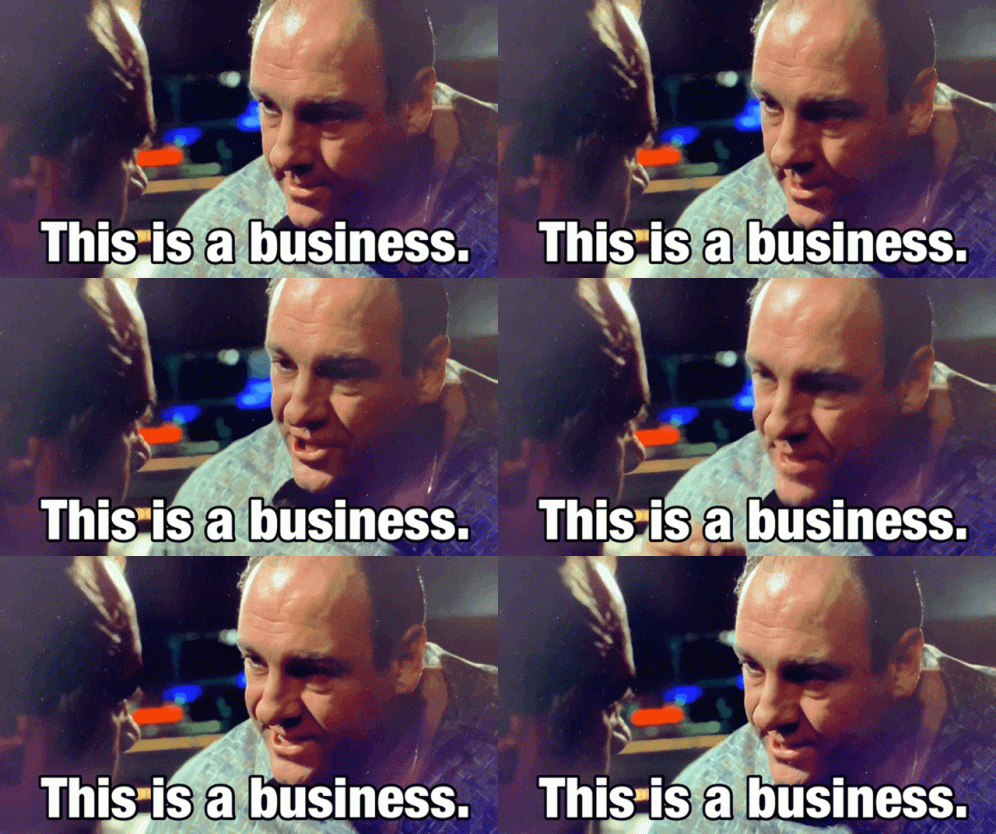
Tony Soprano reminding you that this is a business.
I'll just be blunt: wages are also protection money. They're not just compensation for doing your job, they're compensation for not burning down warehouses, not going on strike, not sabotaging workloads, and not unionizing in the first place. It's the longest unspoken social contract dating back to pre-history: you pay me to live, or else.
Occasionally, employers will call labor's bluff. If twenty-thousand years of history is any indication, their temporary wins are always undone by the sheer ratio of workers to wealthy owners, though not before employers provoke and employ violence first. We are going through such a phase right now, if the above links are any indication.
Employers haven't paid their dues to labor in decades. Labor, kind as we are, have cut back on our lives as much as we're able to. We've given up homeownership, we're dropping out of healthcare, we're begging from food pantries, we're taking on gig work, and we've seen none of the wage gains from productivity our elders enjoyed. It's gotten so bad that, with workers having sacrificed our very ability to move up the socioeconomic ladder, the economy has gone K-shaped.
Despite this, employers seem to think there's more room for workers to yield. I say this because despite median wages being unable to afford median homes, I'm still finding employers offering lower and lower pay for work on their job descriptions. This isn't just economics anymore, this is a security risk, and employers are playing with fire.

Modern employers
Take your CPA, for instance, median pay of $81,680 a year and at moderate exposure to AI displacement according to Anthropic. These are people who know your books better than you. Where every penny goes, and where every penny can be silently swindled. They also audit your fancy new AI financial workflows, making corrections when it goes off the rails, and know where all your financial skeletons are buried.
Do you really want to pay your accountant so little that they can't make rent or buy a home? Do you really want them going to a food bank instead of a grocery store? They're excellent at judging risk, and know exactly what that pay gap is worth to them if the timing is right. Maybe it's blowing the whistle before you can fix an issue and leading to a costly investigation, maybe it's sharing your supply chain costs with a competitor for a higher paying job, or maybe it's committing outright embezzlement that they're sure your fancy AI tooling will miss.

Are you sure underpaying your accountant is a good idea?
Tech work, the last bastion of Middle Class employment, isn't doing any better. Take Computer and Network Architects, with a median pay of $130,390 per year; or the Computer Systems Analysts, median pay of $103,790 per year; or the Systems Administrators, with a median pay of $96,800 per year. These groups have the keys to your systems, your data, your endpoints, your real estate. They can see and do anything with a keystroke, including destroying billion-dollar businesses. The reason for the comparatively high wages was their comparatively high degree of trust.
Instead, employers outsourced to MSPs, then offshored overseas, then on-shored to underpaid and exploited H1Bs shackled to their employer's temporary sponsorship, then briefly hired North Korean spies, and are now attempting to replace the technical workers outright with AI that routinely drops production systems. All the while they lay off workers by the tens of thousands, over and over again.
I feel like there's an example of the consequences of not treating your technical experts with respect in popular media...

Dennis Nedry is a fucking asshole whose actions endangering personnel and guests were reprehensible, but he did repeatedly make it clear he felt undervalued relative to his contributions...
I'm not Dennis Nedry, but I've worked with folks like them before. Brilliant minds who can debug complex architectures and systems, who pour their lives quite literally into the work because they have a passion for it...and increasingly are all too willing to burn it to the ground when they feel slighted. Spend time around actual engineers and the like in most orgs, and you'll see patterns of ill-health: smokers, drinkers, chewers, vapers, over-eaters, out-of-shapers, poor posture, bags under eyes, thinning and greying hair, high amounts of stress, messy desks. All signs of humans sacrificing their own health for their employers, prioritizing work over life, overworked to an early grave.
Most folks aren't as egalitarian as I am, and as someone who has sacrificed physical, mental, emotional, and psychological health to the field for over fifteen years, I sympathize with where my peers are coming from. Most people aren't wired to "do no harm" no matter what, which means most people are a huge security risk if they're undercompensated.
Thing is, undercompensation isn't limited merely to your specialists and senior workers. Fast food workers will slow down lines to give themselves breathing room due to understaffing, and retail workers won't put in the added effort of store maintenance when they can't even maintain a roof over their heads. Office workers doing more menial tasks aren't going to follow through on security best practices if they're more worried about how to pay the electric bill this month while also affording insulin. Your contracted-out security staff aren't likely to pay close attention to camera feeds since they know they'll be replaced in three months before benefits kick in. Your MSP or offshored technical staff won't be invested in your long-term success when their KPIs only cover ticket counts and response times, and their competitors are already preparing to underbid at renewal anyhow.
The workers have been incredibly clear about their problems for twenty years, now, especially the younger cohorts. Employers haven't wanted to listen, believing one more technical control or one more AI system will finally give them the permanent, unassailable leverage they need to keep all the money and fire all the workers.

Fuck you, pay me.
I don't really have a positive way to end this. This is a warning, another canary in an increasingly smoke-choked mine. We're at the point that workers are quite literally burning down infrastructure and engaging in violence against leadership, and the response from those who can change things - our politicians, our corporate leaders, the investor class that's richer than ever in human history - don't really seem to give a fuck. There's this thick tension in the air between workers scrambling to survive, and monied classes who feel the demands of the workers are wholly unreasonable.
History paints a pretty clear picture of how this ultimately ends, but for what it's worth, I still feel like I should at least try to warn folks about the consequences of undercompensation.
Failing to pay your workers the money they need to live is breaking the social contract. It's the single biggest security vulnerability in your organization, and I promise you that there is not, and never will be, a technological control that can protect against it.
You gotta pay up, or you're going to get burned down.

Milton was right.
An addendum.
AI is making it faster and easier to brute-force security vulnerabilities at a time when open source is falling apart due to lack of funding and successors. Major companies are firing engineers to replace them with AI tooling, then hiring them back at lower pay packages when the AI fails, but still holding the AI Sword of Damocles over their heads. Software is expanding rapidly at a time when employers seek to eliminate the technical professionals who ensure their safety and prosperity, who can translate institutional processes and knowledge into cost-effective infrastructure.
Housing prices are up. Rent is up. Utilities are up because of AI datacenter builds. Food costs are rising due to global conflicts instigated by America. So too are energy prices, tariffs, inflation, and interest rates.
You, the employer, have a decision to make: do you start raising wages, working with policymakers to immediately address affordability, cease arbitrary layoffs, invest in worker futures, and promote regulatory schemes that reign in the worst myopic excesses of your peers for society's collective benefit?
Or do you take up smoking cigarettes while sitting inside a warehouse of loose gunpowder and dynamite, with a mob of torches and pitchforks right outside?

Coco has had it up to here with your bullshit.