the two things i still dont understand are:
1) why is there not a dedicated demo environment for demos, like practically every other software? i cant think of any reason why they need live data for a demonstration. (this might be addressed in the article, but the paragraph where it looks like it might be mentioned is also where the article is cut off)
2) is the Marcus Jewish Community Center of Atlanta (MCJCCA) city-owned? if not, the city should not be able to give permission to use the cameras. if so, was the MJCCA notified that the cameras would be used for demo purposes? were the parents notified?
Why is the camera there in the first place??
Presumably there are people that have access to it. And if you are demoing software that connects to cameras, then someone gave the sales guy access to those cameras.
I’m also assuming those probably weren’t the only cameras…
Usually the government is trying to wrap the spying/privacy breaches by "save the children", but this time if you want to save your children from some older dude watching them on a screen, you actually have to be against this privacy nightmare.
It’s much easier to just show live footage rather than rig up canned looping footage.
It’s pretty astonishing how no one watching the demo with me seems to care. No one asking “Hey, will you just be able to do this with our video if we buy from you?”
...is how I imagine that one goes.
I imagine its for security. Ie if there are reports of robbery, you can find who did it. I know its not that popular in the states but its common elsewhere, but with better controls. (well, "better" as in controlled by shitty IoT devices)
I think the thing with flock is just how poorly put together everything is. They are obviously insecure, and the entire network has massive holes in it. Yet its still being rolled out.
Could also be AI.
That said, if there wasn't a crime the camera footage should be deleted.
I was attacked by "a good dog" and then blamed for provoking the dog (like that is valid excuse for starting an attack). I defended myself, and dog owner joined the attacked together with their dog!
After that, I have cameras everywhere, I even record many interactions on my phone. I refuse to be at mercy of random beasts and their "owners". If people start using leashes and muzzles, I may consider taking down cameras!
I think it's probably a just laziness here, which makes some sense - it would be easy to set up 5 Flock cameras on the sales demo tenant sitting in a storage room at HQ, but it would make for incredibly uncompelling demo. Rather than set up a pipeline to run stock footage in as a camera feed, they got lazy and used real tenants.
The camera doesn't prevent crime. It just displaces it. Even when it doesn't it will not prevent the crime from happening. It _may_ provide you an opportunity to prosecute the person who committed it.
In reality the only real reason to have one is to reduce your insurance premiums.
> crime has been solved
A perpetrator was potentially caught and now has to be tried or negotiated into a plea. I understand we use the term "solve" as a term of art but it's a particularly poor one. It speaks to the need of police to clear their books of negative indicators and not to any first order desirable social outcome.
> That said
That said, if during a demo, you access another customers equipment, I will _never_ do business with you. That's just extremely unprofessional behavior.
There is someone that is making the decision right?
Or are you just saying the person placing the cameras is decoupled from the person making the decision to aggregate them all.
But I still feel like the accountability is on who is giving the access to sensitive cameras.
I'm sorry you had a bad experience and using cameras to protect yourself is a thing but filming kids doing gymnastics seems very very far from purely defensive.
And, lest you think generating "600,000 lines of production code in 60 days" [2] is potentially problematic, has also fully solved the primary failure modes of AI coding identified by Andrej Karpathy, once and for all: "Karpathy's four failure modes? Already covered." [1]
As someone who has experienced mania, including with a programming bent specifically, it's hard not to raise an eyebrow at the idiosyncratic human-y bits of his thinking floating up from the sea of em-dashes and it's not X it's Y in his manifestos.
Plus volunteering this [3] in an interview:
“I sleep, like, four hours a night right now,” he told his interviewer, fellow VC Bill Gurley, during an onstage interview Saturday. “I have cyber psychosis, but I think a third of the CEOs that I know have it as well,” he joked about his current AI obsession. (Tan’s assistant confirmed to us that he was joking. ...)
It’s like I was able to re-create my startup that took $10 million in VC capital and 10 people, and I worked on that for two years, and I took anti-narcoleptics — I remember, you know, sort of being on modafinil...
[1] https://github.com/garrytan/gstack
[2] https://github.com/garrytan/gstack/blob/main/docs/ON_THE_LOC...
[3] https://techcrunch.com/2026/03/17/why-garry-tans-claude-code...
Jewish Community Centers are targeted more for attacks than a YMCA.
ok.
I really don’t see how we can avoid having our cities hand over this data sight unseen to a company with a history of enabling stalkers and overzealous policing.
I haven’t checked this, but based on the enthusiasm for this technology, I assume that crime clearance rates are near 100% in cities with these cameras.
(/s)
We decided this was a privacy and security risk, and have gone in a completely different direction, but it would not surprise me if most businesses used one of these companies and just went with whatever they suggested without understanding at all what is at stake or who has access to the data.
That's exactly what's happening.
People are buying webcams which are cheap and have in their ToS something to the effect of "we get to sell everything the camera can see". Which, in turn, allows them to partner with Flock and sell video footage directly to them.
Consider the fact that at one point, Amazon partnered with Flock to sell their ring camera footage to Flock. [1] It only got botched because of the creepy superbowl commercial selling the spying as "finding lost puppies".
[1] https://apnews.com/article/amazon-flock-super-bowl-surveilla...
That's why I periodically leave a bunch of bicycles with cheap locks downtown. They act like a kind of criminal sacrificial anode, reducing crime in the rest of the city.
And that is worth something in itself, at least in areas where disputes between people are the norm. Gyms in particular suffer from theft to sexual harassment.
I want to have video evidence, if some crazy person blames kid for provoking the attack!
I think it's the fundamental issue with these cameras, that it takes pictures of us, but we ourselves cannot access it. Even though it was us who has paid for it!
The bulk of the responsibility here would lie on whoever signed I think. It's one thing to click "I agree" when you are making a SaaS account for downloading cat videos. But at a job, you are getting paid to read these things and to make informed decisions.
And is there any evidence that deploying cameras has changed the rate?
Do you want to punish people or do you want to prevent people from being victimized in the first place?
What you describe is obviously already happening on a much larger scale.
I'm not sure why people have trouble grasping something this basic.
Why does the video footage need to be able to be viewed live, remotely, by a sales team and a prospective client in another state?
Predators have access to these cameras. There are numerous instances of police using these systems to stalk women.
If I want video proof of what happened at a school, I’m much more comfortable with it being held on premises in a tamper evident location. That eliminates some of the predators from the situation.
I have experienced multiple times when I tell police that I have video evidence of a crime happening as well as evidence of the identity of the criminal and they won’t even look at it. I once had a cop tell me that I shouldn’t bother with a report with witnesses and evidence and a known perpetrator since it would never get investigated. That cop got punished for telling the truth, although they were 100% correct, the detective on the case never even opened the file. The detective was not punished.
Residents of an Atlanta suburb have been rocked by the revelation that sales employees at Flock have been accessing sensitive cameras in the town to demonstrate the company’s surveillance technology to police departments around the country. The cameras accessed have included surveillance tech in a children’s gymnastics room, a playground, a school, a Jewish community center, and a pool.
Flock has taken issue with the way that residents and activists have characterized the access but confirmed that the camera access did happen as part of its sales demonstrations. A blog post by Jason Hunyar, a Dunwoody, Georgia resident who learned about Flock accessing the city’s cameras by obtaining Flock access logs via a public records request is called “Why Are Flock Employees Watching Our Children?”
Flock has pushed back against this characterization on social media, in a blog post, at city council meetings, and in a statement to 404 Media: “The city of Dunwoody is one city in our demo partner program,” a Flock spokesperson told 404 Media. “The cities involved in this program have authorized select Flock employees to demonstrate new products and features as we develop them in partnership with the city. Moreover, select engineers can access accounts with customer permission to debug or fix any issues that may arise. No one is spying on children in parks, as the substack incorrectly asserts.”
Flock also argued that it is more transparent than any other surveillance company because it creates these access logs at all, and they can be obtained using public records requests. “Also, I must state the irony of the situation. We're one of the few technology companies in this space dedicated to radical transparency [...] I understand the concern from the resident, but it is unequivocally false to assert that Flock, or the police, or city officials are doing anything other than using technology to stop major crimes in the city.”
The records Hunyar obtained, however, show that some of the cameras that were accessed were in sensitive locations, including the pool at the Marcus Jewish Community Center of Atlanta (in Dunwoody), the children’s gymnastics room at MJCCA, and several fitness centers and studios. The access logs obtained by Hunyar show at the very least how expansive Flock’s surveillance systems can be in a single city, encompassing not just cameras purchased by the city but also cameras purchased by private businesses.
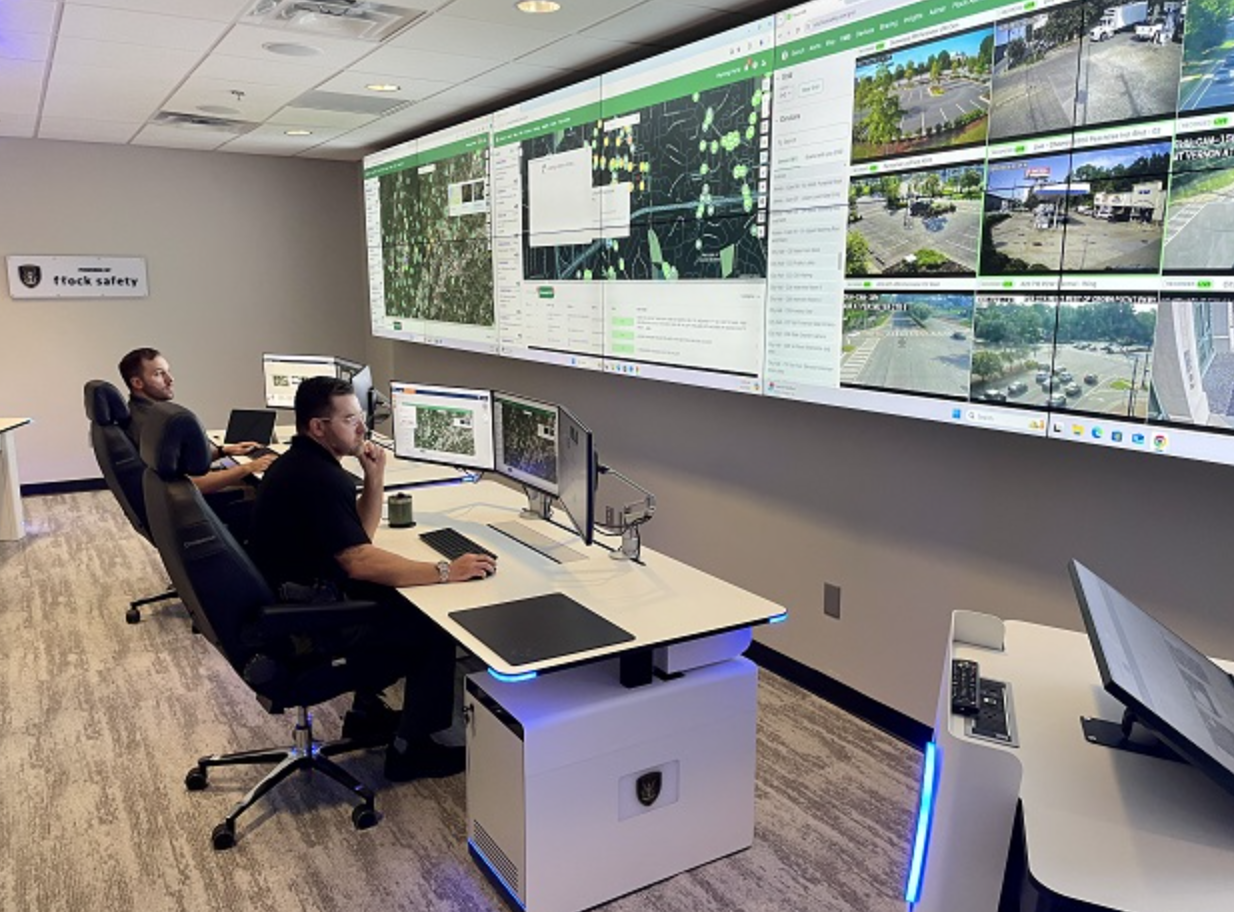
A picture of Dunwoody's "Real Time Crime Center," which is "powered by Flock Safety." Image: City of Dunwoody
After Hunyar wrote about what he found, Flock has agreed to stop using Dunwoody’s cameras to demonstrate its product. Flock’s FAQ page states that “Flock customers own their data” and “Flock will not share, sell, or access your data.” It also states “nobody from Flock Safety is accessing or monitoring your footage.” Flock also published a blog post that notes “one of the benefits communities value most about Flock technology is the ability for law enforcement to directly access privately owned cameras, if and only if the organization allows them to, for crime-solving and security purposes.”
💡
Do you know anything else about Flock? I would love to hear from you. Using a non-work device, you can message me securely on Signal at jason.404. Otherwise, send me an email at jason@404media.co.
“Fair questions have been asked about conducting demos on cameras in sensitive locations when doing this very critical testing in the real-world. Last week, in the City of Dunwoody, questions were raised about a demo conducted as part of authorized activity approved under the city's demo partner agreement, on cameras at a local Jewish Community Center. Although the camera was only viewed during a routine demo, we understand that this is a sensitive location for many. We have therefore determined that employees will be trained to only conduct demos in more public locations, like retail parking lots,” Flock wrote in the blog. “Accusing someone of spying on children is not a policy disagreement; it is a life-altering allegation. Claims of inappropriate conduct by our employees are false. The employees being named online are well-intentioned employees who accessed a camera network with the city's explicit permission, as part of their job. They are now being called predators for it.”
Become a paid member for unlimited ad-free access to articles, bonus podcast content, and more.
Free members get access to posts like this one along with an email round-up of our week's stories.
Already have an account? Sign in