We made our machines 100x faster and instead of running compute locally we just made 100x slower client software.
Embracing constraints and "how it works" used to be at the core of their software ethos.
[0] https://github.com/rothgar/awesome-tuis
[1] https://terminaltrove.com/explore/
[2] https://github.com/ibraheemdev/modern-unix
Even before Claude Code, I always see htop as the prime example of a good TUI.
Lucky you. I avoid electron apps because I'm limping along with 16gb.
People now have access to good terminal emulators. Back in the day, you had cmd.exe in Windows. Now you have a plethora of Linux/Unix terminal emulators, Terminal.app in MacOS, and Windows Terminal in Windows 10/11. These are quite capable applications able to render good, complex text-based interfaces.
For the past few weeks I've been wrapping up Booba [1], which is developer tooling to combine BubbleTea and Ghostty in WASM deployments (using ghostty-web).
It provides for some interesting deployment patterns both locally, over network, and embedded in a web page. It's intended to be very easy to adopt; at the simplest, one just changes `tea.NewProgram` to `booba.NewProgram`.
I used Booba to make a demo page [2] for our NTCharts TUI library published to GitHub Pages. The repo READMEs have GIFs... this page is all embedded WASM.
There's also new Kitty-Graphics-supported widgets in there (picture, chartpicture); I updated Booba and Ghostty-Web to support it. Still getting the kinks out.
[1] https://github.com/NimbleMarkets/go-booba
[2] https://nimblemarkets.github.io/ntcharts/demos/heatpicture-p...
It's by far not as beautiful rendered as the native OS layers, but easy to navigate and a good foundation for cross platform GUI development. And I got it even approved for the MacOS app store. Here's my write up: https://marchildmann.com/blog/imgui-mac-app-store/
What originally got me excited to build TUIs was the concept of delivering apps over the wire via SSH. SSH apps resemble a browser in that way: no local installs required.
It's a major reason why I enjoy hacking on https://pico.sh -- deploying the TUI requires zero user involvement.
The only hard part about vim is to be forced to strecth the finger up to Escape for what is essentially the most essential function in a modal editor: Going back to command mode. The ideal workflow is do a quick edit and go back to command ("normal") mode instantly. The fact that Escape is used is a historical artifact that needs to be called out.
So just remap CapsLock to escape, it system-wide, it's not that hard and it's nice to have Escape there generally. In Linux and MacOS it's just a GUI setting away and in windows you just have to edit (create?) a registry key. Can be done on any machine under a minute.
Apart from that I don't see where the learning curve is since you can just start with the basics from vim-tutor and look up for more when you feel you're spending too much time on something. I already felt faster than in any other editor when I just knew the basics. The real problem of vim is that you get used to modal editing very quickly and it feels like the stone age when you don't have it.
There's not a single good universal UI. The best is the browser and it is reasonably successful but the sandbox makes it specifically unsuitable / high friction for doing things that need local access to files, network, etc. And it is ridiculously high overhead if you just want to run something simple. Then remote access is even more a debacle. Can I access an application running on my windows host from my Mac? can I forward that through a tunneled connection?
TUI is a simple, universal protocol that does what you need and is natively remote. Whatever I use locally will seamlessly work over an SSH connection.
And it's a big middle finger to the OS vendors who thought locking everyone in by making everything incompatible or ecosystem specific was a winning strategy.
I live on the CLI, I have one a hotkey away, but please, technology has advanced significantly since the terminal was the only option, and we have far better options for building UIs now.
It's just a shame that we don't have a great cross-platform, streamed, UI system. The web is great in it's own ways, but clearly something could be a lot better for this purpose. Flutter's ok, but not on-demand enough and too married to Dart.
Oh we need multiple windows we can move around/resize? Let's make them text windows. We want people to be able to quickly select options? Yeah make those text boxes. We want to quickly compose documents with some kinda style/formatting? Yeah they'll need to write more text to format it (but let's not make any apps to easily view the text in formatted mode).
I don’t need pretty buttons, I need usability and readability. Without having a 50” display!
- No distractions from visual content
- Extreme efficiency with keyboard
- AIs can code them up quickly. It used to be a total pain
Also, the explosion of new languages in recent years means having to write a new set of FFI wrappers around existing libraries, and it's easier to make an idiomatic library for TUI development than wrap all of GTK+ or Qt.
I don’t know if TUIs will be the answer, but it’s an interesting development!
To avoid context-switching from the command-line, many essential UIs were made text-only. Another route would have been to integrate the command-line within graphical applications, but few did it -- the main example that comes to mind is Jupyter.
It's not too bad to theme GTK apps and have them all look a consistent way. For example I use Tokyonight Moon and Gruvbox and they both have GTK themes that look great for Firefox, Thunar, GIMP, LibreOffice and more. I don't use Omarchy but here's a few screenshots https://x.com/nickjanetakis/status/2037125261657883061/photo....
Nothing fancy was done on my end, just installed the specific GTK themes. They even support live reloading because GTK's tooling supports it, my dotfiles at https://github.com/nickjj/dotfiles handle all of it for you. I still prefer TUIs but you can have nice looking GUI apps for when you want them.
If you have python installed, you can start a web server with a couple lines of shell script. Is there any really good truly lightweight webserver? (Something under 256KB)
I'm pretty sure the success has nothing to do with the TUI though. I personally enjoy it a lot but the productivity boast doesn't come from avoiding the mouse.
I think the main driver was frameworks, available for a range of languages, that make it easy to create nice-looking TUIs (ratatui, textual, ink, etc.)
It's also nice to have a little less to worry about as a desktop application developer, to be honest. The display is less nice (low text density especially) in exchange.
As far my opinion goes, this is biggest (and really only) reason.
Running TUI apps over SSH isn't ceremony-less either — you have to set up SSH keys and copy your public key over into the remote end's authorized_keys file — but it's ceremony that you would have already had to do anyway to get access to the remote computer in the first place. And once that ceremony is done, you can now run any TUI (that the remote computer has installed) remotely without any more ceremony.
There are quite a few GUIs that can be navigated with keyboard, e.g. menu bars can usually be activated with alt or win and single key presses
I feel seen.
I also think there’s a certain element of reacting against absolutely everything becoming a bloated electron app.
I have no doubt - if it hasn’t already happened - that some apps will unironically embrace the most ridiculous option by shipping as electron apps that implement a TUI layer as their front-end.
Everyone will have a “reasonable” explanation though for why they have to stay in the terminal even when they aren’t really coding anymore and it wouldn’t be hard to have a window next to your terminal if you really have to, but live and let live. Whatever makes you happy as be all become managers.
I too like a cyberpunk interface even if it’s last the need :)
- Firefox: Uses its own custom rendering engine but interfaces with GTK3. It respects standard GTK3 themes.
- Thunar: Uses GTK3
- GIMP: Since v3.0, they now use GTK3
- LibreOffice: Uses its own visual framework (VCL) but has a GTK3 plugin to draw its window frame and menus, and it also respects the system theme.
None of these use libadwaita, let alone GTK4, so they're not good examples unfortunately.
Asking honestly, because none of the ones I use is.
A GUI is a huge regression here.
My bet would be a desire to do away with heavy browser based UI and the curiosity of trying to test the limits of terminal based rendering.
The current implementation isn't command-line, but a re-implemented GUI in disguise, awkward and even more buggy. Why should I use that over a GUI? I would prefer Electron over those TUI unless I have to SSH.
I would say the optimal UI is a Keyboard driven normal Desktop app. An app that can take full advantage of graphics elements of a desktop app but is lightning fast to interact with thanks to that it's keyboard driven. Very few people build apps like that though. Sure there are keyboard hints in many apps but they are usually not 100% guaranteed to cover all cases and are sometimes an afterthought.
I was vibe coding a layer on top of textual last week that allows me to plug in both interactive and information display Python functions into a TUI grid. Really simple stuff, with textual doing the heavy lifting.
TUIs just solve the right problems in the same world we're already working in - the terminal. That they're fast to launch and terminals have modern features like rich color and mouse support just adds to that.
CC demonstrated that one can have a powerful, flexible and responsive interface in a terminal, and to have that for a piece of software that has wide mass market appeal. I don't think we've seen this since WP5.1 . (Personal opinion: the CC terminal application beats their desktop software hands down in usability. That said, the desktop software is a lot better for corporate email trawls and helping to iterate on visualisations.)
Then for prospective devs, CC makes it easy to sling (and debug!) code that handles the various terminal vagaries with much less headache. No need to care about manually maintaining control code state machines; no worries about a missed SIGWINCH handler screwing up your in-window layout on resize or font size change; much easier integration with available CLI tools.
I have written some ncurses/C code in my time. I wouldn't want to do that by hand again.
Right here:
> modal editor
Because it's easy to get things done for a TUI, but if I create a proper GUI, my codebase is suddenly more complex. And it's not like there's a solid, reliable GUI toolkit that I can use, they're all riddled with different bugs and caveats.
> Flutter's ok
If you ignore the absolute nightmare that is building applications in Flutter. Even Flutter itself isn't really designed to be compiled by anyone (although, in practice, your distro will shield you from this issue).
My motivation is avoiding all the piles and piles of extra software dependencies that X and/or Wayland bring in.
In addition (but might only be relevant in my niche platform) is that Wayland is buggy and X is deprecated and unmaintained making making the GUI work there a constant struggle.
Time will tell if it is an improvement
OpenCode for example has not yet figured out "maintain a log of all messages and send that log to the SSE endpoint in the same order to get the next response" and has regular prompt cache misses even with context pruning disabled
I think this is the primary reason. I feel like whether or not there are good native libraries things were bound to converge into cross-platform preferencing since it's cheaper to produce and maintain.
Claude code is almost there
https://levelup.gitconnected.com/theres-a-react-app-running-...
A significant number of these apps are nodejs apps so it’s not that much of a leap!
We need to advocate and evangelize for native apps, like RapidApi on macOS and also Tower.
Jokes aside, I don't understand how devs can bring themselves to ship such inefficient apps.
I assume you mean "orders of magnitude" and not "out of memory". I have never seen the former used as an acronym before, let alone without some kind of contextual clue. (In typical Baader-Meinhof fashion, I'm sure I'll see it again in the next 24 hours...)
Companies make UI/UX to prioritise first 30 minutes of the experience, to keep user using it long enough that they stick with it. Not the 8h/day work the UI will get when a tool become pillar of your work.
With that background, most TUIs are really two steps back compared to a decent GUI. (Wild west navigation/hotekeys, broken copy and paste, lack of integration with the environment, just to name a few.)
The core of the problem is IMHO, that we really lack a decent cross platform GUI platform, which is really integrated into a programming language or part of the standard library.
Outside of Swing (which lacks access to a native browser element), we have Tk (no browser component, no drag'n'drop, at least from Tkinter), wxWidgets (seems that the community is very small and especially its bindings needed to be resurrected at least once), Qt with the ever looming possibility that it will get deshittified to make more money (... and no, KDE is not that important and I doubt the KDE community could take care of a fork long term).
Which leaves us with Electron or the other variants of 'browser component + JavaScript/CSS and callbacks to a local server, which is a really bad programming model (ignoring the memory/runtime overhead for even trivial applications).
The problem is, to build a decent cross platform gui toolkit, one needs a lot of funding and a lot of people (usability, accessibility, design, documentation, testing...). The open source community didn't manage to pull this off (GTK is by now for all practical purposes Linux only) and there is no modern contender for Qt or Swing (with their own problems).
TUIs are no solution to the core problem (and it would be absolutely possible to have a GUI toolkit with a TUI renderer for perhaps 80% of GUI needs), but I understand every developer who chooses TUIs for cross platform UIs given the alternatives.
Also ctrl + [ is standard terminal/ascii for esc so that might be a bit more ergonomic than reaching for esc
I agree, too, besides reminding myself to use numbers before movement commands there was really nothing that felt super hard about vim. It almost disappointed me, I always heard the jokes about not being able to quit it!
I still don't understand why people keep mentioning this, ctrl-c works as well to go back to the normal mode.
> windows you just have to edit (create?) a registry key
Or use Powertoys, which I don't know why it isn't a setting.
(saying as a Mac, Linux and Emacs user, although I still use Vim in the terminal)
But if I want to, say, develop the app for Windows. That is easy. You get a tiny binary to just opens a form and runs with a double click. No install necessary.
The same thing on Linux? Impossible. There is no guarantee the machine has any version of GTK or Qt installed at all, so to be self-contained you need to ship the entire OS. Now your file size is huge. I can't use Python, because now Windows users need to have Python or I have to ship an interpreter.
The only plausible alternative is something like Java. Now you have a single .jar file that runs on any system. But then Oracle changed the license, and JavaFX is no longer part of Java (Swing still is).
Honestly, I just want to display a menubar with keyboard shortcuts. Why can't there be a menubar VM or something that gives me access to a menubar on all OS's without having to deal with all of this. We are already shipping the entire browser with Electron. That is stupid. The way it should work is users install a something like Flash but for desktop apps and every app just uses that platform.
It's probably easier to ship a DOS game than a desktop app because everyone who wants to run a DOS game will just have a DOS emulator installed.
I think it is more of a staffing problem. Plenty of people know web development, so you want to use those people for desktop as well. Having desktop be JS (electron) helps a lot with that.
They want a GUI, but, instead, they have to resort to something like this. A GUI in a TUI.
They want something portable. They want something that can run remotely. They want something they can run more safely than having to expose a socket. They don't want to have to bring up an entire desktop.
Rootless windows are effectively dead. That leaves web interfaces (and all of their issues) or doing a TUI, where all you need is an SSH connection that everyone already has.
In the past you could slap something together with Tcl/Tk, and just launch the window over X Windows. That's not so easy today, and no one is running remote X anyway.
The LCD is SSH, and these are the only things that fit.
When I end up helping other devs and use their non vim setups...now that really trips me up. Capitals everywhere, random hjkls ... I have to really slow myself down when using a "normal" editor.
Also just to be pedantic: https://stackoverflow.com/a/5036294/10469162
I’m not sure if Google actually already gave up on Fuchsia, I’d be surprised if the work actually stopped, but it’s clear now that it will not be a panacea and if it will ever get released and gets some traction, it’s still like a decade away from becoming a major OS.
It's basically like building a website with div and basic CSS.
gpui-component exists: https://github.com/longbridge/gpui-component
Up until sometime late 2025 GPUI wasn't even on crates.io, and it seems like the GPUI-component ecosystem still promotes using git deps. It was also in "read the code for docs" state for a very long time
It's been a while since I've used it, but there were weird things missing too like the Scollbar was located in Zed's UI component crates instead of core GPUI. Arbitrary text selection also is not possible, which is something I really value about egui.
I was quite recently, but even then remote X is missing a really big usability piece: keeping a long-running application open on the host and periodically connecting to it from a remote node (concretely: connecting to my server from my laptop). VNC/RDP/etc all do this at the desktop level, but they're pretty mediocre experience-wise.
tmux gives me this for terminal applications without really any compromises. I run tmux for local terminals as well as remote terminals; the hotkeys are all deep muscle memory at this point. It just works.
If you:
1. Have a low-latency connection to a decent machine, and 2. Are on a machine that's weak, or isn't yours, or that you don't fully control (e.g. employer forces you to run Windows)
... then you live in remote X apps my friend.
Which is essentially exactly the same thing, except your UI is trash relative to a normal GUI
Likewise, Gnome has proven that you can write entire UIs in Javascript and have them be quite performant.
Electron (well, Node is a big sub-culprit) and Javascript in general just make it really easy to create a slow, bloated application.
This is why I love JIS, even though I don't actually need the Japanese keys. That small spacebar is so much better, and you get three extra keys (Henkan, Muhenkan and Kana) along the bottom row. As an Emacs user, I bind Henkan and Muhenkan to be Control keys. It's very comfortable.
Ctrl + [ would be acceptable if it wasn't, imo, the most important function of the editor.
EDIT: My bad, you can do it with Glide apparently
To be fair I mostly use `/` + (n/N) + Enter with `incsearch` on (by default in nvim), I feel it's really the superior way to move around and it has deprecated a lot of my vim-fu.
In the same way, apart from occasinal `ciw` (or other text-objects), I do most of my edits with `:s/old/new`. I don't even use a complicated regex as sometimes it's just easier to write one or two simpler ones. It's just faster to not have to go to a specific location before you make an edit.
So don't be self-contained. I mean, you depend on an X server or Wayland, right? So why not depend on GTK or Qt being available?
(Of course, it _is_ tricky to be able to depend on any of several versions of these, but still.)
There's at least Qt, GTK, umm, and, I guess Juce and wxWindows, right? Oh, I see there are more:
https://en.wikipedia.org/wiki/List_of_platform-independent_G...
Can you explain what's deficient about the first two I mentioned?
That's one word that should never been used in an design meeting. None of the GUI I've used has managed to do this right. Even Emacs and Firefox. The platform are totally different (and in the case of Linux/Unix, there's a lot of different HIG competing). So trying to be cross platform is a good illustration of the lesson in https://xkcd.com/927/
The best bet should be a core with the domain with a UI shell. And then you swap the shell according to the platform.
I do a lot of work in the terminal and that's exactly why I'd rather have other windows to the side so that my terminal can stay exactly focused on what I'm doing there. Those other windows might also be terminals, but I have a big screen, and I want to make use of it to see things all at once. A GUI gives far more flexibility for arranging those multiple views.
I've sat with coworkers taking two to twelve keystrokes to flip between things that I just have side by side in separate IDE windows, browser windows, or tabs... or can switch between with a single click instead of those keystrokes.
Obviously both are capable of the other.
The vanilla HTML styles look bare, so you have do _something_. TUI’s look sort of cool in their simplest form.
This makes it much easier to build cross-platform TUIs. It used to be a chore, now it's probably easier than most GUI frameworks. (Possibly with the exception of Electron, but that comes with a different set of trade-offs.)
The very early DAWs kind of had TUIs, to be fair. Things like the Fairlight CMI
I've rarely seen that turn out very well. Typically it works ok on whatever desktop main developers use, and not so much on the others. That means using multiple frameworks, witht their own idioms and quirks and having to repeat a lot of work. Unless your UI is very simple it is pretty expensive to maintain multiple separate versions of it.
Terminal User Interfaces (TUIs) are making a comeback. DHH’s Omarchy is made of three types of user interfaces: TUIs, for immediate feedback and bonus geek points, webapps because 37signals (his company) sells SAAS web applications and the unavoidable gnome-style native applications that really do not fit well in the style of the distro.
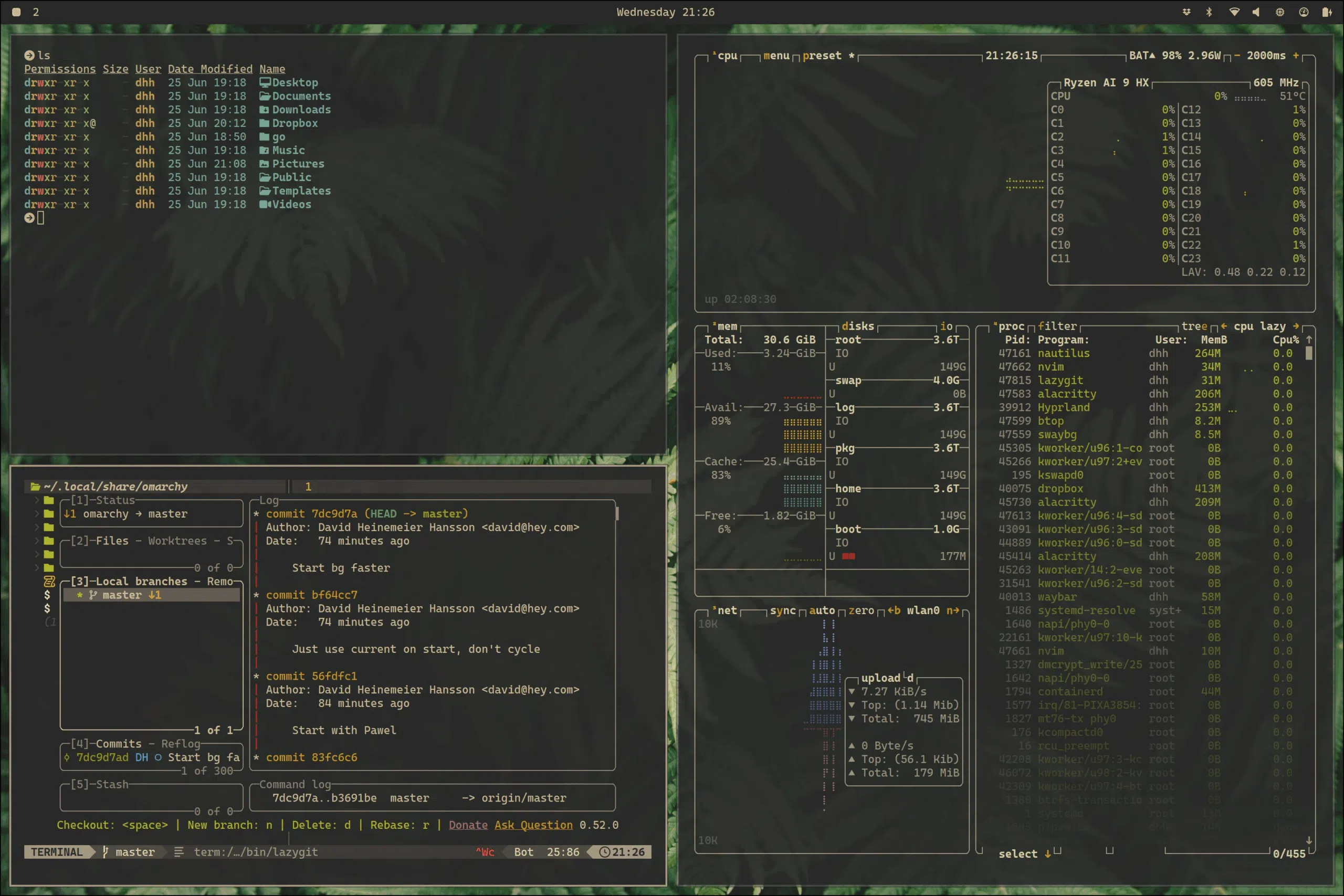
The same pattern occurred around 10 years ago in code editors. We came from the native editors of BBEdit, Textmate (also promoted by DHH), Notedpad++ and Sublime to Electro-powered apps like Atom, VSCode and all its forks. The hardcore, moved to vim or emacs, trading immediate feedback and higher usability for the steepest learning curve I’ve seen.
The lesson is clear: Native applications are losing. Windows is doing the GUI library standard joke. Because one API does not have success, they make up another one, just for that one to fail within the sea of alternatives that exist.
MFC (1992) wrapped Win32 in C++. If Win32 was inelegant, MFC was Win32 wearing a tuxedo made of other tuxedos. Then came OLE. COM. ActiveX. None of these were really GUI frameworks – they were component architectures – but they infected every corner of Windows development and introduced a level of cognitive complexity that makes Kierkegaard read like Hemingway.
— Jeffrey Snover, in Microsoft hasn’t had a coherent GUI strategy since Petzold
Since then, Microsoft has gone through Winforms, WPF, Silverlight, WinUIs, MAUI without success. Many enterprise and personal desktop application still rely on Electron Apps, and the last memory of coherent visual integration of the whole OS I have is of Windows 98 or 2000.
It turns out that it’s a lot of work to recreate one’s OS and UI APIs every few years. Coupled with the intermittent attempts at sandboxing and deprecating “too powerful” functionality, the result is that each new layer has gaps, where you can’t do certain things which were possible in the previous framework.
— Domenic Denicola, in Windows Native App Development Is a Mess
The UI inconsistency in Linux was created by design. Different teams wanted different outcomes and they had the freedom to do it. GTK and Qt became the two reigning frameworks. While Qt is most known for it, both aimed to support cross-platform native development (once upon a time, I successfully compiled gedit on Windows, learning a lot about C compilation, make files and environment variables in the process) but are only widely used in Linux land. Luckily, applications made in the different toolkits can look okay-ish next to each other, something that the different frameworks on Windows fail to achieve. How many engineer-hours does it take to redo the windows Control Panel?
Given the difficulty in testing the million different combinations of distros, desktop environments and hardware in general, most companies do not bother with a native Linux application — they either address it using electron (minting the lock-down), or they let the open-source community solve it self (when they have open APIs).
Apple used to be a one-book religion. Apple’s Human Interface Guidelines used to be cited by every User Interface course over the world. Xerox PARC and Apple were the two institutions that studied what it means to have a good human interface. Fast forward a few decades, and Apple is doing the best worst it can to break all the guidelines and consistency it was known for.
Now, Apple has been ignoring Fitts’ law, making resizing windows near-impossible (even after trying to fix it) and adding icons to every single menu. MacOS is no longer the safe heaven where designers can work peacefully.
Everyone knows that the user experience of electron apps sucks. The most popular claim is the memory consumption, which to be fair has been decreasing over the last decade, but my main complaint (as I usually drive a 64GB RAM MacBook Pro) is the lack of visual consistency and lack of keyboard-driven workflows. Looking at my dock, I have 8 native apps (text mate and macOS system utilities) and 6 electron apps (Slack, Discord, Mattermost, VScode, Cursor, Plexampp). And that’s from someone who really wishes he could avoid having any electron app at all.
Let us take the example of Cursor (but would be true for VSCode as well). If you are in the agent panel, requesting your next feature, can you move to the agent list on the side panel with just the keyboard? Can you archive it? These are actions that should be the same across every macOS application, and even if there are shortcuts, they are not announced in the menus. And over the last decade, developers have been forgetting to add menus to do the same things that are available in their application (mostly because the application is HTML within its sandbox). For the record, Slack does this better than the others, but it’s not perfect.
Together with Dart, Google wanted to design a new operating system, without all the legacy of Android, for new devices. It wanted a fresh UI toolkit (Flutter UI) but Google gave up on the project before a real product was launched. It’s one of those situations where having a monopoly (or a large enough slice of the market) is required to succeed.
Meanwhile, Zed did the same thing in Rust: they designed their own GPU-renderer library (GPUI) which is cross-platform. Despite the high-speed, it lacks integration with the host OS on itself, requiring the developers to add the right bindings. Personally, I would rather have a slow renderer that integrated with my OS than the extra speed.
TUIs are fast, easy to automate (RIP Automator) and work reasonably well in different operating systems. You can even run them remotely without any headache-inducing X forwarding. When the native UI toolkits fail, we go back to basics. Claude and Codex have been very successful on the command-line: you focus on the interaction and forget about the operating system around you. You can even drive code and apps on cloud machines, or remote into your GPU-powered machine from your iPad. TUIs are filling the void left by Apple and Microsoft in the post-apocalyptic world where every application looks different. Which is good if you are doing art (including computer games), but not if your goal is to get out of the way of letting the user do their job.
A checkbox is also part of an interface. You’re using it to interact with a system by inputting data. Interfaces are better the less thinking they require: whether the interface is a steering wheel or an online form, if you have to spend any amount of time figuring out how to use it, that’s bad. As you interact with many things, you want homogeneous interfaces that give you consistent experiences. If you learn that Command + C is the keyboard shortcut for copy, you want that to work everywhere. You don’t want to have to remember to use CTRL + Shift + C in certain circumstances or right-click → copy in others, that’d be annoying.
— John Loeber in Bring Back Idiomatic Design
We need to go back to the basics. Every developer should learn the theory of what makes a good User Interface (software or not!), like Nielsen, Norman or Johnson, and stop treating User Design as a soft skill that does not matter in the Software Engineering Curriculum. In any course, if the UI does not make any sense, the project should be failed. And in the HCI course, we should aim for perfect UIs. It takes work, but that work is mostly about understanding what we need. The programming is already being automated.
Operating systems and Toolkits authors should drive this investment. They should focus on making accessible toolkits that developers want to use, and lower the barrier to entry, making those platforms last as long as possible. I do not necessarily argue for cross-platform support, but having one such solution would help reduce the electron and TUI dependency.
The problem is that world went away from that and into HTML/CSS/JS/DOM mess that makes simple UI things hard and complex UI things slow and/or hard, on top of the bloat.
VB6 could have you roll a GUI interface in minutes, so even trivial tasks could have a GUI.
The tools for CDE on Unices were arguably even better but CDE never really got any momentum.
That it’s tough to put together a GUI now is definitely a regression and Microsoft shooting themselves in the feet regularly over the last 25 years is squarely to blame.
On Linux that doesn't happen. First of all you HAVE to ship the source code if you want it to keep working on every machine because people need to compile it on their machine for it to work, so you're practically forced to open source your desktop app. I know the notion of having a closed source app on Linux sounds weird, but it's more weird that this isn't an option as a side-effect of the how the whole system is designed. Second of all, even if you do ship the source code, you're going to be forced to maintain it. If you made an app in GTK 1 (which looks beautiful, by the way, compared to modern GTK), people won't be able to just install it because GTK 1 is so old that it's no longer in the repositories.
An app made in Java 8 runs in the modern VM. An app made for Windows 95 still runs on modern Windows.
It's only on Linux that I feel like the developer is pressured to open source it and make it the user's problem because the system won't provide support.
Arcane build system. I mean, I guess it technically supports CMake these days, but I have never been able to get anyone else's Qt project to build without much gnashing of teeth.
Emulated native widgets try for pixel-perfect, but tend to feel wrong somehow.
> Gtk
Outside of a Linux/Gtk native environment, Gtk applications are awful. Take GIMP on macOS, for example: it's had window focus issues (export dialog getting lost behind the main application window) literally ever since Gtk on macOS dropped the XQuartz dependence. And that's the flagship application for the toolkit.
> wxWidgets (seems that the community is very small and especially its bindings needed to be resurrected at least once)
Which is a damn shame because they are very close to native appearances on both macOS and Windows and are much easier to program than anything Qt. I think it’s the solution I prefer for multi platform GUIs, both as a user and as an occasional programmer.
> Electron or the other variants of 'browser component + JavaScript/CSS and callbacks to a local server
On the other hand, I absolutely hate this as a user. I would lose features and go back to the command line rather than having to deal with this. Everything is wrong in these applications, they don’t support standard keyboard shortcuts, they look weird and out of place and lag where you least expect it.
> TUIs are no solution to the core problem (and it would be absolutely possible to have a GUI toolkit with a TUI renderer for perhaps 80% of GUI needs)
There are a couple of TUI framework that are almost there already. I like the fact that they are useable without fuss over ssh and stuff but I think they are solving the wrong problem. I would rather use something like tmux but that sucks less for the windowing and persistence bits and get more focused and composable CLI. Make a simple REPL with readline so it has a standard and expected behaviour instead of trying to make everything look or behave like an IDE.
OTOH, I really like how this is driving improvement in terminal emulators.
Not a programming language, but the programming language: C. The toolkit needs to be available as a C API because that lets it a) provide stable API and ABI and b) provide bindings for multiple other languages without having to jump through hoops, especially for other compiled languages (binding Qt to Python might be easy, but bindings to something like, e.g. Free Pascal requires an intermediate C++ library that exposes a C API that itself can be used from Free Pascal - and applications need to distribute it that library too).
Unfortunately the vast majority of GUI toolkits are not writtne in C but in C++ or some other language that makes using them from anything than the developers' favorite language a pain. And really the only mainstream that is written in C is GTK which has a complete disregard for proper backwards compatibility.
(you may think that a library only needs to expose a C API but it can be written in any language, however for something that doesn't have any widespread availability, you may want to link to it statically - however that can be an issue with anything outside C/C++ - as an example i recently tried to make a FLTK backend[0] for Lazarus since FLTK is a C++ library that the devs encourage to link it statically and it would allow creating GUI programs that are self-contained binaries... but statically linking a C++ library -for which i had to first make a C wrapper- in a non-C/C++ turns out to be a PITA under Linux if you are not g++ as that does passes a bunch of magic flags to the linker and impossible under Windows - or at least msys2, so i gave up).
<Meta> <Super> <Alt> <Control> <Space> <Control> <Alt> <Super> <Compose/Meta> <Greek>
I have left Control mapped to Meta, {,Mu}Henkan mapped to Control, Kana to right Alt, right Alt to Super, Menu to Compose/Meta (tap/hold) and right Control mapped to Greek.
I use keymapper[0] to do low-level remapping and tap/hold, and a custom XKB layout for the Greek modifier. I highly recommend this setup.
Binary compatibility means closed source has a chance to grow in an ecosystem. It requires "responsible" developers to put more effort into designing APIs and keeping them alive. It adds complexity that requires a more stable set of long-term developers; in contrast, the constant churn in FOSS requires lower barriers for contributions. With stable APIs/ABIs you have to live with decade-long mistakes. You cannot "just fix it" in a next major bump.
That's so very not true.
Most Linux distros allows for custom repositories. So you can just setup the build infrastructure on your side and then have the users include your repos on their side. No need to open source code and users have painless update notifications.
> It's only on Linux that I feel like the developer is pressured to open source it and make it the user's problem because the system won't provide support.
Lots of users have never seen the source code of their software, they just get the binary package. The pressure you're talking about is imaginary.
WINE is often somewhat jokingly called a more stable platform for Windows programs than Windows is but there's truth there.
So why would you want Discord to be consistent, when you're mostly using the same desktop (or switch between at most two) for hours.
The thing is when HIG were followed instead of everyone trying to create their "brand", everyone knows where the common actions were. You learned the platform and then can use any app. With the new trend, you would only have one computer, but any new app is a new puzzle to figure out.
Multi-monitor terminal juggling also probably loses out to GUIs, though for me it's usually IDE or Browser on one and multiplexer on the other. One big zellij session connected to multiple terminal emulators is probably the best way I could think to handle that.
Two apps can have different CSS while being easy to understand because the core flows and ideas are the same. While many older native apps feel like junk draw UI with crap thrown everywhere and weird app specific quirks and patterns. Even if it all does use native inputs and windows.
Depends very much on your window manager. Tiling window managers such as Hyprland let you open multiple windows and it will automatically arrange them side-by-side. Want one of them to be 60% and the other 40%? No problem, there's a keyboard shortcut (configurable) for that. Have four windows open in a grid arrangement and want to switch between them? Just slide the mouse, no clicking needed so the movement can be as rough and imprecise as you want, OR if you don't want to take your hands off the keyboard then SUPER+arrow keys (also configurable) will move the focus to the next window in that direction. (And if you are in focus-follows-mouse mode then it also moves your mouse cursor to be in the middle of the focused window, so you won't lose window focus by accidentally bumping your mouse and moving it one pixel). Keyboard shortcuts for maximizing and un-maximizing windows, for throwing them onto other workspaces and switching between workspaces...
I throw windows around my screen all the time, and rarely take my hands off the keyboard to do it. It's the fastest, most flow-like window manager experience I've found yet.
I also agree, wxWidgets is quite great, although I have to also agree with the comment above, that C++ for a GUI library is just a PITA when used from any other language. AFAIK the consumers from wxWidget (wxPython, wxErlang?, ...) are using a C wrapper around the C++ wrapper to use it.
I like, that you also added backwards compatibility and ABI stability, two very important and valid points. There is to this day the joke, that the best way to write a binary GUI app for Linux is to target the Win32 API and run it via Wine, if you care for a stable platform. ;-)
I briefly evaluated a bunch (had an LLM make a list of those that satisfied some basic criteria, then visited READMEs and websites) and chose nono. No regrets: https://nono.sh/
That said, obviously it depends on the use case. I’m not going to make a tui to interact with locations on a map - a web app makes a lot of sense in that case. But something like lazydocker makes sense more sense as a light terminal based program
Even if I end up liking virt-free like nono stuff for agents, I am trying to explore and learn about microVM options lately for other development purposes as well. This is a serendipitous recommendation for me. :D