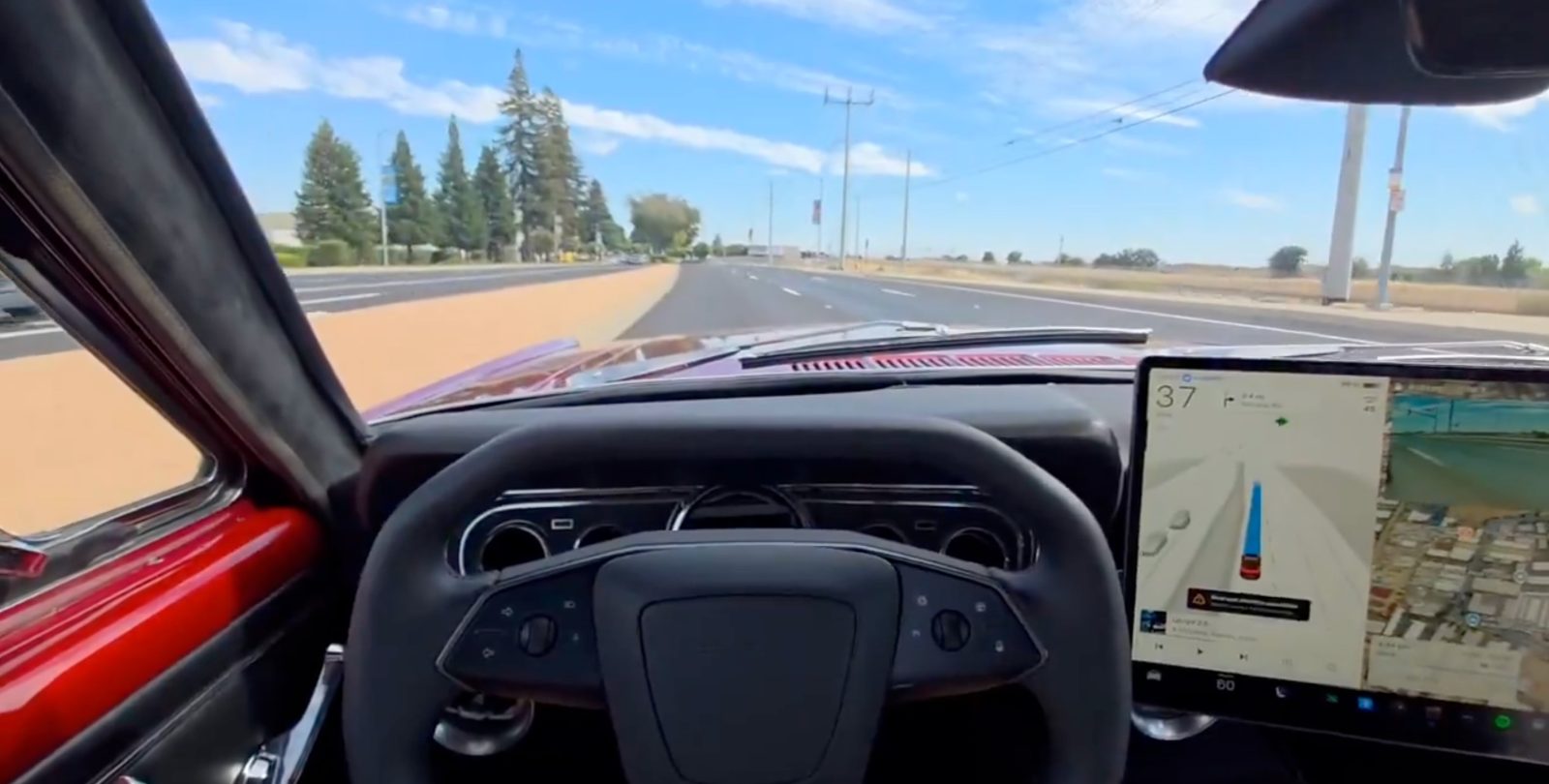
The Model 3 approach takes their unified rear axle (motor,axle,wheels) and mounts it into an existing frame. Then you just need to find a place to stuff the batteries, retrofit some high-voltage electronics, and you're off to the races. One of the drawbacks of that approach is that it changes the stance of the vehicle, but for this Mustang that doesn't seem to matter much - it still looks classic.
Other converters either go for the high end with a model S and fit the motor into a traditional drivetrain for a sleeper build, or they go for the low end and take an old forklift motor and batteries and build what is effectively a street-legal golf cart. Prices range from $5-100k depending on your level of DIY and how dangerous of a classic car you want on the other side of the process.
[1] https://coloradosun.com/2023/06/25/classic-cars-electric-veh...
While there is nothing wrong with converting your classic car to electric, if the powertrain is shot (they are harder to maintain as they age), but IMO, it looses the charm of the point of having a classical car.
Few years ago, there was a trend to do these conversions, but that stopped as people realised the car loses its charm and the feel of having old classic car, and most of them are not being used as dailies anyways.
EDIT: at one point whoever owned the name also owned a warehouse of spare parts and was going to produce an electric retrofit kit for the old vehicle, and hinting at manufacturing new ones a la retromod. Whoever owns the name now just has concept rendering on their site and a Solana token, so, little more than a meme coin now :(
I suspect that this might be more of a "Mustang body kit" on a Tesla chassis and not retrofitting the Tesla tech into a Mustang chassis + body. Still cool, but maybe misleading.
Unless I missed something, this is a completely unsupported claim by the article. Passion projects and retrofits are nothing at all like manufacturing.
This claim is implausible, right? The Mustang is unambiguously less aerodynamic than the Model 3; there's no way it is achieving similar efficiency, especially at highway speeds.

A Tesla auto parts shop owner in Sacramento spent about $40,000 and two years converting a 1966 Ford Mustang into a fully functional Tesla — complete with the Model 3’s dual-motor drivetrain, 15-inch touchscreen, and working “Full Self-Driving” (Supervised).
It’s likely the first non-Tesla vehicle to run FSD, and it achieves 258 Wh/mi — roughly matching the efficiency of an actual Model 3.
Yaro Shcherbanyuk, the owner of Calimotive Auto Recycling in Rancho Cordova, California, found the 1966 Mustang on Facebook Marketplace in the summer of 2022. Calimotive specializes in Tesla and Rivian parts, so Shcherbanyuk had access to the components — and the knowledge — needed for an ambitious build.
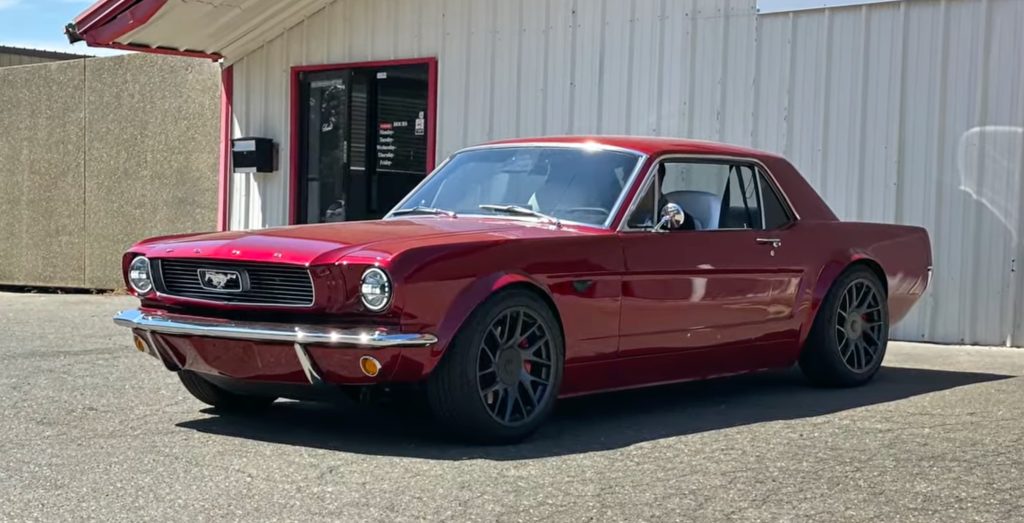
He worked on the project for roughly two years alongside his father Viktor and brother Daniel. The family initially considered fitting the Mustang with a Model S drivetrain, but once the car was stripped down, Shcherbanyuk realized the Model 3 battery was nearly a perfect fit.
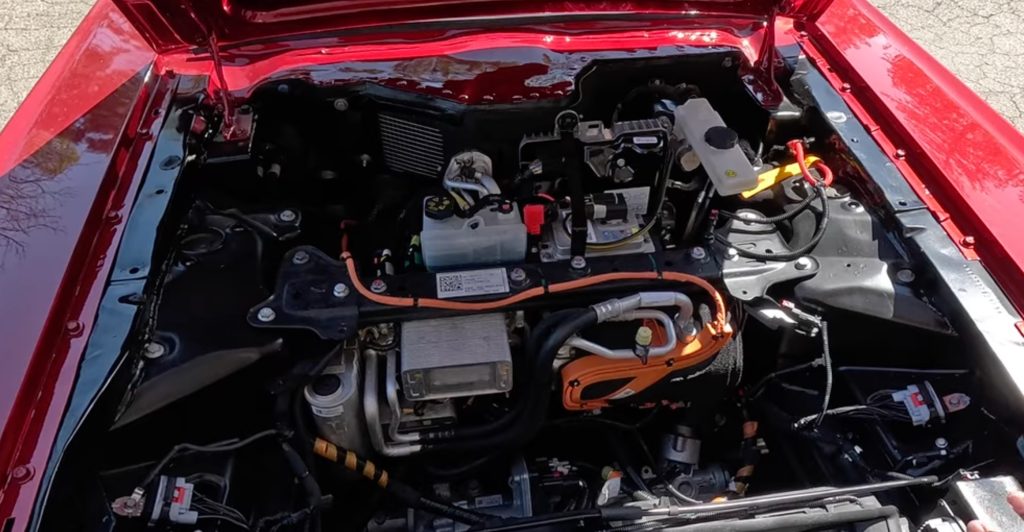
The team grafted three sections of the 2024 Tesla Model 3’s floor and seats into the Mustang’s body, shortening the battery case to fit without altering the car’s original dimensions. The result is a classic Mustang shell sitting on top of a Model 3 dual-motor setup good for roughly 400 horsepower and 471 lb-ft of torque — enough to push it from 0-60 mph in about 3.5 seconds.
The most remarkable part of the build isn’t the drivetrain — it’s the software. Shcherbanyuk retrofitted Tesla’s camera array onto the Mustang, enabling Autopilot, Sentry Mode, and “Full Self-Driving” (Supervised). The system reportedly works, making this what appears to be the first non-Tesla vehicle to actually run FSD.
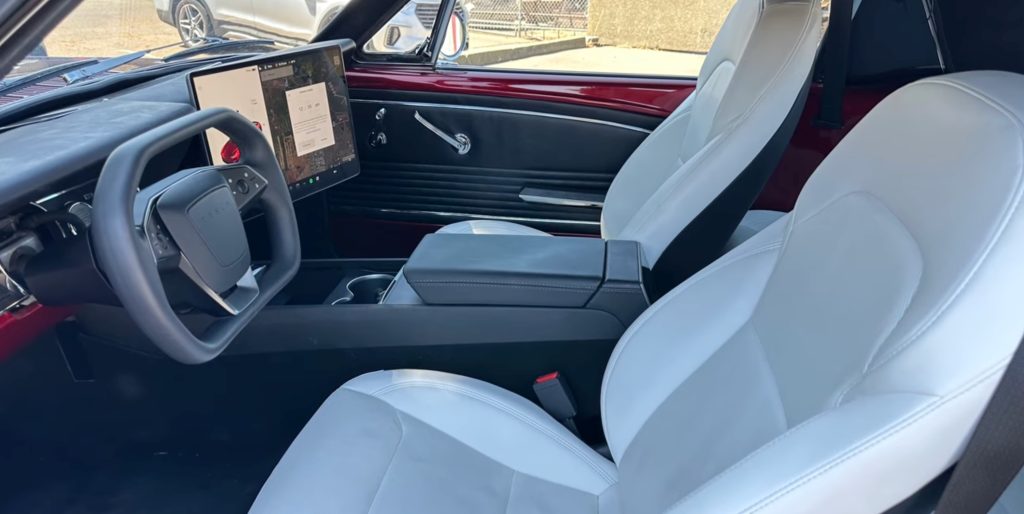
Inside, the Mustang features the Model 3’s 15-inch touchscreen controlling all vehicle functions and receiving firmware updates over the air. Shcherbanyuk also installed the Cybertruck’s yoke steering wheel and Tesla-sourced heated and cooled seats. The Tesla charging port sits where the original gas cap was at the rear of the car.
Here you can see the car using Tesla’s Summon feature:
During a test drive with Business Insider, the car showed 194 miles of range remaining at approximately 80% battery. Shcherbanyuk reported achieving 258 watt-hours per mile, which matches or beats the efficiency of a standard Model 3 — impressive given the Mustang’s less aerodynamic body.
The build is a passion project, but it highlights a few things about the state of Tesla’s technology. Elon Musk has talked about licensing “Full Self-Driving” to other automakers for years, but no manufacturer has signed a deal. Ford CEO Jim Farley publicly shut down the idea, saying Waymo’s system is superior. Musk admitted last year that legacy automakers simply don’t want FSD.
Yet here’s a small auto parts shop in Sacramento running FSD on a non-Tesla vehicle for under $40,000 in total project costs. It demonstrates that Tesla’s hardware and software stack is more portable than the company’s licensing struggles would suggest.
The project also speaks to the growing EV conversion market, where Tesla drivetrains have become the go-to for classic car builds. Companies like Arc Motor Company offer Tesla-battery-based classic car conversions starting at $75,000, making this $40,000 DIY build look like a bargain by comparison. The global vehicle conversion market was valued at $5.9 billion in 2024 and is projected to grow at 9% annually through 2034.
Here’s a cool walkthrough of the car:
This is one of the coolest EV conversion projects we’ve seen. Getting a Tesla Model 3 drivetrain into a classic car isn’t new — we’ve covered Tesla-powered builds ranging from Shelby Cobras to Honda Accords over the years — but getting “Full Self-Driving” working in a 1966 Mustang is a first, and it’s genuinely impressive.
The most impressive part, in my opinion, is getting Autopilot and FSD to actually work with what are inevitably different camera angles throughout the entire sensor suite. Tesla’s vision-based neural network was trained on data from cameras mounted in very specific positions on Tesla vehicles. The 1966 Mustang has a completely different body shape, roofline, and mounting surface geometry — meaning every single camera in the suite is sitting at a different angle and height than what the system was designed for. The fact that FSD still functions despite that is a testament to the robustness of the neural net, and it tells us something useful about how adaptable Tesla’s vision stack actually is to non-standard camera placements.
That’s relevant if Tesla ever does manage to license FSD to other automakers with different vehicle geometries – something it has tried to do for years, but it has yet to convince an automaker to get on board.

FTC: We use income earning auto affiliate links. More.
> it achieves 258 Wh/mi — roughly matching the efficiency of an actual Model 3.
Their recent videos showcase what they're doing in that area https://www.youtube.com/@ElectricClassicCars/videos
I would be surprised however if this project only cost $40,000, when you factor in the cost of labor and maintaining a facility to do this work.
A stock '66 Mustang hardtop had a curb weight below 3000lb, in the lightest configuration close to 2500lb.
Less mass to move will do a lot for efficiency just like aerodynamics will.
Of course, you will also die or be horrifically maimed in an accident in a 1966 Mustang that you might walk away without any serious injuries from in a modern vehicle.
old cars are bastards to drive. I have a softspot for a mark 2 VW golf. But its not fast, the steering is heavy and the brakes are utterly shite.
However, if I had the time and money, I would totally electrify a golf. it would be zippy quiet and hilarious to drive, especially without any kind of traction control.
However it would be fun.
Basically its like vinyl. It is a demonstrably worse format than anything digital(and other analogue formats), however it looks great. Sure you get lots of audiophiles waffle on about "warmth" and shit, but its all lies. they either like it because its how they think things should sound, or it looks cool. It is not a purer warmer sound.
same with backyard steam engines. useless but fucking cool
Watching my brother-in-law buy a 1971 Chevelle for his 16-year old daughter because she thought it looked cool only to have him sell it at a fat loss 3 months later because she couldn't choke down the gasoline fumes driving out of the school parking lot every day was instructive.
A project like this is to have a fun experience in a vehicle that was never designed to drive with electric qualities. I don't need the most efficient vehicle for my use so I could afford to trade some of that for fun. I'd probably try a Subaru Impreza STi because it would just be a blast to have a car of that size and stature with an electric powerplant under the hood (or trunk, or wherever it fits)
Personally I think it's pretty damn cool. But I have always been a Mustang fan, and I know that this era of Mustang is not especially collectable. They made quite a large number of them and plenty are still running.
so if you thought the waymo car rollout was fast and sudden, wait until companies no longer need their own training data, it'll be like a switch got flipped
People can easily adapt to different vehicles in a similar manner.
(yes, I will admit that a lot of that is for crash safety, but not all of it)
It could be that it’s physically impossible to master vinyl for extreme loudness, but whatever the reason is you can absolutely pick up a vinyl copy of an album and find it sounds much better than the streamed or CD version.
That's a good one. I'm partial to David Frieberger's "mobility blobs".
There's no question the first generation of Mustangs are the most collectible.
[1] https://www.hyundai-n.com/en/models/rolling-lab/n-vision-74
However, Tesla hasn't achieved anywhere near the autonomy of Waymo, so that may be the main sticking point.
I'm oversimplifying it here, but the macro process is taking some known attributes and mapping them to what you are observing. For example, if you can detect people, and you know the average height of a person, you can compute where your horizon is, and where you should (or shouldn't) expect to see people in the FOV. You can do this with cameras, lidar, etc. When you have multiple sensors you can do a lot more to have them all sample an object in their own ways and converge on agreement of where they are relative to each other and the object.
I see no reason that LiDAR couldn’t participate in a similar algorithm.
A bigger issue would be knowing the shape of the car to avoid clipping an obstacle.
It’s a trade off most manufacturers are not making because the US market is _so_ range conscious but I think it is fairly small margins we’re talking.
[1] https://electrek.co/2026/05/03/tesla-fsd-10-billion-miles-no...
My daily driver is roughly as old, has a 400 V8 with a 4-barrel, idles so quietly I've had passengers surprised that the engine was running, and gets around 20-25mpg if I resist the urge to open it up all the way.
oh very much so, it would be much easier to do that way, cheaper too.
But I don't think you do this for the ease of it, you do it either for the challenge, or to overcome some blocker (like parts shortage, or the engine is knackered.
> means you have to avoid steering at a standstill
ha! yeah, I still do the creepy and turn, even with the modern cars that I drive. I also still have a strong clutch reflex when driving automatic/electric
At some point, with enough sensor suites, we might be able to generalize better and have effective lower(?)-shot training for self-calibration of sensor suites.
https://www.caranddriver.com/news/a70420085/tesla-drops-auto...
From videos I see on YouTube, I’m struggling to think what is not Full compared to—at a bare minimum—the bottom 10 percent of drivers on the road.
Don’t you have to?
What car can I buy in the US today that's as good as the latest fsd?
Try sitting in the back seat or even just acting like a passenger and you'll see the difference very quickly.
Tesla set their own benchmark, their own goal posts, and their own timelines.
In 2016 Tesla said, "as of today, all Tesla vehicles produced in our factory – including Model 3 – will have the hardware needed for full self-driving capability at a safety level substantially greater than that of a human driver.":
https://electrek.co/2024/08/24/tesla-deletes-its-blog-post-s...
https://web.archive.org/web/20240730071548/https://tesla.com...
That was, of course, a lie. Tesla has spent the last 10 years lying about the state of FSD. Tesla keeps claiming FSD will be achieved "next year".
What about 1 million robotaxis on the road by 2020: https://www.thedrive.com/news/38129/elon-musk-promised-1-mil...
More lies: https://en.wikipedia.org/wiki/List_of_predictions_for_autono...
But you knew all that already. Defending a decade's worth of lies is intellectually dishonest.
On a Tesla, it's not even an FSD-specific feature. Autopilot does it.
I'd love to see good competition in this space, but it seems Tesla has a healthy moat.