Unfortunately, it sounds like the article's author is only on their first step of this realization.
Good example of how people can build identities through their brand choices and purchasing habits.
It’s a foreign concept for many of us who seek out the best product or deals for each purchase and will change brands in an instant if another company releases a better product. Yet the crossover between brands, identities, and lifestyles is deeply held by many people.
I know some will try to turn this into a criticism of Americans, but in my travels and international business experience I wouldn’t even rank Americans in the top 10 for integrating brands and identity. In some countries I had to make a conscious effort to try to wear clothes from acceptable brands and swap my functional laptop bag for something more stylish to avoid letting my purchasing habits become a point of judgment from others. It’s actually refreshing to come back to America where as long as you’ve made some effort to look more or less appropriate for the occasion few people care about the brand of your clothes, laptop bag, or car. Some people are proud of their Audi or designer bag, but I rarely run into situations where I’d be judged for arriving in a sensible Subaru instead of a Mercedes.
- No aisle signs or labels anywhere. I understand the retail strategy here but the lack of efficiency in MY experience kills me. Clearly they can't move the bakery, or meat department. But after ~5 visits I still have no idea where some basic products can be found.
- Who is buying a kayak, or shed while shopping for groceries?
- I continually make the mistake of going during the weekend when it is the most packed store on Earth. There were no less than 3 Cybertrucks in the parking lot.
I don't have the "must-buy" item yet, but every time I go, I feel like I need to take a nap after.
Whole Foods: eye-bogglingly expensive (and no, I don't think it always was)
Wegmans: substantially more expensive than a few years ago, and a noticeable decline in produce quality
Trader Joes: incredible value on many prepared foods, but not the best source for staples like rice or paper products.
Costco is not inflation-proof by any means but they have pretty much 0 margins and they're reliably the best value on just about whatever they sell. The selection can be limited in some ways compared to a supermarket, and they can be a bad place to be health conscious (as it can be hard to resist massive containers of ultra cheap and delicious treats of various kinds) or to try to try to be an ethical consumer (and please spare me the HN cynical line on this, I get it, I have no real agency and I'm pathetically guilt-ridden): I've read bad things about their meat sourcing, they rarely have coffee with bona fides like fair trade or shade grown, I see controversial products like bird's nest soup, etc.
It is kind of fascinating, having come from such a culture, to realize that in the end, Americans, at least the average of the America I met, are not nearly brand conscious as I and everyone in my place supposed them to be.
Of course, America is a fucking giant and diverse place, and I think that even native born Americans have no fucking idea of how many different Americas exist, so, take my views of America with a giant grain of salt.
Unfortunately I think America is starting to lose this way a bit, with the influx of newer premium brands and the fracturing of American consumers into endless lifestyle personas. But there's still some truth left in it.
Costco itself, in a way, is a sort of Wittgenstein's ladder, or Wittgenstein's warehouse, because eventually you realize that everything sold under the Kirkland label is just a de-badged top brand. If you still reach for brand names for staple goods at Costco knowing full well the Kirkland product is either the same or superior, then you know that the shadows of brand names still haunt you and occlude your sight. When you are able to escape these shadows and see the sun, then you are free.
You can't just say this and leave us hanging. Which countries?
I happily pay more at places like Publix to -not- have to do that.
https://www.costco.com/p/-/kirkland-signature-organic-ethiop...
https://www.costco.com/p/-/mayorga-buenos-das-usda-organic-l...
I have no idea why do they not sell these(light roast) ones in warehouses.
Agree their prices have gone up in general though.
And then Disco 2000 was written about Deborah Bone, childhood friend who was a mental health nurse (who helped form Step2 and created the Brainbox), and said the only thing inaccurate about the song was that her home did not have "woodchips on the wall". She said, shortly before she died of myeloma, that she "did grow up and sleep with Jarvis Cocker, somebody had to, and it was perfectly innocent" (I think the implication is that they fell asleep together).
Not of any great relevance. I just see myself as a collector of information that might only be useful for music trivia nights...
> foreign concept for many of us who seek out the best product or deals for each purchase and will change brands in an instant
But you are, yourself, defining yourself partially here through your own purchasing habits. In fact you are doing it to a far more universal degree than most of the ones you criticize.
Not that I'm immune to it, but nor do I claim to be. I think it's useful signal just like anything else. Watch: My quintessential American habit is that I wear roughly the same nondescript black T shirt, black boxer briefs, black socks, and maybe an unlabeled black hoddie that I purchase off of Amazon, mostly just sorting by ratings. If at any point I reach into my closet and the stock-flow system that is my laundry habits have deemed it such that I am actually out of stock of any of these items, I immediately go to Amazon and purchase another 6- or 4- or 12-pack. If you feel you understand me better as a person after reading all that, you probably do.
I feel like logos are 100% done now.
The best clothes here in Sweden, from our own Swedish brands, have no logos. And have not been for a long time. Scandinavian minimalism and quality is the best.
Asia is the one obsessed with brands. Europe is not. We care about quality.
Can you give a few examples of those brand-centric cultures? Which product categories do they follow? I've never seen anything like this, so if I were to go to one of the places that has this culture, I should probably know about it in advance.
When I find myself reading Consumer Reports or The Wirecutter looking for "what is the best toothbrush" it's not that I actually need the best toothbrush. I'd be perfectly happy with a good toothbrush. What I'm trying to do is avoid spending a bunch of money on something that looked like a good option and turns out to be ineffective, unreliable, short-lived, or otherwise terrible. Most retailers are absolutely overrun with trash now.
Generally at Costco it's not a worry, if it's a crappy product they're not selling it.
Unfortunately, they have people like that everywhere.
—Death Cab for Cutie
I love Wegmans for most groceries but their checkouts seem to be getting worse.
My takeaway is at certain income level and lifestyle, one can have all memberships but don't find use of any.
IMO H-Mart is the safest bet in the Boston area for high quality produce (outside of farmers markets, natch)
Publix' pricing is obscene though.
Also, this may be my own bias coloring my perception but there was a palpable undertone among some of the shoppers of “at least we’re not Walmart customers”.
I’m sure quite a few Costco members enjoy the treasure hunt model they offer but I’d much rather have an option to order online and go pick up what I need or, failing that, labeled aisles.
To Costco’s credit, though, they refunded my membership fee in full as soon as I asked to cancel. And their return policy the one time I had to use it was exceptional as well. It’s a shame the rest of the experience has to be such a sensory overload.
Speaking on BBC Radio 4’s This Cultural Life (via The Mirror), Cocker addressed claims that the inspiration was Danae Stratou, a Greek woman who attended St Martin’s at the same time as Jarvis, but confirmed that “it wasn’t her because she had blonde hair and the girl had dark hair.”
https://www.nme.com/news/music/jarvis-cocker-is-on-a-quest-t...
It's not the kind of place where you go in with a shopping list, make point-to-point pickups and then checkout.
I'll join on an occasional trip if I feel like it's a chicken month, but ultimately it seems like a place designed to make it as easy as possible to spend more than I normally would on large amounts of mediocre or bad food and products. It's not remotely a natural optimization of my normal buying habits.
Ironically, I do have a must buy item though, which is the plush blankets.
It makes way more sense to me to just always have a backpack and pick up a few items at a time from smaller shops or other chains, and pay to live closer to these places
I think I've gotten the hang of it fairly well. Coffee is over by the coolers but not in them, cat little is on the back wall, specialty cheese is near the meat, Kirland cheese is near the end of one of the coolers, cheap winter jackets are somewhere in the middle between the pants and the tortilla chips, motor oil is at the far right, bread on the left near the old people, and the big expensive life-optional stuff is at the front.
Everything else is either on the way between those points, or it doesn't exist today (because even if it is there, I'll never find it).
Seems good enough for now.
Who's buying groceries while kayak shopping? The point is if you want to buy something, you can go to CostCo. The thing you want might be groceries, but sometimes people want other things.
I saw someone leaving buc-ees at 10:30pm who just purchased a huge fire pit and was franticly trying to jam it in the back of a large chevy. I can only imagine they went for stacks due to the poor planning
And yet somehow, with first 3/4 of this sentence, you've given a more accurate story about America than is almost ever provided!
I've been around a good amount of the US and yeah, being very judgey on brands just doesn't seem to be much of a thing. Maybe if I hung around rich people it'd be different, but I do know some rich people and they typically don't seem to give a shit either.
I don't find it unfortunate, but I also think this is a bit of a misdiagnosis of the problem.
Coke is a bad example of this because it's mostly unchanged (and when they did try to change it, it became infamous. The "new coke" change). For almost all other american consumer products, the old time well known brands have decided to cut corners and cheap out on production. It's particularly obvious with restaurants where so many of the old chains have moved over to pre-prepped microwaved foods instead of actually cooking in house.
Americans have learned that brands can't be trusted to maintain quality. If a company can get away with it, they'll use any sort of deception to raise the price or cheap out on the ingredients. And they relied heavily on "it's X brand" to keep selling the lower quality goods.
That, IMO, is what's driven americans to brand fracture. People have learned that for a lot of clothing there's no difference between what they get from Temu and what they get from Old Navy. In fact, there's a real good chance those goods were made in the same factory.
I had a recent conversation with a colleague out of SE Asia and it was surprising to me how little access they have to a diversity of product. For example, I was describing my homelab which uses a lot of Minisforum hardware (mostly due to size constraints) and I found out that, despite literally being geographically closer, said product could not be purchased in their country. So I would imagine that leads to more homogenization than what might occur in the States. But that's just my ignorant conjecture.
What are you having trouble finding, out of curiosity? In my Costco everything is pretty much in the same general area. They might move stuff a little bit, but it's pretty consistent.
> Who is buying a kayak, or shed while shopping for groceries?
I see this as separate trips for the larger items. Nobody is buying appliances either when you buy meat or paper towels. Also, Costco never fully replaces a full grocery store in my experience. You just don't need things in the sizes they sell them for many goods. Certain foodstuffs are really designed for restaurants and not people. Like, who is buying the 40 lb bags of flour besides people VERY into baking or restaurants?
And the worst part is, I regret it. We need a greenhouse now and greenhouse prices are through the roof! I can't afford NOT to impulse buy a greenhouse at Costco 18 months ago now! I'll never make that mistake again.
What you wrote sounds intelligent but belies an ignorance of the business model.
But 5% cash back on ($70*52=)$3640 means I get $182/yr by default back to cover the $130 annual cost of the executive membership. Doesn't sound like a good deal until you also factor in that their fuel is typically 10 cents a gallon or more cheaper than the next least expensive fuel place, which means that for my roughly 650 gallons of fuel a year baseline costco gas saves me an additional $65.
So yeah, nothing really amazing, but the fact that having the membership lets me pocket something in the neighborhood of $120/yr on top of the occasional shopping trip and access is nice.
For things that are acceptable, it’s usually hard to beat Costco. You have to give up variety, possibly brand choice, and maybe even buy more than you’ll use, but it works out to be significantly cheaper. There are categories, however, where Costco is never the cheapest (soft drinks) or where the commodity store brand is significantly worse than alternatives (batteries).
To say that "the richest consumers buy essentially the same things as the poorest" by using Coke as an example is a significant oversimplification and is cherry picking examples to prove a point. The richest consumers buy plenty of consumer goods that the poorest cannot even dream of buying or even renting.
If there was a truffle-infused Coke with edible 24k gold flakes that cost 10x as much (and actually tasted good) you can be sure pretty much only the richest consumers would be drinking it, and that everyone who couldn't afford it would be doing everything in their power to keep up with the Joneses.
What percentage of "the poorest" own their own home or go on international trips more than once a year let alone owning multiple homes, luxury cars, and private jets?
Speaking as an American with a formative decade overseas, I think some of that may come from the economics of international trade.
People think about a faraway place based on what gets transported and sold from there. If a country's most-visible exports are gourmet food, you'd start thinking that perhaps the average resident is a gourmand. In the case of the US, those "cultural exports" often involve branded goods, copyrighted media, food franchises, etc.
Another thing on the top of my mind is oatmeal - I’m not a oatmeal connoisseur but I can’t taste the difference between the 5-10 types of oatmeal in the store, not that I’ve an active choice to try them. Do we need that much diversity in oatmeal choices?
And so on and so on.
This is an interesting take. Spending hours min-maxxing the "best" combination of product/price in every given category has always been peak consumerism as an identity to me. Subreddits filled with tens of thousands of posts and strongly held groupthink opinions about why knife brand x is the best option for you to open your amazon packages, or how much you need to try the new mechanical keyboard switch collaboration, deep dives on wirecutter, waiting for the right sale, etc.
I go to costco because I don't want to do any of that for my groceries and basic home needs. I need oil for my car this weekend, and beer and burgers to hang out after I'm done with it. I don't want to spend 10 hours reading about the best 5w30 oil (or should I get 0w20?), I want a high-quality option at a fair price.
If we're dropping random trivia it should probably be mentioned that her husband is https://en.wikipedia.org/wiki/Yanis_Varoufakis
Witness Erewhon fruit juices/smoothies.
... which often mirrors my feelings in Costco, particularly near the registers, where oftentimes in my local stores it feels more akin to the Thunderdome.
Whoever told you to go at noon on a weekday was pulling your leg. That's when all the peeps with jobs go to shop and get a quick lunch on their lunch break. It's always packed then.
At open on a weekday is usually pretty good, but 30 minutes after open might be better (if you've got the executive membership with an exclusive hour, then be sure to go then). Never go on the weekend, unless maybe 30 minutes before closing, if you know what you want and where it is. Or you can probably go during the super bowl, but not before or after. Double don't go on the weekend before a weekday holiday.
Coke is a great example. There’s no product more useless and unnecessary than that flavored fizzy sugar water. Or should I say, high fructose corn syrup water. If you drink it, why? Probably because you were indoctrinated since childhood. Same goes for pretty much all fast food. There’s nothing good or desirable about any of it unless you’ve been indoctrinated into thinking that.
The mantra was sell more, more, more and more, and to do that, you need to sell things to poor people to. A French enterpreneur would be happy selling phones only for the upper middle class and above. In America the idea was to install as many landlines as possible and gain with scale.
I get my beans for my summer cold brew at Costco, but my typical pour over beans elsewhere.
Five employees couldn't find the macarons (I found them next to the raw chicken!?)
The snack bars are being moved around. Now some of the ones we buy are with the toothpaste!?
My wife asks me to pick up some sort of caffeine product. There's three spots they could be in she tells me to look. Sometimes that doesn't work either.
We're considering cancelling. We don't drive much and our vehicles are electric. Not a lot of extra money for their vacation packages.
you'll get a kick out of this. one concrt hall i went to recently was charging THIRTY THREE DOLLARS for a single shot of Whistle Pig. Not even the good stuff.
When a company can make more profit by catering to the ultra-rich-only than selling a quality mass-market product at a reasonable price to masses, that says a lot about the economic segmentation of those masses.
(And for servers and other business machines, well, other criteria apply, but owning something in the Top500 has to count for something in terms of prestige.)
Admittedly that’s because he’s an overgrown child, but what the hey.
Eating a hot dog and a slice, or two slices, and I won't be hungry...for an hour or two.
...I need to get a doctor and ask about a GLP-1.
This is in food grade air tight sealed buckets so ymmv.
1. appliances/bedding/toothbrushes 2. alcohol 3. refrigerated foods with the bakery/meat department 4. cleaning products and flats of drinks 5. dry foods
when this cycle is broken or changed in a different Costco I am visiting, I feel VERY lost
Costco carries one or two options for a given thing, and are outright missing many things you might want. As nice as Costco is for buying things on a budget when you're going to use them up fully, I think it would be a bit of a challenge to make them your only grocery source. Doable as a sort of self-imposed challenge, no problem, there's certainly enough for that, but you'd be missing a lot of things, and/or wasting money on huge quantities of things you won't use. The quality is generally pretty decent (I may have more brand loyalty for "Kirkland" than almost any other brand) but not necessarily the most premium options. If you are the type to even consider the specialty shop in the first place you're more likely to be unsatisfied by Costco than a grocery store.
There are still plenty of produce stands, bakeries, and butcher shops in the country. Most of what was driven out of business were small bodega-style corner stores.
And note how the modern Democratic Party - the originators of that law back in 1936 - utterly failed to give a crap about the issue.
Long ago in undergrad I took a retail marketing class and we did a field trip to Costco; the GM told us it was part of their policy to rearrange parts of the store occasionally so that you had to browse the entire place to check off your shopping list. This increases the likelihood that you stumble across new products. So it’s this combination of “best price/quality without decision fatigue” plus some impulse buying that works for them. The fact that they are figuring out the price/quality trade off for you up front probably also makes it easier to impulse buy with fewer regrets.
South Korea is one example that I have intimate knowledge of where one's consumer habits (the clothes one wears, the car one drives, the logo on one's handbag) is the ultimate signal of status.
You're automatically pre-judged by complete strangers without having to say a single word.
There are always exceptions to the rule, but it is in fact an unspoken rule over there.
You know it's decent at Costco or you can return it in a few months when it craps out.
The things where you notice the money are private planes and nice houses/apartments (and multiples thereof) and art. And perhaps caring even less what people think of them.
Ah, that's too harsh.
Sugar water tastes good. Fast food is made quickly and it tastes good. There's no "indoctrination" that happens to make people realize that.
I agree that coke has 0 nutritional value. However, the flavor is agreeable to most people.
Kirkland batteries actually last longer than Duracell. They're some of the best alkaline batteries you can get, especially considering the price. Sure, lithium batteries will last longer, but the mAh per dollar is lower, so they'll still cost more.
I think it's important to call out that the "capitalism = more stuff" idea is a bit of historical revisionism.
Soviet leaders very specifically saw the goal of Communism was to create abundance and a post scarcity society. There are lots of quotes in particular from Khrushchev about this:
“The socialist system will outstrip capitalism in labor productivity. It will provide the people with more goods, more cultural benefits, and ensure a higher standard of living.”
“Communism is the highest form of organization of society for labor. On the basis of powerful productive forces, it ensures the highest productivity of labor and abundance of material and cultural values for the whole people.”
And it's worth pointing out that that this isn't a Soviet invention. Marx himself made it a central point that material deprivation was an ill (not a feature) of captialism:
"After the productive forces have also increased with the all-around development of the individual, and all the springs of co-operative wealth flow more abundantly — only then can the narrow horizon of bourgeois right be crossed in its entirety…”
“The possibility of securing for every member of society, by means of socialized production, an existence not only fully sufficient materially… but guaranteeing them the free development and exercise of their physical and mental faculties — this possibility is now for the first time here.”
When communist abundance failed to materialize, there was a concerted effort to reframe the promise of communism to be purely one of egalitarianism and turn overconsumption against the West as a criticism.
24 pack of v8 Energy Drinks are super cheap at Costco, usually $13.49 versus $17+ at other retailers.
The implication is the lack of a rigorous class hierarchy in America. Not that the rich don't live different lifestyles or consume more. But that niche luxury products were considered effete and un-American.
(Andy Warhol was almost certainly also being ironic - that the richest people in America publicly shared the same trashy taste as average Americans).
The closest analogue today might be an iPhone. Rich or poor, if you want the "best" phone you have an iPhone. Sure, there are gaudier and more expensive phones out there. But you're essentially using the same product as the richest Americans.
The sabbath was always meant for man and that makes a lot of people very angry because whatever ideological or religious lip service someone gives their behavior demonstrate they hate man, or more subtly, love mankind like dollars in their pocket, stripping humans of their humanity.
This mendacious attitude is also a major driver of enshitification.
The internet and executive social distancing has made a huge swath of people lose touch with how unique individuals are, so they treat humanity with the bigotry and coldness that the law of large numbers has lead them to, which is ultimately very mean.
May 5, 2026
I Want to Live Like Costco People
I resisted the siren song of Costco for much of my adult life. This has increasingly made me feel like an anomaly: it is the third-largest retailer in the world, with an estimated 30% of Americans over the age of 18 holding membership cards. And this cultural penetration is amplified in certain regions. The Pacific Northwest is Costco country. The city of Kirkland, Washington, of Kirkland Signature brand fame, is around half an hour from my hometown of Tacoma, and there are no fewer than eight Costco locations within a short drive of the city of Portland, Oregon, where I live now. Maybe it was turning 40, or buying a house, or doing any number of the rites of middle-life passage (microdosing psychedelics, getting into jam bands, establishing a primary care physician) that have marched me inexorably toward the great parking lot of dreams. I am now, for the first time in my life, a card-carrying, dues-paying Costco member. There’s no distance left to run.
But my acquiesce wasn’t without at least some resistance. Something about the whole thing always registered to me as, like, lame—too normcore, too boring, perhaps even too cheugy to an informed and taste-driven millennial ur-consumer like me. The kinds of brands I like to buy aren’t what they sell at Costco, or at least that’s how my thinking went before piloting my first oversize shopping cart. And yet there’s nothing quite like staring down a little jar of tinned fish whose price has been marked up at the local curated mercantile to break you of this cognitive pattern. It is a jarring thoughtscape, remarkably compelling and nondiscursive and utterly hard to shake. You know the one—that sinking moment, the one that comes with the same lurching inevitability as death and taxes. I’m pretty sure they sell these same Fishwife spicy tuna tins for half the price at Costco!
Embracing the Costco lifestyle means accepting the fact that I am, in many ways, becoming my father. This is an old idea, both Freudian and Kierkegaardian—the belief that we are all destined to embody learned characteristics and habits passed down from parent to child. I remember my father’s Costco order from the ’90s perfectly, because it made up the regular contents of our kitchen growing up. The blueberry, poppy seed, and chocolate muffin multipack, the white chocolate macadamia nut cookies, the bulk powdered superjar of Gatorade concentrate. But I can recall almost nothing about actually visiting the place with him. My dad loved Costco so much that I think he liked to keep the act of visiting as a pleasure solely for himself.
You shift into Costco mode somewhere at the ten-minute driving mark. They’re always in far-off places, and so the last ten or twenty minutes of the drive feel like a rush, like how people talk about getting high on the way to the drug dealer or getting off the plane in Vegas to the ding-ding-ding of the Buffalo Gold machines. The bakery muffins really are smaller now than I remember them being as a kid, but those white chocolate macadamia nut cookies are still exactly the same. And so is the building, an aircraft hangar–size warehouse spectacle operated very much in line with casino design: a place with no outside source of light, randomized reward experiences (part of what’s termed “variable reward frequency,” a central tenet of gambling psychology), and an internal sense of economics that makes it startlingly easy to lose track of money.
Like a lot of married couples, my wife and I maintain a regularly updated shared Google doc for Costco shopping as a form of domestic ritual. Anecdotally, it’s my belief that every Costco shopper has a certain item or two they’re compelled to purchase on each visit—I think it’s very likely you, while reading this, are nodding your head and thinking about your own nonnegotiable Costco pickup right now. Here are ours: the five-pound brick of Tillamook cheddar cheese (my daughter will consume the entirety of this over the course of one month), the large tray of cocktail shrimp (I will personally consume the entirety of this in around 48 hours), a flat of assorted LaCroix or Polar Seltzer or mineral water (my tax guy says I can write this off as a work expense), and a pack of turkey and Swiss cheese pinwheels (my wife’s favorite).
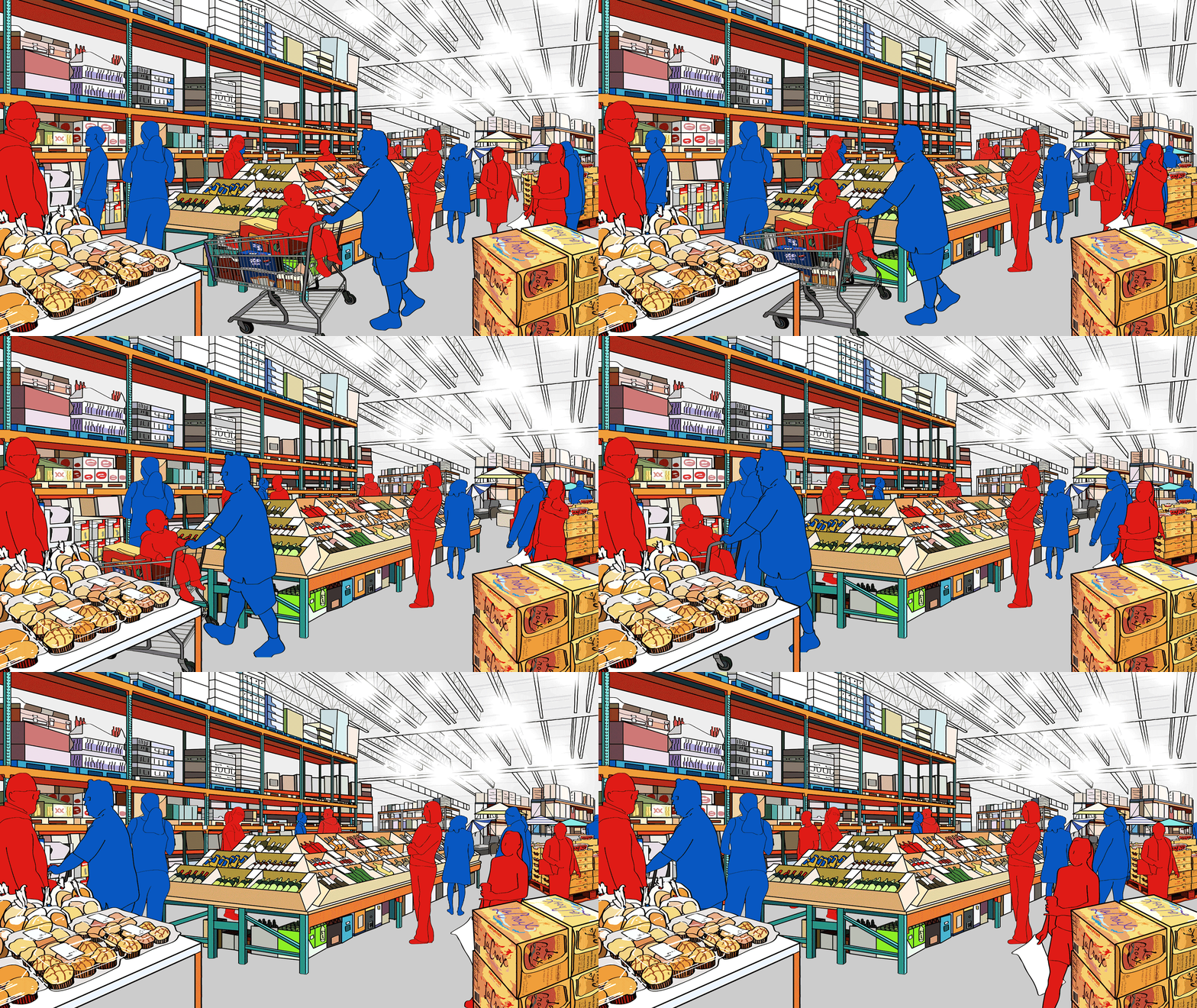
One encounters a thousand and one stories observing the swath of humanity at the Costco, amongst the realm of the Costco people, doing whatever Costco people do. Here we find the well-to-do and the hoi polloi, kings and paupers, the nearly dead and the very recently born. It starts in the parking lot—there’s a man rolling his cart with a single bottle of margarita mix in the child seat—and continues through the membership-gated doors. Here’s a young couple playing house; here’s a pack of families with unruly kids. There’s a man wearing a US Air Force Vietnam Veteran hat; a man wearing a hoodie that says “Moral Monkey”; a man in a full Adidas tracksuit in the style of Christopher Moltisanti.
I observe a woman so lost in the allure of the frozen food aisle that she crashes her cart into the side of a warehouse concrete pole, laughs, and apologizes to no one in particular. We see the elderly, the bent over and infirm, the drywall hanger and HVAC installer types wearing their full-sunblock Ray-Bans indoors. I begin counting how many different languages I hear on this visit; the final count is something like eight, depending on whether the last one was Ukrainian or a Russian dialect I’m unfamiliar with.
Every phase of life can be shopped for at Costco. Where else can you purchase a wedding ring, a baby carrier, and a casket? It follows your own life story—one does not experience Costco the same way before and after owning a home, or before and after having a child. My wife and I recently purchased our first house, and never could I have imagined feeling so drawn toward the allure of outdoor furniture: palapas apropos, gazebos akimbo.
The stores are also intensely localized, as reported previously in these pages by Priya Krishna. Here in Portland, that means products for the upwardly mobile and extremely online: an endcap dedicated to Graza olive oil, Vital Proteins collagen peptides, myriad formulations of imported ramen and cult Korean skincare products. Truly every health halo, diet trend, and burgeoning eating disorder can be shopped for here, and sometimes these products even sit across from one another in stark post-ironic relief, the double box of Cheez-Its staring down a 4.25-pound bag of whey protein isolate, locked in an eternal battle for health-and-wellness mindshare.
Contrapuntal to the list of things we must buy on each visit, there is perhaps a more controversial list, which is the inventory of items I will never purchase at Costco. Maybe this is a hangover from my younger, more disdainful days; this is my list and mine alone, and while you can make determinations about my character from it, I ask that you please do not judge me. I will never buy Costco coffee—I know too much about coffee, and my allegiance to a coterie of indie micro roasters (Yes Plz subscription for life) and esoteric brewing methods has ruined me for life from enjoying the simple pleasures of a Kirkland Signature K-Cup pod.
I will never purchase Costco clothing, flowers, or wine, even though I’m well aware there are some deals to be had ($219 for a bottle of Dom ain’t bad). I don’t like the chicken—buying expensive farm-raised chickens long ago reset my palate—and I don’t like the prepared taco dinners, which I did buy once and swore to never do again. Yes, this makes me a snob; even within the vast democratization of Costco, there are snobs. I also think there are certain items that make no sense in large formats. I love Adams crunchy peanut butter, but an 82-ounce jar is so massive and petroliferous with oil that you’d need a paint mixer to properly incorporate it all.
I observe a woman so lost in the allure of the frozen food aisle that she crashes her cart into the side of a warehouse concrete pole, laughs, and apologizes to no one in particular.
The scale of items at Costco sometimes demands we answer questions beyond easy comprehension. Do I *need* a 300-gram bag of premium orange chicken puffs? What the hell even are premium orange chicken puffs? (They are a “premium rice and potato flour” snack, flavored in the style of an orange chicken entrée.) I’m open to the concept of a yuzu citrus snack nut mix, perhaps to enjoy beneath my new Costco palapa, but do I desire three whole pounds of it? Every time I go to Costco, I stop and look at the 62 ounces of peanut M&M’s, and I think of my father, who loved to purchase this snack in bulk. I do not purchase the M&M’s for myself, but I do often take a picture—sometimes to text my mom, so we can remember Dad together for a moment, and sometimes just to keep for myself.
I wonder about everyone else in Costco, and if they’re having moments like this as they shop. The guy in the army fatigue pants and the Premium Landscapers hoodie, the mom wearing a pair of worn-out On Clouds, the solo adult men with AirPods in (also sold at Costco), listening to God knows what podcast: Are they thinking about a dead relative’s favorite Costco items, too? Some of us are crying in H Mart; some of us are mourning in Costco.
Employees typically leave you alone at Costco, which is appreciated in moments like these. There are, of course, the friendly free-sample elders serving bites of gyoza and apple chicken sausage, and the teenage staffers symbiotically clearing their trash of little paper cups, but otherwise you are rarely confronted by the staff here, and I like that.
It’s getting near closing time, and I notice a young woman and a young man in their Costco employee hats sharing a moment together on the patio, or rather, in the patio furniture section. She’s reading a novel; he’s scrolling on his phone; they look radiant together there beneath the dim halogen glow.
Every cycle of life takes place in Costco, so why couldn’t you fall in love? I’m sure it’s happened. Love finds a way. I walk past them once, trying to figure out what she’s reading for reportorial purposes. Maybe it’s a great novel. Maybe some philosophy. I pass again, trying to be low-key about it, peeking at the top of the page. They used to sell novels here, but the books section at Costco was shelved in early 2025 (limited availability has returned to some stores). It’s a novel called A Voice in the Wind by Francine Rivers, which the internet tells me has never been sold at Costco retailers. She must have brought it from home.
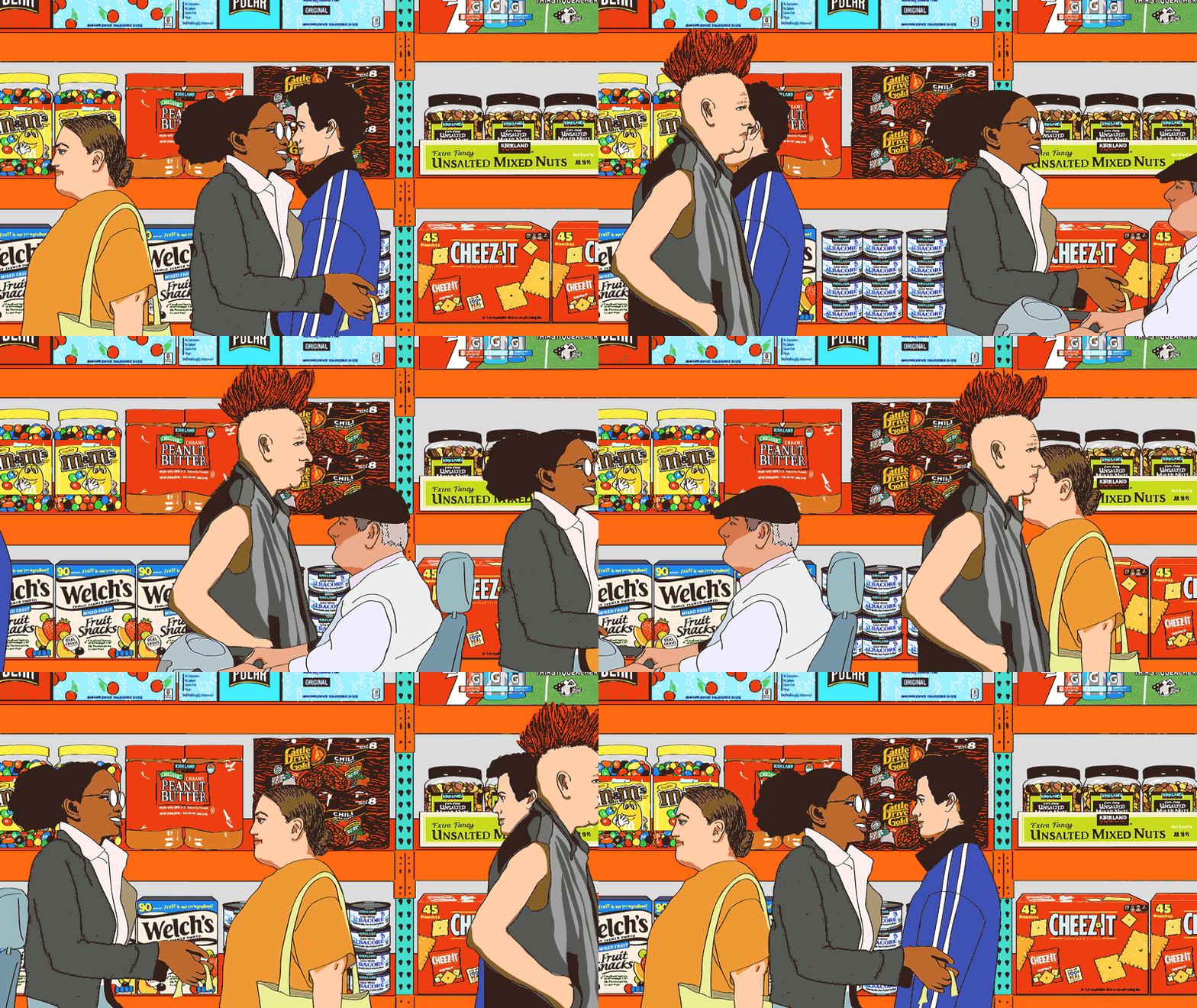
It’s the last call for samples, the last call for audiology appointments. A growing number of Americans satisfy some portion of their critical health care needs right here at Costco, including my mother, who went in for a hearing exam at her local Costco a few weeks back. I snag a final plastic cup of Welch’s gummy fruit snacks. They’re shutting down the ravioli morsels. Sunrise, sunset, but the lighting never changes inside Costco. I make one last pass through the produce room, which is chilled to a degree that becomes uncomfortable after a few minutes but then makes the rest of the store feel downright pleasant the moment you exit. I’m checking the last few things off my list; so are the blue-haired punks and the skinny dude in a Rick and Morty T-shirt and the driven grandpa on his mobility scooter, charging past me in the direction of the paper products.
I stop at a large endcap display proffering huge tubs of cabbage kimchi next to huge tubs of sauerkraut. No matter who we are or where we’re from, at Costco, we’re more alike than we are different. There’s no such thing as the real America, but if there were, you’d find it here. And you’ll find me here, too, for I have become the Costco person I was always destined to be, preordained by geography and epigenetics, nature and nurture. Yes, I’d like a box to take my groceries to the car. I’m pretty sure all this stuff will fit.
Get our freshest features and recipes weekly.
Jordan Michelman is a James Beard Award-winning journalist and author based in Portland, Oregon. His work has appeared in The Los Angeles Times, T Magazine, Portland Monthly, Eater, Noble Rot, and Sprudge, the international coffee and wine publication he co-founded in 2009. His debut book, The New Rules of Coffee was released in 2018 with Ten Speed Press. jordanmichelman.com
Also, most flour lasts well past the 12 month expiration just fine. Barely a need to freeze it.
They mostly exist now in a different form as gas station markets, or in dense urban areas like NYC, or some central business districts.
From the article on the Act -
"Enforcement of the RPA has declined since the 1980s. In 2022, FTC commissioner Alvaro Bedoya endorsed a revival of enforcing the RPA in order to curb price discrimination. In April 2024, sixteen members of Congress wrote to the FTC urging for a revival of the enforcement of the Act. In December 2024, the FTC sued liquor distributor Southern Glazer's under the Act, asserting that they charged small stores more than they charged large chains. On January 17, 2025, the closing days of the Biden Administration, the FTC filed a lawsuit against PepsiCo. In May 2025, The FTC voted to dismiss the PepsiCo suit but the suit against Southern Glazer's is proceeding."
It's a low bar but the Democratic party has given more of a crap about it than anyone else.
> there were hordes of people standing lifelessly in a huge line waiting to check themselves out
Where are the retail experiences where people waiting to checkout are expressing an abundance of joy in life to you? Is the problem the “horde”? Sure, popular places tend to have a lot of people. I’m not sure why Costco customers act way less fun to you than at other places? This whole comments reads like a petulant “everyone is a NPC but me” screed
Then for all the niche stuff that I do truly care about, there's the specialty stores or really the farmer's market. That's where I'll indulge for the first press seasonal olive oils, all sorts of pluot/apriplums/plumpicots combinations, short shelf life wild berries, blueberry/orange/mint blossum honey and whatnot.
The government telling competitive buyers and sellers which kinds of price negotiation are legal and which are not is terrible economics because it attenuates price signals.
Ofcourse it's very convenient that their app doesnt show what aisle things belong to so that was a fun realization.
Maybe it depends on the GM.
Hope I do not jinx it :)
For Marx, capitalism is historically revolutionary precisely because it expands productive forces at a scale impossible under feudalism. In the Communist Manifesto, Marx and Engels explicitly say the bourgeoisie created “more massive and more colossal productive forces” than earlier generations, and then argue that capitalism becomes self-contradictory because those productive forces outgrow capitalist property relations, producing crises of overproduction and destruction of wealth.
We can even say, that is a strict reading of Marx, communism is impossible if the problem of scarcity hasn't been solved before.
Marxism requires abundance as a material precondition for higher communism
I’ve long since stopped worrying about saving a couple bucks per case while timing deals and simply buy from Costco instead. The couple bucks a month it runs me is worth not worrying about the mental overhead.
One: It's terrible that you're shopping at a big box hardware retailer instead of a local hardware store and drinking high fructose mass market soda.
The other: Home Depot usually has what's needed, at a decent price, nearby. And Coke from the cooler next to the cash register is convenient, cold, and delicious.
Neither of these are wrong, and they're both worth keeping simultaneously in mind: life should be both aspirational and satisfying.
At least the grocery store sells cups at the register and there's delicious fountain Coke to be had on your way out the door.
> However, the flavor is agreeable to most people.
Only because most people have undergone that indoctrination.
You can't imagine that people could try Coke and think "what is this ridiculously sugary shit?" The reason you can't imagine that? Indoctrination.
To wit, that end stage capitalism has become an ouroboros eating its own tail that profits off artificial scarcity, while communism's primary defect (an inability to execute economic planning at a pace, scale, and granularity required to run a country well) is now technologically-feasible.
Though the greatest enemy to communism was always the people who made up the party and their fallibility as human beings.
> One who is fond of delicate fare; a judge of good eating. (Cf. gourmet n.)
https://www.oed.com/dictionary/gourmand_adj?tab=meaning_and_...
> In contemporary consumer society, the purchase and the consumption of products have evolved beyond the mere satisfaction of basic human needs,[1] transforming into an activity that is not only economic but also cultural, social, and even identity-forming.
> Milk, eggs, flour, flowers, microfiber towels, batteries, salt and pepper
If you can walk out of Costco month after month with just those essentials, and never pick up any of the nice-looking and reasonably-priced goodies there, I think it's safe to say that you have the level of discipline required to be financially successful and not have to care about whether you're getting the best price per unit of whatever it is you're buying. :-)
And the slices are huge also.
And most people probably get a 32oz cup of sugar water with them.
Maybe I'm overestimating.
We all have to eat, we all have to wipe our asses, we (mostly) all need to change the oil in our cars.
I don’t really see the purpose in describing the purchase of necessities as an identity.
I'm thinking the faded-out enforcement was due to a certain 1980's President, and his administration's "Greed is God" ethos. A lot of protections for the little guy got dumped on his watch.
I'm saying that in the case of South Korea, that extrapolation is very much accurate.
How can you be so sure you've broken free of the indoctrination, when what you have written is also the product of indoctrination? The only practical difference is the banner under which the indoctrination happened under.
As you say it’s not one or the other.
Not leaking is part of the point, but it's definitely not the only point. Alkaline batteries have half the capacity (roughly) compared to lithium cells. They also have lower voltages over time vs. lithium cells and are capable of less current. For certain applications (high current draw intermittent, or long life low current) they excel, and leaking isn't really part of that conversation.
If you're comparing alkaline to alkaline, it's simply not true. The two videos I linked showed people testing it.
> Also the point of lithium batteries is that they don't leak, not that they last longer.
Well, they DO last longer by a significant margin. Again, this was tested in the second video I linked. The description in the video has a link to the spreadsheet of their data: https://docs.google.com/spreadsheets/d/1KwTt0lu7_aytity4IE3S...
Kirkland Alkaline was on par with the Rayovac Fusion+ and Duracell Powerboost. Only Rayovac Fusion was noticeably better (oddly, the non-plus version was better), and even then, it's not significantly better considering the price.
In terms of dollars per mAh, Kirkland is #2, only behind AmazonBasics.
I did look up the calorie count for both. 550-ish for the hotdog, 650-ish for the pizza.
I don't use a lot of AA/AAA batteries, so I'll buy a pack from Costco and it'll sit in my drawer for 5+ years without issue. They go into a TV remote or bathroom scale or whatever and last a couple years with no issue.
Enforcement of the RPA is overseen by the Federal Trade Commission, but cases have declined since the 1980s due to the complexity of the law and the requirement to prove intended damages. Juries in recent cases claiming RPA violations have not found the defendants guilty.
Doesn't the fact that the original quote literally acknowledges "bums on the corner" imply that he wasn't referring to housing at all?
Where I live pretty much all new houses are being built with granite counter tops and hardwood floors. Whether that's a good thing is a whole other topic ...
The original usage of Gourmand was synonymous with gluttony and excess; while a gourmet might be satisfied with exquisitely prepared micro portions tucked away within an expansive plate criss crossed by a drizzle of ??, a gourmand wants the full stack pyramided to the maximal stope angle.
Parent Comment was trying to reject the personal identity of consumer while their words actively affirming their identity as a consumer in the marketplace. You can reject the personal identity of a consumer all you want, but businesses will still judge you by your actions (how much you spend).
https://shop.yokesfreshmarkets.com/store/yokes-fresh-market/...
...also WinCo Foods. Or at least the closest one to me does, right next to the in-store pizza counter.
I don't advertise for free.
In other words, it's still perceived as a sign of status.
Toto survives by brand name reco only nowadays.
When land and labor (and fees leveraged by the city, state, etc.) are extremely expensive, the additional cost for these "luxury" items is very low by comparison. The buyers for these homes are buying everything new and it makes little sense to save $10k or so on such a visible amenity that is expensive to retrofit afterwards, on a home that costs $500k.
It is the same reason why crank windows are gone from cars. They aren't really status symbols.
Even if you removed the word "might", they wouldn't be opposites. With it, they're even further from opposites.
Claims presented without evidence. My slightly modified Subaru Wagon from '05 "out-accelerated" base Teslas - dead even in 1st gear, started pulling once the shift to 2nd happened. (Most) EVs cannot shift gears to get torque multiplication, so they start fast, but fall off as speeds get higher. My Kia gas car will outrun all but the model 3 performance - which the average person is NOT driving. Neither of those cars are "niche".
https://www.merriam-webster.com/dictionary/gourmand
Been a long time since it was purely about quantity.
Nike logo? Polo logo?
Not a chance.
Being rich is better than being poor. The Warhol quote has nothing to do with that fact.
Like car colors, new house design decisions tend to be driven a lot by various current fashions because they're the low risk for purchasing reasons whether by developers or perceived resale by buyers.
Personally, I didn't care. My new color schemes are muted but not neutral. And my kitchen/dining room choices were, I think, practical for the most part.
That has more to do with automotive engineering being tightly coupled to academic engineering and the latter having gone through a "people are idiots, rob them of the ability to put force on anything at every opportunity" phase.
The F-150 extended range is 3.8 as you state, but then the Tesla Model 3 performance comes in at 2.8.
https://www.0-60specs.com/tesla/model-3-0-60-times
https://www.fordoffeasterville.com/blogs/4896/ford-lightning...
The current Model 3 and Model Y are properly built competitively priced cars with many luxury features (such as huge trunks, rear climate control, all wheel drive, etc) and gadgets (Netflix on huge touchscreen, self-driving, etc).
Slightly modified is doing some heavy lifting there. No 2005 Subaru wagon in stock config is anywhere close to beating a Model 3.
> (Most) EVs cannot shift gears to get torque multiplication, so they start fast, but fall off as speeds get higher.
Pretty much irrelevant, because they’re still blisteringly fast up to 60 which is where most of the acceleration happens in day to day. Nobody really cares about 60-80 or 60-100.
> My Kia gas car will outrun all but the model 3 performance - which the average person is NOT driving.
What Kia is that? Even the stinger GT (which is definitely a niche car) is slower than a regular dual motor model 3.
I made no claim they were opposites, read again, that was another commenter.
I answered the question as to the distinction between two words, I did not assert the two words were opposite.
Additionally, "heartily interested" in English usage implies an enthusiastic excess, large amounts, etc.
Still, it appears we agree about the original and primary usage.
As does your link via #1
You're doing okay on stope angle I'm guessing.
[Honda Fireblade: throttle open and in the red, eyes closed and smiling.]
As someone who started out very poor, and is now ~ 30x above that. I strongly subscribe to the idea that happiness from income is very logarithmic. The first 2-3x income was life changing. I'm talking going from eating pasta, rice and beans for most meals to fresh fruit and veg, lean cuts of meat. From renting a room in a noisy apartment with 4 other people to having my own place that was both safe and quiet. My reading list was suddenly more constrained by time instead of price or library backlog.
I suppose it's down to my starting position, a content disposition and a boring lack of imagination, but my expenses have now ~ 5x'd what they were when I was on the strugglebus, but still very modest, and I honestly can't identify any spending that would make my life better or make me happier long term.
We bought it mostly because we wanted an EV for power backup for the house. We get ice storms in the winter and it can knock out power for days, and we need to be able to keep almost 1,000 gallons of aquariums running during them. The F150 extended range has that in spades and was cheaper than the equivalent power wall system.
It's basically a whole house backup generator that we can happen to drive around.
I didn't say you made the claim. "Read again" right back at you...?
But come on, the comment you replied to was "How so?", asking how they were opposites.
You were clearly reinforcing the claim with your answer. If you didn't want to do that, you should have started with something like "They're not, but"
The Oxford dictionary also has both definitions, with the general use going back to 1758.
> 2.1758–One who is fond of delicate fare; a judge of good eating. (Cf. gourmet n.)
[0]: https://www.oed.com/dictionary/gourmand_adj?tab=meaning_and_...
I presume that F150 ain't getting round the corners very quickly.
I reckon optimising for straight line speed is a strange goal.
No, it's an observation that the first primary usage seemed to disagree (not that it did) and so it was observed that the second alt was used by the commenter above
OED has a lot to say about gourmand, Chesterfield in his 1758 letter that you quoted was saying that the Landgrave has a well stocked table .. good food and a lot of it, for he is a Gourmand. Following that Chesterfield example is a 1816 Coleridge extract from Statesman's Man that also about having a lot (but with no talent for preparation) - excess over taste:
Their best cooks have no more idea of dressing a turtle than the gourmands themselves
And, again, the first 1a primary most common usage cited in the OED is: 1. a. One who is over-fond of eating, one who eats greedily or to excess, a glutton.
It's a usage that has morphed in recent times, sure .. but as seen in the OED for a great deal of time the emphasis has always been on the quantity of good food rather than mere quality of good food.Try harder.
Gourmand still, in large parts of the English speaking world, carries large overtones of excessive eating under the guise of quality eating.
If I were to make a guess, I suspect that in your part of the world some of the French persuasion made frequent reference to those that overstack their plates as gourmands and it has since locally become synonymous with gourmet as the troll escaped them.
As for the generator aspect, with its 135 kWh battery pack, I can power the aquariums for weeks and weeks.
> Well, you had to go to #2
This is clearly a disparaging remark meant to discredit their comment. So what if it's #2? It's a definition in multiple dictionaries. This usage warranted its own definition.
> in an American English dictionary
Same thing here- italicizing American as if it means anything. Again, both Merriam Webster and the OED carry both definitions.
> It's a usage that has morphed in recent times, sure
"Recent" being 1758. 268 years. Long enough that it doesn't warrant a nit anymore.
> the first 1a primary
Again: the non-quantity usage warranted a dictionary definition.
> Following that Chesterfield example is a 1816 Coleridge extract
Ignoring the 1804 extract before that and the extracts after it.
All in all I find this type of interaction (needing to be "correct" instead of accepting that there are multiple usages) to be extremely distasteful, leaving a sour taste in my mouth.
Never heard of it being a fat person, except in so far as the word is old fashioned enough to conjure the image of a fancy dressed fat person eating fancy food.
Yeah, maybe slow your roll and think about that, along with everything else you've projected.
Clearly I accepted there are multiple usages, I specifically mentioned multiple definitions above.
Which is really no better evidence than you offer.
You mentioned it in a way that makes #2 sound irrelevant because it's not the "original and primary definition" and diminished it with "recent times".
This is what people are taking issue with.
You're not actually accepting that definition as a proper definition. You're treating it like a minor offshoot.
And I have no idea why you think they're projecting.
Additionally, "heartily interested" in English usage implies an enthusiastic excess, large amounts, etc.
I suspect the two commenters are reading more into my comments than was intended.