This all works great with no local SIM cards or other subscriptions or infrastructure needed.
We plan to run experiments with Reticulum when we stop for the cyclone season. Reticulum would open a lot more possibilities with both LoRa and internet-based comms. The Columba app seems to do a lot to bridge the usability gap, but work will need to be done to integrate Reticulum with our boat systems the way we have with Meshtastic (alerting, telemetry, digital switching control).
Meshtastic and Meshcore are both cool LoRa-based mesh text messaging that operate in an no-license-required band. While this limits your transmit power, it doesn't prohibit encryption - the inverse of most ham radio rules!
Some cities have thriving communities of Meshtastic and/or Meshcore. You can look at maps of coverage to get a very general idea - in my experience, most Meshtastic nodes are NOT listed, while a good number of Meshcore nodes are.
Meshtastic treats the mesh as dynamic - clients are assumed to always be moving, so transmissions flood between different nodes that are in eachother's reach.
Meshcore has a static layer - repeaters that are assumed to be in fixed positions - and a dynamic layer - companions that move. With fixed and hopefully reliable connections between repeaters, routing paths between two users can be 'cached', which avoid the bandwidth overhead of flood routing.
You can get started with a low cost ($30) transceiver board and an SMA antenna ($10) for the ISM band of your region. Stick it in a box an mount it somewhere high up, and see if you can pick up any other nodes!
It reminds me of the early internet. In the early 90s the entire list of URLs could fill a notebook. And it was my first exposure to P2P nets. Meshtastic is a bit like that where it doesn't work well until you have a large enough community of nodes and gateways.
From what I could see the general vibe seems to be shifting from meshtastic to meshcore.io in the past months.
Light up MQTT-explorer and explore the default topics for a good laugh
The edges drawn are between nodes that have been able to hear each other in the last 24 hours, based on observed traceroute packets.
(Even then, it’s only a subset of the actually-connected nodes: the map only shows nodes that have published their position on the public channel, and have set a flag that their data is okay to uplink to a server over MQTT.)
Put it on your roof with a cheap solar panel meant for a security camera, and join it to your home WiFi.
Just use the little plastic case it came in as an enclosure. Cut a hole for the antenna and USB.
A slightly larger antenna will help. There are many on Amazon, and they’re cheap.
(I have tried lots of boards and this has been the best setup for me)
Mesh topology like this is cool, and the concept is cool. Meshtastic as an organization with one of their leadership being a lawyer and being very litiguous to protect their naming scheme, not so much. They go after so many projects, ideas and other things that say they are 'Meshtastic' powered. There's a whole discord of them. It is disheartening and very jarring. They want to use the moniker of M-Powered or M-PWRD which has no identity or meaning.
These local meshes remind me of BBS days. You have to know a few things to access it and the community is all the better for it.
I don't know about online tools, but it should be the opposite when actually using it, as by default Meshtastic is much more chatty (and wasteful) than Meshcore.
But it’s the only radio-based mesh network I’ve ever “seen” anyone else on.
https://reticulum.network/start.html has an overview and how to connect.
There is a manual with a lot more information on how it works and the ideas behind it at https://reticulum.network/manual/ however it's quite large and not really a user friendly guide
If you just want to play with it https://reticulum.network/manual/software.html has a list of clients and software using it.
https://www.seeedstudio.com/blog/2026/03/23/meshcore-vs-mesh...
They are implemented a bit differently. The chatty nature of Meshtastic works very well in small groups, or unknown area, when you need to talk a bunch of your friends scattered during a trip, to monitor your tracktors on a large field, etc..
Then you try to scale it to a larger city and it just completely breaks. Then Meshcore.io enters the picture. Every larger community that switches says the same - it's a huge reliability difference. It also comes at a cost of some discipline and more infrastructure planning (repeater nodes).
The more I play with both the more I respect both projects.
As for Reticulum, I don't see it competing in the same category at all. It has much higher aspirations, but also it seems at the moment it's much less practical and popular.
Unless an intermediate node lies and doesn't decrement and retransmits anyway.
Do people communicate to distribute prohibited anti-government propaganda or is it a network of people who otherwise be too shy to talk to each other by other means?
What is the use case?
This seems like a horrible default setting or configuration. Why public channel isn't separated from a sort of control channel for those kind of station keeping messages is kind of mind boggling.
It's like trying to get friends to use signal. I've moved to Meshcore recently and it gets me connected to the rest of the UK. But it took me 2 dedicated repeaters.
I love the meshcore homesassitant plugin, managed to setup some alerts to send out a message on a private channel every 5 minutes if I lose power as an example.
LoRA is also used extensively for hobby size UAV handheld controller/ground control station to air unit controls, and in its narrower channel sizes can be very long range. The well known TBS crossfire serial bridge radio system which predates LoRA by a number of years uses a chipset that is sort of an ancestor of current-gen LoRA stuff.
Many are using GMRS, as it provides easy access to the entire family for $10 over ten years and requires no test. But as does most UHF/VHF or line-of-sight comms, it relies heavily on repeaters.
My handle on meshtastic, LoRa, etc, is still first impression, but I know a lot is going on here, with compelling twists and alternatives in development, eg js8call?. I'm very interested, though haven't had time to learn anything yet.
Being in Florida, which is 1) a power island 2) a hurricane magnet and burgeoning tornado scape among other vulnerabilities, resilient backup comms seems more than prudent.
I've been procrastinating and distracted, but have had the idea of learning markdown and hugo, then making a Florida ham/mesh/LoRa/gmrs/etc website designed to be highly inclusive rather than exclusive, with the hopes of getting many involved.
I don't know much yet, but the whole mesh subject is objectively fascinating and promising. I went from not knowing AM/FM to ham in two weeks of study. I'm still patching and catching up, but seriously interested.
KR4KZI 73
https://reticulum.network/manual/whatis.html
Reticulum is an open-source, cryptography-based networking stack designed to build secure, resilient, and decentralized low-bandwidth wide-area networks using readily available hardware. It operates efficiently over various mediums like LoRa, WiFi, Ethernet, and serial connections, enabling autonomous communication that cannot be easily censored, surveilled, or controlled
Since wired internal connection inside Russia is not limited, so _for now_ there is no need in dense LoRa meshes - Meshtastic mqtt transport will work just fine.
First, the biggest issue r/n is the concern that external internet will be limited to a point of no return, for this meshtastic is quite useless because to go across the border you need powerful transmitters and risk of placing and maintaining them near the border. In russia this is not only risk of going to prison but also being literally shot if border patrol/FSB overreacts. Even if you're successful bandwidth is miniscule compared to what a modern country needs to communicate internationally.
Second, due to Ukraine piggybacking on cellular networks for drone targeting/control cell service is frequently disrupted by authorities in the areas of a likely attack (it's obviously as effective as this sounds compounded by general incompetence of the government). While they cannot shut it down completely because russia still doesn't want to go back to the stone age, this concern is largely non-existent for meshtastic though. If it becomes widely popular and coverage expands, it also could be used by Ukraine as a control network, and in this case I would expect russian authorities to just jam the whole frequency range and be done with it. So the moment it becomes viable alternative is the moment it will be shut down.
This us vs them/there must be a winner attitude that I see in both communities is really toxic and unnecessary. Look at ham radio: some people use CW, some people use SSB, some people use SSTV, some people use FT8 (but not everyone! There are still hams using other digital modes), many operators dabble in a mix of the above. There are a variety of options and nobody is pressuring other operators to use a particular mode or band.
And I've never spent time learning about it, but I'm under the impression Meshtastic is all about open-source and closer to ham radio philosophy, while Meshcore is backed by some for-profit organization?
It's a fundamental flaw of most wireless communication. Are you referring to something more specific?
For me the team behind meshtastic needs some help behind their approach to APIs, the app releases frequently break that contract and they probably just need a little help in that area to improve it.
Meshcore sounds compelling to me because it has that fixed vs dynamic target approach which I suspect is more true to the real world given folks are standing up solar powered radios attached to fixed points and then trying to send messages from their phones.
Edit: I guess meshcore isn't really a real project.
Chit-chat is one thing.
If you are going to have the setup and work of repeater nodes though doesnt something that gives actual network use between devices make more sense?
6 degrees of separation is probably the intended design constraint, assuming there are sufficient nodes to do long range propagation it would work, so 3 bits should be enough in theory. Or passive repeaters as you suggest to go even further. But it seems in practice to be insufficient.
Perhaps this is the reason Reticulum works so well? hop limit of 255, support for any transport mechnism so a fragmented internet is still suitable for long range propagation.
Indeed, but when talking to friends who find Meshtastic / Meshcore interesting we often also talk about Reticulum as it has some overlaps and is an interesting project.
Five mins from our house suddenly cell service from all the providers gets very spotty. If you live near the top of a hill facing the right direction, you can maybe jury rig a cellular antenna on a pole. There is legacy POTS phone service via 60 year-old copper but few use it because it's only ISDN barely faster than dial-up and >$100/mo. Otherwise, there was no option for reliable residential phone/data/text service until Starlink became available in our area a couple years ago.
So everyone in our entire area has 2M radios to communicate in emergencies because in four years we've had two fires come close enough to close our roads, been snowed in twice (without power) and a small bridge got damaged in flooding blocking vehicle access in and out for four days. We can't even see any of our neighbor's houses from our property yet several times a year we need to get extremely local information from, and coordinate with, people we'd have to hike to visit. And it's usually because something is happening which takes out local power and/or road access. But the old 2M radios have to be monitored in a real-time which feels really antiquated. So, to me, inexpensive LoRa that could enable store-and-forward messaging and conditional unattended alerts suddenly sounds very useful.
Otherwise, you buy a couple, set them up, spend a week or two sending very slow and unreliably forwarded messages that mostly amount to "hi! i have an ACME 32ABC radio! What do you have?", and then put it in a drawer or sell it on.
Just like ham radio, really.
A lot of people use it just to chat with friends and family in a fun way.
Of course the preppers and privacy evangelists see it as a means to get ready for living in a hostile environment. Being fair to them, things don't look awesome in the US.
I bet a few criminals use it, but it's still very niche.
More practically, I'm going to try it out while camping this summer. In areas with low or no cell coverage, my phone is useless or dies quickly. Throw a repeater in a tree, and hand your friends nodes.
Sometimes you discuss new Meshtastic gear or setting up a router together.
It's primarily just an experimental system. Demonstrating that fixed infrastructure isn't actually necessary to communicate.
Beyond that, it's a mixture of HAM radio for communicating with people outside of your immediate circle, and disaster prep.
The best realistic scenario I can see for using it is after a sever weather event like hurricane, tornado, tsunami, etc. that takes out significant comms equipment. Having an ad-hoc network pop up using battery powered nodes able to setup a secure comms channel to organise aid deliveries would be a powerful tool. But existing infrastructure is resilient enough that it's not actually necessary in modern times.
Beyond that, it's probably more of an IoT type thing. Setup a bunch of nodes across a significant area of land, run machinery, sensors, etc. remotely via a self-healing mesh network.
Of course if it ever becomes popular, that will quickly change. But for now it is like early IRC.
That means my awful, underpowered and suboptimally placed gw tries to take part in the network - I can't even make it repeat late (prefer other repeaters), so it jusg mostly adds to the noise (and increases power use).
That's with Meshtastic
With Meshcore? I was unable to hear even one transmission, and I love in the densely populated region.
This doesn't really work, maybe as an impromptu off the grid chat platform for a forest walk, provided no one strays too far. Even 0.5W transceivers work better.
Meshtastic® is a project that enables you to use inexpensive LoRa radios as a long range off-grid communication platform in areas without existing or reliable communications infrastructure. This project is 100% community driven and open source!
Mesh network topology connections
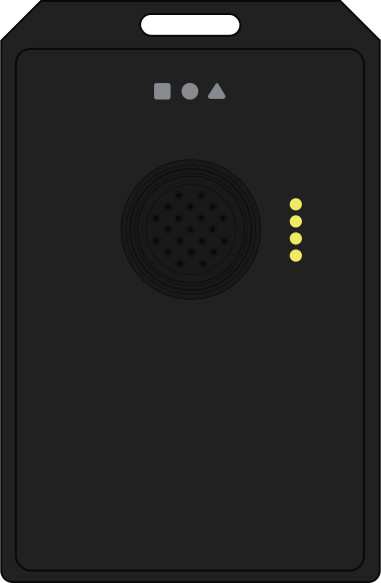
Client
Client
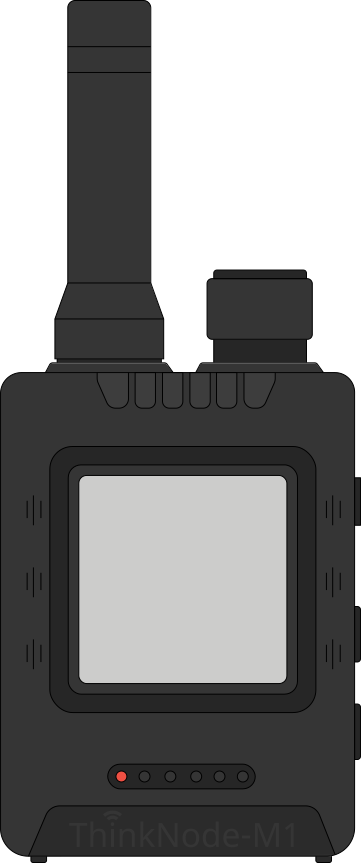
Client
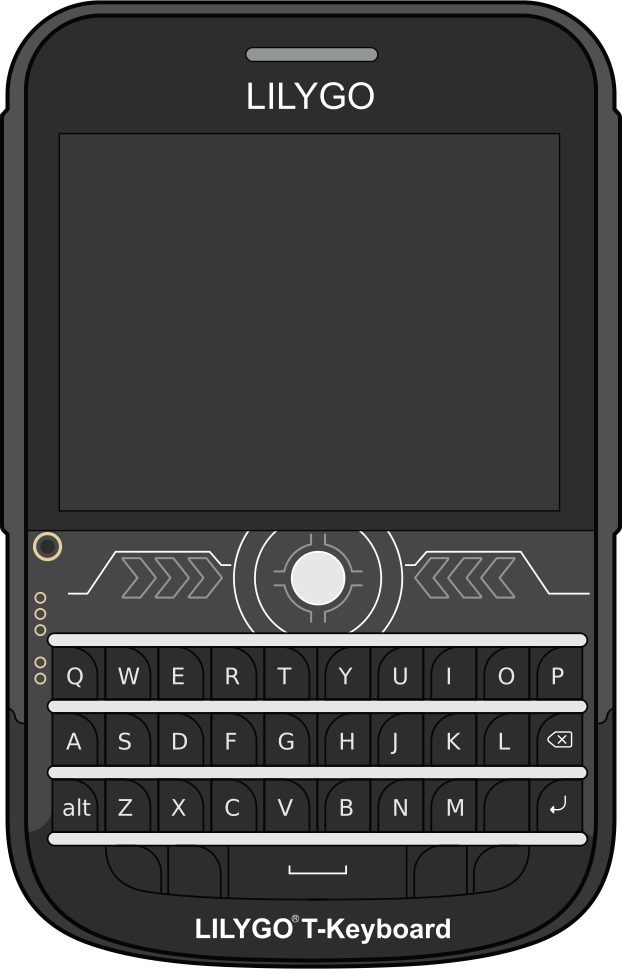
Client
Router
Client
Client
Client
LoRa
Bluetooth
WiFi
USB
Meshtastic utilizes LoRa, a long-range radio protocol, which is widely accessible in most regions without the need for additional licenses or certifications, unlike ham radio operations.
These radios are designed to rebroadcast messages they receive, forming a mesh network. This setup ensures that every group member, including those at the furthest distance, can receive messages.
Additionally, Meshtastic radios can be paired with a single phone, allowing friends and family to send messages directly to your specific radio. It's important to note that each device is capable of supporting a connection from only one user at a time.
If you are interested in a more technical overview of how Meshtastic works, visit the overview section below:
Meshtastic is an open source project available on GitHub. Our generous volunteers donate their personal time to write and maintain this codebase. If you would like to contribute see our GitHub, join our Discord server, and read up on our Meshtastic Discussions.
Hopefully your "Getting Started" experience is straight forward and headache free. If you encounter any issues, please consider updating our documentation to improve future user experiences or reach out on the forum or Discord.
Our support is 100% volunteer based. We are passionate about the project and hope to help newcomers become Meshtastic experts!
Re: markdown and hugo, that's an excellent combo. You could easily setup a raspberry pi or $5/mo vps to serve it behind caddy/traefik/nginx and have a working multipage app (mpa) in a weekend.
Or a few minutes with AI haha
https://www.meshcoretel.ru/en/MOW/map
Maybe other maps too...
I thing Russia's main problem (not only with mesh) is that you have millions of people living in or near few cities and very few inbetween.
And those living "inbetween" typically have no money or time for things like mesh, they are struggling with simplier things.
You could also use their site planner to plan out optimal placement: https://site.meshtastic.org/
There's a history between Tastic and Core, but it's a different one. Meshtastic doesn't scale that well in urban areas and it seems that some on the Mestastic team didn't see that problem as a priority/ignored the problem/are too stubborn. And then Meshcore is created with a different routing, works much better in practice, proving that the mesh could be much better. In countries like the UK it seems to have replaced Meshtastic in most places.
Perhaps a per node hash of known recent routes to avoid flooding every single time and using flooding as a backup.
These people should not be making a short range text solution, they should be building a low bandwidth internet extension with gateways to the real internet. Most of the information content of the internet can readily fit over 56kb lines once you strip out all the fluff. And in an emergency where you need or want a decentralized mesh network, that's more important that being able to text, who exactly?
There's no mention of Meshtastic.
Go somewhere properly remote such as the high north. There is no cell network outside of town. And the satellite coverage is spotty at best. Say you need to go look for someone. Meshtastic relays can be up and working in minutes. A chain of rescuers can spread out along a path, and remain talking to each other, as fast as they can move. Sure, radios can do this too, but long range voice radio require serious power and are still largely line-of-sight. Radio relays are an entirely other expensive thing.
Think also of remote camps (logging/planting/fishing/climbing etc). Toss a lora relay on every vehicle and every work party can talk via the app installed on their normal phones. Use GPS-enabled devices and you can passively keep track of every vehicle. Need to operate two valleys over? As the first crew deploys out they can plop down relays at key points. Years ago I setup something like this using wifi relays. It was hell. It never worked right. The range and lower power demands of lora would have been infinitely easier.
For instance, sprinkling a bunch of nodes + sensors in hostile territory should allow for gathering intelligence, guiding drones, setting of fuses...
I just picked up a T1000-E to take on holiday next week, interested if I see anything in the air of in Europe.
In the PNW there are two very successful meshcore meshes, cascadimesh and psmesh. The former stretches all the way from Oregon to BC and the latter focuses more on the sound.
I just switched over to the mesh core version of psmesh and instantly I was able to get chats from folk across the state. With the Meshtastic version I couldn’t see my friends nodes once we left the pub. And I never got a ping back from my tracker the next town over despite futzing with the channel settings for a couple days
*That and literally hundreds more equal or worse.
After CopyFail (and apparently a lot more), I am thinking I might force myself to BSD for servers, and maybe even my work station. And there's a new idea! An LLM specifically trained for BSD....
One guy associated with the project, but never a contributor to the firmware, decided to create his own vibe-coded client/app and to trademark the name of the project. The rest of the team said "no" to that and continued doing what they were doing before.
The reason Meshcore works better for texting is the different routing. It has nothing to do with the recent drama.
It's just a personal opinion, but I really think this is not the case in reality.
Those guys in the middle of nowhere are the biggest geeks in LoRa networks. They have more practical scenarios, more to gain and better conditions for great distances.
A friend of mine lives far away from me, barely populated area, a big city in between of us. He struggled to get any network traffic, but now he uses narrow antennas to point to particular repeaters and suddenly the whole metropolis is open to him. We talk with acceptable delivery rates (I'm guessing 70%, which is actually very decent in dense area like mine). He is currently trying to expand his local network. His neighbors are less technical, but they have frequent power failures and need alternative way to reach each other.
On the other hand there is A LOT of client nodes and repeaters in my city. Many struggle to reach even a single repeater - hard to access roofs, high buildings, crowded network with plenty of conflicts. This kills motivation for many.
So the split is just a "the development team has nothing to do with the .co.uk site, his youtube channel and discord group", not a fork.
Something that can also use devices we already have seems like a better solution. I'm surprised BitChat has not seen more popularity. Something that combined that + a dedicated hardware mesh transmitter (for longer range when needed) and allowed adhocactual network use between devices would be pretty damn cool.
Also arent LoRA systems mostly still line of sight?
Not to say they don't fill a niche, but bandwidth and range limit it's viability to small operations; even an optimal network cant handle more than a few hundred tweets per hour.
With the obvious solution of putting mesh nodes on the drones, foregoing the scattering part.
For everyone else, IoT is already there. And good old paying people to do things (the supply of dumb people never gets depleted).
I'd argue at this point there's more MeshCore networks in the world than Meshtastic
Population dynamics in Russia are vastly different than in the West.
Geeks don't exist or survive in the countryside.
Not only it's abject poverty, it's also the culture that penalizes anyone who sticks out.
Russian countryside is kept poor and uneducated with no opportunities other than signing a military contract. That's how Russia was able to fight its 3-day invasion of Ukraine for 4 years without doing a full scale mobilization.
Anyone who even knows what a "mesh network" is would be in a city.
That's one aspect in which Ukraine and Russia are different.
They already have it because they ready HN! Only somewhat fascitious... A few motivated individuals can provide connectivity to thousands. There's probably a few such folks in your city already!
> Something that combined that + a dedicated hardware mesh transmitter (for longer range when needed) and allowed adhocactual network use between devices would be pretty damn cool.
This is exactly how these systems tend to work in practice. Just connect your phone via Bluetooth then use the Meshtastic app. The app can function on it's own to send messages to other phones without cell service, you just won't get the range.
I've done a number of projects with commercial radios operating in the 902-928MHz unlicensed band and typically we target 1-10 mi (roughly 1-20km). Elevated antennas with enough gain to get you to the legal limit (4W EIRP) can get you a heck of a lot of range, even without line of sight.
With line of sight, communication to the horizon is possible.
If you're talking about the EU 869 MHz unlicensed band used by LoraWAN, thats quite a bit different and I'm less familiar.
Nevertheless IMO the mentioned demographics/use-cases want something turnkey ready, ~single button, and currently LORA based stuff is not like that, and is clumsier and needs a certain level of... tinkerer mindset, compared to a commercial license free radio system (which might have been set up with a minimal effort), where learning curve is basically volume knob and PTT button.
I have handed out simple FM radios for total tech-illiterate people (mothers, children, elderly physical workers) in an outdoor event with 0 cell coverage, and comms worked perfectly over the dozen square kilometer area. Biggest incident was a lost radio handset.