Same here. I‘d recommend the 2020 documentary „David Attenborough: A life on our planet“ - if you haven‘t already seen it.
https://en.wikipedia.org/wiki/David_Attenborough%3A_A_Life_o...
Happy Birthday David! I'm so happy you are still alive and well.
Fairly well-known locally is that my favourite bookshop, The Open Book in Richmond, stocks signed copies of all his books. They used to be signed directly on the page, but since he got to the mid-to-late nineties in age, tons of hardbacks are too much, so Helena wanders up there to get a load of bookplates signed these days.
Apart from that, I order all my books from them when I'm in London and a subsequent chat with Madeleine usually lasts ten times as long as the book shopping.
Anyway, I digress, yes, Sir David, amazing body of works and the books are wonderful.
It's also fascinating to see he is still active with regards to BBC documentations. I watched some newer BBC documentaries with other people voicing it, and while they are not terribly, all (!) of those newer guys are significantly more boring than even an old David. David understands things better than the newer guys do.
This is what I've been doing over the last few months. Quite a lot is available for free on the Internet Archive, if you look. I just finished the 5-part "Life in the Undergrowth" (2005), about insects and other small critters. Wonderful.
Apparently, he's the reason tennis balls are yellow.
I guess they were traditionally white but when they started broadcasting matches on TV it was too hard to see the ball.
David who was at the BBC at the time suggested they use yellow balls instead so they would come through on camera. Ever since then tennis balls have been yellow.
I wish humans would come together to re-wild more of the earth. Restoring wild nature and cutting emissions is the only way to really restore natural ecosystems. We're nowhere close to doing that.
Of course, they'll still put tracking links in the share button. Got to get that sweet data of who shared David Attenborough's birthday.
The unfortunate thing is that the area of biology he has drawn people to is difficult to make a living in. Jobs are few, there is intense compettion for them, they don't pay well, and there is often little job security. In some ways it is the Art History of a STEM discipline.
Somebody at the palace or the civil service was reviewing the nominations, saw "David Attenborough" and thought "that's a typo, they must have meant Dickie Attenborough".
So it's probably just that he has genetics for longevity in his family. And they were all wealthy which helps
But what is the oldest color photo of white ball tennis?
Also, do we have a good source for this story, because it’s not mentioned on Wikipedia: ”In 1972, the International Tennis Federation introduced yellow balls, as these were easier to see on television. Wimbledon continued using white balls until 1986.”
Most of the growth will be in Africa, not exactly the most lawful place in the world so it looks kind of bleak for the environment and animals there.
Those 2 billion will all want a nice home and a smartphone, computer, TV, car etc…
Earth Overshoot Day https://en.wikipedia.org/wiki/Earth_Overshoot_Day
It's not looking great, not even if we got nuclear fusion reactors figured out tomorrow.
As per David Suzuki: it is shit, it will get shittier, responsible people should act accordingly [0]: <<"The science has said, ‘We have passed a tipping point, we cannot go back,'" Suzuki said. Survival in a warming world, he says, will increasingly depend on the resilience of local communities — and preparation must start now.>>
[0] https://www.cbc.ca/radio/sunday/david-suzuki-memoir-life-bir...
A similar situation exist with hydro power. We know that it is causing major extinction of species that depend on migration, with major harm to the ecosystem, and yet no one want to give it up despite being fully aware of the harm. Removing hydro do not fit any of existing strategies and so the current situation, as unreasonable it is, continues unchanged.
I have also seen similar issues here on HN when people discuss emission per capita vs absolute emissions. A large portion of people who heard the warning and are aware of the effect of global warming, would still argue that reducing emissions where emissions are being created is unfair if emissions per capita is relative lower compared to other places. The two camps created from this has opposing strategies, even if both camps agree with the current situation.
Population 2026: ~8.3 billion
Can't escape this and its consequences on the environment.
Switching to a desk job, he went on to use his position in the BBC to green-light then-pioneering documentaries like “Civilisation” and “The Ascent of Man” (and still travelled occasionally for anthropological and nature documentaries, that he also green-lit) that remain a huge influence on all documentaries today.
Then in 1979, “Life on Earth” created an entirely new format of nature documentary that has only seen iterative change in the almost-50-years since. The rest, as they say, is history. He’s been heavily involved in the production of so many documentaries in the decades since, only reducing his role as he got older. Even in his 90s most of the series he narrates have short on-location sequences with him.
It’s safe to say that he, perhaps more than anyone else, created the “nature documentary” - both in experimenting with the format, and in green-lighting shows - and therefore shares a huge amount of responsibility for the many positive second order effects. Certainly in the UK, I would argue that a significant amount of public awareness of climate change comes from BBC documentaries. As attested to by others in this thread, generations of scientists and conservationists pursued their professions in part because they were inspired by him (and I can throw my own hat in the ring for this). It was also spoken about, at his 100th birthday concert, what an outsized influence his documentaries had on increased worldwide awareness of plastics pollution and the recent UN treaty beginning to address it.
His voice, really, is secondary to all that.
(I would highly recommend reading his “Adventures of a Young Naturalist” and “Journeys to the Other Side of the World” books for anyone with an interest in this sort of thing. They’re combined volumes of books he wrote back in the 1950s and 60s about his Zoo Quest expeditions - both a wondrous first-person view of the travels and interactions with wildlife, but also a fascinating teleportation back in time into a world where air travel and television were brand new, and all of these remote communities were near-untouched compared to today).
I suspect many scientists can trace their early interest in science back to him. And I believe the green movement would have had a lot less impact without him.
Yeah, they put the hours in.
Didn't you see him up to his groin in a giant mound comprised of batshit and cockroaches, and sounding like he was loving every minute of it? Or being cuddled by wild mountain gorillas? Or ...
He definitely goes out there to wild and often dangerous locations, though perhaps not so much at the age of 100.
I assumed there’d be 1 or 2 would be, but 50+ is wild. I just went down the rabbit hole of “things named after Sir David Attenborough” and it’s a lot!
Rewilding at scale, deep emissions cuts, and a serious move away from animal agriculture are the same project.
The renewables revolution has been accompanied by a steady increase in emissions. For emissions read carbon dioxide (no argument from anyone about toxic gases) which is a carbon source for plant growth and as we know, is pumped into greenhouses to increase production. Satellite pictures confirm greening of the Earth in many areas.
This does not have to be a counter argument but the emission story would be more convincing to a lot of people if other factors like this (and the difficult question of just how do you decrease energy use without impoverishing people?) were discussed in the public forum in a balanced way as with dissenting views from those distinguished scientists evidently holed up on luxury yachts financed by the oil industry. 'I think you are wrong because ...' or 'you have a point in that respect but ... '. In a nutshell let's get the discussion onto what used to be called 'an adult level'.
Citing a wilderness figure for developed countries is misleading. Most of it is ecologically vacant--second-growth and tree plantations sans apex predators, large herbivores, intact soil biota, etc. Tree cover is not a functioning ecosystem. Developed countries have exported their ecological destruction: the beef, soy, palm oil, and minerals driving habitat loss in the tropics get consumed in the same places where the domestic "wilderness" figures look great.
The Living Planet Index (actual wild vertebrate populations) is down 73% on average since 1970. North American bird populations are down ~3 billion over the same period. Terrestrial insect biomass shows steep decline in studied regions. None of that shows up in "how much undeveloped land exists" or "how many solar panels got installed."
China's solar buildout is great news for climate, but climate is one driver among several. Habitat fragmentation, pollution, and overfishing don't get solved by the energy transition. You can decarbonize the entire grid and still preside over a mass extinction.
They may be able to distribute all solar panels and wind turbines worldwide; in the end that is just tiny-potatoes good because those markets are not that big. But when it comes to getting to energy independence they are using an "all of the above" strategy to get there. Planetary catastrophy can take a back seat to socio-economic unrest due to less/no money and opportunities for people.
The "everyone on the internet is American" stuff in e.g. politics or job market convos is a lot more grating.
> Tennis balls are fluorescent yellow in professional competitions
"David Attenborough Richmond hill" would've been the way. I'd hardly fault OP for my own choice in query.
https://www.theguardian.com/world/2026/may/09/norway-oil-and...
I live in Europe, I've been to London a few times, I have no idea what "Richmond Hill" is or whether Sir Attenborough actually lives in London.
You in fact rightfully but incompletely recognize : artificial fertilizers (for giant mono-crop fields of soybeans to feed to cows and pigs [0]), replacing forests (to clear room for soybean fields and pasture for cows and pigs [1][2]), and runoff of these fertilizers and manure into waterways. The parent comment is right - if we want to fix these problems, we must stop killing and eating animals at such an industrial and horrendous scale.
0. https://www.ucs.org/about/news/extent-emissions-created-mass...
I get why it doesn't seem so obvious from the outside, but for British people it's as obvious as Apple headquarters being in California.
If we step back a bit, the most impactful bit is true human wish for growth.
If we were satisfied with a comfortable stasis, that would be helpful.
One of the few areas of sustainable farming is aquaculture like shellfish and seaweed, which could actually be used to reduce the negative effects caused by modern farming. If there were a competition in least amount of harm, those would likely be the winners.
Fields of corn or soybeans will still exist without animal-based agriculture, especially with current demand for biofuels. As long as the land can be farmed to generate revenue, people will farm it. Artificial fertilizers is the primary enabler of this.
this is simply false - did you follow any of the citations? you’re welcome to find something to support your position but as they say: if it can be asserted without evidence, it can be dismissed without evidence.
Maybe I'm wrong but reading your comment it feels like you are letting the perfect be the enemy of the good, and you use your conclusion that we will never be sustainable as your excuse to continue to eat animals.
> When the first explorers from the warm lands around the Circle Sea travelled into the chilly hinterland they filled in the blank spaces on their maps by grabbing the nearest native, pointing at some distant landmark, speaking very clearly in a loud voice, and writing down whatever the bemused man told them. Thus were immortalised in generations of atlases such geographical oddities as Just A Mountain, I Don't Know, What? and, of course, Your Finger You Fool.
There is no evidence that there would be far less farm fields without that. Farm fields exists if there is profit to be had. Right now the demand for biofuels are directly competing with the demand for animal feed. Farmers will primary grow and sell crops based on what pay the most, and can easily switch if one pays more than the other.
https://ageconsearch.umn.edu/record/360637/?v=pdf The Impact of Market Prices on Farmers' Crop Choices in Ghana https://www.researchgate.net/publication/373480516_Farmers'_... Farmers’ risk rating and crop portfolio choice in Kewot Woreda, North Ethiopia https://www.sciencedirect.com/science/article/pii/S0308521X2... Understanding factors influencing farmers’ crop choice and agricultural transformation in the Upper Vietnamese Mekong Delta
Notice that none of those says that farmers would not use the fields if the current most price worthy crop would go away. Farmers choose what to farm based, among other things, the market. If you remove animal agriculture, you don't get far less fields. You get fields with a different crop in them.
The only thing that will stop farming is either if the external cost of farming is applied, such as pollution, or if climate change makes farming the land unprofitable. Currently that pollution is not applied as a cost. A carbon and water pollution tax could be a strategy that addressed this, and would impact all farming regardless of crop. If that is "perfection" and "enemy of the good", then the definition of perfection is not shared.
My contribution to this discussion is the place in BTTF which makes fun of this concept, the home of Marty McFly: Hill Valley
Not a tautological name but an oxymoronic one!
23 hours ago
Steven McIntoshand
Helen Bushby

Getty Images
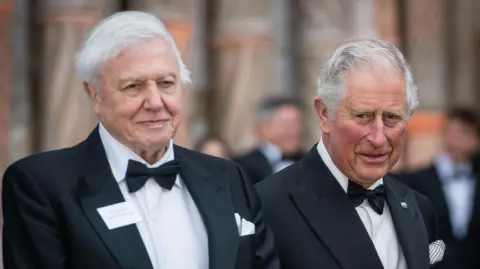
Sir David and King Charles have known each other for many years
King Charles III and Queen Camilla are among well-wishers to share a birthday message celebrating Sir David Attenborough turning 100.
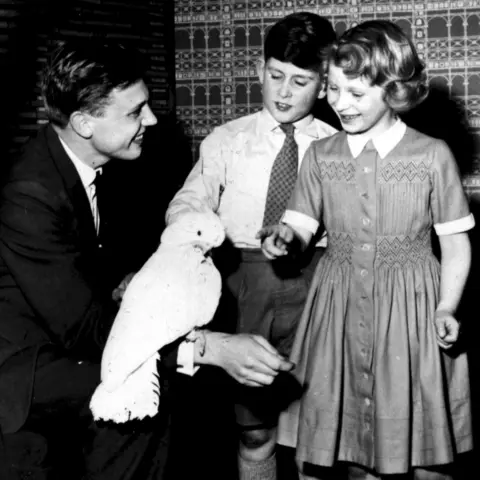
The royal couple also shared photographs of Sir David, including one of him with a young Prince Charles and Princess Anne in 1958, in which he is introducing them to Cocky the cockatoo, from his BBC Zoo Quest TV series.
The veteran broadcaster and environmentalist has said he was "completely overwhelmed" by messages he had received ahead of his big day, which includes a special concert on Friday evening at the Royal Albert Hall in London.
PA Media
In one of the images shared on the Royal Family's Instagram account, Sir David introduced Cocky, the cockatoo to Prince Charles with his sister Princess Anne in 1958
Sir David added: "I simply can't reply to each of you separately, but I'd like to thank you all most sincerely for your kind messages, and wish those of you who have planned your own local events: have a very happy day."
In a video for the Earthshot Prize, which celebrates climate leadership and innovation, the Prince of Wales said: "Happy 100th David, cannot believe it's your 100th birthday."
He went on to thank him for all his support, while noting how "everything you do continues to inspire me".
"His most significant contribution has been the systematic dismantling of the notion that climate issues are happening 'somewhere else'," he said.
"Young people continue to listen to him not just for the spectacle of nature, but for a sense of continuity in an unstable world."
Former England men's football captain Sir David Beckham simply called the broadcaster "our National Treasure", while actress and activist Joanna Lumley wished the broadcaster a happy birthday with a little help from the people of Stroud, Gloucestershire, in a video message.
Joanna Lumley wishes David Attenborough happy birthday
TV naturalist and presenter Chris Packham wrote in The Big Issue: "I don't think that any person in the entire history of our species has made such a significant contribution to engaging people and developing a love for all of life on Earth as David Attenborough."
Meanwhile, the World Wide Fund for Nature (WWF) shared a birthday tribute video, voiced by actors Dame Judi Dench, Morgan Freeman, Miranda Richardson, Asa Butterfield, Sam Heughan and Iwan Rheon, along with former Spice Girl Geri Halliwell‑Horner and wildlife presenter Liz Bonnin.
It is a spoken-word version of the Louis Armstrong classic song, What a Wonderful World, featuring footage of various animals.
Oscar-winning composer Hans Zimmer also paid tribute, saying that despite his extensive feature film success, "none of it is as important as working for David Attenborough because that is really about the existence of our planet."
"His ability to communicate his own enthusiasms are very precious and he's brought such joy to so many people," he said. "And I think, along with a lot of people, my favourite television programmes are probably natural history."
Friday evening's show at the Royal Albert Hall is the climax of a week of special events and broadcast programming in honour of Sir David, who was born in 1926 and joined the BBC in 1952.
Sir David Attenborough says thank you for birthday messages
Presenter Kirsty Young will host the special 90-minute concert celebrating Sir David's life, which will air on BBC One and iPlayer from 20:30 BST.
Special guests including Sir Michael Palin, Steve Backshall, Liz Bonnin and Chris Packham will appear at the event to reflect on Sir David's life and legacy.
Ahead of the concert, Young said: "Sir David's gift to the world has been a life spent exquisitely revealing Earth's wonders to us all.
"The very least he deserves is a big 100th birthday bash at the Royal Albert Hall. I'm very happy indeed, as the host, to be able to invite everyone to the party."
'Have a massive blowout': Your birthday messages
The event will recall some of the most memorable wildlife moments from Sir David's career and the BBC's natural history archive.
Live music from the BBC Concert Orchestra will include pieces associated with his most famous television series, including the snakes and iguanas chase from Planet Earth II, and the wave-washing orcas sequence from Frozen Planet II.
The concert will also feature performances from Bastille frontman Dan Smith, who will join the orchestra for a rendition of the band's hit Pompeii, which featured in Planet Earth III.
Elsewhere, Sigur Rós will perform Hoppípolla, which was used in the promotion of Planet Earth and Planet Earth II, while other musical guests will include singer Sienna Spiro and harpist Francisco Yglesia.
Teens react to iconic David Attenborough moments
The BBC has been celebrating Sir David's centenary with special programming throughout the week.
The BBC's chief content officer Kate Philips said Sir David's 100th birthday marked an "extraordinary" moment, describing him as a "truly remarkable individual".
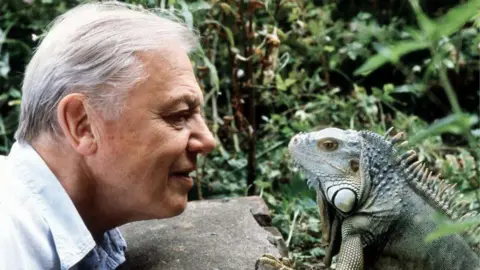

Over the years, Sir David has had countless animal encounters, including this iguana in Living with Dinosaurs
Sir David was born in west London on 8 May 1926, and has also fronted pioneering natural history series including his Life Collection, The Trials of Life and The Blue Planet.
He has two children with wife Jane, who died in 1997. His brother Richard was an Oscar-winning actor and director, and died in 2014.
On Thursday, the Natural History Museum paid tribute to Sir David by naming a species of parasitic wasp after him.
The Attenboroughnculus tau is native to the Patagonian lakes of Chile, and a specimen was recently found in the museum's collection, four decades after it was collected.
Other species to have been named after the broadcaster in the past include a wildflower, butterfly, grasshopper, dinosaur and ghost shrimp.


Get our flagship newsletter with all the headlines you need to start the day. Sign up here.