Unfortunately, maintainability is simply bucketed as a "non-functional" requirement.
Maintainability (and similar NFRs) should actually be considered what preserves and enables the delivery of future functional requirements -- in contrast to framing non-functional requirements as simply "how" the software must do what it does vs. the "what"/functional requirements that "actually matter".
From that standpoint, if a steady flow of features/improvements is important for a project, maintainability isn't really a non-functional requirement at all, and amounts to being a functional requirement, in practice, over anything except the shortest of time horizons.
I'm being completely serious. By giving it some kind of distinct name, you are giving license to it being ring-fenced and de-prioritised by someone who doesn't (but, arguably, probably should) know better.
Quality matters. It hits your P&L very quickly and very hard if you don't maintain it. So it is as important as any other factor.
1. software doesn't only have tech maintenance - there is also user support and it increases as software grows.
2. I'm not convinced maintenance costs scale linearly. And even if it scales linearly, you will eventually get to a point where maintenance takes up all your time.
Some of our developers are overly aggressive about using AI and I've started going down that path because I need to keep up and actually enjoy the flow of working with AI in my IDE.
I put a lot of work into keeping my area of the codebase understandable and coherent but I do not see that from the others on our team. I'm not perfect but I and extremely sensitive to incoherent, or un-grok-able at a glance.
Anyway, I like the novel (to me at least) framing of this article!
One underappreciated aspect: the artifact surface area of an AI session grows much faster than the code surface area. For every hour of Claude Code output, you get not just code changes but screenshots, generated images, exported transcripts, spec drafts, downloaded model weights — all scattered across wherever Finder happened to drop them.
The maintenance cost argument applies here too. If you can't quickly navigate to the right artifact at the right moment, you end up re-generating things you already have, or worse, losing context between sessions. The "maintenance" of your working environment is a real tax on the ratio the article is describing.
I've been trying to address the file-side of this problem specifically, but the broader point stands: AI coding agents will only reduce net maintenance costs if the surrounding tooling (file management, context switching, artifact organization) keeps pace.
Someone is an optimist! I'd estimate those significantly higher, and even worse if you are in a field that has to do any sort of SOC/HIPAA/GDPR audit
The incitives for remote LLMs are off with providing defaults which optimize for maintenable sound architecture though. Same way Claude is going to produce overview of the indexes of the summaries of comprehensive reports, no one is going to read. No doubt this feels like excellent KPI on how much output was generated.
I created a video that talks about this in more detail:
Right! The unfortunate thing is that many software companies don't seem to think much further than a quarter ahead, not really.
Sure they might have a product roadmap that extends for a year or two into the future, but let's be honest. Often that roadmap is mostly for sales purposes, not engineering planning purposes. Product and engineering will pivot if sales slump. The earlier in the company's lifespan, the more likely this will happen often
However if companies get out of this startup mode then they should start to stabilize... But many don't. They continue this pattern of short sighted short term planning, which means product stability remains a low priority effort.
Ultimately I guess many companies just either do not have the resources to build good software or do not actually care to
That's the theory anyway.
When an LLM provides you with an overconfident piece of writing with no sources to back it up, what do you do?
I wonder if AI could make code reviews more presentable.
for example, with human code reviews, developers learn quickly not to visually change code like reflowing code or comments, changing indent (where the tools can't suppress it), moving functions around or removing lines or other spurious changes.
And don't refactor code needlessly.
also, could break reviews up into two reviews - functional changes and cosmetic changes.
AI tooling can also be a place where we start building our view of what maintainable software practices look like so we don't make decisions that have these same tail effort profiles. That can be things like building out tooling to handle maintenance updates
I think the real thing that comes out of AI tooling is probably that the tooling needs to be trained (or steered) towards activities that enhance human attention management.
I get that most of the cost is in training and not inference, but I don’t see how models stay useful once the worlds software updates in a few months post training since the models can’t learn without said training.
Are we just going to have shops do the equivalent of old COBOL shops where everything is built to one years standards and the main language/framework is mostly set in stone?
But say you have that. Then you have great profiling. At that point you can measure correctness and performance. Then implementation becomes less of a focal point. And that makes it a lot easier to concede coding to ai
Edit: I make it sound a bit simple maybe. I do more extensive redactors also, where I'm more involved and opinionated. But I don't feel the need to do that very often very deeply. But yeah sometimes it's definitely necessary to prevent the project from going off rails.
So:
* You get paid less. * The company might pay a similar amount due to LLM costs. Although, it could be more or less as well, depending on how it works out.
A couple of years ago, I saw a story of a guy writing two articles for a website a day. The boss asked him if he wanted to transition to AI-assisted writer for less pay. He said, "No." After a couple of weeks, he got canned. He checked the website out, and it had a bunch of AI writing on it.
LLMs are there to reduce your salaries and increase the businessowner's profits. Bigger inequality in wealth, it's only going to grow more and more. Also, a ton of people fired across many different fields.
I have reduced our response time on our api to 30ms from 80ms and gotten a setup we can comfortably grow into.
I had not had time to track down these optimizations without Claude code.
The AI will then be middle layer that will iterate until tests pass.
Layer 1: Specs (Humans)
Layer 2: Code (AI mostly)
Layer 3: Tests (AI + human checks).
That makes reviews a lot easier. The review starts from "nothing should be changing" and then reviewers can pattern match on that.
Otherwise, the reviewer is re-evaluating every line of code to make sure nothing has changed. That's really hard to do properly.
The version control systems I've worked with have allowed queues of changes, each one reviewed independently. As I'm developing, if I need a refactor, I go up a commit, refactor, send out for review, rebase my in progress work and continue.
I send out a continual stream of "CLEANUP:" "REFACTOR_ONLY:", and similar changes with the final change being a lot smaller than a big monster of a change.
Your reviewers will appreciate the effort.
Plays the metric game (if you're working in that type of org) without being evil too.
You draw made up lines on made up plots and call it evidence, obviously.
This has been possible already but from my vantage point, it doesn't look like anyone really did it? Sure, there already exists tons of OSS that is built for this case, even before AI, yet it seems to me to always come back to incentives. IMO, there is no incentive to write maintainable software (and I'm not sure there ever will be one at this pace). Businesses are only incentivized to write enough software to accomplish the task within their own defined SLAs and nothing further. But even that doesn't seem to be a blocker at this point if Github is used as an example.
Good software comes from people who care deeply about solving the problems in way that they are invested in. If your employees don't care about your product, you're already starting on the wrong foot. AI isn't going to incentivize bad-average developers to write better software or a good developer to push back harder against their clueless manager. When they make the decision, AI might help (assuming it doesn't make a bigger mess) but it's not going to reduce technical debt in any meaningful way without a sea change of perspective from product managers around the world.
So far, I just don't see it happening in theory or in practice. I hope I'm proven wrong!
That's a pretty old economic idea, and it will be interesting to see if it holds up in this instance. I have no idea how this all plays out. I do think it won't be one size fits all though.
https://github.com/nWave-ai/nWave
They have /nw-buddy to point you in the right direction
Very nifty
Write tests. The most boring activity on the planet
There is problem solving in coding, but the bigger problems exist at a higher level and that’s still on you to solve.
Also I’ve been messing with “ai-only” files recently. You make a markdown file that basically tells it what the file does, how it’s used, and point to an API contract in some other file. Then you can run async ai that will try things and only submit a PR of all the tests pass and the perf improves. The files become almost unreadable to be, but I decided to embrace it because they were already unreadable. But so is the output of, say, the protobuf code generator and I never had a problem accepting that
Probably more boring still, though.
I’ll get straight to the point: your AI coding agent, the one you use to write code, needs to reduce your maintenance costs. Not by a little bit, either. You write code twice as quick now? Better hope you’ve halved your maintenance costs. Three times as productive? One third the maintenance costs. Otherwise, you’re screwed. You’re trading a temporary speed boost for permanent indenture.
Oh, you want to know why? Sure. Let’s go for a drive. On a dark desert highway...
Every line of code you write has to be maintained: bug fixes, cleanup, dependency upgrades, and so forth. I’m not talking about new features or enhancements. Just maintenance. For every month you spend writing code, you’ll spend some amount of time in the following year maintaining that code, and some in each year after that, forever, as long as that code exists.
Let’s say you asked a crowd of, say, 50 developers what those maintenance costs were. Using a technique called Wisdom of the Crowd, you could get a reasonably accurate response.1
1You’re welcome to conduct your own wisdom-of-the-crowd survey! But it turns out that the specific numbers don’t matter for the overall point I’m making here.
Your crowd might tell you that, for each month you spend writing code, you’ll spend...
10 days on maintenance in the first year; and
5 days on maintenance each year after that.
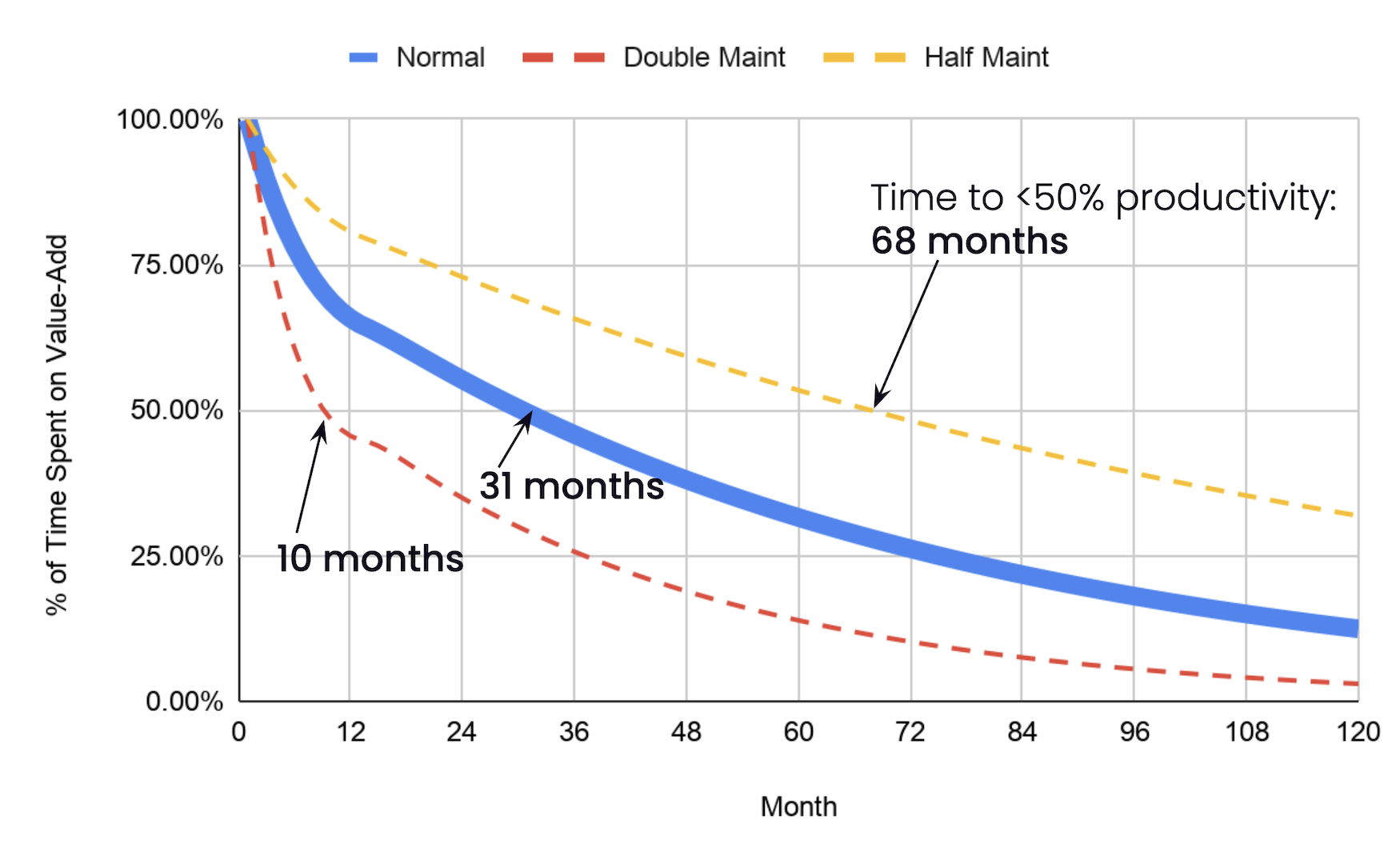
If you were a particularly obsessive individual, you could spend hours making a spreadsheet modeling how those estimates affect productivity over time. A spreadsheet like this.
The first month of a new project is glorious. You spend all your time building fancy new features.
The next month is slightly less glorious. A fraction of your time—not much, but a smidge—goes to fixing bugs and cleaning up design mistakes from the first month. In the third month, a smidge more. And the fourth month, the fifth, the sixth...
Eventually, it’s not glorious at all. According to our crowd’s maintenance estimates, you’ll spend more than half your time on maintenance after 2½ years. After ten years, you can hardly do anything else.
Halving the crowd’s maintenance estimates gives you three more years before you hit the 50% mark. Doubling them sees you below 50% in less than a year.
The lesson is clear. If you want a productive team, you have to focus on their maintenance costs.
Do these numbers ring true to you? They do to me. In my career as a consultant, I specialized in late-stage startups, and they all had the exact problem shown in the graph above. About 5-9 years in, they’d notice their teams were no longer getting shit done, and then they’d call me.
Their teams weren’t quite as bad as the graph shows. Maybe their maintenance costs were lower. Or maybe... and this feels more likely to me... their maintenance costs were exactly that bad, and they papered over the problem instead. Maybe they:
Decided not to fix every bug, or upgrade every dependency
Added people when the team got slow... and then kept adding more, because it was never enough
Scrapped it all and started over with a rewrite
There’s room to debate the precise maintenance numbers, but overall, the model feels right. If you’ve been around the block, you know this graph is true. You’ve seen how productivity melts away over time. You have the scars.
Only everything.
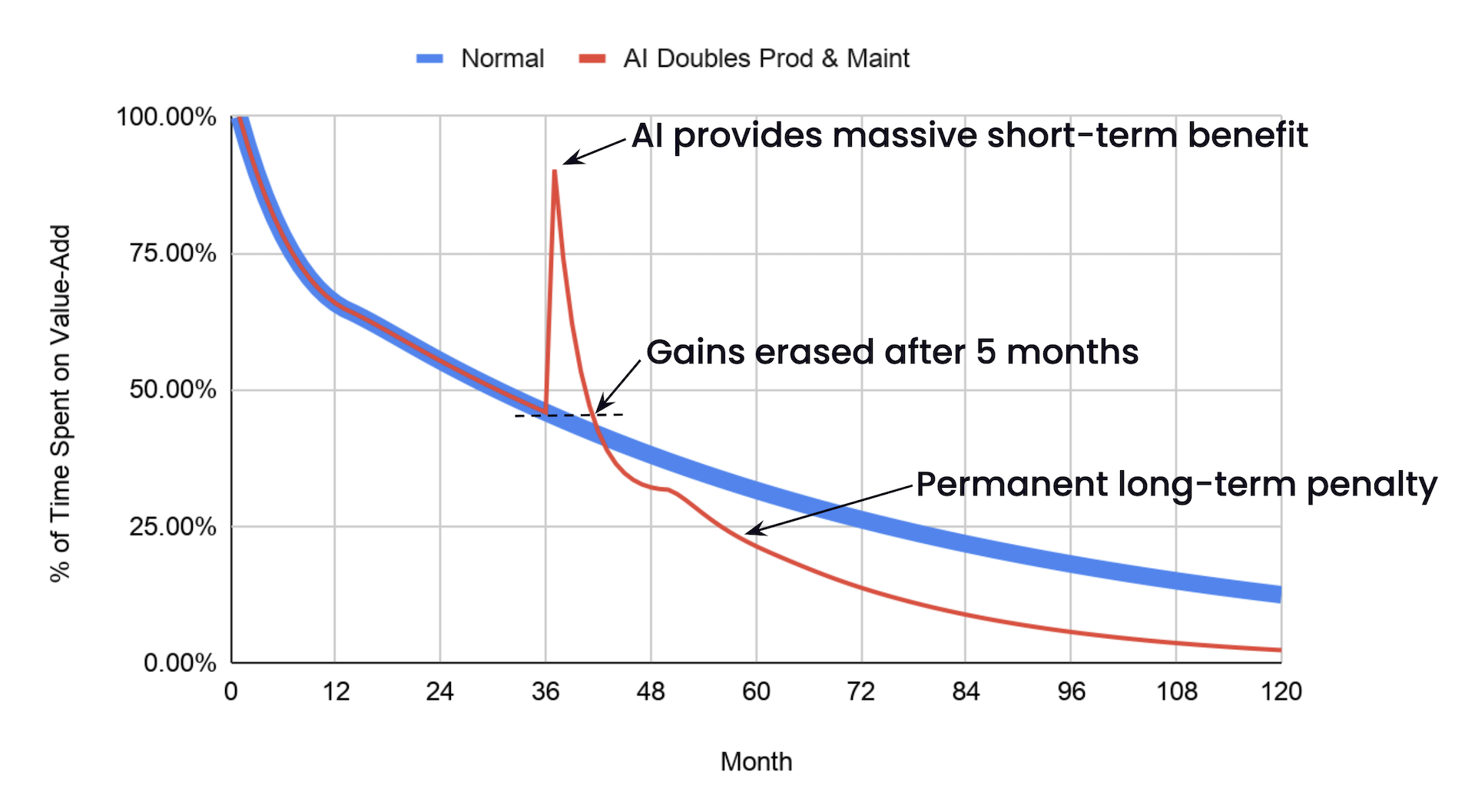
Let’s say your team just started using Rock Lobster, the latest and greatest agentic coding framework, and it Doubles!! your code output! Woohoo! The code’s a bit harder to understand, though, and your team is drowning in pull requests, and you maybe kinda sorta teensy weensy don’t actually read the code before smashing the approve button. Like, at all. I mean, you skimmed it, during boring meetings, sometimes, and that’s gotta be good enough, right? LGTM, let’s get this shit done!
So now you’re producing two months of work in a month, and let’s say you’ve doubled how much each “month” of output costs to maintain. Next month’s maintenance costs quadruple.
Oh.
About five months after you start using Rock Lobster, your productivity is back down to where you started, and a few months after that, it’s worse than it would have been had you never touched Rock Lobster in the first place.
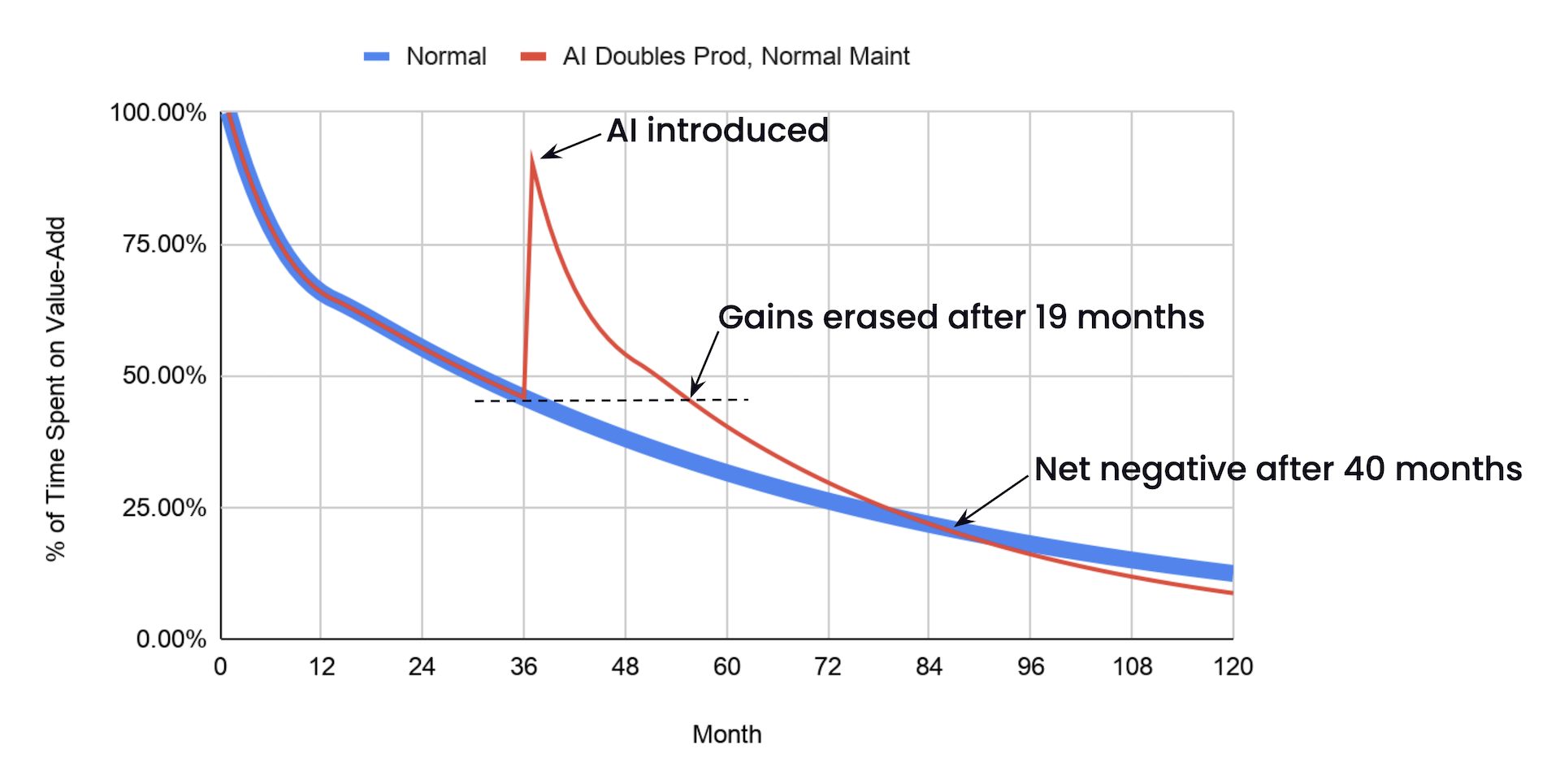
I’m not saying your AI doubles maintenance costs. Or productivity. This is an extreme example. But even if your AI produces code that’s just as easy to maintain as your human-written code, the productivity gains don’t last.
2But you can never leave.
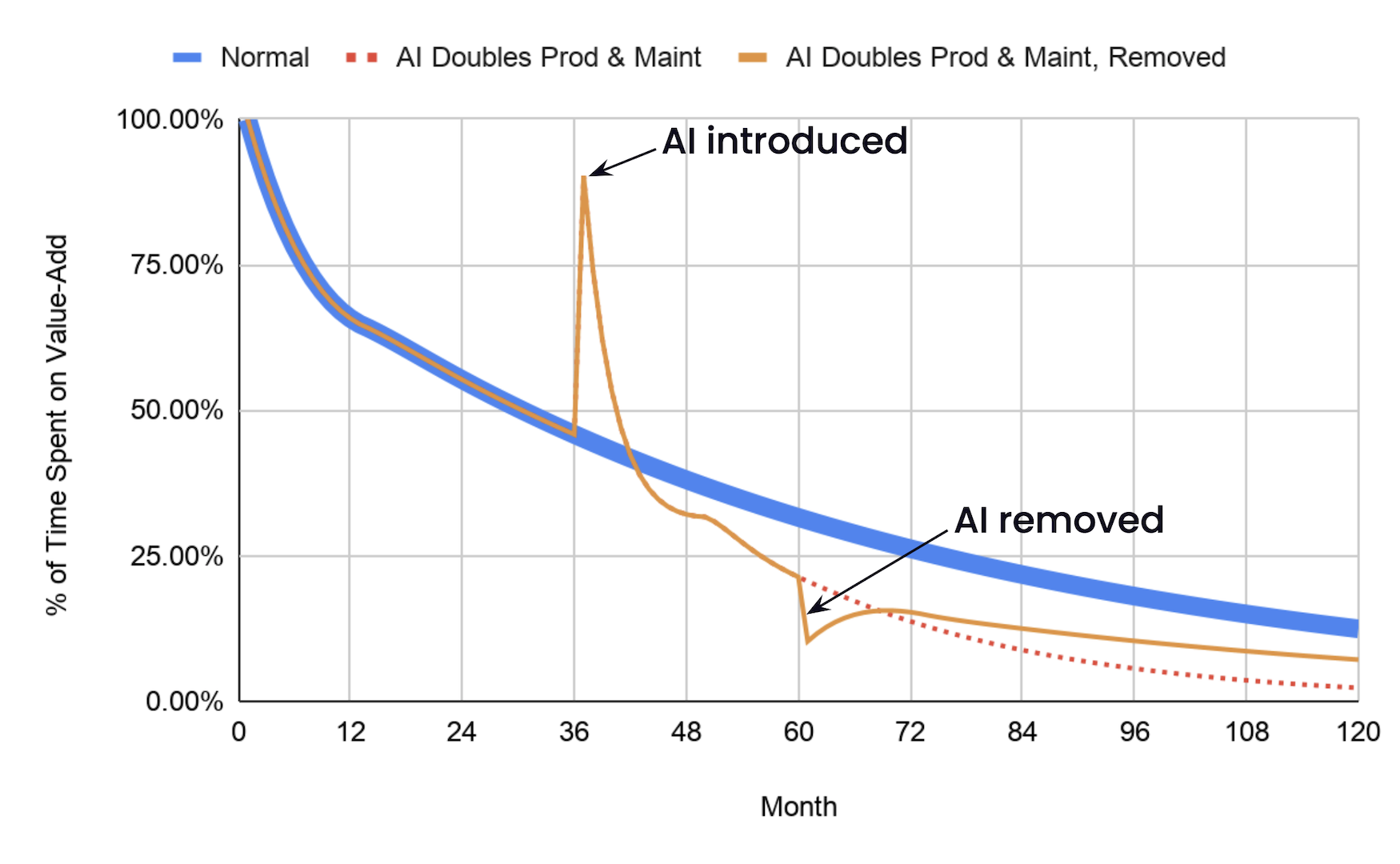
Agents are expensive, and they’re only getting more so. Once your agent’s juice is no longer worth the squeeze, you might decide to save your pennies and go back to coding the old way. Like a caveman. With your fingers.
Ha! Joke’s on you! When you stop using the agent, all the productivity benefit goes away... but the added maintenance costs don’t! As long as that code’s still around, you’re stuck with lower productivity than if you had never touched the agent at all.
The math only works if the LLM decreases your maintenance costs, and by exactly the inverse of the rate it adds code. If you double your output and your cost of maintaining that output, two times two means you’ve quadrupled your maintenance costs. If you double your output and hold your maintenance costs steady, two times one means you’ve still doubled your maintenance costs.
Instead, you have to invert your productivity. If you’re producing twice as much code, you need code that costs half as much to maintain. Three times as much code, one third the maintenance.
This is the secret to success. All the benefits, none of the lock-in.
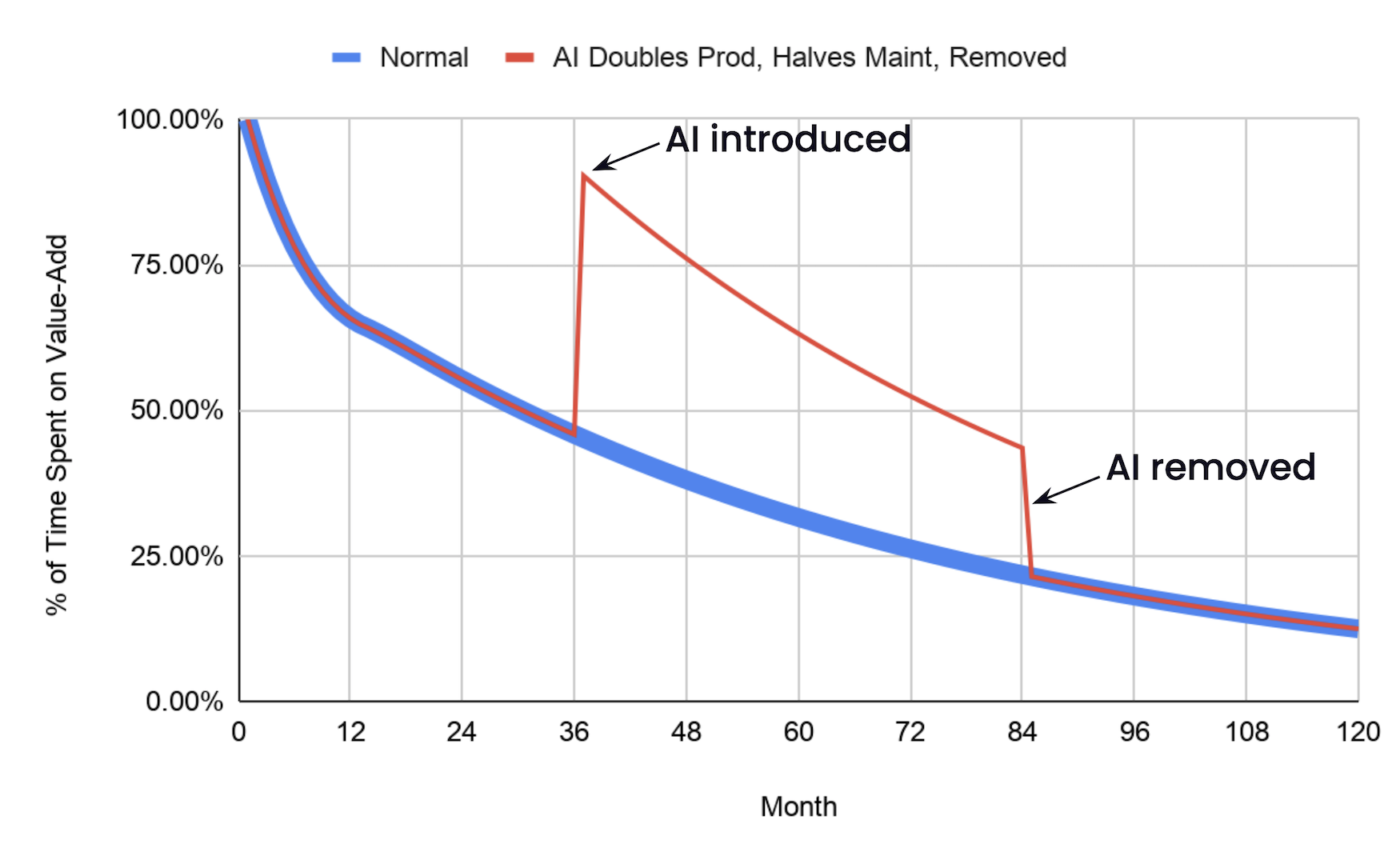
I dunno. All my reading of the finest news sources says that coding agents increase maintenance costs. Some people do say they help them understand large systems better. But big decreases in costs, of the size we need to see? No. Just the opposite.
That’s a problem. The model isn’t a perfect representation of reality, but the overall message is right. You need AI that reduces your maintenance costs, and in proportion to the speed boost you get from new code. Without it, you’re screwed. You’re trading a temporary speed boost for permanent indenture.
So, yeah, go ahead, chase improvements to your coding speed. But spend just as much time chasing improvements to your maintenance costs. Or you, too, will be trapped in Hotel California.
Such a lovely place.
Such a lovely face.
As much as it might seem like it, this isn’t meant to be an anti-AI rant. There’s other levers to pull, such as AI that makes maintenance itself more productive, even if it doesn’t make the code more maintainable. I encourage you to copy the spreadsheet and play with all the levers in the model. See what happens when you change the assumptions to match your real-world situation.