I even heard of people going to sleep with airpods pro in their ear.
Now that it's fixed tho my body decided I would need to pee every night about 2 hours after I went to bed... La vieillesse est un naufrage.
Mouth taping (stopped snoring immediately), magnesium glycinate before bed, no screens an hour before sleep, keeping the room cold, not eating dinner so late and regular sauna sessions. Individually they helped.
Together they made a real difference, loud cars and city noise don't wake me up anymore.
I know it sounds like biohacker stuff, but it works. This tool makes it possible to actually find the root cause instead of just guessing. Love it!
https://github.com/introlab/odas
Claude of course has a nasty habit of reinventing every wheel.
Which makes a lot of sense. Especially non-Tier-1 services.
Note: Having previously worked at Amazon, certain shifts can be really busy. Busy as in 30-40 pages/incidents over the course of the shift. I sometimes wake up to a "ghost" page, although I left my position earlier this year...The mechanism: mast cells (the immune cells that release histamine among other things) have their own circadian clock. The CLOCK gene controls their IgE receptor expression in a time-of-day manner, and both plasma histamine and tryptase peak during the night. In healthy people this is fine. In MCAS or histamine intolerance, this nightly mediator release is excessive, and it happens right in the window where cortisol (which normally suppresses histamine release) bottoms out around 2-4am. Histamine is itself a wake-promoting neurotransmitter, so you get woken up, often by something minor like a noise, reflux, or a temperature shift that wouldn't otherwise register. Signs it might be worth looking into: 3am waking with a racing heart, sweating, flushing, itching, or reflux/throat tightness. A good in-depth resource: https://health.programmerlife.org/en/
Two observations. 1. Often you wake up after a loud noise but like 5 minutes later with no memory of it. 2. even if you don't wake up from the noise your breathing changes, more likely to talk in sleep and shuffle more. So even if you not waking up your quality of sleep is disrupted.
Our case had some random construction like noise in the early morning, lasted around 10 seconds and disappeared. However, we noted even ordinary sounds we didn't think was loud was effecting our sleep.
Solution for that place was earplugs and a loud fan to generate white noise.
I spend time in two places. San Juan Islands WA and Santa Cruz, CA.
On island, nights are too quiet. During the day, a float plane a mile away sounds like it is next door.
In Santa Cruz, the house is on a major street. Busses, ambulances all sorts of yahoos.
I sleep better quiet. But I sleep even better when settled - mind not going, etc.
I generally don’t sleep well at all. The biggest factor is - has my brain settled. Background and noise don’t matter.
In my case, thinking too much about the causes of bad sleep actually contributed to making sleep worse, so if this guy is anything like me then this whole project could be hurting his sleep rather than helping.
I went to work at a BBB office once. They turned all their computers off at night and every morning they were back on. It was just "normal" for them.
I can't even remember what problem I was troubleshooting. At the time I was working on IVR systems.
Anwayz, I was working late in their office. Everyone had turned off their computers and went home. At exactly Midnight, every computer in the office turned back on.
I walked around the office looking at desks wondering what had happened. On one persons desk was an alarm clock with a very quiet alarm buzzing. I checked the clock and it was set for midnight (probably a default). About two minutes later it turned off automatically.
I turned off computers and re-set the alarm to go off a few minutes later.
When that alarm clock went off it somehow caused either draw or feedback in the wiring that caused all the computers to turn back on. At the time I wondered if it had something to do with wake on lan.
In any case, I suggested that person take their alarm clock home.
That’s not how lightning and thunder work.
Also, iOS has background (white noise etc) sounds built-in: https://support.apple.com/en-us/109346 Android has something similar too?
We also installed triple-layered windows for sound insulation, but I believe it degraded the quality of the air, so sometimes have to open the windows for a few minutes before sleep to get fresh air.
As an avid reader of aircraft accident reports (ok, more reader of blog posts and watcher of YouTube videos based on those reports - yeah, people have strange hobbies), it reminds me more of flight data recorder graphs - the first FDRs actually inscribed the graphs with needles on metal foil (https://aviation.stackexchange.com/questions/59289/was-the-f...), which is of course no longer the case, but the presentation has been kept.
Then correlate the time you woke up in your sleep log with the camera footage.
It’s funny how many things can boil down to "rich distributed traces" and events / logs.
Then there is the two sleep theory that suggests we are not supposed to sleep in single block. In more traditional environments, people got up to stoke the fire at this point. I know some folk that get up to urinate or have a drink. I used to turn the radio on for a bit.
Slightly off the main topic, but I can strongly second that recommendation for Coros gear!
No relation other than a very happy Coros user (Pace Pro). They make an excellent series of sport & health monitoring watches and bike gear, best GPS I've ever seen producing the most accurate run/bike tracks I've ever seen (using 5 GNSS systems: GPS, Galileo, QZSS, etc.), very reasonable pricing compared to the competition, continuous useful updates, and just a great overall approach to health and technology.
Not exactly great, but does the job.
Using ear plugs in the past caused infections as I have curved ear canals.
> Measure before you fix
In my case, I got a few IKEA CO2 sensors, and after leaving them in the bedrooms for a few days, we found that leaving an outside window slightly open + the bedroom door open, kept the CO2 levels below 600PPM at night.
We're 1000ft/300m away from a motorway, but fortunately the noise pollution isn't bad. So ventilating (even as it's getting cold) turned out to be a simple fix. I hadn't thought of collecting sleep data from our devices, but maybe I'll get an AI to do that, so I can correlate our sleep quality with the environment.
[1] https://academic.oup.com/sleep/advance-article/doi/10.1093/s...
I love my Garmin, but it's one of the worst smart watches to track sleep with. It consistently ranks poorly in tests that stack it up against pro sleep equipment, and from my experience it struggles to even detect sleep times properly. That 3:32 event that the watch said has pulled you out of deep sleep may not have been real.
> *= I do not like Garmin, I think they're a fraudulent company systematically breaching consumer rights and I'm looking for alternatives. Already converted multiple people to Coros.
And thanks for sharing that comment, I can second your two observations
For multiple months, I thought I’m waking up at night because I need to go to the bathroom so often (even checked for insulin resistance but markers were perfect). Interestingly enough, most of the times (not always) there are one or multiple louder sounds just before I wake up to go to the bathroom. Zero memory or conscious perception of the noise, still woke up and feeling like I need to go to the bathroom
For some reason, I've never slept better. Every little noise generally wakes me up (like someone walking in the same room) but the demolition noises kind of numbed me to all audio, apparently.
I also somehow sleep better when I leave a window open, and get some morning sun and noise? Though in that case, loud motorcycles revving will probably wake me up, but random people talking/shouting is fine.
Anecdotally, we have an air monitor gadget and the highest I've ever seen (small home office, fairly well-sealed, winter, me working there all day with no ventilation) was around 1100-1200 PPM. I get that two people in a small sealed bedroom could push it higher, but 3350 PPM?!
Again, not medical advice, just anectdotal experience..
Edit: this is entirely due to the 'Stop playing when falling asleep' function of iOS 26, which I loathe. But this feature barely make it worthwhile.
An off topic addendum - those are 2 very nice places to be. Maybe someday.
Also, why not?
If the goal was to have fun, that's great. If the goal was to solve a problem, I'm reminded of when engineers build over-engineered solutions, when a simple solution is available.
Could also have been “AC power restored” functionality being triggered.
Honestly, feels more like a bit. I sometimes say I need to cross my i's and dot my t's to suss out who's still paying attention in a meeting...
Most wakeups are from noise (I can see it in the data) but high CO2 levels can also make me a lighter sleeper.
Not sure where you’re based but in Europe the priority is mostly on heat isolation, so air movement suffers. The US is better in that regard. There was a big thread on that topic on X the other week (Peter the indie hacker initiated it and there were some good recommendations in case you’re the owner of the flat)
Does it really matter in the grand scheme of things tho ? I have a captor at home, even when I leave the door opened and CO2 remains low, I don't notice anything different at wakeup.
https://www.nytimes.com/wirecutter/reviews/advice-wearing-ea...
I moved to the US 15 years ago and it was too noisey for me to sleep well (fire trucks, cars, etc), but ear plugs solved the problem and are portable to other places you might need to sleep.
I grew up in the country side and unfortunately, where I live now, double glassing isn’t a thing unless you live in a recently built house.
That doesn’t nullify what you’re saying, obviously putting worries into sleep affects the sleep itself. Still thought it was an interesting project to build as I’m anyways cautious about noise and air pollution topics :)
I started meditating recently (~10mins per day) and have found it to be surprisingly effective. It’s a combination of body scanning & mindfulness meditation.
It doesn’t always help, but tends to.
It resonates well with what some people have been saying about building software for 1 person.
- when hit by ransomware, disclosed publicly, bit on the data loss and told them to fsck off
- devices can very much operate without any account, app, or cloud connection (of course you don't get the more advanced "Connect" features)
- plug it in and you have rw access to .FIT files over MTP
- same mechanism to build and sideload apps made with Monkey C
- ANT+ is a fairly open ecosystem (progressively replaced by BLE, often in much less open ways)
I hear that some people are annoyed that devices stop receiving major feature updates after a year or two, and see that as predatory "you must upgrade every year", which is like, ridiculous?
Also in a sense I like that I buy the device and it's mostly "done". Like a mechanical watch it's a utility item I can rely on and it won't ever have a Liquid Ass pulled up on me.
“Almost 2%. The reduction in carbon-dioxide concentration when 60 square centimetres of plants were placed in an office, according to one study.”
It's important to measure this somehow - I do this with a $100 Co2 sensor and display I got off amazon, but you seem to already have these sensors available.
I notice a difference if I move between a ventilated room vs congested one. I suppose it depends on what's causing the concentration. If it's human breath, I'll smell freshness. If it's e.g. burning a portable gas heater (common in my part of the world), I'll feel like I'm not inhaling smoke (probably small amounts of CO).
A few years ago, I would sometimes wake up at night and open a window wide, or go open the outside door and stand there for 5-10 minutes.
Big fan of plants though, help me feel calm
we rarely get over 1k here
That's the idea
The only downside is you get used to the quiet and it means when I don't sleep with them I get a worse night sleep than I used to. (But I still get a better night sleep with them than when I didn't use them.)
I used to wear them every night and they definitely improved my sleep. But then I also had instances where my ear was blocked with wax for several days.
YMMV
What they're good for is sleeping due to desperation while travelling. I couldn't imagine having to wear them every day at home. That sounds like hell.
“These results are not applicable to typical buildings, where outdoor-to-indoor air exchange already removes volatile organic compounds (VOCs) at a rate that could only be matched by the placement of 10–1000 plants/m2 of a building's floor space.[2]
The results also failed to replicate in future studies”
Once I also had automatic blackout blinds, they would slowly roll up before my my alarm rings. All controlled by home assistant, which can read the phono alarm time. Waking up slowly by light is nice :)
I’ve been using swimmers plugs for a few years now and they’ve been fine. Do you use an eye mask too?
They’re little putty molds that you shape to fit your ear.
I also rip them in half before molding so I get 2 ear plugs from 1 putty.
Then I fixed my health.
> Hijacking the vicitim’s COROS account and accessing all data
> – Eavesdropping sensitive data, e.g. notifications
> – Manipulating the device configuration
> – Factory resetting the device
> – Crashing the device
> – Interrupting a running activity and forcing the recorded data to be lost [0]
The security firm disclosed the vulnerability to Coros in Mar 2025. They planned to fix it by the end of 2025, and didn’t address it until the security firm publicly released the finding.
[0]:https://www.dcrainmaker.com/2025/06/coros-confirms-substanti...
Otherwise making sure the windows are properly sealed is first resort. And if you’re living with other people (partner, flatmates, family) it also helps to check the doors
But I think you need to get lucky with the ear canal print. Mine had 30 days return policy of they don’t fit well. I did it in a local store
The downside is they're very expensive, relative to other earplugs and mine no longer seal as well as they used to so I'd need to get a new pair. They're still better than nothing. I started using earbuds around the same time, from using cans, and I wonder if I've very slightly widened my ear's opening.
I also use an eye mask if I'm somewhere that doesn't have good curtains or blinds. Really works very well, but I recommend one that wraps around and doesn't have an elastic band to dig into your ears (Matador makes a good one).
Have the same pattern, issue is cortisol/stress, not sounds / etc that happen precisely at night
Built simular things tonwhat Op did (thoug using Oura for sleep tracking, not Garmin)
Result: no statistically significant variations in sounds, CO2 normal etc. Cortisol is what doctors/AI told me first
Silicone: expensive, effective, fussy.
Wax: cheap, effective, disposable. (Needs warming up, slight drawback.)
9 min read May 11, 2026
I try to pay attention to the small things that affect my quality of life. When something keeps bothering me, I want to investigate, find a likely cause, and act on it.
What changed recently is what I'm willing to build to support that. With AI tooling, projects I would have dismissed a few years ago as "too much effort for the payoff" now fit into a weekend. So whenever I bump into a problem in my daily life, I catch myself thinking, "actually, I could build something to look into this".
This post is about one of those problems: my sleep.
I live in a noisy city. Some nights I wake up at 3 am with no idea what woke me up. Other nights I don't fully wake up, but my watch the next morning shows that something pulled me out of deep sleep at 3:32 am.
The frustrating part is that you almost never know what caused it. When a sound wakes you up, your brain is still transitioning out of whatever sleep stage you were in, and it takes a moment to come back online properly. By the time you can register what's happening, the noise is already gone. Unless it repeats (thunder, car alarm that won't stop) or leaves a clue afterwards (a flash of lightning following the boom), you wake up confused and the cause stays a mystery.
And without naming the cause, you can't fix it. Was it inside the flat? Outside? A neighbor? A truck? A door? Any "solution" you try is just a guess, and guessing tends to be expensive.
So I was on a mission 😏
One bit of context first: I already have a smart home setup with Home Assistant and a bunch of sensors around the flat (motion, doors, lights, temperature, humidity, CO₂, air quality). A lot of the data I needed for this project was already being collected. I only had to add the audio piece, pull in my sleep data, and tie everything together.
I only needed to add a few things:
When the Pi hears something loud enough to be interesting, it saves a short clip with a few seconds of context before and after. The whole detection mode is gated by Home Assistant: the Pi exposes itself as a Home Assistant integration, and an automation only switches it on when I'm at home, in bed, and around my usual sleep time. Outside of those conditions, it's completely disabled, no microphone access at all. That's the behavior I wanted, even on my own home network.
The web app is where the actual usefulness happens. Each night is laid out like tracks in a music editor: one for sleep stages, one for heart rate and HRV, a few for the sensor events, and one for the noise events with the audio loaded in.
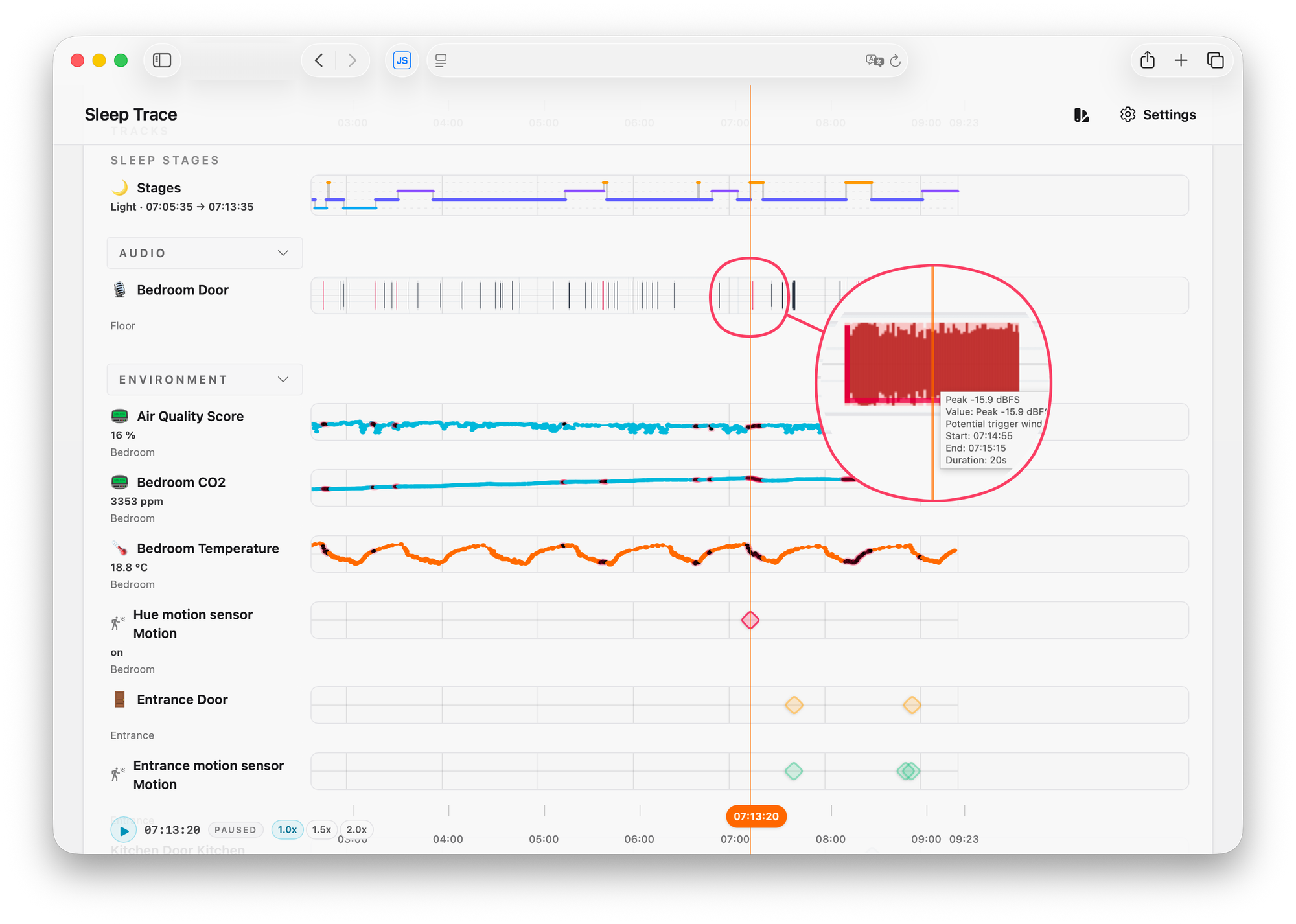
Responsive, also works on mobile. Tracks can be zoomed in and out, like a music DAW.
The most useful feature, by far, is how it visually marks the moments where my sleep stage shifted or I woke up. That's the entry point. I scan a night, find the highlighted moments (in red), and click to listen.
One more nice touch: the frontend is a progressive web app with web push, served only inside my home network. The moment I wake up and check my phone, I get a notification that last night's data is ready to review. Nothing leaves the network, which I really like.
To set expectations clearly: AI is what made it realistic for me to build this in a weekend. The whole thing took roughly 8 hours of work, plus a few small improvements over the following days. Without AI tooling, I would not have started.
But I'm not using AI to identify the actual sounds (at least, not yet). The listening part, recognizing a door vs. dishes vs. a motorbike, is still me with headphones on. The tool just points me at the moments worth listening to.
And on the workflow: I didn't read the code (conscious choice). I tested the results, gave direct feedback when something was off, and let the AI verify its own output by letting it take screenshots of the running app in my browser.
For the micro-computer side, I went one step further. The Raspberry Pi was a fresh, empty install, so I gave the coding agent SSH access and let it test things directly on the device. It would set up an experiment, ask me to shout, drop something, or run the kitchen tap, record the sample, and then analyze it for me, sometimes pulling out spectrograms. I had to be explicit about wanting it to work this way, but once instructed, the iteration loop was honestly quite fun.
For a personal project running on my own hardware, this whole setup was enough.
The interesting shift here isn't that AI solved my problem. It's that AI lowered the cost of building the thing that lets me solve my own problem.
I get the sleep data from my Garmin* watch. Every watch and ring calculates sleep slightly differently, and to be honest, I don't fully trust any of them on the exact sleep stage I was in at any given second.
What they're all reasonably good at, though, is detecting when you actually woke up. Those wake events, plus the rough transitions between stages, are what I actually care about here. They're not a clinical truth. They're visual markers that tell me "this moment is worth investigating". Without them, I'd be sitting through hours of audio of the fridge humming and a neighbor doing nothing in particular.
I'm not trying to do sleep science. I'm trying to find what sometimes made me feel rough in the morning.
Once I started actually using this, the patterns came out fast. The usual suspects:
With actual data, I could finally act with some confidence instead of guessing:
It's not perfect (cities are cities), but the difference shows up both in how I feel in the morning and in the Garmin* data over time.
A bit more detail for anyone interested in the tech:
What I have is already enough. I can take action, which is the part that matters most. But there are a few extensions I might get to at some point:
Each of these would probably be another weekend, which is sort of the broader point of this post. I'll get to them eventually, or maybe I won't, because what's already there does the job.
The specific project matters less to me than the underlying pattern. There's a whole category of small, personal problems that used to sit in the "would be nice, not worth building" bucket. With AI tooling, a lot of those projects have crossed into the "sure, why not, let's give it a weekend" zone.
A few things I'm taking from this one:
About my background: I come from software engineering. That's the main reason I could pull this off in 8 hours. I knew what to ask for and when to be skeptical of what came back. Audio processing, on the other hand, is a space I'm new to (I've used Logic Pro and a few of its plugins, but not much beyond that), and I built most of that side with no prior foundation.
That said, I would not publish this code anywhere as-is. It's only tested based on results, with no proper code review. The reason that's fine in my case is that it runs in my home lab, where I can lock it down and restrict what it can access.
I'm not a sleep scientist, and this isn't meant to be a guide to good sleep. I'm someone who tries to pay attention to the small things that affect daily quality of life and act on them when I can. There are many things in my life I approach this way, big and small. This is one of them.
If you also live in a noisy city and your sleep tracker keeps telling you "your sleep was rough" without telling you why, I'd really recommend trying some version of this. You don't need to build exactly what I built. Even just placing a microphone next to your bed and reviewing the spikes the next morning will already teach you a lot 🤗.
Plot twist: now that I've added more insulation to the windows and doors, I have to figure out a smart way to reduce the CO₂ levels..
*= I do not like Garmin, I think they're a fraudulent company systematically breaching consumer rights and I'm looking for alternatives. Already converted multiple people to Coros.
Get my latest articles delivered right to your inbox .
[[email protected]
Subscribe
](#/portal/signup)
Foam: The most effective, by far. I suspect many people wear them incorrectly and do not insert them far enough. You can use lube (they make special ear lube for stuff like hearing aids, although I think anything medical grade will do) if you have difficulty doing so. I have unusually small ear canals; the most comfortable and best I've found by a mile are Mack's Ultra Soft Foam Earplugs. These are much more comfortable than slim fit alternatives and also have very high attenuation.
Silicone: expensive (but they're reusable and last years), but the least fussy once you get them. They are moulded to your goddamn ear---it's a perfect, pressure-free fit every time and they go right in. Drawbacks include lesser attenuation and attenuation that isn't immediately at 100%---it takes a while for it to "seal". I abadoned these once moisture started to accumulate between my ear canal and the plug and I'd hear it as I moved and it became very annoying.
Wax: joke attenuations compared to foam, and bad compared to silicone. The most expensive long-term unless you're serious about reuse. Somewhat fussy and may fall out. Very comfortable (little insertion).
Foam + wax: this is what you really want if you care about maximum attenuation. My ear canals are slightly too short to comfortably insert an entire Mack's earplug, so I snip the ends off mine, lube them up, and insert them completely flush into my ear canal. Then, I take a wax plug and mould it on top. It's perfectly comfortable and it performs better than any other option I'm aware of. I tend to also wear a Bluetooth sleep mask and play rain sounds on 100% volume and it just comes through the double earplug situation to mask any very loud/spurious noise. To remove the flush-inserted earplugs, I use a pair of blunt tweezers.
When I used slim fit foam earplugs I'd routinely get ear infections. Switching to silicone fixed that, but suffered from the aforementioned issues. With the ultra soft earplugs + wax method I never get ear infections. I make sure to always insert a fresh pair (but I reuse the wax ones for a few days) and to always do so with clean hands. I think the infections are due to friction between the plug and the canal during insertion as well as plugs that are too large/exert too much pressure once expanded---the lube and very soft plug addresses those issues.
Stop eating the foods that stimulate it.
I now have visible production on a tissue or cotton swab once a week or fewer.
You're worth X.
You have 1 cat who owns you, total value X.
Get 10 black market cats for free, now 11 cats own you for a total net worth of 11X.
That's even before considering the compound effect of each cat owning a human worth 11X, which means you can divest from 1 cat for 11X, and still be worth 110*X.
The system basically works like xAI shares. Don't look too close into it.
huh, potentially a game-changer. Thank you!
Also, for anyone getting reading this, cotton swabs in your ears is a bad idea and usually makes the problem worse (pushes wax in and compacts it).
That’s not what’s being discussed.
They asked what I did.
This is anecdata.
and anecdotally:
I no longer make enough wax to see in a month.
But you also shouldn’t be surprised if someone challenges the implications or merits of your anecdata, for the benefit of others that might take it as good advice.
checks notes
consider switching up environment
or diet/things you’re ingesting,
if you’re generating excess goo known for waste-carrying,
and protection from environmental debris...
Are you serious?
Feel free to struggle until a peer-reviewed study gives you permission not to,
but don’t be surprised if others continue making basic observations and improvements for themselves.
But changing your diet won’t help with ear wax. And cotton swabs are a bad idea.
You seem upset; this is just a discussion on an internet forum. It’s ok for people to have different opinions and share them in a thread :)
Changing mine does - and I can reliably show it - and I’m what was asked about.
Also, cotton-swabs or a tissue aren’t a bad idea (again, anecdotally for me - what was asked about)
unless one has build-up,
and/or the ear opening has become smaller as a protective measure,
ensuring one rifles the gunk in from the walls,
instead of going past it in the center,
and then pulling out and around the walls.
Most have ear-openings too-tight to even know what I’m referring to.
Anyway, not upset, just steadfast that words matter.
and that individuals don’t need the permission of peer-reviewed studies (or you!) to make basic improvements in their lives.
Anyway, I’m not trying to convince you of anything. My comment was aimed at other readers; further discussion between us won’t be necessary. Good day! :)