The new live version refers almost exclusively to the former meaning, and adds "stop" to turn it into a protest song.
I've seen Kraftwerk live twice, at London's Albert Hall and Berkeley's Greek Theater, both times absolutely amazing. Highly recommended.
I've often thought they would be the ideal band to perform inside the "Sphere" in Las Vegas.
P.S
Also check out Ashra - Deep Distance (1976).
It was an amazing show, and incredible night.
Kraftwerk sounds novel even today, I can’t imagine how it must have sounded 50 years ago.
Also, has anyone ever compared the cultural context and zeitgeist of both songs? Probably would be a fun high school assignment, haha. Kraftwerk's song came out in the same decade that the Club of Rome published its Limits To Growth report[2], so when fears about humanity's future really started to become A Thing that was impossible to ignore. Later versions of the song turning it into a protest song encapsulate Cold War fears for a nuclear apocalypse of the time (presumably, I wasn't really around yet back then).
The main audience for the Imagine Dragons song was a generation fully born after the fall of the Berlin Wall. One that grew up playing the Fall Out games. It also came out in 2012, right after the 2008 crisis kick-started the "oh the previous generation will leave us with nothing huh?" Doomer mentality among millennials and Gen Z kids. Remember the media going nuts over the "Ok, Boomer" expression for a while? (which still feels like the media intentionally dividing a community to stop it from actually fixing things me, tbh, but let's not get too side-tracked)
In that context, when put side by side the ID song almost feels like a Doomer generation follow-up and implicit critique of how nothing seems to have actually be done about to prevent the impending apocalypse that the Kraftwerk song's generation was supposedly so worried about, turned into a fantasy about living in that post-apocalyptic planet.
It's "vibe" is weirdly hopeful too, especially compared to the Kraftwerk song as well. Instead of fearing an apocalypse, it's set after one and embraces living within it.
At least, that's how the two songs come across to me, which probably says more about me than anything else. Apparently Dan Reynolds, main singer on ID and one of writers of the song, has said that in retrospect after almost a decade, he had realized that it was actually about him "not giving up hope after losing faith in Mormonism."[3]. Which makes sense as a personal experience of going through feeling doomed and figuring out how to survive and embrace living on in a "post-apocalyptic" world on a personal, social level.
I think that's what annoys me about the Kraftwerk song's status as a protest song, and a lot of other music from the same era: it doesn't feel like it's insisting on a better future. It's passive late 70s, early 80s pessimism.
[0] https://www.youtube.com/watch?v=w3viBe2Q0P8
[1] https://www.youtube.com/watch?v=NyXeJZJUFHE
[2] https://en.wikipedia.org/wiki/Club_of_Rome
[3] https://en.wikipedia.org/wiki/Radioactive_%28Imagine_Dragons...
"Kraftwerk: Future Music from Germany", by Uwe Schütte. It's packed with details of albums, songs, tours, equipment, and people.
The anti-nuclear message in "Radio-Activity" certainly came later and was repeatedly updated, right into the Fukushima era [2011], but this was not the original sentiment [1976]. From the book:
"At the time, Billboard magazine featured the most-played singles by the large network of radio stations under the heading 'Radio Action'. The band seemed to have misread or misremembered this as 'Radio-Activity'. 'Suddenly,' remembers Wolfgang Flür, 'there was a theme in the air, the activity of radio stations, and the title of 'Radioactivity is in the Air for You and Me' was born. All we needed was the music to go with it. ... The ambiguity of the theme didn't come until later.' Radio-Activity was intended to celebrate radio broadcasting as a convenient, easy and democratic means to listen to music and news."
Germany has been pretty widely criticized for decommissioning it's nuclear power program, only to replace it with Russian oil.
What replaced all other fossil fuel sources are renewables, which at 50% are now by far the single largest source of energy.
I'm pro-nuclear as well, but understand that for many decades the "smart" thing to do was to oppose it. I wouldn't expect a musical artist to have a more nuanced opinion than most of their contemporaries.
Anti-nuclear sentiment in Germany was entirely manufactured; it was the product of Gerhard Schröder and similar robots who enriched themselves on Russian oil and gas.
Ironically, it is also where the so-called Green Party began.
Either way, Germany has perfected the efficient foot bullet, at least.
I could imagine Kraftwerk devising a stonkin’ “Fußkugel” track, actually ..
The paranoia around nuclear power is tied to generational fear mongering of governments during the Cold War. The oddest part is why not use safer reactor designs; water reactors make sense for the US Navy and not on land.
Having enemies the population is afraid of is good for politicians and they'll take any enemies they can find, and they'll do so indiscriminately regardless of the real nuance of the issues.
Immigrants, abortion, this religion or that, rock music, jazz music, alcohol, marijuana, global warming, windmills, books... just whatever as hard as they can regardless of if it's reasonable or not.
And Chernobyl. And Fukushima. Nuclear is great but it has some very real risks
There was a pretty good reason to be scared of nukes when these folks were children in the 50s. The world was quite a different place back then. The US was lagging behind the Soviets, militarily speaking, and Communism was much more expansionary.
1. Radioactive waste gets less toxic over time unlike many toxins like mercury, lead, and cyanide. People seem to emphasize the duration of toxicity for radiation while apparently giving 'forever toxins' a total pass.
2. Short-lived radiation is what's really dangerous. When atoms are decaying fast, they're shooting out energy that can cause real damage fast. Longer-lived radioactive stuff with billion-year half-lives like natural uranium can be held in a gloved hand, no problem. In the extreme, and infinite half life means something is stable and totally safe (radiologically at least).
Yet people still want to emphasize that radioactive byproducts of nuclear power have long half lives. I don't really get it.
> requiring custodianship on a timescale that humans can barely conceive of let alone commit to or execute responsibly.
This is fearmongering. Casing waste in big concrete casks is enough. It's so incredibly overblown that we're willing to burn coal and kill people over it.
The question that matters for both industries is what bad things happen when their stewardship inevitably lapses and the happy path dead-ends.
I don't like either answer, so that heightens the urgency of pursuing alternatives with fewer long-lived hazardous byproducts. Neither coal nor nuclear is an acceptable long term solution.
The concert itself was a gift from Victor Pinchuk, one of the Ukrainian oligarchs and renowned patron, to the city. Previously he also sponsored a full-blown Elton John concert on the main city square which I also attended.
Just a small correction, but the anti-vax arguments are very conservative, not liberal.
The big problem is having one country be able to do it without deterrents and with impunity. MAD is a good thing, if anyone will have those things at all.
Will it actually get encased successfully, will it be stored onsite in environmentally sensitive areas because it’s too much trouble to move, will your children’s children uphold the commitments you foisted on them through the political and economic turbulence in their lifetimes, and if not what happens comparatively when those coal ash heaps and nuclear fuel dumps are left to rot…
The externalities of concentrated radioactive material are not something that our socio-economic institutions are capable of handling at scale. Tragedies of the commons are the rule and eventually all of that waste will be go through periods of mishandling at one time or another.
Nuclear power plants have been extremely safe for many decades! Fuck, even the worst disasters related to nuclear power plants have killed less people than coal or oil disasters, even including Chernobyl which was a fuck up beyond comparison.
> Will it actually get encased successfully
Yes, this is literally done and has been done for many decades.
> will it be stored onsite in environmentally sensitive areas because it’s too much trouble to move
What does that mean? You can live 1 feet away from a cask and receive less radiation than you do from the sun.
> will your children’s children uphold the commitments you foisted on them through the political and economic turbulence in their lifetimes, and if not what happens comparatively when those coal ash heaps and nuclear fuel dumps are left to rot…
This is a bad argument because all of society relies on our grandchildren upholding present commitments. What happens if our grandchildren stop upholding the electricity grid? They die. What happens if they stop large scale agriculture? They die. And on and on and on.
> The externalities of concentrated radioactive material are not something that our socio-economic institutions are capable of handling at scale.
It's quite literally something society has been doing very successfully for 50+ years.
Rectang explained it very well, and all their points stand imo.
> Worrying about expanding nuclear and ending up putting the waste in a hole deep in the ground is such a nonissue to me.
Blithe minimization of the problem of storing nuclear waste over millenia feels like "Peak HN". :)
("Peak HN" jabs are a cheap shot, though — so let me engage more seriously...)
First, "coal vs nuclear" is a false dichotomy. Everybody I see advocating for nuclear power in this thread is advocating for it as a permanent solution rather than an interim solution — in which case there are other competitors.
Second, if nuclear waste is too dangerous for less-than-ideal storage conditions, that speaks negatively to the viability of nuclear power — because over the long term less-than-ideal storage is guaranteed by our inability to design incentive structures for responsible stewardship that persist over centuries.
1 day ago
Arwa Haider

Getty Images
Fifty years old this month, Kraftwerk's single Radioactivity was a groundbreaking track that morphed into the German electronic pioneers' most political protest song.
From the tremulous opening seconds of Kraftwerk's Radioactivity – a pulsing Geiger counter; escalating synths; shrill morse code spelling out the title – you sense that nothing will sound the same again.
This core track from the German electronic pioneers' fifth studio album Radio-Activity (1975) feels like a scientific hymn, but it also strikes warning notes within its insistent hooks and haunting Sprechgesang (spoken singing) refrain: "Radioactivity / Is in the air for you and me".
Over the decades, Radioactivity itself has mutated, from elegiac melody to club banger and an anti-nuclear clarion call, while remaining fantastically distinctive. Half-a-century on, the album is reissued for its 50th anniversary, and this anthem still crackles with Kraftwerk's creative power.
Kraftwerk originally recorded their Radio-Activity album between bursts of transatlantic tour dates. It extended the experimental pop and deadpan wit of their international breakthrough Autobahn (1974), with lyrics in both English and German.
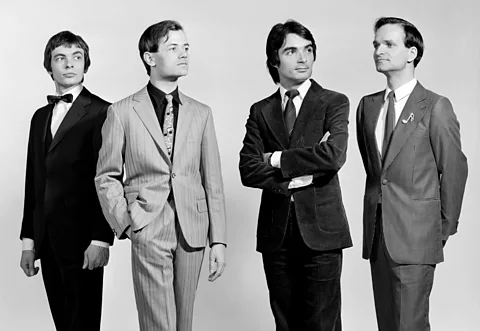
It was also a curiosity, evoking a new "information age" as well as a Cold War-era dread. It debuted Kraftwerk's "classic" quartet line-up: co-founders Ralf Hütter and Florian Schneider (who co-produced the album at the band's Kling Klang studio in Düsseldorf), Karl Bartos, and Wolfgang Flür.
I discovered Kraftwerk because they were the heroes of my heroes. It was like travelling back in time to tune into tomorrow
Their music moved into fully electronic realms, coolly detaching from Kraftwerk's earlier folky/jazzy style (where Schneider had played flute and violin); their signature synth sounds were sealed, including on the punchy Minimoog and the eerie chorals of the Vako Orchestron. Despite the album's relative brevity (its 12 tracks run to under 38 minutes), its atmosphere is intoxicating – and there is always a sense of wonder amid the tension.
"It's a science fiction kind of album," Hütter, the band's remaining original member, told Uncut magazine's Stephen Dalton in 2009. "Horror and beauty. The concept was infiltration by radio station – which is maybe more dangerous than radioactivity. We worked with tapes, editing pieces, glue. All electronics. And more singing and speaking, like speech symphonies."
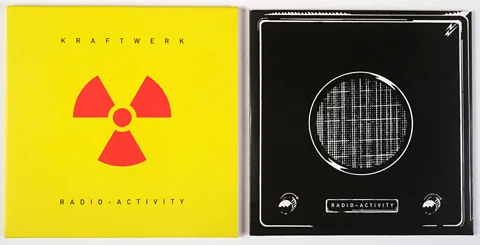
Kraftwerk's entire catalogue is a kind of extraordinary circuit board, connecting to unlimited musical styles: hip-hop; electro; ambient; new wave; synth pop; industrial rock; Detroit techno; contemporary classical. Radio-Activity particularly seized the spirit of sound and vision. The original artwork was designed by long-time collaborator Emil Schult, while the music was presented in increasingly ambitious ways: in Flür's book, I Was a Robot, he relates playing Radioactivity live using a light-triggered "percussion cage", which would frequently glitch onstage. The album has been sampled by acts including New Order (most famously on Blue Monday), The Chemical Brothers, and Miley Cyrus.
Many of the artists from my period wouldn't have existed in the way that we do now, if it weren't for Kraftwerk – Martyn Ware
The band have also been cited as an inspiration by stars from David Bowie to Ryuichi Sakamoto (who once told US journalist Jim Sullivan that he'd co-founded Yellow Magic Orchestra because "we wanted to make a Japanese Kraftwerk") and the composer Max Richter (who once told me that, aged 13, he'd written to the BBC after hearing Kraftwerk on TV for the first time: "I freaked out, because I'd never heard electronic music before… I thought: 'I've got to get my hands on a synthesizer' – and then I found out a synthesizer costs as much as a house").
As music tech progressively became more accessible, it sparked further possibilities – and as a young music fan, I discovered Kraftwerk because they were the heroes of my heroes. It was like travelling back in time to tune into tomorrow.
Alamy
Over the decades the song Radioactivity has mutated from elegiac melody to an anti-nuclear clarion call (Credit: Alamy)
"Kraftwerk are one of the pillars of my creativity," says celebrated musician/composer/producer Martyn Ware, whose own repertoire includes co-founding late-'70s/'80s trail-blazers The Human League, Heaven 17, and British Electric Foundation, as well as hosting his Electronically Yours podcast series. "Many of the artists from my period wouldn't have existed in the way that we do now, if it weren't for Kraftwerk.
"It kind of started when I met Phil Oakey [who would later become The Human League's frontman] at school; he had a much bigger record collection than me, which was an awakening. We got into Kraftwerk together, before they were even an electronic band. The thing that really changed it for me was Radio-Activity. It's conceptual art, it didn't sound like anyone else. I loved the bravery of Radio-Activity, and there's a certain gentleness, as well. It's ethereal, like there was a profound intelligence behind it all."
Growing up in the British industrial city of Sheffield, Ware adds that this music deeply resonated: "Kraftwerk's sonic impressionism painted strong pictures. They used found sound in combination with electronics, and it felt like a signpost to the future for us."
By the turn of the '90s, Kraftwerk's impact on club culture was unmistakable; their dancefloor-driven collection The Mix (1991) featured recharged versions of '70s and early '80s classics such as Autobahn, The Robots and Trans-Europe Express – and a particularly radical reinvention of Radioactivity.
Whereas the original track hailed scientific innovation ("discovered by Marie Curie"), the new version was an emphatically anti-nuclear anthem ("Stop radioactivity"), opening with a vocoder roll-call of power station disasters and atomic horror ("Chernobyl… Harrisburg… Sellafield… Hiroshima"), with additional lyrics highlighting nuclear devastation ("Chain reaction and mutation/ Contaminated population").
It's really unbelievable that Radioactivity was released 50 years ago. With those high morse code pulses, half-tempo electro drums and epic synth bass, it could be a new vaporwave track – Kees Berkers
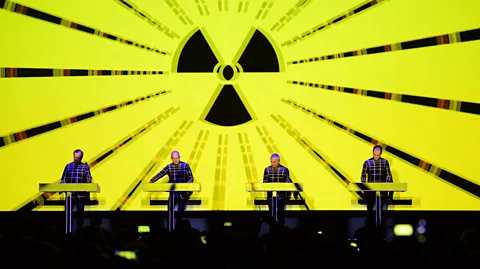
Radioactivity had shape-shifted into a thrilling protest song and party anthem, emblazoned with trefoil symbols. Kraftwerk played this version live at 1992's Stop Sellafield concert organised by Greenpeace, and at UK festival all-nighter Tribal Gathering in 1997 – where I watched breathlessly as a young clubber, before racing to the nearest record shop to buy my first Kraftwerk album.
Getty Images
Kraftwerk's classic quartet line-up was Karl Bartos, Ralph Hütter, Wolfgang Flür and Florian Schneider (Credit: Getty Images)
The reworked Radioactivity has become a fixture at Kraftwerk's packed live shows in recent years, though it's often regarded as an unusually political work from a largely enigmatic outfit. In a 2012 live review, Rolling Stone described Radioactivity as "the band's only overt piece of activism… an all-out DEFCON 3 protest against nuclear power".
For Ware, its adaptation made absolute sense: "I think, by the time they came around to the remix album, they were totally different people," he says. "The function of an artist is to reflect the times, and to make an authentic statement based on your lived experience. So I'm not surprised at all."
Radioactivity also arguably sounds more relevant than ever, in a modern world beset by warfare and environmental damage. In 2012, Ryuichi Sakamoto invited Kraftwerk to play the No Nukes concert in Tokyo, and Radioactivity's lyrics were expanded again, namechecking Fukushima, where a major nuclear disaster occurred in 2011.
At the time, Sakamoto explained in a broadcast for Japanese radio station J-Wave: "They [Kraftwerk] have been putting out strong anti-nuclear messages since 1991, so I thought they might sympathise with us… We exchanged emails almost every day, and I helped them a little, and we put the [Radioactivity] lyrics into Japanese. It was also the first time Kraftwerk and YMO had met in 31 years."
More like this:
Radioactivity remains in the air – and on-screen (it's featured on soundtracks from German arthouse movies to Brazilian telenovelas). It has been covered in a range of musical styles, from Fatboy Slim's kitsch funk reworking, to a dreamy country-folk version by Yellow Magic Orchestra's Haruomi Hosono. For new generations of artists and music fans, Kraftwerk still sound like a vital shock to the system.
"Radioactivity, and the album around it, is like a collection of sketches, experimenting with different synthesizers and sonic effects, and making new ideas out of them," says indie musician/writer Nabihah Iqbal, who will premiere her new commission for electronics and strings at Goodwood Art Foundation later this month. "The amazing thing is that even now, you can hear how that work has gone on to permeate so many different types of music. They set the blueprint for what's possible."
"Kraftwerk have such a unique approach to music," says Kees Berkers of Dutch psych-funk band Yin Yin (who have previously covered another Kraftwerk classic, The Model). "It's really unbelievable that Radioactivity was released 50 years ago. With those high morse code pulses, half-tempo electro drums and epic synth bass, it could be a new vaporwave track. Absolute game-changers!"
The modern world may feel uncertain, but Radioactivity lives on in the digital age. "Young people don't associate songs with a particular time as much anymore," says Ware. "They don't see this track as a nostalgia trip. They're listening to the DNA of their lingua franca, which is music made on a laptop."
Radio-Activity is reissued on 15 May. Kraftwerk are currently on a world tour.
--