Show HN: Open-Source 8-Ch BCI Board (ESP32 and ADS1299 and OpenBCI GUI) - https://news.ycombinator.com/item?id=46502051 - Jan 2026 (21 comments)
https://github.com/Cerelog-ESP-EEG/ESP-EEG/issues/1
A quick look over the other links looks like they're okay, follow them instead for the moment.
Texas Instruments ADS1299 (24-bit, 8-channel) analog-digital converter
There is no way to do what that chip does for less, maybe 7$ less but then not as good. They have priced it perfectly and I hate them for it.
https://www.digikey.com/en/products/detail/texas-instruments...
Thanks for pointing this out.
Or try the newer ADS122S14.
There are multitudes of neuro research projects using animals as test subjects that could save a lot of money using a tool like this. If the research project is able to use a device like this rather than a human verified device. From my limited knowledge, these projects do their best to be very kind to the animals being tested. A device like this wouldn't need to be enclosed within the animal, so less risk of harm right away.
In Africa, clever locals built a humidy crib from car parts. It ended up not working as a product, but a great idea. In the link below, its celebrated as a commercial failure to learn from.
https://www.bbc.com/future/article/20140430-why-bad-inventio...
There's another affordable humidy crib that won a design competition here, https://www.theguardian.com/global-development/2014/dec/25/i...
I think EEGs (Electro EncepheloGraph) can produce a far more detailed, brain related view of what an ECG (Electro CardioGraphs) can produce. An EEG can of course look into many other brain related functions and issues.
Creating a low cost version of an EEG will hopefully at least provide some thoughts to the engineers of commercial EEGs.
Commercial, medically verified devices are tied down in many ways...
- Full checks of the software and hardware design,
- backwards interoperability and compatibility for devices and their connections over their lifespan
- A full medically based software/hardware quality check,
- Providing very detailed documentation,
- doing a full test cycle around every device,
- Interacting with doctors and health experts to fully characterise the domain and typical device use. This is great to do as an engineer, but is expensive for the company :-)
- Older (often slower) more fully field verified/trusted chips for any logic are used, since they have a large measure of reliability, reducing the risk you'd get from new products.
The list above is from memory. Engineering around devices like this become part of the culture of the company. Each region (US, Europe, Oceania) have their own requirements and levels of completeness. The big market for any medical product is the US. It's FDA in the past has been the most important regulatory body to satisfy to allow access to the US market. Several other markets use the FDA as a base for their own standards too.
This process takes several years and millions to complete. Its a very necessary step. Think of the Therac 25, https://en.wikipedia.org/wiki/Therac-25 . The mistakes in this device design caused fatalities.
I used to work for Cochlear. Their devices have had some issues, but overall I think they have a very good record. The verification/quality checks outlined above are super necessary.
Anther Oz company Telectronics, built many pacemakers and unfortunately made a design mistake in the choice of material for a lead feeding the part of the device that fed the therapeutic current to the patient. After time, the lead cracked. Failure of physical integrity in a fully enclosed medical device is quite a bad failure mode. I believe The company lost 75% of its share price overnight when the issue was reported. https://en.wikipedia.org/wiki/Telectronics
When this device becomes fully wireless, its risk will drop somewhat.
This project is awesome also as a teaching tool for people wanting to join companies that make medical products. They'll be able to look over a modern design and discover what's involved.
Please jump in and make any additions or corrections to the above.
Should I delete the issue since its not their article?
I have a much larger screed in another part of the tree of comments too. It's a case of braindump, TLDR.
I recently ran across a new open-source (or is it source-available?) EEG board that looks interesting: the Cerelog ESP-EEG.

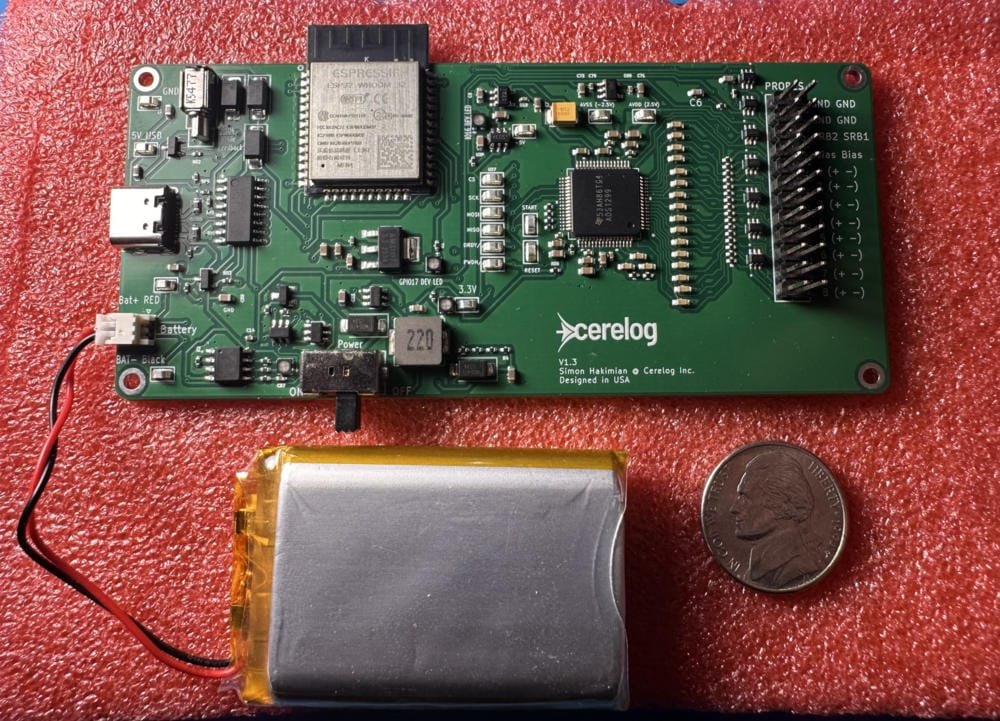
Cerelog ESP-EEG development board in action
At its heart is the Texas Instruments ADS1299 (24-bit, 8-channel) analog-digital converter, the same chip the OpenBCI Cyton uses.
So what's different or better about the Cerelog? From my perusal of the materials, it seems that the selling point is cleaner signal due to true closed-loop active bias, at a price point close to the price of the OpenBCI when it launched (less than half the price of the Cyton now).
Software support includes a fork of the OpenBCI GUI (via Lab Streaming Layer) and Brainflow.
The project is by former SpaceX hardware engineer Simon Hakimian.
Git repository with firmware and schematic here:
⇒ https://github.com/Cerelog-ESP-EEG/ESP-EEG
Product page:
⇒ https://www.cerelog.com/eeg_researchers.html
Usage guide:
⇒ https://www.cerelog.com/eeg_researchers_guide.html
Socials:
⇒ https://x.com/CerelogOfficial
Announcement post on Reddit r/BCI:
⇒ https://old.reddit.com/r/BCI/comments/1polj4b/i_designed_an_open_source_8channel_eeg_board/
More info about where this is going:
⇒ https://www.cerelog.com/investor_info.html
Cerelog also has a tCDS board available for pre-order:
⇒ https://www.cerelog.com/tdcs_researchers.html
YouTube video:
⇒ https://www.youtube.com/watch?v=6XKdIbguI00
Caveats:
It has hardware support for Bluetooth/Wifi, but the firmware isn't ready yet, so for the time being it can only be used with USB, which means it isn't electrically isolated, which means absolutely don't ever use it with a desktop computer or a laptop that is charging.
Some of the promo materials sound like they could have been hallucinated by an LLM; but then, investor-speak has never sounded human to me.
Though the schematics and firmware are open source (MIT Licence, and CC-BY-NC-SA 4.0), the PCB layout files are specifically not available, and the firmware/schematics only allow non-commercial use.
In the guide it says the firmware is not available unless you email; elsewhere it says it's open source under MIT licence. And in some places it says the hardware is CC-BY-NC-SA 4.0, and elsewhere it says it's merely CC-BY-SA 4.0. I'm confused!
Update: Simon has clarified the licencing: “Regarding licensing, sorry about the confusion between my repo init and the docs. I have updated the repo to clarify the distinction: Firmware & Software: MIT License. I want people to build whatever they want on top of the stack. Hardware Schematics: CC-BY-NC-SA (Non-Commercial). Why the split? Since I am a solo bootstrapper, I need to protect the hardware from low-effort commercial clones while I get the business off the ground. But I strongly believe in "Source Available" schematics so researchers and engineers can debug, learn, and modify their own units, hence the CC-BY-NC-SA choice for the board files.”
Questions: