Side Project · 2026
Greek Alphabet
Cards
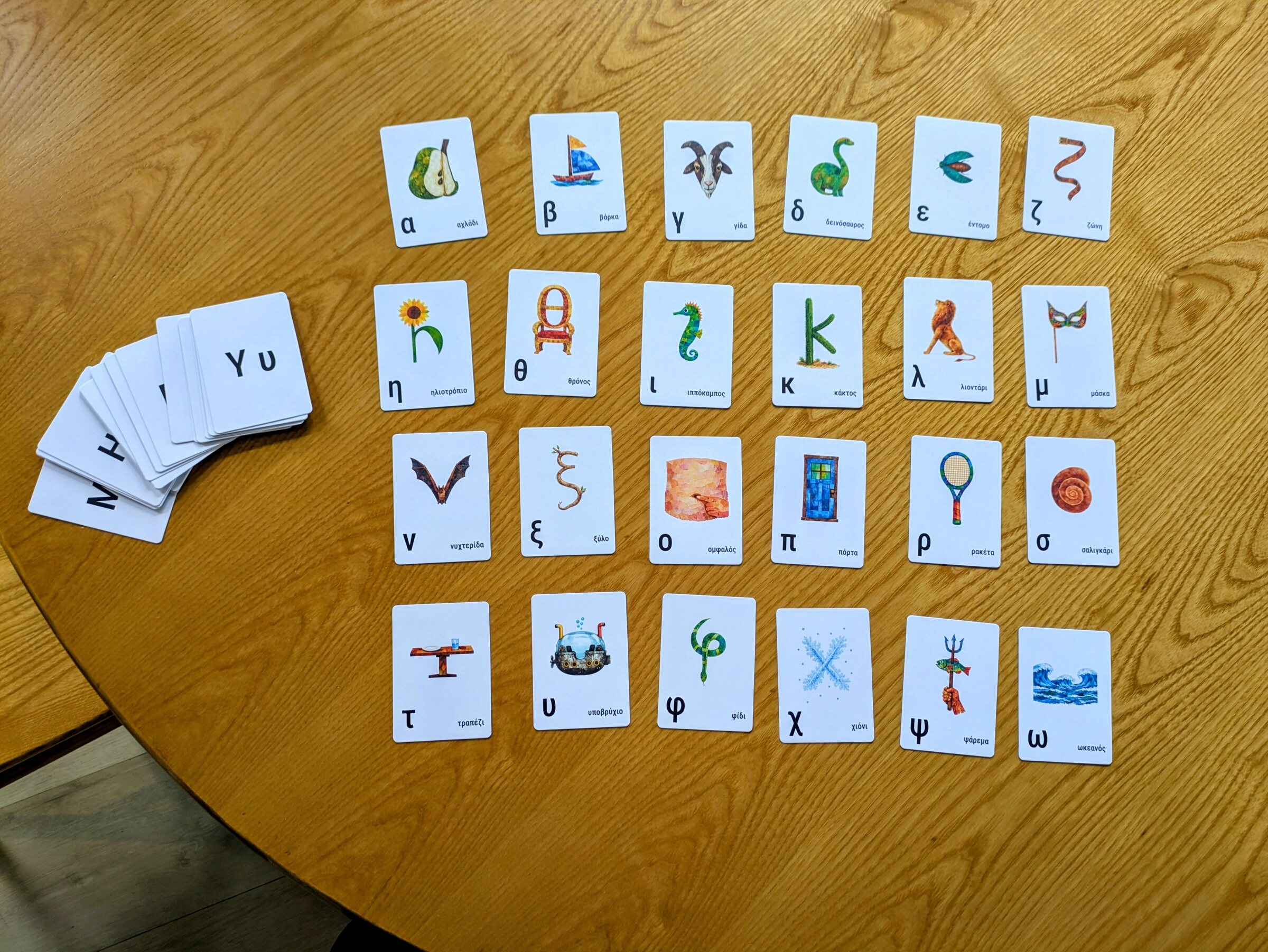
A set of cards I made to help my kids learn the Greek alphabet through visual associations — each object is drawn so that it looks like the letter its name begins with.
The Idea
We live abroad in China, and Greek is one of three languages my kids are learning. They were three and a half when I started these cards about five months ago, so I wanted something playful to nudge them along.
My first attempt was an “A for airplane”-style deck — pictures of objects whose names start with each letter. After printing version one, I had the epiphany:
What if the object didn’t just start with the letter — what if it looked like it too?
The shape of the letter pulls up the object, and the object’s name pulls up the letter. Research seems to back this up — kids learn the alphabet far faster this way than by rote.
Finding the Objects
In the beginning I relied on my memory to come up with these associations, but you run out of ideas very quickly. So I got a bit more organised about it:
- Dictionary I downloaded an entire Greek dictionary that contained not just the words but also a list of words per letter, along with the frequency with which each word appears in Greek text. I used GreekLex, which contains 35,304 Modern Greek words ranging in length between 1 and 22 letters.
greeklex.csv · excerpt
| IDnr | Word | Length | LemmaFreq | WordFreq |
|---|---|---|---|---|
| 223 | φως | 3 | 125 | 90.2 |
| 224 | χαν | 3 | 7 | 7.4 |
| 225 | χαφ | 3 | 14 | 13.5 |
| 226 | χολ | 3 | 6 | 5.6 |
| 227 | χοπ | 3 | 3 | 2.8 |
| 228 | ψες | 3 | 0 | 0.1 |
| 229 | ψιτ | 3 | 0 | 0.2 |
| 230 | ωδή | 3 | 3 | 1.4 |
| 231 | ωθώ | 3 | 17 | 0 |
| 232 | ώρα | 3 | 549 | 335.8 |
| 233 | ώση | 3 | 7 | 3.6 |
| 234 | αβάς | 4 | 2 | 1 |
| 235 | αγάς | 4 | 1 | 0.1 |
| 236 | άγια | 4 | 2 | 1.9 |
| 237 | αγνή | 4 | 4 | 3.2 |
| 238 | άγος | 4 | 3 | 1.1 |
| 239 | άγρα | 4 | 6 | 3 |
| 240 | αγώι | 4 | 0 | 0.1 |
| 241 | αδάμ | 4 | 4 | 4.4 |
| 242 | άδης | 4 | 2 | 0.4 |
| 243 | αέρι | 4 | 0 | 0 |
| 244 | αθώα | 4 | 6 | 5.7 |
| 245 | αίγα | 4 | 0 | 0 |
A small slice of the GreekLex corpus. Each row is a word with its length in characters, its lemma frequency (how often the base form occurs in the corpus) and its word frequency (how often this exact surface form occurs). The frequency columns are what let me filter for words a child would plausibly recognise.
- Filtering I ran a filter to keep only words that were:
- between 3 and 10 characters long, and
- had a frequency of at least 100 in the corpus, so they wouldn’t be too rare.The aim was a vocabulary that my kids would plausibly know.
- Visual candidate generation That still left 50 to 2,500 words per letter — too many to eyeball. So I fed them to ChatGPT in batches of 50, asking for each one whether its referent could be drawn to echo the letter’s shape, and how. The list usually came back down to 10–200 candidates. Ω Omega was the extreme case — essentially no match. Most suggestions were weak, but every batch had a few good ones.
triage · letter ε · sample output
›ελιά — an olive tree can be stylised with a vertical trunk on the left and three rounded clusters/branches extending to the right, echoing the three arms of ε ›ελαία — same idea as ελιά: a small olive tree with a slim trunk and three leafy bulges to the right can read clearly as ε ›ελάφι — a deer’s head in profile could be stylised so the neck forms the spine of ε and the snout, chest, and lower jaw create the three outward curves
Sample of what ChatGPT returned for one of the letter ε batches. Each line is a candidate word with a suggestion for how its referent could be drawn to echo the shape of the letter. Most suggestions weren’t usable, but a handful in every batch were genuinely promising.
- Image generation From the much smaller shortlist, I tried examples in OpenAI’s image generation (
gpt-image-1.5) and experimented until I got the images I used on the cards. To improve visual match, I also gave the image model an image file of the Greek letter so that it could keep it in its “mind” while generating the object.
Input prompt to image model
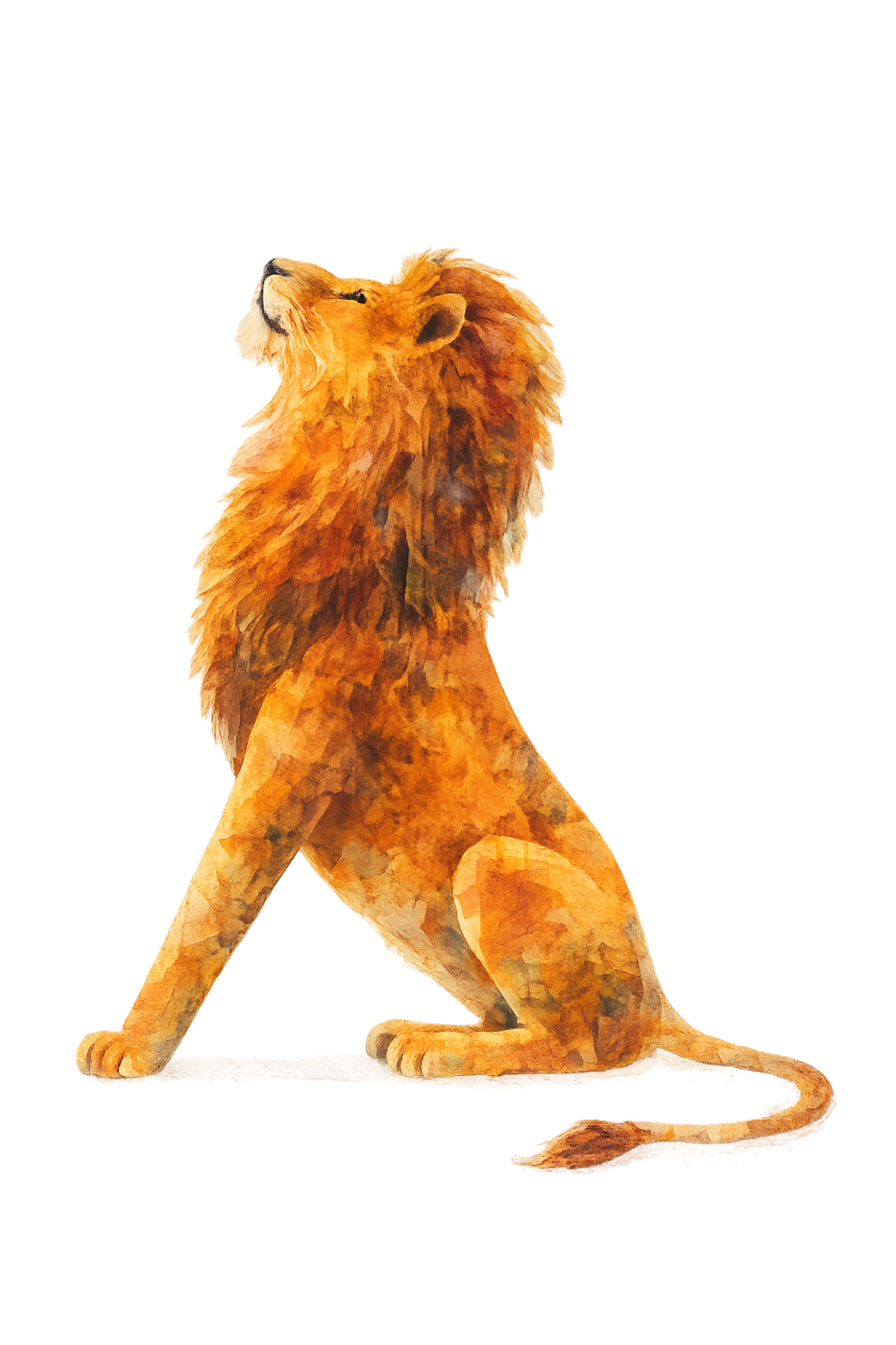
generate an image of a lion seen sideways, sitting back on its rear legs and looking slightly upward, with the front legs supporting the body in a graceful diagonal posture inspired by the greek letter λ. The mane and neck can softly curve near the top while the tail gently trails downward to the right, creating only a subtle visual echo of λ. The composition should feel like a natural, believable lion pose rather than a forced typographic construction. I am attaching the image of the letter so that you can use it.
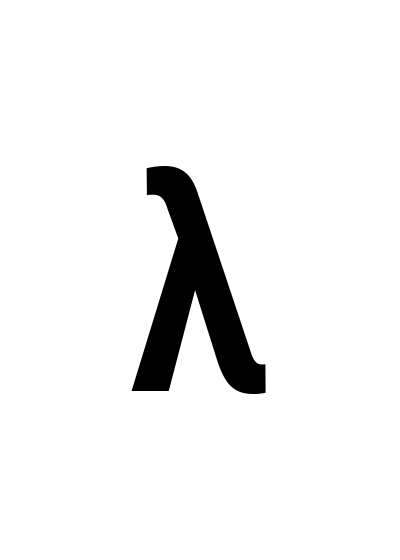
Attachment lambda.png · reference letter
Output image returned by model
Some cases were a bit more stubborn. For example, as much as I tried prompting it to make an image of a snake (φίδι in Greek) that looks like the letter φ (phi), it just wouldn’t do it correctly. In the end I drew a snake by hand and asked it to render it in the appropriate style:
- Card layout I wrote some code to lay the text out on the cards.
Two Card Sets
There are two sets:
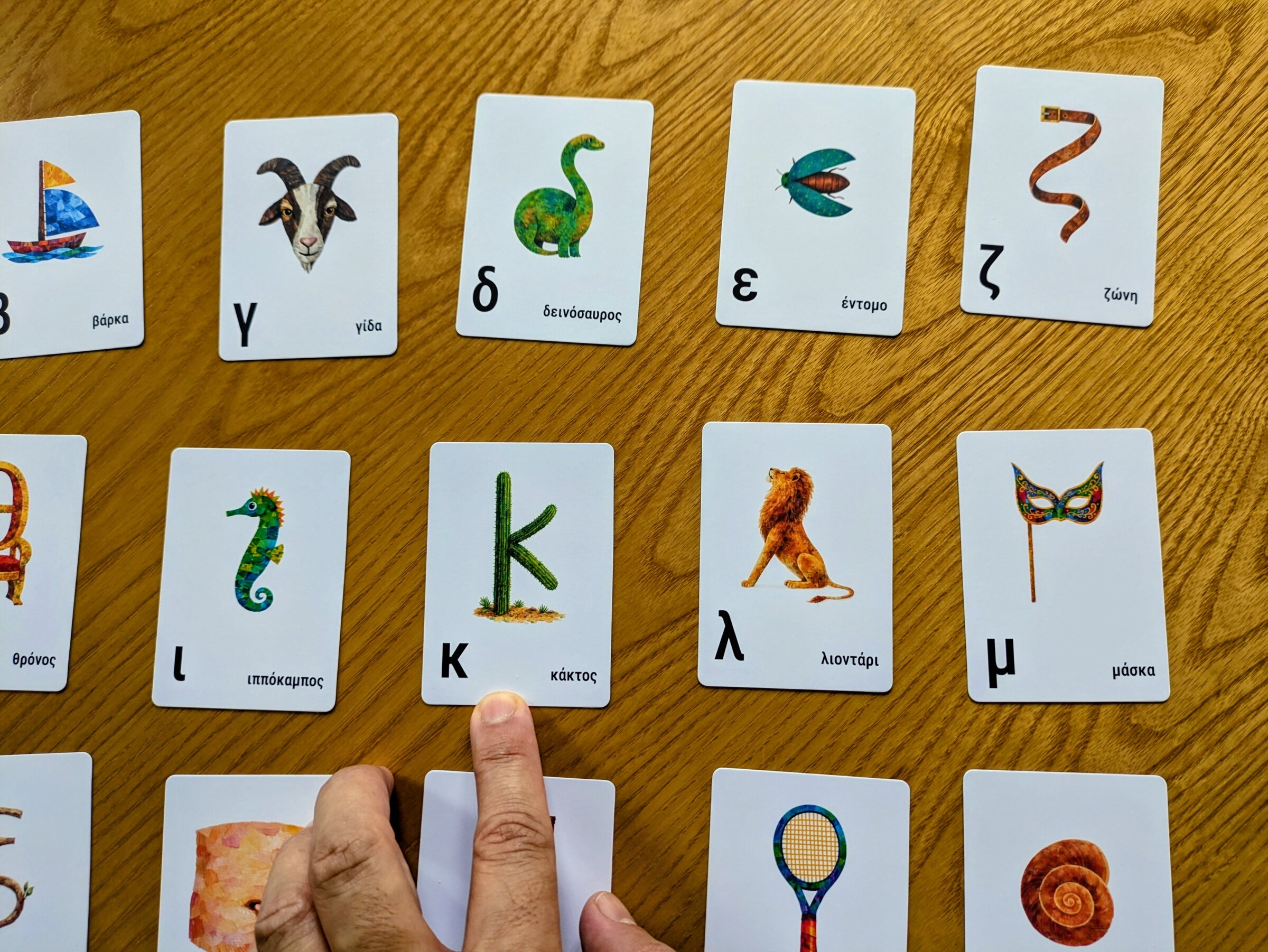
- Object cards — each card shows an object whose name starts with a particular Greek letter, drawn so that it resembles the letter. On the bottom I also show the letter in large size as well as the full object name.
- Alphabet cards — a separate set of 24 cards showing just the letters. The back of these reads Ελληνικό Αλφάβητο (Greek Alphabet), with an image of one of my children on the back — my daughter on one set, my son on the other — so we can play games with both sets.
The illustrations are in the style of Eric Carle, who wrote The Very Hungry Caterpillar. He has great colours and a wonderful aesthetic. Some cards came out better than others, but overall I’m happy with the result.
How We Play
Learning the cards
First they have to know the objects. Most are already in their world (lion, snail, door), but a few needed teaching — ιππόκαμπος (seahorse) for Iota, or γίδα (a less common word for goat). Then I show them the trick: how each object echoes its letter. In one afternoon — two half-hour sessions — they learned about 18.
I don’t push. If they drift, we stop. But they keep asking to play with the cards.
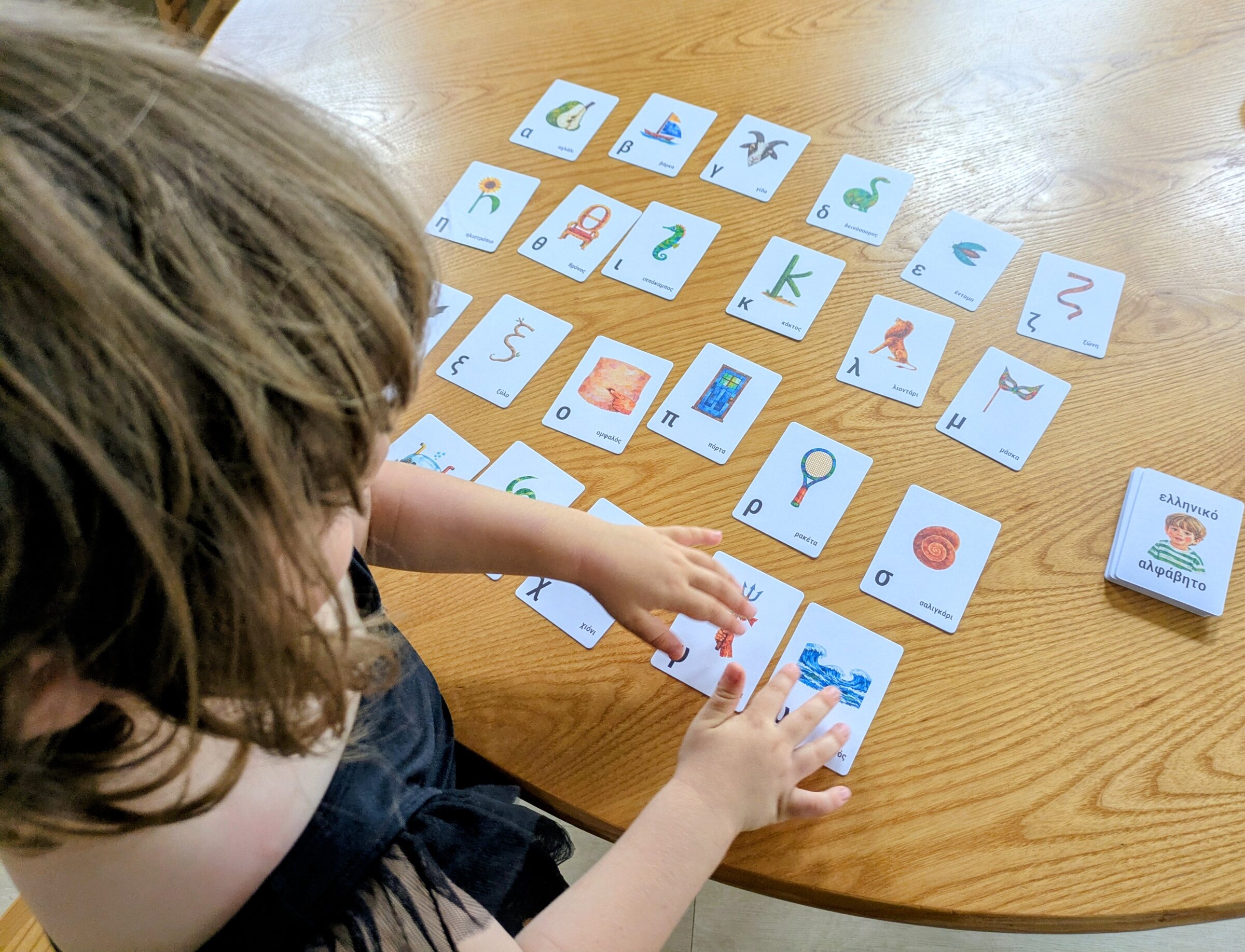
Memory game
We lay all the alphabet cards face down and the object cards face up (or the other way around). Then take turns flipping a card and trying to match each object to its letter, the way a normal memory game works (“where was the sigma?”).
The fire game
This one is more physical and they love it. I stand about five meters in front of them, holding up a card, and pretend there is a fire behind me. Each time they correctly name the letter for the object I’m holding, I get to take a step forward, away from the fire. If they get it wrong, I take a step back and pretend to be burning. They laugh a lot at this, and the physical element really hooks them.
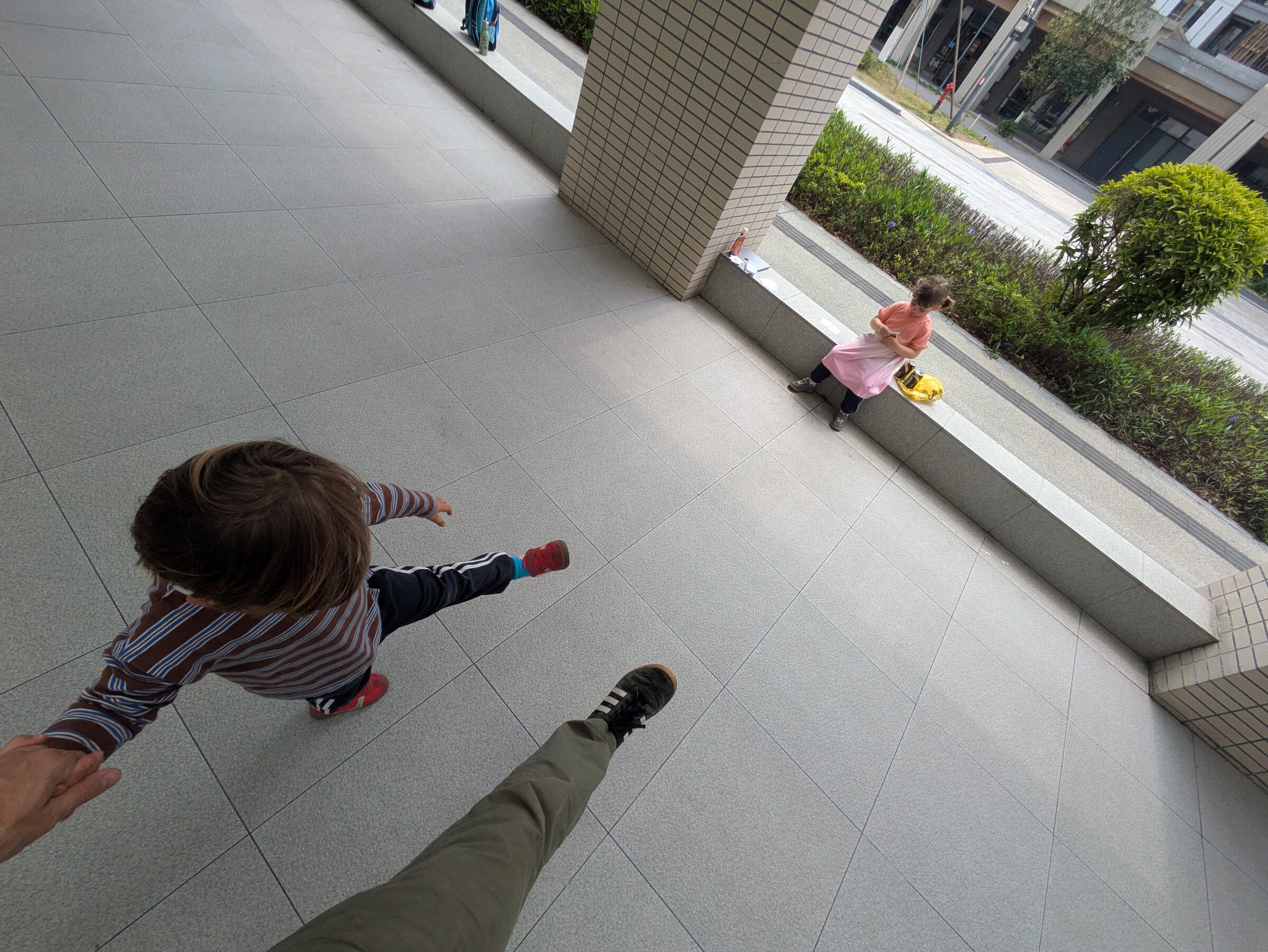
The fire game · don’t step back
Am I the first?
No, certainly not. I realised after iteration 2 that this method of learning is a letters in English is fairly common. However, I haven’t found any such cards for Greek characters, so I think mine are the first in Greek.
There are many products for English, but most that I’ve found aren’t very good. They tend to be in the vein of “K for koala,” with a picture of a koala hiding behind the letter K. They don't try to pick objects that could be made to look like the letter. See examples below.
I hope you’ll find my attempt visually cleverer.
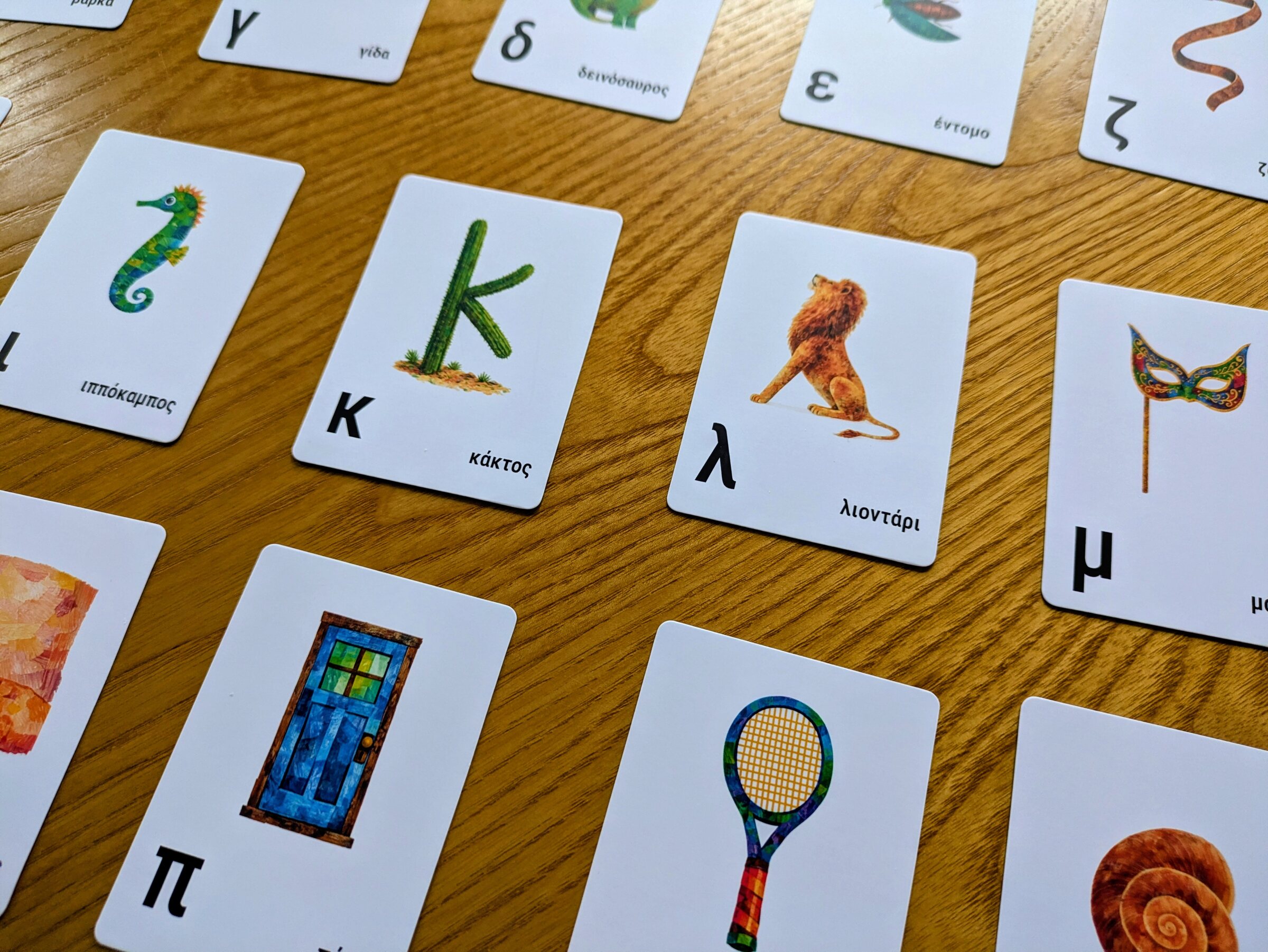
A close-up of one of the cards
Most importantly: my kids enjoy the game.