Modern establishments (businesses/governments) work by making people afraid. It is truly, the age of fear.
Let me quote M.I.B
>There's always an Arquillian Battle Cruiser, or a Corillian Death Ray, or an intergalactic plague that is about to wipe out all life on this miserable little planet, and the only way these people can get on with their happy lives is that they DO NOT KNOW ABOUT IT!
At some point we figured that there is good money to be made by making the people perpetually aware of how they or their loved one are going to die 24x7!
TV interview with parents taking their little kids to see Alien (1979):
https://x.com/TheCinesthetic/status/2058998742506954766
https://xcancel.com/TheCinesthetic/status/205899874250695476...
To be a devil's advocate - maybe lower frequency of crimes against children is a result of that red tape? Or maybe not. I don't know.
It's the context around you that is changing. Also, the digital divide is so strong that many old people and village folks see anything related to technology or complex online processes as alien things that they can't dare to deal with. They are basically living in the non-digital islands. The logins, MFA, password recovery, OTP, finding the correct web portal, filling in the right information - it's a nightmare for a common human.
I live in an average California suburb. Average priced homes, relatively quiet street, not really any disorder or even appearance of disorder. When I let my kids play in the front yard - minding themselves - neighbors call the cops. I've written about this before, and it's not simply a matter of choosing to let your own kids have more freedom.
There are simply no kids outside anymore so if yours are, they stand out. Kids playing outside is now so outside the norm and neighbors on edge that they will call the police. The police will not ignore it, and you or your kids will have to contend with a police encounter. This has the effect of making parents perform a calculus every time their kids ask to play outside.
If there's a way to get neighbors to feel that kids playing in yards is normal, I'm all ears.
Yet a lot of the comments here suggest that kids would have more independence if cities were safer (particularly from cars).
IMHO, the answer is to improve safety by teaching children how to navigate dangers. Teach children how to cross the road; teach children to be aware of distracted drivers; teach children about situations to avoid (e.g., being in a blind spot).
Waiting for cities to be sanitized theme parks before letting kids out of the house is how we got into this mess.
I call this "Shitarticlism" and it includes OP's article and also a bunch of clickbait I read. And Microsoft Learn.
If I work from home I see tons of unaccompanied kids going to school in the morning. I live in what is statistically the most crime ridden area in my city. My toddler has a drive for independence that will probably lead to him doing this himself in a few short years just need to impress road safety on him a bit more.
The people in my life who consume conservative media are afraid. They all say the world is so different now. It is. It's safer.
The people in my life who don't consume conservative media aren't so afraid...
In general there is excessive alarmism, and the internet makes it possible.
When my son, a pre-teen at the time went to Spain with me, things were quite different: A small town that even had stores targeting kids, places to sit everywhere, things to see, other people walking too. He could even go to the beach and be fine, as there's lifeguards. By the second week of the summer, you'd see group of new friends hanging out with no parents, just going back home for meals and sleep.
Build environments where children can be independent, and they might even want to be. But it's amazing how much modern-ish suburbia just has no place for you to even exist without a car.
My 5 year old bikes to school, accompanied by an adult. It’s a bit more than half a mile away from the house.
I’d like to tell him he can do this on his own next year, but there’s a single intersection he has to cross that makes this difficult.
I’m not worried about him getting lost, abducted by a stranger or any host of movie plot scenarios. I’m worried about vehicles. Specifically pickup trucks and SUVs.
40 years ago a 5 or 6 year old mostly had to contend with sedans with hoods lower than 30 inches. Today there are large numbers of vehicles twice that high, where even an adult can’t look the driver in the eye at close distances.
The Insurance Institute for Highway Safety says:
Vehicles with hood heights of more than 40 inches and blunt front ends angled at greater than 65 degrees were 44 percent more likely to cause fatalities.
https://www.iihs.org/news/detail/vehicles-with-higher-more-v...I’ll probably let him bike alone anyway. But it’s a different equation because of the cars.
Damn, I'm glad I got to grow up then.
We joke about having a main child and an emergency backup child, but deep down it's not a joke, it changes our behavior.
But the article doesn't consider whether restricting children's wanderings is the REASON it is so much safer for children now.
"We have so many fire-safety rules in the building codes in Seattle. But get this: we haven't had any major fires since 1889! It's obvious we don't need these rules!"
It's true there is a cost to restricting children. But let's be a bit more realistic about the tradeoffs.
One correlation with "safetyism" this article doesn't mention: the rise of the two income household (https://www.pewresearch.org/social-trends/2014/04/08/after-d... for the US; the UK appears to be similar.) In reality when we kids were running wild about the town, someone was watching us out their windows. If we got into (or more likely caused :) ) a problem, adults, usually a housewife, would show up quickly from somewhere. Even when we were off in the woods there was a sense that we could find a house where a grown-up would help us if needed (like if some kid's little brother ruptured his spleen on a dare, which actually happened.)
Nobody would call Child Protective Services - you knew it was little Billy who threw that rock that hit Jimmy, so-and-so's kid. You would tell Billy's dad, who would make sure he didn't ever do _that_ again, and that would be the end of it. Now I imagine police and lawyers would be involved. It seems we don't have the informal social connections any more, which were largely driven by someone just being around.
The above link BTW shows that "only" 50% of mom's were stay-at-home in the 1970's. In my specific time and place, many of the moms who did work outside the home had jobs that revolved around the school schedule (i.e., working at the school, or some work schedule that allowed them to be home when the kids were not in school.) The ones with full time jobs like my single mother, supporting three kids through full-time work, were a rarity back then. Maybe my brothers and I had excessive freedom because there simply wasn't anyone to watch over us - fortunately we all turned out more or less OK :)
For me growing up in 2000's suburbia, the closest kids around my age that I knew of were about one mile and major road crossing away, but to get to a friend it could be a lot more. I think kids out in a group doesn't feel like a safety concern to most people even now, but if they have to travel 5+ miles solo just to meet up with one other person, that's where the issue might lie.
However, I'm GenX and having all my friends and I roam the neighborhood from the time we got out of school until our parents got home from work with no supervision seems perfectly normal.
"Come home when the street lights come on" and television PSAs asking "It's nine o'clock, do you know where your children are?" were the norm in the 70's.
Ppl are so stupid, they need online courses for locating their wiener when peeing outside their regular zone...
Towns and cities with less car dependency more gracefully transitioned into the post-internet world, where 3rd places and community are easy to maintain since the library/bar/office/school is a 5 min walk away.
The biggest difference, imo, is the number of families.
I lived on a small street with a cul-de-sac. Maybe 35 houses or so. At least half had kids aged 0-15.
I now live on a street about the same size with my kids. There is one house with ~7-10 year olds, two houses with 3-5, one house with a couple of teens, one house with a baby.
Nothing else really matters, you can't expect kid communities to self generate at these densities.
And of course in high school there was the standard minimum of one student death per year per school, usually related to driving. So teen deaths seemed more prevalent than younger ages.
Then when I was ~12 we moved further away. Probably 3-4 kilometers and I would still ride in.
I had friends scattered all over the area between my place and school but I never needed any assistance from them.
Stuff like training wheels, bike helmets when you are just doing leisure rides. Don't get me started with bike helmets, people wear them and do risker things, drivers drive less careful around them, and you get a false sense of superiority instead of being more careful. If you're on the road/off roading, sure, but now you can get fined in some place for not wearing is one small example of safetyism taking over.
We _have_ built these environments, you just choose not to live in them. Move to a city or other urban center. Your house might be smaller, and you might have to take public transit sometimes, but you will be happier and there will be no shortage of places for your kid to walk.
When I was young, that block had maybe 1-2 cars parked on the street, visibility was good and you could kick a football and ride bikes out there safely. When I visit now, there are so many cars that it's sometimes hard to find a park. I would guess the bulk of it is residents who don't want to shuffle cars in the driveway or have their garage full of other stuff rather than the cars.
I would not want my kids playing out there unsupervised.
It’s too bad the district no longer lets middle school or high school students do crossing guard jobs anymore.
No wonder kids are being made to make do with alone time on digital devices. That's all we have left (and they're trying to control that too, for good and bad reasons).
But, that overprotectiveness is very much an American phenomenon - exported a little but not that much yet.
- stranger danger was worse in the 70s than it is now. - safety in numbers was better in the 70s -- if all kids are outside it's more likely to be somebody else's kid that is snatched. If your kid is the only one, ... - car danger was worse in the 70s. Cars are bigger/faster now, but there were more drunk drivers then. This varies widely by jurisdiction.
It's hard to balance the factors -- it's not clear whether or not it was safer to let your kids outside today than it was in the 70's.
Don't get me started with bike helmets
Bike helmets mitigate one of the most serious and common forms of injury while riding bikes. You can fall or be hit by a car/tree branch anywhere. They don't prevent you from doing anything you would otherwise do.I'm someone who advocates for rolling back helmet laws because they decrease ridership, but helmets are a fantastic example of reasonable PPE, not overactive safetyism.
That didn’t stop me from biking and exploring all over from age 6-7, which seems unthinkable now. I think it was mostly just more risk tolerance and less flashy warnings about danger. Like my dad biked around the same block so why not let me and there was not much more thought given to it.
Your suburb sounds nice but I guess Im just saying that level of community wasn’t necessary for kids to have freedom.
"Safe Routes to School" are programs in the US and there's one here in Washington; Seattle has their own partial adoption of this, and I'm hoping to lobby my suburb into adopting it as well.
The school principal won't allow my son to walk home alone because of the traffic, but the traffic is only present because so many parents drive their kids to school.
In another comment a few days ago I reminisced about how I was let running alone for hours on end when I was very young, and how that was normal.
It's a bit hard to reconcile both events now. I gained a lot of independence and had real unrestricted fun, but in hindsight I might've died a few times.
My idea, even if it might be traumatic, is to show the kid a few clips of people being hit by a car and getting mangled, with all the gore visible. Especially people following the laws and being careful. I miss /r/watchpeopledie as it was actually very educational.
In practice, if somebody is right in front of my grill where I can't see them, they were close enough for me to notice them before they got there without me having to be on high alert for people.
I'm not putting this here as a truck-vs-car thing or whatever, I'm just trying to people a realistic idea of where the blind spits are that actually cause trouble in my experience.
> Vehicles with hood heights of more than 40 inches and blunt front ends angled at greater than 65 degrees were 44 percent more likely to cause fatalities.
I'm not sure that height matters for a young kid and, 40 years ago, there weren't abs and sensors that will brake for you. Plus, drunk driving rates were much, much higher and the vehicles were significantly heavier.
I don't have any insight on the answer but I'd be curious if the rates of kids dying as pedestrians/cyclists have gone up (per mile, which would be hard to track down and sway the numbers significantly).
This is a big one for me. Not that long ago I just about got into a fistfight with some asswipe who drove his Ram through a crosswalk in a school zone, while children were crossing. With a crossing guard.
And somehow he thought I was the jerk for flipping him the bird as he went through.
But that pressure is on the parents too. There's this weird two-way feedback loop.
Single child household has made parenting culture neurotic. Because if you screw it up it ends your entire bloodline.
But the neurotic attitude makes child rearing feel like such a burden, people can hardly imagine doing it more than once...
I am told this attitude does not produce beneficial outcomes in the children either. Apparently people grow up healthier when their parents are relaxed.
I just can't conceive it - how is this even a thing? What is the psychology of these adults doing this? How is the morality of this lacking? And how can there be so many people involved? Where is all this insanity coming from? How did it develop? How did it slip through the idea of safety in the neighborhood we used to have?
I don't understand how this is real, the scale is inconceivable (how can so many people be so totally demented) it's the craziest thing I cannot comprehend.
By beating the child?
Sure. They should be widely available, cheap or free for kids, public awareness campaigns funded, etc.
> not overactive safetyism.
Not once they devolve into laws. That would be overactive safetyism with the second order effects worse than the cure - as you note earlier in your comment.
I know I simply stopped riding my bike altogether once my mom decided (as a young teen) out of the blue helmets were now required. That or I'd bike a block away, stash it in the bushes, and grab it on the way back home.
And for me it was simply comfort (sweaty!) and the fact I'd forget the damn thing everywhere and be forced to go back to get it/pay for one out of my allowance if I lost it.
Especially with E-bikes, which are operated at higher average speeds.
I usually wear a helmet but am opposed to such laws not because they decrease ridership but because they decrease our freedom to do stupid shit.
But yeah I've heard that about Atlanta and a few other cities (mostly in Texas).
Yes, I live in one, and it's a city that often gets used as the poster child for urban crime.
I don't feel in danger. What I am most worried about when walking with my kids outside is them getting hit by a car.
So basically the main change affected already the childhood of, what? 85% of the average HN reader, at least if they are from England. What are we talking about then?
I’m convinced that’s more of the explanation than we realize. Adults in a lot of places move about almost entirely by car and often look down on other modes of transportation, to the extent that having your kid walk or bike while you have a car in the driveway seems wrong, like if you shopped at Whole Foods for yourself and fed your kids on gruel.
i don't know how true this is. residents care about the speed of cars. the trend in government is more holistic public land allocation (ie street design) in almost all growing communities.
Yeah, that's called living! I definitely got myself into one or two dangerous situations growing up. I couldn't imagine a childhood where everything is safety railings and padded walls.
The onus here is on municipal and federal governments to make roads and cars safer.
If you want something with a gut punch related to car safety, check out British vehicle PSA advertisements. Holy moly are those grim! They’re memorable, focused, and unflinching.
Personally, I’d go with some mini-documentaries or after-the-fact breakdowns put out by local American TV stations. They take it slow, film on location, and try to have a takeaway lesson.
When I was young my dad took me out to the curb and warned me about the dangers of being on the street. He pointed out how fast cars were going, how being hit could be really damaging, how animals not infrequently died from being hit. He also warned about getting excited while playing games and inadvertently running into the street. Even bicycles were a danger. Everything changes at the curb. Having a good imagination, I took the lesson to heart.
How much of our "safety" culture around kids is because people don't have basic life skills and aren't passing them on to kids?
It’s a perfect example from the article. “I totally would let my kid leave the house, but [made up danger]”
Why? It's not like drivers have to pay up when they hit someone, as long as they weren't drunk. And in the unlikely event that a driver does get made to pay the big risk is medical bills, so the incentive is to make sure the car is set up to always kill anyone they hit.
"We've planned a trip to the woods for next week, it's expected to be minus twenty Celsius so please make sure they have appropriate clothing, hats, gloves, boots. Also we will have a fire so make sure they bring some sausages and a hunting knife so they can cut sticks for the fire and to hold the sausages over the fire."
No. 2 son came home with a plaster on his arm after one such excursion, I think when he was about ten, and explained that one of his friends had been careless with his knife. There was no drama, the teacher carries a first aid kit for precisely this scenario, his friend was firmly told to not be so stupid, and the teacher used it to explain to the class why knives need to be properly handled.
In high school, many kids had rifles and shotguns in their cars to go hunting after school. Then we were old enough to keep our mouths shut haha.
When I was a child, I always had with me a multi-tool Swiss army knife, including at school, because I was very frequently building various things, or disassembling others to see how they were made. That early experience was very influential in becoming a successful engineer.
Decades later, as an adult, I was astonished to learn about the so-called "no tolerance" policies of many US schools, where the possession of even a small knife or even of less dangerous tools may be a reason for severe punishment.
Obviously, as a child, starting with the second day of school when 6-year old, I have always gone to the school and back, every day, alone, even if initially that was about a half hour of walking and then the later schools required long commuting by public transportation. Also none of my colleagues have ever been brought to school by someone else, and like me they did not have any contact with their parents since morning till late in the afternoon. All this was considered normal at that time.
When I was a boy I wanted a pocket knife b/c a friend got one and I saw it as useful. My Dad vetoed that until....I joined the Boy Scouts! Mom paid for a new official BSA knife along with the uniform. I promptly cut myself once with the knife, despite warnings from Dad. Doing so is a rite of passage for a knife-owner, I believe.
Fast forward to today. I've almost always carried a pocket knife and found it enormously useful. For my ~30th birthday my Dad finally bought me an Uncle Henry's 3-blade pocket knife about 3" long. It is finely made, always sharp, but difficult to fiddle with and not really very practical. I think of it as his acknowledgment that I am ready to carry a knife!8-) I'm glad I didn't have to ask him for a penis, though!
That little knife always sits atop my file cabinet. Someday I'll pass it along to someone else to perplex them. And I carry a folder of my own choice in my pocket.
200yr ago they'd have used some Victorian morals bullshit or religion to the same end.
Even going from one child to two.. suddenly you don't have numbers on your side in dealing with things.
A form that is still extremely rare. No-one seriously advocates helmets for car passengers, for example, even though the injury rates are very similar.
> be hit by a car
Cars don't hit people, drivers hit people.
> They don't prevent you from doing anything you would otherwise do.
They're annoying enough that they do, in practice if not in theory. To say nothing of the fact that drivers pass you closer and more dangerously if you're wearing a helmet.
> helmets are a fantastic example of reasonable PPE, not overactive safetyism.
Quite the opposite.
Besides being an mc person I always considered bicycle helmets a useless compromise in that they don't provide true protection like full-face motorcycle helmets do. You're still as likely to leave half of your face on the obstacle, so either don't bother or wear something that would prevent that.
Here's things our traffic engineer told me:
1. It doesn't matter how fast the fastest cars are going or how many cars go by a certain point, only the 85pct is used in deciding whether to intervene "and that's the same as Shoreline, and Bothell, and Bellevue, and..."
2. A bunch of people will get pissed and raise hell if you dare take away some street parking to make it safer for people actually using the road. (I saw this around 35th Ave NE in Seattle) And they tend to get their way.
3. The whole city's budget for traffic safety is $10k.
4. In the last four years, the traffic safety program has resulted in a new stop sign.
5. Public roads are for everyone who drives and the people in the neighborhood get no say in it until the 85pct speed is more than 5 over the speed limit.
My biggest problem with number one is obviously 250 extra cars driving past my kid walking to school is 25x more dangerous than 10 cars, but because of 5 the city will do nothing to reduce people from all across the district driving through my little neighborhood to take a shortcut. Expect they'll spend some of that $10k buying signs for our yard which say "kids live here". Wow, thanks.
My kids still roam, albeit with check-ins, and a lot of training about streets, driveways, and people.
I don't fault parents who reach for trackers or are uncomfortable with letting young kids out of sight. Even back in the day a lot of horrible things happened that weren't reported widely. A family member of mine was nearly abducted off their bike as a teen, if not for a nearby neighbor opening the door when she knocked looking for help.
All the tradies around here are mostly driving Fords and Tacomas.
Yea, the problem isn't that we don't want to give kids the freedom we had as kids. The problem is the nosy public that won't mind their own business and instead call the cops when they see someone out just playing. Not willing to risk involvement with poorly-trained, amped-up, armed law enforcement.
Don't know where you're from, but where I am people love to state this but it's almost never true. Much like how everyone thinks there was some kidnapping epidemic in the US in the 90's which started the whole stranger danger junk.
I was told my kid would have CPS called on me, the cops arresting me, etc. due to the freedom I gave him at a young age. Sure the cops came around once in a while to check on things due to a busybody neighbor but not much came of it. I always knew where he generally was, had reasonable explanations over why I was letting him do what he was doing, was never high or drunk when the cops showed, etc. Yet if you asked any of the other parents in his classrooms? They would have bet money in the other direction and would have been aghast at what he did on a daily basis alone.
Yes, there are horror stories here and there when everything goes off the rails. I was prepared for such a fight if needed.
Luckily there were a couple kids in the neighborhood who had parents who were either not present or somewhat like minded. So he still had a few compatriots not utterly cowed by the Karens of the world to go get into (and out of!) trouble with.
He's very loved by them, BTW. I didn't meet him, but they always talk with admiration of him.
Governments should make roads safer but until they do, we should care for ourselves.
Imagine a sidewalk where the ground is crooked, full of holes and parts of the pavement sticking up. Should we blindly go on the sidewalk saying "the government should make it better" or should we exercise caution not to trip and fall?
The same logic applies to most dangerous things. Should the government make sure the food and supplements that are imported is safe? Of course. Does that mean you should order food and supplements from any shady site from a random 3rd world country with no reviews? Absolutely not.
Also much cheaper than casts, physical therapy, and possibly permanent damage. An ounce of prevention and all that.
Northern Spain? (Maybe francophone Swiss? Southern France? Belgium?)
(Pardon me for being presumptuous)
Imho school admins need to have skin in the bullying game. Bullying seems to be a natural (=inevitable) outcome of kids exploring social status outside the normative system of rules. I have always been fascinated with how bullies justify (sometimes "subconsciously") their own behaviour, and how these justifications mirror those "adult" rules..
An administration that shows the kids it's willing to place _its own status_ at risk might earn their loyalty.
(By contrast, the American edu system you speak of prioritises maximising its own safety hence the -ism suffix)
I'm hunting for real world examples of such. It seems that you might have encountered them!
I'm loathe to imagine what kind of trouble they might get into now for that.
Stigmatizing mental help drives a lot of problems underground. So does our awkward immigration system that keeps all kinds of migrants in precarious positions, even legal agricultural laborers.
Our president has the strongest personal ties to the most prolific sex trafficker in recent decades, second only to Gladwell. Yet he has suffered no legal consequences for his association, nor even serious investigation. Epstein himself seemed afraid to name him under oath, and yet privately called him "the dog that hasn't barked". This leader of the nation bragged to journalists of sexually assauting people, and over 20 victims say it's true. And roughly half of the voting public still checks the box with his name on it.
Neither accident involved a car.
Both would have likely had a few broken bones at the absolute worst if they’d been wearing helmets.
I wasn’t in an especially large elementary school, either.
With surgical assistance, I can heal from leaving half of my face on an obstacle. Healing from leaving a big chunk of my brain on an obstacle [0] is -at best- quite a bit more involved.
[0] ...or a chunk of an obstacle in my brain...
No thank you, I’ll stay in Manhattan and not get kidnapped and murdered by monsters tyvm.
The answer isn't binary. It's both. Governments are us, and we use that tool to manage collective resources like roads and sidewalks.
Obviously we do what we can in the moment. That doesn't mean those given power are free to neglect our collective property, or even sell out to the interests of those who would profit from pedestrian hostile "solutions".
Making eye contact and waiting for a vehicle to actually respond to the conditions at hand will eliminate the vast majority of "assumed" mistakes. Trying to be 100% aware of traffic and understanding that folks can be even bigger aggressive idiots is also part of it, but not perfect.
You just have to accept that in some rare instances the swiss cheese holes will line up regardless of what you do. And be at peace with it.
I suppose since this seems to logical and "not a big deal" to me means that I am extreme outlier on the subject.
You can teach kids how to safely handle and use blades. This reduces -but does not prevent- accidents... and some kids will handle them carelessly despite the training. [0]
In other words, the fact that a kid on the trip was cut by his friend doesn't mean that there was no blade safety training prior to the trip.
[0] Source: In another life, I used to teach kids these sorts of safety courses.
When I was a child, bullying happened, but it was infrequent. Teachers would punish it severely if reported, but snitching was considered rather shameful, so it was more frequent that bullying was handled by the weaker bullied children teaming against the stronger bully.
Meanwhile in Shanghai, it tends to be a little too difficult to cross an entire street at once, so the way you cross is lane by lane, as if you were playing Frogger. (Except that you'll rest on lane dividers as opposed to right in the middle of a lane.)
Pedestrians getting run over while doing this is not a noticeable problem.
When I was 11 and 12, I’d ride my bike to meet friends at the local sandlot baseball field 1.5 miles away, or to a friends house to go play pickup football in the street. When I was 14, I’d go on 10+ mile runs, exploring every bit of road, sidewalk, and path I could find. Exploration was a rite of passage.
Today, 84% of 11 year olds aren’t allowed to leave their street, with 53% not even allowed to leave their front yard. For 14 year olds? 92% aren’t allowed to leave their neighborhood, and 55% can’t leave their streets.
In England data shows that in 1971, 86% of primary-age children traveled home from school unaccompanied. By 1990, that had fallen to 35%. By 2010, it was 25%.
What in the world happened? Why are we so afraid to let kids explore?
There’s a temptation to read this as a story about phones, screen time, or modern danger. It isn’t. It’s a story about us. The parents, coaches, and grownups who decided, somewhere in the last two decades, that the right amount of freedom for a 10-year-old is to be visible from the kitchen window.
We told ourselves we were keeping them safe. We were doing something else.
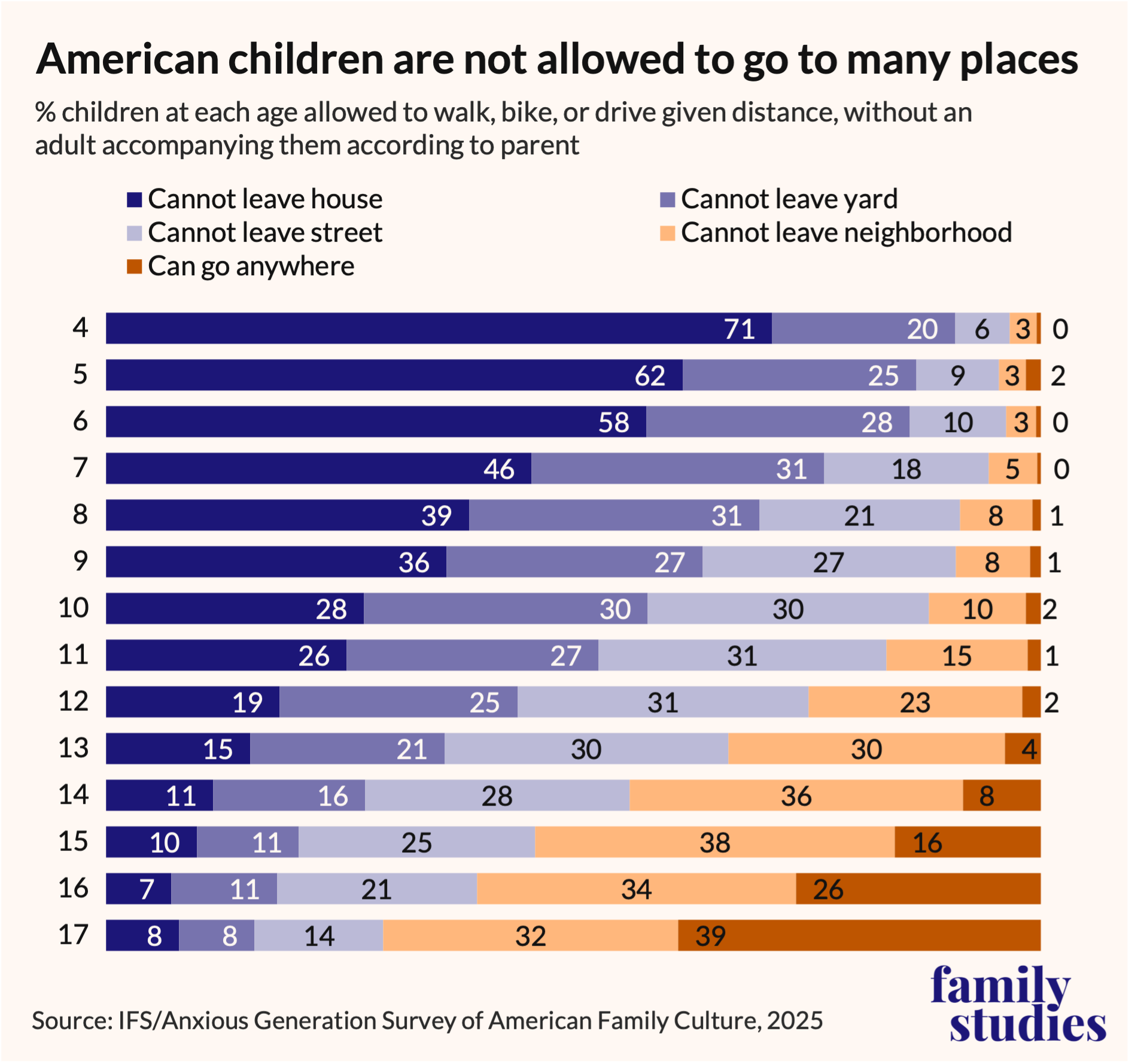
When I tell people these numbers, the usual response is some version of “the world is more dangerous now.” It certainly feels that way. The only problem is that all of the data we have shows it’s much safer than when you or I were wandering the streets. Violent crime against children has fallen steadily since the early 1990s. Stranger abductions, the thing every parent imagines when they hesitate to let a 10-year-old walk to a friend’s house, were rare in 1985 and are rarer today.
The world didn’t get more dangerous. We got more afraid.
In the 1970s, professor of communication George Gerbner coined a term for a similar phenomenon‑mean world syndrome. Gerbner found that we tend to see the world as more dangerous and threatening than it is and that it was related to the overabundance of violence on TV.
A 2008 study found that media exposure explains why Americans, in particular, often see the rest of the world as dangerous. Other research shows a link between the amount of crime reported on the news and the degree of fear people have over crime. It’s not just worry. News consumption is related to avoidance behavior as a way to deal with the fear of violent crime. It’s not just traditional media that plays a role. A recent analysis found that social media consumption is linked to an increased fear of street violence.
When we are inundated with a message that the world is threatening, we start to believe it. The difference between the era I grew up in and today is that we weren’t constantly pinged with notifications of crimes by the neighborhood app or local facebook group every day. These notifications make it feel like crime is abundant and happening right next door. It makes sense that our brains are primed for thinking that if our kids wander too far they’ll get abducted. They’re working off the information they have.
A 2025 study backs this up, a fear of “stranger danger” more than doubled the likelihood of risk-averse parenting and keeping your kids contained to near the house. We’ve got a perception-reality gap that is hard to close because it involves our most precious cargo.
But it’s not all just in our head.
Depending on where you live, cars, traffic, and more distracted people staring at their phones while driving has certainly risen. That’s a legitimate and structural concern. We absolutely need better urban design, more parks, sidewalks, etc.
But the major problem is that it’s not just people not letting their kids out of the front yard because of fear of cars, it’s that nearly all behaviors related to autonomy of kids are down. From making their lunches to walking down a different aisle of a store, to not being able to use a knife, have all declined. We’ve not only taken away more “high-stakes” independence like walking in the neighborhood but also low-stakes tasks, which signals a much larger problem than just fear of abduction or cars.
Again, much of it is in response to a environment that punishes parents for giving kids autonomy. A 2023 study found that state laws are all over the place and often disconnected from what the best science says is age appropriate. For example, Maryland law effectively says no child should be alone before the age of 8. While Minnesota allows 6 year olds to be unsupervised. There is no consistent national standard, and most laws have no developmental rationale.
And this leads to another legitimate fear. No one wants to be reported to child protective services. And it happens at an astonishing rate. According to a 2017 study, approximately 38% of all children will be investigated by CPS by the time they are 18. And the majority of those cases aren't about abuse. They're about supervisory neglect, children being somewhere without an adult.
Which ties into another thing preventing parents from lengthening the leash, judgment of others. If there’s one thing that’s skyrocketed over the last few decades it’s certainly judgment. With social media and other outlets, we walk around criticizing any and everyone. According to some recent data, 25% of parents admitted they had personally criticized another parent for not adequately supervising their child. So a quarter of parents are walking around as the enforcement mechanism.
While research published in 2024 found that “intensive parenting attitude” produces stress, anxiety, depression, and guilt in mothers. We feel guilty when we aren’t always on, always there. We feel like bad mothers and fathers.
The feeling creates anxiety and that anxiety pushes us towards over-protecting. And we’re well aware of it. In fact, we want better. We just don’t follow through.
In a survey of parents of 5-11 year olds, four out of five parents actually agreed that unsupervised free time is good for kids. They wanted more of it. But in practice:
Only 50% would let a 9-11 year old find an item at the store while they shopped in another aisle
Only 15% would let them trick-or-treat without an adult
Only 20% of 5-8 year olds prepare their own snack
The top reported fear was that “someone might scare or follow” the child
And the kicker is that it largely wasn’t about actual danger, as only 17% reported that they lived in a neighborhood that was unsafe. The researchers concluded that parents “may be unintentionally restricting their child’s path to independence.” They want to let go. They just can’t.
The Consequences of Safetyism
We live in a culture of safetyism. And it’s largely an English speaking phenomenon. These same views aren’t held in other countries. For example, a 2023 study found that while English-speaking parents generally expect kids to handle some independence around 9 or 10, Japanese and Kenyan parents expect that same level of independence at 5 or 6.
Similarly, in an international study that looked at 7 to 15 year old children across 16 different countries they found that most english-speaking countries were in the lowest autonomy tier (12th- Ireland, 13th- Australia, 16th- South Africa). Americans weren’t surveyed, but countries like Finland, Germany, Norway, Sweden, Japan, and Denmark scored the highest on autonomy. For example, in Finland, the majority of 7 year olds are routinely allowed to walk or bike alone. And by 8, the majority of kids cross main roads, commute to school, and navigate their neighborhoods unaccompanied.
Once again, part of this is structural, with easy access to bikes and such, and we should absolutely address that. But increasingly, the data points to a large part of this being the safetyism that has taken hold in places like America.
Safety is preventative. It’s the impulse to prevent every possible discomfort, fall, or bruise. It's making sure that there aren't monkey bars at a playground so that no one can fall. It's providing trigger warnings, so that people can walk out instead of face being uncomfortable in the classroom. Safetyism provides the illusion of security. It has the appearance of care, but in reality, it’s avoidance.
We confuse safety with security, and they aren’t the same thing.
Security is something different. It’s having the knowledge that if you fall, someone you trust will help you get back up. It’s the idea of knowing that if you make a mistake in the office, you should let others know so that you can improve the processes, instead of hiding it away for fear of losing your job. Security gives you a base to explore from. Safety builds walls.
The strange thing is that the more we choose safety over security, the less of either we get. A 2024 meta-analysis on trigger warnings found that they make no difference at best, and at worst they increase anxiety, because our predictive brain prepares for the disaster we just got warned about. Watch what happens at recess when adults always step in to mediate. Children stop learning how to resolve their own arguments. Watch what happens when a parent always rescues a child from a hard math problem. The child stops trying, learning that mom or dad is there to save them.
It’s part of the reason (along with phones, social media, etc.) that we’ve had such an alarming surge in youth mental health issues. According to the CDC 40% of US high school students reported persistent feelings of sadness or hopelessness in 2023, up significantly from earlier data. Suicide among children under 15 rose 3.5-fold between 1950 and 2005, then another 2.4-fold by 2020.
A 2020 longitudinal study followed 500 adolescents from age 12 through 19. The teens whose parents stayed at persistently elevated levels of psychological control across those seven years showed measurably worse trajectories of both depression and anxiety. A 2024 meta-analysis of 52 studies on overparenting confirmed the pattern: across cultures and income levels, overparenting predicts higher rates of depression, anxiety, and internalizing symptoms in offspring. When we eliminate the small discomforts that build emotional regulation, we don't make kids safer. We make them more anxious.
It’s why Peter Gray and colleagues writing in the Journal of Pediatrics concluded, “A primary cause of the rise in mental disorders is a decline over decades in opportunities for children and teens to play, roam, and engage in other activities independent of direct oversight and control by adults.”
The Power of Freedom
Early in my high school coaching career, I learned a hard lesson that stuck with me. It was easy to get someone to finish a workout while I was standing there watching them. I could get 14 year old freshman to do lots of mile repeats or go on a 10 mile run if I, as the coach, was running with them. But what ultimately mattered and determined their success is what they did when I wasn’t. Did they do their runs over the summer when we didn’t have practice, or run the whole way instead of walking and taking shortcuts when we ran at the local park. That’s what mattered.
And research shows that when we use a leadership style where control by the coach is the key, kids work hard while you’re there, but don’t when you aren’t working. On the other hand, autonomy supportive coaching, where you lengthen the leash and empower agency does. It increases intrinsic motivation, self-belief, confidence, and even resilience.
That’s because our body and brain were meant to be stressed appropriately. Just like a muscle needs to feel the strain of lifting a weight or running a mile to adapt and grow, humans need exposure to just manageable risks, peer conflict, and personal discomfort to properly wire our executive function and build cognitive resilience.
Pickup games are the lab where children practice being human. Research shows kids learn to solve conflict and disagreements on the sandlot or at recess. Playgrounds are where kids learn to take appropriate risks for their current capabilities. They don’t know if they can climb the wall, hang on the monkey bars, or what not until they try.
When we replace the sandlot with the travel league, we replace the curriculum with a script. The coach picks the teams, calls balls and strikes, intervenes during any conflict. We learn to outsource everything. The thousand small acts of judgment that built emotional regulation in previous generations have been quietly handed back to the grownups.
Similarly, when we’re never given the chance to bike to our friends house, walk to school, or explore the world around us, we’ve created an artificially small world. Not only, do we never develop our internal spatial awareness, but we ingrain a mental model that says the outside world is dangerous and we are not capable of navigating it. We never learn to make risk-assessments ourselves. And as we are learning, an appropriate assessment of risks, rewards, and our capabilities is how our brain decides whether to work hard and give effort or not. If our brain is convinced everything is risky, we default to “why try mode.”
By completely removing unsupervised exploration, we’ve inadvertently denied kids the raw material required to overcome normal developmental anxieties. The things that helped develop self-regulation, conflict resolution, an internal locus of control…are gone.
It’s as if we took everyone in school and said, use AI to solve all of your work because doing math, staring at a blank page to write, or giving a speech are too uncomfortable. Sure, we might complete the assignments and they’ll have the appearance of doing math, writing an essay, and so forth…but there’s zero learning going on.
By stepping in to eliminate all minor discomforts and physical risks, parents disrupt the child’s capacity to learn through physical trial and error. In many ways, we’ve systematically engineered learned helplessness.
In my coaching work, I tell every athlete the same thing on day one: my goal is to make myself kind of obsolete. I’m trying to coach them toward independence, not dependence. That doesn’t mean I disappear or check out. It means I gradually give away control, in small bites, until the athlete is the one steering the ship. My role slowly shifts to guide, mentor, or even a co-pilot on the journey.
In order to get there, you have to gradually give away responsibility and choice. Sure, it may start out that you dictate the workouts precisely. But over time, you ask and collaborate more (What do you think? What would you do?). You hand over decision making. At first, it might be something simple, do you think you can do one or two more reps? But over time, you provide more responsibility and autonomy. Those are the ingredients that build self-reliance, toughness, and a sense of agency.
The late Kobe Bryant put it well, when watching his daughters basketball practice, and there was a parent on the sidelines encouraging and yelling at their daughter with things like “Dig deep!“ After practice, Bryant pulled that parent aside and said, “When she’s doing those line drills, don’t say anything. Because there’s a conversation that’s happening inside her head. She’s talking to herself pumping herself up to do it. So for an outside voice to come in to give her guidance and the push to keep going actually interrupts her process. Let her be. Let her figure it out herself.”
Parenting works the same way. If we’re always the person dictating and controlling, it might look and feel like the right thing in the moment. But too often we’re preventing them from developing the exact skills that allow them to thrive when we’re not there.
So of course we need to fix the structural elements to allow our kids to roam. Of course, we want violence and danger to be low and should be aware of the safety of the area we’re in. And of course, a 5 year old is going to have a different leash length than a 10 or even 15 year old. But… we’ve got to let them navigate discomfort, to feel bored, to face conflict, to wander. Those are the building blocks of confidence, resilience, self-determination, and emotional regulation.
I think about this when I watch my own daughters. Every instinct in me wants to fix the small problem before it becomes a hard one. As a person with OCD, there’s always a tinge of fear of what will happen when our oldest reaches for those monkey bars or climbs the rock wall that I’m not quite sure if she can handle yet. Part of my brain is always screaming “Danger! Intervene!” But just like I learned with OCD, not every feeling or thought needs power. Some we have to sit with it, realize that the world isn’t on fire and that we aren’t going to die. And eventually, that thought quiets down to its rightful level.
Every parent I know has similar instincts. We aren’t bad parents. We’re just living in a world that has conditioned us to be afraid. But the kindest thing I can do, the thing that will actually make my daughters resilient, is to let the small problems happen. To let her negotiate the friendship I could fix in one phone call. To let her ride further than I’m comfortable with. To gradually, appropriately lengthen that leash.
-Steve Magness
For more, you might like my piece on The Hidden Costs of Comfort or my books: Do Hard Things and Win the Inside Game.
In a sea of nonsense, help good stuff reach others, please share:
Ghislaine Maxwell, I suppose you meant.