It is not the conical nose or leading edges that are the show stopper problem(s). There the shockwave generally does not touch the craft. The internal shockwaves that touch the walls of the engine ducting are. The heat loading and heat soak ability on those shockwave impingement sites will limit the duration of hypersonic travel.
Hypersonic travel through the atmosphere is easy, a problem solved in the 1950s. Be conical and carry your oxygen internally. Hypersonic travel that is air-breathing is an entirely different class of problem and I don't think it is anywhere near to being solved.
The only silver lining is that at hypersonic speeds you don't need to be propulsive for very long to get anywhere.
I don’t think you’d be pushing much freight on an Arrow (though I’d love to fly one!).
An XB-70 with modern engines? Now that would be interesting.
https://youtu.be/SpEO-jIKhE8?si=89Qw1_AOXYow9PfR
But ramjets have been promised to us for years
No. By itself, a new hypersonic engine can't make 2-hour flights between Japan and the US a reality. We are not even close to being able to build an aircraft that can do that - we don't even have the materials for that. What seems "easier" (as in "less impossible") is a hypersonic glider design that enters a suborbital trajectory and does shuttle-like aerobraking while it glides to its destination, before reengaging propulsion prior to landing on an airstrip (because passenger planes need to be able to abort landings and do multiple attempts). Not sure how reverse thrust would work there - variable geometry rocket bells?
At 25km altitude, with 1% of normal atmosphere, maybe you're close enough to vacuum that it can get really quiet?
Qantas wanted to offer London to Sydney, but they couldn't fly supersonic over land. Mainland China or Japan to Australia is a feasible route for high-margin, low-capacity supersonic flights.
If you could make the flight from Beijing to California take less than 5 hours that seems like a premium product many ultra wealthy people would spring for. Dubai to SFO is also a possible route.
Is there really that much premium traffic between Dubai and the Bay Area?
A. It's a bait and switch by a founder who wants to pivot to weapons/military aircraft but wants to be able to hire high grade talent without paying the "we're gonna kill people" premium, can pivot once a good chunk of the workforce is complacent with a paycheck. You laugh but this happens SO FUCKING MUCH.
B. It's for business jet scale operations for billionaires. There are >3000 billionaires and however many corporate aviation departments and if you can build a super/hypersonic private jet that's not horribly expensive to operate the "time savings"* for that class of person will demand they buy one.
* when I say time savings I mean dick measuring contest
Again, not that problematic for missiles due to shorter flight times and single-use ablative heatshields being viable.
Seems more likely that Japan is designing this engine for a hypersonic cruise missile program, and the passenger aircraft concept is somewhat of a cover.
IMO, there is no point in a Mach-5 Aircraft (other than cruise missiles). There is potentially some point in Mach 2-3 aircraft, (not that we have ever made them commercially viable) but at the boundary to hypersonic, you might as well just switch to a suborbital hop concept.
A suborbital hop gets you to anywhere in the world within ~90min, avoids issues of supersonic overflight and you don't need to worry about the massive engineering issues caused by sustaining hypersonic flight. And as a bonus, the passengers get a hour of weightlessness.
And in this case smaller is better?
I'm sad to tell you, they're already looking for places on earth to buy land to build their nest after they decimate or help decimate humanity.
1) Rich people are WAY richer, and time is even more valuable 2) Businesses have some very important employees and "2 day trip" vs "3-4 day trip" is worth $50-100k 3) Larger population of people able to pay $20-30k for a flight than ever before.
The biggest practical impact is there's probably going to be a private jet version instead of just a commercial one, and there will likely be transpacific demand exceeding transatlantic. Also government/military use.
> This is as pie-in-the-sky as it gets.
All your critiques are things we heard about Starlink too. "Oh, you're just reinventing Globalstar[0], which already failed. What makes you think this time will be different?" The question isn't wrong, per say, but most of the time it is used dismissively rather than in earnest. There's thousands of products you use today that were invented and ahead of their time. Hell, Google itself is famous for this. A great example being Google Glasses. When they first came out you could get punched in the face[1], but now there's Meta Glasses, Snap's, and dozens of others. The landscape changes, and fast. Just because others failed before doesn't mean others later won't.It's not bad to ask these questions, but it is easy to be too dismissive. People love to tear things down, but not build them up. The two go hand in hand, but there needs to be a more measured approach. Frankly, projects can fail for many reasons. Too often it is simply bad luck. You either learn from the past or you repeat it.
[0] https://en.wikipedia.org/wiki/Globalstar
[1] https://www.cnet.com/tech/services-and-software/google-glass...
1. Would have much lower sonic booms thanks to recent research (quite a bit of it by NASA on wing geometry) and more importantly computer simulation available now
2. The engines would be far more fuel efficient
3. The flights would be able to have better efficiency in the subsonic regime as well. Just see what winglets and the like have done to fuel economy .
I fly 14 to 18 hour routes maybe 4-5 times a year on business paying 5x the economy cost and it still sucks. Breaking the flight with a connection (IMO) sucks more. My management flies such routes every month. There is a lot of revenue headroom in that fare gap for something that flies maybe 3x-4x as fast which military aircraft already do.
What will hold back the idea is conservatism among the business managers in aircraft manufactures and incumbent airlines who will "draw lessons" from a 50 year old experiment
The people who have that kind of money are going to be more interested in flying in a jet share doing mach .96 leaving when they want to leave, going where they want to go, when they want to go, how they want to go, with who they want to go with.
You get treated like a criminal for forgetting your shampoo bottle is 2 ounces too big for some dipshit TSA agent's liking, and meanwhile the ultrawealthy are shuttling around physical assets worth millions of dollars in their private jets and customs barely does more than stamp their passport.
Customs always takes time, though, even in the happy (no extra questions, no bag searches) path.
---
Do you want to know the secret to fast security lines?
Either reduce the work security does, or open more lines and hire more agents[1], until they can meet the throughput requirements. Both seem to be anathema to an American airport.
---
[1] This also works to reduce lines and improve quality and cleanliness in other aspects of society. It's not that Japanese people don't produce any garbage, or dirt, it's that their public infrastructure is regularly and meticulously cleaned and maintained.
The only reason Concorde did as well as it did, economically speaking, is the respective governments footed the bill for development.
Getting to NYC before the clock time you left London was a cool trick. It allows you to make a morning meeting in NYC without coming in the night before.
But flying subsonic leaving NYC after dinner and arriving in London for breakfast works fine. Getting to London faster in 3.5 hours travel time but 8.5 hours later clock time means losing a day in the air effectively.
Case of China's got them, and can't rely on the Orange Emperor and his heirs to have their backs.
Given there will at some point be the need to deliver competing cruise missiles for this platform, and after the crisis of the US not being able to keep demand with Israel's and Ukraine's orders they greenlighted SK and Japan to enter the European defense market, to answer your question yes, this is of course a defense related project.
There's been an industry request to develop native defense components on these matters within the EU following pressures and contrasts with the US (on a report to the EC for the ReArm campaign, EU's biggest playes of aerespace industry made a joint report estimating 60-80% of their components and tech are sourced from the US).
One is not exclusive to the other.
Skylon was expected to use air breathing engine up to Mach5+ and switch to rocket engine beyond it.
You can probably do the same for a suborbital airliner if you are insane enough.
Places I haven't worked:
Skydio
Applied Intuition
Saildrone
Planet Labs
Boom
Scale AI
Also worth noting that sometimes it's on purpose, sometimes the founders are all "we're gonna save the world" then AFWERX enters the chat with a big fucking check and the founders yell "Nevermind! Guess we're the baddies now! How many slaughterbots did you say?"
I saw the "sounding rocket" and thought: Oh, hypersonic missiles money.
It was impractical due to physics, not some weird racism. You simply can't push a supersonic shockwave over inhabited areas, and the only way to not do that is to fly subsonic over land. Even if the oversea leg is supersonic, the tickets were much more expensive for not very much shorter flights. It wasn't a valuable proposition for most people.
Also, Concorde's maximum range was 4,488 mi, which was calibrated to allow trans-Atlantic but not much more. Trans-Pac was not an option and even Australia to North Asia would be a stretch.
Despite two superpowers making the attempt, and plenty of time for more tries since then, Concorde is the only one that came even remotely close to something commercially viable.
I’m sure there’s a market for California to China in five hours. But is it enough to support a whole new type of aircraft? Fuel burn is going to be enormous. Maintenance on something so cutting edge will be extremely expensive. Tickets would probably cost more than a private room on a widebody.
Concorde was commercially viable at Mach 2.2 in supercruise (although there's a common misconception that it was not).
However, its overheads were very high, and its applicability was severely limited by fears around the sonic boom (most particularly in the US, which banned supersonic flight overland, possibly largely because they wanted to kill off foreign competition).
Also, this doesn't scale down to Mach 3-4 and under. This thing uses scramjet, or supersonic combustion ramjet. It REQUIRES intake air to be at high supersonic speeds for it to work.
That said, go look at salaries right now in the defense space.
However, when you’re doing journalism, you should contextualise for your readers. TFA doesn’t even try to do the bare minimum.
2) The technology has changed. We're much better at dealing with sonic booms now. You can't get rid of them entirely, but you can reshape them. You can't send everything "up" but the longer of a tail you can make the more the sound dissipates by the time it hits the ground. There's lots of research around this and as you can imagine, incredibly important for the military. You can't fly fast spy aircraft if they are just announcing their position while flying around. Sure, there are satellites, but those are predictable by the enemy, you'll always need aircraft to do this.
Far louder though — it would wake all the pheasants up just as they’d gone to roost.
There is money in NYC-LHR (it brings BA alone $1B in revenue annually) but the market for supersonic basically vanished. In the 70s when Concorde started flying, it was certainly a step up. However, the market niche basically disappeared when the lie flat seat was developed; for a lot cheaper, you could have a sleep for six hours in a really cushy lie flat, or you could spend a crapton more to be in a much louder, more cramped cabin for only about three hours less. If you were halving a 12-16 hour journey instead, there would still be a market left, but Concorde just didn't have the ability to do so.
There are no economies of scale to be had here. If there are only a handful of plausible economically-profitable routes, all of the expenditures on R&D, testing, certification, and production facilities can only be amortized across a handful of aircraft.
Once you’ve built a dozen or two of them and a handful of extra engines and spare parts… what then? There’s no point in keeping the production lines open.
From an airline’s perspective, they have to now have an entire separate chain of employees (pilots, mechanics) dedicated to another airframe that barely makes up a fraction of their fleet. That’s a lot of overhead for two or three routes.
Those are some pretty big structural disadvantages that need to be overcome in order to make a boutique supersonic route appealing.
This is why I am highly sceptical it can be part of a commercial supersonic passenger jet: how do you get from subsonic -> supersonic without also tacking on some kind of conventional jet engine?
Enforcement is super uneven, and etc, but IME, they just open your bag, find the thing, and then offer you the choice of tossing it or going back to check your bag. Depending on how much you paid for your shampoo and how much a checked bag would cost you and if you have time to do all that and then wait in line again, I expect most people toss it.
https://cloud.google.com/distributed-cloud-air-gapped
https://www.defence.gov.au/news-events/releases/2025-12-19/d...

Oasis2me/Getty Images
At first blush, it sounds like science fiction: supersonic jets able to traverse the vastness of the Pacific Ocean in under two hours. But recent tests by Japan's Aerospace Exploration Agency (JAXA) in conjunction with several Japanese universities have brought that once seemingly impossible vision closer to reality (alongside similar Mach-5 testing in the U.S.).
A team of engineers from JAXA, Waseda University, the University of Tokyo, and Keio University has completed a successful ground combustion trial of a ramjet engine designed for a Mach‑5 hypersonic aircraft, a key step toward a future where flights from Tokyo to Los Angeles could take roughly the same time as a short domestic hop. The test was conducted at JAXA's Kakuda Space Center, simulating flight at five times the speed of sound and focused on validating the aircraft's heat‑shielding, control surfaces, and engine performance under extreme conditions. The results, and aircraft like NASA's "quiet" supersonic X-59, may help redefine how engineers think about high‑altitude, high‑speed passenger and even suborbital travel.

Andrey 69/Shutterstock
A ramjet, the technology at the core of the test, is a type of air-breathing jet engine that has no moving parts. The name is derived from the engine's reliance on rapid forward motion to "ram" and compress incoming air before mixing it with fuel and igniting it for thrust. The technology eliminates the need for heavy rotating compressors and allows them to operate at speeds that far exceed the capabilities of conventional turbofans. However, ramjets can't operate from a standstill: to function, they first need to be accelerated to supersonic speeds.
In the Japanese test, an experimental aircraft was mounted in a wind tunnel simulating conditions at around 25 kilometers of altitude, where the atmosphere is roughly one‑hundredth as dense as at sea level. At that elevation at Mach‑5, air around the nose and leading edges can reach temperatures exceeding 1,000 degrees Celsius (1,832°F), a challenge the U.S. Air Force has struggled to overcome with its own hypersonic jets.
To handle that level of heat, engineers constructed an advanced thermal‑protection system that maintained the aircraft's interior near normal operating temperature, allowing the onboard avionics and control electronics to function normally. Simultaneously, sensors mapped surface‑temperature distribution to verify thermal‑structure calculations, crucial for scaling up to a full‑size passenger vehicle.

YMZK-Photo/Shutterstock
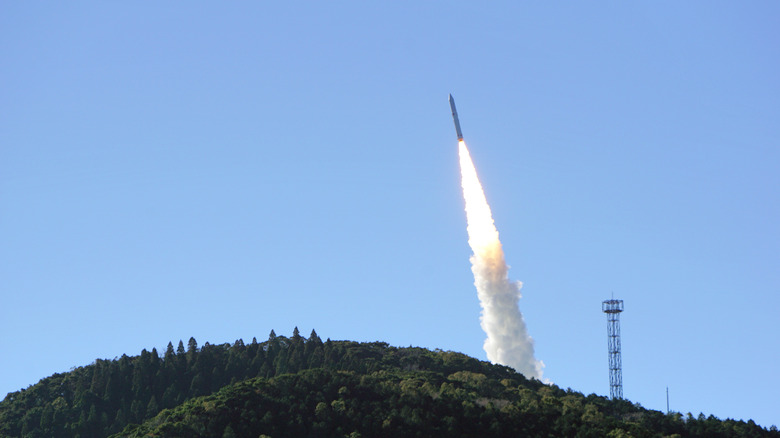
To be clear, this initial test is still a far cry from an actual test flight. What it represents is a ground‑based validation of a scaled‑down model. Next, JAXA plans to mount the experimental vehicle on a sounding rocket (a suborbital rocket typically used to take measurements and conduct scientific experiments in space) and attempt an actual flight at Mach 5. Assuming success and that regulatory and technical hurdles can be cleared, the goal is commercial hypersonic passenger service by the 2040s.
If progress continues at this pace, a Mach-5 plane flying at an altitude of 25 kilometers (nearly double the altitude achieved by current commercial airlines) could theoretically cut the Tokyo‑to‑Los Angeles route from roughly 10 hours to around two hours, without the complexity of entering full orbit. That means slashing transit time for a flight from the U.S. to Japan, transforming what would previously have been a week-long ordeal into a day trip with just a few hours in the air.
> I’m in favour of projects like these - even on spending taxpayer money on them.
Even a few hits is extremely valuable. I mean the US's investments in CERN and ARPA sure lead to way more economic activity and resultant tax money than they ever spent. By many orders of magnitude (I mean the US still is committing like a billion a year, that's nothing in government money. Let alone considering how many multi-trillion dollar companies there are?) > However, when you’re doing journalism
Which is why I say the questions are fair and to not use them dismissively. I agree, context matters.Nominal SECO for the last starship mission was at ~8 minutes and it took ~20 minutes from deceleration started (well, from air resistance outweighed the forces of acceleration) to landing. So basically 30 minutes of flight is just the "getting up to speed" and "slowing down" part. Both account for some distance traveled, but still. ~45 minutes is probably a good bet.
Do note however that you may have to go around the world "the wrong way" to get some places due to launch constraints. But living in a world where going around the world "the wrong way" is the easier path is interesting. Imagine that.
If I catch a train that is 10 minutes before the train departs on a metropolitan train station in Europe.
With planes in my experience arriving two hours before the actual departure is not uncommon at bigger airports, since there are more insecurities involved like how crowded security checks are, where your gate is, etc.
Yes, TSA is a big part of the problem. It's less "how long it took" and more "how long can it take". I've personally experienced those days where "TSA decided to go slow" and a couple hours disappears. The 5 minute days just make that worse.
Yes, the airport matters. If you're at some small regional it's no big deal. JFK or Atlanta etc is another thing entirely.
Yes, domestic or international matters. Yes, flying business class makes it faster. Yes signing up for "special status" makes things faster.
But airports are typically some drive away from city center (both ends, in traffic). Security and immigration both take time (often significant time.) Door to door time is easily 6 hours more than flight time.
A suborbital craft won’t be travelling at that speed.
Logistics around the flight would be a big asterisk behind the flight time.
If I come earlier, it's with the expectation that I'll waste some time hanging out in a lounge.
(Train situation is similar in the US, in places where we actually have those. Generally fine to show up right before departure.)
On international returns, both Global Entry or MPC lines are virtually empty when I arrive (SFO)
The worst part is international arrivals in foreign countries, where immigration can soak up a lot of time, and you have no choice but to stand in line. Luckily I don't have to fly internationally too many times a year.
It was proposed as nuclear warhead delivery method though: https://en.wikipedia.org/wiki/Fractional_Orbital_Bombardment...
Another example that comes to my mind is a highly skilled expert in repairing some important machinery, e.g. ship engines or factory lines.
What kind of multi million dollar deal blows up because a dude arrives 18 hours later? And what are they doing when they get there that couldn’t have been done online?
Lucky you :). And I hope you stay lucky! Alas your experience is not universal.
Who said anything about 3-4 times a week? There are plenty of businesses with high earners where time matters and I could see flights like these being profitable. Boards meet quarterly typically and they are often preferred to have in person.
In business face time still matters. Less than prior to COVID but it still matters. Most boards prefer to meet in person.
But yeah, if it is going down almost vertically then this will not be enough.
You can also reduce peek deceleration forces by using aerodynamic lift to stretch out the reentry over a longer period.
Unless one has seriously variable aerodynamics, the vehicle will have to swerve to nearly horizontal over a distance of about 1 scale height of the atmosphere, which is about 10 km. The exponentially thinning atmosphere goes from "too thin to matter" to "brick wall" over a short distance.
The acceleration for turning is v^2/r; for v = 5000 m/s and r = 10 km this is 250 g.
Acceleration also limits how rapidly one can reenter from beyond Earth orbit. At > LEO velocity, the vehicle has to use (downward) lift to stay in the atmosphere, and if v is too high the required acceleration is too high.
> having a private cabin with a shower
AFAIK: Showers are only available to first class customers flying via the major Gulf carriers. I checked Google flights for business class and first class tickets between Tokyo and London. Business is about 5,000 USD and first class is about 10,000 USD. Assuming that we are talking about first class here (to satisfy your shower requirement), what kind of developer is hacking code at 10,000 meters in first class... except... hmm... Mitchell Hashimoto?So any hacker considering a SST flight should also be able to afford the first class cabin.