
I love Google's AI answers and their AI Mode tab. DDG is just Bing or a search vendor proxy, so I've never understood the fascination. At least Perplexity is different to Google. DDG seeing a 28% increase is like Google saying they saw a drop of 0.0000000001% in traffic.
HN crowd forget that the world isn't like us, they didn't grow up with Yahoo and Alta Vista, with Excite etc etc. Our SOP is to resist all change, anytime Apple brings out a new version it'll be the end of Apple according to HN - Apple - the biggest company in the world - what do they know about UI, "Liquid Glass sucks!" :) :)
We're a community in danger of pushing out those new to the tech world, recent graduates will be made to feel unwelcome if we continue to trash everything that the biggest companies in the world do, like we always know better. I implore the community to be more positive about the future, about the technologies that will take us into that future.
For the search, some of the local results are wrong but I live in a very small area so it may be more reliable for highly populated areas. Lately I've been checking out Kagi for a few things just to see what the quality is like on competition. The anonymized chat (proxy) for AI is cool but very small context limit. Good for looking up random questions and they typically include references.
The google live scores is a great feature. But when it's not coming up, even googling "french open google live scores" doesn't just bring it up every single time. It might if you try, but try multiple times over the day...
If Google isn’t carefully they’re going to push people away from their golden goose.
Of course DDG / others can do the exact same thing as they already have an AI mode. Maybe you can even set up ChatGPT as a search engine - not sure. The key for this use case is speed - it has to be nearly instant.
> The DuckDuckGo mobile app saw installs spike in the US by 18.1% on average compared to the previous week. TechCrunch reported this growth was sustained over six days, peaking at 30.5% on May 25. An even greater number of iOS users hit download on the app though, with installs seeing an average week-on-week growth of 33% and a peak of 69.9%.
Why do they report only relative numbers? These numbers alone are meaningless. This is just lazy reporting.
For as much as how the startup space loves to pay lip service to contrarian bets, people sure do all be running in the same direction.
The only Google service I haven't been able to replace is YouTube - no real alternative. I still use Google Maps as well, but could probably switch to Apple maps without missing much. For hiking trails, Apple Maps has often been superior. I briefly tried OpenStreetMaps years ago, but the lack of traffic data and the fact that it gave me bad directions made it untenable.
Recently I switched to Kagi and has been a very happy customer. I never visited Google after that. Only downside is the Search on mobile. You have to install an app and enable it as extension on safari. Logging in never worked and couldn't enable my premium Kagi on iPhone.
I'm sure the model is fine, but it's not Google Search, and when I want Search I want Search. If I wanted to ask an AI, why can't I ask the one from my subscription... that I'm already paying for... that's actually good... that can also search the web?
I assume it's a play to test the waters for how the ad market is going to work, because as a product I really can't see why I would ever use it. Dropbox comment moment incoming?
I personally have had to use DuckDuckGo to search for things that Gemini finds to be against its instructions to answer.
And I'm not talking about things that are NSFW, but some things that Gemini just doesn't want to discuss.
That's kinda Gemini's problem in general, it just is overly restrictive and doesn't like to talk about anything things that Claude will freely talk about and push against and discuss with you.
Classic example of misleading with stats.
And supposing these technologies do take us into the future: when said future is bleak and worse in most ways than what came before, people aren't going to be encouraged or enthusiastic about the tech world.
However, I find that most of my queries don't require Google to find the result. Maybe once every couple days I do a search, don't like the results, and then add a "!g". Most of the time it's fine and I get to avoid Google's ecosystem.
Users aren't adopting their AI at the rate shareholders expect, so they now force the adoption at the cost of search.
You can add a custom search engine to your browser with something like:
https://www.google.com/search?q=%s&udm=14
Sometimes that will glitch out on Chromium browsers. If so, try this variant: {google:baseURL}search?q=%s&udm=14Google's search volume has been growing 12%+ per year for 20+ years, there's obviously much more room for volatility when you're smaller...
Just because Google used to do search as their main point of business does not mean that holds true today. Holding on to the false premise will only add to your confusion about their decisions.
My friends who previously had no interest in technology and never talked about it, are suddenly following tech news closely all because they have fear of missing out on AI :(
AI is going to be great at pushing ads. Plus AI trains you to give google even more control. Instead of just presenting you with a list of websites offering different perspectives and opinions on something, Google can just tell you what they want you to know/think (or not tell you anything they'd rather you not know/think about). The more you get used to treating google like an oracle instead of a librarian the easier it will be to manipulate you.
When people open a search bar and type stuff, they're showing an incredibly strong intent to... search the web.
This reminds me of when MS tried to turn all Windows user interactions into bing, or (even worse) copilot. How did that work out for them?
Anyway, unlike windows, there's zero cost to switch away from Google's search product. I'm predicting a bigger backfire.
Google search had degraded so badly pre-AI, I was already finding it equivalent for most things. The odd few searches benefit from Google, but nowhere near enough to warrant them as a default.
They killed their competition and now they will give you the product that gives them the most money.
>Just one year after its debut, AI Mode has surpassed one billion monthly users, with queries more than doubling every quarter since launch. As people have realized just how much more Search can do for them, they’re searching more than ever before — so much so that last quarter, we saw queries reach an all-time high.
>Another place where we’ve been rapidly innovating is in the Gemini app. Last year at I/O, the Gemini app had 400 million monthly active users. Today, we’ve surpassed 900 million, more than doubling in a year. In that same time, daily requests have grown over seven times.
Its search results ordering is quite good, but the accessible information for them seems to be shrinking. And quickly.
I’m at the point where I don’t search for complex things anymore. I use Kagi for things which can be found with any search engines. Not because I chose it, but because I was forced. This was not the case a few years back, when I started to use it.
Btw, there was one thing with which Google was superior all along: define <word>. And they fucking killed it in the past months, for a far, far worse solution. Nothing comes even close.
Ads make the money, but Search is still the consumer facing product that brings people to Google and keeps them there. It’s so ubiquitous people don’t even think about it or notice it anymore.
I’m always surprised by how much people are still searching for stuff as we’ve moved from the open web to various platforms (Amazon, TikTok, Facebook, etc), but every time I see Google’s revenue breakdown I’m shocked by just how important Search still is to their business.
This is from 2024, but shows Search accounting for nearly 57% of revenue. Yes, this is made possible by the AdWords business, but without Search, that 57% goes away, unless that traffic goes to a 3rd party that is also using AdWords and Google were to make the same from 3rd party ads as 1st party. I find that doubtful.
https://www.doofinder.com/en/statistics/google-revenue-break...
That's been my experience too, both with friends and coworkers.
It would seem that the negative sentiment around AI is largely an internet phenomenon. I've yet to run into a hardcore "AI skeptic" irl. People seem either neutral, or enthusiastic about it.
A ~30% jump of DuckDuckGo is about 0.3% of global search traffic, basically a rounding error for google.
Still, it's an interesting signal, but not nearly enough to worry Google. If the jump had been 300% that would merit some thought.
If I'm looking for a relatively straightforward and simple piece of information quickly (e.g. "wooden arch mirror stores linden") then the AI summary can be useful, because I don't need more than surface level info.
If I intend to analyze and understand something (e.g. "developer API issues Zoho Thrive"), then the AI summary and the general degradation in the quality of search results from Google really hinder me. I have to work to avoid a lazy and low value answer, whereas what I really want to do is go through various actual websites and reflect on them to gain insight.
Don't you have to do that _anyway_? Unless you're just blindly trusting the AI to be correct, and if that's the case, please do enjoy gluing your cheese to your pizza.
edit: my school blocks all search engines other than google though XD
Of course, asking it to give yes/no answers or specific numbers is asking for trouble, but finally I can let something else read the SEOed garbage, point me in the right direction and let me browse the search results in a much more pleasant way than before.
There's a local search engine with a motto that translates to something like "Find what you don't know." Google has seemingly adapted "find what you don't want."
We just don't need to search as much. But I _do_ still want to search sometimes, it's still a valid use case, just not as important as it used to be.
But when a do search, I want simple, relevant, external search results so that I can go straight to those good sources. Google isn't satisfied with their returns on that though.
I wouldn't be surprised if they made up the statistics to justify the enslopification.
Also why is AI mode default?
This include work.
I use DDG, kagy and the LLM du jour .
Again, no friction. No plan. No transition période. I just changed the default search engine on a whim.
Too late, people have started moving. They have to act fast to stop the migration from growing.
Which is kind of the scary hazard for Google. They made people notice search by their announcements. They drew attention to the thing people took for granted as just how things work. People suddenly have a reason to look critically at it. Google has to hope to god the attention they receive back is actually positive.
Right, but you know what's even more effective than ads in search? Biased (towards paying customers) information in LLM output.
I'm not entirely sure I'm buying that, unless users keep prompting the AI to reduce the amount of reading they need to do. Sort of interrogating the AI, rather than reading a Wikipedia page.
Technically, all the people who google "how do I disable this shitty AI mode in google" would count as "driving an increase in total search queries."
An easy way to make a feature popular is to force it on everyone. Then you can pat yourself on the back when 100% of your users are using it!
The flip side is that multiple AI Search engines have overtaken and lapped DuckDuckGo many many times over in the past year or so.
The header and input bars are too big. The max width of the response is too narrow. The font is too large. The way it renders onto the page feels weirdly clunky. There is a whole sidebar in addition to the top bar just for two buttons. In the + button under user input, they hide everything under there like model selection even though there's a ton of real estate to the right of it. Everything feels unnecessarily cramped on the page in spite of ridiculous amounts of whitespace.
Yet my ultimate dislike feels like something more than the sum of the parts. It feels like the Yahoo of AI. Anyone not relying on distribution advantages would know they need to do better.
It really speaks to Google's perennial weakness: they can never seem to make an incredible UX.
There's no alternative left, no webrings, no web directories. If all your content is now only on your server, you're invisible.
But recently I had an entertaining experience with it. I was trying to apply a math technique to an application it wasn't normally used for, and I figured that somewhere out there was a paper or two explaining how to do what I was attempting. So, I tried Googling, and the response was something like:
"You appear to be working with two completely different areas of mathematics, which have absolutely no connections between them. That's fascinating! Would you like to know more about either of these two completely separated subjects which have nothing to do with each other?"
Not useful, Google, but definitely good for a laugh.
While Google has certainly failed with their products before, by and large as a company they are "too big to fail" at this point so to speak where the myriad products they offer have become a very significant part of the digital infrastructure on which much of the world runs.
Anecdotally I've also switched to DuckDuckGo in the past because I didn't want Google looking over my shoulder on my browsing history (this was pre-AI), but I ended up coming back because I felt the search results weren't quite as good (or perhaps it was just in my head, and the differing UI was enough to throw me off).
And this may be a contrarian opinion, and while I hate the idea of Google mining all of my data and monetizing it, I actually find value in the AI 'previews' that Google provides (and will often ask it follow up questions as a means of getting 'free' LLM responses back for 'easier' prompts that I don't want to burn Claude tokens on).
All conventions and user centricity go out the window with AI feature launches lately. If you look at examples from the last week it’s stuff like posthogs opt-out training, Copilot training, or Google’s antigravity chat-app switch.
I’ve had the worst customer experiences of my life in the last few months.
My health insurance company decided calling support meant I consented to them saving my voice for model training. They said you can opt-out online, but that option didn’t exist in app or on their website. It was only after calling back and threatening to sue that they added an option to opt-out.
This is the daily experience now. Seemingly every company is opting you into selling your data, breaking your workflows, disabling features you use, and force installing AI integrations you have to fight to remove. And several companies are perfectly fine to reenable or reinstall them after removal.
It should be no surprise to anyone people are mad.
What real value AI does have has been poisoned by premature rollouts (training users it’s crap) and forcing it on people too aggressively.
we have moments like this every few years (almost as frequent as crypto waves in recent memory), but they keep chugging along.
couple years back it was all about saying the GPTs have replaced search for people and how google is dead. now when they implement the same, it drives people away.
i can imagine how it can be difficult to be in their shoes, when any change is met with negativity. no surprise that the core interface has...had not changed all this time.
context: left to ddg almost a decade ago in a similar exodus wave.
What for? Just use the website via your favourite browser.
I’m getting extremely annoyed by the Base44 ads I see on YouTube every other video.
First I pressed skip all the time, but the ads keep popping up. So now, every time I see it, I click on the ad and then immediately close the site. At least I can make their aggressive ad strategy a bit more expensive.
> but Search is still the consumer facing product that brings people to Google and keeps them there.
And let's not forget, these are the same people that when searching for "eBay" will put an ad at the top of the results, linking to eBay, and then place eBay as the top search result.I've found it hilarious that every single search engine does the same thing. You can do it even in Apple's App Store too. (Not seeing the scam I'm talking about? Search a few more times, it'll hit) How does anyone see this as anything but a scam? User clicks the ad? Get paid. User clicks the search result? No pay. Either way, the user gets the same experience. But why the fuck should any company pay for an ad when the user explicitly searched for their product? It's metric hacking. I mean what's their next move? Down rank the explicit result? When making more money requires degrading the product you know we've fucked up
I'm a bit afraid that although AI is being presented as part of the carrot, it may actually be a shittier stick.
You ask AI for a product recommendation. It says "Buy X from Acme". Is that paid product placement? Who knows?
One of my friend ended up spending too much time on Candy AI or some sort of AI companion thingy :/
This reads as a strongly closed minded claim that has been "whitewashed into corporate appropriate speech" by an llm. If you cannot understand any validity to the other side of a debate then you are not engaging in discussion, no matter how your claims are dressed up.
So I'm wondering how other folks are finding this out.
How do you know the answer is exact?
> or I suppose I could click the links and wade through all the validation for choosing <ICE vehicle> and how often one should change the oil, and which brand of oil that blog is pushing etc etc.
Where do you think that "exact answer" is being scraped and averaged-out from?
Like you, I use both search and AI separately. Even casual, nontechnical users are starting to work like that. Including AI with traditional search results will keep a lot of users from jumping ship in the first place and will help win back users from ChatGPT.
I know a lot of people hate AI - at a minimum, there’s a vocal minority - but the reality is AI is eating search like nothing we’ve ever seen.
If I truly want to search I will ignore the llm results, but I like the convenience of a quick llm search that knows "all the things". I get the answer to my question without searching multiple ad-ridden websites (since the ad provider does all the things)
To each their own.
Slight digression: Claude/ChatGPT/etc all can search the web, but Google's AI already has a local copy of the web. It's much faster because of Google's TPUs, but also because Google has a copy of almost the entire web available locally. I recall others testing this and they observe that Google doesn't actually make HTTP requests to sites it references. It just uses its local cache. That's an advantage that all others seem to lack.
Of course, I agree that when I want search, I want search. But personally I've found if I want an LLM to very quickly answer a simple question, the type of thing all of them would do an equally good job on, I prefer Google's for its sheer speed.
Couple that with the fact that a lot of folks have moved their search to GPT or Claude once those platforms start taking in ad money... that budget will come from somewhere and that's likely existing Google ad buy dollars shifting.
Personally, I like it sometimes, but I'm a techie and understand the limitations, and I dislike not being given options to use or not use it.
If I have an issue with my Mac, seeing an Apple Discussions result at the top readies me for disappointment.
Meanwhile, I've found a normal chat with current ChatGPT to be very helpful, as long as it isn't about itself or other OpenAI products.
I'm also finding that the AI-cited links are often more helpful and authoritative than the top search results.
It's better to just ask codex to do the search for me, but this is much slower - but increasingly my go to. I wish there was a fast search api codex could hook into to answer internet questions faster.
The problem is that's not discoverable though. The toggle on google.com would be nice but most people probably arent searching that way.
1. To protect ad revenue they make search results worse to increase the number of searches by making people refine their searches. This made people upset because search result quality went down. 2. "AI everywhere!" put them in a panic, so they shoved am LLM into results, hoping it could pick through bad results and give good data to the user. 3. LLMs are expensive to run, so they're using a cheap model.
Cheap model + bad results = abysmal user experience.
There are too many groups with opposed interests fighting. Ad groups wants worse results so people search more (not realizing this just drives users away). Search groups want a better product so they stop losing users, and the AI group is being given a bad name because management is using their worst AI product on search. So the whole experience is just garbage.
Not me. I really appreciate having both results simultaneously. I can scan the first couple sentences of the AI response, and if that already has the answer then great. I can expand it to see if there's more.
Or, if I see that the AI mode didn't understand my brief search query, I just glance at the search results below.
And often times, when I do need to follow a link, I find the source result links in the AI mode to be a better quality than the search result links.
It's the best of both worlds.
I just have Kagi set a custom search engine in mobile browser - no seperate app needed.
"AI" gets higher volume of use than search. This was disclosed by Google under oath
More traffic, more usage time, more data collection
Of course they have more AI queries every day. They have full control over what goes to LLMs and what doesn't.
If the results are garbage, or people have difficulty with it... Of course number of searches goes up. That doesn't mean the product is better or its not resulting in brand damage.
I search more when I cant find the thing I am looking for. I search less when I find the thing I am looking for.
Second, it takes additional effort to not do AI search.
Random snapshot of what it looked like: https://web.archive.org/web/20220101023001/https://duckduckg...
In some ways the last bastion of the real web are the web comics. Small personal projects where they link to like minded other projects.
A lot of people keep saying this, and yet I never saw a reasonable example. Whenever DDG fails for me, the Google's results are even worse.
It should seriously be 100% illegal to force someone's content into AI training without their explicit consent, and no not opting out should not be an escape hatch.
The other day I googled "I'll be resolving" in quotation marks as I usually do when I'm unsure if it's idiomatic (or grammatically correct for that matter) English.
AI mode replied with: "I'm on it. Tell me what you're working on, and I'll jump right in with the exact steps, scripts, or details you need to tackle it! What exactly are you looking to resolve?"
Just give me the damn phrase used in a sentence along with the number of results so that I can assess how common this expression is.
Their friend are probably the kind of people conflating Chrome/Google with "The Internet"
And I think on Android its even less clear the distinction between the browser app and "Google"
This is the exact use-case, and it makes a lot of sense. The hard part for Google is identifying when someone wants search and when someone wants an AI response. It's somewhat identifiable by the input but of course thats extremely messy to determine systematically.
But if you still want ChatGPT/Claude, then you simply create a custom bang and associate it with something like `https://chatgpt.com/?q=%s`
So now in your address bar you type "how to center a div !gpt" and it will start a session with your query
I recently bought a Bambu 3d printer after Reddit/HN drew my attention to them and AI mode has been really useful for me to learn about my new printer and troubleshoot things. There is so much information and I don't have time to read everything. I just want to ask a targeted question and have something summarize the literature's answers for it.
It will be a sad day when Google inevitably enshittifies it, but for now I'm happy for them to subsidize my expensive LLM queries.
I think this is a step beyond that - why should people be creating cooking websites when you can ask LLM how to cook given thing, while indeed, serving their own ads. It's the continuation of "we own content other people produce" policy
Block Googlebot from your sites.
Let's go back to webrings.
Though that's not to say they're acting altruisticly here.
Google seems to be racing toward a new dark pattern where users learn to trust rely on the AI for neutral, smart objectively correct answers — which boosts trust in its sponsored product recommendations. Super gross.
A large fraction of the people using Google probably have no idea DDG exists. So the backlash is likely significantly larger than just the 0.2% who left to this search engine.
Could you elaborate on this? What ad company did Google buy?
I think to some degree, that effect is also at play here. CEOs, product managers etc are simply amazed, and want to spread the good news. I doubt they can even _comprehend_ that others might not be as excited as them.
It is insane, and I hate modernity and every single modern product that just shoves random LLM crap at you and pretend they are not AI-enabled.
>I’ve had the worst customer experiences of my life in the last few months.
I attribute that to the massive amount of tax breaks and money that has been funneled to them by various governments. The government is the customer that they are appeasing right now. As soon as the spigot is turned off, they will be more inclined to appease us.
I do not know the consumer or b2b AI market well right now. I do know that billions of dollars are at stake from government sources. A smart company would focus on that.
If this isn’t how it works, I’d be interested to know. The whole idea of these opt-outs seem like smoke and mirrors to act good while still gaining the advantage from the dark pattern. The only way to truly opt-out is to not register or use a service at all. There really needs to be legislation around this.
If you don't buy out the top-place for the query, someone else will. In a better case a competitor - imagine Facebook Marketplace being the top result for "ebay". In the worst - a phishing site. The latter happens quite often for software searches.
Do you see an ad when you search for ebay? I don't.
eBay stopped paying for placement on the term "ebay" more than a decade ago, and I believe the executive who made that call got a bonus. It's possible of course that they changed their mind later, but since there still isn't an ad on the term today, I suspect they didn't.
(Methodology: I opened Microsoft Edge, where I have no addons or adblocking or anything installed, went to google.com, and searched for "ebay". There are no ads in the results panel. There is a sidebar with some non-sponsored information provided; below that sidebar is a section saying "people also search for" that mentions Etsy, Shopify, Poshmark, and Mercari. That section isn't sponsored either.
As a point of comparison, I also searched for "mortgage loans". (Same window, new tab, google.com.) On that search, there is no informational sidebar, and the results panel begins with a section called "Sponsored Results" which occupies the entire vertical extent of the browser window. (And consists of all of four links, with blurbs.) Below the sponsored results is the AI overview, and below that are the genuine results.)
The platform has been various kinds of hostile for a few years now
https://www.wired.com/story/even-if-you-hate-ai-you-will-use...
I don’t have to click through a load of cookie banners and login popups to see it.
No, it's not. AI mode is something you have to select (in the search window). There is an AI overview provided with your basic search results.
I wonder how much the search results thing is related to language and locality. I have a hunch but I haven't really dug into it.
I live in the US, I speak English, and my browser is normally chrome.
The number of times I've gone to the 2nd page in Google search results you can probably count on one hand in the last 15yr or so.
I use the standard Google search things when I want specifics... Using quotes, site:news.ycombinator.com to search a site, or add a "-" to remove results from that site. I use a "+" when needed. Nothing fancy.
When people say they can't find things in Google search, I'm genuinely baffled. I have a strong suspicion that it has something to do with the combination of browser, locality, and language. Why? Could be tons of reasons for that, some probably anti-competitive on the browser side.
I have tried to use ecosia, start page, duckduckgo, etc. Was never happy with those results and always ended up back at Google search.
I just want to know what's different, you know? I look up some pretty obscure stuff sometimes.
Note: I do normally have my Google account logged in in the browser when doing search, however I have search personalization and history turned off, so that should not be influencing the quality of my search results compared to whatever "baseline" is.
Then it became so common to be a techy person and surround yourself with other techy people that it was easy to fall into a bubble and not realize it. When all of your news websites, coworkers, social media feeds, and friends in the group chat all think the same thing it feels like everyone in the world agrees with you.
You see it whenever social media topics come up. On Hacker News there’s never ending confusion about how Facebook continues to exist because the common refrain is “nobody uses Facebook any more”. Leave the tech bubble, though, and Facebook has a massive number of active users and activity. Whenever I mention this it gets doubted, denied, or even dismissed as lies from Meta trying to inflate their stock price. The dismissals always come from people who proudly deleted their Facebook account ten years ago and therefore have no idea what happens on Facebook, of course.
One of my favorite comment sections this year was when a lot of people were recounting how their aunt or cousin or grandma used Facebook and actually enjoyed it, which attracted comments saying they must be a rare outlier. It just goes too much against the bubble consensus that everyone hates Facebook and has a bad time when they use it.
(I didn't quickly find polls for the rest of the world)
1. Labor replacement
2. AI is actually bad in-and-of-itself. Doesn't work, not useulf etc.
3. Energy concerns
Why would this work? Were yahoo and askjeeves sandbagging their results too just so they can get more clicks?
But how do make the determination that the answer is good and you should stop reading the page? Vibes?
- Search ad pricing is inelastic and auction based (supply goes down price goes up).
- A jump in traffic to DuckDuckGo does not mean Google is experiencing a decline in search volume. Number of queries per session has increased since launching AI Overviews.
And I think the rest of it will end the same way. People will be significantly less eager to do all that free work when no one will be able to find it.
It would be a shame if someone else got the top result
>> When making more money requires degrading the product you know we've fucked upIt was an example. You're getting lost in the weeds. Similar to this saying BuT sOmEoNe ElSe WiLl GeT tHe ToP sPoT
He also tries to troubleshoot/debug stuff without calling me... and just asking me to choose right path offered by AI. I love it :) Because I usually make people wait and don't have much time outside my business hours to do additional tech stuff.
People have many more questions in their life than they do queries.
(I don't know anybody that is actually more productive because of it, but I know people that consistently use it successfully in small tasks.)
I also know people afraid it will make all code worse and their jobs a nightmare. It's harder to find those people because they don't say it out loud, but there are plenty who think this way.
But if they're letting me using AI for free without logging in and I just need a dumb AI slop answer, then I'm more than happy to burn their tokens instead of my own. Any serious work goes to a different LLM provider. The switching cost for moving to a different LLM provider in the future is practically zero.
That was essentially how people praised Google in their early days. It certainly has ads now.
there are other such goodies like mashed potatoes with broken lightbulb gravy, or fiberglass omelette, enjoyed by beldar conehead.
i wouldnt trust an AI for any recipe that i dont have personal experience with.
the safety rails are not very strong yet.
At least he's not one of the many mooks who are doing ChatGPT-assisted (Grok-assisted?) blogging and boasting about it, even when it goes wrong, like Casey Handmer.
If you care about music just a little bit you should stop using it today and directly buy music from the artists you care about.
I'll believe it when I see it.
FWIW I think it's a combo of people who spend all their time in online circles and and the effect on upvote sites where people try to appeal to the group sentiment to farm for votes. There's a lot of tech communities that consist of people who pretty much don't socialize in person and it was greatly exacerbated by the pandemic.
I have no issues with the technology itself.
I wonder how many still say they have a negative sentiment on AI yet are still paying customers.
Humans are predictable and hate change. For a short while it DOES work, people are used to great results, assume they're not using the the best keywords, and they'll reformulate their searches. For a while. After a while of all searches being not as good as they used to be, people start looking for other alternatives, which is why DDG is seeing an uptick.
It's called enshittification. It's easier than improving a product.
> Were yahoo and askjeeves sandbagging their results too just so they can get more clicks?
No idea.
The same way I make the determination as to whether a linked search result is good and I don't need to click on another search result.
It's not like non-AI webpages are inherently more trustworthy or anything. The internet is full of misinformation everywhere, you know?
False. Advertisers have budgets and ROI targets. If Google cannot compete people will get their clicks elsewhere.
> A jump in traffic to DuckDuckGo does not mean Google is experiencing a decline in search volume. Number of queries per session has increased since launching AI Overviews.
But it does produce lower ROI for advertisers (in this case: CTR goes down because my ad is being shown to more people). Once user is on my landing page, my conversion rate is fine month on month (±1%), but my CTR on google got sharply worse by 5% since, and if it goes much further I'll stop completely on Google.
I doubt I am alone: Maybe others will jump ship sooner and the price will recover (demand goes down) but in either event Google is less net revenue, and given how aggressive their sales pushes have been I think it could be that big
Regular people are/were really bad at using google, so google moved towards showing what it thinks you want rather than what you want. They paved over the skill gap between people who understood keywords and word order, and people who just typed in a quasi legible sentence to find something. In doing so though, they killed a lot of skill that people had developed with google for years.
Basically they made the game worse for pros so it could be better for amateurs. I have never heard a non-tech person complain about google getting worse over the years, and they seem to overwhelmingly use AI overviews now too.
I wonder how many in that poll have a negative sentiment about AI, yet are also heavy users. There seems to be some kind of disconnect going on?
That's what I get, in the UK, logged out of Google, from a search in Firefox omnibar using "Google" as provider.
I'm aware that they have other things that can be described as AI modes.
Most of the time I'm looking for something very specific that there are plenty of articles about, but clicking on the articles results in popups, banners and an unhealthy amount of scrolling to get to the answer.
AI overview provides me the answer instantly.
Think about suff like "does china borders afghanistan". In those cases you can be confident that the AI overview is right, and saved you time.
If it is a complex or niche question I tend not to trust the overview and go straight for legitimate-looking results

(Image credit: Serene Lee/SOPA Images/LightRocket via Getty Images)
These days, a typical Google Search feels like an obstacle course. Type out 'upcoming PC games 2026' and your gaze has to swerve around a chunky AI overview which recycles the work of human writers in a bid to kneecap efforts to click away from Google. It's a bleak state of affairs for what was once the premier discovery tool for the internet, and as such many users are looking for alternative search engines.
DuckDuckGo has been one major winner of this Google Search abandonment. Just for a start, visits to its AI-free search page noai.duckduckgo.com between May 20 to May 25 are said to have increased by 22.7% on average week-on-week, with the figures peaking May 24 at 27.7%.
The DuckDuckGo mobile app saw installs spike in the US by 18.1% on average compared to the previous week. TechCrunch reported this growth was sustained over six days, peaking at 30.5% on May 25. An even greater number of iOS users hit download on the app though, with installs seeing an average week-on-week growth of 33% and a peak of 69.9%.
This all follows Google CEO Sundar Pichai claiming last week that, "People love [Search's AI Mode]." DuckDuckGo CEO Gabriel Weinberg criticised Google's all-in-on-AI approach to Search, telling Paul Thurrott, "Google is force-feeding AI with no way to opt out. As a result, their results are getting worse, not better. We want to be the place that puts users in charge and allows them to decide how much or how little AI they want."
To be clear, Google isn't about to lose its Search crown; DuckDuckGo represents about 2% of the search engine market in the US—Google still enjoyed about 85% as of last month.
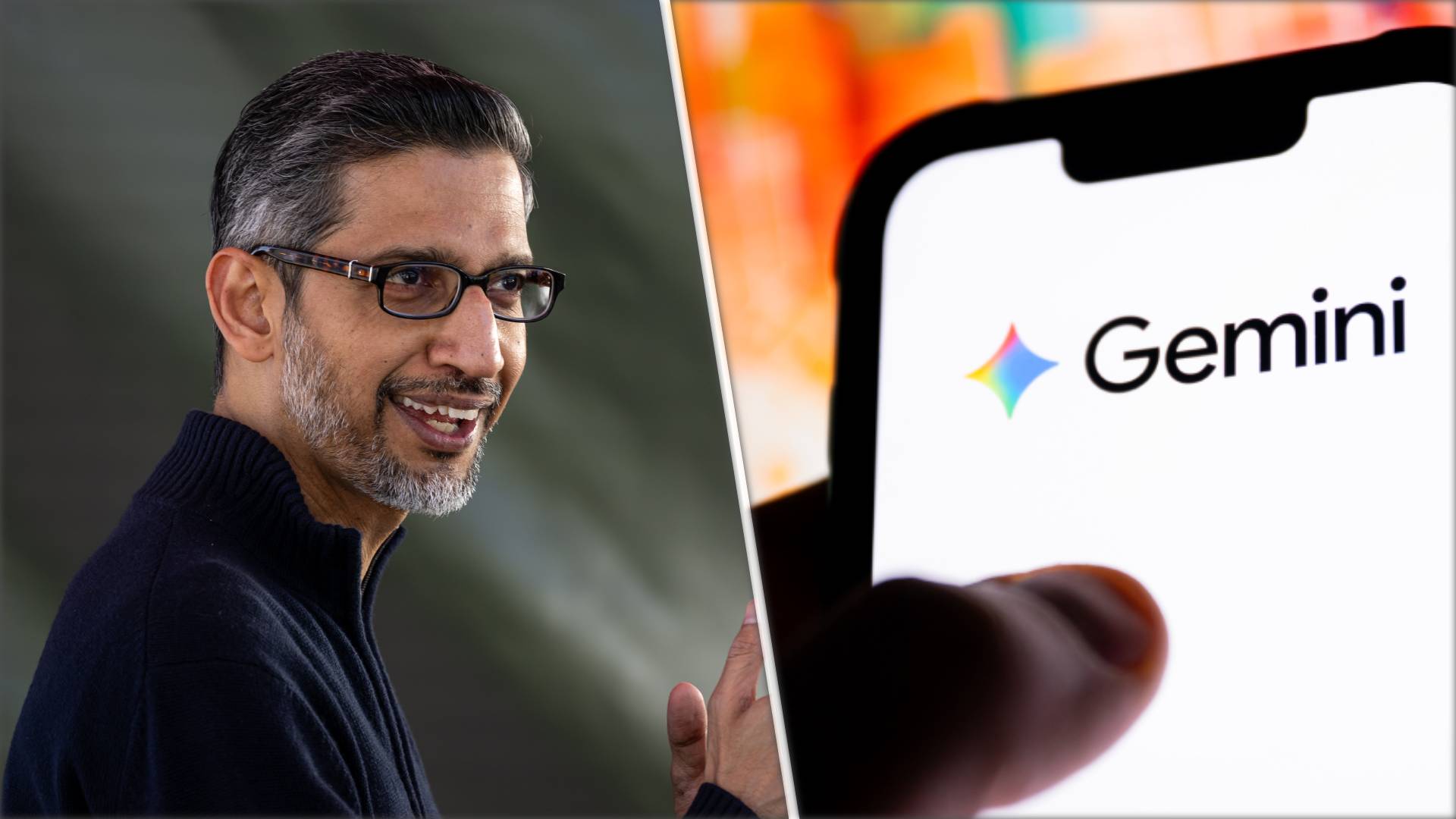
(Image credit: David Paul Morris/Bloomberg via Getty Images (left) / Mateusz Slodkowski/SOPA Images/LightRocket via Getty Images (right))
DuckDuckGo also offers AI products such as duck.ai, which allows users to chat privately with a number of major LLMs such as GPT-5 mini and Claude Haiku 4.5. Given that Google reported its revenue from search grew by 19% during Q1 2026—apparently thanks to its "AI experiences like AI Mode and AI Overviews"—it wouldn't make much business sense for any company to completely exile itself from the AI industry at this moment in time.
However, DuckDuckGo has endeavoured to prioritise user choice and privacy. Weinberg said earlier this week, "Everything you do in DuckDuckGo is private, we don’t collect search histories or chats, and nothing is used for AI training."
Keep up to date with the most important stories and the best deals, as picked by the PC Gamer team.
According to chief communications officer Kamyl Bazbaz, DuckDuckGo's own AI overviews remain popular—though so does the option to filter out AI-generated images from search results. He said, "People just want a choice." Amen to that.

Jess has been writing about games for over ten years, spending a significant chunk of that time working on print publications PLAY and Official PlayStation Magazine. When she’s not investigating all things hardware here, she's either constructing a passionate defence of a 7/10 game, daydreaming about her debut novel, or feeling wistful about the last time she chased some nerds around a field with an oversized foam sword.
Rather than "users don't find what they want with the AI as easily so they have to spend longer with it"
I know it's only anecdata, but it's one data point.
I'm a tech startup co-founder able to avoid all the bullshit around it and just build stuff. My favourite part is that I can go through the planning part, get a decent plan for the build together, and then go do something else while the LLM builds it. It also really helps with maker/manager time because the LLM is keeping the context, not me, so if I'm interrupted I don't lose track of everything and have to reload context.
I'll stick with my mom's handwritten recipe book.
You can - but it's not advisable, not in the least.
But your best strategy is to zoom past those ads quickly no pausing or close the browser when you see them
Could be correct, could be not, who cares?
Most non technical people I know asked questions to Google even before the AI overview. Instead of looking for the answer in seo-bloated articles, they find it in the overview.
I think google should improve in detecting the kind of query when I need a link that I don't remember, and deactivate the overview on those. If I search for "ryanair booking" I clearly need the url for booking a Ryanair flight, AI overview is useless
And a "?" at the end is not going to capture a lot of real LLM prompts like "What should I pack for my vaction? Im going to Florida in September."
I mean you could do something like this. But it's really not much different than other manual search codes that are used by more power users like like "", "site:" etc.
They probably have a term for it but their AI response is just another "embedded result" for lack of a better term. Like displaying the local weather directly at the top when you search "weather", etc.
Point is, unless you're stupid enough to add glue or broken glass to your meal just because a recipe told you to, it's perfectly safe. More than just safe, LLM recipes these days are utterly boring in their normalacy, and, unlike cookbook recipes, can dynamically adapt to what you actually have in your pantry.
Can you really though? Are the results delicious? I've never tried that.
Hell, even if you... acquire the music files unofficially and go buy a t-shirt or poster, the artist is still probably getting way more than they ever would have from you streaming all their albums on a loop.
AI Mode in that screenshot is the tab to the left of All.
They believe they won’t be wrong for long.
Hard agree. The only thing I've ever witnessed another person do on Google (this is only an incredibly slight exaggeration) is:
1. Type a 'query' - either a brand/website name or some kind of stream of thought like "dishwasher error 03F" (without quotes)
2. Click or look at the very top thing in the results.
This used to mean 80% of the time they'd click the top ad, 20% the top organic result. Then they started putting non-clickable "answers" in that top spot, which would always be accepted as 'the right answer'. When those appeared, approximately no one would ever click any 'blue links.' These started out pretty reliable because they were just direct extracts from sites like IMDB: "Brad Pitt is 44 years old" etc.
Now it's like 60% of the time an ad, 40% of the time their bargain-basement-model "AI Overview" slop. Either way, approximately all users always just use whatever is on top and ignore everything else.
Citation needed. A hard push to change their search offering, sure. To improve it? Well, if by improve you mean 'require more interaction and viewing of more adverts on average before leaving' ...
Was I the frog in the pot and now I'm cooked? I don't feel like in search Google any different from maybe 2005 or so.
Being a heavy user seems like it'd create a lot of resentment if you don't actually enjoy doing it.
If you have used a tool for years and years and suddenly it shoves in a bunch of AI, like Duolingo or Google, are you a heavy user who may well dislike the results?
I have to put in some work to not be a heavy user by any reasonable definition.
Well before Google screwed it all up there used to be some correlation between top hits and what you were looking for. SEO has muddied the waters for many years now and it’s never been truly “merit based” or “objective” or whatever we want to call it, but generally speaking, the first results were the best by default.
I use AI a lot. But I’m specifically looking for ways it actually ads value.
If programmers and engineers are saying "why would anyone want that?", odds are the product will be a gigantic success.
Noyb alone has several hundred successful GDPR lawsuits: https://noyb.eu/en/project/cases
Of all the reports I've submitted (evidence included) followups and fines have been issued to exactly 0 companies. Hell, Quadlock [phone mount company] happily acknowledged that their policy is to verify identity by requesting plain emails including photocopies of the credit card used for purchase and full state ID. Absolutely against regs.. who cares? Not the SCC nor the FTC.
"I wish I'd supported the crazy folks who did carrot science in public and distributed seeds and allowed everyone to breed them so that we could all find better varieties for the common good! They still seem to be eating well."
(I see your very practical point, but I do think making the locally suboptimal choice in the hope of better long-term outcomes is a valid philosophical position.)
Okay, so you don't trust LLM, so you go to a website instead. And... LLM-generated pages are SEO'd to get the top links. So you can't trust any website now (shoot, so much nonsense even before LLM, just more obvious to some of us). So basically everything on a computer is untrustworthy, directly from an LLM or not, unless you got yourself a copy of Encarta '97.
So you pick up a book at the local library. Librarians picked some books to order in subject matters they aren't expert in. How do you know those are accurate and safe? If the book says to use rice starch glue, how do you know the author didn't just copy that from an LLM? Or make it up?
Trust is fading entirely.
AI got better over the last couple of years, and you didn't keep up, and because that's not going to stop, it will eventually become a problem for you.
The computer generated recipes can be useful as inspiration, but of course common sense is required.
That being said, an LLM can give creative ideas, mix and match components, but you should not trust the details at all.
Disregarding that, laws don't apply to the first processing party only. If you keep data, that you got informed are not consented to anymore, it is the same as if you keep selling fenced goods.
>>>> When making more money requires degrading the product you know we've fucked upWtf
The government does procure services from private firms, this isn't new or special.
I would bet all of my money that you never once did a Google search (pre-LLM mania, but maybe even after) that looked like
"What kind of clothing is best for when you are going hiking around the lake, so my feet don't get so cold?"
Sadly, this is how most humans have used a search engine for decades now.
SEO optimization totally ruined google search for me for the past few years
People have all sorts of concerns about how AI will change society, but that's precisely because it's so useful for so many things. If it were useless or just a fad, there would be no reason to worry.
The thing is, these things do produce some kind of result that looks like what you want. But it is still up to you to test these things on a project before you rely on them for whatever it is you really wanted them for, and that requirement doesn't go away just because you sourced the information from some LLM, or a book at the library, or Nick Offerman, or whoever else.
"On two occasions, I have been asked [by members of Parliament], 'Pray, Mr. Babbage, if you put into the machine wrong figures, will the right answers come out?' I am not able to rightly apprehend the kind of confusion of ideas that could provoke such a question."
~ Charles Babbage
I often use terse searches too, mostly when I forget to write it out longhand to satisfy Google - but either way it's getting less wheat with my vat of chaff in the SERPs and several times recently I've had to re-phrase to get anything useful.
Ok, but it’s been mine. And clearly I’m not alone.
I feel like at this point any discussion about LLM’s has an implied “my experience” because LLM’s are super inconsistent due to not being refined tools at all. I’m sure your experience has been different, just like my experience has been different. I imagine you’ll want to chalk it up to operator error, but it sure seems like a lot of people have variations of my experience. If so many people are operating it wrong, then maybe the tool is poorly designed.
Understand that I use LLM’s pretty frequently. I am not “anti-AI.” I’ve used production tools incorporating machine learning for years now. But LLM’s simply aren’t the bespoke tools that these companies want you to believe, and they are definitely not a suitable replacement for search. It’s simply too inconsistent and will hallucinate answers. Google search didn't make up answers, it presented indexed sources that you ver in real time which I find to be a far superior way to do research. I don’t like having to guess when an LLM is just making shit up as it asserts something with simulated extreme confidence. Not only that, you can take a correct answer from a LLM and just start saying “know that is not right,” and it will start apologizing to you and generating other answers. That is a huge problem! I shouldn’t be able to “convince it” to give me a different answer.
Yes SEO made things objectively worse. Doesn’t mean we need to add another layer of issues on top of that.
Just because it benefits them doesn't mean it's not a handout, especially when said money could be used elsewhere for purposes that actually benefit everyone and not a dozen people living in SF.
> because that's not going to stop, it will eventually become a problem for you.
How? Will it stop being possible to cook without AI?
And you frequently ended up finding a discussion forum with around that question and relevant discussion under it.
Less than 10% in our case :)
That's like saying the fundamental technology behind an Egger-Lohner Hybrid and a Prius are the same. Technically true, but if you use that truth as a basis for decisionmaking, you're doomed. A modern AI model wouldn't make such a foolish mistake, so you'd better not make it yourself.
I could see LLMs being helpful to explore what's out there, like finding similar dishes or dishes involving a specific set of ingredients or dishes involving a particular technique, but a pretty poor tool for the actual technicalities of cooking or more importantly the uniquely personal aspects of food culture.
I dunno. I'd just buy larousse and on food and cooking.
Forum hiking warm socks backpacking trail running
Which was basically a structured programmatic query that activated the old google algo just right.
Heck, I haven't even downloaded the ChatGPT app, but I use their website all the time.
AI use has taken off, and a large fraction of the population is using it regularly, if their own accord.
https://cdn.bsky.app/img/feed_fullsize/plain/did:plc:allu5vs...
Aside from that, please let me know when you find a machine or a human that never makes mistakes. I'd like to invest.