But here are some good video introduction for what Ising computers are and how they work by Aaron Danner : https://www.youtube.com/watch?v=mD-0VpNSJA0&list=PLXb3r5ny8_... Ising Computers #1: Introduction Ising Computers #2: The Number Partitioning Problem Ising Computers #3: The Max-Cut Problem
It's an alternative way of computing, by setting up physical system, letting them evolve, and looking what state they evolve to.
You are setting problem by defining a system of coupled harmonic oscillators. Statistically (Boltzmann) after a long time it should settle in a configuration of low energy state, where the energy function is defined by the values of the coupling constant you set up.
It has a lot of similarity with quantum computing but none of the weirdness and you can simulate them numerically on standard computer instead of using real hardware to study them.
A 'regular' autoencoder is a neural network trained to compress data and then reconstruct it.
A neuromorphic autoencoder is instead implemented using brain-inspired computing elements like spiking neurons, event-driven updates, local interactions, sometimes specialized hardware. In this paper, looks like the autoencoder is being used as a structured energy-minimizing circuit for an Ising optimization problem. The architecture manipulates Ising clauses rather than only pairwise spin interactions.
Ordinary artificial neurons compute matrix ops such as y=f(Wx+b), while this uses artificial neurons that accumulate input, which emit a spike when they cross a threshold, like biological neurons (event driven neural dynamics).
The title is especially buzzword based with minimal meaning for the actual paper.
Which tasks, in particular, does it do better? Not as in "it could do them better", but actually there are benchmarks. If they are, they are buried beneath marketing; if not - well, we have our answer.
What is "thinks like nature"? Spin systems, are no more (or less) nature than transistors.
That said, I am all for exploring various systems for computation and simulation - I think there is a lot to discover.
In other words, gradient descent isn't good at combinatorial optimisation. I'm sure the research is better but the hype in the blog post leaves a bad taste.
There must be a version of Rich Sutton’s Bitter Lesson that applies to alternative computing like this, along with all the other exciting specialised hardware we've seen come and go over the years, like expert systems, optical computing, neuromorphic computing, etc.
Something like:
General purpose commodity silicon with rapidly evolving software generally beats specialised hardware.
Software is just so much faster to iterate and improve than hardware. AI is also improving it too (eg AlphaEvolve).Specialized hardware may give a single, significant improvement that grabs headlines but in the long term, compounding small improvements win.
This ought to be the most rhetorically compressed, stacked-legitimacy-seeking hype phrase I've ever seen in a tech description.
So at the heart of the solution is some FPGA that does something (close to?) quantum computing and that helps exploring exponential search space in somewhat feasible way? Is the gist that we might have stumbled upon a practical application of QC? And if so, what's the secret sauce if not lots of qbits? A new algorithm? Is it just hype?
Can someone that understands quantum computing please comment?
They seem to work in a similar way, sampling from chaotic datasets to find the lowest energy state.
Is one fundamentally more scalable? More efficient?
Is there some code or results from experiments where we can see the speed up?
All of the Amiga people are sighing right now, as they recall how their beautiful, elegant system synergistically designed with custom chips was outpaced by CPU/memory brute force in the early 90s.
I have Bruce Sterling’s Ascendaries: The Best of Bruce Sterling” and… the reality is somewhere here in his stories…
Or take Charles Stross and his Accelerando book.
Do you think that teams behind such projects are avid readers and just fulfill the sci-fi stories? :)
We would be able to switch microcode at boot and set one for security, another one for C performance, others for Lisp performance and so on.
> The hardest computational problems are not waiting for faster chips – they are waiting for machines that compute in a fundamentally different way.
Surely they don't actually believe that, right? Like you say the benefits must be limited to specific shapes of problems (not all of "the hardest" ones), and the whole history of computing is about how faster chips is an excellent answer to difficult computational problems.
- use Ising machines to describe a certain problem into clauses, storing system state (e.g. spin of something) in variables
- then use a neural network layer where each neuron determines the value of one clause
- then for each state item, use the neuron output to determine if flipping that state would improve the overall system score
- and then use FN-like "noise" to determine whether to flip or no
If the energy landscape of the problem is pretty local, this is guaranteed to find a good solution to the system, using way less compute than brute-forcing it.
I don't really disagree, and I am definitely not taking their marketing pitch seriously. Yet, you could look at the same computation history and interpret it as an economically constrained hill-climbing around an idea that was simple enough to work reliably (von Neumann architecture) and that worked and scaled so well that we were rarely forced or desperate enough to move conceptually far away from it.
Sufficiently general digital computers can simulate other computational models, so I think 'faster' is ultimately the end game, but for some classes of computation, as you also noted, we may need to go for analog hardware, (maybe) quantum devices, optical interconnects, and so on.
Bret Victor has a talk about this, more or less: [0]
From the paper:
> The FN-dynamics may be realized either by a physical FN-tunneling device or via a digital emulation of the FN-tunneling dynamical systems. In this work, we employ the digital emulation to achieve the precision required for simulated annealing in the low-temperature regime.
With a "real" (read: analog) FN device, you potentially get large speed ups and even larger cost/energy savings, because the physics is essentially working for "free" -- that's the quantum part.
What's unclear is how scalable the autoencoder architecture would be with analog FN devices today.
[1] https://arxiv.org/abs/2503.05693 [2] https://arxiv.org/pdf/2507.22117 [3] https://arxiv.org/abs/2008.09913
Edit: There it is, Adrian Thompson evolution of tone generators, 1997.
...
Crickets
...
I'm only commenting on the title. I like their work.

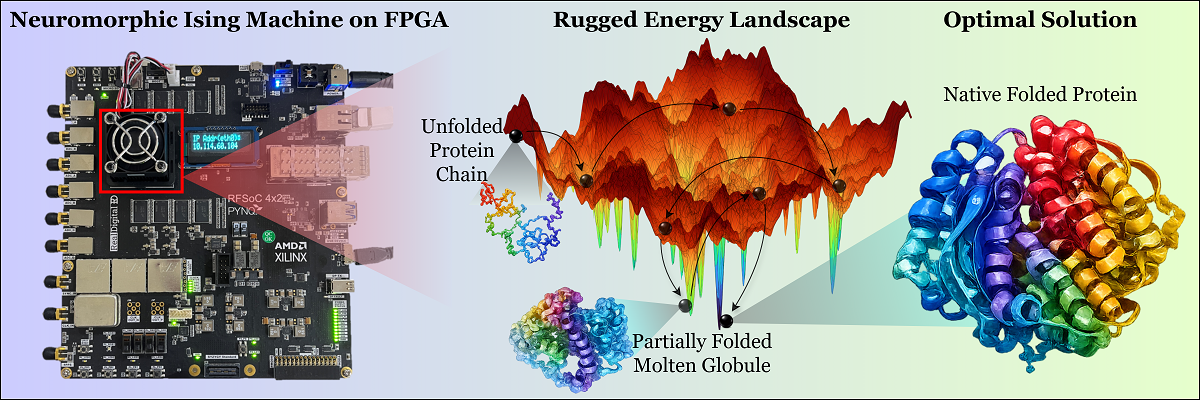
Neuromorphic Ising machine implemented on an FPGA board rapidly explores rugged energy landscapes with exponentially many competing possibilities, enabling fast discovery of near-optimal solutions for complex optimisation problems such as protein folding, where the search evolves from an unfolded chain through intermediate molten-globule states toward the most stable folded structure.
The hardest computational problems are not waiting for faster chips – they are waiting for machines that compute in a fundamentally different way.
A multi-institution team, emerging from the Telluride Neuromorphic and Cognition Engineering workshop in Colorado, and the Bangalore Neuromorphic Engineering Workshop (BNEW) at IISc, has built a neuromorphic computer that combines quantum-tunnelling physics with a brain-inspired architecture to find solutions to hard mathematical problems. Published in Nature Communications, the work introduces a new direction in quantum-inspired computing built on CMOS technology.
Today, AI models may have the capability to write novels and even steer a spacecraft. But give them a logistics network, a microchip to route, or a cryptographic lock, and they stall. These are combinatorial problems – among the most consequential unsolved frontiers in computing. The new study suggests that a neuromorphic autoencoder with a Fowler-Nordheim annealer can solve these problems at scale, with a guarantee of asymptotic convergence to the optimal solution.
Such an autoencoder does not simply compute a solution – it searches for one, the way natural processes navigate a complex energy landscape to settle into stability.
For decades, Moore’s law delivered the exponential gains that made “buy a faster computer” a viable strategy for tackling complex problems. But that era is approaching its limits. The next order of magnitude will not come from smaller process nodes, rather from architectures that think and compute differently.
The collaborative study was led by Shantanu Chakrabartty, Professor at Washington University in St Louis, whose research group has been investigating Fowler-Nordheim based neuromorphic architectures for many years. The team includes Chetan Singh Thakur, Professor at the Department of Electronic Systems Engineering, IISc. Other institutions involved in this research include Heidelberg University in Germany, The Johns Hopkins University in Baltimore and The University of California in Santa Cruz.
This work therefore represents a community of neuromorphic engineers from around the globe, who regularly meet and brainstorm ideas at the Bangalore Neuromorphic Engineering Workshop in Asia, the Telluride Neuromorphic Engineering Workshop in the Americas, and the CapoCaccia Neuromorphic Workshop in Europe. Together, they are shaping a new generation of machines designed for the hardest problems in computing.
REFERENCE:
Ahsan F, Maiti S, Chen Z, Kaiser J, Nandi A, Srivatsav M, Schemmel J, Andreou AG, Eshraghian J, Thakur CS, Chakrabartty S, Higher-order neuromorphic Ising machines—autoencoders and Fowler-Nordheim annealers are all you need for scalability, Nature Communications (2026).
https://doi.org/10.1038/s41467-026-71937-4