AMD, you can make more money selling chips than software, but take away the entry level software and you eliminate the on-ramp. I’m not buying a license to prototype.
I wonder how many Linux GPU sales their decision to penalize Linux on their FPGA line will cost them.
It is absurd that in 2026 you have to pay for such tools. It feels like buying a propietary compiler in 80's or 90's.
No one wants that anymore.
It seems silly to put up SW barriers for people to use your fairly expensive HW, but what do I know.
https://www.zeroasic.com/platypus https://www.zeroasic.com/projects/wildebeest https://www.zeroasic.com/projects/logik
Of course we don't have silicon yet...so nobody here cares. I think a lot of people forget that Xilinx spent $10B+ develop their awesome devices. I figure we can do it with 1/10th of that.;-)
This is an absolute foot-gun moment. And the gaslighting PR responses are just unacceptable. I'm very disappointed in them.
Second: Can this software be run from Wine on Linux?
These tools do need attention, it's too bad there's not a better model than subscription bases like these.
Pretty sure, based on TCL base, that these tools were native Unix at some point, so the no-linux-free-beer vs windows-free-beer version are hilarious...
Ultimately one has, with so many vendor tools, a windows box somewhere so make it a remote compile machine.
(of course that's the bean counter calculation without factoring in "karma")
And I kinda agree, the cost of supporting those tools on different platforms is not great
Honestly just run Wine
Link to my comment, so that I don't repeat myself: https://news.ycombinator.com/item?id=48256417
Eventually the empire will strike back though.
I now marked AMD as a company that can not be trusted.
We need more indie companies in general, and cheap 3d printing for the masses. It'll be a long way to go to nanoscale perfection, but we'll have to go it - AMD but also Intel before, showed that NONE of those mega-greedy corporations can be trusted. They'll always try to do a switcheroo move. But as I stated here: the empire will strike back eventually. The Barbara Streisand effect is real.
Also this site (itsfoss.com) is unusable and riddled with hundreds of ads and sets my machines fans to full blast.
At least use another credible source or go to the source instead as per the HN guidelines.
Quote: 'The only source I can give at this time is "trust me bro"'
Don't upgrade. It's just that simple.
Do they offer some unique features in the new version or is it a habit to upgrade everything every day?
"AMD never misses a chance to miss a chance."
In this case, the chance to trash its reputation with customers.
It's likely a case where maintaining separate builds for the free and commercial tiers was getting complex. Often times, this kind of software requires lots of manual reviewing and adding or removing modules, and they probably decided it's just not worth it.
Okay, but what if you run a company whose business model no longer supports giving away free stuff? How can you transition? What would users consider less outrageous?
Imagine if the whole industry made interoperable tools that worked on open data formats and competed on merit instead of customer lock-in.
Imagine the world we could have.
If it’s any consolation, it wasn’t and still isn’t available on macOS. Also the part about Linux having a “small user base” made me chuckle.
That’s the opposite of what I’m observing. If they wanted to save costs, they would have dropped Linux support altogether. But instead, they are making it a paid benefit. It can only mean that their Linux user base is growing, ie. more commercial operators are turning to Linux. Still, there are much better ways to handle this without alienating your user base.
Honestly? I bet the number is in the hundreds of units total.
Most people do not care that a software package they don’t use and possibly never heard of before today no longer has a free tier on Linux.
And the reason pretty much always came down to good integration between various open source software and proprietary CUDA drivers. And the assumption is that this support will continue for many years.
So, yeah, burning their existing FPGA users is a strong signal never to invest real money in their GPUs for compute workloads.
Not many I would guess.
The problem is, none of these devices can match the raw performance of the devices from Xilinx / Altera / Microchip / etc. So you're kinda limited if you are trying to do something that needs serious horsepower.
> But instead, they are making it a paid benefit. It can only mean that their Linux user base is growing, ie. more commercial operators are turning to Linux.
Vivado has always been primarily a paid product, including on Linux. The free tier has been a limited version useful for small projects or as a trial, which can support a limited set of FPGAs. The paid tier licenses have price tags in the thousands.
They aren’t making new paid products for a growing user base. They are continuing to support their paid Linux user base.
Xilinx was never positioned that it made sense for them to open it up. If/when it gets run into the ground by AMD short sightedness they might just open it to claim that was the plan all along...
Most of the revenue comes from the IP cores.
A common business model for companies like this is to enable developers to learn their tools cheaply, so that when they develop something for their employer, they're more likely to reach for those tools/ecosystems and have the employer pay for those tools.
This just cuts out beginner/hobbyist FPGA devs from using industry standard tooling.
It is a trade off, and I have no idea about the state and quality of Vivado. Back in the day I was tinkering with FPGAs, the Xilinx software stack was horrible.
Ideally yes, SW should be free, but we don't live in an ideal world. This isn't Apple or Google who can give you SW for free since they take a 30% cut on everything on the Appstore besides the profit margins on the HW they sell you.
The typical customers of FPGAs are large HW companies with money to spend on SW, not tinkerers in their garage who might some day build a billion dollar company. And if you do become a billion dollar garage company, you will still buy their FPGAs because they're some of the best and the SW costs will be a rounding error plus a tax write-off. You think Anduril doesn't use Xilinx FPGAs because Palmer LUckey didn't get SW for free 15 years ago?
So there's zero incentive to give away costly to develop SW, for free.
AMD just does not see the world this way.
God speed if you can get something a lot better for a lot cheaper.
Well, more correctly that they think the commercial base has grown, and that there's revenue on the table by forcing their standard-edition-using commercial Linux users into contracts.
Maybe the thinking is that the Linux users are more sophisticated and able to self-support than windows shops, and so they're choosing not to buy support even though they could? Seems not implausible, though hard to measure even from within AMD.
Basically this seems like a "good beancounting but terrible marketing" decision out of product management. They're not being deliberately mean to their amateur users, they're just trying to squeeze out a few more dollars for their department's quarterly.
I just can't see that cost of having a free Linux version (on top having a paid Linux version) is big?
It should be required after a certain amount of time that schematics and code be open sourced and that anti-walled-garden measures are prevalent so we get compatibility and extensibility right out of the box.
Xilinx/AMD charging for any of their tools is also a recent thing. 20 years ago, you could download these tools freely without even having to register on their website.
Jensen Huang (Nvidia CEO) is related to Lisa Su (AMD CEO).
A decade ago, I saw a demo of some AMD skunkworks GPU datacenter tech, that could execute CUDA natively on AMD/ATI graphics cards. Initially was half speed, but having the flexibility was crazy amazing. Created a big buzz in the big iron and educational markets.
Where'd it go? Buried. You cant even find articles about it. Its a few comments on edtech datacenters.
Now look at AMD's graphics line. Where's their ROCm LLM tooling? It's a fucking joke. Its like they're intentionally sinking it for her Nvidia uncle Huang. And Su takes the cheaper CPU market and offers better features than Intel.
If you want the platform to be x86 but not AMD then your only other choice is Intel, but they've only recently started making high performance GPUs. So then you need another vendor for the GPU, and your only choice is Nvidia.
A lot simpler, cheaper and predictable to go with a single vendor for both I imagine?
Once you learn how to get automation to work for you, it's not that bad.
FPGA software gave me FPGA PTSD. I still to this day don't want to go near them - but I am dying to get back into using them. Help ...
Also remember that one of those 2 companies has opensource drivers for Linux for their old GPUs, while the other doesn't (newer NVIDIA GPUs have an opensource driver but this isn't the case for the 10xx series). Users of legacy NVIDIA cards needs on Linux needs to use their old driver branches, with results that are less than optimal to say the least.
[1]: https://videocardz.com/newz/nvidia-officially-ends-geforce-g...
[2]: https://arstechnica.com/gadgets/2025/11/amd-says-that-its-no...
The cost of the software required to develop or operate the hardware should be included in the cost of the hardware. I say this as someone who's been into embedded development for 20 years. It's simply a part of the cost to make the hardware.
Support should be an additional paid service, that every single of my former employer would have paid. But the toolchain itself, as-is with no warranty, should be free.
I don't think that's necessarily a hard rule, here. Nvidia won over the HPC segment by offering CUDA and PTX as a free value-add to their hardware, and ended up becoming a multi-trillion dollar company that ate AMD's datacenter market for lunch.
Giving away software to commoditize your compliment might be a good idea, for AMD.
What better way to do that than decrease availability, I ask, both rhetorically and sarcastically! CUDA-proper did well, at least partially, because it was put in front of everyone. This is taking an exclusivity angle that doesn't make much sense for ecosystem development, IMO.
I suspect this goes to show how much influence/priority B2B carries, my point is it's a mistake they've made before. The maintenance/support costs I believe they're trying to remove have paid dividends for CUDA and countless others. Anyway, a play on the tagline before I go: "Together we advance... licensing and removal of [positive] feedback loops over product development"
I think it was a dev of the reboot of Planetary Annihilation that said their Linux users / build made up a few percent of the sales but over 90 percent of all support tickets (!). Mind you that this was before Valve's Proton.
Edit: It was <0.1% sales but 20% of all support tickets: https://xcancel.com/bgolus/status/1080213166116597760
And for those who forget RHEL for instance has to pay salaries to back port fixes and such and the same logic applies here.
There's no bait and switch. It's just people expecting things for free, as always, when this was never an open source project.
So if they have to keep maintaining it and offer the basic tier for free on Linux... just why? It doesn't make any sense to me.
Maybe they receive "too many" bug reports from Linux users?
They are "first cousins once removed" meaning that Su is the child of one of Huang's cousins. Or put another way, one of Huang's grandparents is one of Su's great-grandparents.
Hardware vendors lost the plot in the Winmodem era.
Nvidia never cared much for those types of deals. They preferred to lose Apple as a business than to admit fault, they’ve always refused to compete on price for the business of Sony and Microsoft’s consoles. They’re adamant to beat at the sound of their own drum.
They tried to push the same into the desktop market with their APUs, where it was mostly ignored. But console games only target a couple hardware configurations, making it viable to take advantage of such hardware features
(Note that mention of Steam Linux is not about the games aspect, but about the Valve’s seeming plans to become a competitive target for Linux support to the exclusion of other consumer-focused miscellaneity. But I tend to go on about this too often, and shouldn’t have invoked it here, apologies.)
That would then make you chips more expensive than the competition and less competitive on the BOM side, and BOM costs are a different accounting budget than SW licenses.
People in the industry have already thought of this. HN likes to think they somehow found the magic solution nobody ever has thought before, when the truth is HN doesn't understand sales of the HW industry.
Where I work now the top 10 customers are Linux shops. They probably account for 80% of our revenue. The remaining hundreds of customers are more evenly split between Linux and Windows.
So I guess it depends very much on what industry you're in. For consumer games it might be Windows, but outside of financials and administrative realms and into the world of embedded it's a heckuva lot of Linux. Support costs tend to be lower, and you really only have to target Red Hat and Ubuntu.
Even the "0.1% of sales" figure is quite atypical.
In Vivado, it's the same release for the free and expensive builds on both Linux and Windows. It's just a question of the installed license file/license limits.
> such as the Linux builds require proprietary 3rd party code with royalties, and they chose not to eat that cost.
This seems unlikely for a multitude of reasons.
Linux users write highly detailed bug reports because it's the only way to get things fixed without coding the fix yourself.
Yeah but people would buy Nvidia chips mainly for gaming, not (just) for CUDA, so basically the massive gaming clientele would finance expensive projects that don't yet make any money like CUDA. Meanwhile nobnody buys FPGAs for playing at home en-masse. There's no equivalent consumer market like gamers for the FPGA vendors, their sales are almost exclusively B-2-B.
FPGAs isn't something most people, even the hardcore tinkerers ned at home. Consumers into hardware tinkering are more than fine with what you can do with Raspberry PIs, ESP32s, STM32 boards.
Also my understanding of many Asian cultures is they tend to have a much more tight-knit large family structure. And doubling that is the fact they're 2 heads of world-level hardware tech companies.
And, well, there's no such thing as coincidences. Having all of this line up, and for "some reason" AMD keeps missing when they could have owned a big chunk of the market has a certain family oligopoly smell to me.
The actual problem with winmodems was them breaking the established software/hardware boundary, and the Linux community not having the resources to follow suit.
Nothing stops someone from taking the free Windows Vivado and making it run on Linux, or taking a Winmodem driver and making it run on Linux, or writing a from-scratch software implementation of a 56k modem that can run on any sound card plugged into a phone line (which is what a Winmodem is), or reverse engineering the bitstream format for these FPGAs and writing a compiler from scratch (or even just the device-dependent backend - the frontend and middle-end can be developed in a more normal way and can be shared with other toolchains). But nobody actually stepped up and did it, which I think is proof that the free software community is a lot weaker than it thinks it is.
You could even do it right now, if you wanted to. You're not, and I'm sure there are good reasons for that. Extrapolate it across all developers, and it's unfortunate that it seems none of them have enough reason to do it. On the flip side, if anyone reading this does suddenly decide they have enough reason to do it... (Incentive: FPGAs are fun to play with!)
Consoles are always pressured to minimize upfront purchase costs, and they generally replace the vendor-provider SW stack with their own anyways.
It might be excusable that they want to vet their customers receiving the tool chain for the high end chips to avoid leaking trade secrets to Intel, but that isn't excusable for the low end. Someone who starts with your $10 chips is likely to develop brand loyalty and if they need $100k chips later, they'll be more likely to pick your ones.
Baseless speculation
> probably is somewhat of a loss leader for small-batch users
Wrong. AMD/Xilinx doesn't sell devices directly to customers, they sell them to distributors in huge quantities. Those distributors then sell them to "small-batch users", and they're not involved with AMD/Xilinx free-tier software at all.
> they’re running at around -10% profit on small sales to try and drive subscription revenue multipliers
More baseless speculation
IMO, this is a question about where AMD wants to be in the stack. They can sell hardware, they can license their IP, but they're going to be bent over a table selling software licenses that people don't want. A free HDL software suite can help you sell hardware and license IP, whereas an expensive one can cut you out of the FPGA/ASIC market entirely.
A lot of the serious CUDA compute stuff is also not supported on all platforms (it's linux only, because why would you do such stuff on windows).
in other words, if you want your game tested and get good feedback for it, do release on linux. maybe even release on linux first. linux users will love you for it, and you get to release a more polished game for a wider audience on windows.
Combinatorial mathematics actually says certain types of coincidence happen more often than we seem to expect intuitively (eg. the Birthday "Paradox").
I have no particular view on AMD. But any argument that includes "I don't believe in coincidences" should probably be weakened in your estimation.
The EULA and the fact that the linux versior runs faster & has fewer bugs.
> just the device-dependent backend would be a major improvement and the frontend and optimizer could be shared with other toolchains
That's yosys and it's used by smaller commercial vendors.
> or reverse engineering then bitstream format for these FPGAs
Getting the timing is the hard part (+ good routing afterwards). The bitstream format has AFAIK mostly been reversed. 7 series has mediocre support , but US, US+ and Versal doesn't (probably because they're too expensive for personal usage).
Actually looking at this thread, there’s a lot of good reasons they were the go-tos for consoles. Consoles seem to be in rough shape at the moment, I wonder if part of that is that AMD has been doing too well since Zen, haha.
Your elided quote removes the five words where I declared my views as speculation openly and in plain language. The complete sentence that you misquoted opens with that:
> I would hazard a guess
I’m perfectly content to be wrong at HN; it’s a forum where we all have opinions and people rarely restrict themselves to exclusively their own expert subjects, or else we’d all never learn anything! So I will be considering the arguments made here by others before engaging with this topic in the future.
Edit: https://news.ycombinator.com/item?id=48256417 from a few days ago apparently makes some of my points much more clearly, or at least with less hostile replies. I wish I’d found it sooner, but I didn’t realize this entire post was a dupe in time to go back through its comments in detail. Would have saved me commenting at all! Ah well.
Compared to the dylib nightmare that Microsoft keeps shipping in Windows, native Steam/Linux is actually pretty consolidated.
Big tech companies have a habit of offering something for free, watching the user base grow, and then quietly walking it back once people are too invested to leave easily. A bait-and-switch, so to speak.
Redis did exactly this back in March 2024, dropping its long-standing BSD license for the more restrictive dual licensing model, and the blowback was severe enough that the community forked it into Valkey almost immediately.
Linux tends to get hit hardest by these moves. Its comparatively smaller user base means less commercial pressure, making it an easy target to throw under the bus whenever companies feel like cutting costs or boosting profits.
One such case has now surfaced that will make you wonder if this particular company's decision was really shortsighted or is just a cash grab.

Vivado is AMD's design suite for its FPGAs and adaptive SoCs. It is what engineers, students, and hardware hobbyists use to write, synthesize, and test their FPGA designs. Until now, it has been available for free on both Windows and Linux under what AMD called the Standard Edition.
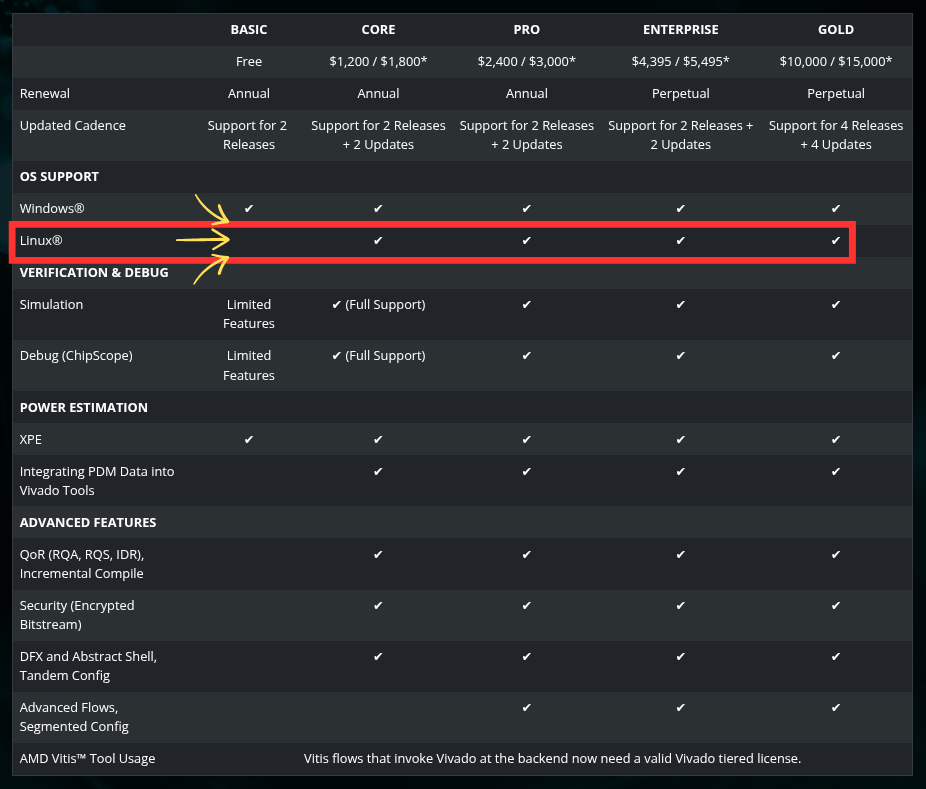
Starting with the 2026.1 release, AMD is switching to a tiered licensing model. The free Basic tier covers entry-level devices but is restricted to Windows only. Linux support does not show up until the "Core" tier, which costs somewhere between $1,200-$1,800 per year.
AMD framed all of this on its download page as a move toward more flexible licensing. On its dedicated licensing options page, the company told free-tier users the only thing changing was a simple annual license renewal.
That's not all. 🤷
When users went to AMD's support forum asking for an explanation, forum moderator Anatoli Curran showed up in the thread. His first order of business was to warn people about "bad language or abusive behaviour towards AMD," before getting around to addressing anything of substance.
When pushed for a real answer, Anatoli pointed unhappy users toward Vivado 2025.2, suggesting they simply stick with it if they did not want to pay. He did mention that 2025.2 loses official support once Vivado 2026.3 ships, but that detail was buried in a thread reply, leaving users with little more than a dead-end recommendation.
Anatoli also started putting out numbers, claiming that 70% of their customers still use Windows. As expected, someone cross-questioned him, asking if much of their users were on Windows, then why was Linux support being locked away behind a paywall.
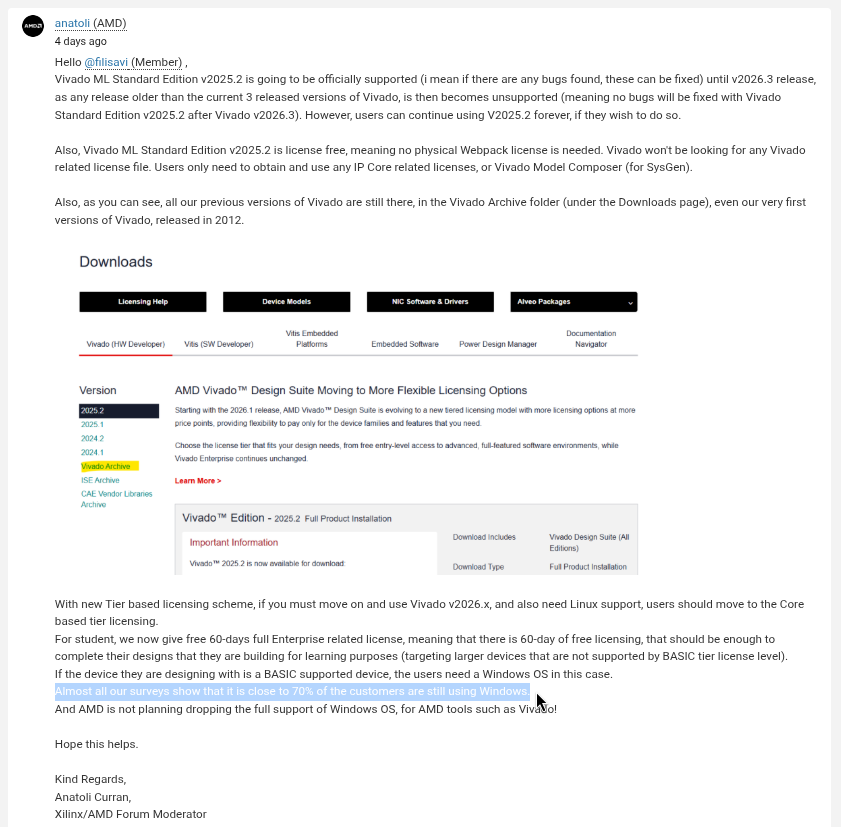
To which he replied in a very PR-coded manner, completely disregarding what was brought up:
From Core and higher tiers, both Windows and Linux are supported platforms.
As stated already, AMD expectation is that the BASIC tier is used for simple, entry‑level needs. While more advanced, production workflows are aligned with paid tiers. These tiers are specifically designed to deliver the full flexibility and capabilities needed for serious development.
Hence, all paid tier levels have options of both Windows and Linux platform usage. Only BASIC tier limited to Windows ONLY platform support.
That really doesn't instill one bit of clarity and shows how apathetic tech giants like AMD can sometimes get. The conversation in the thread then continued along the lines of how Xilinx, and later, AMD, had gained the trust of Linux users by keeping an open outlook towards the community.
But pulling off such a thing without considering how people benefited from having Vivado on Linux tells you a lot about what this company actually thinks of its non-enterprise user base.
Students, hardware tinkerers, and academic researchers who have relied on a native Linux workflow are now left hanging. Keep in mind that many of those people eventually end up in engineering and procurement roles where they have real influence over hardware-related decisions.
As of writing this, AMD hadn't put out a statement regarding this, and the stonewalling has continued. Of course, more and more people are getting to know about this. It is just a matter of time before someone at PR has to do something about this.
Plus, with the kind of flak they have been getting over some of their most bizarre choices lately, I would handle this now instead of later.
Until then, you can participate in the conversation either on the main thread where this shady behavior was first reported, or you could head over to Hacker News and join the others in calling out AMD.
Suggested Read 📖: Bambu Lab Has Been Violating AGPLv3

About the author

A nerd with a passion for open source software, custom PC builds, motorsports, and exploring the endless possibilities of this world.