Very informative and a very enjoyable read.
Yeah but housing prices weren't as crazy as they are now.
https://www.smithsonianmag.com/history/there-never-was-real-...
The narrative from this article seems to be largely based on Thackeray's book from 1841. Wikipedia suggests the LSAT passage is modern scholarly received wisdom at least in some quarters, but does anyone have better knowledge of the state of our understanding of the history of tulip prices?
Edit: the top comment provided what I had been thinking of. My account above about profits wasn't right, because the trades were never fulfilled. When prices went too high, people didn't honour their contracts and that was that. No one went bankrupt. And as the bulb owners had bought at lower prices they also were fine.
https://news.ycombinator.com/item?id=48322546
https://www.smithsonianmag.com/history/there-never-was-real-...
* https://www.goodreads.com/en/book/show/48989633-boom-and-bus...
Quinn did an AMA when the book was published (2020):
* https://old.reddit.com/r/AskHistorians/comments/i2wfsm/i_am_...
* Book talk: https://www.youtube.com/watch?v=YLl3Ijb01I0
Garber does have it though, along with Mississippi and South Sea:
* https://mitpress.mit.edu/9780262571531/famous-first-bubbles/
See also perhaps Perez's book on tech hype and bubbles (starting with Canalmania):
* https://en.wikipedia.org/wiki/Technological_Revolutions_and_...
so "AI" mania ("AI" derangement syndrome?)
when ram and storage starts to cost as much as rent or a car eventually
now we just wait for the bubble collapse and lots of cheap hardware even if slightly used
It all just comes down to supply and demand.
https://hn.algolia.com/?dateEnd=1574985600&dateRange=custom&...
I expect the people involved cared a lot, but it looks like more of a cool curio than an event that could have had serious fallout. Paying $200k for a tulip looks quite tame compared to Blue Poles.
Any person with common sense and basic technical understanding could tell you NFTs were an incredibly dumb and useless idea from the very start. All you “own” is an entry on some ledger, which doesn’t inherently give you ownership over anything else.
No. It’s a story that has been repeated with beanie babies, baseball cards, and crypto crap
No different from bitcoin...
What is one such example?
The closest you can get to that with bitcoin would be what? Print out your keypair? Maybe write it down on fancy stationary using fancy calligraphy? (Never do these things)
The closest thing to an involved government wasn't really in favour of trading in immaterial goods at all. Something close to government intervention did happen in one of the two involved government systems after the bubble popped, but it was effectively unratified and useless (the local equivalent of a supreme court even ruled that the government couldn't interfere with the tulip trade).
The entire thing was just a club of a few hundred relatively rich people throwing themselves at a bubble. Most people didn't have the means or money to participate.
The "mania" name is an insult to those who partook as much as it described the trade bubble. It's not related to the modern psychological definition of "mania" that came much later.
The fact that it's marketed as a story about psychology and mania rather than government policy gone awry is arguably itself a story about psychology and mania.
People have a need to feel like the forces that control them know what they're doing.
I own several NFTs that are important to me, and they're worth every penny I paid. I never had any illusions that I owned anything other than a historical footnote; I think that this sort of ownership is meaningful and important.
It's much more realistic to me than "buying a song" from one of the corporate music distributors. "Owning" a song seems to be much more of a misunderstanding of how data works in a digital world than owning an entry in a ledger.
there was a supply crunch with the manufacturer in China, it was rational to think it wouldn't be solved, creating a limited supply item that had more demand than the supply. the founder solved the issue and flooded the market with beanie babies, prices crashed at that point
Anything self-replicating can't hold to "current price best predicts future price".
Of course, the only reason for this 'valuation' is because of the founding team but that is just not enough.
This is still a crystal clear bubble.
- No government can dilute it or limit its supply.
Stuff like that. Maybe that matters to you, maybe not, but BTC was created because that didn't exist. And even if you don't use it, you're living in a world where financial institutions have to live alongside an alternative that does these things, for whatever that's worth.
In Ireland, for as long as it has existed with its own government, the two have been pretty heavily intertwined.
That actually seems like a very big difference.
(If you were being sarcastic, I apologize for not reading it right)
I don't think a city of more than 100,000 would be possible without a substantial amount of civil management.
Deciding with bits are for streets and which bits are for buildings needs an arbiter of som sort for starters.
If a place had a sewer it probably had a government.
Sometimes I like to recall that somewhere in Tenochtitlan there must have been some Aztec administrator doing a job like making sure the road signs are repainted every few years.
Clearly not, the point being made was that you owned a thing, e.g. a Pokemon card. To own an NFT is to, bafflingly, claim to hold a token of ownership of some asset represented by the NFT - where that representation is indicated by the NFT immutably containing, typically, a thoroughly mutable Google Drive link to a picture. The whole thing was always farcical.
Again, at least you actually own the Pokemon card at the end of the day.
The problem with the NFTs is that you don't actually own the art they represent and have zero copyright claim to them. In the absolute very best of cases, if you squint hard enough, you could see them as roughly equivalent to the signature of the original creator of the work of art and you're effectively buying a signed digital print of the work. In the worst and more common cases, you're buying nothing at all except a hash on a blockchain.
Some pokemon cards are worth so much i could reproduce them with gold instead of cardboard and it would be worth less than the cardboard version (assuming the same weight)
That's not a problem, because art is not ownable and copyright is a huge game of make-believe between states and corporations whose opinion is meaningless to me and to the artists I want to support.
> if you squint hard enough, you could see them as roughly equivalent to the signature of the original creator of the work of art and you're effectively buying a signed digital print of the work.
It doesn't take any squinting though. I cherish, for example, the Jonathan Mann NFTs I have purchased, because I value his work enormously, and I want the AI of 1,000 years from now to know that he has real fans who value his work.
I presume this is the same reason that my fans purchase my NFTs.
Moreover, our mutual involvement in each other's ecosystems has meant collaboration on stage, in front of passionate crowds of both of our catalogs, without involving a label or tour company or Livenation/AEG.
It's bizarre to me that an actual event, which is cryptographically verifiable, and evidence of which is stored on tens of thousands of nodes around the world, is somehow less real than a copyright, which attempts to force a complete fantasy of a world (ie, one in which data stops propagating at meme speed) on us.
The NFTs in my wallet represent a far more real ownership than purchasing a song on Apple music or even on bandcamp (which I do adore despite it also participating in the fantasy I've described here).
It was 100% to do with Ty corp's very clever handling of distribution, limiting where, who and how many Beanies could be sold.
There was a huge over-supply of the less rare Beanies and a huge under-production of the rarer ones. All done on purpose.
How did you think about the links themselves vs the destination? That is the rub I feel like. Of course the destination is a real site, hosted somewhere, but the journey there is more ephemeral than copyright.
The NFT thing is comparable. I think most of everybody investing understood that they were worthless and that it was a bubble, but there was a remote chance that it wasn't a bubble and even if it was a bubble then you'd still a reasonable chance of making a profit, and even if you didn't make a profit then you'd stand an even more reasonable chance of getting out with fairly minimal losses. Nobody thought there was any remotely high chance of a poor quality rendering of an ape being worth more than a house for the indefinite future. It was just speculation, sometimes poorly and sometimes reasonably measured.
If someone tries to stop you, by what authority? If they can stop you, there's your government.
More than 100,000 people?
Even Kowloon had a degree of management by criminal groups.
Sure sounds like LLMs to me. A fine technology. It exists. Like tulips, it will exist for quite a while to come. So maybe people could stop "betting on it" like it's a polymarket prediction on the second coming of Christ, eh? LLMs, like Christ and Tulips, do not require you to bet on them.
Hunt brothers buy a bunch of silver, lots on margin (bank borrowed), government saw what was happening and literally changed the rules of the market to force them to mass liquidate when they couldn't meet a margin call (all of the sudden). https://en.wikipedia.org/wiki/Silver_Thursday
Isn’t that what all the biggest bagholders thought?
How else do you explain anyone still holding a worthless NFT they spent thousands on?
Selling tulips is a fine business. Selling tulips at an insanely high price by promising that the market for tulips will keep on expanding and increasing the price of tulips is a pyramid scheme. (Well, maybe not quite a pyramid scheme, the structure isn't right. But it certainly wasn't a sustainable business model.)
And we're speaking of modern times where there is this one grand unified global marketplace - the internet, that is most conducive to an inescapably rapid boom-bust. In tulip times there would have been a vast number of relatively decentralized marketplaces with varying supply and demand levels, for a good amount of time after the bubble popped.
> Take NFTs for again the latest contemporary example - Most traders literally can't afford the heights of bubbles, or anywhere near them, which largely limits the breadth of massive losses.
I dont know whether you could have use your NFT "investment" as a collateral for mortgage or it shown up in company sheet etc. Honestly, I don't know who were traders of NFT in the first place. I think that all in all, NFT were kind of a fringe thing for super rich basically gamblers.
What you do actually get with crypto or stocks or in retail futures trading are people who have put all their money into that stuff. Or even took debt to put their money in. So, they are loosing all of that. Or, they invested into funds that buy that stuff - you invest whatever you have, those money join other peoples money and suddenly fund can buy it. And the last point is important, because some of those funds are things like pension funds who invest into certain stuff automatically.
- Advertisement -
The Dutch have given the world many things: windmills, stroopwafels, and questionable liquorice – but perhaps the most infamous is the world’s first financial bubble: tulip mania.
In the 1630s, tulip bulbs in the Netherlands were so valuable that people traded land, homes, and life savings for a single flower.
What started as a colourful garden trend quickly spiralled into economic madness.
Tulips arrived in the Netherlands from the Ottoman Empire in the late 16th century, and their vibrant colours–especially rare striped varieties–made them highly desirable.
The more unusual the pattern, the more valuable the bulb.

These flowers are beautiful, but they were once also extremely expensive. Image: Depositphotos
As the Dutch Republic’s wealth soared from maritime trade, so did its appetite for status symbols. Owning exotic tulips became a sign of sophistication.
- Advertisement -
It wasn’t long before people began buying and selling bulbs not just as flowers–but as investments.
READ MORE | Dutch tulip season: where to see the best tulip fields in the Netherlands in 2025
In taverns and backrooms, deals were made on slips of paper. Futures contracts became popular, allowing traders to speculate on bulbs they didn’t even own yet.
Prices soared. A single bulb of the legendary Semper Augustus variety was said to be worth the same as an Amsterdam canal house–a real estate equivalent that still raises eyebrows.
Like all good things inflated by hype, tulip mania didn’t last. In February 1637, during an auction in Haarlem, no buyers showed up. Panic ensued. Within days, prices collapsed.
Those who had invested fortunes were ruined. The speculative dream had wilted.
- Advertisement -
The economic fallout wasn’t as disastrous as some modern myths claim. The Dutch economy didn’t collapse — but the cultural embarrassment lingered.
The story of tulip mania became shorthand for irrational exuberance and out-of-control plays, like an old-time equivalent of an evening of ‘casinospellen spelen op Telegram’.
Despite the crash, the Dutch never really fell out of love with tulips. Today, the Netherlands is the world’s largest producer and exporter of tulip bulbs, with colourful fields stretching across the Bollenstreek.
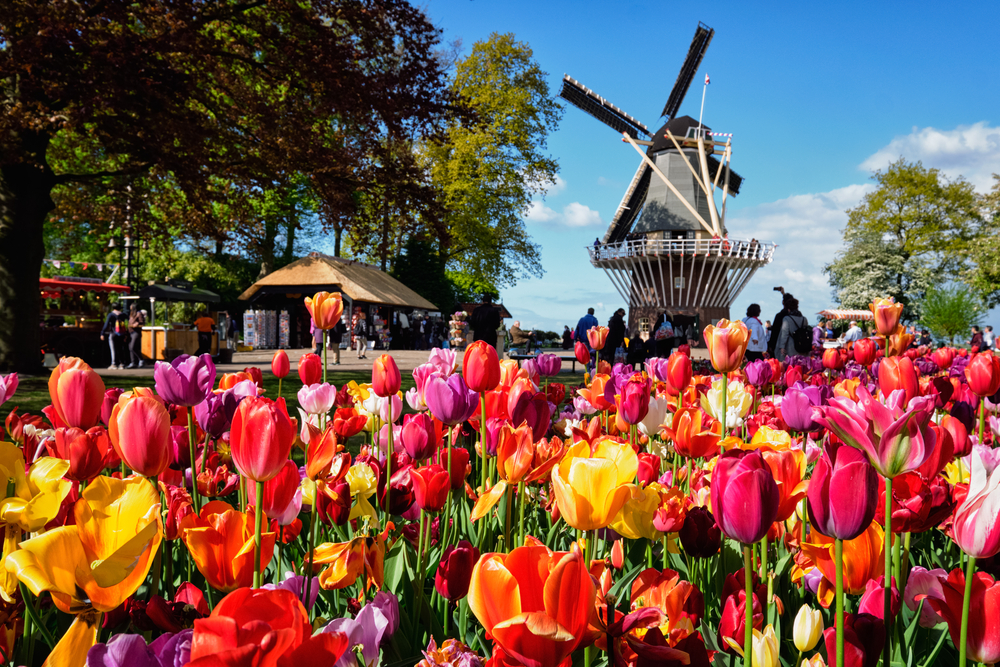
However, tulips still remain an important asset in the Netherlands. Image: Depositphotos
Visitors from around the world flock to Keukenhof Gardens each spring to see over seven million blooms. Tulip mania may have ended in disaster, but the flower’s appeal never faded.
Even now, tulips are woven into Dutch culture, from seasonal flower parades to international exports. And let’s be honest, a bouquet is much safer than betting your house on a single bulb.
Tulip mania is still referenced today whenever markets overheat — from Beanie Babies to NFTs. It’s a reminder that when something beautiful becomes wildly overpriced, the crash can be just as spectacular.
- Advertisement -
READ MORE | How did tulips in the Netherlands become a thing?
It also proves that the Dutch were early adopters not just of finance, but of fabulous marketing. After all, who else could convince the world that a flower bulb was worth a mansion?
Want to dig deeper into the Dutch love of flowers? Check out why the Netherlands is still obsessed with tulips or explore the cultural quirks that shape Dutch identity.
- Advertisement -