The price of living in Rome must have been substantial. A tombstone from a shared tomb outside Rome bears an inscription termed “The Tenant’s Lament” for the ex-slave Ancarenus Nothus. It reads: “My body knows no longer hunger . . . now it is no longer [paying] deposit on the rent, but enjoys for free an eternal lodging.”
As people migrated to Rome seeking opportunities, they would have faced daunting housing challenges. Ancarenus Nothus, who belonged to a lower urban class, likely lived in an insula (Latin for “island”). Insulae were apartment buildings that often occupied entire city blocks and may have risen up to eight stories. Their ground floors typically housed shops, while the upper floors were crammed with cellae—single-room units arranged around a central light well.
Long before the Industrial Revolution brought vertical living, the insulae pioneered the concept of the walk-up apartment. Though their origins remain obscure, a historical record of the Roman historian Livy suggests they may have existed as early as the third century BC. He recounted an unusual event, in which “an ox is reported to have climbed up of its own accord to the third story of a house, and then, frightened by the noisy crowd which gathered, it threw itself down.
Architecturally, the insula may have borrowed certain features from the domus, such as a colonnaded atrium. Like the domus, its entrance was typically a narrow walkway flanked by stores. But besides these more familiar elements, it also introduced innovations: communal staircases, vaulted arcades, balconies, and multifunctional spaces that combined residential, commercial, and even religious uses within a single complex.
The insulae became a lucrative business. Marcus Licinius Crassus, a Roman general and notorious real estate mogul, exploited the city’s frequent fires and building collapses. According to the first-century biographer Plutarch: “He proceeded to buy slaves who were architects and builders,” snapped up fire-damaged buildings from panicked owners at “a trifling price,” and then used his slaves to rebuild them and profit. “In this way the largest part of Rome came into his possession,” Plutarch noted. Crassus was allegedly the wealthiest man in Rome.
Around the same time, the Roman architect Vitruvius championed vertical living. “With the present importance of the city and the unlimited numbers of its population, it is necessary to increase the number of dwelling-places indefinitely.” He recognized that “the case has made it necessary to find relief by making the buildings high.” By having “many floors high in the air,” he noted, “accommodations within the city walls . . . multiplied,” and “the Roman people easily find excellent places in which to live.” Yet Vitruvius also acknowledged the limitations of traditional building materials. “Brick walls, unless two or three bricks thick, cannot support more than one story.”
Structural stability was an ongoing concern. The poet Juvenal lamented: “We live in a city shored up for the most part with gimcrack stays and props: that’s how our landlords arrest the collapse of their property, papering over great cracks in the ramshackle fabric, reassuring the tenants they can sleep secure, when all the time the building is poised like a house of cards.”
“I prefer to live without fires and midnight panics,” Juvenal concluded. “By the time the smoke’s got up to your third floor apartment (and you [are] still asleep), your heroic downstairs neighbour is roaring for water and shifting his bits and pieces to safety. If the alarm goes at ground level, the last to fry will be the attic tenant, way up among the nesting pigeons.”
Fire was an acute hazard in buildings constructed with light wood frames and filled in with branches daubed with mud. As Vitruvius warned, “As for ‘wattle and daub’ I could wish that it had never been invented. The more it saves in time and gains in space, the greater and the more general is the disaster that it may cause; for it is made to catch fire, like torches.”
Enter Roman concrete. Though lime had been used for centuries as a binding agent, such as by the Egyptians, the Romans transformed it into concrete, a standalone building material. By mixing lime with volcanic ash, sourced near Mount Vesuvius, they created a remarkably strong concrete that could even set underwater. Seneca noted, “The dust at Puteoli becomes stone if it touches water.”
By mixing lime with volcanic ash, sourced near Mount Vesuvius, they created a remarkably strong concrete that could even set underwater. Seneca noted, “The dust at Puteoli becomes stone if it touches water.”
This breakthrough allowed Romans to build structures on a scale never before seen. Monumental works like the Colosseum and the Pantheon were made possible—and so too were more resilient, multistory insulae. Builders often paired concrete with brick-facing and vaulting techniques, enabling vaulted ground floors providing stability and room for shops and communal spaces.
A turning point came after the Great Fire of Rome in 64 AD, which raged for six days and destroyed nearly two-thirds of the city. In its aftermath, Emperor Nero launched a sweeping reconstruction effort. His reforms included new building codes and a height cap of sixty Roman feet (roughly equivalent to our current feet). These regulations were among the earliest height restrictions, though they were probably more often violated than followed.
These new codes mandated fire-resistant materials, such as stone and brick, in insula construction. Yet, risks remained. Without steel reinforcement, Roman concrete had its limits. Structures above five stories grew increasingly vulnerable to cracks—and, especially during earthquakes, risked collapse.
At the same time, legal protections for tenants were minimal. One example comes from the correspondence of statesman and philosopher Cicero, who speculated in insulae. “Two of my shops have fallen down and the rest are cracking. Not only the tenants but the very mice have migrated,” he wrote in his letters. He betrayed no sign of remorse, already eyeing higher rents through reconstruction. “Other people call this a misfortune, I don’t call it even a nuisance.” Sanitation was another urban hazard. Tenants used chamber pots, and despite prohibitions, they were often emptied out windows. Later Roman laws addressed the issue: As recorded in the Digest of Roman Law, victims struck by falling waste were entitled to medical compensation and wage replacement. Juvenal described the grim reality:
  See how pots strike and dint the sturdy pavement.

  There’s death from every window where you move.

  You’d be a fool to venture out to dine,

  oblivious of what goes on above,

  without your having penned that dotted line,

  of your last testament.
The public latrines of Rome, however, while providing a communal solution, had their flaws. Ancient latrines lacked partitions for privacy, with rows of up to twenty seats. The shared xylospongium, or sponge on a stick, was the only tool provided for personal cleaning. Users seeking relief had to contend with scurrying rats and the danger of igniting sewer gas rising through the openings. And patrons had to pay for the privilege. Emperor Vespasian, in a move that would later lend his name to public urinals (vespasienne in French), imposed a tax on urine collected from these latrines, which was sold to launderers for its ammonia content—allegedly inspiring the famous Roman saying pecunia non-olet, or “money doesn’t smell.”
The upper floors of the insulae were notorious for leaky roofs and pests. Then there was the inconvenience of climbing multiple flights of stairs. Poet Martial described the plight of a “rapacious fellow” who climbed up “some two hundred steps” to get to his garret. Unlike modern penthouses in today’s elevator buildings, these top floors were the least desirable. Poorer residents occupied the upper story. The author Petronius captured this divide in Satyricon when a character tells his wife, “If you are born on a mezzanine, you don’t dream of a house.”
At their worst, the insulae could be likened to warehouses for human storage. One researcher noted “unhappy resemblances” to the horrea, the multistory warehouse buildings. Yet for all their flaws, insulae marked an achievement in high-density urban living, giving many an opportunity to live in the city.
This was particularly evident in the well-built insulae of Ostia, Rome’s ancient port city. These gradually replaced domus structures as the dominant building type. With their brick-faced concrete and well-spaced layout, they reflected Nero’s postfire building codes. With Ostia’s ruins relatively intact, the city opens a rare window into ancient vertical urban life.
On my visit to Ostia, the surviving insulae struck me as well-built. For instance, portions of the richly textured brick facade of the four-story Insula of Diana still stand strong today, two thousand years later. The intricate mosaics on some of these buildings signal a level of luxury. Still, these surviving examples may skew perceptions, as structures built with subpar materials would have decayed more readily.
Ostia makes clear that insulae were not just tenement buildings. It even has entire upper-middle-class apartment districts. Some upscale versions had a tablinum, an office-like reception area commonly found in wealthier domus, overlooking a courtyard. Others had apartments boasting as many as seven rooms. These buildings often had distinctive names, such as Insula Bolani, Insula Vitaliana, and Insula Sertoriana, reflecting prestige—similar to modern apartment buildings today.
These insulae afforded their residents access and convenience. In Ostia, about two-thirds had ground-floor stores—a necessity since apartments lacked running water, making home cooking difficult. Many residents would have gotten “takeout” from nearby thermopolia, food stalls serving fast fare like sausage-stuffed bread, an ancient version of a hamburger. For laundering togas and tunics, residents turned to nearby cleaners. Some insulae even had private baths and shrines. Shopkeepers often lived above their storefronts.
The Insula of Diana, for instance, lies a stone’s throw away from the forum, a block from the main street, and directly across from a thermopolium, where aromas would have wafted through the open counter. Instead of the quiet and crickets heard today, there would have been the excitement of thousands of people. In their mixed-use form, insulae recall nineteenth-century European blocks, such as in Paris and Barcelona. There, shops are located on the ground floor and households reside above—a combination that creates convenience for residents and built-in demand for stores.
But Ostia’s prosperity did not last. Roman deforestation for smelting, construction, shipbuilding, and farming triggered soil erosion that silted the harbor. Much of trade then moved to Portus, a deeper man-made harbor built by Claudius. By the third century AD, Ostia’s harbor became too shallow for large ships. The changing environment led to stagnant ponds that bred malaria-carrying mosquitoes. Ostia’s population declined for centuries. Today, the city lies two miles inland. Its insulae—once symbols of urban vitality—became quarries, their bricks repurposed elsewhere.
Nevertheless, the insulae of Ostia remain a compelling model of dense, walkable living, with a vibrant street culture. Ancient cities like Ostia, constrained by pedestrian and animal-based transport and housing shortages, built compact, multifunctional cores. Even as their ruins stand in quiet repose, these buildings challenge our assumptions as we confront the issues of urban sprawl. Their history proves that innovation often arises under constraint, and the architecture of the past can inspire the blueprints of the future.
Featured image: Insula Diana, Ostia, ca. 150 AD.40
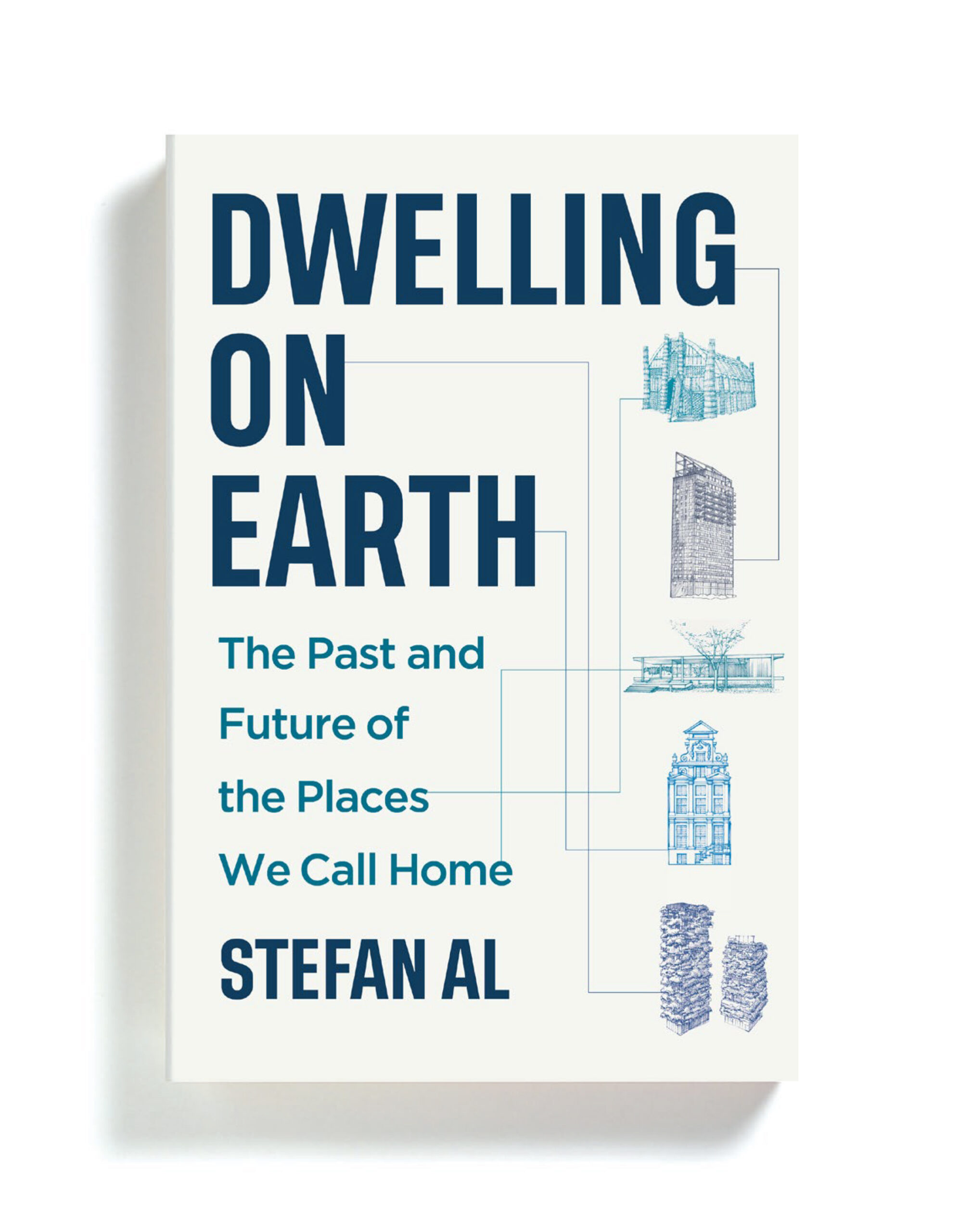
This essay is excerpted from Dwelling on Earth: The Past and Future of the Places We Call Home. Illustrations © 2025 by David M. Dugas. Used with permission of the publisher, W. W. Norton & Company, Inc. All rights reserved.