Also interesting to note the number of partners they invited. Going from Microsoft, Accenture and EY to startups like alpic.ai or lingo.dev . Seems like they are ramping up their M&A game too
But Mistral has fall really far behind since 2025Q3. It seems they can't get good reasoning models working at even medium context sizes, which is necessary to be at the table right now.
Gemma4 and Qwen3.6 are currently best in the small size; Mistral's "small" model has ~4x the parameter count at 120B and isn't even competing with models a quarter its size.
Back one year ago with Mistral Small 3.1 they were keeping up, but they've fallen into irrelevancy right now.
If Mistral seriously wants to play the on-prem and small task-specific model game, a decent proxy would be to build models that get the r/localLlama crowd excited
Mistral leaning into on-prem and European-hosted models is very smart.
Maybe my perspective is skewed on what "huge scale" means, but 2 million users? That's like a few hundred megabytes of data? Or a couple GBs if there's a lot of per-user data?
I really like the direction and the transparency of Mistral, among those players.
I am wondering what is keeping them back, though: Money? Compute? Skills? Training data? My fear is that you are really only getting really good models by training on very dubious data (outputs from the frontier models etc) and that Mistral is too European and too enterprisey to take those risks.
This is tangential: and forgive my ignorance here, but is there an inherent reason why there aren't smaller, focused models from the frontier model providers?
I'm thinking something like a software-specific subset of Opus that is the default for use in Claude Code. Smaller, cheaper to deploy and consume, maybe faster.
Fully agree to your point though, Mistral in general is far behind where I'd expect and Qwen in particular is crushing it at the smaller sizes.
Personally, I'd consider anything 20B params and above a "medium" model. Small being <20B and large >100B. I think obviously we can get to the huge 1-2T param models, but frankly the margin of accuracy improvement for the speed hit is kinda insane (1-2% for many metrics).
Foundation model labs should be building very large reasoning models, then leaving it to the community to distill them down.
You can't scale a small model up, but you can scale a small model down.
I'm convinced the only way we'll have a seat at the table in the future and avoid total runaway takeoff is if there are very large models within 80% of the capabilities of the frontier models. Tiny RTX models do diddly squat to remain competitive.
Build open weights models for running on H200s. I'll spin them up on RunPod or Lambda.
Europe shot itself in the dick with this hastily implemented at the height of mass hysteria bullshit and now no sane company will build anything there.
an AI startup in the US or China can be a boy and his computer. in Europe, the boy needs a dozen lawyers.
I have used Mistral models out of pure ideology for web agents and the like which aren't doing a lot of heavy lifting.
And yet another time they will be thinking aloud in few year "what happened that we are fully dependent on USA?"
Who else will buy their AI?
and what other options do they have?
OTOH such things can be quite defensible, they just rarely become anything like as profitable.
Or is this a case of the humans, now preparing for the excuse it was the AI failure?
"BNP Paribas Sentenced for Conspiring to Violate the Trading with the Enemy Act" - https://www.justice.gov/archives/opa/pr/bnp-paribas-sentence...
"BNP Paribas caught up in French money laundering investigation" - https://www.reuters.com/business/finance/bnp-paribas-caught-...
"BNP Paribas faces $246m fine in currency scandal" - https://www.bbc.com/news/business-40635070
"BNP Paribas caught in a Cypriot money laundering investigation" - https://www.lemonde.fr/en/les-decodeurs/article/2023/12/26/b...
In Money Laundering their track record is unmatched: https://violationtracker.goodjobsfirst.org/parent/bnp-pariba...
Assuming BNP Paribas leadership wants to stop the corruption of course.
What is "weird training biases" to us might not be weird to them and vice versa. Just ask the Chinese what they think about LGBTQ+, Japanese, pride parades, Islam and colored minorities.
Every nation has its own biases injected in its domestic LLMs at this point. Otherwise they risk getting in trouble for hate speech/disinformation in the jurisdiction where they operate.
Same how Google Maps cleverly biases the lines of disputed borders based on where you are viewing it from. Or how Google maps switched 'Gulf of Mexico' to 'Gulf of America' in an instant when the orange man signed the paper. Google won't want to anger the US administration the same way how Mistral won't want to anger France and the EU, so Mistral will have all the EU prime directives injected into its LLMs no matter if they're ludicrous or not. The law is the law whether you agree with it or not. Companies want to survive and will pander to whatever the whims the regime they live under are at the current moment regardless of what is right or wrong.
But if I'm using a LLM for personal projects or generating a photorealistic choreographed fight between Tom Cruise and Brad Pitt, I don't care what its political biases are, I care if it solves my problem better and cheaper than the competition, and here the Chinese models could end up winning the consumer market, which is why you see Mistral and other EU alternatives focusing exclusive on B-2-B corporate market.
I agree. That's why I think European companies might prefer a European model.
Mistral is mostly French and tends to have mostly French speaking customers, like BNP PAribas in Belgium. Germany will want its own domestic AI champions, maybe in partnership with Switzerland and Austria, similar to how Denmark already has invested in LLMs focused on the Nordic languages with money from Norway.
The biggest mistake is treating Europe like a single homogenous country/market.
I for one would love to see more country-specific models. There was a story here the other day about Norway’s National Library developing a LLM specialized in Norwegian: https://news.ycombinator.com/item?id=48270770
May 29, 2026
4 min read
I was in Paris the last few days to visit the AI Now Summit by Mistral AI, hoping to learn more about their models, plans for the future of European AI and more. My personal insights:
Mistral is no longer just a model company. They're building the full AI stack: compute, models, platforms & consultancy. They own the compute (a 40MW data center in Paris, more data centers coming soon, including one in Sweden). They focus on efficient, open and bespoke models that you own and can run on-prem. That seems to be their unique selling point compared to Anthropic or OpenAI.
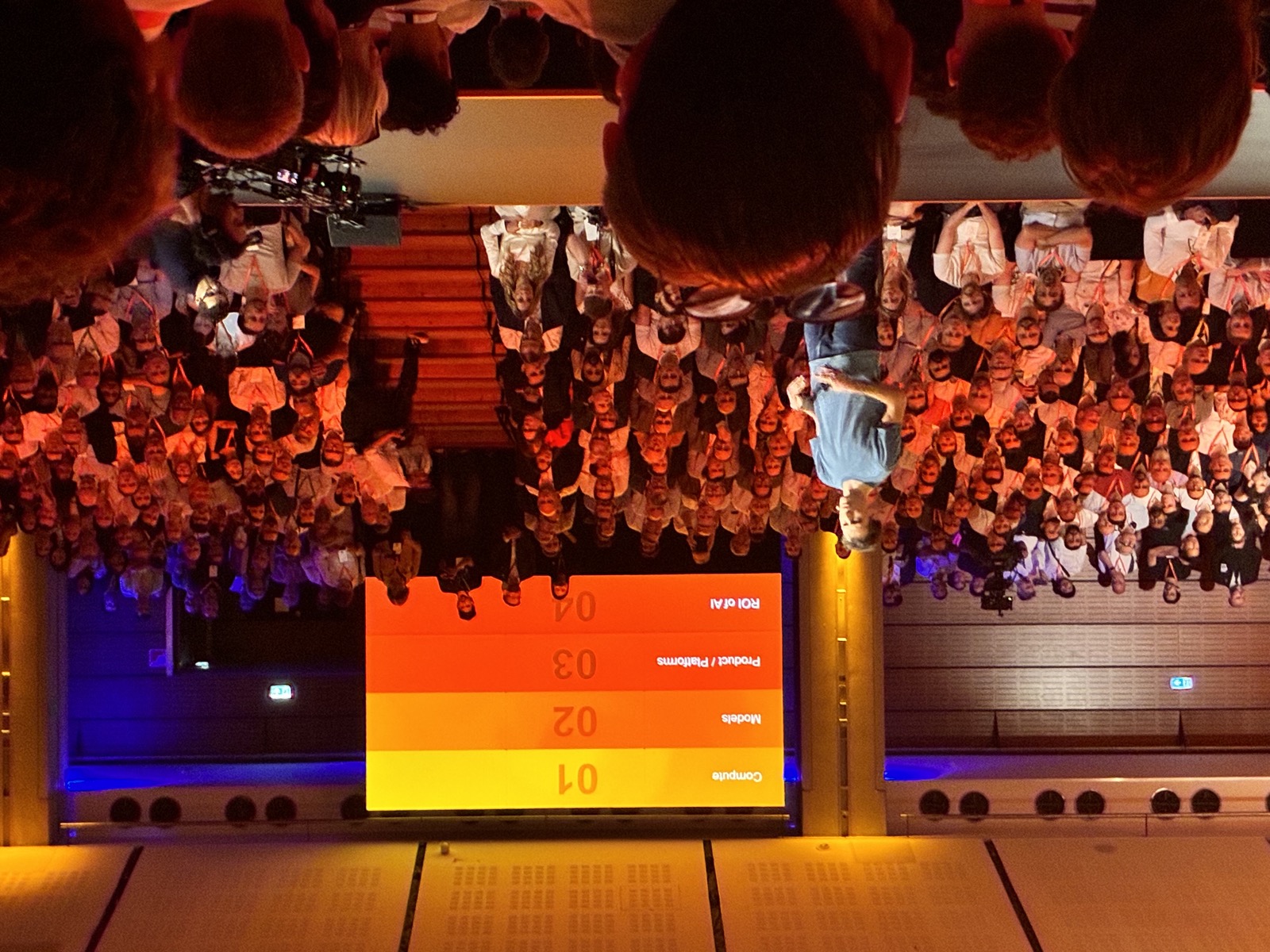
The messaging was all about partnerships: collaborations with ASML, BNP Paribas, Amazon's Alexa+ and how they were helping them with AI to solve real problems. It was less about upcoming new models and tech innovation. Something I found disappointing. They did launch Vibe for Work, a product similar to Claude for Work.
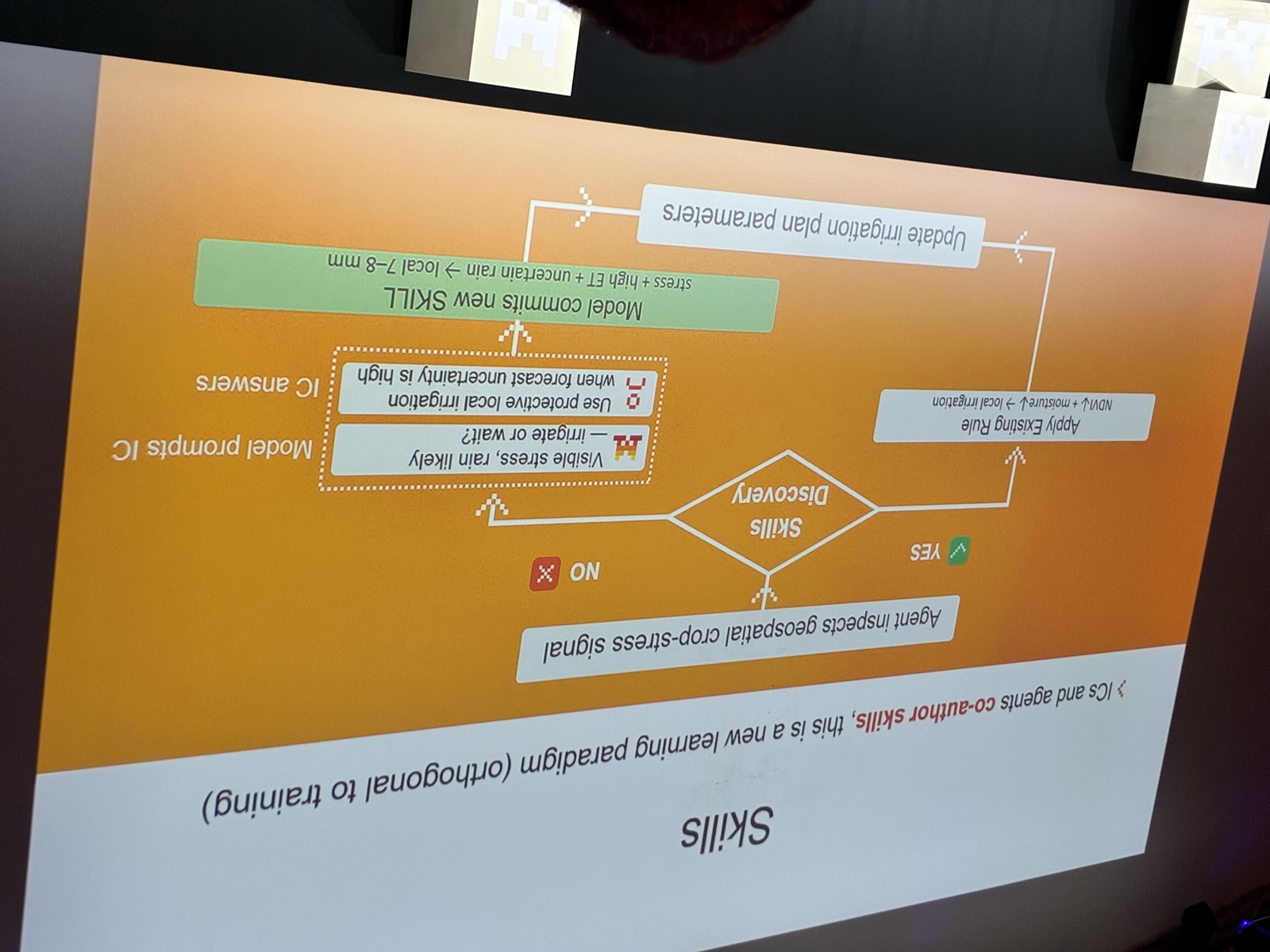
When it comes to agentic, the harness is everything. In a talk by Pieter Stock he mentioned that the model alone isn't enough. With a harness you add context, persistence and learning. Reasoning is essential for this; it's what lets a system backtrack, recover from errors and stay transparent. Skills are the way for organisations to capture best practices, you develop these in cooperating with the AI agent.
Specialized small models are their strategy. Mistral showed several examples where small, fast and focused models outperform the big general-purpose ones when it comes to energy efficiency and speed: Document AI for OCR (used by the EU Patent Office to do large scale OCR), Voxtral for multilingual voice (powering Amazon's Alexa+ in Europe), and Robostral for industrial robotics with ASML. And also in token-heavy agentic applications, speed and efficiency are becoming as important as raw capability.
Sovereignty and on-prem are their selling points. BNP Paribas runs Mistral models on-prem for KYC in Belgium, with sensitive data staying within the bank's walls. Abanca is using agent orchestration to handle sensitive customer information at a huge scale (more than 1 million customers in their app). For European companies in regulated industries, this is a good alternative to relying on US hyperscalers.
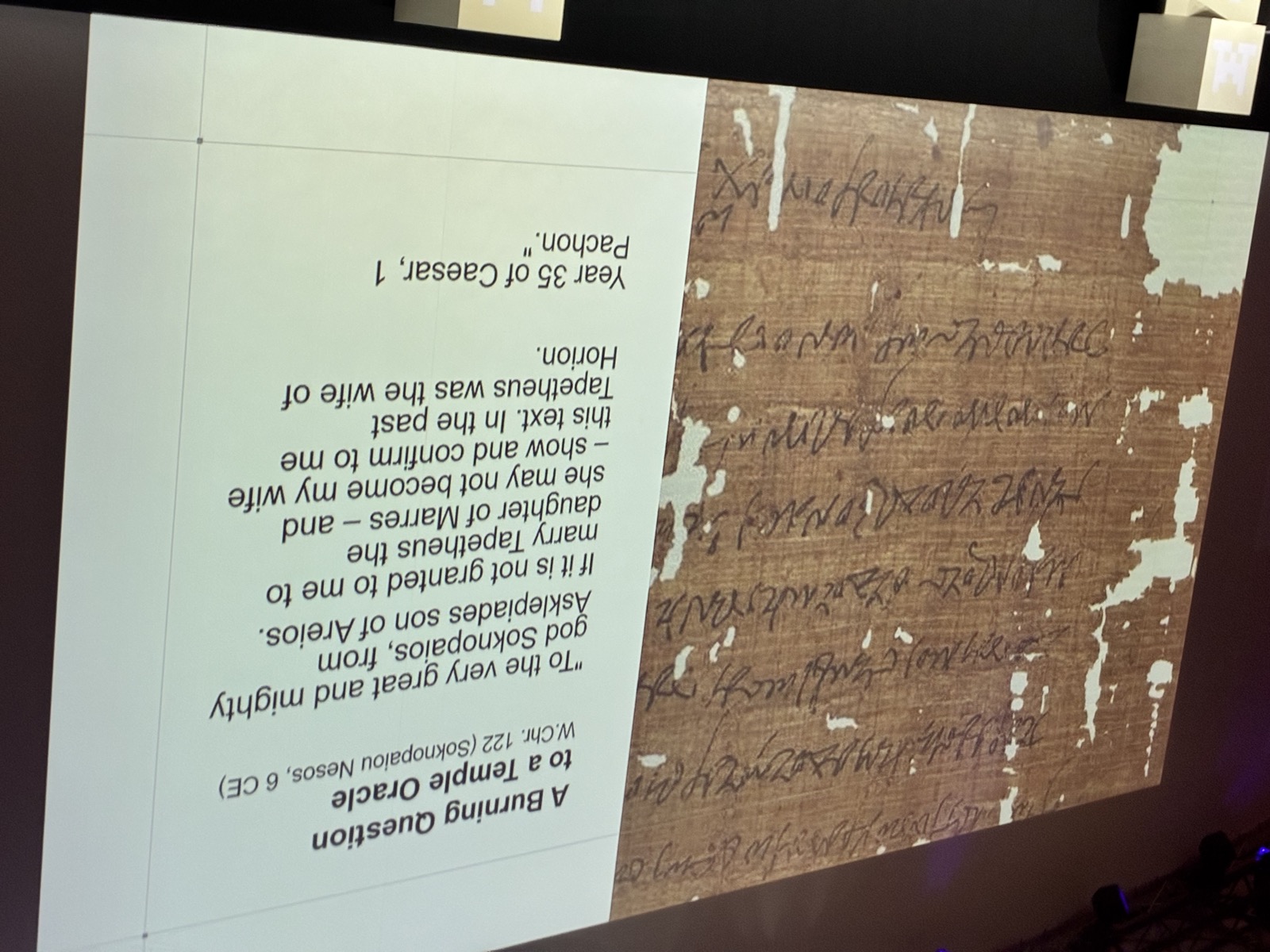
A talk that was a bit out of the ordinary and that I really enjoyed was about ancient papyrus documents: a research team from the Austrian Academy of Sciences finetuned a coding LLM by Mistral (Codestral) to read tiny snippets of millennia-old discarded papyri that had sat unpublished for decades. This work helps make a collection of 180,000 documents found in the Egyptian desert accessible, a job that would have taken more than 2000 years without AI. A beautiful example of how AI can also help the humanities.
All in all, the summit left me with a better picture of Mistral's vision for Europe an AI: maybe not to win the race for AGI (Artificial General Intelligence), but to become the European full-stack AI partner that delivers real return on investment NOW. Whether that pays off will depend on more European companies committing to this, but the combination of open models, on-prem deployment and enterprise partnerships could be appealing to many big organizations in the EU. And honestly, it's good to see a serious European player at the table. The days of blindly relying on US tech giants is coming to an end.
Post-script: Many thanks to Mistral for the invitation. The location was just perfect, in the middle of Paris near the Louvre, and it was really something to be in the place where Paris Fashion Week normally takes place: with co-founders and other speakers on the catwalk.
This article was also published on LinkedIn and Hacker News. Feel free to join the discussion there.