Google Mosquitoes - Debugging Florida
(probably the other way around, but what's the fun in that)
The Krogans got punitively infected with the genophage to drastically reduce successful births after their rebellion.
Google wants to release up to 32M good mosquitoes California and Florida
https://ktla.com/news/google-wants-to-release-up-to-32-milli... (https://news.ycombinator.com/item?id=48351077)
https://www.theguardian.com/technology/2026/jun/01/google-pe...
(perhaps one of these should be the submitted link)
Some previous discussion:
We’re trying to stop bad mosquitoes by raising and releasing good ones (2016)
https://news.ycombinator.com/item?id=12657034
Google Has a Plan to Eliminate Mosquitoes (2018)
I might be an idiot.
Crazy that despite their progress behind the scenes, they appear to have not touched this website since.
I probably spent a little too much time tweaking the CSS to get the mosquitoes to not overlap the text on various viewport sizes :)
Release a few thousand females carrying a gene drive that produces all infertile males, and all fertile females (who all also have the same gene due to it being a gene drive). Every generation, there are more and more infertile males, and more and more fertile females carrying this extinction gene. After several generations (a.k.a. a few years), the population collapses completely.
I vote yes.
https://www.nea.gov.sg/corporate-functions/resources/researc...
We should go out of our way to avoid spraying insecticides in our lawns and other spaces. The lifecycle of the mosquito is much more rapid than that of fish, spiders, dragonflies, bats, etc. If you regularly nuke an area with insecticides, the mosquito population will have a lot less pressure to deal with.
Eliminating mosquitoes sounds great to me on the surface, but I wonder if it will have any adverse effects on any plants that rely on them for pollination, or if it's expected that there are plenty of other insects ready to fill any void they leave.
Mosquitoes are a vector that spreads disease-causing germs to a population. The proposed solution is to use different mosquitoes as different vector that spreads a different disease-causing germ to a different population.
Unless there's been some new announcement that I don't obviously see here?
And yes, some of us are either old enough that we remember DEBUG.COM, or we got started way too young.
I think for the releasing-sterile-mosquitoes angle, it's actually more interesting to me to use some kind of molecular clock, I think I read about a genetic modification that resulted in a generation or two of fertile males, but then the Nth generation is sterile as a result of the molecular clock unwinding.
Linus's LinkedIn indicates debug moved from verily to google in Dec 2024 (I missed this at the time). Debug was always a passion project (unlikely to make a huge amount of money compared to ads, AI, and cloud) and Verily's transition to something that lost less money probably required them to move Debug back to Google.
They won't harm then it sounds like, but they'll not fertilize the eggs.
The DEBUG utility was originally named DEBUG.COM in early versions
of MS-DOS, but it was renamed to DEBUG.EXE starting with MS-DOS 3.2
Shoutout to the 12 of us who remember debug> g=c800:5The debug.com binary only showed one measly ASM instruction at a time as I recall. Shudder.
Then even after std lowlevel it was worth using Spinrite to check if interleave value was proper. And if it wasn't it was worth letting it first before anything else. Same when changing a faster CPU as it could speed up IO so much that no interleave would not needed any more and get faster IO.
Spinrite was such a great tool and time saver fixing or making preventive periodic maintenance to customers disks, even though it chugged hours even 30M disks. And just because not to take absolutely any risk it was necessary to make full backup first, which that took quote long also. LapLink was a great tool for that, before LAN became more common.
https://blog.debug.com/2019/11/singapore-collaboration-achie...
However, it turns out the eggs are fertilized. Note that the FAQ says the males are effectively sterile and links here: https://en.wikipedia.org/wiki/Cytoplasmic_incompatibility
That wikipedia article says that there are embryos, but the embryos die.
However, the real question to ask, I guess, is whether the embryo is infected. As I read that article, it sounds like it isn't. Instead, the male parent is infected and this creates sperm which can fertilize the egg but in a way that creates an embryo that can't survive. In other words, the male parent has an infectious disease which causes the embryo to have a fatal genetic disease.
So this also brings up another question: what exactly is a vector? In this scenario, the embryo has a disease it would not otherwise have gotten, if it weren't for this germ. However, the embryo doesn't have the germ itself. Is being a vector defined by whether some disease is caused, or is it defined by whether the germ is spread? I don't know.
It makes me wonder if this kind of technology is deployed, where should the stop line be? And I don't think it's a trivial question.
Dr. Ian Malcolm in Jurassic Park
Don’t be so quick to rush to a verdict. We are still living with invasives we introduced with the same good intentions.
So from this armchair, I'm glad to see that at least for aedes aegypti (which seems like the clearest case for deploying a gene drive), there's an alternative like debug.
https://www.youtube.com/watch?v=M4k5xfrkR4Y https://www.youtube.com/watch?v=cH57Oo-FYQ8 https://www.youtube.com/watch?v=zAcxBNcAV00 https://www.youtube.com/watch?v=GGiCO_4EqoU
It's been so long since I've heard about Debug that I was afraid it was cancelled.
So...which areas is humanity native to?
My favorite thing about WinDbg is that many people pronounce it "Windbag".
edit: I see I simul-posted with u/modeless, but I can't remove it now that there's a (duplicate) reply. Maybe mods can remove or at least collapse mine (their ID is one lower so they were first)
Hopefully all of these concerns have satisfactory answers, but the reference to it being a 1950s idea isn’t inspiring. Nuclear powered cars, widespread asbestos use, leaded gasoline, Freon… environmental impact wasn’t as big of a concern back then to put it mildly.
COVID proved that we can produce safe and effective vaccines extremely quickly if we actually try: so why not focus on that?
I know this isn't attainable for most of the world but sharing in case someone else is similarly frustrated. I ended up spending $500 on a trap w/ co2 tank and it has been a life changer. I don't even see mosquitos anymore. Refilling the co2 is quite annoying and expensive ($20 every other week) and you have to clean out the 100s of bugs from the trap net but I can literally sit in my backyard all day again.
I wonder if a cheaper trap could be designed to give everyone little bubbles of safety.
I wonder why we don't just try it on some remote island that has had mosquitoes introduced to it, but is otherwise considered isolated from the rest of the ecosystem (at least as far as mosquitoes are concerned).
Depending on how you define it, I could see "parts of Africa" as being "native" but that doesn't really help this discussion.
So, no, WinDbg has nothing to do with debug.com.
It's the clearest possible example of the fact that simply "eradicating non-native species" is anything _but_ simple, and will have unforeseen implications and consequences. I doubt that modeless intended to advocate for the culling of the majority of humanity, but that was technically what they did. Similarly, SilverElfin correctly points out the high probability of unforeseen consequences of "just" changing the species make-up of a large component of the food web.
Its assembler is sadly stuck in the pre-x86_64 era (and refuses to do arm at all), however it disassembles all of those fine.
Signed: someone who does pronounce it wind bag
Bad mosquitoes spread disease. Good mosquitoes can stop them.
Debug is a group of scientists and engineers developing technology to raise and release sterile mosquitoes to eliminate the ones that carry disease.

Watch to learn more
The Problem
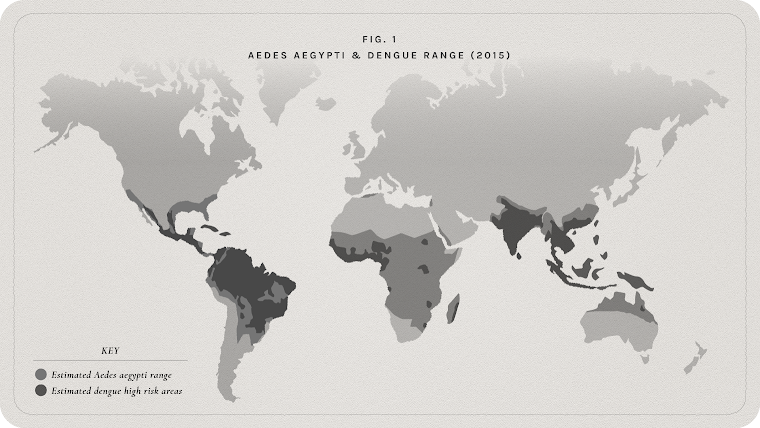
Mosquitoes are the deadliest animals on the planet.
Mosquitoes kill more people than every other animal combined. One species, Aedes aegypti, carries diseases such as dengue, Zika, yellow fever, and chikungunya which make hundreds of millions of people sick every year. And these diseases are spreading faster than ever.
And they're a difficult problem to solve.
Most of these diseases don’t have effective vaccines or treatments. Attacking mosquitoes with pesticides is unsustainable because they're becoming less effective over time and can be toxic. Clearing standing water is not enough because people can never find all the places that mosquitoes breed. We need a new approach.
Our Solution
We're trying to stop bad mosquitoes
by raising and releasing good ones.
Good bugs are the same species of mosquito as the bad bugs that spread disease. Our good bugs are male mosquitoes that have a naturally-occurring bacteria called Wolbachia which makes them unable to have offspring with wild female mosquitoes. Male mosquitoes can’t bite or spread disease, so good bugs will stop bad ones from reproducing. Over time, there will be fewer and fewer bad mosquitoes.
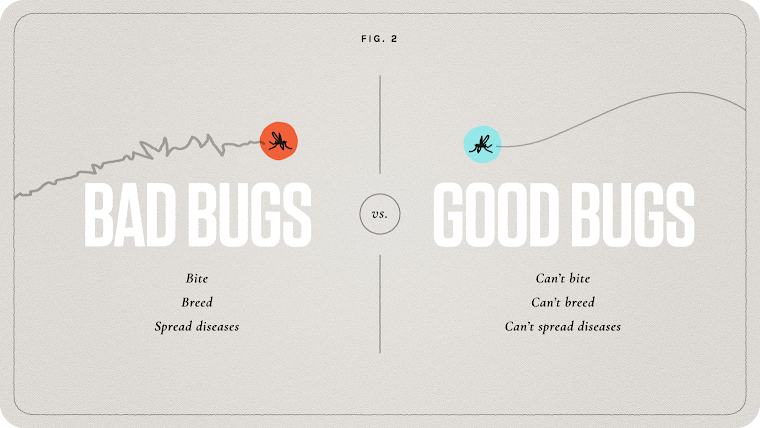
This technique uses a naturally occurring bacteria and uses no chemicals, no toxins and doesn’t involve genetic modification. Similar approaches have been used to safely combat other pests for decades. We’re combining the Debug team's scientific and engineering expertise with the help of international partners to raise and release lots of good bugs and stop bad mosquitoes that can spread disease.
Find out more about good mosquitoes and how we raise them
Our First Steps
Fighting bad bugs one community at a time.
We’re currently developing our technologies and methods to target Aedes aegypti mosquitoes. This means partnering closely with scientists, communities, and governments.
Debug is off to a good start, but there is still plenty to do. We look forward to working with communities to show that by releasing enough good bugs Debug can have a real impact on mosquito populations and disease. Eventually, we hope to help millions of people live longer, healthier lives.
Want to help us stop bad bugs?
Lisa: But isn't that a bit short-sighted? What happens when we're overrun by lizards?
Principal Skinner: No problem. We simply unleash wave after wave of Chinese needle snakes. They'll wipe out the lizards.
Lisa: But aren't the snakes even worse?
Principal Skinner: Yes, but we're prepared for that. We've lined up a fabulous type of gorilla that thrives on snake meat.
Lisa: Then we're stuck with gorillas!
Principal Skinner: No, that's the beautiful part. When wintertime rolls around, the gorillas simply freeze to death.
I don't consider France to be part of the modern world, since I haven't visited Europe lately.
This is addressed in their FAQ as well: "The general consensus among scientists is that the ecological impact of removing Aedes aegypti mosquitoes from urban environment would be small. They are not a significant food source for other animals and are invasive to many areas. The main ecological impact would be to restore the ecosystem to how it was before the mosquitoes invaded. Debug team is committed to working with communities and regulators to ensure the safety and acceptability of our field trials and releases."
This isn't a project to eliminate all mosquitos. There are over 3600 species of mosquito - this project is only targeting one: Aedes aegypti, which spreads many diseases, and is in fact an invasive species. Anywhere you see an Aedes aegypti outside of North Africa, it was humans who brought it there in the first place. This project is just trying to undo that.
https://en.wikipedia.org/wiki/Neglected_tropical_diseases#Ec...
(intervention in a complex system, and without proper testing at that... even if the covid vaccines were safe, that was by luck)
I say this as something who does all the things you described debug.com as doing, in this modern era.
My twisted brain spun out a version of this paragraph from some kind of parallel universe Hacker News (presumably where humans aren't the dominant species on the planet) that said:
> Homo sapiens, which spreads many diseases, and is in fact an invasive species. Anywhere you see a Homo sapiens outside of North Africa, it was humans who brought it there in the first place.
I think it's fun that my brain decided to come up spin the accepted African origin of humans and their proliferation around the world into this fun paragraph. No value judgement about humanity is implied.
In Indonesia for one they are. Every night, countless geckos come out, both indoors and outdoors, and start hunting for mosquitoes. Even lullabies sing about it [1].
The above song is so popular that it got an AI parody [2].
I'm curious what food chain reaction this will start if successful.
The extermination of sparrows – also known as the Eliminate Sparrows campaign – resulted in severe ecological imbalance, and was one of the causes of the Great Chinese Famine which lasted from 1959 to 1961, with an estimated death toll due to starvation ranging in the tens of millions (15 to 55 million).
https://en.wikipedia.org/wiki/Four_Pests_campaignThough that's unlikely to follow on from simply reducing mosquitoes in urban areas ... it absolutely warrants a close eye being kept on roll out and knock on effects.
I was a computational biologist and specifically went to work at Google to get access to their world-information-organizing technology to apply it to medical/biological problems. I was convinced at the time (mid-to-late 2000s) that AI was going to transform medicine, especially drug discovery, and that huge amounts of (organized) data was going to be key to achieving this goal. While there, we worked on protein folding and design and drug discovery, as part of a team that eventually was called Google Accelerated Sciences. It was mostly made up of people who had some level of scientific background, then had made $$$ for Google, and made good friends with the leadership and could use some of the research budget.
Of course, the protein folding and design work ended up being replaced by DeepMind's work on protein structure prediction, which led to protein design and drug discovery, mainly in DM spinoffs.
Many people at Google who work on CS stuff would absolutely love to see Google's resources applied to curing diseases. I know that Jeff Dean has been angel investor in this space.
The choice is between making one species of mosquito extinct or using traditional mosquito control methods such as removing standing water. The traditional methods affect many different insects not just mosquitoes. Attacking specifically the species that are vectors for disease is the more ecologically sound method.
If we could remove the insects that carry disease then the outcome could be more insects overall, because people will be more willing to have ponds, etc.