I got an ortholinear keyboard that looks like a rectangular grid, just 12 by 4 keys around 10-15 years ago.
I don't recall the last time I felt pain in my hands, completely gone.
Screw Apple and their persnickety, controlling myopia.
Make apps for device, which are 100% owned by people.
I have no idea what they’re thinking. Insanity.
Microsoft was almost broken up over not allowing third party programs to use certain APIs. Apple abuses their dominant position to suppress competition.
However, I would like to point out that Apple isn't totally wrong here because the accessibility API unfortunately is way too broadly scoped, and because of that you literally get access to everything on the computer like you you can screenshot listen and and move the cursor... This is completely ridiculous and the proper engineering solution would actually be to phase out the accessibility API and replace it with something that is narrowly scoped so you can grant specific permissions individually.
However, Apple, being Apple, is obviously not doing anything, and instead says no accessibility permission for anything that isn't demonstrable accessible. Now, there are obviously some exceptions because Apple is not particularly well known for applying its rule consistently and granting big exceptions for itself. However, they do have a valid point on privacy and data protection. And I say that as somebody who ended up distributing my MacOS app outside the App Store because I only got approval for iOS.
That said, I would definitely appreciate if Apple would gradually improve its developer program experience, because compared to its hardware lineup, the developer program is nothing short of abysmal.
If you're worried about people not trusting payment to you, might be worth seeing if you could implement this, so anyone who bought on the app store can still access the full feature set. Cuts you out 30% like, but better than nothing maybe.
Where I was more frustrated was how much this limited the potential usability of the iPhone app. Because of app store restrictions it is a far worse app ... though like in your example, still useful to a degree.
I can only hope they use the new CEO as an opportunity to seriously re-evaluate their entire approach to how they work with developers, though I'm not actually expecting them to. If anything, with the increase in apps being created via AI tools I worry they will go the other way.
Install some GNU/Linux distro and you can do whatever you want.
This API is sensitive. I imagine Apple is particularly stringent as to how the access is justified. Not how it uses it but how the reason for using it is explained.
It's not like someone tests the app and all api calls to deem them reasonable or not.
Have fought similar demons lately, feel your pain.
Imagine a banking app, and for example an IBAN field.
OP’s description in the linked article doesn’t say much more than this, so what am I missing with this particular app?
I just wish they weren’t so obstinate about people installing from other sources without signing/notarization. I understand it from a security standpoint but it’s also nakedly self-serving.
I’m glad that they’re fine with signing in this case.
Edit: Ah, it's in the article, this is about AppStore distribution. Walled gardens are going to walled garden.
If anyone here has more direct experience with this guideline, especially from the App Store review side, I would like to hear it. I would rather understand the policy than just guess at it.
If you don't have use of your hands you want that. The whole point of accessibility APIs is allowing arbitrary control of your computer via novel means. One of the big selling points of Dragon Natually Speaking is the ability to tell your computer to do things based on descriptions without a mouse. "open outlook", "click compose", "select subject", "type foo", etc. Unfortunately modern software breaks this a lot. Chrome and anything electron based don't provide any accessibility information to the OS. The interior of the window excluding the tab bar is a void. Yes chrome has an inbuilt screen reader as do a number of electron apps. But if you aren't blind and want to use something like Dragon it doesn't work. Canvas based apps are often the same.
In other words, Apple is abusing their position by defining overly broad permissions so that they can deny them and pressure people to fork over more cash to them.
I'm using https://github.com/cjpais/Handy whichseems to be doing exactly what this app does, and has a very similar background story (author couldn't type die to injury).
I want apps to be able to do that!
Is there an opinionated reason not to break out capabilities?
Checks out, what's the problem? /s
If you're not, ask your representatives why you don't get the same rights.
I'd argue that installing and updating apps on MacOS is simpler than on Linux distros because most apps have built-in auto-updates (or you can just drag the app to the applications folder) instead of having to rely on snap / apt / insert your package manager which may a lot of outdated and unmaintained packages and apps.
I tried very hard to switch to Linux full time some months ago, but I couldn't find a way of getting Microsoft Office to work satisfactorily. There are clever packaged versions of Outlook and Teams, but I need full native installed versions of Word/Excel/Powerpoint, and there just wasn't a good solution. That was a deal breaker, sadly, so I'm back on Mac for the time being.
Other examples would be some of the popular games with anti-cheat that requires Windows.
Build system woes are almost always solved by deleting build cache & artifacts and trying again. Often necessary after messing around with deeper dependencies.
I get that some people are unfairly targeted but some other times it's people being (extremely) naive or just playing dumb
"Hey you know what would be cool? If we named our bluetooth speaker company bee oh emm bee!!11"
The problem from Apples perspective could be that there is a ton of tools that require access to the accessibility API because they want to do stuff that Apple have deemed a security risk and the only way to do it is by abusing the API. Some of these are also because macOS simply lacks certain APIs.
I think Apple overreacting due to previous API misuse by other apps.
https://en.wikipedia.org/wiki/WinDirStat#Version_history[10]
You get a channel for installing apps, where someone vetoes random apps that want to have access to control your whole computer and potentially steal sensitive data?
>Install some GNU/Linux distro and you can do whatever you want.
And any random app can get total control and steal your data, unless you know how to enable restrictions. I'd rather have restrictions as the default, and for the most naive users who'd follow every app prompt, and then cry about their lost work/private documents/money, no way to bypass them.
update: You're right, this is a real bug. The Direct version's auto-paste hardcodes the QWERTY keycode for V instead of translating for the active layout, so Dvorak / Colemak / AZERTY users would all hit it. The MAS version is unaffected (clipboard-only; the user presses their own Cmd+V, which is layout-correct). Fix is going into the next release. Thanks for the careful read.
Worried about grandma installing shady apps? Enable parental controls on her phone.
Lots of shady and well-known developers (like Dropbox) are notorious for trying to weasel their way into getting Accessibility permissions, so they can do god knows what with them to your system.
On top of that, the app is completely optional: if you aren't comfortable giving it those permissions, don't install it?
Those two desires should both be fulfilled.
I just installed PopOS on a laptop recently, and… it just worked. There’s an app store for noobs that I think installs flatpaks. GPU drivers just work. Whole disk encryption. Everything just works.
I don’t see what else my grandma that just uses Facebook would need. Maybe automatic updates?
No - moving to far away areas is not the right analogy. After all you need to have use cases where those huge companies do not control your business. So the alternative is to avoid becoming dependent on them; or cut off the dependency when possible.
I dont wanna start a war over this btw, even though it may not seem :)
Then don't install apps and use the web, mobile sandboxing is much weaker compared to any modern browser.
[0]: https://boltai.com
If you and your grandma only rely on the computer for its web browser, then good for you. You have flexibility that is not afforded to most people. But that's not how a person's phone works; phones dig a lot deeper into one's lifestyle, intentionally so. The walled garden was constructed to keep outsiders out, but now it seems the primary purpose is keeping those inside hostage.
I couldln't imagine having the time to set it up as a daily driver that handles my daily workflows, hardware needs, etc. Terminal in OS X is a close enough approximation out of the box and goes beyond it in DX (IMO) with very little additional setup.
I know this will be an unpopular opinion.
She loves it. Zero problems. It's been a week and she's using it just fine. No lifestyle upheaval.
Everything I ever added was kept, and I was permanently banned. I created [ciation needed], started the admins noticeboard, reworked the USA Patriot Act article, wrote numerous articles for WiR with extensive referencing, contributed to peer review and good article reviews, and a shitload more, but nope. Not good enough.
Why anyone would contribute to that cesspool is anyone’s guess.
I own more (and have them running right now) machines with linux than anything else and yet I'm not saying people can just switch. The problem is usually not "can do at all costs" but "can do with a reasonable addition of extra steps/relearning/tool does not exist/etc". There's some nuance and when I have some spare time I will (again) try to switch that one machine, but "it just works" maybe can also mean you're not using it for a diverse enough set of things.
In my case the reasons are actually quite boring: some hardware I couldn't get running and some (maybe minor) things that drive me nuts. The hardware is kind of a deal breaker atm. And yes, some people do a lot more weird things at home, my work machines were running Linux for 90% of the time since 2010ish.
i call bullshit. i have worked in very big orgs. changing a single icon can cause a deluge of support tickets.
I can assure you, there are those on Wikipedia who committed far worse offenses and they remain.
Like I say - a cesspool that doesn’t respect article writers.
https://en.wikipedia.org/wiki/Wikipedia:Administrators%27_no...
I built WhisperPad because I needed it. In the fall of 2024 the joints in my fingers started to hurt when I typed. Maybe the bill came due for spending most of my life on a keyboard: a childhood of video games, then 10 years working in tech. It got worse throughout the winter, and by early 2025, I could not type for sustained stretches without triggering an unsustainable level of pain. It was a progressive injury, so there was no single dramatic moment; just a slow narrowing of how much I could do in a day.
That narrowing arrived at an inconvenient time. I was between jobs and trying to decide what came next, and I had landed on applying to a master's program in human-computer interaction. My biggest fear about it was not whether I could keep up mentally. It was whether my hands would let me produce the work fast enough to keep pace.
WhisperPad lives in your menu bar. You press a keyboard shortcut, you talk, it transcribes what you said locally on your Mac, and it places the text into whatever field your cursor is in. Nothing is sent to a server. If you have clicked away by the time it finishes, the text is on your clipboard and you can paste it wherever you want. That is the whole app. The point was to make getting words out of my head and into the computer cost as few hand movements as possible.
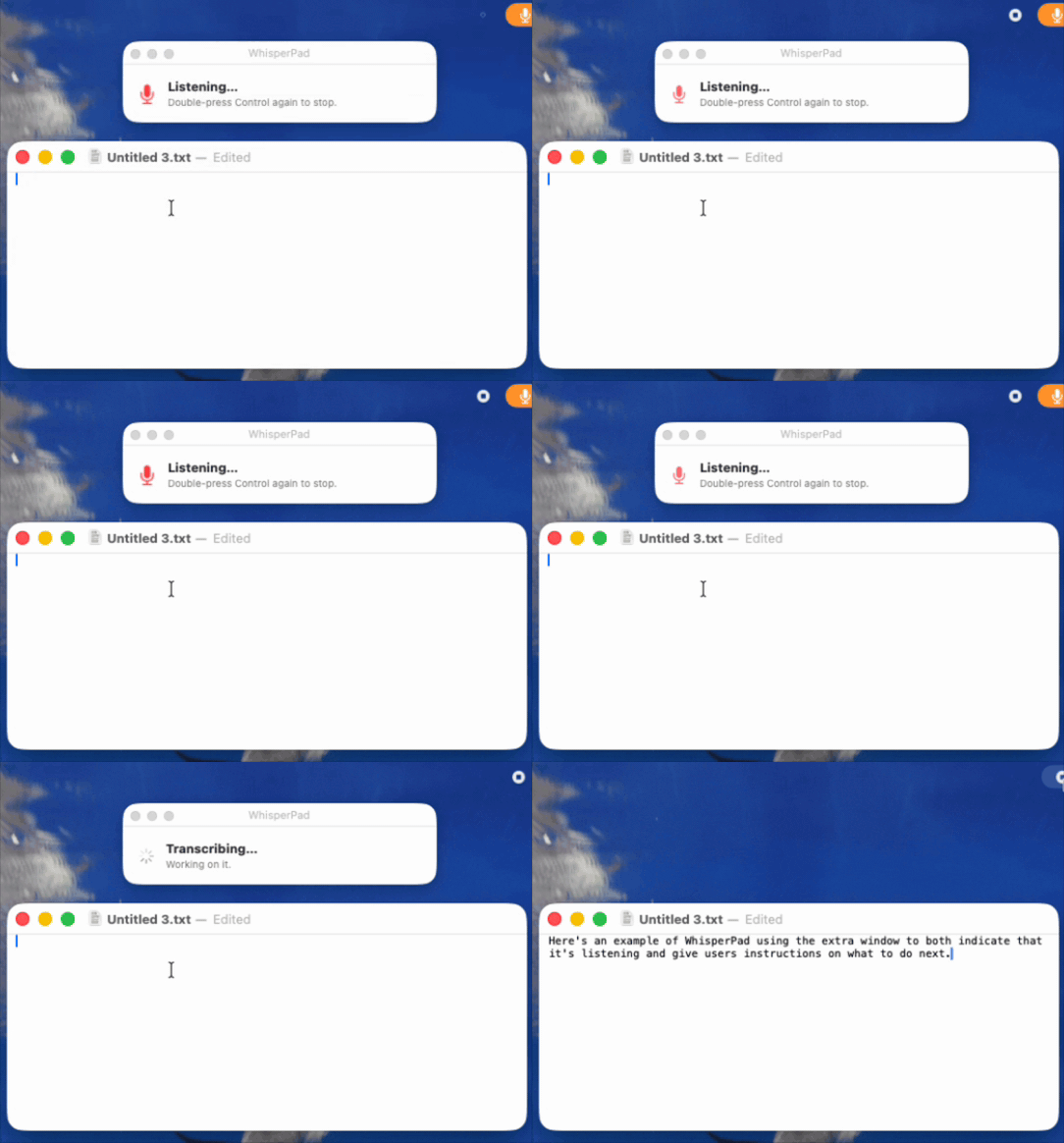
The window indicator that appears while you're dictating.
In April, Apple rejected an update to my Mac dictation app, WhisperPad, under Guideline 2.4.5. Their position was that I was using the accessibility API in a way that wasn't an accessibility use. The app exists because I have a hand injury. Apple had approved earlier versions doing the same thing. This time they did not.
I had used Apple's built-in dictation first, and the experience was a particular kind of frustrating. The transcription was close but rarely right, and every correction meant going back in with the keyboard, deleting, retyping. I was hurting my hands to fix the tool that was supposed to be saving them. That is the specific problem I wanted to solve: not "transcribe my voice," but "transcribe my voice well enough that I am not constantly typing corrections."
I will be honest about how I approached this. I did not do much market research. There were probably good tools out there already, but most sent your audio to a server somewhere, and I wanted one that didn't. When I want something, my first question is usually "can I just build it," not "what can I buy."
The first version was rough, but I used it every day and kept improving it. I shared it with a couple of classmates and watched them fold it into their own daily workflows. Seeing other people quietly come to rely on it made me want to release it properly.
Version 1.0 shipped in the winter, and it was free to download from the App Store. Next I added features early users asked for, and I decided to make it a paid app. That update was version 1.5.
Apple rejected it under Guideline 2.4.5. The rejection was specifically about the accessibility permission. WhisperPad uses it to inject transcribed text into other applications, and Apple's position was that this was not an approved use of that API. Earlier, approved versions of the app already did the identical thing with the identical permissions, so this was hard to swallow.
The rejection explanation had some fair feedback, too. I fixed those issues, but the 2.4.5 issue was the real wall. So I appealed, explaining that WhisperPad functioned as an accessibility tool, that I had a repetitive strain injury, and that the whole reason the app injected text the way it did was to spare the hands of people who, like me, could not afford the extra keystrokes. I asked Apple to look at it in that light.
They responded that they would take a closer look. They told me not to reply in the thread, and said they would come back with a decision. That was April 21st.
Then it went quiet. By May 21st I had heard nothing, so I sent a short, polite note asking about the status. I have worked in customer support. I know tickets fall through the cracks, and I wanted to nudge it back onto the pile.
They responded quickly, and the answer was another rejection.
That second rejection is what forced a real decision, and I want to explain, because it would have been easy to make a worse one.
I spent some time weighing two options: comply with Apple's restrictions and release a version that fit their rules on the App Store (sacrificing the direct paste), or release WhisperPad through direct distribution. I decided I couldn't sacrifice the reach of the App Store. So I would build a version that complied with their rules and put it there, and at the same time move ahead with direct distribution to deliver the full version I had originally set out to build.
Here is the thing about the constraint. Apple's guideline, as far as I can tell, is meant to govern apps injecting text into themselves for accessibility, rather than into other apps. That is my assumption, since I never got a perfectly clear explanation. (If you understand this guideline better and can correct me, reach out — I want to hear it.) Either way, an app reaching into every other app on your system is something to be careful about, and I can see how WhisperPad sits in an awkward spot relative to that line.
So I split WhisperPad into two versions.
The version on the Mac App Store does not auto-paste. It puts your transcribed text on the clipboard, and you press Command-V to place it. That takes the core flow from roughly four steps to six. That does not sound like much, and for most people it is not. The entire design goal of the app was to remove hand movements for people who need to be economical with them, so a 50% increase in steps is significant. It is a compromised version of the idea. But it is a real, useful app, and it is on the store where people with or without accessibility needs can stumble onto it. The App Store makes it discoverable.
The original vision, the one that pastes directly where your cursor is, I shipped myself — outside the App Store.
Shipping software outside the App Store means rebuilding the things the store normally does for you. There's a new trust hurdle, too. You're asking people to trust you to process their credit card on your own site.
For payments I went with Paddle, after some research into the options. For updates I am using Sparkle, the long-standing framework for keeping Mac apps up to date outside the store. Licensing is handled with license keys checked against a small server. None of this is exotic, it is the well-worn path for independent Mac software, but it was all new to me, and getting it right took real work. Practically, I forked the app into separate build targets: one configured for the App Store, one for direct release. I finished wiring up the direct release pipeline on May 27, the morning I started writing this.
What first looked like an obstacle turned into a constraint that pushed me to build a better-organized product. I now understand my own build configuration, my update path, and my payment flow far better than I did in March, because Apple's "no" forced me to learn all of it. Apple's guidelines exist for defensible reasons, even if I wish my particular app had landed on the other side of the line.
When a platform tells you no, you usually have more options than the moment makes it feel like. The choice is rarely "comply or quit." It is often "comply here, and do the fuller thing somewhere else." Shipping two versions, each one serving its channel as well as that channel allows, was not a defeat. It was just the next piece of work.
WhisperPad is on the Mac App Store now, with a free tier of 120 minutes a month so you can find out whether it fits how you work before paying for anything. The direct version, with full auto-paste, is available at mitmllc.com/whisperpad. If you want to talk to me about it, I am Rene Zelaya, and you can reach me at contact@mitmllc.com.