It describes the regression in accessibility software for Linux from x11 to Wayland. Unfortunately, judging by the pace of protocols being accepted, I think we're years out from having a solution.
The most notable thing not working is Talon, which is a voice input system that lets you insert speech to text, manipulate windows, call scripts, etc, all via voice. It's software that works on Windows, MacOS, and x11, but not Wayland.
I think unfortunately right now the best bet is to, if you need the software, stick with X11 for as long as possible. An environment like i3 will probably be maintained for decades to come. Alternatively it might make sense to build some type of bespoke solution on top of a specific wayland stack, like re implementing what you get of talon in a kde plugin or via sway IPC. This seems viable to me but an incredible amount of work.
For people that need this, having to be a developer and build your own tooling in order to use your computer... it's not a future of Linux I'm particularly excited about. I don't want to leave people who need accessibility software behind, and I don't think any security justifications are actually real roadblocks which would prevent being able to serve these people. We have a coordination problem. It's less of a technical issue and more of an issue of getting people to agree on protocols which would let software like Talon work against the entire ecosystem.
I am happy the ecosystem is moving to Wayland, I think we're going end up in a better place. Wayland does solve some real problems for me (x11 screen tearing / frame pacing issues on Nvidia). I'm happy that KDE exists, it's great software.
I'd love to be proven wrong about KDE's accessibility support. Hopefully they'll adopt GNOME's acccessibility extensions for wayland but that seems less likely than making their own that work with their compositor's design.
Good bye KDE. Good bye Red Hat. We're doin our own thang now.
> Moving forward with a single code path going through Wayland is going to allow us to bring new performance improvements, memory optimisations, and brand new exciting features throughout Plasma.
I think the blog post would have been better if he had some specific examples in mind that he could have shared here.
Not saying that X11 is not broken and should not be replaced, but many Wayland's decisions harm user experience more than X11.
I'll be sad if that is still the case when 6.8 rolls around as then I'll be hunting for another DE.
I wish they would have listed what some of those features might be.
Oldschool KDE devs were better. Today's generation of David or Nate, are just killing KDE off. But no worries, on their blog they'll continue how everything is great. It is so great that they need a donation-widget to keep on pestering people to donate. So now you can pay for them ruining the legacy here.
What is with KDE and releasing broken software? What's the rush to release when there are known issues?
Instead, I could tell literally no difference. Multiple desktops works fine, scaling works fine, screen capture works fine, old apps work fine, literally everything works just fine.
Good job, KDE team.
I'm guessing this would mess up other games as well, like multi-screen flight simulators or driving games. It would be really nice if user-trusted apps could be granted permissions on an app-by-app basis to allow absolute placement of windows for these cases instead of making us jump through hoops.
If the logic is that it's the window manager's job to set window rules for this, fine, but in that case Plasma should probably ship with preconfigured rules matching the Chrome/Firefox PiP window.
I also find the lack of an Xlib-compatible macro API disruptive but I usually run an X11 session inside Xvnc for this purpose anyway.
1. Right click PIP window 2. More Actions -> Configure special window settings 3. Add property -> Layer Force Popup
After this it spawned always in middle, I also added property Position Remember, so it spawns where it was previously. I have no idea if this is the best way to fix but worked for me.
Modern KDE is nothing like that, and i cannot see how this is a bad thing.
Or, the X11 code is more complex and they prefer Wayland because it is simpler. Fewer features. Is it a surprise that wayland would be faster, if it does less?
> by this point most stuff has been updated to work properly on Wayland
Really? Strange how comments on reddit do not confirm this. Admittedly they did fix various issues. I don't see how this equates KDE on wayland being better than KDE on xorg - even more so as they abandoned xorg now, as that blog post shows. So how can this even be compared?
> I don't notice any breakage or missing features in day-to-day usage
Why is this contradicting what others report then?
> I think the blog post would have been better if he had some specific examples in mind that he could have shared here.
David and Nate are all about marketing buzz. I am hardly the only one to have noticed this already. Then again if you are too critical of them on reddit, you get banned. I found that out when I critisized Nate's obsession with money. :)
Though, I am hardly the first with that either:
https://jriddell.org/2025/09/14/adios-chicos-25-years-of-kde...
Edit: Interesting, the above URL no longer works. Guess jriddell took down his old criticism some weeks ago. Anyone able to show how the old content looked like?
Edit2: Hah, found it - wayback machine is so great; people would have thought I made the above URL in error, but here is the old content from last year:
https://web.archive.org/web/20250917012150/https://jriddell....
1. Right click the PIP window and then click "More Actions-> Special Window Settings".
2. On the window that pops up, click "Add Property", and add "Window title". Change the drop-down from "Unimportant" to "Exact match" (this works on Firefox because the window title is always "Picture-in-Picture", you might have to do something slightly different on Chrome if it does something different).
3. Click "Add Property" again, add "Keep above other windows", change the drop-down to "Force", and change the radio button to "Yes".
4. From now on, all PIP windows will show up on top of other windows.
It would definitely be nicer if there was some sort of "always on top" permission that applications could request, but it's not too bad.
That is because people who don't have a problem don't think about this and so don't comment. Many wayland users don't know. I think I switched this machine I'm using now to wayland a while ago but I don't remember, and maybe it switched back in an update and I didn't notice (which is the point, I know I switched at some point and I couldn't tell the difference - which is how it should be)
Meanwhile there is a slightly larger minority that need things that cannot be done in X.
For the vast majority of people they cannot tell the difference, either works just fine. If there are issues they are tiny things they don't notice until somebody points it out - and then they forget in a few days.
They showed the statistics based on their telemetry tools and said they match crash data.
Not that it was 100% from crashes.
Also the fact they can tell which one is in use does not mean that’s the reason it crashed. It could be crashes due to bad network handling or file corruption or something that has nothing to do with the GUI.
The ones that don't are more likely those who leave things on defaults, are involved with the project or a distro, or similar. No, I don't have anything that backs this up. The statistics they're using can never be accurate, by virtue of being free software that ships on privacy concious distros to privacy cincious people. There was a study that backs up this claim, but I'm not google.
OTOH, xfce is doing fine.
>For transparency, the one caveat in all of the above is that I've deliberately always focused on people using the latest Plasma release. We do still have a sizable chunk of users on X11 still using Plasma 5.27. Including them, the total Wayland adoption rate is about 76%.
The risk in that in this age of AI-assisted bughunting, X11 security vulnerabilities are more numerous and as nasty as they've ever been. And that says a lot.
The maintenance and performance stuff is good, but it’s not exactly end user stuff. Yeah you benefit but it’s less obvious.
I don’t follow this stuff closely so personally I have no idea what kind of Wayland only features could exist that couldn’t before.
Honestly my computer gave it a red underline so I decided to do that. I didn’t think about it harder than that.
If I recognized it like “colour” I wouldn’t have.
What is a compositor - thing that actually draws window content on the screen? Whatever KDE provides?
Edit: To be fair to KDE/Wayland, the Wayland Kubuntu 24.04 experience was vastly improved over Kubuntu 22.04.
The only issue that I noticed it's with screen scaling doing weird things with OpenOffice.
When we first announced the transition to Plasma Wayland, one of Martin's slides from stated, "It's done when it's done!"
That talk was 15 years ago!
Nothing in software is never truly "done", but as announced previously we are finally at a point where we're ready to retire the X11 and put all our focus on the future.
As of today, the Plasma X11 session you can log into has been officially removed, and we will start a mass cleanup of X11-specific code soon.
This change will be included in Plasma 6.8, which will be released in around five months.
In Plasma 6.8, there will be no X11 session in the login screen. There will only be a Wayland session available to log into.
In 6.8, all X11-specific code paths in Plasma for Plasma Shell, System Settings, and device configuration will be gone.
XWayland support remains present. You can keep using your X11 applications, and our XWayland application support is second-to-none.
If you use KDE applications on another desktop environment, this change will have no effect. KDE applications will continue to work in X11 for the foreseeable future.
Plasma Login Manager will continue to be able to log you into X11 sessions of other desktop environments.
The possibilities this opens up are very exciting. Until now, on the desktop side, we've had to target the lowest common denominator or be stuck trying to maintain two conflicting code paths. It was absolutely the right choice to do a gradual transition and approach things this way, but that approach has its limits.
Moving forward with a single code path going through Wayland is going to allow us to bring new performance improvements, memory optimisations, and brand new exciting features throughout Plasma.
Our internal metrics within KDE show that over 95% of users of Plasma 6.6 are on Wayland, with a gradual increase every release. The metrics also show that basically no one is testing or developing Plasma on X11 anymore. The platform was already, for all intents and purposes, abandoned by KDE contributors.
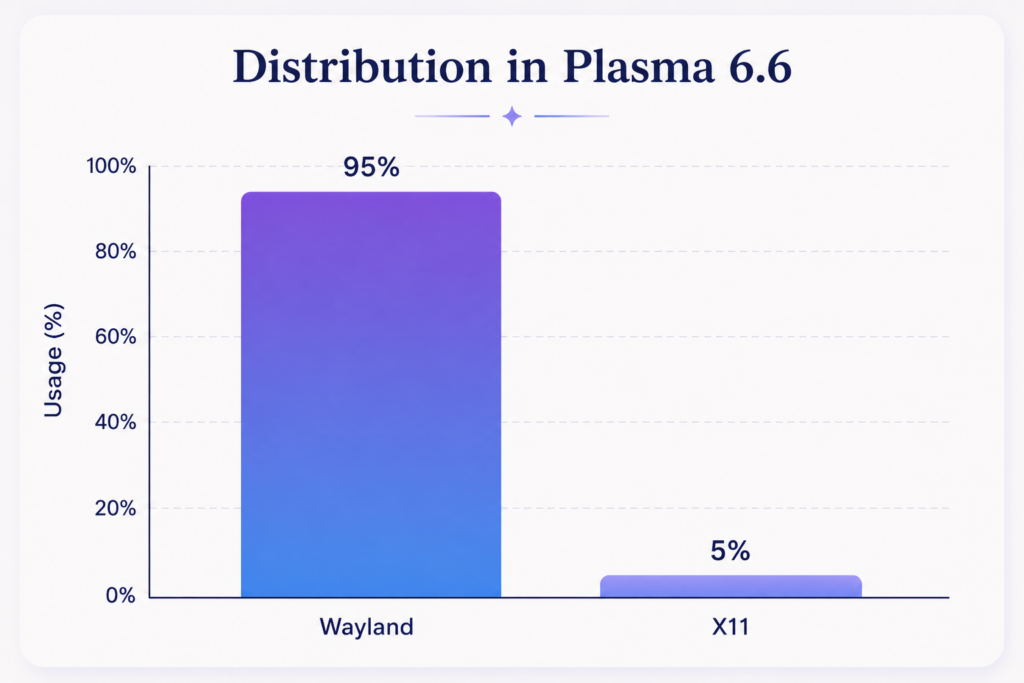
We have every reason to trust this metric data, as it is exactly in-line with what Sentry (our automatic crash reporting tool) reports for newly-encountered crashes shows.
For transparency, the one caveat in all of the above is that I've deliberately always focused on people using the latest Plasma release. We do still have a sizable chunk of users on X11 still using Plasma 5.27. Including them, the total Wayland adoption rate is about 76%. But back then, Wayland wasn't the default session type, so it's hardly a surprise those users are still on X11. Things have come a massively long way in the three years since Plasma 5.27 was released.
Anyone still using Plasma 5.27 — or any release older than Plasma 6.8 — won't be affected by what we do in Plasma 6.8, and nothing will be applied retroactively.
Whilst we have had full confidence since Plasma 6.0 that our Wayland session provides the better overall experience, we are aware that things don't behave exactly the same. Not everything works the same especially in specialised areas.
We are not expecting a completely seamless transition for everyone. Custom scripts, tools used and even workflows might have to change. But we are aiming to offer a transition where there is still a way to accomplish all your day-to-day tasks.
Plasma 6.7 is the last release that will include an X11 session, and it's coming out in just a few days. If you still have issues that force you back to X11 we would love to hear from you.
We can't promise to get everything fixed in time for 6.8, but we can promise to listen and be aware. People's remaining pain point are and will be on our radar, so please take this time to communicate them.